
Stationary VS. Portable Butt Fusion Machine Comparison
Table of Contents
Get the equipment spec wrong on a high-pressure gas line, and you aren’t just looking at a headache—you’re looking at a $15,000 hole in your budget per failed joint once excavation, re-welding, and downtime tally up. For project managers and procurement officers, deciding between portable field units and stationary workshop butt fusion machine isn’t a matter of brand preference. It is a hard calculation of logistical reality, fabrication precision, and asset utilization.
In this guide, we strip away the marketing fluff to examine the architectural DNA of field versus workshop units. We will break down how ISO 21307 welding parameters shift depending on the butt fusion welding machine type and identify the economic “tipping point” where fabricating your own fittings becomes cheaper than buying them. You’ll walk away with a technical framework to choose the right butt fusion machines for your HDPE infrastructure, ensuring you avoid costly specification errors.

—
Engineering & Design: Distinguishing Portable vs. Stationary Architectures
At their core, portable and stationary units fight different battles. While they both harness the same thermodynamic principles to fuse HDPE, PP, and PVDF, their mechanical designs serve opposing masters: agility versus absolute rigidity. Grasping these structural nuances is the first step in matching the tool to the task.
Define portable butt fusion machine characteristics
Portable butt fusion machines are built with one mission: modularity in hostile environments. Ekberg’s field series (spanning 63mm to 1600mm) relies on high-strength Aluminum Alloy (Standard ZL104) for the main chassis. This isn’t just about shaving grams; it’s about reducing the physical toll on installation crews while maintaining the tensile strength needed to survive high-pressure fusion cycles.
The hallmark of a portable unit is its detachable hydraulic system. Unlike workshop behemoths where hydraulics are buried inside a massive console, field machines isolate the hydraulic power unit (HPU) from the frame. This allows a crew to lower the lightweight skeleton into a narrow trench while keeping the HPU topside, tethered by extended hoses. Furthermore, the heating plate and facer (milling cutter) are designed for quick manual removal. This modularity ensures that whether you are in a tight urban excavation or a remote mining site, the hdpe pipe welding machine can be positioned exactly where the pipe ends meet.
Define stationary workshop machine specifications
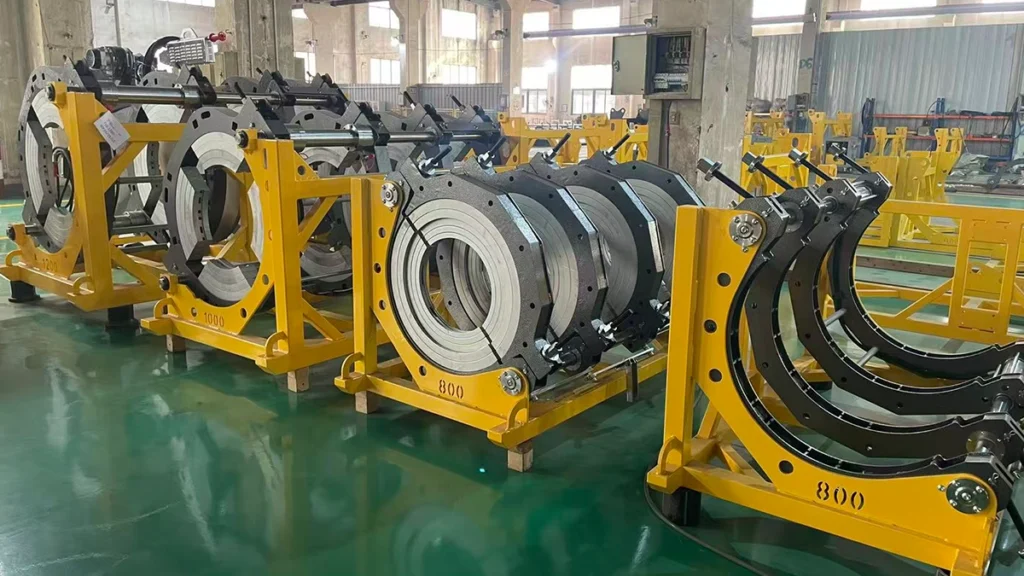
Conversely, stationary butt fusion machines treat weight as a virtue, not a vice. These units typically feature a heavy-duty steel “four-column” or “classic” frame design. The sheer mass of the steel structure acts as a dampener, absorbing vibration during milling and preventing even a micron of frame deflection during high-pressure cooling cycles.
Stationary machines are the heavy artillery for manufacturing segmented fittings—elbows, tees, wyes, and crosses. To make this happen, the clamps aren’t simple semi-circles; they are often articulated or mounted on sliding cross-tables, allowing for complex angle adjustments (like stitching together a 90° elbow from multiple mitered segments). The hydraulic systems here are high-capacity, housed in floor-standing consoles that deliver the flow rates necessary to actuate heavy, multi-jaw clamping systems. Anchored to a concrete floor, these machines ensure alignment tolerances stay under <0.1mm, even when fabricating heavy wall thickness (low SDR) components.
Weight and Dimensional Comparison Tables
To visualize the logistical gap, let’s look at the tale of the tape for a standard 315mm capacity machine. The portable version fits in a pickup truck; the stationary version demands a forklift and dedicated floor space.
| Feature | Portable Field Machine (315mm) | Stationary Workshop Machine (315mm) |
|---|---|---|
| Primary Material | Aluminum Alloy | Heavy-Duty Structural Steel |
| Total Weight | Approx. 180–220 kg | Approx. 850–1,100 kg |
| Footprint | ~ 1.2m x 0.8m (Compact) | ~ 2.5m x 1.5m (Fixed Station) |
| Hydraulics | Detachable, Portable HPU | Integrated High-Capacity Console |
| Power Requirement | ~ 4.5 KW (Single/3-Phase) | ~ 6–8 KW (3-Phase Industrial) |
| Mobility | Man-portable components | Requires Crane/Forklift |
—
Operational Scenarios: Where Each Machine Type Excels
Context is everything. A butt fusion machine that purrs in a climate-controlled factory might choke in a muddy ditch, and a field unit might lack the finesse for factory-grade fabrication.
Field Installation and Trench Operations
Portable hdpe pipe jointings machines are the trench warriors of linear pipeline installation. Whether it’s a cross-country gas pipeline, a municipal water grid expansion, or an agricultural irrigation network, the weld location moves with every joint. Portable butt fusion machines are armored for this shifting reality.
Ekberg field units, for instance, come with protective roll cages around the hydraulic unit and large, all-terrain wheels on the chassis stand. In the muck of a trench, the ability to detach the facer and heater allows operators to clean these critical components away from the mud before re-inserting them. The electrical systems are also hardened to tolerate the voltage spikes common with portable diesel generators. Trying to deploy a stationary machine with its sensitive CNC electronics and immense weight in a muddy trench isn’t just difficult—it’s a logistical impossibility.
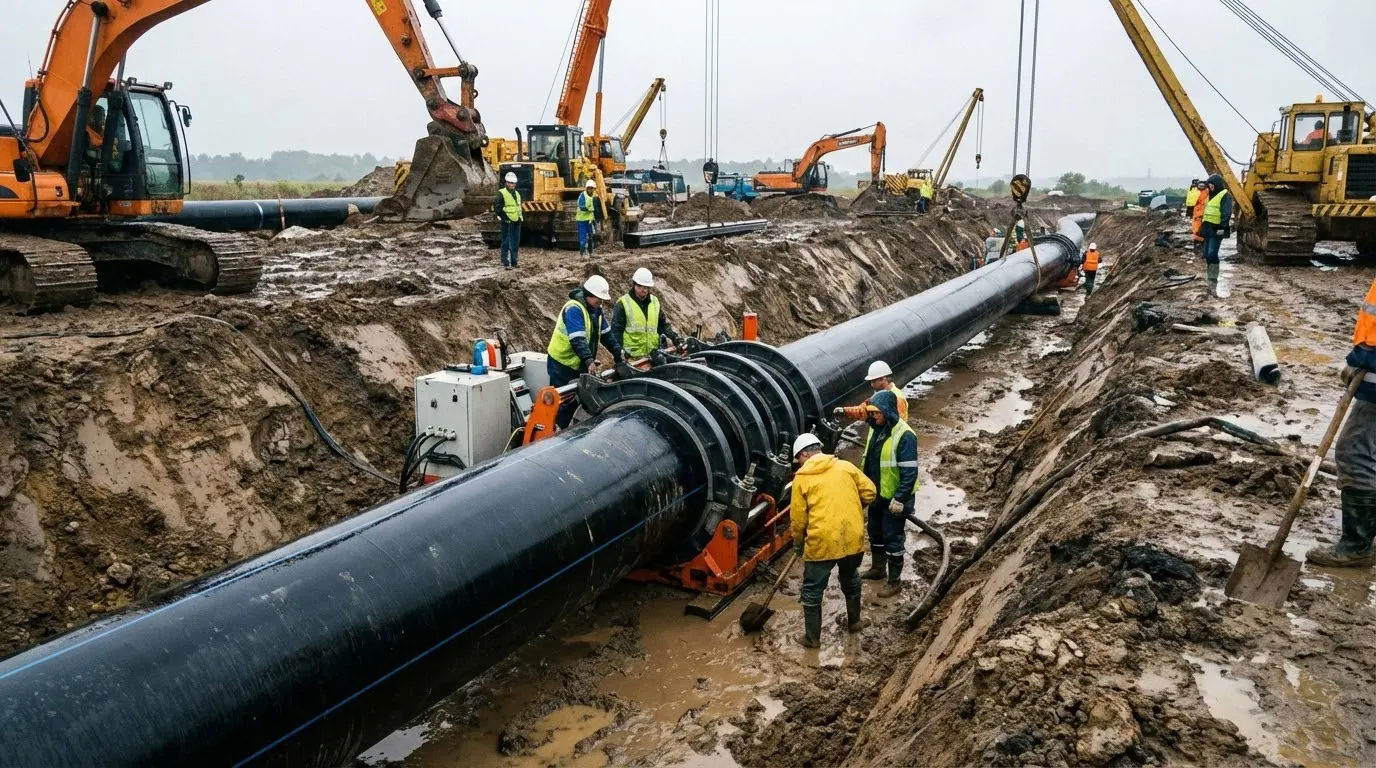
Butt fusion machines in trench operation
Workshop Prefabrication and Fitting Manufacturing
Stationary butt fusion machines own the workshop floor. When a project spec calls for hundreds of specific fittings—say, 45° elbows for a mining slurry line or complex manifolds for a water treatment plant—doing this work in the field is inefficient and risky.
In the workshop, a stationary machine enables an assembly-line workflow. An operator can dial in the machine for a specific diameter and angle, then churn out identical fittings all day. Integrated angle scales and specialized clamps for segmented bends allow for geometry that is brutal to achieve with a standard field machine. Plus, the workshop setting allows for overhead cranes and roller beds, slashing the handling time for heavy pipe segments. This controlled environment is non-negotiable for mass-producing fittings that meet strict dimensional tolerances.
Impact of Environmental Factors on Welding Quality
Weather is the silent killer of weld quality. Field welding fights a constant war against wind, rain, and ambient temperature swings. Portable hdpe butt fusion machines must be robust enough to maintain heating plate temperatures (typically 200°C–230°C for PE100) despite cutting winds, often requiring operators to erect welding tents.
Stationary machines operate in a “zero-variable” environment. Indoors, wind chill doesn’t strip heat from the plate, and ambient temperatures remain stable. This consistency allows for tighter control over bead formation and heat soak phases. While portable machines are fully capable of perfect welds, they demand higher operator vigilance. Stationary machines remove the variables, making them the superior choice for critical components where failure is not an option.
—
Technical Performance & Welding Standards Compliance
Adhering to standards like ISO 21307 and DVS 2207 isn’t optional; it is a contractual obligation. Both butt fusion machine types can get you there, but they take different mechanical paths to compliance.
High-Pressure vs. Low-Pressure Welding Parameters (ISO 21307)
ISO 21307 outlines distinct pressure ranges. The “Single Low Pressure” method (standard in Europe and Asia) calls for an interface pressure of 0.17 MPa (±0.02 MPa). Both portable and stationary butt fusion welding machines handle this easily. The challenge arises with the “Single High Pressure” method (common in North America/ASTM contexts), which demands 0.52 MPa.
Hitting that high pressure on large diameter pipes (e.g., DN800 and above) requires massive hydraulic force. Stationary machines, with their rigid steel frames, can sustain these loads without flinching. Portable butt fusion machines, however, must be specifically rated for high-pressure applications; a standard field unit might flex under the load required for DN1000 High Pressure welding, leading to misalignment. Buyers must verify that their butt fusion machines are rated for the specific pressure standard (ISO High vs. Low) dictated by the project.
Alignment Precision and Ovality Correction
Pipes are rarely perfect circles—especially large diameter, thin-wall pipes that have been stacked for weeks. Correcting this ovality before welding is critical for joint integrity.
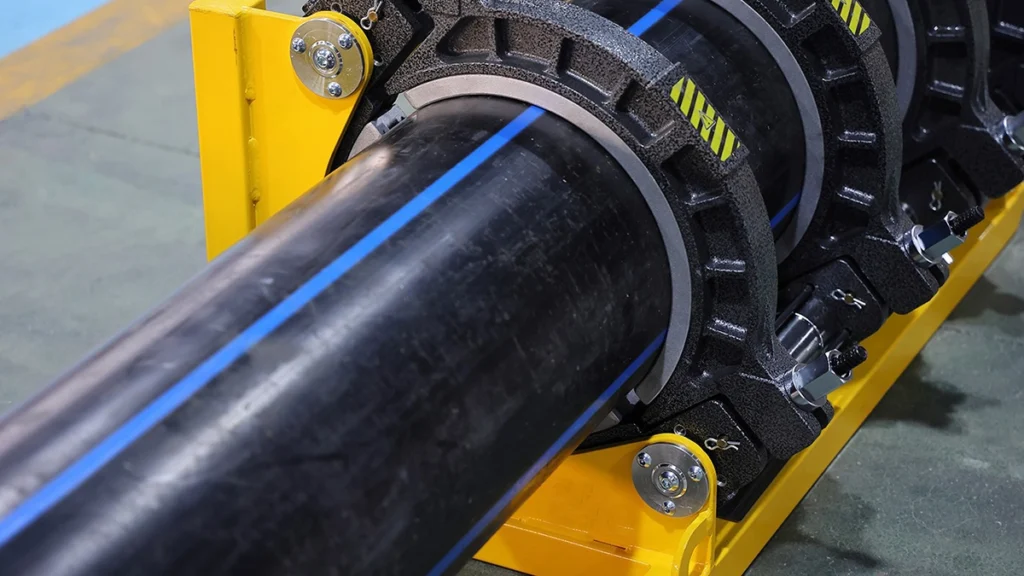
Stationary machines possess superior clamping force and jaw depth, allowing them to brute-force the pipe back into shape. The hydraulic clamping systems on a workshop hdpe butt fusion machine can exert tons of radial pressure to force a slightly oval pipe into a perfect circle. Portable field machines generally rely on manual screw-down clamps or lighter hydraulic clamps. While effective for standard pipes, they may struggle to correct significant ovality in heavy-wall pipes. In field scenarios, operators often have to rely on separate re-rounding tools, whereas the stationary machine handles this as part of its intrinsic function.
Data Logging and Traceability (LDU & CNC Options)
In modern infrastructure, if you didn’t record the data, the weld didn’t happen. For field operations, Data Loggers (LDU) are essential. These devices plug into the hydraulic unit to record pressure, temperature, and time for every phase of the weld. Ekberg’s portable butt fusion machines support integrated data logging that uploads reports to the cloud, giving engineers remote verification capabilities.
Stationary machines often take this a step further with full CNC (Computer Numerical Control) automation. In a CNC automatic butt fusion machine, the operator simply inputs the pipe parameters (e.g., DN500, SDR11, PE100), and the butt fusion welding machine takes the wheel—controlling milling depth, heating plate insertion, and pressure modulation. This virtually eliminates human error, ensuring every fabricated fitting is a carbon copy of the last. While CNC is available for field machines, it is most effective in the stable environment of a workshop.
—
Economic Analysis: ROI and Total Cost of Ownership
Sticker price is a distraction. A comprehensive ROI analysis must account for logistics, labor efficiency, and asset lifespan.
Initial Capital Investment vs. Operational Logistics
Stationary fitting machines are significantly more expensive upfront than portable units of the same diameter capacity—often costing 200% to 300% more. This premium pays for the steel structure, advanced hydraulics, and specialized fitting clamps. However, the operational logistics tell a different story.
Dragging a 2.5-ton stationary machine to a remote site is prohibitively expensive and often technically impossible. Portable machines, with their lower capital cost, are designed to hop onto standard pickups. For a contractor working on a 50km pipeline, the portable machine is the only viable option. The ROI for a stationary machine is realized only if it remains in one location, churning out fittings that would otherwise have to be purchased at a markup.
Labor Efficiency and Setup Times
In a workshop setting, a stationary butt fusion welidng machine offers unbeatable cycle times. With overhead cranes and roller beds, loading a pipe, making a cut, and welding a 90° elbow happens in a fraction of the time it takes in the field. The “weld-to-weld” cycle is minimized because the material comes to the machine.
In the field, the butt fuison machine chases the pipe. Setup time becomes a major cost driver. A crew might spend 30 minutes just positioning the portable fusion welding machine in a muddy trench, aligning it, and setting up the generator. While the welding time (physics-based) is the same, the *handling* time is vastly higher. Therefore, if a project requires hundreds of welds in a single location (e.g., a pumping station), setting up a temporary workshop with a stationary butt welder might actually be cheaper in labor costs than using a portable machine for every joint.
Versatility and Asset Utilization Rates
Asset utilization drives profitability. A portable machine is highly versatile; it can be rented out, moved between multiple small projects, and used for emergency repairs. High utilization rates (e.g., 70% billing time) allow contractors to recoup the investment in 6–12 months.
A stationary butt fusion machine is a specialist. It requires a steady stream of fabrication work to justify its footprint. If a contractor stops winning projects that require custom fittings, the hdpe pipe welding machine sits idle, consuming floor space. The ROI period for stationary equipment is typically longer (18–24 months), though the lifespan is also significantly longer due to the controlled operating environment.
—
Strategic Selection Guide: How to Choose the Right Butt Fusion Machine
Making the right choice involves mapping equipment capabilities to project realities.
Project Scale and Pipe Diameter Assessment
Use this simple decision matrix:
- Small Diameter (<315mm) Linear Projects: Always choose portable butt fusion machines. The agility allows crews to move fast, keeping pace with trenching equipment.
- Large Diameter (>800mm) Linear Projects: Use heavy-duty field but fusion machines (crawler-mounted). These bridge the gap, offering mobility with the power to handle heavy pipes.
- Complex Facilities (Water Treatment Plants, Pumping Stations): If the design calls for hundreds of elbows and tees within a small footprint, rent or buy a stationary machine to set up an on-site fabrication shop.
Requirement for Custom Fittings vs. Straight Line Welding
There is a specific economic “tipping point.” If a project requires more than 50–100 large-diameter custom fittings, the cost of purchasing pre-molded fittings from a supplier often exceeds the cost of buying a stationary butt fusion machine and fabricating them in-house.
- Scenario A: 5km straight pipe, 10 elbows. Buy hdpe pipe fittings, weld with portable machine.
- Scenario B: 500m complex industrial piping, 200 elbows/tees. Buy stationary machine, fabricate in-house.
Buyer Checklist for Equipment Specs
Before issuing a purchase order, verify these 10 critical points:
1. Welding Standard: Does the software support ISO 21307 and DVS 2207?
2. Voltage: Is the site 220V single-phase or 380V three-phase?
3. Pressure Range: Can the hydraulics deliver High Pressure (0.52 MPa) if required?
4. Insert Availability: Are aluminum inserts included for all SDRs and diameters?
5. Data Logging: Is the LDU integrated or an optional add-on?
6. Hydraulic Oil: Is the oil grade suitable for the ambient temperature (e.g., -20°C vs +40°C)?
7. Chassis Material: Is it Aluminum (durable) or cheap casting?
8. Heating Plate Coating: Is it high-grade PTFE (Teflon)?
9. Spare Parts: Are seals and blades standard sizes or proprietary?
10. Warranty: Does it cover the hydraulic pump and motor?
—
Ekberg Manufacturing Excellence, Quality Control & Global Support
At Ekberg Welding, we bridge the gap between field durability and workshop precision. Our manufacturing process ensures that whether you buy a portable or stationary unit, the core fusion technology remains world-class.
Precision CNC Machining of Machine Bodies
We utilize advanced 5-axis CNC machining centers to fabricate our butt fusion machine bodies and clamps. This ensures that the flatness of the heating plates and the alignment of the clamps are within a tolerance of <0.1mm. For a stationary butt fusion welding machine, this precision ensures that a 90° elbow is exactly 90°. For a portable machine, it means the chassis won’t twist under load, preventing “hi-lo” misalignment at the joint interface.
Durability Testing and Coating Technologies
Field equipment faces brutal conditions. Ekberg applies a specialized corrosion-resistant powder coating to all steel frames, tested to withstand 1000+ hours of salt spray. Our heating plates feature a triple-layer PTFE coating that prevents molten plastic from sticking, even after thousands of cycles. We also subject our portable chassis to drop tests and vibration analysis to simulate years of transport in rough terrain.
Spare Parts Availability and After-Sales Service
Downtime kills project margins. Ekberg maintains a global inventory of critical consumables—planer blades, hydraulic seals, thermocouples, and electronic control boards. Our “Rapid Response” system ensures that replacement parts can be shipped to major global hubs within 48 hours. We don’t just sell butt fusion welding machines; we sell the assurance that your welding operations will remain continuous.
—
Frequently Asked Questions
Q1: Can a stationary workshop machine be used in the field for pipeline installation?
Generally, no. Stationary butt fusion machines are too heavy and lack the ground clearance, wheels, and protective framing required for field use. They require a flat, concrete surface and often 3-phase industrial power, which is rarely available in a trench. Attempting to use one in the field creates significant safety risks and logistical nightmares.
Q2: What is the maximum pipe diameter difference between portable and stationary butt fusion machines?
Both types can reach very large diameters (up to 1600mm or more). However, the minimum diameter capability often differs. Stationary butt fusion machines usually have a narrower range (e.g., 315-630mm) optimized for fittings, while portable machines often cover a wider range (e.g., 315-630mm) using nested inserts to handle various service line sizes.
Q3: Do I need different certifications to operate portable vs. stationary welding equipment?
The core welding certification (e.g., ISO 13067 qualification) is usually the same because the physics of the fusion process are identical. However, stationary butt fusion machines, especially CNC models, may require additional training on the specific software interface and safety protocols regarding automatic clamping mechanisms.
Q4: How does the maintenance schedule differ between hydraulic field machines and workshop fitting machines?
Field machines require more frequent maintenance due to environmental contamination (mud, dust, moisture). Air filters, hydraulic quick-couplers, and guide rails must be cleaned daily. Workshop machines operate in cleaner environments but require stricter calibration checks for their CNC sensors and hydraulic pressure valves to maintain fabrication tolerances.
Q5: Can Ekberg portable machines be upgraded with CNC modules later?
Yes, select Ekberg portable models are “CNC-ready.” This means the hydraulic unit can be upgraded or swapped for a CNC control module, converting a semi-automatic field unit into a fully automatic butt fusion machine. This allows contractors to start with a lower budget and upgrade technology as their fleet requirements evolve.
—
Conclusion
Deciding between portable and stationary butt fusion machines isn’t just about preference—it’s about profit margins and project survival. Portable machines offer the unmatched agility required for linear pipeline installation across rugged terrain, while stationary machines provide the stability and automation necessary for precision fitting fabrication in a controlled workshop environment.
Ultimately, the best butt fusion machine is the one that aligns with your contract’s specific mix of straight-line welding versus complex geometry requirements. For many large contractors, a mixed fleet—utilizing portable units for the trench and a stationary unit for the yard—is the key to maximizing efficiency.
Ready to optimize your projects? Contact Ekberg Welding today for a technical consultation. Our engineers can review your project specifications and provide factory-direct pricing on the ISO-compliant fusion equipment tailored to your needs. Request your quote now and ensure your next project is built on a foundation of quality.