
HDPE Pipe Welding Machine Price: What Affects the Cost?
Table of Contents
Understand HDPE pipe welding machine price and the key factors that affect cost, including machine type, pipe diameter range, automation level, build quality, and supplier terms. This guide helps B2B buyers compare specifications, evaluate quotes, and choose the right machine for their project.
How Much Does an HDPE Pipe Welding Machine Cost?
Procurement managers ask this question constantly. The reality? The price tag hinges on a few critical variables: automation levels, pipe diameter capacity, and the equipment’s engineering tolerances. If you only need a small, manual jointing butt fusion machine for 40–110mm pipes, you can pick up an entry-level unit for roughly $200 to $230. However, industrial-grade hydraulic and CNC systems are a completely different story. These heavy-duty rigs require a substantial capital investment. Prices easily scale into the thousands depending on the hydraulic pressure thresholds and the precision of the heating plates.
Typical Price Ranges by Machine Type
As you upgrade from manual setups to automated systems, baseline costs shift dramatically. Basic manual units handle low-pressure, residential jobs perfectly well, keeping your initial spend to a bare minimum. But municipal and mining pipelines over 110mm demand hydraulic butt fusion machines. Here, you pay for essential upgrades like hydraulic control stations, high-torque milling cutters, and rugged aluminum frames. Moving up the tier, CNC automatic butt fusion machines carry a price tag three to four times that of standard hydraulic units. Why? They integrate PLCs, advanced sensors, and closed-loop hydraulics—non-negotiable features for meeting strict gas pipeline regulations.
What Is the Average Cost in 2026?
Pinning down the HDPE pipe fusion machine price list for 2026 means zooming out to look at broader market trends. Valued at roughly $1.8 billion in 2025, the global market is on track to hit $3.2 billion by 2034. This surge in demand directly impacts equipment pricing. Manufacturers continuously roll out premium units packed with advanced IoT capabilities and GPS tracking, which incrementally drives up average costs. Meanwhile, Chinese manufacturers provide a crucial counterbalance. They maintain highly competitive pricing on standard hydraulic models, keeping the market accessible for contractors.
Manual vs Hydraulic vs CNC Price Comparison
| Control System | Typical Application | Relative Price Level | Technical Complexity |
|---|---|---|---|
| Manual Butt Fusion | Small residential water (<110mm) | Baseline ($) | Open-loop, manual pressure |
| Hydraulic Butt Fusion | Municipal water, mining (110-630mm) | Moderate ($$) | Semi-automated, precise pressure |
| CNC / Automatic | Gas pipelines, strict compliance | Premium ($$$) | Closed-loop PLC, data logging |
Assessing the true cost of an HDPE butt fusion welding machine requires looking past the initial invoice. You must weigh the capital expenditure against project compliance and labor demands. For instance, swapping manual welders for an automated CNC automatic butt fusion machine can slash labor expenses by $20,000 to $30,000 over a standard six-month project. That kind of savings instantly offsets the steeper equipment price.
Core Working Principle of Butt Fusion Welding
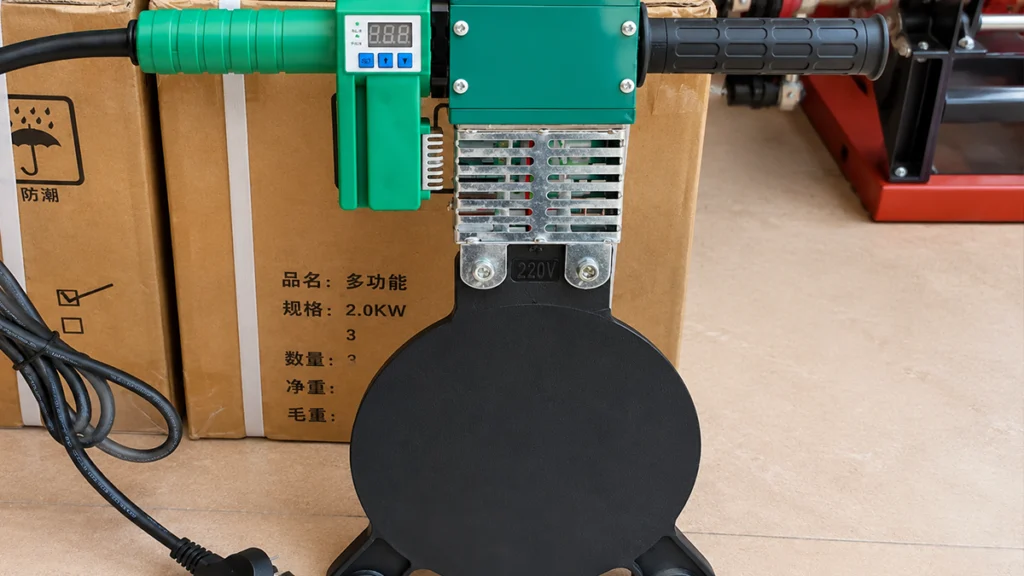
Flawless execution of the core fusion process dictates the baseline cost of any butt fusion machine. The unit transfers heat from a PTFE-coated heating plate directly to the pipe ends, typically running between 0°C and 270°C. Once those surfaces melt, the butt fusion machine drives them together using highly controlled hydraulic pressure. ISO 21307 standards require maintaining a strict fusion pressure of 0.15 N/mm² (roughly 1.5 bar). Hitting this exact metric consistently depends entirely on the quality—and cost—of the internal hydraulic components.
What Is an HDPE Pipe Welding Machine and How Does It Work?
Think of an HDPE pipe welding machine as specialized industrial hardware built for one specific purpose: thermofusion. It joins high-density polyethylene pipes to create a bond that is often stronger than the pipe itself. The plastic pipe welding machine aligns the pipe ends, heats them, and presses them together using strict engineering parameters. The result is a permanent, leak-proof molecular bond.
Key Components That Affect Build Quality
A HDPE pipe jointing machine’s overall build quality rests on four main pillars. These include the three-phase solid-state relay, the temperature sensors, a high-torque motor for the milling cutter, and the hydraulic control box. Premium models utilize independent temperature control systems paired with top-tier PTFE surface coatings. This combination restricts temperature fluctuations to a tight ±3°C to ±5°C range. Cut corners with cheap components, and you invite uneven heating. Under operational pressure, that inevitably leads to catastrophic joint failures.
Why Does the Welding Method Influence Price?
The welding method you choose dictates the HDPE pipe jointing machine’s internal engineering architecture. Manual models rely on open-loop systems and manual valves, which keeps production costs incredibly low. Advanced butt fusion machines take a different approach. They utilize closed-loop systems packed with solenoid valves, electronic feedback loops, and displacement detection technology. Developing stable software to run these complex closed-loop operations costs manufacturers anywhere from 5,000 to 15,000 yuan per design. Naturally, that R&D expense pushes the final retail price higher.
Butt Fusion Welding Machines
When joining large-diameter continuous pipelines, butt fusion is the undisputed industry standard. The pipe fusion machine firmly clamps the pipes, shaves the ends flat with a milling cutter, applies heat, and forces the molten ends together via a hydraulic cylinder. The reliability of this process in muddy, harsh trench environments depends heavily on two things: the structural integrity of the aluminum frame and the absolute precision of the hydraulic drag pressure.
Electrofusion Welding Machines
Electrofusion completely removes the need for operators to manually adjust voltage and current. Instead, these butt fusion machines automatically read the correct welding parameters by scanning a barcode on the pipe fitting. The unit then feeds electrical current to heating coils embedded directly inside that specialized fitting. When you look at an HDPE electrofusion welding machine price, you are paying for sophisticated internal electronics. This includes ambient temperature compensation, data logging hardware, and multiple alarm systems that trigger if voltage drops unexpectedly.
Factory-direct pricing with technical consultation included
Get Your Free QuoteMain Types of HDPE Pipe Welding Machines
Picking the right equipment starts with understanding how the primary butt fusion machine categories actually operate in the field. Engineers design each type to handle specific pipeline pressures, diameters, and regulatory environments.
Manual, Hydraulic, and CNC/Automatic Models
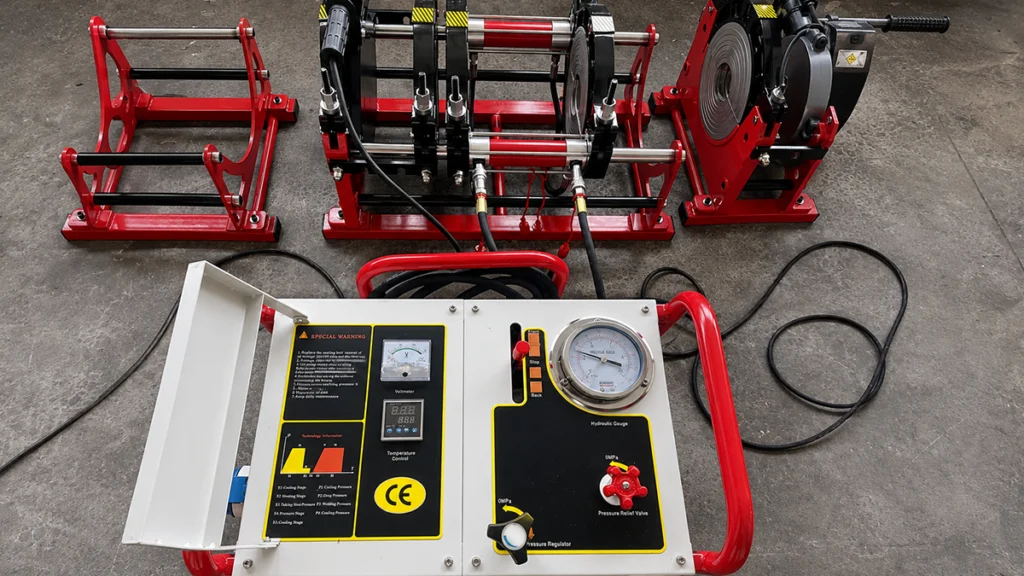
Manual models run purely on physical force to apply fusion pressure. Because of this, they only make sense for small-diameter, low-pressure lines. Hydraulic models split the clamping and operating systems, giving operators precise control over welding parameters through a dedicated hydraulic station. CNC models take it a step further by automating the entire cycle. They record detailed data for every single joint, ensuring compliance with strict traceability standards like TSG D2002-2006.
Which Type Suits Your Project?
Finding the best HDPE pipe welding machine for contractors comes down to project scope. Laying a 63mm irrigation line? A simple manual unit will get the job done. Installing 450mm municipal water mains? You absolutely need a hydraulic butt fusion machine. And if you are bidding on high-pressure gas distribution networks, regulatory bodies leave no room for debate. You must use fully automatic CNC automatic butt fusion machines to eliminate defects like incomplete fusion or uneven weld bead heights.
Pipe Diameter Range and Welding Capacity
Manufacturers categorize these butt fusion machines by their maximum welding diameter. No single unit can weld every pipe size on the market. Instead, they handle specific bracketed ranges using reducing inserts. Take a standard 315mm HDPE pipe welding machine, for example. It can comfortably weld 90mm, 110mm, 160mm, 200mm, 250mm, and 315mm pipes. Never push a butt fusion machine beyond its engineered capacity. Doing so overloads the hydraulic drag pressure and guarantees weak, unreliable joints.
Manual vs Hydraulic vs Fully Automatic Control
The control system you choose dictates the consistency of your joints. Manual control leaves fusion pressure entirely up to the operator’s judgment, heavily increasing the risk of cold welds. Hydraulic setups offer a pressure gauge for accurate parameter settings, but the operator still has to manually time the heating and cooling phases. Fully automatic control eliminates human error altogether. By utilizing PLCs, these systems execute the precise heating durations, changeover times, and cooling pressures mandated by DVS 2207-1 standards.
Key Factors That Affect HDPE Pipe Welding Machine Price
Knowing exactly what drives an HDPE pipe welding machine price empowers procurement teams to evaluate quotes with confidence. When two butt fusion welding machines look identical but carry vastly different price tags, the difference almost always lies in internal component quality, metallurgical standards, and brand positioning.
Build Quality, Materials, and Heating Plate Standard
The grade of aluminum used in the clamping frame drastically affects the bottom line, with high-quality alloys varying in price by thousands of yuan per ton. Cheaper rigs use inferior metals that physically warp under intense clamping forces. Beyond the frame, premium heating plates maintain a maximum surface temperature differential of just ±5°C. Hitting that tight tolerance requires high-density heating elements and top-tier PTFE coatings, both of which add significant manufacturing costs.
Brand, Certification, and Country of Origin
Tier 1 global names like McElroy (USA), Ritmo Group (Italy), and Georg Fischer (Switzerland) firmly control the premium, high-cost market segment. However, an established HDPE pipe welding machine supplier in China, like Ekberg Welding, delivers a highly competitive ROI. Chinese manufacturers offer CNC and hydraulic equipment that meets rigorous ISO/DVS standards at a fraction of the capital cost demanded by Tier 1 brands. This allows contractors to aggressively scale their fleets without blowing their budgets.
Small Diameter Machines (63–315mm)
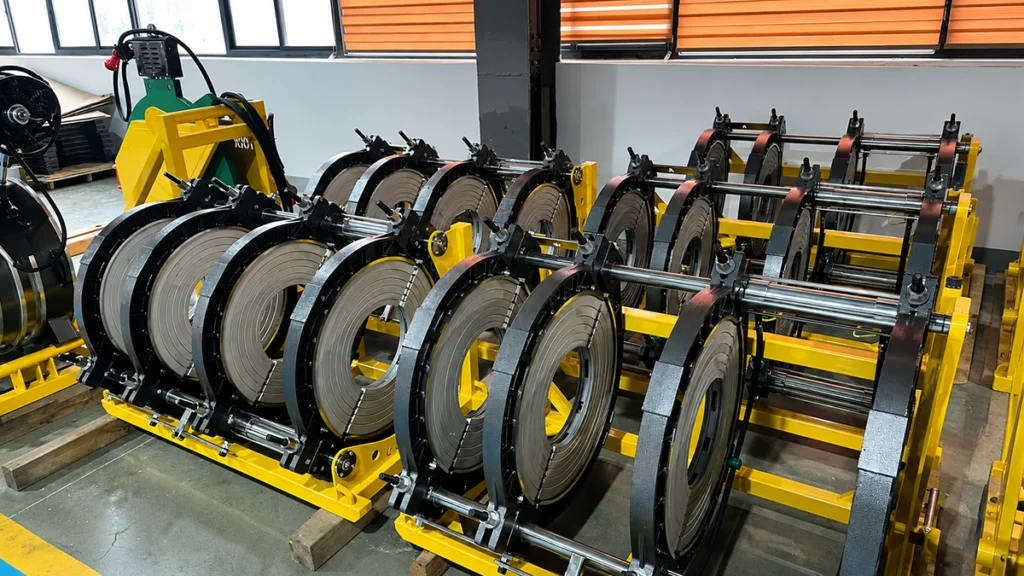
Models designated as 160, 200, 250, and 315 make up the lowest cost tier for hydraulic equipment. These units usually run on a standard 220V single-phase power supply and require a modest 2–4 MPa of working pressure. Thanks to their lighter frames and compact hydraulic stations, they are incredibly portable and cost-effective for standard plumbing or light municipal tasks.
Medium Diameter Machines (315–630mm)
As pipes get wider, the required fusion pressure scales up exponentially. Models like the 450 and 630 demand a robust 380V three-phase power supply and operate at higher working pressures of 4–6 MPa. This power jump significantly inflates the cost of the hydraulic station. It also requires much thicker aluminum clamps and a heavier power rating for the milling cutter motor.
Get detailed specs and custom configuration options
Request Technical SpecificationsPrice Breakdown by Pipe Diameter Range
To build an accurate budget, buyers need to analyze the HDPE butt fusion machine 63mm to 630mm price continuum. Understanding how physical footprint and power requirements dictate capital investment is crucial.
Large Diameter Machines (630–3200mm)
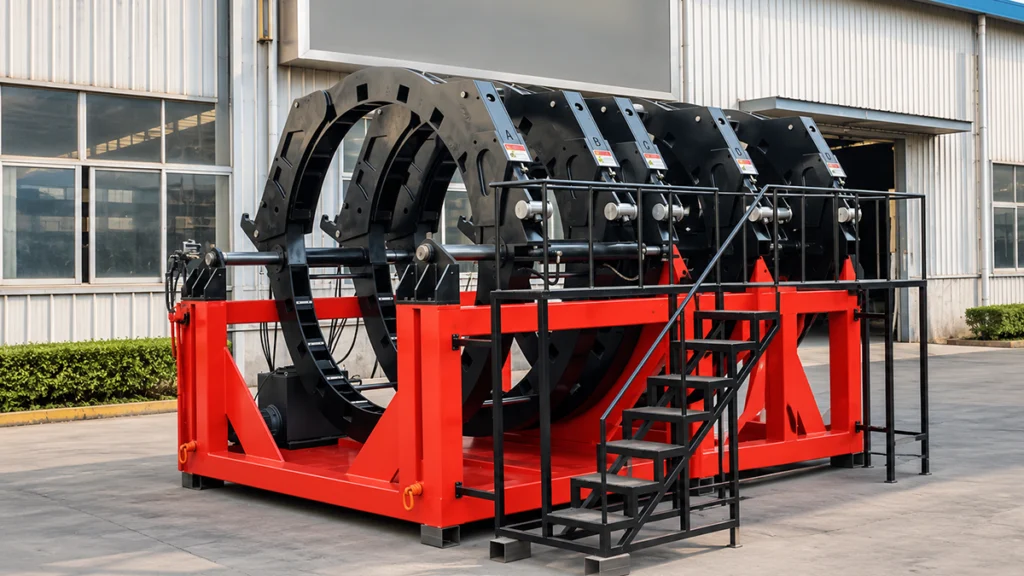
Heavy-duty models engineered for 710–1000mm pipes represent massive capital investments. These behemoths draw up to 23.5 KW of total power, boast pressure adjustment ranges of 0–16 MPa, and often weigh more than 2,600 kg. Keeping massive 1000mm pipe faces perfectly aligned under immense pressure requires extraordinary engineering, translating to heavy steel and thick aluminum sub-structures that drive up costs.
Welding Range, Pressure, and Heating Plate Temperature
An HDPE pipe welding machine’s specifications and price are intrinsically tied to its thermal and pressure capacities. To slash joint failure rates by 60%, a butt fusion machine must hold a rock-steady 0.15 MPa fusion pressure at exactly 220°C. Rigs rated for extreme pressures—up to 16 MPa for the largest diameters—need heavy-duty hydraulic cylinders and steel-reinforced hoses. Those heavy-duty components naturally increase the final price.
Power Supply, Voltage, and Hydraulic System
Total power consumption swings wildly depending on the butt fusion welding machine’s size. A compact 250mm unit might only draw 4.21 kW, while a massive 1000mm rig pulls 23.5 kW. The hydraulic system must be sensitive enough to handle low start-up pressures for smaller pipes within its bracket, a capability verified by three consecutive drag pressure tests. High-precision hydraulic valves that can handle this variance cost significantly more than standard off-the-shelf industrial valves.
What Specifications Matter Most for Your Application?
Avoid the trap of over-specifying or under-specifying your fleet. Welding SDR 11 pipes? You absolutely need a high-pressure hydraulic station. Operating in sub-zero winter conditions? Prioritize a heating plate with rapid thermal recovery and ambient temperature sensors. Always double-check that the HDPE pipe jointing machine’s voltage (whether 220V or 380V) matches the output of your on-site generators.
Technical Specifications to Evaluate Before Buying
When reviewing data sheets, ignore the marketing fluff. Focus strictly on the measurable parameters that guarantee your welds will comply with international pipeline standards.
Water Supply and Gas Pipeline Projects
Gas pipelines operate under zero-defect tolerances. Any HDPE pipe welding machine bought for gas applications must feature fully automated, data-logged operating systems to meet rigorous standards like TSG D2002-2006. Water supply projects might be slightly less regulated, but they still demand highly robust hydraulic butt fusion machines. These units must handle thick-walled HDPE pipes without experiencing any pressure drop-off during the critical cooling phase.
Mining, Drainage, and Industrial Applications
Mining sites subject equipment to brutal, highly abrasive, and corrosive conditions. Hydraulic butt fusion machines are the go-to choice here, particularly those utilizing flat-face quick-connect fittings to block dust from contaminating the hydraulic fluid. Furthermore, the butt fusion welding machine frames must be exceptionally rigid to survive the daily abuse typical of heavy industrial and deep trench drainage work.
On-Site vs Workshop Welding Requirements
Trench welding demands specific HDPE pipe welding machine geometry. Rigs equipped with separate clamping and operating systems, or pull-out plate structures, are non-negotiable for tight, muddy trench work. On the flip side, workshop fabrication of segmented fittings relies on massive, stationary butt fusion machines. In a shop environment, portability doesn’t matter, but absolute alignment precision is everything.
Minimum Order Quantity and Bulk Pricing
When you request custom voltages or specialized IoT tracking features, manufacturers often impose a Minimum Order Quantity (MOQ). While the standard MOQ for off-the-shelf hydraulic butt fusion welding machines is typically just one set, larger contractors have an advantage. By standardizing their fleet specifications across multiple international job sites, they can leverage bulk pricing to drastically reduce the per-unit cost of highly customized CNC models.
Application Scenarios and Industry Use Cases
The physical environment where your butt fusion machine operates dictates the features you need, which ultimately shapes your final procurement costs.
Lead Time and Production Schedules
Project delays bleed thousands of dollars a day. Top-tier suppliers prevent costly downtime by offering expedited shipping, rapid on-site services, and backup equipment for critical project schedules. Factoring lead time into your purchasing strategy is just as vital as negotiating the base price of the hardware.
Shipping, Import Duties, and Spare Parts Costs
HDPE pipe welding Machine size and weight heavily dictate freight costs. Consider a 1000mm butt fusion machine: its frame packaging measures 2200x1800x1700mm and weighs 2.6 tons. Moving that requires specialized LCL or FCL ocean freight. To get an accurate picture of cross-border quotes, buyers must calculate import duties, terminal handling charges, and the landed cost of consumable spare parts.
Certifications and Quality Standards to Verify
Always verify that the equipment complies with ISO 21307 and DVS 2207-1, the leading international and German standards for low-pressure welding. These guidelines mandate exact fusion pressures to guarantee molecular diffusion without creating excessive bead formation. If you are working on American projects, you may also need to verify compliance with ASTM F2620 for high-pressure welding parameters.
What to Ask a Supplier Before You Order?
Demand verifiable data. Ask the manufacturer to provide temperature differential maps for their heating plates. Clarify whether the hydraulic station relies on an open-loop or closed-loop control system. If your project mandates digital twin integration or remote quality assurance, be sure to inquire about Beidou/GPS positioning and IoT remote monitoring capabilities.
MOQ, Lead Time, Shipping, and Hidden Costs
A suspiciously low initial quote usually masks downstream expenses that will obliterate your project’s ROI. Smart procurement means hunting down these hidden costs before you ever sign a purchase order.
Red Flags That Signal a Low-Quality Machine
Steer clear of suppliers who cut corners using cheap, oil-lubricated shafts with poor stiffness or low-grade aluminum frames. Inferior sealing rings degrade rapidly under high hydraulic pressure. This creates micro-leaks that cause fusion pressure to drop during the critical cooling phase, directly resulting in failed pipe joints.
Choosing Price Over Capacity and Quality
Trying to weld pipes larger than 110mm or with walls thicker than 6mm using a manual butt fusion machine is a catastrophic engineering mistake. Manual rigs simply cannot exert stable fusion pressure across large surface areas. The joints will fail immediately during hydrostatic testing. Never sacrifice hydraulic capacity just to save a few dollars upfront.
Ignoring After-Sales Support and Spare Parts
Field data reveals that 60% of butt fsuion machine operators prioritize stable supply channels for consumable parts. A high-end butt fsuion welding machine becomes a useless paperweight if replacing a blown solid-state relay or a shattered milling cutter blade takes three weeks. Always evaluate the supplier’s standing inventory of PTFE plates, sensors, and hydraulic valves.
Overlooking Voltage and Site Compatibility
Plugging a 380V three-phase machine into a 220V single-phase generator (or vice versa) guarantees failure. The current will not increase properly, preventing the heating plate from ever reaching the required 220°C target. Always cross-check your on-site generator capacities against the butt fsuion machine’s kW rating before moving equipment to the field.
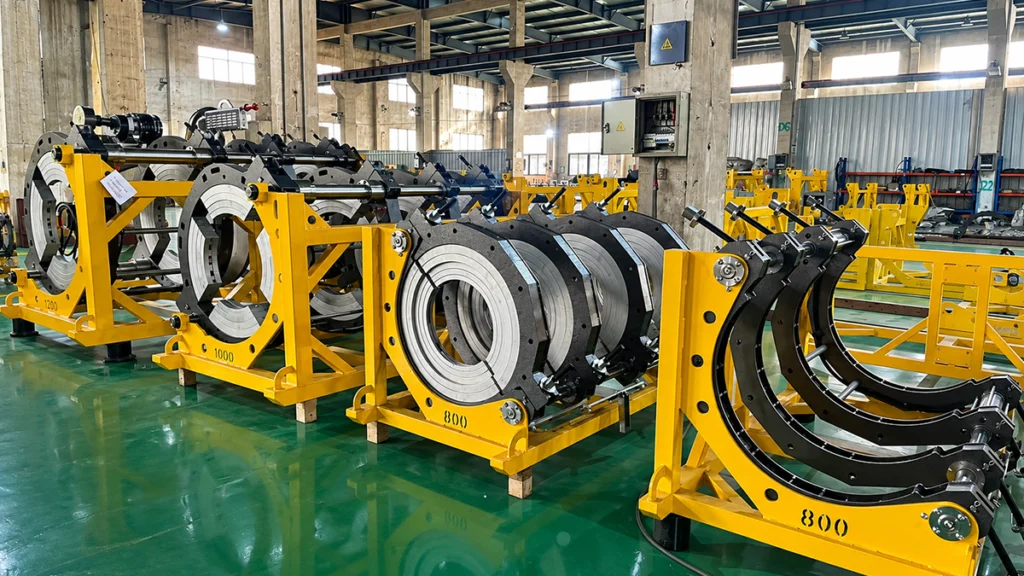
How to Choose a Reliable HDPE Pipe Welding Machine Supplier
Vetting an industrial equipment manufacturer requires looking past glossy spec sheets and diving into their quality control infrastructure. The best suppliers deliver butt fusion machines equipped with built-in welding quality detection systems. These might include ultrasonic scanning compatibility, printable data logs, or proprietary weld strength testing algorithms.
Seek out partners who offer a comprehensive service backbone. This means video troubleshooting, remote IoT diagnostics, and even trade-in programs for aging fleets. A trustworthy manufacturer will gladly share the CNC machining processes behind their aluminum clamps and back their heating plates with a guaranteed ±5°C maximum temperature differential. Walk away from any supplier unable to produce detailed hydraulic drag pressure charts, or who swaps out high-torque milling motors for cheaper, underpowered alternatives.
Common Mistakes to Avoid When Buying
Procurement disasters usually happen when buyers misunderstand actual field conditions. One massive error is forgetting to perform a discharge calibration when moving equipment to a new geographical location. Shifts in atmospheric pressure and ambient temperature dramatically alter heating and cooling times. Ignore these environmental changes, and your splicing quality will plummet.
Another frequent mistake is purchasing a butt fusion machine with a highly restricted clamping range. This forces contractors to scramble and rent extra equipment the moment pipe specifications change mid-project. Always verify that the unit ships with a full, comprehensive set of reducing inserts. Finally, never assume all PTFE coatings perform equally. Cheap coatings aggressively stick to molten HDPE. When you remove the plate, it tears the melted face, completely destroying the integrity of the butt fusion joint.
FAQ
Is a hydraulic HDPE welding machine worth the higher price?
Yes. For medium and large HDPE pipe projects, a hydraulic HDPE welding machine is often worth the higher investment because it provides more stable fusion pressure, better alignment control, and more consistent welding results than manual equipment.This is especially important for municipal water supply, drainage, mining, and long-distance pipeline projects, where poor pressure control or misalignment can increase the risk of joint defects, rework, and project delays.
What diameter HDPE pipe welding machine do I need for my project?
Choose the machine according to the pipe’s outside diameter, wall thickness, and project requirements. The machine’s rated working range should fully cover the largest pipe size used on site.For example, a 63–315mm hydraulic butt fusion machine is suitable for many medium-size water supply projects, while 315–630mm equipment is commonly used for larger municipal and industrial pipelines. For mixed pipe sizes, reducing inserts may be needed within the machine’s rated range.
How long does an HDPE pipe welding machine last?
With proper maintenance, an industrial HDPE pipe welding machine can typically serve for 10 to 15 years or longer, depending on usage frequency, working conditions, and equipment quality.To extend service life, operators should keep the hydraulic system clean, protect the PTFE-coated heating plate from scratches, replace worn sealing rings and planing blades, check hydraulic oil regularly, and store the equipment in a dry environment when not in use.
Are Chinese HDPE pipe welding machines reliable for export markets?
Yes. Many Chinese HDPE pipe welding machine manufacturers supply reliable equipment for export markets, especially when the machines are built with stable hydraulic systems, accurate temperature control, durable frames, and proper quality inspection.For international buyers, it is important to check the manufacturer’s certificates, welding range, spare parts support, testing process, and whether the equipment can support project standards such as ISO 21307, DVS 2207-1, or ASTM F2620 when required.
What is the difference between butt fusion and electrofusion machines?
Butt fusion machines use a heated plate to melt the pipe ends before pressing them together under controlled pressure. They are commonly used for straight pipe joints and large-diameter HDPE pipeline projects.Electrofusion machines work with special electrofusion fittings that contain embedded heating wires. When electrical current is applied, the fitting inner surface and pipe outer surface melt together to form the joint. Many electrofusion units can read welding parameters automatically through a barcode scanner.
Do HDPE welding machines come with a warranty and spare parts?
Yes. Most professional HDPE welding machine suppliers provide a warranty, commonly around 12 months, depending on the model and purchase terms. They should also offer spare parts such as heating plates, planing blades, hydraulic seals, clamps, inserts, cables, and control components.For overseas buyers, spare parts availability, technical support, operation videos, and after-sales response time are important factors. Reliable support can help reduce downtime and keep welding equipment working properly on project sites.
Can one machine weld multiple pipe diameter ranges?
Yes, many hydraulic butt fusion welding machines use interchangeable reducing inserts to cover different pipe sizes within their rated working range. For example, a 315mm machine can usually weld several smaller diameters when fitted with the correct inserts. This gives contractors more flexibility for different pipeline projects, but the machine should not be used outside its designed diameter range.
What ongoing costs should I budget for after purchase?
After purchase, buyers should budget for hydraulic oil, planing blades, sealing rings, heating plate maintenance, calibration, and possible replacement parts such as inserts, clamps, cables, and sensors. Regular pressure and temperature checks help keep the butt fusion equipment working accurately and reduce unexpected downtime on job sites.
Conclusion
Procuring the right HDPE pipe welding machine requires a careful balance between upfront cost, long-term reliability, jobsite conditions, and project quality requirements. While basic manual units may suit small-diameter or simple repair work, large-scale pipeline projects often require hydraulic or CNC butt fusion equipment with stable pressure control, accurate temperature control, and reliable data recording.
The true value of welding equipment goes beyond the initial purchase price. Spare parts availability, component quality, heating plate performance, clamping rigidity, hydraulic stability, and after-sales support all affect long-term operating costs. By carefully reviewing these factors, contractors can choose butt fusion equipment that improves welding consistency, reduces installation risks, and supports reliable HDPE pipeline construction in demanding field environments.
Let our experts help you choose the right equipment for your project
Contact Our Engineering Team