
HDPE Pipe Butt Fusion Welding Procedure: Step-by-Step Field Guide
Table of Contents
Butt Fusion Welding Procedure guide for HDPE pipe projects, explaining field steps, key parameters, joint inspection, common mistakes, and equipment selection for reliable pipeline installation.
What Is the Butt Fusion Welding Procedure for HDPE Pipe?
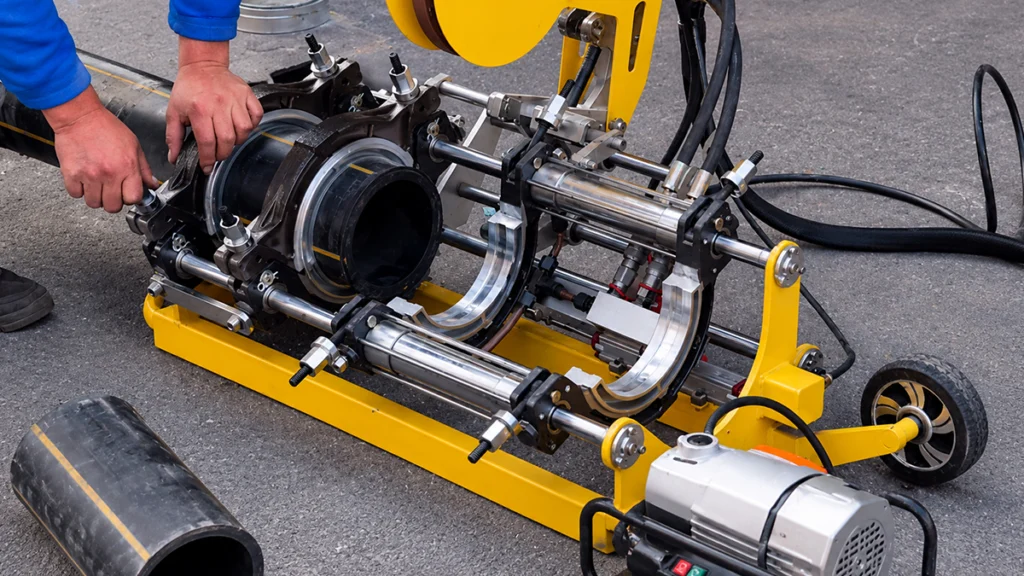
The Butt Fusion Welding Procedure stands as a rigorously controlled thermofusion technique designed to fuse two identical high-density polyethylene (HDPE) pipes. Operators heat the pipe ends until they reach a viscous state, usually hovering around 210±5°C. Once melted, calculated hydraulic pressure forces the ends together to forge a permanent, leak-proof bond. Out in the field, this fundamental process demands strict adherence to engineering parameters across several distinct phases: clamping, facing, aligning, heating, fusing, holding, and cooling.
How butt fusion creates a continuous HDPE pipe joint
Molecular entanglement is the driving force behind a continuous butt fusion joint. A PTFE-coated heating plate warms the matching pipe surfaces until they reach a viscous flow state. After hitting that precise temperature target, the operator quickly yanks the heating plate away. Hydraulic cylinders then drive the molten pipe ends together under fusion pressure. This action creates a planar interface where individual polymer chains interlock and solidify into a single, unified structure as the assembly cools under constant pressure.
Where butt fusion is commonly used in field projects
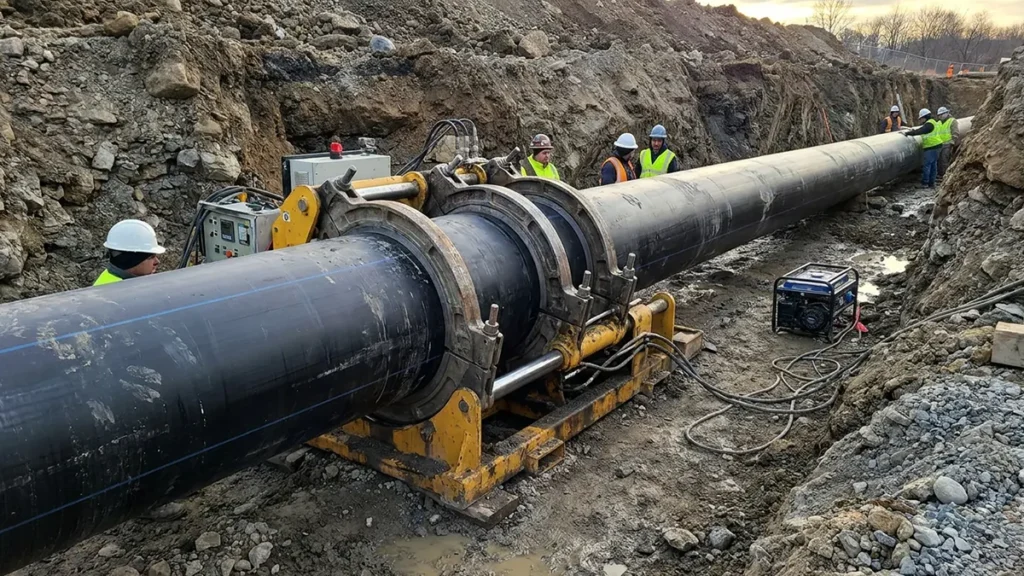
You will find this welding methodology deployed across major infrastructure projects that demand absolute leak prevention. Municipal utility departments and pipeline contractors depend on butt fusion to secure high-pressure water mains, industrial chemical piping, and natural gas distribution networks. Heavy-duty sectors also lean heavily on the process. Large-scale agricultural irrigation and rugged mining operations use it to build tough water transport systems and slurry lines capable of surviving brutal environmental stress.
When butt fusion is preferred over electrofusion or mechanical joining
Engineers actively specify butt fusion when a project requires continuous structural integrity without introducing external fittings. Mechanical couplings inherently add weak points and potential leak paths over time; butt fusion, by contrast, delivers a seamless transition. Electrofusion certainly shines in tight repair spaces, but butt fusion dominates long, straight pipeline runs. It scales cost-effectively, drastically reduces the need for consumable fittings, and produces a joint that blends flawlessly into the pipe body.
Why Proper Butt Fusion Procedure Matters in Field Installation
Nailing the exact welding procedure goes beyond simple best practices. It serves as the bedrock for pipeline safety and long-term durability. Field installations constantly battle dynamic ground movements, severe thermal expansion, and internal pressure spikes. A correctly fused joint guarantees that the entire pipeline absorbs these forces as one continuous, uninterrupted conduit.
Impact on joint strength and pipeline service life
A flawlessly executed butt-fusion joint boasts tensile strength and pressure resistance that matches—and sometimes exceeds—the original HDPE material. Because this incredible joint strength effectively removes the connection as a potential failure point, the pipeline can easily hit its designed 50-to-100-year lifespan. Cut corners during the HDPE pipe fusion welding procedure, however, and you will drastically cripple the pipeline’s fatigue resistance and operational longevity.
Common field failures caused by poor fusion practice
Applying incorrect fusion parameters remains the single biggest driver of HDPE pipeline failure. Wrong temperatures, weak pressure, or rushed cooling times spell disaster. Shoddy field practices spawn poorly fused joints, contamination-driven weak spots, and stress concentration defects that eventually crack. Take asymmetrical flange curling, for instance. Usually triggered by uneven heating or poor alignment, this defect generates localized stress zones that fracture under heavy operational pressure.
Why contractors and buyers should standardize welding procedures
Standardizing these HDPE pipe fusion welding procedures forces strict compliance with overarching global frameworks like ASTM F2620, ISO 21307, and DVS 2207-1. These standards mandate rigorous parameter controls to stop material deformation and guarantee uniform molecular bonding. For project managers and procurement teams, standardization acts as an insurance policy. It slashes rework rates, speeds up project acceptance, and ensures every single joint satisfies the tough quality metrics demanded by industrial and municipal stakeholders.
Factory-direct pricing with technical consultation included
Get Your Free QuoteRequired Equipment, Tools, and Site Preparation
Pulling off a compliant HDPE pipe butt fusion weld demands specialized hardware and obsessive site preparation. Without the right tools and a rock-solid working environment, even a master operator will struggle to produce a passable weld.
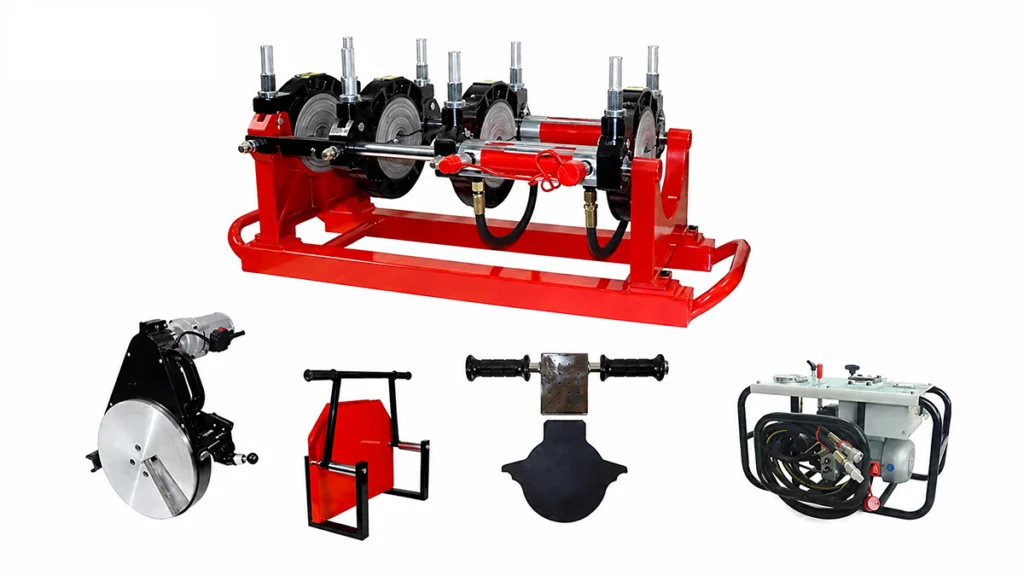
Butt fusion welding machine components
Industrial butt fusion equipment relies on several distinct components engineered for both power and precision. The standard configuration features a heavy-duty frame to lock the pipes in place and a hydraulic control box (usually AC 220V/380V) to dictate pressure application. You also need a thermostatically controlled heating plate and a motorized milling cutter, or facer, to prep the pipe ends. Higher-end butt fusion machines even integrate precision reducing clamps and displacement sensors to accommodate varying pipe diameters.
Pipe preparation tools and cleaning materials
Contamination destroys thermofusion. Prepping the pipe requires industrial paper towels or clean, lint-free cloths. Operators must pair these with approved cleaning solvents—like 90%+ isopropyl alcohol—to strip moisture, grease, and dirt from the inner and outer surfaces before facing begins. Grab a dirty rag or skip this cleaning phase, and you guarantee a failed weld.
Field conditions to check before starting work
Site preparation ultimately dictates the stability of the entire welding operation. The fusion butt fusion welding machine needs a perfectly level, stable footprint so it won’t slip during high-pressure phases. If the trench floor is packed with uneven stones or hard rock, contractors have to dig out 0.15 to 0.2 meters below the design elevation and replace it with compacted sand backfill. This critical step protects the pipe from gouges and keeps the butt fusion machine frame flawlessly aligned from start to finish.
What safety equipment is required?
Safety gear and handling tools are absolute mandates to protect your crew and the pipeline itself. Operators must deploy reliable roller supports at both ends of the pipe to control drag friction and stop heavy pipe sections from ripping up the HDPE pipe welding machine clamps. Furthermore, crews need to set up exclusion zones and sturdy safety guards during high-pressure testing to shield workers from sudden kinetic energy releases. Standard personal protective equipment (PPE)—specifically safety glasses and heat-resistant gloves—is completely non-negotiable.
HDPE Pipe Butt Fusion Welding Parameters to Control
Precision separates a successful butt fusion weld from a costly failure. Operators must constantly track and tweak hydraulic and thermodynamic variables to align with environmental conditions and specific material grades.
Heating plate temperature range for HDPE pipe
For HDPE butt fusion welding, the heating plate temperature is commonly set within 200–220°C under DVS/ISO practice, while ASTM-based butt fusion welding procedures often use 400–450°F (204–232°C). Dropping below this target restricts molecular mobility and creates a brittle cold weld. Pushing past it degrades the polymer chains and sparks thermal oxidation. Keep in mind that alternate materials demand different thermal profiles.
Fusion pressure, drag pressure, and interfacial pressure
Pressure management means calculating the required fusion pressure and adding the measured drag pressure caused by pipe movement, machine resistance, and roller friction. The gauge on your hydraulic butt fuison machine displays the hydraulic pressure hitting the piston, not the true interfacial pressure at the weld zone. Operators have to measure drag pressure (the force needed to physically pull the pipe) and add that figure to the baseline fusion pressure. Interfacial standards shift depending on your region: ISO/DVS procedures commonly use an interfacial pressure of 0.15 N/mm², which is approximately 1.5 bar at the pipe interface.
| Parameter Type | Standard / Calculation | Field Importance |
|---|---|---|
| Interfacial Pressure (ISO/DVS) | 0.15 N/mm² ≈ 1.5 bar | Ensures proper polymer chain entanglement without squeezing out excessive molten material. |
| Interfacial Pressure (ASTM / North America) | 60–90 psi | Used mainly in ASTM-based butt fusion procedures, especially in North American pipeline projects. |
| Drag Pressure | Measured for each joint | Must be added to the calculated fusion pressure to overcome pipe movement, machine resistance, and roller friction. |
| Heating Plate Temperature | DVS/ISO: 200–220°C ASTM: 204–232°C | Critical for achieving a proper molten interface before fusion. |
Heating time and cooling time by pipe size
Heating (often called heat-soak) and cooling durations scale directly with the pipe’s Standard Dimension Ratio (SDR) and wall thickness. Thicker walls demand exponentially longer heat-soak periods to drive the melt depth deep enough into the material. Cooling time under pressure proves equally critical. You must keep the joint clamped securely until the pipe wall’s core drops below its crystallization temperature. Releasing it early allows residual stresses to rip the soft polymer apart.
Why pipe manufacturer specifications should override generic values
Generic welding charts offer a helpful starting point, but the pipe manufacturer’s exact specifications must always take precedence. Unique material characteristics—like the distinct thermal stability gaps between PE100 and PE80 resins—require highly targeted changeover, cooling, and heat-soak times. Ignoring the manufacturer’s data sheet and failing to calibrate your butt fusion machine accordingly will void warranties and severely compromise the pipe’s pressure rating.
Get detailed specs and custom configuration options
Request Technical SpecificationsStep-by-Step HDPE Pipe Butt Fusion Welding Procedure
Pulling off the butt fusion welding steps requires a disciplined, highly methodical approach. Rush the transition phases or skip a single step, and quality inspectors will inevitably reject the joint.
Step 1: Inspect and secure the pipe ends
Start by loading your pipe segments into the butt fusion machine frame. Use reducing jaws that perfectly match the pipe’s outer diameter. Deploy heavy-duty roller supports to keep long pipe sections aligned with the frame’s centerline. Securing the pipe correctly stops it from slipping once hydraulic pressure kicks in and drastically lowers the drag force the HDPE pipe jointing machine has to fight against.
Step 2: Face the pipe ends until clean and square
Drop the motorized milling cutter (facer) between the clamped pipes and turn it on. Ease the pipe ends against the spinning blades using light pressure. Keep milling until continuous, unbroken ribbons of HDPE shave off both pipe ends. This guarantees the surfaces are parallel, perfectly square, and clean. Once facing wraps up, pull the facer out and measure the gap. The distance between the newly faced ends cannot exceed 0.3mm.
Step 3: Check alignment and pipe gap
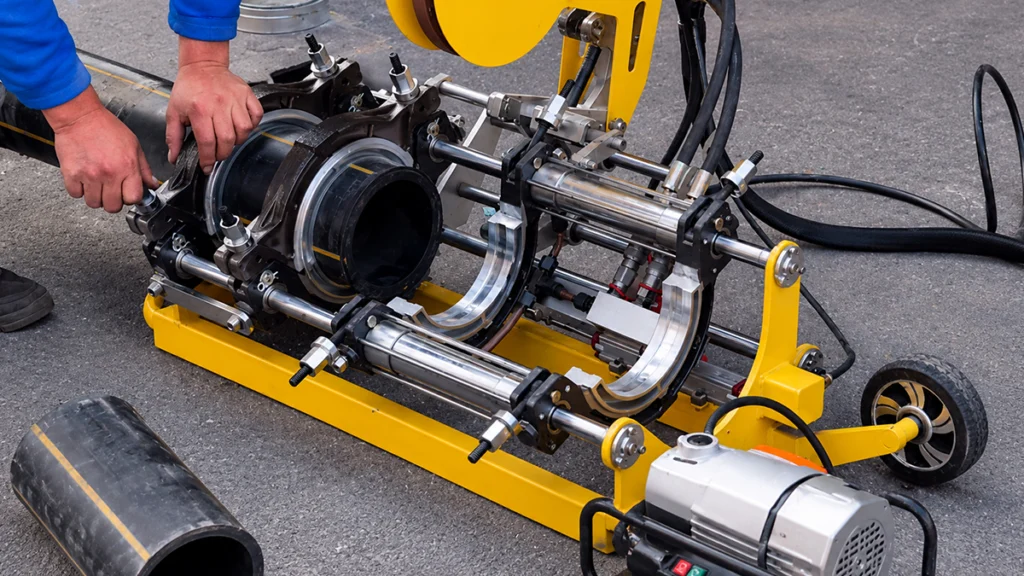
Push the faced ends together under slight pressure to verify their alignment. Run your hand or a gauge around the entire circumference to confirm the outer walls sit flush. You must strictly control high-low misalignment; wall thickness variations cannot exceed 10% of the pipe’s total wall thickness. If the offset is too large, adjust the butt fusion machine clamps, rotate the pipe segment, or re-face the ends until everything falls within tolerance.
Step 4: Heat, join, hold pressure, and cool the joint
Slide the heating plate (pre-verified at 210±5°C) between the pipe ends and apply initial pressure until a uniform melt bead rolls back. Drop the hydraulic pressure down to the designated heat-soak level and hold it there for the required time. Once the heat-soak finishes, rapidly retract the carriage, pull the heating plate out, and slam the melted ends together. This changeover needs to be lightning-fast to prevent a “cold skin” from forming on the molten plastic. Finally, maintain the calculated fusion pressure on the joint until the mandated cooling timer completely expires.
How to Inspect a Finished Butt Fusion Joint
Visual inspection acts as the immediate frontline defense to verify the HDPE pipe joint satisfies the inspection checklist. A well-trained operator can literally read the fusion bead to assess the internal integrity of the weld.
What a good HDPE fusion bead should look like
A structurally sound, proper HDPE fusion bead displays symmetrical, uniform flange curling completely around the pipe’s 360-degree circumference. The bead needs to roll over smoothly onto the pipe’s surface without forming sharp V-notches in the center. Both halves of the bead should look relatively equal in size, proving that both pipe ends absorbed uniform pressure and heat.
Signs of misalignment, contamination, or under-fusion
Defect indicators stand out clearly if you know what to spot. Asymmetrical flange curling points directly to severe misalignment or uneven heating. A noticeably undersized bead hints at inadequate pressure, under-fusion, or a rushed heat-soak phase. Surface flaws like pitting, depressions, or tiny bubbles offer hard evidence that particulate contamination or moisture became trapped inside the melt interface.
Field inspection checklist before backfilling or pressure testing
You must complete a rigorous field inspection checklist before any trench gets backfilled. While visually checking the bead profile is standard protocol, best practices demand performing at least one test butt fusion connection daily on the job site. Operators should run a non-destructive “bend test” on a sample strip. This proves that the current HDPE pipe jointing machine settings and ambient environmental conditions are actively producing high-strength, ductile welds capable of surviving intense hydrostatic pressure tests.
Common Butt Fusion Welding Mistakes and How to Avoid Them
Even veteran operators occasionally slip into bad habits. Mastering butt fusion welding troubleshooting means identifying the root triggers behind common field errors and enforcing strict preventative protocols.
Using incorrect temperature or pressure settings
Applying inadequate cooling time or excessive drag pressure usually happens when crews try to rush production to shorten equipment cycle times. Pumping up the pressure too high actually squeezes the molten polymer right out of the fusion zone. This leaves colder material at the interface and severely weakens the joint. Guessing the drag pressure instead of calculating it mathematically remains a primary culprit behind hydrostatic blowout failures.
Skipping pipe cleaning or facing
Bypassing the mandatory facing or cleaning steps leaves moisture, oxidation, grease, and dirt clinging to the pipe ends. This contamination acts as a physical barrier, blocking the polymer chains from cross-linking. It is the leading reason why contaminated, weak joints might pass a quick visual check but fail catastrophically once operational pressure hits the line.
Moving the joint before proper cooling
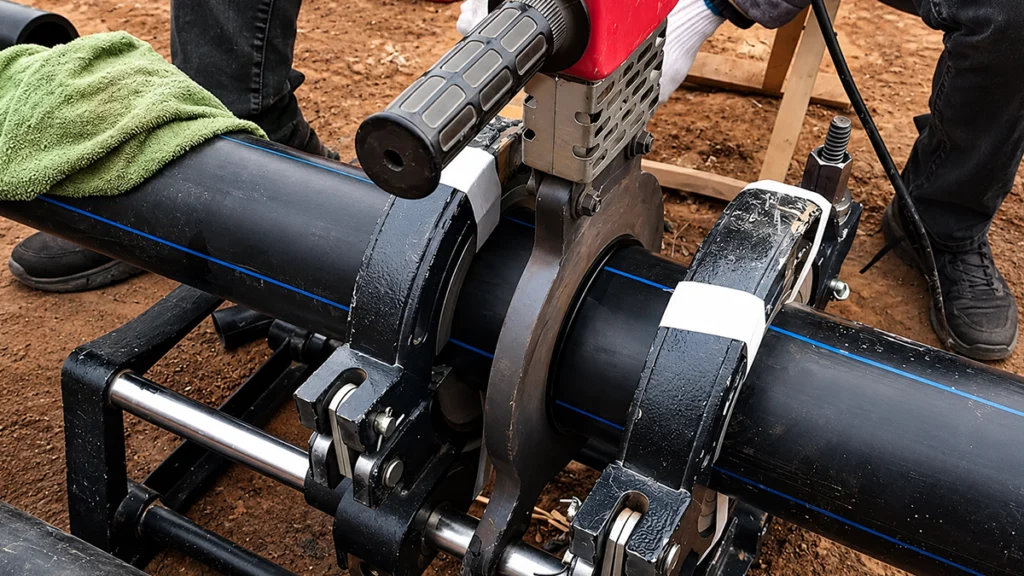
Thermofusion demands patience. Rough handling, unclamping the pipe fusion machine, or moving the joint before the cooling timer expires violently tears apart the molecular entanglement. Premature movement injects massive residual stress into the plastic, creating a brittle “cold weld” that will inevitably fracture during ground settlement or pressure testing.
Welding in poor weather without protection
The environment heavily dictates thermodynamic stability. Trying to weld in high winds, extreme cold, or damp conditions without setting up environmental protection tents ruins the thermal stability of both the weld interface and the heating plate. Wind strips heat away from the melted polymer during the changeover phase, while ambient moisture flashes into steam pockets, causing deep porosity inside the joint.
Butt Fusion Welding Machine Selection for HDPE Pipe Projects
Picking the right hardware directly influences total project ROI, joint reliability, and daily field productivity. Buyers have to weigh butt fusion machine capabilities against the uncompromising demands of their specific HDPE pipe welding equipment selection criteria.
Manual, hydraulic, and automatic butt fusion machines compared
Manual hydraulic butt fusion machines rely on open-loop systems and hand-operated valves. They depend entirely on the operator’s personal skill to juggle timing and pressure. Fully automatic CNC automatic butt fusion machines, however, leverage closed-loop systems packed with electronic feedback, Programmable Logic Controllers (PLCs), and solenoid valves. By locking in the parameters and taking over the heat-soak, changeover, and cooling phases, automatic machines effectively eliminate human error.
| Machine Type | Control System | Best Use Case | Operator Dependency |
|---|---|---|---|
| Manual Hydraulic | Open-loop, manual valves | Small to medium projects, lower budget | High (requires skilled operator) |
| Semi-Automatic | Hydraulic with basic timers | Standard municipal water/gas lines | Medium |
| Fully Automatic (CNC) | Closed-loop PLC, solenoid valves | Critical high-pressure gas, large-diameter mains | Low (machine controls process) |
How to match machine size to pipe diameter and SDR
You must meticulously match the butt fusion machine’s size to the pipe’s SDR and diameter. Crews achieve this by swapping in precision reducing clamps and the correct heating dies. For instance, if you are welding a smaller pipe inside a massive pipe fusion machine chassis, you have to install a smaller die up front and a larger stabilizing die in the back. This setup maintains flawless axial alignment without crushing the thinner pipe walls under heavy clamping force.
Which machine features improve field welding consistency?
If you want to guarantee repeatable perfection across thousands of joints, prioritize specific tech features. Closed-loop hydraulic feedback, digital data logging, and CNC automation are the heavy hitters for improving field consistency. These advanced systems actively monitor interfacial pressure in real time, automatically tweaking hydraulic flow to offset micro-fluctuations. This ensures every single weld perfectly mirrors the programmed standard.
When to request technical specifications from a supplier
Procurement teams need to demand comprehensive technical specifications right out of the gate during the bidding phase. Buyers must verify the hardware strictly complies with ISO 12176.2-1998, the global standard that defines technical indicators, safety performance, and classification for fusion equipment. Validating these specs guarantees the butt fusion machine can operate safely and legally on highly regulated industrial and municipal job sites.
Quality Control, Documentation, and Project Acceptance
Modern pipeline construction demands hard proof of quality. Passing a pressure test isn’t enough anymore; contractors must provide exhaustive documentation tracing every single joint back to the exact environmental conditions and the specific operator who performed the weld.
Welding records and operator qualification
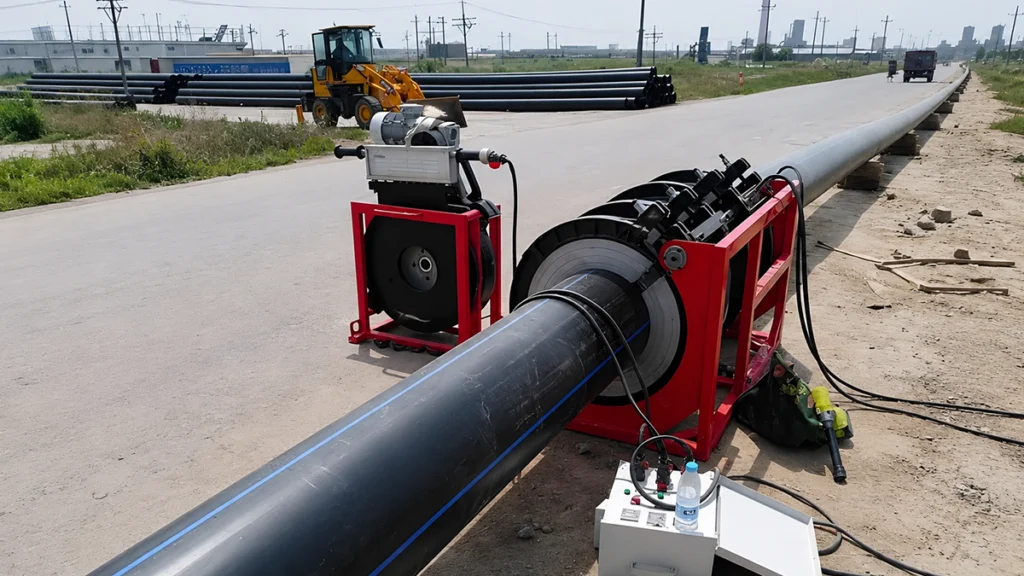
Securing project acceptance hinges on strict operator qualification and verifiable welding records. Operators must hold active certifications for the exact class of butt fusion machine they operate. Detailed field logs need to capture the operator’s ID, ambient weather data, the specific butt fusion welding machine utilized, and the precise parameters applied to every joint across the pipeline network.
Pressure testing and acceptance criteria
Hydrostatic pressure testing serves as the ultimate validation of pipeline integrity. Crews should conduct tests in 200–300 meter segments. Aim for cloudy days, early mornings, or late evenings when ambient temperatures remain stable and low. While testing, engineers must ramp up the pressure gradually and strictly adhere to pressure reduction factors tied to the pipe’s current material temperature, preventing catastrophic over-pressurization.
How digital data logging improves quality control
Digital data logging completely transforms quality assurance by delivering 100% production traceability. Top-tier HDPE pipe welding machines scan barcode-coded parameters straight from the pipe manufacturer, then digitally record the actual times, pressures, and temperatures applied to every weld. This unalterable digital footprint proves to utility owners and inspectors that the Butt Fusion Welding Procedure was executed to the letter, radically speeding up final project sign-off.
Practical Recommendations for Reliable HDPE Pipe Fusion
Delivering zero-leak performance on a massive HDPE pipeline requires blending disciplined field execution with high-grade equipment. Project managers have to lay down the law with strict operational rules to shield their profit margins from the crushing costs of rework.
Best practices for field welding teams
Field crews must make daily calibration a top priority. Run a first-piece weld verification—like a bend test—every single morning before kicking off production welding. This calibrates the hardware to the day’s specific environmental conditions. Furthermore, teams need to obsess over equipment maintenance. Keep hydraulic fluids pristine and free of moisture, and immediately re-coat heating plates with PTFE the moment they get scratched.
Procurement checklist for butt fusion equipment buyers
B2B buyers should lean on a rigid procurement checklist when vetting suppliers. Verify that the proposed butt fusion machinery features closed-loop hydraulic feedback and supports automated data logging. Demand documented compliance with DVS 2207 and ISO 21307 standards. Finally, scrutinize the supplier’s backend support: evaluate their ability to deliver robust after-sales technical help, comprehensive operator training, and lightning-fast spare parts availability.
Final decision points before starting a pipeline project
Successfully wrapping up an HDPE pipeline project demands pairing fully qualified HDPE pipe fusion machine operators with calibrated, premium welding equipment. Yes, fully CNC automatic butt fusion machines demand a 3-4x higher upfront investment than basic manual units, but the ROI is impossible to ignore. On a standard 6-month build, swapping one expensive manual monitoring laborer for an automated process easily saves $20,000 to $30,000. That savings often pays for the automatic butt fusion machine upgrade on the very first job while virtually guaranteeing a zero-leak pipeline.
FAQ
Q1: What temperature is used for HDPE pipe butt fusion welding?
Operators strictly maintain the heating plate at DVS/ISO: 200–220°C,ASTM: 400–450°F / 204–232°C. Hitting this exact thermal window is mandatory to reach the viscous flow state required for proper molecular entanglement. Run it cooler, and you get a brittle cold weld; run it hotter, and the polymer degrades through thermal oxidation.
Q2: How long should an HDPE butt fusion joint cool before handling?
The required cooling time depends on pipe diameter, wall thickness, SDR, ambient temperature, and the manufacturer’s welding specification. The joint should remain clamped and undisturbed during the required cooling period. Moving or releasing the joint too early can weaken the weld and cause joint failure.
Q3: How do you know if an HDPE butt fusion weld is good?
A good HDPE butt fusion weld should have a continuous, symmetrical, and uniform fusion bead around the full pipe circumference. There should be no visible gaps, sharp V-notches, severe misalignment, contamination, or uneven bead formation. When required by the project specification, additional testing may be used to verify weld quality.
Q4: What causes HDPE butt fusion weld failure?
Common causes include incorrect heating temperature, improper fusion pressure, insufficient cooling time, poor pipe alignment, contaminated pipe ends, incomplete facing, or movement during the cooling stage. Proper preparation, parameter control, and inspection are essential for reliable HDPE pipe fusion joints.
Q5: Can HDPE pipe be butt fused in cold or rainy weather?
Yes, but proper environmental protection is required. Butt fusion welding should not be performed directly in rain, snow, strong wind, or dusty conditions without a protective shelter. Low temperatures may require adjusted heating and cooling times according to the welding procedure, while moisture or contamination on the pipe ends can reduce weld quality.
Q6: What is the difference between manual and hydraulic butt fusion machines?
A manual butt fusion machine relies on the operator to apply and control fusion pressure, so it is usually used for smaller pipe sizes and simple site work. A hydraulic butt fusion machine uses a hydraulic system to apply more stable and controllable pressure, making it more suitable for medium and large-diameter HDPE pipe projects. CNC or automatic hydraulic machines can further improve repeatability and reduce operator error by controlling and recording key welding parameters.
Q7: Do HDPE butt fusion welding parameters change by pipe diameter?
Yes. Heating time, cooling time, fusion pressure, drag pressure, and bead size all change according to pipe diameter, wall thickness, SDR, material grade, and the selected welding standard. The heating plate temperature usually remains within the standard temperature range, but the time and pressure settings must be calculated for each pipe size and welding condition.
Q8: Is butt fusion stronger than electrofusion for HDPE pipe?
When performed correctly, both butt fusion and electrofusion can produce joints as strong as the parent HDPE pipe. Butt fusion is commonly used for long, straight pipe runs because it creates a continuous joint without additional fittings. Electrofusion is often preferred for fittings, branch connections, repair work, tight spaces, and trench installations where butt fusion equipment is difficult to operate.
Conclusion
A reliable HDPE pipe butt fusion welding procedure is essential for strong, leak-free pipeline systems. Welding quality depends on proper pipe preparation, accurate alignment, correct heating temperature, controlled fusion pressure, measured drag pressure, and sufficient cooling time.For contractors and procurement teams, choosing the right butt fusion equipment is also important. Manual machines suit smaller jobs, while hydraulic and CNC machines provide better pressure control, repeatability, and welding records for larger projects. With proper equipment, trained operators, and strict quality control, HDPE butt fusion joints can deliver long-term performance in water supply, drainage, mining, gas, and infrastructure applications.
Let our experts help you choose the right equipment for your project
Contact Our Engineering Team