
Automatic Butt Fusion Machine: When Do You Need Data Recording and Controlled Welding?
Table of Contents
Automatic Butt Fusion Machine guide: learn when data recording and controlled welding are required, how automatic models compare with manual and semi-automatic units, key specifications, ISO compliance, costs, and how to choose the right machine for HDPE, gas, and water pipeline projects.
What Is an Automatic Butt Fusion Machine?
At its core, an automatic butt fusion machine operates as a fully self-directed, data-driven system. It relies on a closed-loop Programmable Logic Controller (PLC) to govern pipe welding procedures with absolute precision. No manual intervention required. The equipment seamlessly handles pipe end milling, drag pressure measurement, thermal compensation, heating, and final pressure application. The result? Unwavering joint quality every single time.
Definition and core working principle
A closed-loop hydraulic and thermal control system drives the entire process. Real-time feedback flows constantly from pressure sensors and temperature probes straight into the PLC. The controller then measures these live metrics against pre-loaded industry standards like ISO 21307 or DVS 2207-1. If a parameter drifts even slightly, the system instantly tweaks the hydraulic solenoid valves or heating elements. This rapid compensation holds the specifications tight and completely removes human error from the equation.
What makes a butt fusion machine ‘automatic’?
True automation takes the guesswork out of the operator’s hands. Manual systems force workers to pull hydraulic levers and judge timing. An automatic unit, however, deploys electric solenoid valves commanded by a CNC controller to shift between welding stages. From the initial flanging phase right down to the final cooling period, parameters remain firmly locked. Should someone prematurely release a fixture or drop the pressure, the machine instantly logs an alarm and shuts down the operation.
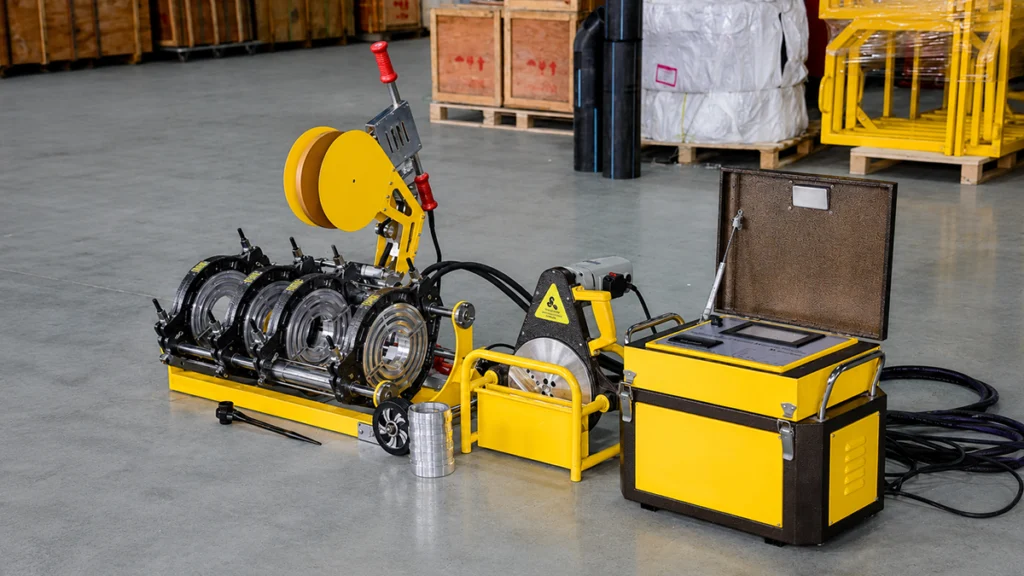
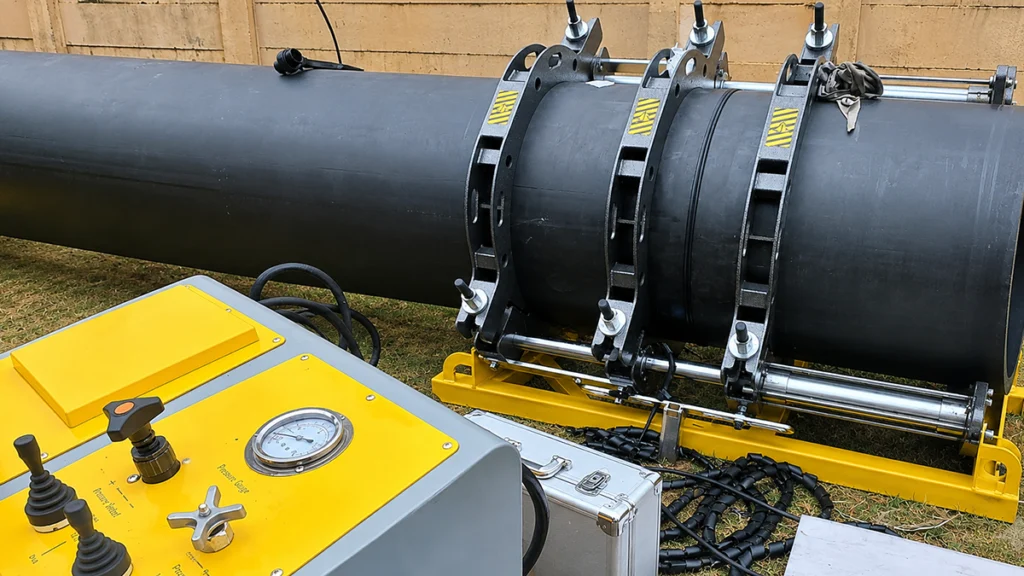
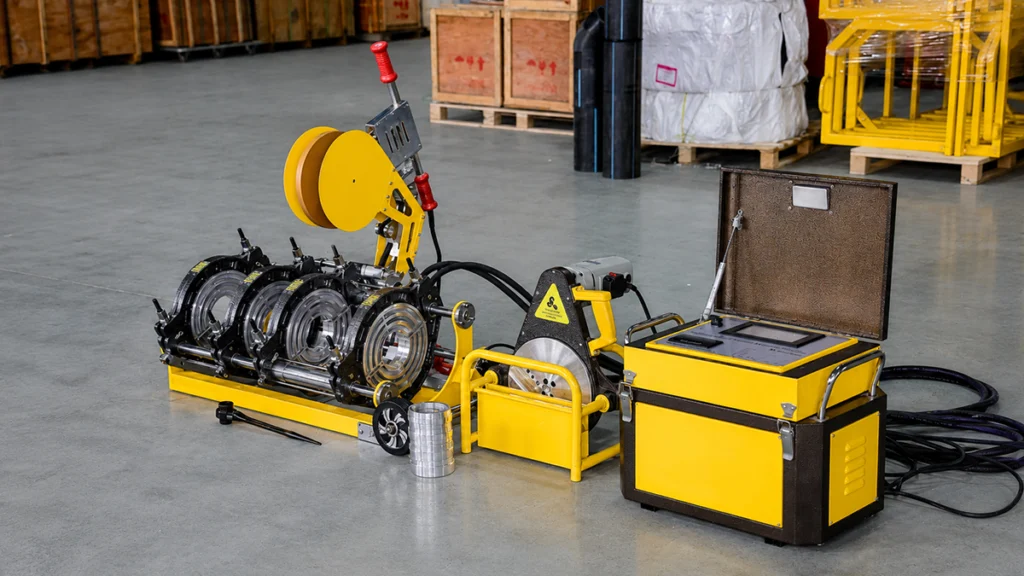
Key components: hydraulic unit, heating plate, planer, CNC controller, data logger
Five heavily engineered components form the backbone of this machinery:
- Hydraulic Unit: Pushes precise, closed-loop pressure through automated solenoid valves.
- Heating Plate: Forged from ZL104 standard aluminum alloy. This material maximizes corrosion resistance while spreading heat uniformly across the contact surface.
- Planer (Milling Cutter): High-speed carbon steel blades slice through pipe ends, driven by a rugged chain mechanism to guarantee perfectly parallel faces.
- CNC Controller: A heavy-duty touchscreen interface. Operators use it to punch in pipe specs and lock in the desired welding standard.
- Integrated Data Logger: Silently captures and encrypts every fusion metric, securing the data for future audits and full traceability.
When Do You Actually Need Data Recording and Controlled Welding?
Upgrading to a data-logging butt fusion machine isn’t just a luxury; for gas and water pipelines, strict project demands often force the switch. Controlled welding and verifiable data become non-negotiable when:
- National codes (like TSG D2002-2006) legally require documented joint records.
- Pipelines transport hazardous or high-pressure fluids, meaning a single failure could trigger a catastrophe.
- Project owners withhold payment until they receive GPS-tagged weld data.
- Crews handle massive pipe diameters where manual pressure adjustments simply lack the necessary precision.
Projects that legally or contractually require weld traceability
Major infrastructure projects no longer treat traceability as optional. It is a strict legal mandate. Frameworks such as TSG D2002-2006 and GB/T 20674.1 force contractors to document at least five distinct elements: management details, equipment specs, pipeline components, exact welding parameters, and the final fusion outcome. Deploying a traceable butt welding machine on utility jobs ensures total compliance. It automatically generates unalterable digital reports for every single joint.
When does pipe diameter or pressure class demand controlled welding?
Error margins shrink rapidly as pipe dimensions grow. Fusing a DN315 SDR17 pipe takes exponentially more force and demands a much longer cooling window than a standard DN90 line. High-pressure networks operating above 10 bar, alongside large-diameter pipes exceeding 315mm, require immense clamping power. They also need highly precise drag pressure compensation. Human operators pulling manual hydraulic levers simply cannot hold these tolerances consistently.
Gas, water, mining, and industrial scenarios that need data logging
High-stakes environments demand hard proof. Natural gas networks must maintain absolute leak-proof integrity to prevent catastrophic explosions. Municipal water systems require 50 to 100-year lifespans to bypass the staggering costs of urban excavation. Meanwhile, mining slurry lines push violently abrasive materials under intense pressure. Data logging gives engineering teams the undeniable mathematical evidence that each joint easily meets the designed safety factor.
Risk-based decision: when manual welding is no longer acceptable
Manual welding crosses the line into unacceptable territory the moment a joint failure’s financial liability eclipses the cost of automated gear. An automatic system watches for anomalies in real time. If it detects an error, it immediately kills the welding cycle. This aggressive risk mitigation shields contractors from the multi-million dollar lawsuits that follow pipeline ruptures or severe environmental spills.
Factory-direct pricing with technical consultation included
Get Your Free QuoteManual vs Hydraulic vs Fully Automatic Butt Fusion Machines
Grasping the differences between automatic and Hydraulic equipment is vital before you sign a purchase order.
| Feature | Manual Hydraulic | Hydraulic | Fully Automatic CNC |
|---|---|---|---|
| Control System | Open-loop, manual levers | Open-loop, button operated | Closed-loop PLC, solenoid valves |
| Data Recording | None (or external add-on) | Basic parameter logging | Comprehensive, encrypted, GPS-tagged |
| Operator Skill | High dependence | Medium dependence | Low dependence |
| Typical Application | Low-pressure irrigation | Medium-diameter municipal | High-pressure gas, large-diameter |
| Relative Cost | Baseline | 1.5x – 2x Baseline | 3x – 4x Baseline |
Operational differences in pressure, temperature, and time control
Manual operators must constantly watch an analog gauge and physically tweak a relief valve to hold pressure steady during the cooling phase. Semi-automatic units step up by handling specific tasks—like inserting the heating plate—but they still wait for human prompts to move between stages. A fully automatic CNC automatic butt fusion machine for HDPE pipes takes absolute control. It calculates exact drag pressure, ramps the heat precisely to 200-220°C, and locks in the required cooling pressure (for instance, 0.15 N/mm²) without a single human input.
Which type fits which project scale?
Manual equipment does the job for modest agricultural irrigation or basic gravity sewers. Hydraulic rigs step in nicely for mid-sized municipal water repairs where budgets run tight but quality remains a priority. Fully automatic machines? They are purpose-built for heavy-hitting professional crews tackling massive, highly regulated Engineering, Procurement, and Construction (EPC) contracts.
Total cost of ownership comparison
Yes, the upfront capital needed for a fully automatic machine runs three to four times higher than a bare-bones manual unit. Yet, the Total Cost of Ownership (TCO) paints a much brighter picture. Swap out one expensive skilled laborer for an automated process, eliminate costly joint rework entirely, and a standard six-month pipeline job can easily return $20,000 to $30,000 in direct savings.
How automation reduces operator-induced weld failures
Fatigue remains the number one culprit behind failed welds. Dropping cooling pressure a minute too early or misjudging the bead-up size shatters the molecular bond of the HDPE. Automation forces strict discipline. The HDPE pipe jointing machine physically locks the clamps down and refuses to release hydraulic pressure until the programmed cooling timer hits zero. Operator-induced cold welds practically disappear.
How an Automatic Butt Fusion Machine Works: The 5-Stage Welding Cycle
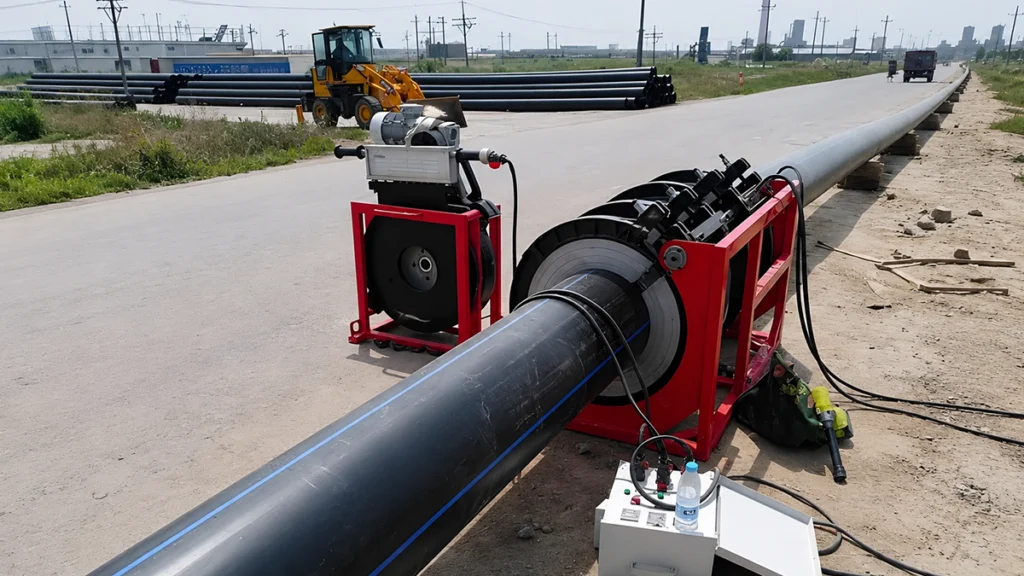
Stage 1: Clamping and pipe alignment
A highly rigid, independent frame structure anchors the pipes. The operator secures the HDPE segments into the inserts to lock in perfect positioning. Next, the PLC takes over. It slowly drives the carriage forward to gauge the initial drag pressure—the precise hydraulic push needed to overcome both the friction of the pipe fusion machine’s internal cylinders and the sheer dead weight of the pipe itself.
Stage 2: Facing and surface preparation
The automated planer drops between the pipe ends. Powered by a heavy-duty motor spinning high-speed carbon steel blades, it aggressively shaves the pipe faces until clean, continuous ribbons of polyethylene peel away. Limit switches keep the operation entirely safe. This critical step ensures the pipe ends sit perfectly parallel, completely free from surface oxidation.
Stage 3: Heating and bead-up
A precision electronic thermostat brings the ZL104 aluminum plate up to standard operating temperature (usually hovering between 200°C and 220°C). The plate slides into position automatically, and the butt fusion welding machine presses the pipes against it. Initial pressure forces a specific bead size to form. Once achieved, the system drops into a lower “soaking” pressure, letting the intense heat penetrate deep into the pipe walls.
Stage 4: Fusion and cooling under controlled pressure
To prevent any sudden heat loss, the heating plate retracts rapidly. The HDPE pipe welding machine instantly drives the melted pipe ends together under strictly controlled hydraulic force (such as 0.15 N/mm² for DVS low-pressure guidelines) to fuse the material. The system then transitions directly into the cooling stage. It stubbornly holds this exact pressure until the joint solidifies completely.
What parameters are automatically recorded at each stage?
The integrated data logger works silently in the background throughout this entire 5-stage cycle. It captures everything: heating temperatures, precise soaking durations, applied fusion pressure, dynamic drag compensation, and total cooling time. If a single metric strays beyond the strict tolerances set by the chosen standard, the logger instantly flags the joint as a failure.
Get detailed specs and custom configuration options
Request Technical SpecificationsKey Technical Specifications and Parameters to Evaluate
Engineering teams must ruthlessly compare automatic butt fusion machine specifications against their actual field requirements before buying.
| Specification | Typical Range / Standard | Engineering Impact |
|---|---|---|
| Diameter Capacity | 90–315mm, 315–630mm, up to 1600mm | Determines pipeline versatility and machine frame rigidity. |
| Pressure Control | Closed-loop hydraulic, up to 250 bar | Ensures precise fusion force and automated drag compensation. |
| Temperature Accuracy | ±2°C deviation | Prevents thermal degradation of HDPE material during soaking. |
| Data Storage | 2,000+ joints, USB/Print export | Provides necessary audit trails for regulatory compliance. |
| Environmental Rating | IP54 | Guarantees operational stability in outdoor trench conditions. |
Pipe diameter range (e.g., 90–1600 mm)
Manufacturers categorize these b8tt fusion machines strictly by their maximum welding capacity. Standard classes cover 90–315mm for distribution grids, 160–400mm for municipal mains, and massive units scaling up to 1200mm or 1600mm for major transmission pipelines. Operating an automatic butt fusion machine for large diameter HDPE pipe requires incredibly thick hydraulic cylinders and a heavily reinforced chassis just to manage the extreme weights.
Hydraulic pressure, heating plate temperature accuracy, and ramp control
You cannot compromise on precision. The hydraulic system must utilize closed-loop control to instantly fix sudden pressure drops. The heating plate requires top-tier electronic thermostats to hold temperatures inside a tight ±2°C window. This extreme accuracy ensures the polymer chains melt uniformly without scorching.
Data logger capacity, export format, and ISO 12176 compliance
A legally compliant HDPE pipe welding machine has to record the five specific data points demanded by TSG D2002-2006. Internal memory should comfortably hold thousands of individual joint records. Beyond sheer storage, the system must export standard formats effortlessly (via USB or Wi-Fi) and support on-site printing. This allows contractors to feed the data directly into their enterprise management software.
Power supply, environmental rating, and transport configuration
Pipeline trenches are brutal environments. Equipment needs an IP54 environmental protection rating to block out aggressive dust and water. Depending on the diameter class, these butt fusion machines pull serious power—often requiring a 3-phase 380V supply for the big units. To navigate the mud, they usually sit on heavy wheeled chassis or tracked trailers for easy trench-side mobility.
Application Scenarios Across Industries
Municipal water supply and sewerage networks
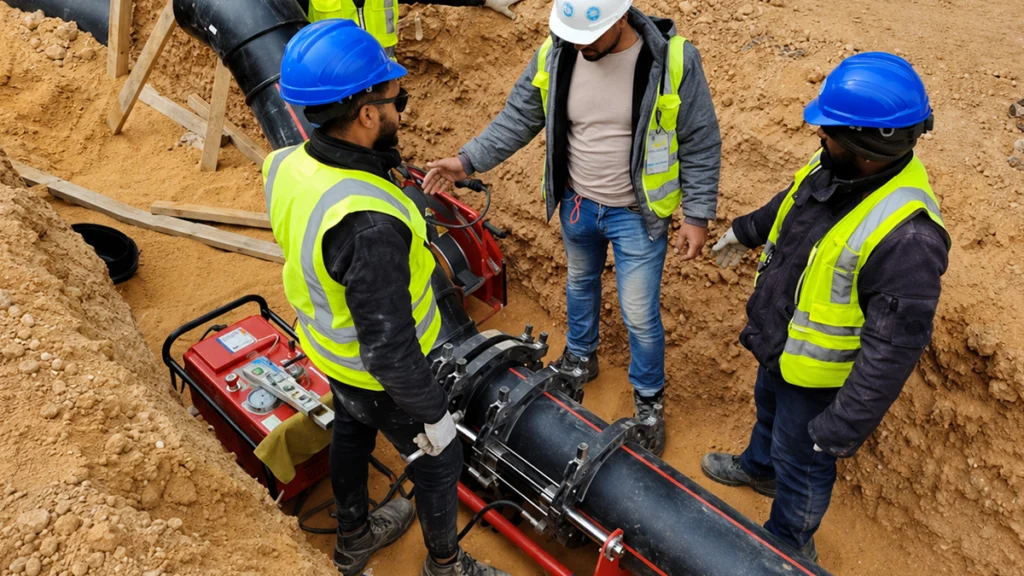
City water networks must deliver decades of flawless, leak-free service. Automatic butt fusion machines fuse high-density polyethylene mains deep beneath urban streets, where digging up a failed pipe costs a fortune. The automated cooling cycle guarantees that every joint builds the maximum tensile strength needed to survive ground shifts and relentless water pressure spikes.
Natural gas distribution pipelines
The natural gas sector enforces the most punishing safety regulations in the pipeline world. One weak joint can trigger catastrophic gas migration. Contractors deploy fully automatic machines to ensure every single weld locks perfectly into ISO 21307 parameters. This completely erases the threat of human-induced cold welds across the grid.
Mining slurry and dredging HDPE lines
Mining sites pump fiercely abrasive slurry and heavy tailings through thick-walled HDPE lines. These pipes face brutal internal wear and massive operating pressures. Automatic fusion equipment delivers the crushing clamping force required to align heavy SDR7 or SDR9 pipes, guaranteeing the joints survive the abrasive onslaught longer than the pipe itself.
Industrial and chemical plant piping
Chemical processing plants move highly aggressive acids and alkalis daily. Industrial engineers lean heavily on CNC automated fusion to lock down exact temperature and pressure controls during the build. This granular precision stops internal bead deformities from forming, which could otherwise disrupt fluid dynamics or create dangerous traps for corrosive chemicals.
Standards, Compliance, and Weld Traceability Requirements
Competing on a global scale means your equipment must meet international engineering benchmarks. An ISO 12176 compliant automatic butt fusion machine is your ticket to entry.
ISO 12176-1, 12176-3, and 12176-4 explained
The ISO 12176 series strictly governs polyethylene fusion hardware and data traceability.
- ISO 12176-1: Lays out the core mechanical, performance, and general characteristics required for butt fusion equipment.
- ISO 12176-3: Standardizes operator identification badges, ensuring that only fully certified personnel can unlock and run the butt fusion welding machine.
- ISO 12176-4: Dictates exact traceability rules. It specifies precisely how pipeline components and weld data must be encoded and permanently logged.
What weld data must be recorded for audit and warranty?
To pass strict audits and validate warranties, the HDPE pipe jointing machine has to capture deep metadata. We are talking project numbers, contract IDs, operator badges, and specific joint identifiers. The most advanced systems take it a step further by weaving in real-time Beidou or GPS coordinates, locking down the exact spatial location of every weld along the trench.
How traceability protects contractors from liability
When a pipeline bursts, lawyers aim directly at the contractor. Real-time uploading of encrypted, firewall-protected welding data prevents any unauthorized tampering. This creates an immutable digital ledger. It hands contractors absolute mathematical proof that they fused the joint flawlessly to standard, shielding them from massive, unwarranted legal claims.
Cost, MOQ, Lead Time, and Supplier Evaluation
Grasping the true automatic butt fusion machine price and understanding lead time dynamics will sharpen your project bidding and keep procurement schedules on track.
Typical price ranges by diameter class
Capital costs scale directly alongside pipe diameter capacity. Fully automatic units usually start around $6,700 for compact 90–315mm rigs. Need to fuse massive 24″–36″ (600–900mm) pipes? Expect to invest upwards of $40,000. Integrating closed-loop PLC controllers and massive heavy-duty hydraulics naturally pushes prices toward the higher end of the spectrum.
Lead time, MOQ, and shipping considerations for export buyers
Sourcing internationally? Standard manufacturing lead times generally run between 7 and 11 days. Most factories maintain a Minimum Order Quantity (MOQ) of just 1 set, letting contractors buy exactly what they need for a specific bid. Export buyers must factor in ocean freight transit times and demand that suppliers pack the equipment in rugged, export-grade wooden cases to shield delicate CNC electronics.
How to evaluate a butt fusion machine manufacturer
Never choose a supplier based purely on the bottom-line price. Dig into their independent R&D capabilities and raw engineering talent. A top-tier manufacturer will hand over clear documentation proving where their hydraulic components originate. They will guarantee future software upgrades and enforce strict protocols for annual equipment calibration.
What spare parts and after-sales coverage to negotiate upfront
Pipeline downtime bleeds thousands of dollars a day. Bake critical spare parts right into your initial purchase order. You absolutely need extra high-speed carbon steel milling blades, backup ZL104 heating plate liners (with fresh PTFE coating), and a solid set of V-groove inserts. Make sure the supplier guarantees remote technical support and fast-tracks replacement sensors when things go wrong.
Common Mistakes and Hidden Risks When Buying Automatic Butt Fusion Machines
Confusing ‘CNC display’ with true automatic control
The single most disastrous procurement error is paying for “fake automation.” Slapping a digital screen onto an open-loop manual valve system changes nothing. A genuine CNC butt fusion welding machine relies on a closed-loop PLC system paired with automated solenoid valves. It physically governs the hydraulic pressure with zero human input.
Ignoring data logger compatibility and export formats
Buying a HDPE pipe jointing machine equipped with a closed or proprietary data logger makes the recorded information virtually useless. If you cannot export the data into standard PDF or CSV files for official audits, or sync it with your enterprise management systems, you will fail regulatory compliance checks instantly.
Underestimating training, calibration, and certification needs
Assuming “automatic” means you can skip operator training will trigger catastrophic field failures. Crews still need formal certification to prep pipe ends and navigate the CNC interface. Furthermore, if you ignore the annual calibration of temperature probes and pressure sensors, the PLC will blindly execute flawed welding parameters.
Choosing under-spec machines for large-diameter pipelines
Trying to save a few bucks by pushing a mid-range rig to its absolute maximum diameter limit is a recipe for disaster. Under-spec butt fusion machines simply lack the frame rigidity and hydraulic clamping muscle needed to grip large-diameter, high-pressure pipes. The result? Dangerous pipe slippage right in the middle of the critical cooling phase.
Practical Buying Checklist and Final Recommendation
Figuring out how to choose an automatic butt fusion welding machine demands a methodical approach. You must align the equipment’s raw capabilities with your specific project constraints.
Pre-purchase checklist: project, pipe, standard, budget
1. Define Pipe Specifications: Pinpoint the exact outer diameter range (OD) and the maximum wall thickness (SDR).
2. Identify Welding Standards: Double-check if the contract dictates ISO 21307, DVS 2207-1, or ASTM F2620 compliance.
3. Verify Traceability Needs: Review local codes to see if data logging and GPS tagging are mandatory.
4. Assess Environmental Conditions: Demand an IP54 rating to ensure the gear survives muddy, wet trench operations.
5. Evaluate Power Availability: Make sure your site generators can actually handle the massive startup surge from the heating plate and hydraulic motors.
6. Review Budget vs TCO: Weigh the steep initial capital cost against the massive labor savings and zero-rework benefits of automation.
When to choose fully automatic over semi-automatic
Always mandate a fully automatic butt fusion machine over a semi-automatic model when tackling large-diameter transmission mains or high-pressure gas lines. The same rule applies to any job where the infrastructure owner legally demands strict weld traceability. Completely removing operator error easily justifies the heavier upfront cost.
How to request a meaningful quotation and technical proposal
Stop asking for generic price lists. Demand a comprehensive technical proposal. It should explicitly detail the PLC specifications, the exact storage capacity of the data logger, and the manufacturing origin of the hydraulic solenoid valves. Insist on written proof that the plastic pipe welding machine can execute pre-loaded DVS/ISO parameters smoothly, and get absolute clarity on their after-sales calibration support.
FAQ
Q1: What is the difference between an automatic and a semi-automatic butt fusion machine?
An automatic butt fusion machine relies entirely on a closed-loop PLC and solenoid valves to drive heating, pressure, and cooling cycles. It requires zero manual intervention, entirely removing human error. A semi-automatic setup automates certain physical movements—like dropping in the heating plate—but still relies on a human operator to push buttons for stage transitions and watch the pressure gauges.
Q2: Is data recording mandatory for HDPE pipe welding in gas and water projects?
In most major jurisdictions, absolutely. High-pressure natural gas lines and critical municipal water grids legally demand strict data recording. Frameworks like TSG D2002-2006 force contractors to log equipment details, exact welding parameters, and operator IDs. This ensures total accountability and perfect traceability for every single weld.
Q3: Which ISO standards apply to automatic butt fusion welding equipment?
The ISO 12176 series is the gold standard here. ISO 12176-1 dictates the mechanical and performance baselines for the hardware. ISO 12176-3 handles operator identification protocols, while ISO 12176-4 outlines the exact data traceability requirements. When it comes to the actual welding parameters the HDPE pipe jointing machine executes, those generally follow ISO 21307 or DVS 2207-1.
Q4: What pipe diameter range can an automatic butt fusion machine handle?
Manufacturers build these HDPE pipe welding machines in distinct diameter classes to guarantee the frame stays rigid under pressure. Standard groupings include 90–315mm for local distribution, 160–400mm, and 315–630mm. For massive transmission pipelines, heavy-duty models scale all the way up to 1200mm or even 1600mm.
Q5: How much does a fully automatic butt fusion machine cost?
The price tag scales aggressively alongside the pipe diameter capacity. A fully automatic unit generally starts around $6,700 for smaller ranges (90–315mm). However, massive capacity models (like 24″–36″) can easily exceed $40,000. You are paying for advanced closed-loop PLC controllers, highly engineered hydraulics, and encrypted data loggers.
Q6: How long does it take to weld a large-diameter HDPE pipe with an automatic machine?
Welding duration hinges entirely on the pipe’s diameter and wall thickness (SDR), following strict standards like DVS 2207-1. The butt fusion machine handles the heavy lifting, but you cannot cheat the physics of heating and cooling. Fusing a DN315 SDR17 pipe generally takes about 20 to 30 minutes per joint, covering setup, facing, heating, and the final cooling phase.
Q7: Can the welding data from an automatic butt fusion machine be exported as a report?
Yes. Any compliant automatic butt fusion machine includes an integrated data logger that holds thousands of individual joint records. You can export this encrypted data via USB or Wi-Fi, or even print it right there in the trench. This generates unalterable PDF or CSV reports perfect for engineering audits and final quality assurance sign-offs.
Q8: What training and certification do operators need for automatic butt fusion welding?
Even with full automation, operators must hold formal certification (frequently tied to ISO 12176-3 standards). Proper training ensures they know how to align pipes correctly, execute surface preparation (facing), navigate the CNC touchscreen, and decode data logger error messages. They also learn to perform daily calibration checks so the PLC continues to execute parameters flawlessly.
Conclusion
Purchasing an automatic butt fusion machine marks a profound shift. You are moving away from labor-heavy, error-prone pipeline construction toward data-driven, verifiable engineering. The true power of this equipment stems from its closed-loop PLC control, which aggressively strips human error out of the highly sensitive heating and cooling phases. By automatically adjusting drag pressure and locking down hydraulic force via solenoid valves, these plastic pipe welding machines guarantee every single joint complies strictly with ISO 21307 or DVS 2207-1 benchmarks.
For high-stakes environments—think natural gas networks, municipal water grids, and aggressive chemical piping—an integrated data logger isn’t just a nice add-on; it is a strict legal requirement. The power to record, encrypt, and export precise welding metrics alongside GPS coordinates shields contractors from crippling liability lawsuits. Sure, the upfront capital cost dwarfs manual alternatives. However, when you eliminate joint rework and slash the need for expensive skilled labor, the Total Cost of Ownership becomes incredibly attractive. As you evaluate suppliers, insist on genuine CNC automation, strict ISO 12176 compliance, and rock-solid after-sales calibration support to secure your long-term operational success.
Let our experts help you choose the right equipment for your project
Contact Our Engineering Team