
Butt Fusion vs Electrofusion Machine for HDPE Pipe: Cost, Strength and Application Comparison
Table of Contents
Butt Fusion vs Electrofusion explains how HDPE pipe joining methods differ in cost, strength, equipment needs, site conditions, and best-use applications for smarter project selection.
Butt Fusion vs Electrofusion Machine: Quick Comparison for HDPE Pipe Projects
Short answer: which method is better for most projects?
So, you’re weighing butt fusion against electrofusion for your next HDPE pipe network. Here is the bottom line: butt fusion typically wins out for long, straight, large-diameter runs. Why? It’s highly efficient, and your per-joint material cost drops to basically zero. On the flip side, electrofusion is your go-to for emergency repairs, tie-ins, branch connections, and tight trenches where a bulky butt fusion machine simply won’t fit. Realistically, most major infrastructure projects don’t just pick one. They use a hybrid approach—relying on butt fusion for the main trunk lines and electrofusion to handle the final connections.
Key differences in cost, strength, equipment, and site conditions
Budget and logistics ultimately drive the choice between these two methods. Let’s break down the core differences.
| Comparison Factor | Butt Fusion Welding | Electrofusion Welding | Practical Takeaway |
|---|---|---|---|
| Cost Structure | High CapEx (equipment), near-zero OpEx (fittings). | Low CapEx (processor), high OpEx (consumable fittings). | Butt fusion is cheaper for high-volume joints. |
| Joint Strength | 100% homogeneous; equal to or stronger than base pipe. | Slightly smaller fusion area; fully compliant with ISO 13954. | Both meet national pressure standards. |
| Site Conditions | Requires level ground and large footprint for chassis. | Requires minimal radial space but absolute cleanliness. | Electrofusion is mandatory in tight trenches. |
| Equipment | Heavy hydraulic rig, generator, facer, heating plate. | Lightweight 40V computerized processor, barcode scanner. | Electrofusion offers superior portability. |
When the choice depends on pipe diameter, access, and project scale
Pipe diameter plays a massive role in the financial breakdown. Take butt fusion: it’s incredibly cost-effective for large diameters, spanning anywhere from 63mm up to a massive 2000mm. Once you get into those larger sizes, the price of electrofusion couplers skyrockets, making standard electrofusion joints way too expensive. Then there’s site access. If you can’t physically pull the pipes apart or align them inside a butt fusion welding machine chassis, electrofusion becomes mandatory for those final tie-ins. As for project scale, if you’re fusing hundreds of joints, the return on investment for a butt fusion machine easily outweighs the endless recurring costs of buying electrofusion fittings.
How butt fusion creates a continuous HDPE pipe joint
Here is how the magic happens. A PTFE-coated heating plate warms the pipe ends until they reach a viscous flow state—usually between 200°C and 270°C. Once you hit the right temperature and melt depth, you pull the heating plate out. Hydraulic cylinders immediately press the molten ends together, applying a highly specific fusion pressure. This forces the molecular chains to diffuse across the interface. As the material cools under pressure, it forms a single, continuous pipe. No third-party couplers required.
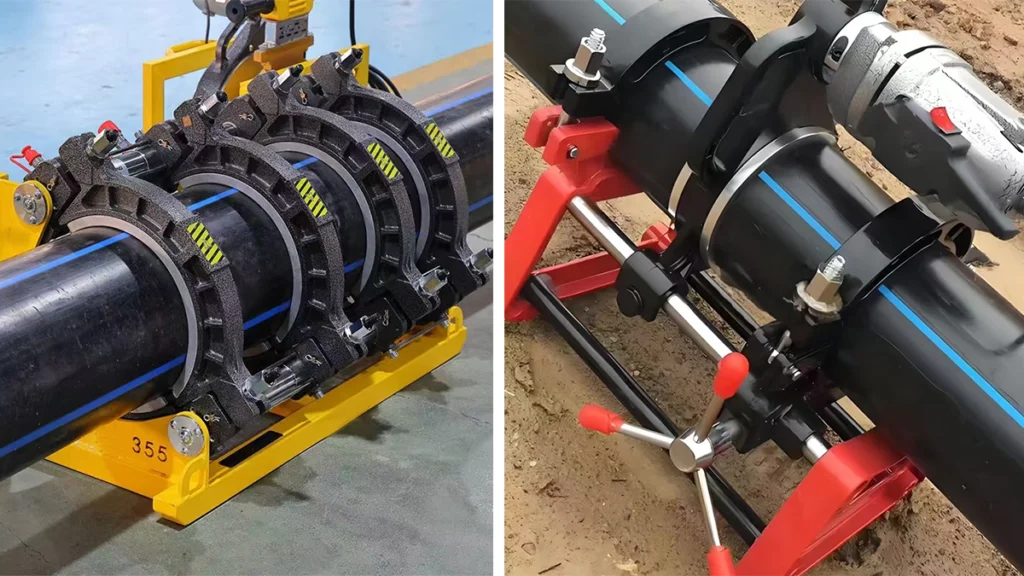
What Is Butt Fusion Welding Machine for HDPE Pipe?
Main machine required for butt fusion welding
You need four main pieces of gear to pull off a successful butt fusion weld. First, the chassis (or frame) locks the pipes in place using reducing clamps to stop any lateral shifting. Next comes the milling cutter, or facer. This tool planes the pipe ends so they sit perfectly flat, parallel, and square to the centerline. Third is the heating plate, an electrically heated unit equipped with dual temperature controllers. Finally, the hydraulic control box takes charge. It manages the exact pressure required during the bead-up, heat-soak, and cooling stages to keep everything strictly compliant with ISO 21307 or ASTM F2620 standards.
Common pipe sizes and project types suited to butt fusion
Contractors rely on this method globally for pipe sizes ranging from 63mm all the way to 3200mm, though the sweet spot usually lands between 50mm and 630mm. It serves as the gold standard for long-distance gas transmission lines, municipal water trunk mains, mining slurry operations, and massive agricultural irrigation networks. Butt fusion shines in straight-line, open-trench layouts. Crews can efficiently fuse multiple joints sequentially above ground, then simply lower the entire pipe string right into the trench.
What affects butt fusion joint quality?
Nailing a perfect joint requires absolute discipline regarding temperature, pressure, and time. If your heating plate runs too hot, the polymer degrades; too cold, and you don’t get enough melt. You also have to watch your switching cycle—the brief window between pulling the heater out and applying hydraulic pressure. Take too long, and a “cold skin” forms, blocking the molecular entanglement you need. On top of that, releasing the hydraulic clamps before the weld core completely cools will create internal voids. That is a guaranteed recipe for premature failure.
How electrofusion fittings and embedded heating wires work
Electrofusion takes a totally different approach, relying on the Joule effect. The consumable fittings feature precision-wound electrical resistance coils built right into their inner surface. When a welding processor energizes those coils, they generate exact amounts of heat. This melts both the inside of the fitting and the outside of the pipe. As the molten plastic expands, it creates its own internal pressure, fusing the two surfaces. The processor usually runs on a 40V welding voltage and uses a barcode scanner to dial in the exact time and energy parameters.
Factory-direct pricing with technical consultation included
Get Your Free QuoteWhat Is Electrofusion Welding Machine for HDPE Pipe?
Typical electrofusion components: couplers, saddles, tees, and reducers
The entire electrofusion process hinges on specialized, consumable fittings. Couplers (or sockets) handle straight connections and trench tie-ins. Saddles step up for branch connections on live or depressurized mains, letting crews tap into a system without ever cutting the main pipe. The fitting lineup also includes equal tees, 45° and 90° elbows, and reducers. You’ll typically see these in diameters from 20mm to 315mm, though manufacturers do produce larger custom sizes for highly specific jobs.
Why electrofusion is useful in confined spaces or repair work
Electrofusion’s biggest superpower is its tiny spatial footprint. You only need enough radial clearance to slide the fitting over the pipe and hook up two electrical leads. This setup allows crews to weld directly inside the trench. You completely eliminate the nightmare of lifting heavy, rigid pipes out of the dirt just to lock them into a butt fusion machine chassis. During emergency blowouts, electrofusion lets teams finish repairs fast, minimizing excavation work and drastically cutting down on water or gas service interruptions.
What affects electrofusion joint reliability?
If you want a reliable electrofusion joint, surface preparation is everything. You have to mechanically scrape the pipe surface—sanding doesn’t cut it—to completely strip away the oxidized polymer layer. Skipping this step is the number one reason electrofusion joints leak. You also need to push the pipe fully past the internal heating coils. If the insertion depth falls short, the coils can overheat, short circuit, or force molten plastic straight into the interior of the pipe. Finally, the joint has to remain clamped and perfectly still throughout the entire fusion and cooling process.
Which method has lower upfront Machine cost?
An electrofusion processor is basically a highly advanced, computerized power supply. That makes it significantly cheaper, lighter, and easier to haul around than a massive hydraulic butt fusion rig. Butt fusion demands a heavy chassis, a hydraulic pump, a facer, and a heater—all of which translate to a steep initial capital expenditure (CapEx). However, the math changes drastically on long pipelines. In those scenarios, the cost analysis swings heavily in favor of butt fusion because it completely eliminates the need to buy pricey consumable fittings.
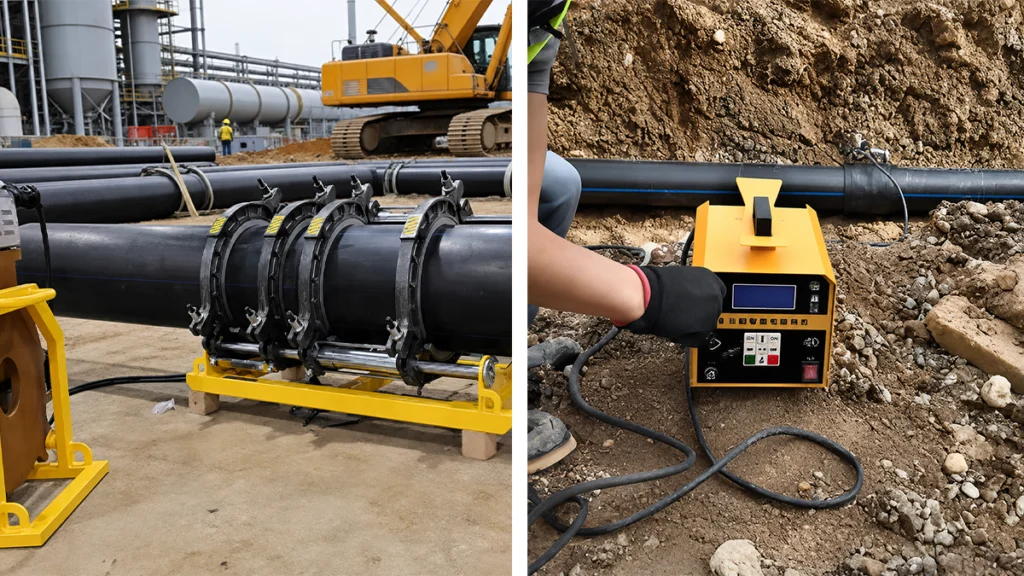
Cost Comparison: Machine, Fittings, Labor, and Project Scale
Why electrofusion fittings usually increase material cost
Electrofusion fittings aren’t just simple pieces of plastic; they are highly engineered components. They feature precision-wound copper coils, custom terminal pins, and complex injection molding. All that manufacturing complexity drives up the unit price, and that cost scales exponentially as the pipe gets wider. A 63mm coupler might not break the bank, but a 630mm electrofusion coupler costs an absolute fortune compared to the zero-fitting material cost of a 630mm butt weld. On large-diameter projects, those fittings will eat a massive hole in your procurement budget.
How labor, welding speed, and crew skill affect total installed cost
Labor dynamics shift depending on the environment. On long, straight runs, butt fusion moves faster per joint. But it demands a highly skilled operator who understands tactile variables like pressure drag and temperature curves. Electrofusion, meanwhile, relies heavily on automated barcode scanning. This lowers the technical barrier for entry, but it requires uncompromising discipline when it comes to surface prep. In tight, constrained spaces, electrofusion actually speeds up the installation by cutting down on excavation and pipe handling.
Cost scenario: long straight pipeline vs repair or tie-in work
Imagine laying miles of straight pipeline. Here, butt fusion wins the cost battle hands down. You quickly amortize the high equipment cost across hundreds of joints, keeping your material expenses strictly limited to the bare pipe. Now, flip the scenario to a repair or a tricky tie-in. Electrofusion takes the lead. Sure, the fitting itself is expensive, but that price tag is nothing compared to the staggering costs of heavy pipe fusion machine, extra labor, and digging a massive trench just to fit a butt fusion machine.
Are butt fusion joints stronger than electrofusion joints?
When done right, a butt fusion joint is 100% homogeneous. In many cases, it actually boasts a higher tensile strength than the base pipe itself. Electrofusion joints have a slightly lower theoretical strength because the fusion area is smaller and the embedded wire matrix physically remains in the plastic. That said, both methods fully meet rigorous international pressure standards, including ISO 13954 (Peel Test) and ISO 13955 (Shear Test). You can trust either method to deliver reliable, long-term performance under rated pressures.
Get detailed specs and custom configuration options
Request Technical SpecificationsStrength and Joint Performance Comparison
Pressure rating and long-term sealing performance
Butt fusion joins pipes sharing the exact same Standard Dimension Ratio (SDR) and outside diameter (OD). This guarantees a uniform pressure rating across the entire pipeline—like maintaining SDR 11 for 200 PSI from start to finish. Electrofusion fittings, built with high internal tolerances, can sometimes fuse pipes with slightly different wall thicknesses, as long as the OD matches perfectly. If you go the electrofusion route, engineers must verify that the fitting’s pressure rating matches or exceeds the pipe’s SDR to avoid derating the whole system.
Failure risks caused by poor scraping, alignment, heating, or cooling
Ignore standard operating procedures, and both methods will fail. With butt fusion, misalignment leads to asymmetrical flange curling. If you don’t heat the pipe enough or release the pressure too soon, you get a weak “cold weld.” Electrofusion risks almost always trace back to poor surface prep. Fail to scrape off that oxide layer, and the weld won’t hold. Angular misalignment can trigger internal wire short-circuits. And if an impatient crew tries to force-cool the joint with water or air, it induces severe internal stress that eventually tears the weld apart.
How inspection and welding records affect quality assurance
QA protocols look very different depending on the method. Butt fusion lets inspectors immediately evaluate the joint visually by checking the size, shape, and rollback of the external melt bead. Electrofusion leans into advanced digital traceability. Modern plastic pipe welding machines complying with ISO 12176.2-1998 automatically log the welding voltage, fusion time, ambient temperature, and operator ID via the barcode scanner. They spit out a downloadable PDF or CSV report, which is usually mandatory for compliance audits and municipal handovers.
Best method for large-diameter transmission pipelines
When building large-diameter transmission mains, butt fusion easily takes the crown. It delivers unbeatable operational efficiency, structural integrity, and cost-effectiveness for pipes scaling up to 2000mm. Trying to source and install massive electrofusion fittings at that scale is logistically absurd and financially ruinous. For heavy infrastructure, butt fusion is the only engineering choice that makes sense.
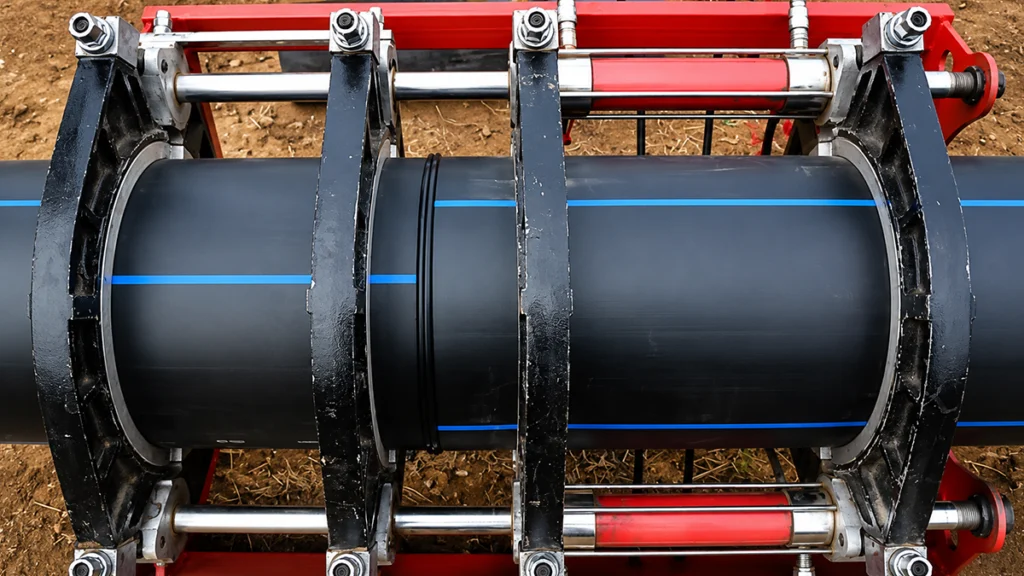
Application Comparison by Project Type
Best method for gas distribution networks and service connections
Gas distribution networks utilize both methods, depending entirely on the specific tier of the network. Crews use butt fusion to lay the main PE4710 gas trunk lines across long stretches. But when it’s time for service connections, electrofusion saddles and couplers are the undisputed global standard. They allow utilities to safely tap directly into live gas mains and route service lines to residential meters while staying strictly compliant with ISO 8085-2000 and GB15558.2 guidelines.
Best method for confined spaces, trench repairs, and branch connections
If you are working in a confined space, electrofusion is your best friend. Because the pipe doesn’t need to move laterally during the fusion cycle, it’s perfect for deep, narrow trenches, wall corners, and manholes. Picture a repair scenario: contractors can cut out a defective section, drop in a replacement spool piece, and slide two electrofusion couplers right into position. The existing buried pipeline never has to shift an inch.
How industrial fluids, mining slurry, and irrigation projects influence selection
What flows through the pipe heavily dictates the joining method. In mining and slurry operations, butt fusion leads the pack. You can mechanically remove the smooth internal bead, preventing abrasive particles from grinding down the joint interface over time. In the agricultural sector, butt fusion is the favorite for long-distance irrigation runs due to its rock-bottom installation costs. These industries generally save electrofusion for emergency leak repairs or putting together complex manifold assemblies.
How much working space does each method need?
The spatial requirements couldn’t be more different. Butt fusion demands a flat, dry, and highly stable staging area. You need several square meters just to fit the electrofusion welding machine chassis, the standalone hydraulic power unit, and the pipe support rollers. Electrofusion? It only requires the radial clearance of the fitting itself—often just a few inches around the pipe’s circumference. You can execute an electrofusion weld in virtually any spot you can physically reach.
Installation Requirements and Site Conditions
Power supply, generator, and welding control requirements
Clean, stable power is non-negotiable across the board. Butt fusion requires a heavy-duty generator (think 220V/380V AC). It has to simultaneously run the hydraulic pump and the high-draw electrical heating plate, which can pull over 30 KVA on large-diameter rigs. Electrofusion processors demand a highly stable power supply to push out a precise 40V. If an undersized generator or a long extension cord causes a voltage drop, the processor will automatically abort the weld to prevent a weak joint.
Surface preparation, scraping, cleaning, and alignment rules
For butt fusion, the facer mills the pipe ends perfectly square, physically shaving off any surface oxidation or dirt right before heating. Electrofusion takes a lot more manual effort. You must rigorously scrape at least one-third of the pipe’s circumference, ensuring the scraped area extends past the fitting’s insertion depth. After scraping, crews have to wipe the area down with 90%+ isopropyl alcohol and lint-free cloths to eliminate any lingering moisture, grease, or dust before sliding the fitting on.
Weather, trench conditions, and cooling time considerations
Mother Nature plays a huge role in heating and cooling cycles. If temps drop below 12°C (55°F), crews must clear away frost and set up windbreaks so the butt fusion heating plate doesn’t cool down too fast. Cooling times are strictly enforced. ASTM F2620 mandates roughly 11 minutes of under-pressure cooling time for every inch of pipe wall thickness during butt fusion. With electrofusion, the cooling countdown is hard-coded right into the fitting’s barcode. You cannot remove the clamping tools until that timer hits zero.
Decision checklist for engineers and purchasing teams
Purchasing teams and engineers should run through a strict checklist before making a final call:
1. Identify the Pipe OD and SDR to figure out what equipment is actually feasible.
2. Tally up the total number of joints to compare upfront equipment CapEx against the OpEx of consumable fittings.
3. Walk the site to evaluate staging space, trench access, and topography.
4. Finalize the budget split between heavy HDPE pipe welding machine and consumable materials.
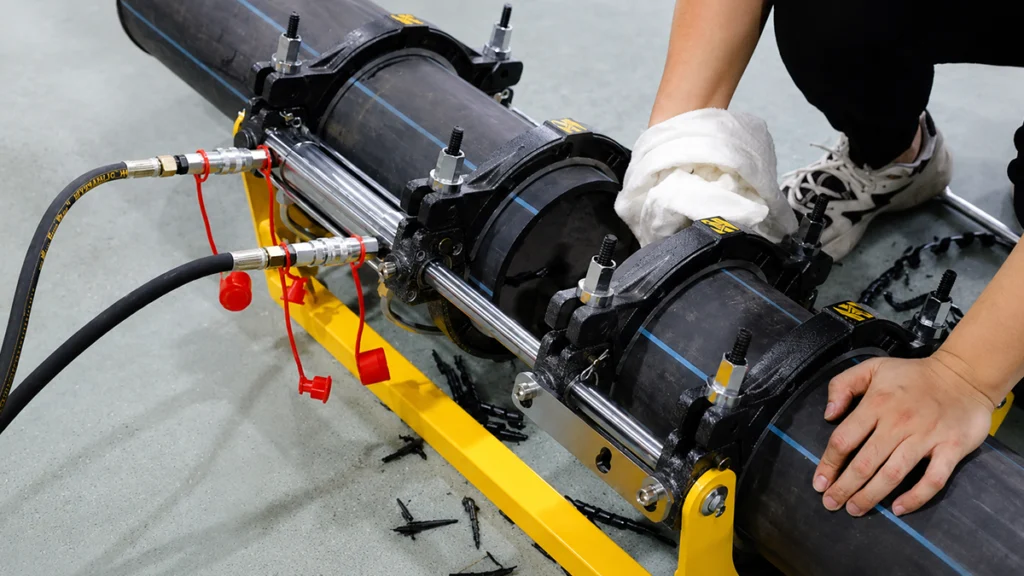
Selection Guide: How to Choose Between Butt Fusion and Electrofusion
Choose butt fusion when these project conditions apply
Make butt fusion your primary specification when dealing with pipe diameters from 110mm up to 3200mm. It is the smartest choice for long, straight runs across open terrain where you have plenty of flat ground to stage heavy equipment. From a procurement standpoint, it is the clear winner if your overarching goal is to crush long-term consumable material costs.
Choose electrofusion when these project conditions apply
Pivot to electrofusion when working with smaller diameters (typically 20mm to 110mm) or when the job site forces you into subterranean manholes, deep trenches, or incredibly tight spaces. It stands alone as the only practical option for executing live tie-ins, fixing emergency bursts, or joining pipes that share the same outside diameter but feature slightly different wall thicknesses.
When a project should use both methods together
Top-tier pipeline contractors rarely choose just one; they run a hybrid playbook. Standard practice involves firing up butt fusion machines above ground to weld standard 12-meter pipe sticks into massive, continuous strings. Crews then drag those strings into position and lower them into the trench. Finally, they use electrofusion couplers to tie those long sections together. It perfectly marries the spatial convenience of electrofusion with the unbeatable economics of butt fusion.
Mistakes that reduce butt fusion joint strength
Ignoring drag pressure is the deadliest sin in butt fusion. If an operator fails to factor in the force required to physically move a heavy pipe, the joint won’t receive enough fusion pressure, resulting in a weak connection. Another massive mistake is pulling the clamps off too early. Releasing hydraulic pressure before the core polymer fully crystallizes traps internal stress and micro-voids right inside the weld.
Common Mistakes and Hidden Risks in HDPE Pipe Fusion
Mistakes that cause electrofusion coupling failure
When electrofusion fails, it’s almost always human error. The biggest culprit? Skipping the scraper and relying purely on chemical alcohol wipes. If you don’t physically peel away that oxidized plastic, the joint will fail. Misalignment is another silent killer. Forcing a pipe into a fitting at a bad angle pushes the internal heating coils together, causing a short circuit. Also, never fuse wet pipes. Residual moisture boils into steam during the weld, blowing structural voids right through the melt zone.
Why operator training and approved procedures matter
Each method demands a specific skill set. Butt fusion operators need sharp tactile and visual judgment to assess melt bead rollback and pressure curves. Electrofusion technicians need rigid, uncompromising discipline when it comes to marking insertion depths and scraping. To protect pipeline integrity and prevent high-pressure blowouts, operators must hold formal qualifications under recognized standards like DVS 2207-1, DOT Part 192.283, or equivalent local codes.
Documentation, traceability, and pressure testing before handover
Today’s infrastructure projects demand bulletproof digital traceability. High-end welding processors track GPS coordinates, pressure curves, ambient temperatures, and operator IDs for every single joint. But here is the most critical rule for handover: never start hydrostatic pressure testing until the pipeline has completely cooled to ambient temperature. Testing a line while the joints still hold residual core heat guarantees an immediate blowout and instantly voids the manufacturer’s warranty.
Best overall choice for long pipelines
If you are laying miles of pipe, butt fusion is the ultimate champion. The heavy upfront investment pays for itself rapidly by zeroing out your fitting costs. Plus, when it comes to high-pressure gas and water transmission, the structural integrity of a homogeneous butt weld is second to none.
Final Recommendation for HDPE Pipe Buyers and Contractors
Best choice for repairs, connections, and restricted access
When dealing with retrofits, maintenance, or cramped access zones, electrofusion easily takes the win. Yes, you pay a premium for the consumable fitting. However, you instantly make that money back by slashing labor hours, avoiding heavy excavation equipment, and minimizing costly system downtime.
What information to prepare before requesting a quote
Want an accurate quote and proper equipment sizing? Come prepared. Buyers need to provide the exact Outside Diameter (OD) alongside the Pressure Rating (PN) or Standard Dimension Ratio (SDR). You also need to specify the material grade (PE80, PE100, or PE4710), the terrain layout, the estimated joint count, and the specific compliance standards (ASTM, ISO, DVS) dictating the project.
—
Frequently Asked Questions
Q1: Is butt fusion cheaper than electrofusion for HDPE pipe?
Absolutely. On large-scale jobs, butt fusion costs significantly less per joint because you aren’t buying consumable fittings. While the upfront capital expenditure (CapEx) for a heavy-duty HDPE pipe jointing machine is steep, the virtually zero material cost (OpEx) makes it the smartest financial play for long runs. Electrofusion only wins the cost battle on small-scale repairs where buying or renting a massive rig makes zero sense.
Q2: Which HDPE pipe joining method gives the strongest joint?
A properly executed butt fusion weld creates a 100% homogeneous connection that often outpaces the base pipe in tensile strength. Electrofusion joints offer slightly lower theoretical strength because the fusion zone is smaller and the wire matrix stays embedded in the plastic. Still, both techniques easily pass rigorous ASTM and ISO pressure tests, guaranteeing leak-free, long-term performance.
Q3: Can electrofusion be used for large-diameter HDPE pipes?
They are, but you rarely see them. Manufacturers do produce massive electrofusion couplers (exceeding 1000mm), but the pricing scales exponentially. A single large-diameter fitting can set you back thousands of dollars. Because of that, contractors strictly reserve large-diameter electrofusion for unavoidable tie-ins, tight spaces, or emergency repairs where a butt fusion chassis simply cannot fit.
Q4: When should electrofusion be used instead of butt fusion?
Switch to electrofusion when navigating deep trenches, manholes, or extremely confined spaces where bulky butt fusion machine cannot operate. It is also the mandatory go-to for tapping live gas mains with saddles, fixing burst pipes, joining pipes with slightly different wall thicknesses (SDRs), and executing final tie-ins where lateral pipe movement is impossible.
Q5: Do butt fusion and electrofusion joints have the same pressure rating as the pipe?
Yes, both methods are engineered to uphold the pipeline’s full pressure integrity. Butt fusion directly joins pipes of the exact same SDR, ensuring continuous strength. Electrofusion fittings are specifically designed to meet or exceed the pipe’s pressure rating (PN), provided the fitting’s SDR matches or surpasses the SDR of the pipe itself.
Q6: What causes HDPE electrofusion joints to fail?
Poor surface preparation is the number one culprit. If a crew fails to mechanically scrape the oxidized plastic layer off the pipe, the weld will fail. Other frequent triggers include angular misalignment (which causes the embedded heating coils to short-circuit), pushing the pipe in too shallow, contamination from dirt or moisture, and prematurely removing the clamps before the joint fully cools.
Q7: What equipment is needed for butt fusion welding?
A proper butt fusion setup relies on a heavy-duty chassis to clamp and align the pipes perfectly. You also need a mechanical facer to shave the ends flat, a PTFE-coated electrical heating plate to melt the plastic, and a hydraulic control box to manage the exact drag and fusion pressures. Don’t forget a heavy-duty power generator to run it all.
Q8: Can butt fusion and electrofusion be used in the same pipeline project?
Without a doubt. In fact, it is standard industry practice. Smart contractors use butt fusion above ground, welding 12-meter pipe sticks into massive, continuous strings to keep costs low. They then lower those long strings into the trench and use electrofusion couplers for the final, in-trench tie-ins where pipe fusion machine access is limited.
—
Conclusion
Nailing down the right joining method for an HDPE pipeline project comes down to balancing site logistics, material costs, and upfront equipment investments. Butt fusion holds its ground as the undisputed champion for long-distance, large-diameter transmission mains, thanks to its homogeneous strength and zero-fitting requirements. On the other hand, electrofusion delivers the ultimate flexibility required for rapid emergency repairs, complex branch connections, and tight trench work where heavy butt fsuion machines are useless. Ultimately, success doesn’t come from blindly picking one over the other. It comes from matching the method to your specific access constraints and pipe diameters, while strictly enforcing operator training, cooling times, and ISO/ASTM preparation standards.
Let our experts help you choose the right equipment for your project
Contact Our Engineering Team