
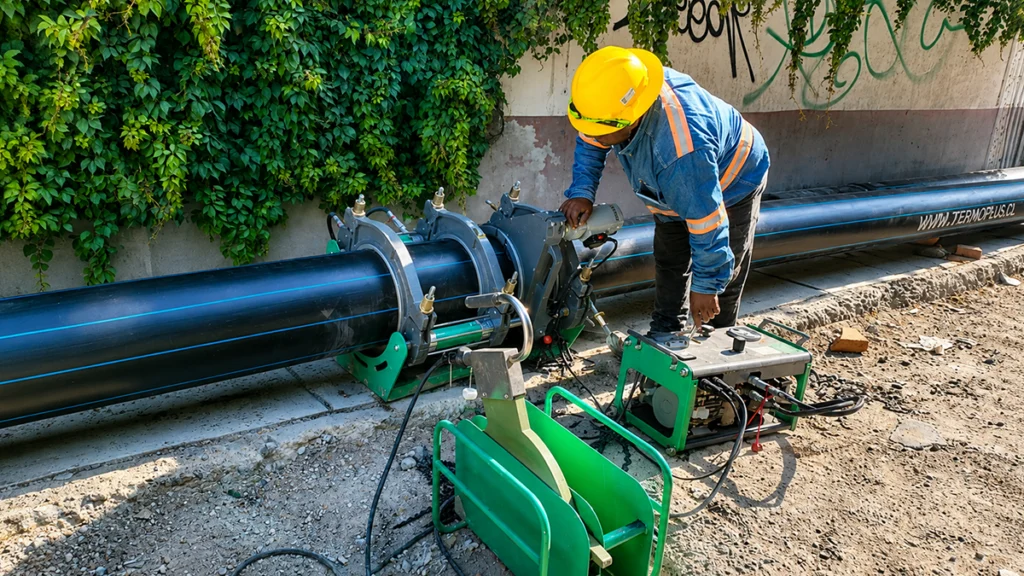
HDPE Pipe Welding Machine for Water Supply Projects
Table of Contents
HDPE pipe welding machine is critical for leak-free water supply pipelines. This guide explains butt fusion vs electrofusion machines, key specifications, selection criteria, cost factors, and supplier evaluation tips to help engineers and procurement teams choose the right equipment.
What Is HDPE Pipe Welding Machine and Why It Matters for Water Supply Projects
Definition and Core Function of HDPE Pipe Welding Machine
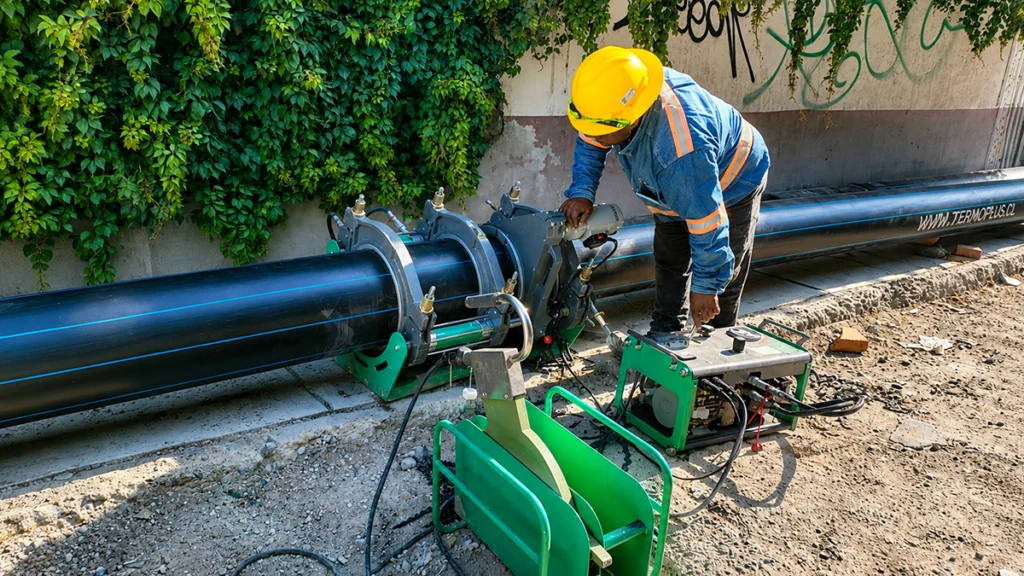
HDPE pipe welding machine uses highly controlled heat and hydraulic pressure to physically melt and fuse polyethylene molecules. Forget about mechanical couplings or messy chemical solvents. This thermal fusion process creates a monolithic joint—one that actually ends up structurally stronger than the pipe itself. For municipal water engineering, these butt fusion machines are the absolute go-to tools for building continuous, leak-proof pipeline networks.
Why HDPE Is the Preferred Material for Water Supply Pipelines
Polyethylene (PE) pipes now dominate urban water distribution worldwide. Why? They offer incredible durability alongside a 100-year design life. Traditional steel and ductile iron degrade over time, but HDPE is completely immune to rust, scale buildup, and galvanic corrosion. Plus, it flexes. This inherent flexibility allows the pipe to absorb seismic shifts and ground settling without cracking. The result is a highly cost-effective infrastructure material that slashes long-term municipal maintenance budgets.
What Role Does Welding Machine Play in Pipeline Reliability?
A water distribution network is only as reliable as its weakest joint. In pressurized water mains, poorly welded connections are almost always the primary failure points. That’s exactly where high-quality HDPE pipe welding machine comes into play. Premium butt fusion welding machines guarantee perfect molecular integration right at the joint interface. This level of precision prevents groundwater from seeping in and virtually eliminates the threat of pressurized blowouts—the kind that trigger massive sinkholes and costly infrastructure damage.
Main Types of HDPE Pipe Welding Equipment Used in Water Projects
Butt Fusion Welding Machines (Manual, Hydraulic, CNC)
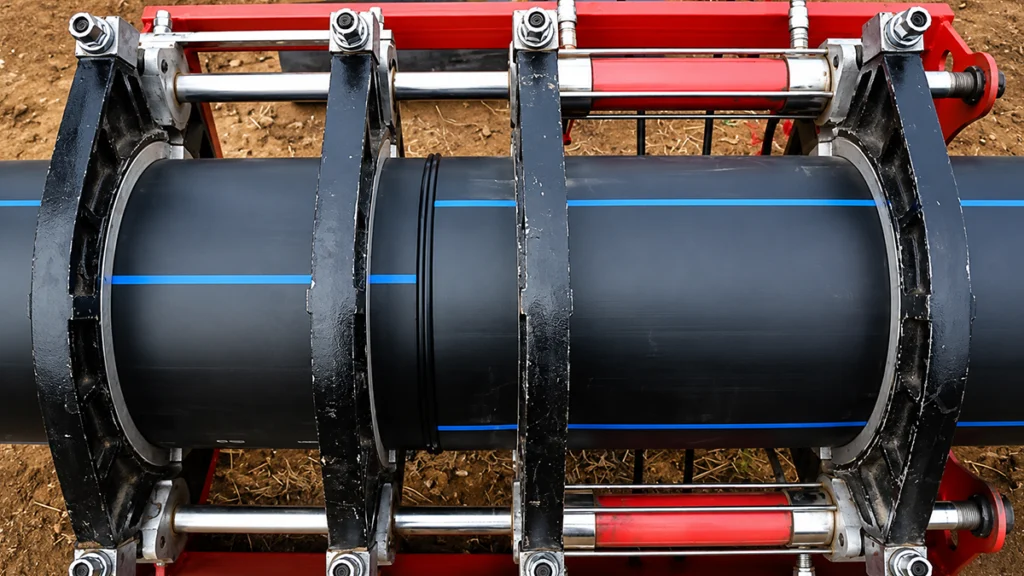
When joining large-diameter PE pipes in long, straight runs, butt fusion is the undisputed heavyweight. The butt fusion machine tightly clamps the pipe ends, planes them perfectly flat, and introduces a heated plate to melt the plastic. From there, hydraulic pressure forces the molten ends together. While manual and semi-automatic units depend heavily on operator calculations, advanced CNC models take over the heavy lifting. They automate the entire pressure and temperature cycle to deliver repeatable, standard-compliant welds every single time.
Electrofusion Welding Machines for Fittings and Repairs
Electrofusion processors take a completely different approach. They use specialized plastic fittings packed with embedded resistive heating coils. Once the butt fusion machine pushes an electrical current through the system, those coils simultaneously melt the inside of the fitting and the outside of the pipe. Because this method needs barely any trench clearance, an electrofusion welding machine for HDPE water pipes is the smartest choice for navigating tight urban spaces, managing complex layouts, and handling rapid emergency repairs.
Socket Fusion and Saddle Fusion Equipment
Crews rely on socket and saddle HDPE jointing welding machines mostly to fabricate fittings, tie-ins, and branch connections—think elbows, tees, and wyes. Socket fusion heats the exterior of a pipe and the interior of a fitting before sliding them together. Meanwhile, saddle fusion attaches branch lines directly onto the sidewall of an existing main. This technique proves incredibly efficient when expanding active municipal distribution networks.
Which Type Is Best for Municipal Water Supply Networks?
Finding the right equipment always comes down to your specific project constraints. To help guide your procurement strategy, here is a quick HDPE butt fusion vs electrofusion comparison:
| Equipment Type | Best For | Diameter Range | Typical Water Project Use Case |
|---|---|---|---|
| Butt Fusion (Hydraulic/CNC) | Long, straight transmission lines | 63mm – 3200mm+ | Cross-country water mains, trenchless HDD |
| Electrofusion | Tight spaces, complex nodes | 20mm – 1200mm | Urban trenches, emergency leak repairs |
| Socket/Saddle Fusion | Branching and custom fittings | 20mm – 160mm | Service connections to residential properties |
Factory-direct pricing with technical consultation included
Get Your Free QuoteWorking Principle and Key Components of HDPE Butt Fusion Welding Machines
The 5-Stage Butt Fusion Welding Process Explained
Pulling off a flawless butt fusion joint demands strict adherence to a specific thermodynamic sequence.
1. Preparation and Milling: First, the plastic pipe welding machine clamps the pipe ends. A rotating planer shaves them down to ensure they are completely parallel and free of any surface oxidation.
2. Heating: A PTFE-coated heating plate drops between the pipe ends, elevating the plastic right to its melting point.
3. Heat Soak: The pipes rest gently against the heated plate under minimal pressure. This allows thermal energy to deeply penetrate the pipe wall.
4. Changeover and Joining: Operators quickly pull the heating plate out. Immediately, specific hydraulic pressure rams the molten pipe ends together.
5. Cooling: The joint sits under static pressure until the plastic totally solidifies. This final step guarantees complete molecular entanglement.
Key Components: Heating Plate, Planing Tool, Hydraulic Unit, Clamps
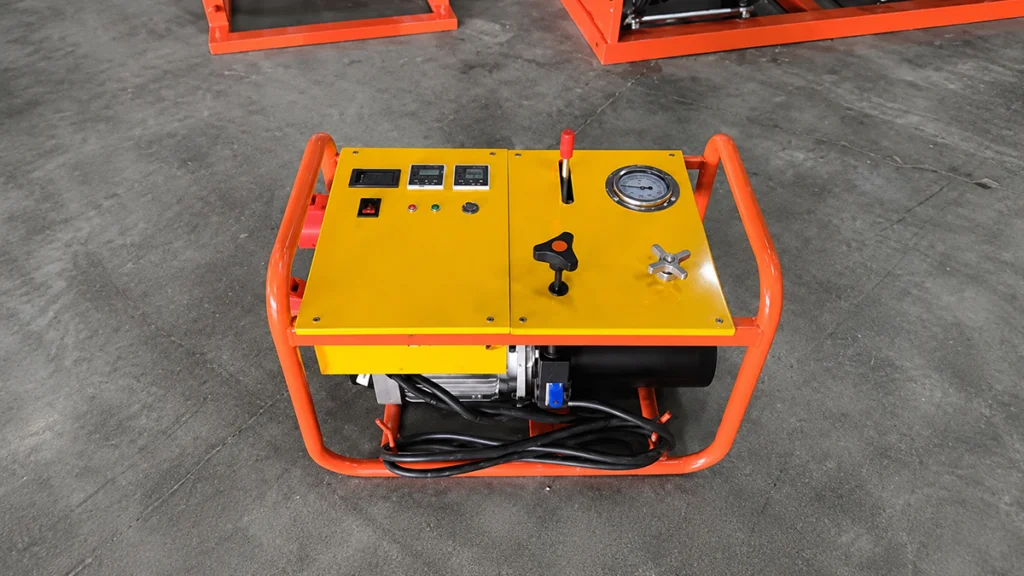
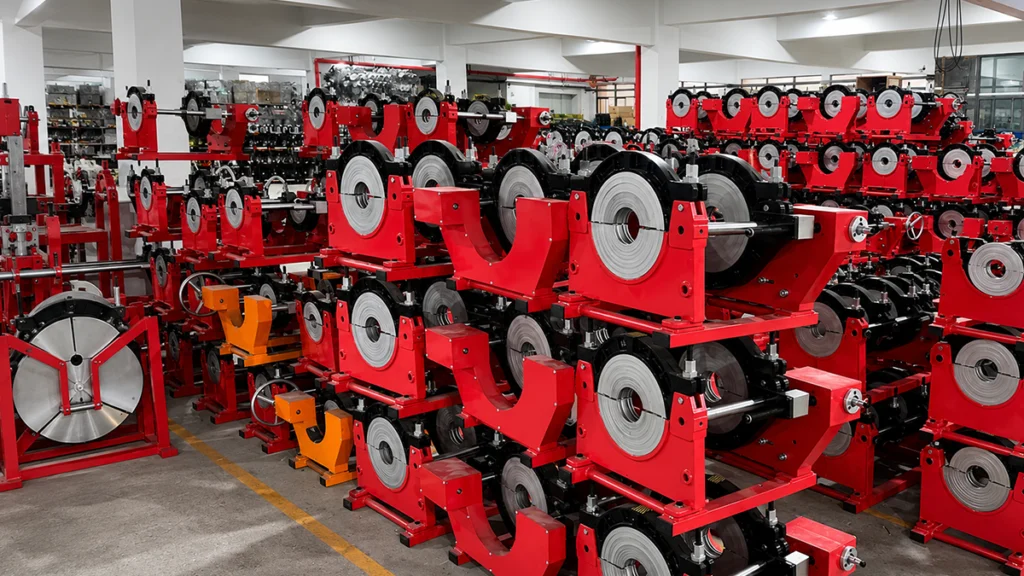
Think of an industrial hydraulic butt fusion machine 630mm as four distinct, critical sub-assemblies working in unison. The heavy-duty chassis features thick aluminum clamps to lock and align the pipes. Next is the planing tool, or facer, equipped with hardened steel blades designed to square off the pipe ends perfectly. Then you have the heating plate, packed with precision electrical elements that push thermal energy out evenly. Finally, the hydraulic unit powers the whole operation, housing the pump, valves, and gauges required to apply and hold exact joining pressures.
How Does Temperature and Pressure Control Affect Weld Quality?
When it comes to thermodynamics, precision is absolutely non-negotiable. You must maintain standard operating temperatures strictly between 220°C and 270°C. Run it too hot, and the plastic oxidizes and degrades. Run it too cold, and the molecules simply refuse to integrate. Fusing pressure works the exact same way. Depending on your specific standard, you generally need between 0.2 MPa and 0.4 MPa. Not enough pressure leaves dangerous voids right at the weld interface. Too much pressure squeezes the molten material entirely out of the joint zone, ruining the connection.
Technical Specifications and Parameters to Evaluate Before Buying
Pipe Diameter Range (63mm–1600mm) and SDR Compatibility
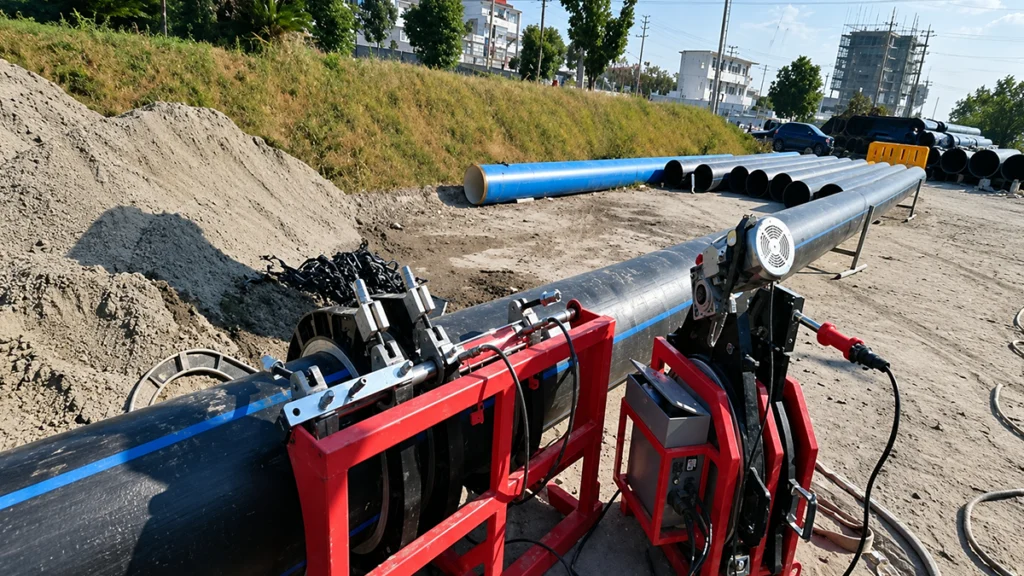
Evaluating HDPE pipe welding machine specifications and parameters always starts with diameter capacity. Standard pipe fusion machines handle everything from 63mm up to an impressive 1600mm, relying on reducing inserts to grip smaller pipes inside a larger chassis. But diameter isn’t everything. Buyers must also confirm SDR (Standard Dimension Ratio) compatibility. You need to know that the hydraulic cylinders pack enough force to weld the heavy-wall pipes—like SDR 9 or SDR 11—routinely used in high-pressure water mains.
Heating Plate Temperature Accuracy and Hydraulic Pressure Rating
Procurement engineers need to look closely at the heating plate’s thermal variance. Top-tier equipment keeps temperature uniformity incredibly tight—within ±5°C across the entire surface. On the hydraulic side, the system needs a highly responsive accumulator. This component is critical because it maintains steady interfacial pressure throughout the long cooling phase, ensuring the pump doesn’t have to run continuously.
Power Supply, Voltage, and Site Power Requirements
Industrial welding equipment pulls serious electricity. While small manual units might run fine on standard 110V/220V single-phase power, massive hydraulic butt fusion machines demand 380V/400V three-phase generators. Before buying, calculate the simultaneous kilowatt (kW) draw of the heating plate, the hydraulic pump, and the milling motor. Sizing your onsite generators correctly prevents catastrophic voltage drops that can instantly ruin a weld.
Data Logging, Traceability, and ISO/CE Certification Standards
Today’s municipal contracts demand absolute traceability. Advanced equipment tackles this by integrating digital data loggers that comply directly with ASTM F3124 and ISO 12176 standards. These smart loggers capture the operator ID, ambient weather conditions, pipe codes, and real-time temperature/pressure graphs for every single joint you make. Beyond that, never procure equipment unless it carries valid CE marks and proves ISO 9001 manufacturing compliance.
Get detailed specs and custom configuration options
Request Technical SpecificationsApplication Scenarios in Water Supply and Municipal Pipeline Projects
Urban Potable Water Distribution Networks
Densely populated urban environments throw everything at a pipeline crew: frequent directional changes, hidden valves, and endless service branches. In these scenarios, the best HDPE welding machine for municipal water pipelines is usually a hybrid fleet. Contractors deploy medium-capacity hydraulic butt fusion machines for the long main street runs. They then supplement those with electrofusion processors to tackle complex tie-ins where tight trench shoring makes bulky equipment impossible to use.
Long-Distance Water Transmission Mains
Moving water from remote reservoirs to urban treatment plants means laying down kilometers of large-diameter PE pipe, often spanning 800mm to 1600mm. Projects like this lean exclusively on heavy-duty CNC automatic butt fusion machines mounted on wheels or tracks. Automating the process ensures that hundreds of consecutive joints hit strict DVS 2207 or ISO 21307 standards. This drastically lowers the risk of catastrophic failures in high-volume transmission lines.
Rural Water Supply and Trenchless HDD Installations
Expanding rural and agricultural water networks frequently requires Horizontal Directional Drilling (HDD) to punch under highways, rivers, or environmentally protected land. For HDD installations, butt fusion isn’t just an option; it’s mandatory. The resulting monolithic joint is literally the only connection strong enough to survive the massive longitudinal pull-back forces generated by the drilling rig without snapping underground.
Repair, Tie-In, and Retrofit Scenarios in Existing Networks
When old PVC or ductile iron water mains finally fail, utility companies increasingly swap the damaged sections out for HDPE. Electrofusion technology completely dominates these emergency retrofit scenarios. A crew can excavate a tiny footprint, slice out the broken section, drop in a new PE spool piece, and slide electrofusion couplers over the ends. It permanently seals the network while keeping service disruptions to an absolute minimum.
How to Choose the Right HDPE Welding Equipment for Your Project
Matching Machine Size to Pipe Diameter and Project Volume
Buying the right equipment starts with a hard look at your project’s bill of materials. Trying to use a butt fusion machine built for 630mm pipe on a 110mm line is a logistical nightmare—it’s too heavy and the hydraulic scaling is completely mismatched. Contractors need to procure HDPE pipe welding machines tailored to the median diameter of their specific job. If you handle diverse operations, invest in overlapping ranges. Owning one 160-315mm unit and one 315-630mm unit gives you unmatched operational flexibility in the field.
Manual vs Hydraulic vs CNC: Which Automation Level Do You Need?
Manual butt fusion machines have zero computational costs, but they rely entirely on the operator’s skill. Keep them restricted to low-pressure, small-diameter jobs. Hydraulic units, which use open-loop manual valves, serve as the true workhorses of the industry. However, CNC automatic machines step it up by using closed-loop solenoid valves tied to electronic feedback. Yes, CNC units demand a steeper initial capital outlay. But replacing manual calculation errors with automated precision routinely saves contractors tens of thousands of dollars in rejected welds and rework over a standard six-month project.
On-Site vs Workshop Welding: Equipment Mobility Considerations
Mobility directly dictates your project speed. If you are building cross-country pipelines, self-contained, trailer-mounted units with integrated generators let your crews hustle from joint to joint. On the flip side, if you are fabricating complex manifolds or custom fittings in a workshop, you don’t need rugged terrain mobility. Instead, you need stationary equipment engineered for rock-solid stability and precise angle adjustments.
What Questions Should You Ask a Supplier Before Ordering?
Never finalize a purchase without interrogating the manufacturer’s technical capabilities first. Start with the tough questions. Does the hydraulic system actually hold pressure during the cooling phase without firing up the pump? What is the exact temperature variance across that heating plate? Will the data loggers talk to our utility company’s proprietary tracking software? And crucially, can the chassis handle heavy-wall SDR 9 pipe without the frame deflecting under pressure?
Cost, MOQ, Lead Time, and Supplier Evaluation Criteria
Typical Price Range by Machine Type and Diameter Capacity
The HDPE butt fusion welding machine price scales aggressively depending on how wide it opens and how much it automates. Entry-level manual hydraulic units (handling up to 250mm) usually sit between $1,500 and $3,500. Step up to mid-range hydraulic butt fusion welding machines (up to 630mm), and you will spend anywhere from $4,000 to $8,000. If you need fully automated CNC automatic butt fusion machines with integrated data logging for massive transmission pipes (up to 1200mm), expect those to command prices ranging from $15,000 to well over $40,000.
MOQ, Production Lead Time, and Shipping Considerations
In the industrial pipeline equipment world, the standard Minimum Order Quantity (MOQ) is usually just one set. Production lead times, however, hinge entirely on the butt fusion machine’s size. Standard units spanning 63mm to 315mm typically ship out within 7 to 15 days. Massive custom butt fusion machines built for 1400mm to 2000mm pipes require a solid 15 to 30 workdays for fabrication and rigorous testing. If you are shipping internationally via sea freight, insist on heavy-duty wooden crating. It is the only way to shield sensitive hydraulic and electronic components from transit shock and corrosive moisture.
How to Evaluate an HDPE Welding Equipment Manufacturer
A truly reliable HDPE pipe welding machine manufacturer supplier backs up their sales pitch with robust in-house R&D and ruthless quality control. Take a hard look at their factory testing protocols. You specifically want to see Factory Acceptance Testing (FAT) that pushes hydraulic cylinder seals to their maximum load limits. Checking their CE and ISO certifications isn’t just a formality—it is mandatory to guarantee the gear meets strict international safety and electrical benchmarks.
After-Sales Service, Spare Parts, and Operator Training
Look beyond the sticker price; the true cost of heavy equipment lies in its lifecycle support. Premier suppliers deliver comprehensive after-sales service. That means guaranteed, fast availability for critical wear parts like PTFE-coated heating plates, planing blades, and hydraulic seals. Furthermore, a top-tier supplier will offer virtual or on-site operator training. Your field crews must thoroughly understand the specific quirks of the butt fusion machine’s control interface and its precise calibration requirements.
Common Mistakes and Hidden Risks in HDPE Pipe Welding
Top 7 Welding Defects and Their Root Causes
You can buy the most premium equipment on the market, but operator error will still wreck joint integrity. Here are the top seven defects to watch out for:
1. Lack of Fusion: Usually happens when the heat soak time is too short or the plate temperature drops too low.
2. Cold Welds: Triggered by a sluggish changeover time. If the operator moves too slowly, the plastic solidifies before the pipes even touch.
3. Porosity (Air Bubbles): The direct result of dirt or moisture contaminating the pipe ends.
4. Undercutting: Happens when excessive joining pressure squeezes too much material right out of the weld zone.
5. HiLo (Misalignment): A classic setup error. Failing to adjust the clamps properly leaves you with uneven pipe walls.
6. Slit Defects: These micro-cracks appear if someone impatiently rips off the external bead before the joint fully cools down.
7. Oxidation: The consequence of leaving the hot heating plate against the pipe for way too long.
Why Poor Equipment Calibration Leads to Joint Failure
Jobsite vibrations and constant thermal cycling cause hydraulic gauges and temperature sensors to drift over time. If your butt fusion welding machine falls out of calibration, the digital screen might boldly claim 220°C while the actual plate sits at a lukewarm 190°C. That blind spot guarantees a cold weld, which will absolutely fail the moment the municipality runs a pressure test. Bringing in third-party certified instruments for annual calibration isn’t just a good idea—it is a rigid requirement for maintaining pipeline integrity.
Operator Skill Gaps and Certification Requirements
Modern automatic HDPE pipe fusion welding equipment for sale is brilliantly advanced, but it cannot fix fundamental operator ignorance. Your crews need to know how to calculate drag pressure—the actual physical force it takes to drag the pipe through the clamps—and then add that number to the baseline joining pressure. Because the stakes are so high, many municipalities now outright refuse to let uncertified operators touch equipment on public water infrastructure projects.
How to Avoid Buying Underspecified or Counterfeit Equipment
The global industrial market is flooded with counterfeit rigs. They mimic the look of premium brands but hide cheap hydraulic seals and inferior aluminum alloys inside. If you buy an underspecified chassis, it will literally warp under the clamping force needed for heavy-wall pipes. Protect your investment by demanding detailed material spec sheets. Verify the exact brand of hydraulic valves they install, and refuse to wire a single dollar until you have comprehensive warranty documentation in hand.
Maintenance, Calibration, and Operating Best Practices
Daily, Weekly, and Annual Maintenance Checklist
Staying on top of HDPE welding equipment maintenance and troubleshooting is the easiest way to prevent brutal jobsite downtime.
- Daily: Before striking a single weld, wipe down the heating plate using a lint-free cotton cloth and a non-petroleum solvent. Check those planing blades for any chips.
- Weekly: Inspect your hydraulic fluid levels. Look closely at all quick-connect hoses for sneaky micro-leaks. Make sure the clamps glide smoothly across the guide rods without binding.
- Annually: Drain out the old hydraulic fluids and replace them. Box up your data logger, pressure gauges, and temperature controllers, and ship them to a certified lab for professional recalibration.
Heating Plate and Hydraulic System Calibration Procedures
Quality assurance lives and dies by calibration. Technicians need a calibrated surface pyrometer to check the heating plate across multiple quadrants, ensuring the thermal variance stays tightly within that ±5°C window. For the hydraulics, plug a master pressure gauge inline with the pipe fusion machine’s manifold. You must verify that the digital or analog readout perfectly matches the actual, physical pressure pushing out of the cylinders.
Safe Operation and Jobsite Setup Best Practices
Jobsite safety and environmental controls trump everything else. Operators must gear up with heat-resistant gloves and protective eyewear—touching a 240°C heating plate will cause catastrophic burns in a fraction of a second. Furthermore, always shield the welding zone from wind, rain, and blowing dust by setting up a welding tent. If environmental grit blows onto the molten plastic, it instantly destroys the molecular bond, ensuring the joint will blow apart under pressure.
Final Recommendation and Procurement Checklist for Water Supply Projects
Quick Summary: Equipment Type vs Project Type Matrix
Matching the right technology to your specific terrain is the ultimate step in a smart procurement strategy:
- Urban Distribution (Complex): Lean on electrofusion processors paired with small manual or hydraulic butt fusion units.
- Rural Transmission (Straight runs): Deploy wheeled or track-mounted CNC butt fusion machines.
- Trenchless HDD: Bring in high-pressure hydraulic butt fusion machines built to handle heavy-wall SDR 9/11 pipes.
- Facilities/Pump Stations: Set up workshop-based socket and saddle fusion equipment.
10-Point Pre-Purchase Checklist
1. Verify exact pipe diameter and SDR compatibility.
2. Confirm the required automation level (Manual, Hydraulic, CNC).
3. Validate direct compliance with ISO 21307, DVS 2207-1, or ASTM F2620.
4. Ensure the onboard data logger meets ISO 12176 traceability standards.
5. Check the heating plate temperature variance (it must be ≤ ±5°C).
6. Confirm onsite voltage requirements and proper generator sizing.
7. Demand proof of CE marking and ISO 9001 factory certification.
8. Establish clear Factory Acceptance Testing (FAT) protocols upfront.
9. Evaluate how fast you can get spare parts (PTFE plates, facer blades).
10. Review the manufacturer’s warranty terms and operator training programs.
When to Request a Customized Quote or Technical Consultation
Off-the-shelf HDPE pipe welding machines rarely align perfectly with complex municipal engineering specs. You should immediately initiate a technical consultation if you are dealing with non-standard pipe diameters, extreme ambient weather (which heavily alters cooling times), or ultra-thick wall pipes that demand a reinforced clamping chassis. Pulling a manufacturer’s engineering team into the conversation early ensures your new equipment flawlessly handles the brutal realities of your specific jobsite.
FAQ
Q1: What is the difference between butt fusion and electrofusion welding for HDPE pipes?
Butt fusion uses a heated plate to melt the pipe ends before pressing them together under controlled pressure. It is commonly used for large-diameter HDPE transmission pipelines because it creates a strong, continuous joint without additional fittings. Electrofusion uses special fittings with embedded heating coils. When electrical current is applied, the fitting and pipe surface melt together to form the joint. Because electrofusion requires less working space, it is often suitable for tight urban trenches, repair work, complex municipal layouts, and smaller-diameter pipe connections.
Q2: How much does an HDPE pipe welding machine cost in 2026?
The cost of HDPE pipe welding equipment varies depending on pipe diameter, automation level, pressure control system, data logging function, configuration, and supplier. Small manual or hydraulic butt fusion units may start from around $1,500 to $3,500. Mid-range hydraulic machines for larger pipe sizes may range from about $4,000 to $8,000. Fully automatic CNC butt fusion equipment with advanced control and welding data records can cost significantly more, often from $15,000 to $40,000 or higher. Electrofusion processors are usually priced separately and may range from about $1,200 to $4,500 depending on power output and functions.
Q3: What pipe diameter range can HDPE butt fusion welding machines handle?
Standard HDPE butt fusion welding machines can typically handle pipe diameters from 63mm up to 1600mm, depending on the model. Manufacturers often divide machines into working ranges such as 63–250mm, 160–315mm, 315–630mm, or larger sizes to match different project requirements. For large municipal, mining, industrial, or transmission pipeline projects, custom heavy-duty butt fusion systems may be designed for pipes above 1600mm or even over 2000mm. These large-diameter machines usually require stronger hydraulic systems, larger frames, and site-specific operating support.
Q4: Is HDPE welding equipment suitable for drinking water pipelines?
Yes. HDPE pipe welding equipment is widely used for potable water pipeline projects when the pipes, fittings, welding procedure, and equipment meet the required standards. Thermal fusion joins polyethylene pipes without chemical solvents, glues, or metal soldering materials, helping create clean and reliable pipeline connections.For drinking water projects, contractors should use approved HDPE pipes and fittings, follow the correct welding standard, and ensure proper operator training. High-quality fusion joints can help reduce leakage risks and improve municipal water supply reliability.
Q5: How long does it take to weld an HDPE pipe joint?
HDPE pipe welding time depends on pipe diameter, wall thickness, SDR rating, welding method, ambient temperature, and welding standard. Larger and thicker pipes usually require longer heating and cooling times.For example, a DN315 HDPE pipe joint may take about 15 to 20 minutes from facing and heating to fusion and cooling, depending on the machine model and jobsite conditions. Operators should always follow the approved welding parameters.
Q6: What certifications should HDPE pipe welding equipment have for water projects?
For water supply projects, HDPE pipe welding equipment should meet electrical safety, mechanical safety, and project quality requirements. CE marking is commonly requested in many markets, while ISO 9001 certification shows stronger factory quality control.Depending on the project, the equipment should also support welding standards such as ISO 21307, DVS 2207-1, ASTM F2620, or local pipeline installation standards. For CNC butt fusion equipment, data logging and traceability may also be important.
Q7: Can one HDPE welding machine handle both small and large diameter pipes?
No single HDPE welding machine can cover every pipe size. Butt fusion machines are usually designed for specific diameter ranges, such as 63–250mm, 160–315mm, or 315–630mm. Reducing inserts can cover smaller sizes within the rated range, but they cannot make one machine suitable for all diameters.Using equipment outside its designed range may cause poor alignment, unstable pressure control, and unreliable welding quality. Projects with both small and large pipes usually need different welding machines or a combination of butt fusion and electrofusion equipment.
Q8: What is the lifespan of an HDPE butt fusion welding machine?
With proper maintenance and regular calibration, an industrial-grade HDPE butt fusion welding machine can typically serve for 10 to 15 years or even longer, depending on usage frequency, working conditions, and maintenance quality.To extend service life, operators should protect hydraulic cylinders and seals from dust, keep the PTFE-coated heating plate clean and scratch-free, replace planing blades when needed, check hydraulic oil regularly, and store the equipment in a dry, protected environment when not in use.
Conclusion
Building a reliable municipal water network starts with selecting the right HDPE pipe welding equipment. Since HDPE pipeline systems are designed for long service life, precise and durable fusion equipment can help reduce leakage risks, joint failures, maintenance costs, and project delays.
Project teams should consider pipe diameter, SDR rating, installation environment, welding standard, and jobsite conditions before choosing between hydraulic butt fusion machines, CNC butt fusion equipment, or electrofusion processors. Long-distance transmission pipelines usually require stable pressure control and strong alignment capacity, while urban repair or narrow-space projects may benefit from electrofusion equipment.
Successful procurement is not only about machine price. Reliable temperature control, stable hydraulic pressure, accurate data logging, operator training, and factory quality inspection all affect welding performance. By working with a professional manufacturer, contractors can improve welding consistency, reduce installation risks, and build HDPE pipeline systems with long-term reliability.
Let our experts help you choose the right equipment for your project
Contact Our Engineering Team