
Heating Plate, Facer and Clamps: Key Parts of a Butt Fusion Machine Explained
Table of Contents
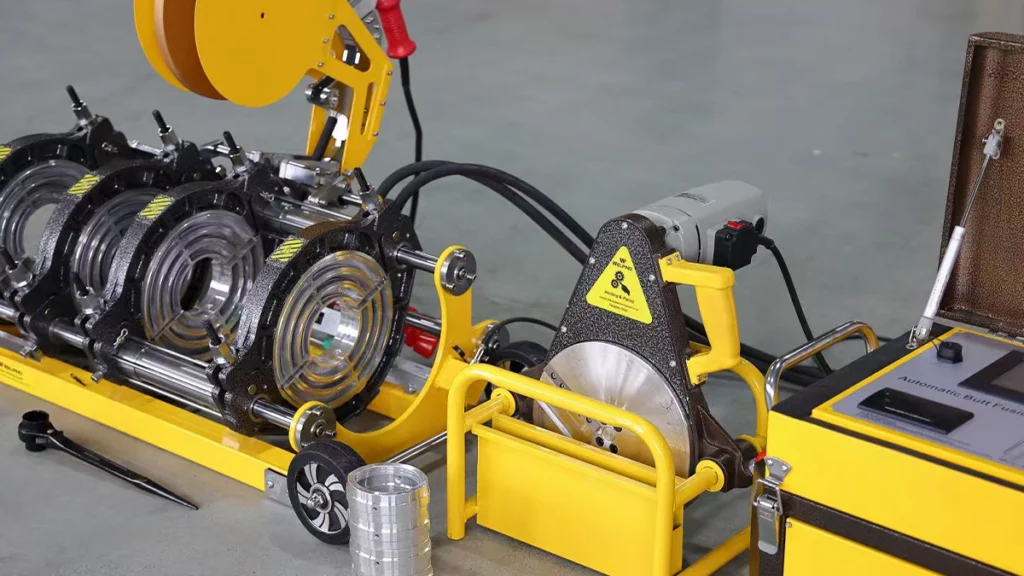
Parts of a butt fusion machine include the heating plate, facer, clamps, hydraulic unit, and frame. This guide explains each component's function, key specifications, and selection criteria, helping B2B buyers and engineers evaluate quality, avoid common failures, and source the right machine for HDPE pipe welding projects.
What Are the Main Parts of a Butt Fusion Machine?
Every parts of a butt fusion machine setup relies on a highly engineered system built to permanently bond thermoplastic pipes. If you break down the main parts of a butt fusion welding machine, you’ll find five essential elements at its core: the heating plate, facer, clamps, hydraulic unit, and the structural frame itself. Working in unison, these components handle the exact trimming, flawless alignment, and controlled thermal fusion needed to create high-integrity pipeline joints.
Quick Answer: The 5 Core Components at a Glance
- Heating Plate (Heater): An aluminum alloy disc engineered to melt pipe ends to highly specific temperatures.
- Facer (Planer/Milling Cutter): A rotating cutting tool that shaves the pipe faces until they are completely parallel.
- Clamps (Fixtures): Heavy-duty gripping mechanisms that lock the pipes into perfect alignment.
- Hydraulic Unit and Control System: The powerhouse generating and regulating the exact pressure required for a solid weld.
- Frame (Base): A rigid structural foundation that stops any micro-movements or misalignment during the fusion cycle.
How These Parts Work Together During a Fusion Cycle
To truly grasp how a butt fusion welding machine works, you have to look at the strict sequence of operations. The cycle kicks off with trimming, where the facer mills down the pipe ends. Next comes alignment. Here, the clamps secure the pipes to guarantee perfect coaxiality. After that, operators insert the heating plate to melt the pipe faces. Finally, the fusion and cooling phase takes over, with the hydraulic unit applying sustained, measured pressure to forge a permanent joint.
Why Component Quality Directly Affects Joint Integrity
The caliber of your components directly dictates the ultimate strength of the weld. Take the heater, for example. A premium PTFE coating stops cold welds caused by melted plastic sticking to the plate. Meanwhile, precision hydraulic cylinders guarantee exact pressure control, and a rock-solid frame prevents any tiny shifts during the make-or-break fusion stage.
Construction and PTFE Anti-Stick Coating Explained
Manufacturers must build heating plates from highly conductive aluminum alloys, finishing them with a Polytetrafluoroethylene (PTFE) coating. This anti-stick layer is crucial. It stabilizes thermal performance, keeps molten HDPE from clinging to the bare metal, and guarantees a smooth, frictionless release once the heating phase wraps up.
Heating Plate (Heater): The Heart of the Butt Fusion Process
Serving as the core of the operation, the heating plate is arguably one of the most vital parts of a butt fusion machine. It carries the heavy responsibility of bringing the polymer exactly to its melting point without causing material degradation.
What Temperature Range Is Required for HDPE and PPR?
Hitting the correct butt fusion machine heater plate temperature range isn’t just a suggestion—it’s a strict requirement for meeting ISO 21307 standards.
| Material | Common Welding Method | Recommended Temperature Range | Notes |
|---|---|---|---|
| HDPE / MDPE | Butt fusion / Electrofusion | 200°C – 220°C under DVS; 204°C – 232°C under ASTM F2620 | Exact temperature should follow the welding standard, pipe material, SDR, and machine setting. |
| PPR | Socket fusion | 260 ± 10°C | Commonly used for PPR pipe and fitting socket welding. |
| PP | Butt fusion / Socket fusion | 200°C – 230°C for butt fusion; 260 ± 10°C for socket fusion | Temperature depends on the welding method and PP pipe or fitting type. |
| PVC | Solvent cement / Rubber ring / Flange / Mechanical connection | Not commonly joined by standard pipe fusion welding | PVC pressure pipes are usually not welded by standard HDPE or PPR fusion methods. |
How to Inspect, Clean, and Replace a Heating Plate
Once the red indicator light flips on, operators need to wait at least 10 minutes. This pause ensures the temperature distributes evenly across the entire plate. You should clean the surface frequently using non-abrasive materials to wipe away dust and oil. If you spot deep scratches, scheduling a butt fusion machine PTFE coating replacement becomes mandatory to avoid cold welds and eventual joint failure.
Common Heating Plate Failures and Their Causes
Temperature drift stands out as a leading cause of failure, heavily compromising butt fusion machine heating plate specifications. To combat this, premium butt fsuion machines rely on a PT100 modular design for temperature control. This setup delivers drastically better accuracy and thermal stability compared to older AC contactors, which tend to degrade over time.
Electric vs. Hydraulic Facer: Which Is Better for Your Site?
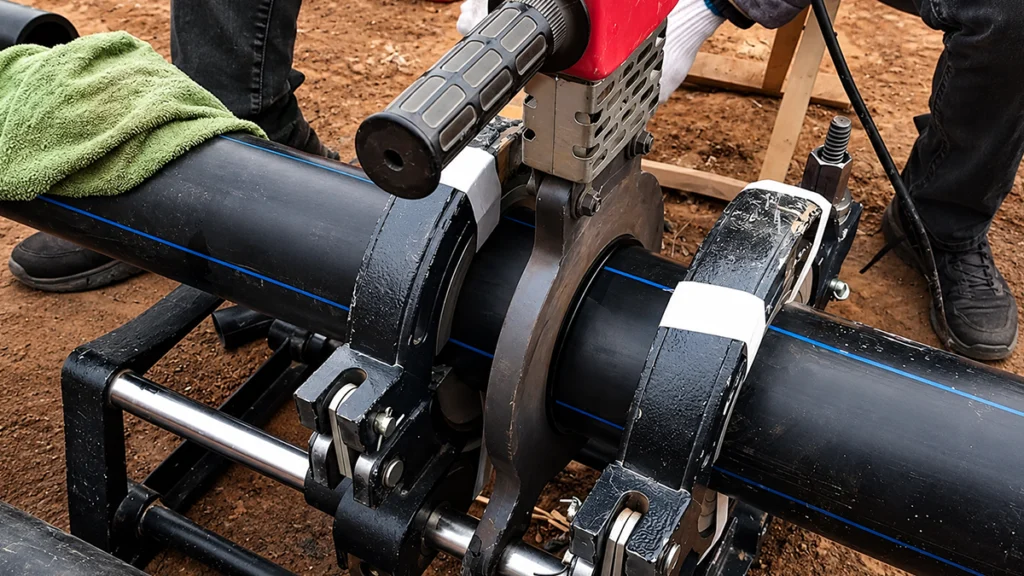
While the heating plate manages the thermal side of things, the facer takes care of mechanical preparation. Electric milling cutters are the industry standard, usually outfitted with safety limit switches to block accidental start-ups. Motor power scales with the equipment, running from 1.5kW for Ø450mm units up to 2.2kW for Ø800mm giants. On the flip side, hydraulic facers step in for ultra-large diameter projects where electric motors would simply be too heavy to manage.
Factory-direct pricing with technical consultation included
Get Your Free QuoteFacer (Planer / Trimmer): Ensuring Parallel and Clean Pipe Ends
The main HDPE butt fusion machine facer function is shaving down the pipe ends until they sit perfectly flat and parallel. This prep work guarantees 100% surface contact once the heating phase begins.
Why Flatness Tolerance Is Critical to Weld Strength
Freshly milled pipe ends need to be completely free of uneven spots, shedding continuous, ribbon-like plastic chips during the cut. After facing, the alignment deviation must stay under 0.3mm. Any gap exceeding that tight tolerance will ruin the interfacial pressure, creating dangerous weak points in the finished weld.
Facer Blade Sharpening and Replacement Schedule
Crews should inspect blades daily for obvious chips or dull edges. A dull blade makes the facer wobble violently between the jaws, ruining the cut and threatening the weld’s integrity. Swapping out a $50 set of fresh facer blades right away can easily save you from a catastrophic $5,000 pipeline pressure test failure down the road.
Four-Clamp vs. Two-Clamp Designs Compared
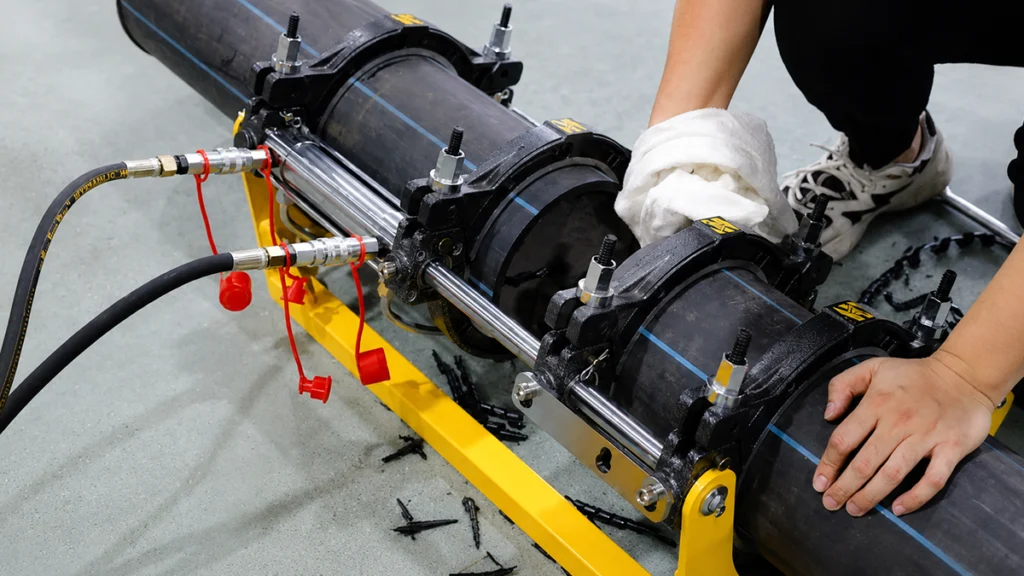
After the facing step, you have to lock the pipes down. For industrial-grade HDPE pipe welding machines, a four-clamp sleeve structure remains the gold standard. This layout delivers incredibly precise positioning and makes fixing high-low misalignments a breeze. Lighter two-clamp designs just can’t compete, which is why they are mostly reserved for basic indoor plumbing tasks.
How Reducer Inserts Expand Your Working Range
Reducer inserts give a single HDPE butt fusion welding machine frame the versatility to weld multiple pipe sizes. Independent-type inserts boost concentric alignment accuracy and minimize clamp damage from pressure loss, even if they do cost more upfront. Meanwhile, stacked structure inserts offer unmatched convenience and cost-effectiveness for everyday, general applications.
Clamps and Reducer Inserts: Aligning Pipes for a Perfect Weld
Heavy-duty butt fusion machine clamps and inserts do the heavy lifting when it comes to holding strict coaxial alignment against massive hydraulic forces.
What Alignment Tolerance Should You Expect from Quality Clamps?
Top-tier industrial clamps should easily hold an alignment deviation of ≤0.3mm. If your clamps flex or slip while the fusion cycle is running, the final joint will suffer from severe structural misalignment, instantly violating ISO 21307 standards.
Manual, Semi-Automatic, and CNC Fully Automatic Control Compared
The control system ultimately governs how much force these clamps apply.
| Control Type | Control Method | Traceability & Data | Typical Use Case |
|---|---|---|---|
| Manual | Operator-controlled valves | None | Small repairs, plumbing |
| Semi-Automatic | Hydraulic assist with manual input | Limited | Standard municipal water/gas |
| CNC (Fully Auto) | Uninterrupted automated cycle | Full ISO 12176-1 compliance | Large-scale municipal, mining |
Understanding Drag Pressure and Fusion Pressure
To find your drag pressure, you need to average three separate measurements taken under no-load conditions. This accounts for the natural friction of the moving carriage. Later, during the heat absorption phase, the applied pressure absolutely cannot exceed that peak drag pressure. Otherwise, you risk pushing the molten material completely out of the weld zone.
Built-in Data Loggers and ISO 12176-1 Traceability
Modern CNC units pack built-in storage drives capable of recording up to 1,000 distinct weld cycles. They also handle remote data transmission and meet ISO 12176-1 standards. This regulation demands a unique 9-character alphanumeric code for equipment traceability, making sure every single joint is fully auditable.
Get detailed specs and custom configuration options
Request Technical SpecificationsHydraulic Unit and Control System: Powering and Managing the Weld
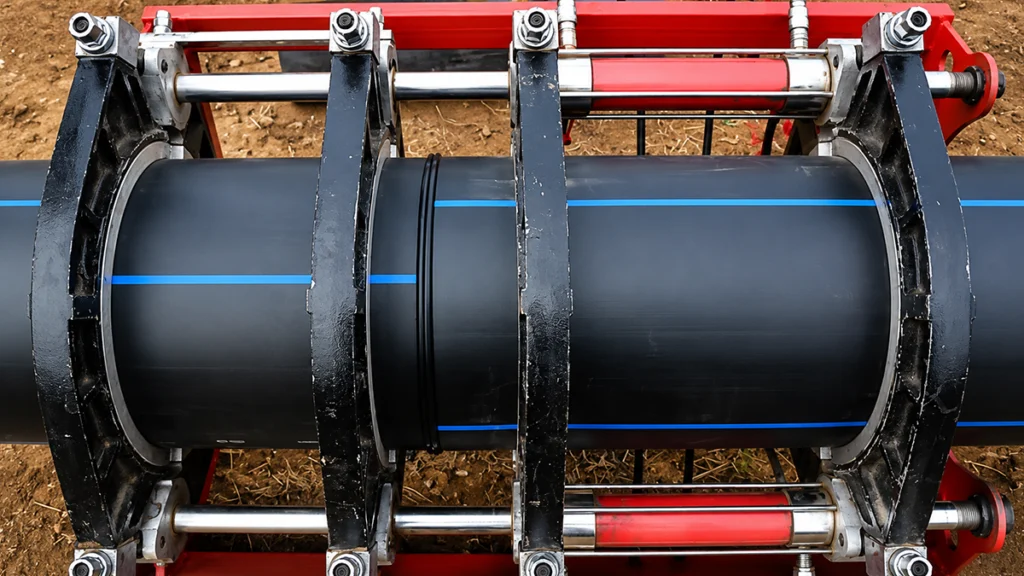
The hydraulic butt fusion machine components step up to generate the massive forces needed to merge those melted polymer chains together during the cooling phase.
Why Frame Rigidity Matters in Large-Diameter Welding
Manufacturers build industrial frames out of high-strength aluminum alloys, frequently utilizing a 45° inclined layout to boost stability and simplify pipe loading. Without this extreme rigidity, the sheer hydraulic force would warp the chassis, instantly throwing the pipe ends out of alignment.
Insulation Box and Facer Stand: Do You Really Need Them?
Absolutely. An asbestos-material insulation block sits right between the center plate and the heating plate to manage temperatures. On top of that, ISO 12176-1 strictly requires a dedicated heating-plate guard and support stand. This setup keeps environmental dirt off the sensitive PTFE coating and protects your crew from severe burns.
Recommended Accessories for Field Operations
When you head out into the field, you need the right gear. Essential accessories include high-pressure hydraulic hoses, reliable quick-connect fittings, and a hyper-accurate digital hydraulic pressure gauge so you can read drag pressure without second-guessing.
Small-Diameter Machines (Ø40-Ø250 mm): Workshop and Plumbing
HDPE pipe jointing Machine components scale dramatically depending on the pipe size. Small-diameter models (like the 160, 200, and 250 series) usually run on manual or semi-automatic controls. Because these parts of a butt fusion machine are lightweight, they are a perfect match for workshop fabrication and indoor plumbing jobs.
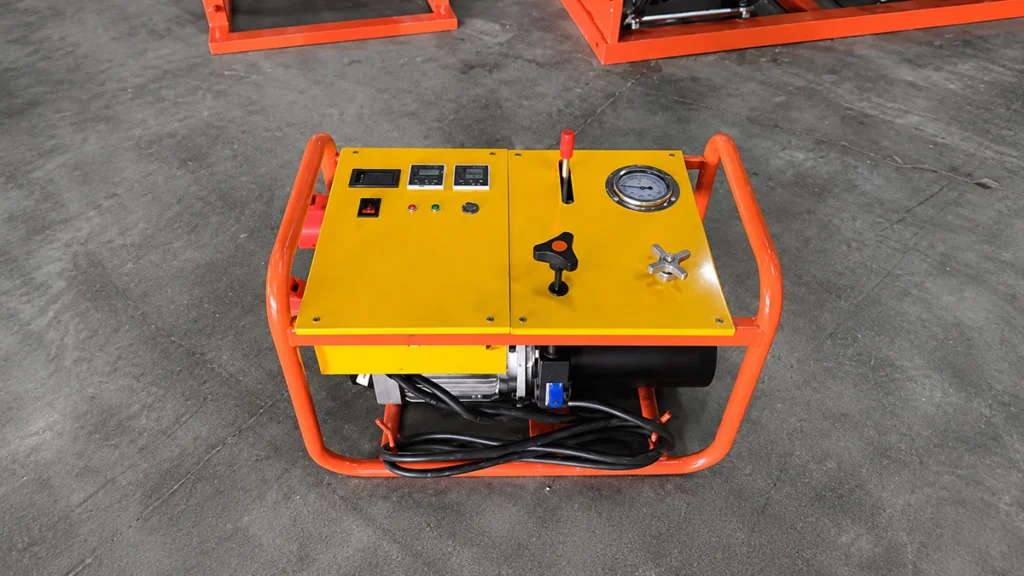
Supporting Components: Frame, Trolley, and Accessories
Look beyond the core welding elements, and you’ll find supporting components that guarantee the butt fusion machine survives transportation and performs reliably in brutal field environments.
Medium-Diameter Machines (Ø250-Ø630 mm): Municipal Water and Gas
Step up to medium-diameter models (such as the 315, 450, and 630 series), and you need serious hydraulic assistance. These rigs are the true workhorses of municipal water and gas distribution networks. They demand rugged frames paired with dependable semi-automatic or fully CNC controls.
Large-Diameter Machines (Ø630-Ø1600 mm): Mining and Trunk Lines
Massive equipment (models 800, 1200, and larger) relies entirely on heavy-duty CNC hydraulics and requires cranes just to handle the pipe. You’ll find these HDPE butt fusion machines out on mining sites and major trunk lines, where a single joint failure brings catastrophic financial and safety consequences.
Key Certifications to Request (ISO 12176, CE, PED)
Before you buy, always verify that the butt fusion machine meets ISO 12176-1 standards. It has to execute welds flawlessly according to ISO 21307, DVS 2207-1 (for low-pressure practices at 0.15 N/mm²), or ASTM F2620 (handling interfacial pressures of 60–90 psi). Furthermore, CE and PED certifications aren’t optional if you operate in European markets.
Spare Parts Availability and Lead Time
Industry surveys reveal that 60% of buyers prioritize stable supply chains above all else. Keeping a readily accessible butt fusion machine spare parts list—especially for high-wear consumables like PTFE plates, facer blades, and quick-connect fittings—is the smartest way to keep project downtime to an absolute minimum.
How Butt Fusion Machine Parts Differ by Pipe Size and Application
The engineering tolerances and actual physical dimensions of the parts of a butt fusion machine must perfectly align with the pipeline diameter and the harsh realities of the job site.
Warranty, MOQ, and After-Sales Support Considerations
For industrial-grade equipment, standard expectations should always include a 1-year warranty, lifetime maintenance support, and a free annual on-site calibration. Look for flexible Minimum Order Quantities (MOQs) as well, which give contractors the freedom to scale their fleets without breaking the bank.
Heating Plate: Avoiding Coating Damage and Temperature Drift
One of the biggest mistakes operators make is dragging metal tools across the PTFE coating. You should only clean the plate with approved, non-abrasive materials. If you spot damage to the coating, replace the plate immediately before it ruins your next weld.
Facer: Preventing Blade Chipping and Misalignment
Never jam the facer into pipes that are heavily misaligned. Double-check that the motor includes a self-locking mechanism, and swap out the blades the second you notice chipping. That’s the only way to hold that crucial ≤0.3mm flatness tolerance.
Hydraulic System: Stopping Leaks Before They Cost You a Joint
Brushing off a minor hydraulic leak is a fast track to dangerous pressure drops during the fusion phase. Make it a habit to inspect hoses, monitor oil levels, and track oil temperatures. When you change the hydraulic oil, flush the tank completely to clear out any leftover impurities.
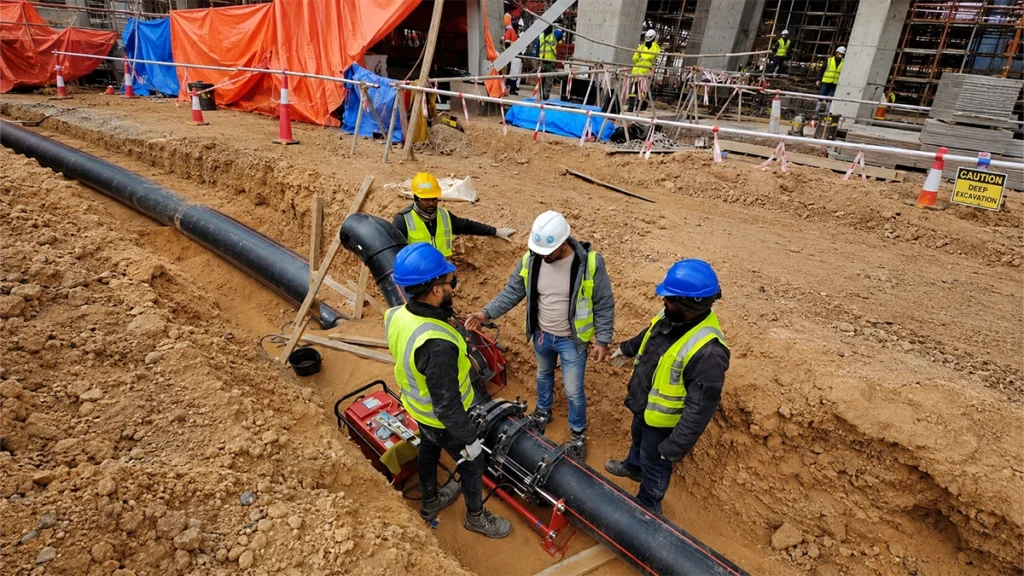
Buyer’s Checklist: How to Evaluate Butt Fusion Machine Parts Before Purchase
Run through this checklist to guarantee you are sourcing top-tier parts of a butt fusion machine that actually comply with international standards:
1. Verify the heating plate uses PT100 modular temperature control.
2. Confirm the facer includes an electric safety limit switch.
3. Check that the frame consists of high-strength aluminum alloy (a 45° incline is best for larger diameters).
4. Ensure the clamps hold an alignment deviation of ≤0.3mm.
5. Demand CNC models equipped with built-in data loggers (capable of storing 1,000+ cycles).
6. Verify full compliance with ISO 12176-1, CE, and PED regulations.
7. Ask the supplier for a comprehensive butt fusion machine spare parts list.
8. Confirm warranty details (a 1-year minimum) alongside lifetime maintenance support.
Decision Summary by Pipe Size and Application
| Diameter Range | Machine Class | Clamp Count | Typical Application |
|---|---|---|---|
| Ø40 – Ø250 mm | Manual / Semi-Auto | 2 or 4 | Plumbing, small repairs |
| Ø250 – Ø630 mm | Semi-Auto / CNC | 4 | Municipal water and gas |
| Ø630 – Ø1600+ mm | Heavy-Duty CNC | 4 | Mining, industrial trunk lines |
When to Choose a Manual vs. CNC Machine
Manual butt fusion machines top out at about 2 to 3 joints per hour, making them perfectly fine for minor repairs. However, CNC automatic butt fusion machines are non-negotiable for massive municipal projects. They deliver strict parameter control, automatically adjust heat absorption based on the ambient weather, and provide fully traceable data logging.
Next Step: Requesting a Tailored Configuration
As you finalize your purchase, clearly state whether your crews need independent or stacked reducer inserts. More importantly, insist on PT100 temperature modules to lock in long-term reliability.
Common Mistakes and Maintenance Tips for Each Major Part
Taking care of the parts of a butt fusion machine is the only way to maximize your ROI. Stick to a routine maintenance schedule—ideally every 2,000 interfaces or 12 months—to keep the rig perfectly within ISO calibration limits.
| Component | Common Mistake | Maintenance Tip |
|---|---|---|
| Heating Plate | Cleaning with abrasive tools, causing deep scratches. | Use only soft, lint-free cloths. Replace PTFE coating if damaged. |
| Facer | Operating with dull or chipped blades. | Inspect daily; replace blades immediately to maintain ≤0.3mm tolerance. |
| Hydraulic Unit | Ignoring minor oil leaks or skipping oil changes. | Check oil level and temperature regularly; flush tank during changes. |
| Clamps | Leaving dirt or debris in the reducer inserts. | Wipe down inserts before each weld to ensure perfect coaxial alignment. |
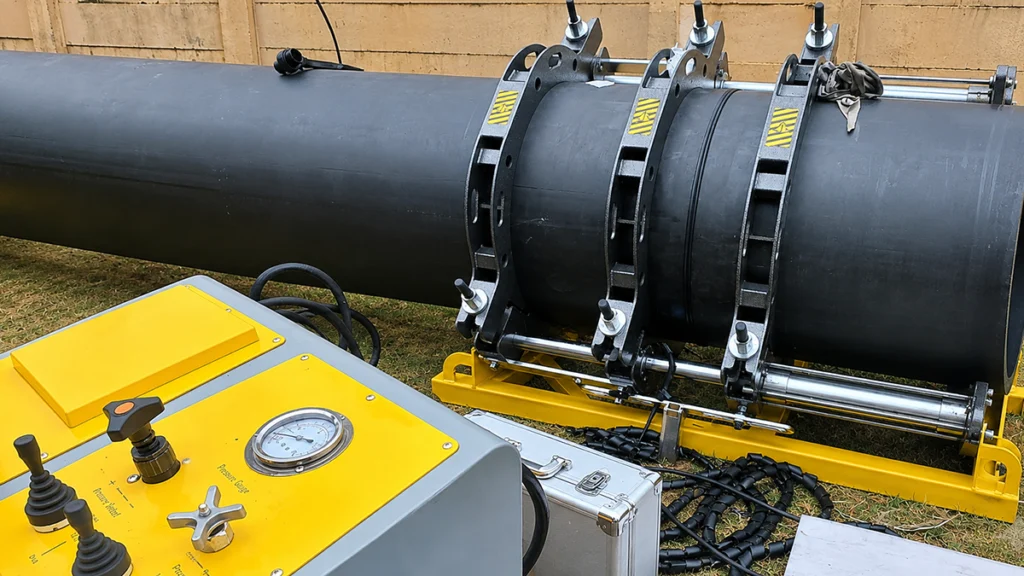
Final Recommendation: Matching Components to Your Project Requirements
Getting the right parts of a butt fusion machine boils down to aligning frame capacity, hydraulic automation, and temperature control precision with your specific pipe diameter and site standards. Stepping up to CNC hydraulic butt fusion machines with PT100 temperature modules drastically cuts down changeover times. More importantly, it wipes out costly joint failures—which happens to be the number one cause of HDPE pipeline blowouts. Grab a butt fusion machine parts diagram and sit down with your supplier. This helps your maintenance crew visually map out the exact independent inserts and hydraulic setups required to tackle your next major installation.
FAQ
Q1: What is the function of the heating plate in a butt fusion machine?
The heating plate is a specialized aluminum alloy component covered in an anti-stick PTFE layer. Its main job is to evenly heat and melt the ends of thermoplastic pipes (like HDPE, PPR, or PP) to very specific target temperatures (such as 210±10°C for HDPE). This preps the plastic for the fusion phase, guaranteeing a solid molecular bond.
Q2: Why does a butt fusion machine need a facer?
A facer (often called a planer) mills the pipe ends so they sit completely flat and parallel to one another. This crucial step strips away oxidation and uneven edges, locking in a helps keep the pipe ends flat, clean, and parallel before welding. Precise facing ensures the pipe makes 100% surface contact with the heating plate, which you absolutely need for a strong, leak-free weld.
Q3: How many clamps does a standard butt fusion machine have?
Most industrial butt fusion machines utilize a robust four-clamp sleeve structure. This setup delivers excellent rigidity and precise coaxial alignment, while also giving operators the leverage to easily fix high-low misalignments. Smaller HDPE butt fusion welding machines built for workshop or basic plumbing tasks might use a simpler two-clamp design to save weight.
Q4: What is the difference between manual, semi-automatic, and CNC butt fusion machines?
Manual butt fusion machines run entirely on operator-controlled valves and lack any sort of data traceability. Semi-automatic models add hydraulic assistance to the mix but still require the operator to manually adjust the pressure. CNC (Fully Automatic) butt fusion machines take over the entire process, providing uninterrupted, automated control over time, temperature, and pressure. They also feature built-in data logging for traceability and quality control.
Q5: How often should the heating plate PTFE coating be replaced?
You need to replace the PTFE coating the moment it suffers deep scratches or starts peeling. A damaged coating allows molten plastic to stick to the metal, which triggers temperature drift and leads directly to cold welds. Make it a habit to visually inspect the coating after every single fusion cycle.
Q6: Which butt fusion machine parts wear out the fastest?
Consumables like facer blades and the heating plate’s PTFE coating take the most abuse and wear out the fastest. Facer blades dull and chip from constant milling, while the PTFE coating breaks down due to aggressive thermal cycling and physical friction. You should always keep these specific items stocked on your butt fusion machine spare parts list.
Q7: What standards apply to butt fusion machine components?
The major standards include ISO 12176-1, which outlines general equipment characteristics and traceability rules. The actual welding parameters the pipe fusion machine executes are dictated by ISO 21307, DVS 2207-1, and ASTM F2620. If you are operating inside European markets, For European markets, CE requirements may apply depending on the machine type and applicable directives.
Q8: Can butt fusion machine parts from different manufacturers be interchanged?
For the most part, core structural elements like frames, hydraulic cylinders, and heating plates are heavily proprietary. You cannot safely swap them between different brands. However, universal accessories—think standard hydraulic quick-connect fittings or generic digital pressure gauges—might fit perfectly. Even so, sticking to OEM parts is always the smartest move to maintain safety and keep your warranty intact.
Conclusion
Grasping the exact functions and technical tolerances of the parts of a butt fusion machine is the baseline for executing flawless HDPE pipeline installations. From the hyper-accurate thermal regulation of a PT100-equipped heating plate to the rigid ≤0.3mm alignment tolerance of a four-clamp aluminum frame, every single piece drives joint integrity. When you are comparing equipment, push for CNC hydraulic systems with integrated data logging to guarantee you hit ISO 12176-1 and ISO 21307 standards. If contractors stick to a proactive replacement schedule for high-wear consumables like facer blades and PTFE coatings, they can wipe out cold welds, slash project downtime, and secure the long-term performance of the pipeline.
Let our experts help you choose the right equipment for your project
Contact Our Engineering Team