
HDPE Pipe Welding Machine USA: Buying Guide for Contractors
Table of Contents
HDPE Pipe Welding Machine USA buying guide for contractors and rental companies comparing machine types, specifications, price factors, supplier checks, and selection criteria.
What Is an HDPE Pipe Welding Machine and Who Needs One in the USA?
An HDPE Pipe Welding Machine USA serves as specialized, heavy-duty industrial equipment designed to permanently join high-density polyethylene pipes and fittings. Through the precise application of heat and controlled pressure, these systems melt the pipe ends and fuse them together. The result? A monolithic joint that often surpasses the original pipe in strength. Selecting the ideal butt fusion welding machine ultimately hinges on factors like pipe diameter, standard dimensional ratio (SDR), specific compliance standards, and the total cost of ownership.
How HDPE pipe welding machines join thermoplastic pipe
Butt fusion relies heavily on the principles of thermodynamics and fluid mechanics. The equipment employs a PTFE-coated electric heating plate to transfer intense heat—usually hovering between 200°C and 270°C for standard polyethylene—directly to the precisely faced pipe ends. Once these surfaces hit the optimal melt state, operators rapidly withdraw the heating plate. The HDPE pipe machine then drives the melted ends together under exact hydraulic or manual pressure. As the material cools, the polymer chains interlock to form a seamless, leak-proof bond.
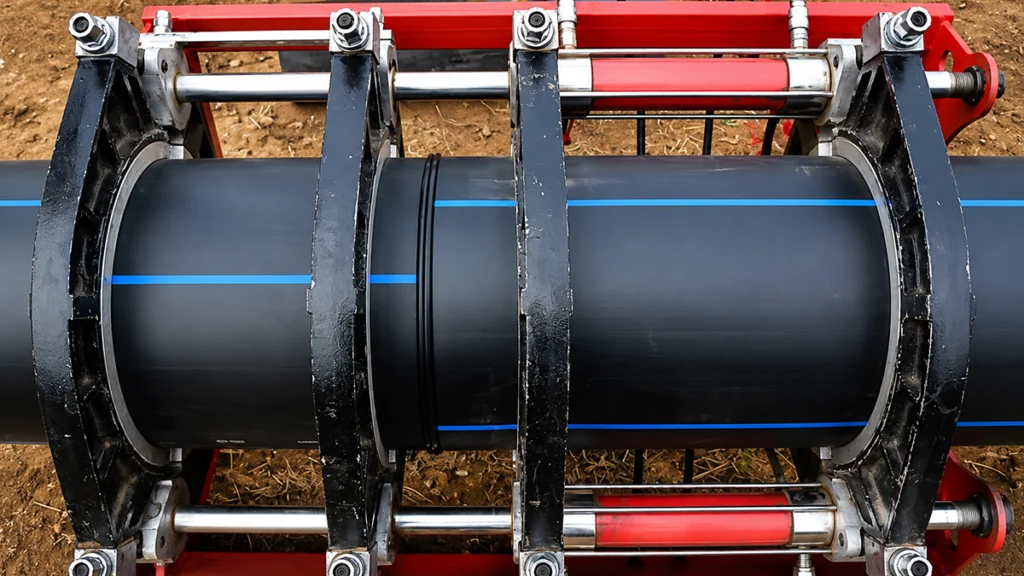
Common users: contractors, rental companies, utilities, and distributors
The primary buyers for this pipe fusion machinery typically operate within critical infrastructure sectors. Pipeline contractors managing municipal water supplies and gas transmission networks lean heavily on high-capacity hydraulic units. Meanwhile, rental companies maintain versatile fleets to equip short-term projects on demand. Municipal utility departments and agricultural irrigation installers depend on these fusion tools for rapid emergency repairs and routine system expansions. Distributors complete the ecosystem, acting as the vital supply chain link that guarantees localized equipment access and spare parts for field operators.
When buying makes more sense than subcontracting fusion work
Subcontracting fusion work frequently introduces steep hourly rates and scheduling bottlenecks, both of which can easily derail project timelines. Thermoplastic fusion welding offers immense potential for mechanization. If a contractor manages a steady pipeline of infrastructure jobs, investing in proprietary equipment slashes long-term labor expenses dramatically. Owning the gear empowers construction teams to control their own fusion schedules, train in-house operators, and ultimately capture much higher profit margins on competitive municipal bids.
Joint quality and leak prevention in pressure pipeline systems
Execute a butt-fusion joint correctly, and you completely eliminate the corrosion and leakage vulnerabilities inherent to mechanical fittings or traditional steel systems. The fused joint essentially becomes an integral part of the pipeline itself. It easily withstands severe ground vibrations, seismic shifts, and wild temperature swings. A flawless weld also maintains a perfectly smooth internal surface. This minimizes friction loss and prevents dangerous water flow blockages across high-pressure networks.
Why HDPE Pipe Fusion Equipment Matters for U.S. Pipeline Projects
Productivity impact on municipal, industrial, and infrastructure jobs
Modern fusion technology directly drives project velocity. When experienced crews operate highly efficient pipe fusion machines, they routinely hit fusion rates of 6 to 12 inches per minute. Because high-density polyethylene features a 100-year lifespan alongside zero-corrosion properties, getting the installation right the first time wipes out future maintenance burdens. High productivity out in the trench keeps complex municipal and industrial builds well under budget while minimizing public disruption.
Why equipment consistency matters for repeatable fusion results
Pipeline integrity hinges entirely on repeatable, precise parameters. Today’s advanced HDPE pipe fusion machines incorporate displacement detection systems that tightly control both preheating and beveling phases. These digital systems lock in pressure and temperature variables automatically, guaranteeing that every single weld aligns with strict engineering tolerances. Lose that consistency, and operators risk producing cold welds or over-melted joints—flaws that can trigger catastrophic pipeline failures under active pressure.
Manual butt fusion machines for small-diameter work
Manual equipment is built for sheer agility. Engineered specifically for small-diameter pipes ranging from 2 to 8 inches (Dn50-200mm), these units rely on mechanical leverage instead of hydraulic pumps. Because they demand lower start-up pressure, they excel in tight trench environments, residential water tie-ins, and agricultural irrigation repairs where heavy butt fusion machine USA simply cannot fit.
Hydraulic butt fusion machines for contractor-grade applications
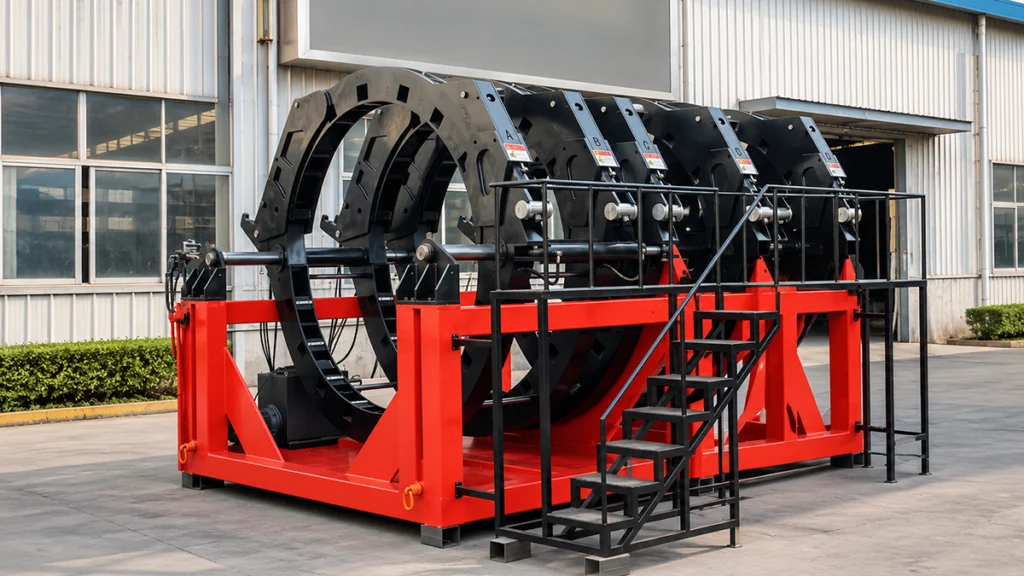
Hydraulic butt fusion welding machines remain the absolute gold standard for heavy civil construction. They leverage robust hydraulic cylinders to generate and sustain the massive interfacial pressures (60-90 psi) demanded by North American standards like ASTM F2620. These heavy-duty units manage large cross-sections with ease. They deliver the immense clamping force necessary to overcome heavy pipe drag, ensuring perfect bead formation across thick-walled materials.
Factory-direct pricing with technical consultation included
Get Your Free QuoteMain Types of HDPE Pipe Welding Machines Available in the USA
Before issuing a purchase order, buyers need a firm grasp of the specific capabilities tied to each butt fusion welding machine category.
| Machine Type | Typical Pipe Range | Best Use Case | Key Advantages |
|---|---|---|---|
| Manual Butt Fusion | 2" – 8" (Dn50-200) | Tight trenches, small repairs | Lightweight, zero hydraulic maintenance, highly portable. |
| Hydraulic Butt Fusion | 6" – 40" (Dn160-1000) | Mainline water/gas infrastructure | Consistent high pressure, handles heavy pipe drag. |
| CNC / Data-Logging | 6" – 40"+ | Heavily regulated municipal jobs | Automated parameter control, full weld traceability. |
| Electrofusion | 1/2" – 12"+ | Tie-ins, repairs in confined spaces | Requires very little clearance, automated welding cycle. |
CNC or data-logging fusion machines for traceability needs
Municipalities and gas utilities now routinely mandate comprehensive traceability for underground infrastructure. CNC automatic butt fusion machines satisfy rigid standards like TSG D2002-2006 by automatically logging critical joint metrics. This includes operator ID, environmental conditions, pressure graphs, and exact cooling times. The system exports this data to generate bulletproof compliance reports, proving definitively that every joint meets the required engineering specification.
Socket fusion and electrofusion equipment: when are they used?
While butt fusion connects pipes end-to-end, socket fusion dominates small-diameter applications with thinner walls, where the pipe physically pushes into a heated fitting. Electrofusion, on the other hand, relies on specialized fittings containing embedded heating coils. Field crews prefer this method for vertical tie-ins, rapid emergency repairs, and exceptionally cramped spaces where a standard butt fusion carriage simply cannot maneuver.
Pipe diameter range and SDR compatibility
Manufacturers strictly categorize butt fusion welding machines by their functional welding range. Small units tackle Dn110-250mm, medium frames handle Dn160-315mm, and large-diameter rigs manage 710-1000mm pipelines and beyond. Crucially, your HDPE fusion machine’s clamping force must align perfectly with the pipe’s Standard Dimension Ratio (SDR). Thicker walls—indicated by lower SDR numbers—demand substantially higher hydraulic pressure to achieve a proper melt and a secure fusion bond.
Facing tool, heating plate, and hydraulic pressure requirements
The quality of the core components dictates the quality of the final weld. The facing tool (facer) must feature double-edged tool steel milling blades to shave pipe ends perfectly square. The heating plate has to hold temperatures up to 270°C with an incredibly tight error margin of ≤±3°C to ±5°C. Finally, the hydraulic system must deliver sustained, unwavering pressure—ranging from 0-6.3 MPa for standard municipal jobs up to a massive 16 MPa for extreme, heavy-wall industrial applications.
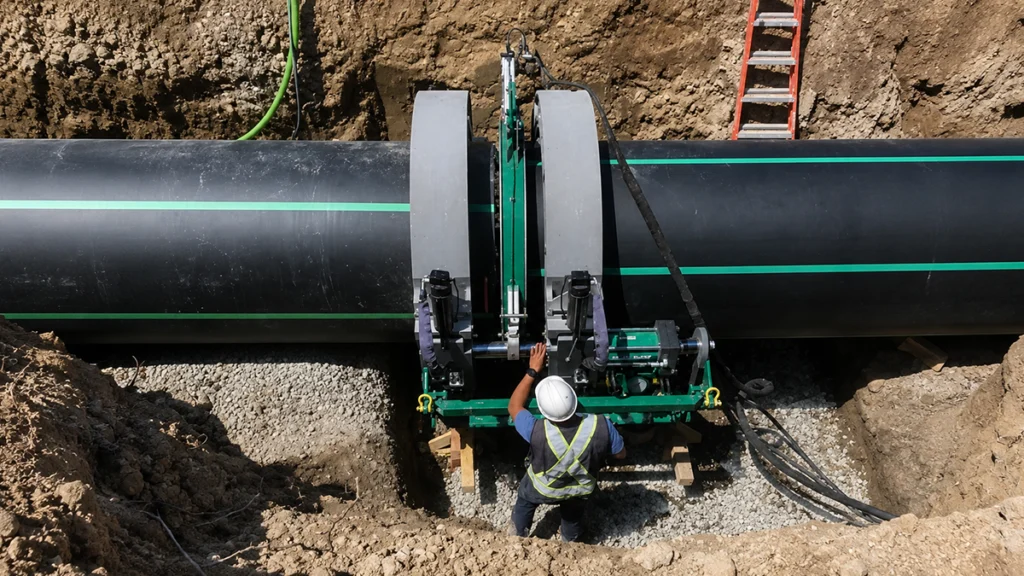
Key Specifications to Compare Before Buying
| Specification | Standard Requirement | Heavy-Duty / Large Diameter Requirement |
|---|---|---|
| Power Supply | 220V Single Phase | 380V 3-Phase |
| Total Power (kW) | 3.7 kW – 4.2 kW | Up to 23.5 kW |
| Temp Accuracy | ±5°C | ≤±3°C |
| Max Pressure | 6.3 MPa | 16.0 MPa |
Power supply, generator compatibility, and jobsite portability
Power constraints routinely bottleneck field operations. Small butt fusion machines USA generally run on 220V and pull roughly 3.7 to 4.2 kW, making them easy to power with standard portable generators. Conversely, a massive 1000mm machine demands a 380V 3-phase power supply and up to 23.5 kW. Buyers must calculate their generator sizing with absolute precision. Regarding jobsite portability, 80% of construction crews heavily favor machines weighing under 200 kg that feature heavy-duty wheels and accessible lifting points.
Data recording, temperature control, and operator safety features
Modern equipment specifications prioritize risk mitigation above all else. Seek out heating plates equipped with advanced PID temperature controllers to prevent accidental polymer degradation. Safety features remain strictly non-negotiable. Electric milling cutters must incorporate physical safety limit switches, ensuring the facer cannot accidentally activate unless it is securely seated within the machine chassis.
When contractors should buy instead of rent
A contractor should purchase an HDPE Pipe Welding Machine USA the moment their annual utilization rate crosses the 40% threshold. Buying proves incredibly cost-effective for firms locking down multi-year utility contracts or those looking to standardize their fleet around a specific pipe diameter. Taking ownership completely eliminates rental availability risks, permits permanent modifications to transport trailers, and steadily builds equity within the company’s equipment portfolio.
When rental companies should add HDPE fusion machines to inventory
Rental houses need to expand their inventory whenever local municipal infrastructure spending spikes. Across U.S. rental fleets, the highest ROI typically comes from mid-range hydraulic butt fusion machines (6 to 18 inches) that service both the water and gas sectors simultaneously. By offering fully inspected, precision-calibrated equipment, rental businesses can capture high-margin revenue from general contractors who lack the necessary specialized fusion gear.
Get detailed specs and custom configuration options
Request Technical SpecificationsBuying vs Renting HDPE Pipe Welding Machines in the USA
Utilization rate, depreciation, and service costs
The buy-versus-rent decision hinges entirely on total utilization. Owning equipment requires proactive internal management of depreciation and wear parts, such as swapping out scratched PTFE plates and faulty hydraulic sensors. Servicing also eats up dedicated mechanic time. Renting shifts the entire maintenance burden, calibration scheduling, and financial depreciation over to the distributor. This makes renting the smarter choice for firms dealing with highly fluctuating project volumes.
Short-term project rental vs long-term fleet investment
For a highly specialized, one-off project—like laying a massive 78-inch high-capacity stormwater outfall—renting stands as the only logical move given the staggering capital cost of ultra-large butt fusion welding machinery. However, if a contractor drops 8-inch water mains into the ground every single day, a long-term fleet investment pays for itself rapidly. You eliminate recurring monthly rental fees, often recouping the cost within the very first major project phase.
What affects HDPE pipe butt fusion machine price in the USA?
Pricing fluctuates drastically based on automation levels, diameter capacity, and country of origin. Small manual butt fusion machines (2″-8″) start at roughly $5,790 USD. Mid-range hydraulic units generally span from $15,000 to $40,000. Meanwhile, fully automated, large-diameter CNC machines capable of fusing 40-inch pipe can command anywhere from $324,340 to well over $447,000 USD. Meeting strict North American compliance standards (like ASTM F2620) and integrating data-logging hardware will also drive up the initial purchase price.
Accessories, inserts, clamps, heaters, and transport cases
Keep in mind that the base pipe fusion machine represents only a portion of your total investment. True operational readiness demands a comprehensive suite of accessories. You will need reducing inserts to weld multiple pipe sizes on a single chassis, specialized stub-end clamps for flange connections, and backup heating plates. Ruggedized transport cases are also vital to shield sensitive hydraulic and electrical components from brutal jobsite conditions.
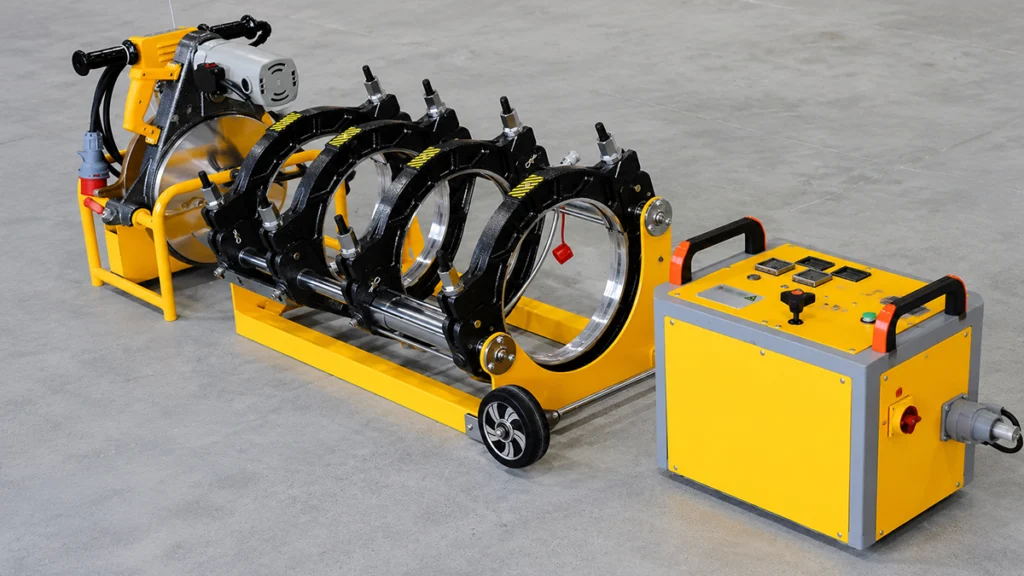
HDPE Pipe Welding Machine Price Factors and Total Cost of Ownership
Maintenance, calibration, spare parts, and operator training costs
The Total Cost of Ownership (TCO) extends far past the initial purchase order. Unlike traditional arc welding, plastic fusion requires virtually zero consumable materials. However, it demands rigorous upkeep of wear parts. PTFE-coated heating plates require immediate recoating or replacement the moment they sustain deep scratches. Hydraulic gauges need annual calibration to maintain ISO or DVS compliance. Furthermore, operators must undergo specialized training; unauthorized parameter adjustments remain a leading cause of catastrophic joint failure.
How to estimate payback for contractors and rental fleets
Estimating payback involves weighing the equipment’s daily amortization against the massive labor savings generated by mechanization. While higher automation spikes upfront costs, it drastically slashes the time crews spend manually calculating drag pressures and cooling intervals. By reducing the reliance on highly skilled traditional welders, contractors accelerate their ROI. Many achieve full payback within 8 to 14 months of consistent trench use.
Step 1: Match pipe size range to your project pipeline
Never purchase a pipe fusion machine based on a single, outlier project. Instead, analyze your bid history over the past 24 months. Match the new equipment to your most frequently recurring pipe diameters. If 90% of your current workload involves 8-inch to 12-inch water mains, invest heavily in a premium machine optimized specifically for that range. Avoid overspending on a bulky 24-inch capable unit that will prove too heavy and sluggish for your daily operations.
Step 2: Decide between manual, hydraulic, and data-logging models
Take a hard look at your client base. If your crews work exclusively on private agricultural irrigation systems, a manual or basic hydraulic frame will do the job perfectly. Conversely, if you bid on municipal gas lines or heavily regulated federal infrastructure projects, a data-logging CNC automatic butt fusion machine becomes mandatory. Modern inspectors demand the rigid traceability and quality assurance documentation that only these advanced systems can provide.
How to Choose the Right Machine for Contractor and Rental Applications
Step 3: Evaluate jobsite mobility and setup time
Trench conditions ultimately dictate your operational efficiency. Prioritize equipment featuring quick-connect flat-type hydraulic fittings; they prevent dirt ingress and drastically speed up hose connections. Butt fusion machines offering a distinct separation between the clamping carriage and the operating system facilitate much faster setups in tight, muddy excavations. Finally, wheeled chassis designs are essential to minimize reliance on heavy lifting equipment at the site.
Step 4: Check support, parts availability, and warranty coverage
Unplanned downtime destroys project profitability. Over 90% of commercial buyers now insist on 24-hour online technical support alongside nationwide warranty services. Ultimately, a HDPE fusion machine is only as reliable as its distributor’s ability to overnight a replacement hydraulic seal or temperature controller the moment a field breakdown occurs.
What documents should a supplier provide?
A trustworthy supplier must deliver comprehensive documentation alongside the hardware. Roughly 75% of professional construction outfits require detailed operation manuals, strict maintenance schedules, and video tutorials upon delivery. The supplier should also readily furnish factory calibration certificates, CE/ISO compliance declarations, and highly detailed electrical schematics to support your in-house mechanics.
Questions to ask before requesting a quotation
Before kicking off the procurement process, define your technical parameters clearly. Ask the supplier directly: What is the exact generator kW requirement? Are the reducing inserts cast or forged aluminum? Does the onboard data logger export files to standard PDF or CSV formats? What is the realistic lead time for replacement PTFE plates?
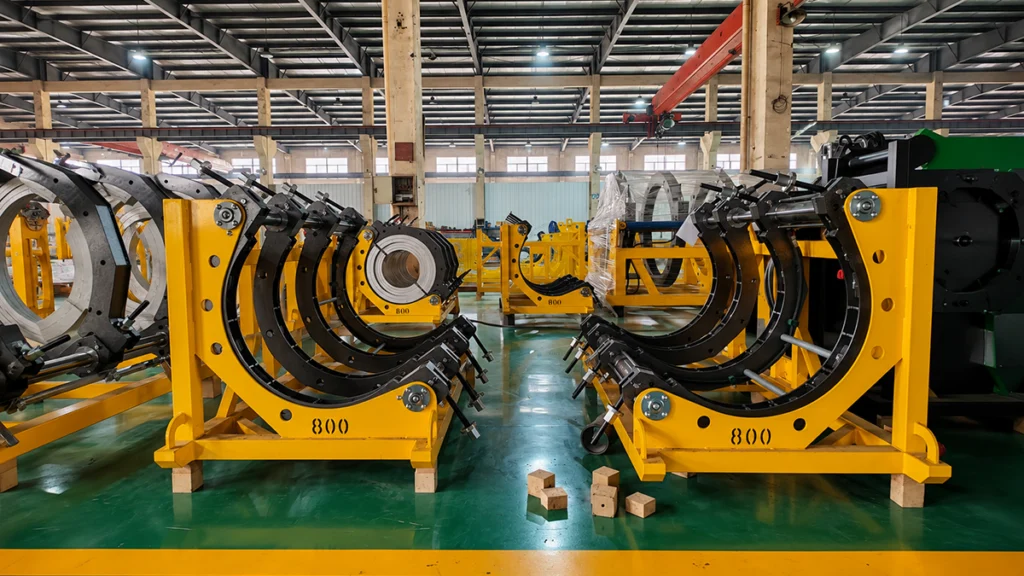
Supplier Evaluation Checklist for U.S. Buyers
How to evaluate spare parts and technical support availability
Refuse to accept vague promises regarding aftermarket support. Demand a localized spare parts inventory list from the supplier. Verify that they maintain highly stable supply channels for critical consumables, including heating plates, pressure sensors, and milling nozzles. If a supplier cannot guarantee a 48-hour delivery window on common wear parts, they pose a massive risk to your project timeline.
Red flags when comparing low-cost HDPE fusion machines
Approach abnormally cheap equipment with extreme caution. Major red flags include missing displacement detection systems, the inability to print or export critical weld joint data, and a complete lack of safety limit switches on electric milling cutters. Furthermore, flimsy frame construction that visibly flexes under high hydraulic pressure will inevitably result in misaligned pipe ends and failed welds.
Choosing a machine only by pipe diameter
Buying a unit based solely on its maximum diameter capacity is a notoriously costly mistake. Yes, a butt fusion machine built for 24-inch pipe can technically weld an 8-inch pipe using reducing inserts. However, it will be vastly oversized, incredibly cumbersome to maneuver in the trench, and it will consume excessive generator power. Always optimize your purchase for the median diameter of your standard workload.
Ignoring operator training and fusion procedure control
Even the most sophisticated CNC butt fusion welding machine cannot compensate for a poorly trained operator who forgets to clean the pipe ends or ignores severe environmental factors like wind and rain. Pouring capital into equipment while completely neglecting formalized operator training programs directly compromises the weld’s interfacial pressure. Inevitably, this leads to catastrophic field failures.
Common Mistakes That Increase Welding Risk or Ownership Cost
Underestimating field power and transportation requirements
Failing to accurately calculate jobsite generator requirements triggers severe operational delays and equipment faults. Hooking a 23.5 kW butt fusion machine up to an undersized 15 kW generator guarantees voltage drops. This leads to incomplete heating cycles and fried electronic controllers. Always size your field generators at least 20% above the machine’s absolute peak draw.
Buying equipment without spare parts or service planning
Running a pipe fusion machine with worn, deeply cracked, or damaged PTFE heating plates destroys weld integrity by causing the melted polymer to adhere to the metal. Purchasing equipment without placing a concurrent order for spare facer blades and backup heating plates guarantees future downtime. Your crew will eventually sit idle while waiting for basic consumables to ship.
Best choice for small contractors
Small contractors focusing heavily on residential tie-ins and minor localized repairs are best served by 220V manual or semi-automatic hydraulic butt fusion welding machines. These compact units provide low start-up pressure, exceptional portability, and highly reliable small-diameter welding capabilities—all without the complex maintenance overhead associated with fully automated systems.
Best choice for high-frequency infrastructure work
Firms tackling continuous municipal water and gas mainline installations should invest exclusively in fully automatic (CNC) butt fusion machines featuring integrated data-logging. These robust machines guarantee strict compliance with ASTM F2620 and ISO 21307. They completely remove operator guesswork from the equation and generate the exact traceability records needed to pass aggressive municipal inspections.
Final Recommendations for Buying an HDPE Pipe Welding Machine in the USA
Best choice for rental companies building a durable fleet
Rental fleets demand maximum durability paired with extreme user-friendliness. The optimal choice is typically a mid-range (e.g., 6″ to 18″) semi-automatic hydraulic butt fusion machine. Look for heavily reinforced steel chassis construction, flat-face hydraulic quick-disconnects, and easily replaceable electrical contactors. Standardizing on one highly reliable brand significantly reduces the parts inventory rental houses must manage.
What to prepare before asking for a quote
To secure an accurate, actionable quotation, buyers must prepare a highly specific technical brief. Clearly define the exact pipe diameter range, the wall thickness (SDR), and the required operating pressure. Detail your intended application scenarios (e.g., wide-open trench work versus tight vertical tie-ins) and list any specific safety or data-logging certifications mandated by your end client.
FAQ
Q1: What size HDPE pipe welding machine do I need for my project?
The correct machine depends on the pipe outside diameter, SDR or DR, wall thickness, pipe standard, and approved fusion procedure. Before purchasing, confirm the machine’s rated pipe range, available reducing inserts, hydraulic capacity, facer and heater size, and power requirements.
Q2: How much does an HDPE pipe butt fusion machine cost in the USA?
The price depends on pipe capacity, machine type, automation level, configuration, and included accessories. Manual machines generally cost less than hydraulic or CNC systems. Buyers should request a detailed quotation covering inserts, tooling, freight, training, warranty, spare parts, and after-sales support.
Q3: Is it better to buy or rent an HDPE pipe fusion machine?
Buying is often more economical for frequent or long-term fusion projects and provides greater control over machine availability and maintenance. Renting is more suitable for short-term work, emergency projects, or uncommon pipe sizes. Compare utilization, rental duration, transport, storage, maintenance, and financing costs.
Q4: What is the difference between manual and hydraulic HDPE pipe welding machines?
Manual machines use operator-applied mechanical force and are generally suitable for smaller pipes and lighter-duty projects. Hydraulic machines use a hydraulic power unit to provide controlled movement and fusion force, making them more appropriate for larger diameters, thicker walls, and projects requiring consistent pressure control.
Q5: Can one HDPE welding machine handle different pipe diameters and SDR ratings?
Yes, provided the pipe sizes remain within the machine’s rated range. Reducing inserts allow one frame to clamp several diameters. Buyers should also confirm that the hydraulic system, facer, heater, and clamps can handle the required wall thickness and approved fusion procedure.
Q6: What accessories are needed for HDPE pipe butt fusion welding?
Common accessories include reducing inserts, stub-end holders, pipe rollers, a facing tool, heater stand, and temperature-checking equipment. Depending on the project, contractors may also require additional clamps, lifting equipment, data logging, spare facer blades, hydraulic hoses, transport cases, and heater protection.
Q7: How often should an HDPE pipe welding machine be serviced or calibrated?
Service and calibration intervals should follow the manufacturer’s instructions, usage frequency, and project requirements. Operators should regularly inspect the heater surface, temperature controller, pressure gauge, hydraulic system, facer blades, clamps, cables, and connectors. Calibration is also necessary whenever equipment accuracy is uncertain.
Q8: What should contractors check before choosing an HDPE fusion equipment supplier?
Contractors should compare machine range, technical documentation, warranty terms, spare-parts supply, training, calibration support, and after-sales service. Before ordering, confirm the voltage, frequency, included accessories, delivery scope, maintenance requirements, replacement-part availability, and whether the equipment supports the selected fusion procedure.
Conclusion
Selecting the right HDPE pipe welding machine in the USA requires balancing initial investment, project frequency, pipe diameter range, SDR or DR, job-site conditions, and long-term operating costs. Manual machines may suit smaller pipes and occasional work, while hydraulic or CNC systems are generally more appropriate for larger pipelines and projects requiring repeatable process control.
Buyers should evaluate temperature control, hydraulic performance, data-recording requirements, power supply, maintenance, operator training, and spare-parts support. The selected equipment should also support the approved fusion procedure and relevant project requirements, such as ASTM F2620 or ISO 21307 where applicable.
By comparing machine capacity, included accessories, documentation, warranty terms, and total cost of ownership, contractors and rental fleet managers can select equipment that improves job-site productivity and supports consistent long-term welding performance.
Let our experts help you choose the right equipment for your project
Get a Machine Recommendation