
HDPE Pipe Welding Machine in Libya: Selection Guide for Infrastructure Projects
Table of Contents
HDPE Pipe Welding Machine in Libya selection depends on pipe size, project type, welding quality requirements, power conditions, supplier support, and total ownership cost for infrastructure work.
What Is an HDPE Pipe Welding Machine and Why Is It Important in Libya?
Finding the perfect HDPE pipe welding machine for projects in Libya goes far beyond picking a brand out of a catalog. You have to nail down specific project parameters, pipe diameters, and tough environmental variables. With infrastructure booming across both municipal and industrial sectors, contractors need heavy-duty gear that consistently delivers leak-proof, high-pressure joints. At its core, an HDPE pipe welding machine is a highly specialized piece of industrial equipment. It permanently fuses high-density polyethylene pipe ends and fittings using exact combinations of heat and pressure. The result? Uncompromised integrity across critical pipeline networks.
How HDPE Pipe Welding machines Join Polyethylene Pipes
These butt fusion machines operate on a straightforward but highly precise principle: a heavy-duty pull-out plate structure paired with electric heating elements. First, the unit clamps the pipe ends securely in place and mills them perfectly flat. Next, the operator introduces a heating plate to transfer thermal energy straight onto the pipe surfaces. While the plate can reach up to 600°C, standard HDPE work requires tight temperature management—usually between 0-270°C. Once the polymer hits the right melt depth, the operator swiftly pulls the plate out. Immediately, the hydraulic system drives the molten ends together. It holds that sustained pressure until the plastic cools and forms a seamless, permanent bond.
Why Butt Fusion Quality Matters for Water, Drainage, Gas, and Irrigation Networks
The quality of your fusion joints dictates everything: the safety, the sealing capacity, and the overall lifespan of your network. Whether you are building municipal water supplies, gas transmission lines, or massive agricultural irrigation grids, the stakes are high. A correctly executed butt fusion joint actually matches—or even exceeds—the structural strength of the parent pipe. On the flip side, running a poorly calibrated butt fusion welding machine for HDPE pipes in Libya guarantees weak connections. Those weak links eventually trigger catastrophic bursts, expensive water loss, and major environmental hazards in sewage systems.
Key Challenges for HDPE Pipeline Projects in Libya
North Africa presents a unique set of environmental and logistical hurdles for pipeline contractors. Blistering ambient temperatures, harsh solar radiation, and relentless desert sand will ruin a weld fast if your crew isn’t prepared. Add to that the reality of remote job sites. You rarely get a stable electrical grid out in the desert, which means your butt fusion machinery has to run flawlessly on generator power. Even minor voltage fluctuations can wreck a heating cycle. Because of these brutal conditions, rugged durability and automated temperature compensation aren’t just nice-to-have features—they are absolute requirements.
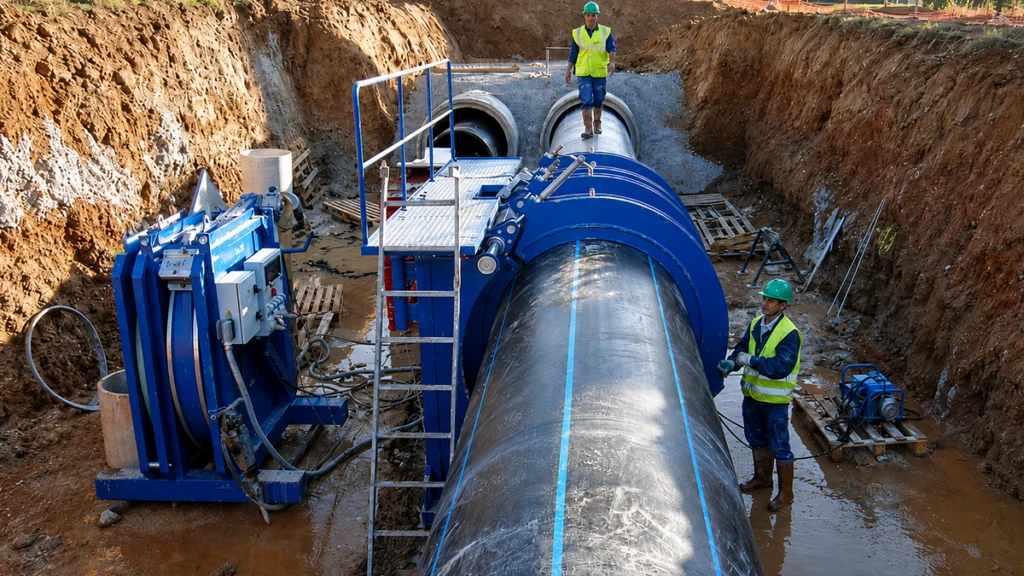
Main Types of HDPE Pipe Welding Machines for Infrastructure Projects
Manual HDPE Welding Machines for Small-Diameter Pipe Work
Manual butt fusion machines offer a practical, cost-effective option for small-diameter HDPE pipe installation and repair. The operator controls pipe alignment and joining pressure mechanically, so weld consistency depends heavily on training, experience, and correct procedure. These machines are best suited to smaller pipe sizes, low-volume work, irrigation lines, and projects where portability and simple maintenance are priorities.
Hydraulic Butt Fusion Machines for Medium- and Large-Diameter Pipelines
Hydraulic butt fusion machines use a powered hydraulic unit to control carriage movement and joining pressure more consistently than manual equipment. They are commonly selected for municipal water, industrial pipelines, mining applications, and medium- to large-diameter HDPE pipe projects. Buyers should compare the machine’s pipe range, hydraulic pressure capacity, heating plate accuracy, facer performance, and compatibility with the required SDR and project procedure.
CNC Automatic Butt Fusion Machines for Quality-Controlled Projects
CNC automatic butt fusion machines are designed for projects that require repeatable welding parameters, process monitoring, and digital traceability. Depending on the model, the control system may calculate or guide heating, changeover, joining, and cooling parameters based on the entered pipe diameter, material, SDR, and selected welding standard. Integrated data logging can record key information such as pressure, temperature, welding time, operator details, and joint identification for later inspection and project documentation.
Socket Fusion and Electrofusion Equipment: When Are They Suitable?
Butt fusion definitely rules the large infrastructure space. Yet, specific technical scenarios make socket fusion and electrofusion mandatory. For instance, contractors have to switch to electrofusion when dealing with pipes that have a nominal diameter (dn) of 63mm or less, or a wall thickness under 6mm. The same rule applies when joining components from mismatched SDR (Standard Dimension Ratio) series. Electrofusion also shines during tight-space repairs where dragging in a massive butt fusion frame just isn’t physically possible.
| Machine Type | Best Use Case | Automation Level | Typical Diameter Range | Data Logging |
|---|---|---|---|---|
| Manual Butt Fusion | Small-diameter pipelines, irrigation, repairs, and low-volume projects | Manual | Approximately 40–250 mm, depending on model | Usually not included |
| Hydraulic Butt Fusion | Municipal water, industrial pipelines, mining, and larger pipe projects | Semi-automatic hydraulic control | Approximately 63–1600 mm or larger, depending on model | Optional or model-dependent |
| CNC Butt Fusion | Regulated projects requiring repeatable parameters and traceability | Automatic or guided automatic cycle | Approximately 63–1200 mm or larger, depending on model | Typically included |
| Socket Fusion | Small-diameter pipes, indoor installations, plumbing, and compact work areas | Manual or temperature-controlled | Commonly 20–110 mm, depending on system | Usually not included |
| Electrofusion | Repairs, branch connections, confined trenches, tie-ins, and complex installations | Programmed fusion cycle | Commonly 20–800 mm or larger, depending on fitting availability | Model-dependent |
Factory-direct pricing with technical consultation included
Get Your Free QuoteHow to Choose the Right HDPE Pipe Welding Machine in Libya
What Pipe Diameter Range Does the Project Require?
Figuring out how to choose an HDPE pipe welding machine starts with one basic metric: the exact outer diameter (OD) range of your pipeline. Manufacturers categorize these units by their maximum clamping capacity. A 315mm butt fusion machine, for example, handles pipes ranging from 90mm up to 315mm. But be careful. Buying a rig that barely fits your largest pipe puts unnecessary strain on the hydraulic frame. Smart contractors usually size up, grabbing a machine with a slightly higher capacity to handle unexpected project expansions down the road.
Which Welding Pressure and Heating Plate Performance are Needed?
Your hydraulic station needs to deliver precise pressure adjustments perfectly matched to the equipment’s size. Take a 250mm butt fusion machine: it needs a pressure range of 0-6.3 MPa. Scale up to a massive 1000mm unit, and you are looking at 0-16 MPa just to achieve a solid fusion. At the same time, look closely at the heating plates. They must hold steady temperatures between 0-270°C (or up to 300°C) with an incredibly tight maximum deviation of ±3°C to ±5°C. Anything looser, and you risk localized cold spots that weaken the joint or overheat the material until it degrades.
How Project Location, Site Conditions, and Operator Skill Affect Selection
Out in the extreme desert, ambient heat drastically changes how fast polyethylene absorbs thermal energy. This is where CNC models earn their keep. They automatically detect the ambient temperature and dynamically adjust the heating cycle on the fly. That feature alone cuts down your reliance on operator expertise in brutal site conditions. If your crew consists mostly of unskilled labor, spending the extra capital on highly automated equipment is the best way to shield your project from joint failures driven by human error.
When Should Buyers Choose Manual, Hydraulic, or CNC Models?
Keep manual models restricted to non-critical tasks like small-diameter agricultural irrigation or basic drainage lines. For everyday heavy lifting, hydraulic models serve as the standard workhorse for general contractors laying medium-to-large water and sewage networks. CNC models? Those are strictly non-negotiable for gas transmission lines, deep-trench municipal water mains, or any contract where the engineering consultant demands digital weld data logs before signing off on the handover.
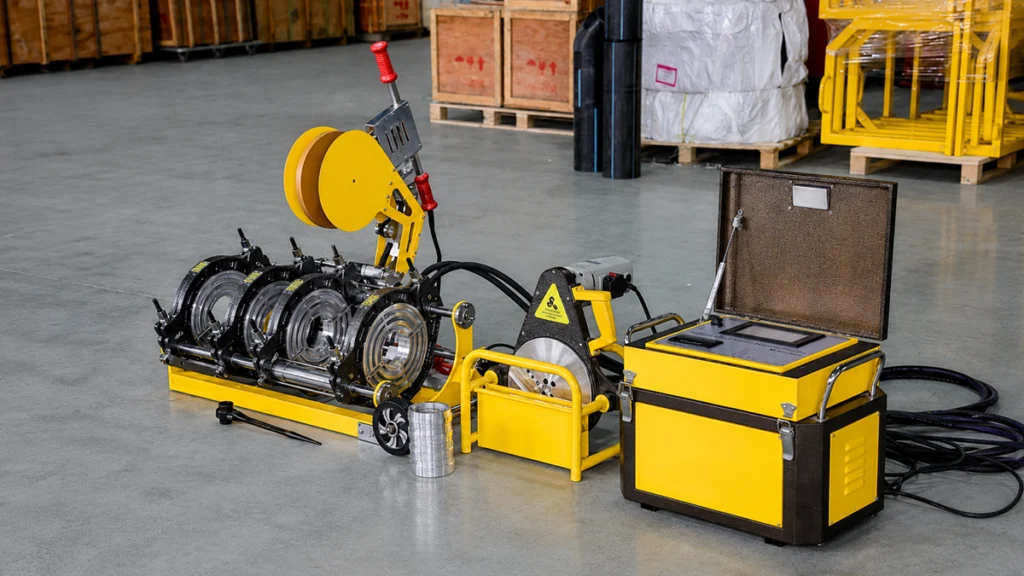
Key Technical Specifications to Check Before Buying
Pipe Diameter Capacity And Clamp Configuration
A butt fusion welding machine’s frame integrity and clamp layout dictate your pipe alignment. If you buy a low-quality frame, it will flex under the immense hydraulic pressure, throwing your pipes out of alignment. Industry standards are unforgiving here: alignment deviation must stay strictly at ≤0.2mm or ≤0.3mm, depending on the pipe size. Anything worse creates a weak weld. Always double-check that the package includes a complete set of heavy-duty, precision-machined aluminum reduction inserts to cover your full diameter range.
Heating Plate Temperature Control And Anti-stick Coating
When sourcing an HDPE pipe fusion machine for water pipeline projects, pay close attention to the heating plate surface. It absolutely needs a premium Polytetrafluoroethylene (PTFE) anti-stick coating. This crucial layer stops molten polyethylene from sticking to the metal during the extraction phase—a nightmare scenario that ruins the weld face. Beyond the coating, the plate has to run on an independent temperature control system to guarantee flawless, uniform heat distribution from edge to edge.
Facing tool power, hydraulic station pressure, and frame stability
Your facing tool (the milling cutter) does the vital job of shaving the pipe ends until they are perfectly parallel. For this to work, it needs high-speed carbon steel, double-edged reversible blades powered by a dedicated, high-torque motor. Facing tool motors usually range between 1.36 KW and 3.0 KW, depending on the rig’s size. Meanwhile, your hydraulic station must pump out smooth, non-fluctuating pressure. Pair that with a main frame built from reinforced alloys, and you ensure absolute stability during intense milling and fusion cycles.
Voltage, Generator Compatibility, and Field Operation Requirements
Electrical requirements vary by machine size, heater capacity, facer motor, hydraulic unit, and destination-market configuration. Smaller butt fusion machines may operate on a 220–240 V single-phase supply, while medium- and large-diameter models commonly require a 380–415 V three-phase supply. Buyers should verify the rated voltage, frequency, phase, total connected load, and plug configuration for the exact machine model.
For field operation, the generator should provide sufficient continuous output for the heater, facer, and hydraulic unit, with additional capacity for motor starting current, simultaneous operation, cable voltage drop, and unstable site conditions. Undersized generators can cause voltage fluctuations, slow heating, motor trips, and interruptions during the fusion cycle.
| Specification | Technical Requirement | Why It Matters for Contractors |
|---|---|---|
| Heating Plate Coating | Uniform PTFE-coated heating surface | Reduces pipe sticking and supports clean heating-plate removal |
| Temperature Control Accuracy | Verify the manufacturer’s stated tolerance and calibration method | Helps maintain consistent heating across the fusion surface |
| Pipe Alignment Control | Must meet the approved welding procedure and applicable project standard | Reduces pipe mismatch and supports uniform fusion-bead formation |
| Facing Tool Blades | Replaceable, double-edged blades suitable for the specified pipe range | Produces clean, parallel pipe ends before heating and joining |
| Rated Voltage and Frequency | Must match the site power supply and the exact machine nameplate | Helps prevent electrical faults, motor damage, and unstable operation |
| Power Supply for Large Models | Commonly 380–415 V, three-phase; total power varies by model and configuration | Determines the required generator, cable, breaker, and site-power capacity |
| Generator Capacity | Size above the machine’s total connected load with an appropriate operating margin | Allows for motor starting current, simultaneous operation, and site-power fluctuations |
| Cable and Grounding | Correct cable cross-section, plug, breaker, and protective grounding | Limits voltage drop and improves electrical safety during field operation |
Get detailed specs and custom configuration options
Request Technical SpecificationsCommon Applications of HDPE Pipe Welding Machines in Libya
Municipal Water Supply and Distribution Pipelines
HDPE pipe is widely used in municipal water systems because of its corrosion resistance, flexibility, and fused-joint construction. For water-distribution projects, the selected welding equipment must provide accurate alignment, controlled heating, and stable fusion pressure. Properly completed joints help reduce leakage risk and support long-term performance under internal pressure, soil loads, traffic loads, and changing ground conditions.
Sewage, Stormwater, and Drainage Network Construction
HDPE welding equipment is used in pressure sewer, stormwater, and drainage projects where fused pipe joints are required. Correct facing, alignment, heating, and joining procedures help produce a continuous internal flow path and reduce the risk of leakage or groundwater infiltration. Equipment selection should reflect the pipe diameter, wall thickness, installation space, and whether the system operates by gravity or under pressure.
Agricultural Irrigation and Long-Distance Water Transfer Projects
Agricultural irrigation and regional water-transfer projects often require long HDPE pipeline runs across remote or uneven terrain. Hydraulic butt fusion machines are commonly used because they provide controlled joining pressure and are available for a wide range of pipe diameters. Properly fused pipelines can support trench installation, long pull sections, and operating conditions involving temperature changes, pressure variation, and ground movement.
Mining, Industrial, and Utility Pipeline Installations
HDPE pipelines are used in selected mining, industrial, and utility applications for water, slurry, process fluids, and other compatible media. These projects often require consistent weld parameters, detailed quality records, and reliable field equipment. Hydraulic or CNC butt fusion machines may be selected depending on the pipe size, project specification, traceability requirements, and applicable welding procedure. For chemical service, compatibility must be verified for both the pipe material and the transported fluid.
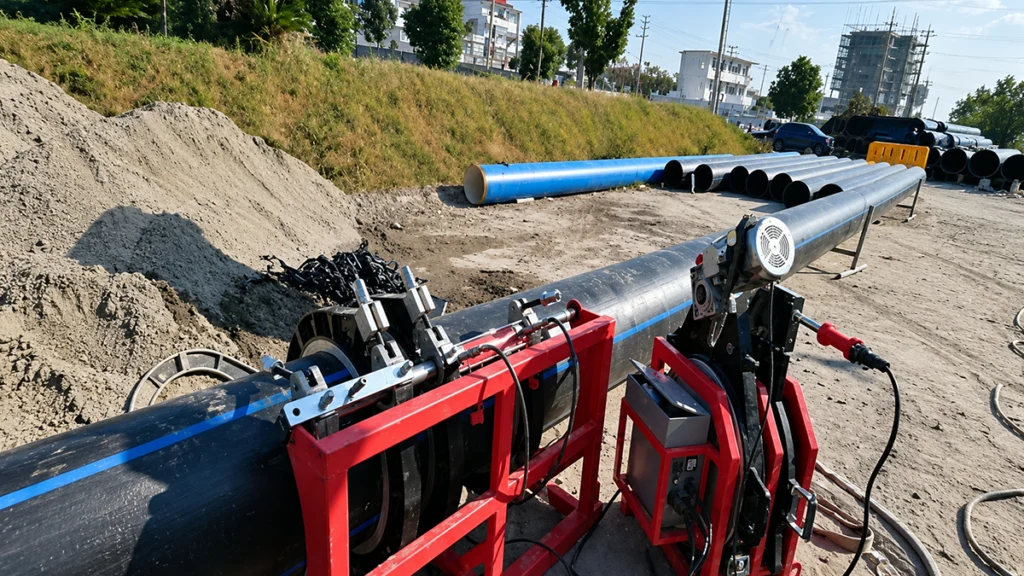
HDPE Pipe Welding Machine Price Factors in Libya
Machine Size, Automation Level, and Welding Capacity
When looking at the HDPE welding machine price in Libya, two main factors drive the number: maximum diameter capacity and the level of automation. If you review the specifications for a rig handling large diameter pipes (like 800mm to 1200mm), you will find massive hydraulic cylinders, incredibly heavy-duty frames, and high-kilowatt heating plates. Naturally, this demands a much higher capital investment than a basic 315mm manual unit. Likewise, stepping up from standard hydraulics to a fully automated CNC data-logging system adds a premium to cover those advanced sensors and electronics.
Import Costs, Accessories, Spare Parts, and After-Sales Support
Since this heavy butt fusion machinery is imported, Libyan contractors have to calculate international shipping fees, customs tariffs, and tricky local logistics. Don’t just look at the base price, either. Your initial budget needs to cover essential accessories like stub end device holders, crane hoists to lift massive heating plates, and a full set of reduction inserts. The best suppliers will also bake the cost of rapid, accessible after-sales support right into their upfront pricing.
Training, Maintenance, and Downtime Costs
The initial capital outlay might seem steep, but the operational material costs are phenomenally low. Because fusion welding works by melting the parent pipe itself, you spend exactly zero dollars on consumable welding rods or flux. Investing in high-quality automated machines slashes your dependency on manual labor and drastically cuts down on expensive project delays. As for routine maintenance, you are mostly just paying for cleaning agents, fresh cutter blades, and basic hydraulic fluid top-offs.
Why the Cheapest Machine Can Increase Project Risk
Hunting for the absolute lowest price tag usually triggers catastrophic hidden costs down the line. Cheaply built butt fusion machines notoriously feature flimsy frames that warp the second you apply real pressure, pushing pipe misalignment well past the 0.3mm limit. They also struggle with terrible temperature regulation, which guarantees incomplete fusion. Think about it: a single failed joint on a buried 600mm water main can rack up tens of thousands of dollars in emergency excavation, repairs, and client penalties. That easily wipes out whatever money you saved buying substandard gear.
Supplier Evaluation: What Libyan Contractors Should Verify
Can the Supplier Provide Technical Specifications and Welding Parameters?
As you evaluate HDPE pipe welding machine suppliers in Libya, do not hesitate to demand comprehensive technical datasheets. A legitimate supplier needs to prove that their hardware executes welds fully compliant with strict international standards, like ISO 21307 or DVS 2207. Furthermore, they should hand over detailed welding parameter charts without hesitation. These charts must clearly map out heating times, soak durations, and precise fusion pressures across various pipe SDRs.
Are Spare Parts, Clamps, Cutters, and Heating Plates Available?
Dealing with equipment downtime on a remote pipeline job is a financial nightmare. In fact, industry data points out that 60% of B2B buyers rank a stable supply chain for wear parts as their top priority. Before you sign any purchase orders, make sure the supplier actually holds inventory. They must be able to rapidly ship out replacement PTFE heating plates, fresh carbon steel cutter blades, hydraulic seals, and spare aluminum clamp inserts at a moment’s notice.
Does the Supplier Support Operator Training and Troubleshooting?
You can’t just hand advanced pipeline equipment to an untrained crew and expect perfection. Roughly 90% of construction teams lean heavily on technical support to troubleshoot on-site butt fusio machinery issues quickly. Ask your supplier exactly what they offer. Do they provide thorough operation manuals, in-depth video tutorials, and live remote troubleshooting? Setting up a solid HDPE fusion welding machine maintenance and training program is the best way to ensure your operators maximize the equipment’s operational lifespan.
What Documents Should Be Requested Before Purchase?
Navigating customs and proving regulatory compliance requires a very specific paperwork package. Always request the commercial invoice, a detailed packing list, the certificate of origin, and certified CE or ISO manufacturing quality documents. Don’t forget the comprehensive operation manuals. If you are investing in CNC equipment, take it a step further: verify that the butt fusion machine’s proprietary software actually complies with local and international data logging standards for true weld joint traceability.
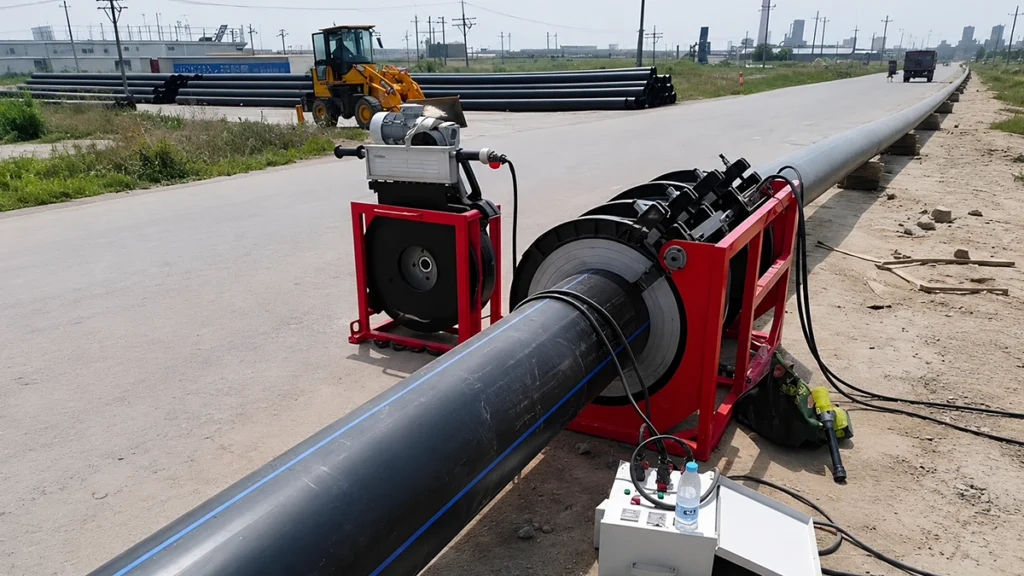
Quality Control and Welding Process Best Practices
Basic Butt Fusion Welding Steps for HDPE Pipes
Pulling off a flawless weld means following a strict, sequential playbook. The core steps look like this: First, position and secure the pipes tightly inside the clamps. Next, mill the pipe ends until they are totally flat and parallel. After that, apply the heating plate under initial pressure, then back off slightly to let the plastic absorb the heat (the soak phase). The transition phase follows, where you rapidly extract the plate. Immediately move into fusion joining by driving the melted ends together under exact pressure. Finally, cool the joint, holding that hydraulic pressure steady until the plastic completely solidifies.
How to Control Heating Time, Pressure, and Cooling Time
Mastering time and pressure is the true science of butt fusion. You have to minimize the transition cycle—the brief window where you remove the plate and close the pipes—to avoid critical heat loss. Just as importantly, the cooling phase must happen under continuous hydraulic pressure. Polyethylene is notorious for its poor thermal conductivity. This means the core of your weld stays molten long after the outer surface feels hard to the touch. If you release the clamps too early, the shrinking plastic will tear itself apart, forming hidden internal voids and micro-cracks.
Common Welding Defects and How to Prevent Them
Field crews have to stay vigilant against standard procedural errors. For example, slamming the pipes together in a high-pressure collision during the closing phase is a massive mistake. This aggressive move squeezes all the vital molten material right out of the fusion zone, leaving you with a brittle “cold weld.” Also, pay attention to how much pipe sticks out from the inner clamps. It needs to be at least 10% of the nominal outer diameter. This guarantees the frame has enough travel distance to complete the full fusion stroke without bottoming out prematurely.
Why Operator Training is Critical for Infrastructure Projects
Top-tier hydraulic equipment is fantastic, but the operator is still the one punching in the timing and pressure variables. Putting your team through certified training ensures they actually know how to read complex parameter charts and compensate for extreme desert temperatures. They also learn how to visually inspect the final weld bead to confirm proper rollback and perfect uniformity. Ultimately, a well-trained operator serves as your absolute best defense against catastrophic pipeline failure.
Common Mistakes When Selecting HDPE Pipe Welding Equipment
Choosing a Machine Without Confirming Pipe SDR and Diameter Range
One of the most common procurement blunders is buying hardware without checking the specific Standard Dimension Ratio (SDR) of your pipes. If you try to butt fuse pipes from mismatched SDR series—meaning they have different wall thicknesses—you will get uneven melting and an inevitable joint failure. Additionally, never try to butt fuse small pipes (≤ 63mm diameter or < 6mm wall thickness) with heavy hydraulic clamps. The massive force will simply crush the plastic. Those sizes strictly require electrofusion.
Ignoring Power Supply and Jobsite Mobility Requirements
It happens all the time: buyers grossly underestimate how much juice large welding equipment needs. Buying a massive 1000mm butt fusion machine that pulls 23.5 KW is pointless if you haven’t secured a heavy-duty, voltage-regulated generator to run it. Without adequate power, it becomes a very expensive paperweight on a remote site. Beyond electricity, ignoring the sheer physical weight and footprint of these butt fusion machines creates massive logistical headaches. Maneuvering a giant steel frame into a tight, muddy trench is no easy feat.
Underestimating the Need for Spare Parts and Service Support
Treating your HDPE pipe welding machinery like a simple, one-and-done commodity purchase is a dangerous game. Out in the field, hydraulic hoses degrade, facing tool blades lose their edge, and PTFE coatings inevitably get scratched. If you buy from a vendor that lacks a streamlined spare parts pipeline, you are asking for trouble. A simple snapped $100 heating plate cable could completely paralyze a multi-million-dollar infrastructure project for weeks while you wait for a replacement.
Buying Equipment Without Testing or Documentation
Never wire funds for heavy butt fusion machinery without demanding factory test videos, official calibration certificates, or sample digital weld logs. Skipping this step exposes your firm to massive liability. Imagine a municipal client demanding hard proof of weld integrity, only to find out your butt fusion machine can’t export the required pressure and temperature data. They could reject the entire pipeline installation. Always secure documented proof of performance before you finalize the deal.
Final Recommendation for Buying an HDPE Pipe Welding Machine in Libya
Best Choice for Small Contractors and Repair Teams
If you run a smaller contracting firm, a municipal repair crew, or handle residential irrigation, your smartest move is a 160mm to 250mm manual or entry-level hydraulic unit. These butt fusion machines run comfortably on standard 220V power, drawing a manageable 3.7 to 4.2 KW. They deliver incredible jobsite mobility and unbeatable cost-effectiveness for everyday, small-diameter polyethylene tasks.
Best Choice for Municipal and Large Infrastructure Projects
Major contractors tackling city-wide water distribution, deep-trench sewage networks, or heavy industrial fluid transport need to aim higher. For these jobs, hydraulic CNC or fully automatic machines are an absolute necessity. The built-in displacement detection, locked automatic parameters, and USB data logging capabilities guarantee your work complies with the strictest engineering standards, shielding your company from future liability.
Procurement Checklist Before Requesting a Quote
Don’t start emailing suppliers until you have a rock-solid technical brief. This ensures you get accurate, usable quotes:
- Pinpoint the exact minimum and maximum Outer Diameter (OD) range of your pipes.
- Identify the specific material grade (like PE100) alongside the SDR and wall thickness.
- Clearly state the application (e.g., high-pressure gas mains versus gravity-fed drainage).
- Verify the exact power supply available on site (220V single-phase or 380V three-phase).
- Itemize any necessary accessories, such as stub end holders, separate data loggers, or heavy-duty wheeled carts.
- Lock down the final delivery location so the vendor can calculate precise freight and logistics costs.
Frequently Asked Questions
Q1: What size HDPE pipe welding machine is suitable for municipal water projects in Libya?
Municipal water projects may use HDPE pipes ranging from small distribution lines to large transmission mains. The welding machine should be selected according to the project’s actual pipe outside-diameter range, SDR, wall thickness, welding procedure, and site conditions. Hydraulic butt fusion machines are commonly used for medium- and large-diameter pipes, but buyers should not select a DN315, DN630, or DN800 machine until the complete pipe schedule has been confirmed.
Q2: How much does an HDPE pipe welding machine cost in Libya?
The price depends on the machine’s pipe range, manual, hydraulic, or CNC configuration, component quality, electrical specification, included reducing inserts, data-logging functions, and spare-parts package. Buyers in Libya should compare the total landed cost, including the machine price, ocean freight, insurance, customs-clearance expenses, inland delivery, commissioning, training, and replacement parts. Request a current quotation based on the required pipe sizes and delivery location rather than relying on a general market price.
Q3: Is a manual or hydraulic HDPE pipe welding machine better for infrastructure projects?
Hydraulic butt fusion machines are generally more suitable for municipal, industrial, and larger-diameter infrastructure projects because they provide more stable carriage movement and joining-pressure control. Manual machines remain practical for smaller pipe sizes, low-volume work, irrigation, and repair applications where portability and lower initial cost are priorities. Final selection should be based on pipe diameter, SDR, required fusion force, productivity, and the approved welding procedure.
Q4: What specifications should contractors check before buying a butt fusion machine?
Contractors should verify the machine’s complete pipe range, compatible SDR and wall-thickness range, heating-plate temperature control, PTFE coating quality, facer performance, hydraulic capacity, clamp alignment, voltage, frequency, phase, total connected load, and available reducing inserts. Buyers should also request calibration records, operating manuals, spare-parts lists, warranty terms, and confirmation of the welding procedures supported by the machine.
Q5: Can HDPE pipe welding machines be used for irrigation and drainage pipelines?
Yes. Butt fusion machines are widely used for HDPE irrigation lines, pressure drainage systems, pumping mains, and other pipelines requiring fused joints. However, equipment selection depends on whether the system is pressurized or gravity-fed, as well as the pipe diameter, wall thickness, installation space, and required jointing method. Some non-pressure drainage systems may use socket, electrofusion, extrusion-welded, or gasketed connections instead of butt fusion.
Q6: What spare parts are important for HDPE pipe welding equipment?
Recommended spare parts may include facer blades, heater temperature sensors, electrical heating elements, hydraulic seals, hoses, quick connectors, pressure gauges, switches, fuses, and commonly used reducing inserts. The exact spare-parts package should match the machine model and local service conditions. Buyers should also confirm whether the manufacturer can provide PTFE heating-plate recoating, replacement plates, remote troubleshooting, and fast parts delivery to Libya.
Q7: How can contractors avoid weak HDPE pipe fusion joints on site?
Use a qualified operator and follow an approved welding procedure for the pipe material, diameter, and SDR. Before fusion, verify pipe cleanliness, facing quality, alignment, heater temperature, drag pressure, and site conditions. During welding, control bead-up, heating, changeover, joining pressure, and cooling time according to the selected procedure. Do not move or remove the joint from the clamps before the specified cooling period is complete.
Q8: What documents should a supplier provide before exporting HDPE welding machines to Libya?
The supplier should provide a commercial invoice, packing list, certificate of origin, bill of lading, product specifications, operating manual, warranty document, and spare-parts list. Additional conformity documents or Arabic translations may be required, so the final requirements should be confirmed with the Libyan buyer and customs broker before shipment.
Conclusion
Choosing the right HDPE pipe welding machine for a project in Libya requires careful evaluation of pipe diameter, SDR, site conditions, power supply, welding procedure, and required productivity. Contractors should compare manual, hydraulic, and CNC machines based on the actual project scope rather than purchase price alone.
Machine reliability, heating control, hydraulic performance, generator compatibility, operator training, technical documentation, and spare-parts availability should all be reviewed before ordering. A properly selected machine, supported by qualified operators and approved welding procedures, can reduce rework and support consistent pipeline installation for municipal water, irrigation, industrial, and infrastructure projects.
Need help matching the machine to your pipe range and project requirements?
Get Machine Selection Support