
Butt Fusion Welding Machine in Colombia: Buying Guide for HDPE Water Pipelines
Table of Contents
Butt Fusion Welding Machine in Colombia helps buyers choose the right HDPE pipe fusion equipment for water projects, comparing machine types, technical specs, supplier terms, costs, and quality checks for reliable pipeline joints.
What Is a Butt Fusion Welding Machine for HDPE Water Pipelines?
What does the machine do in simple terms?
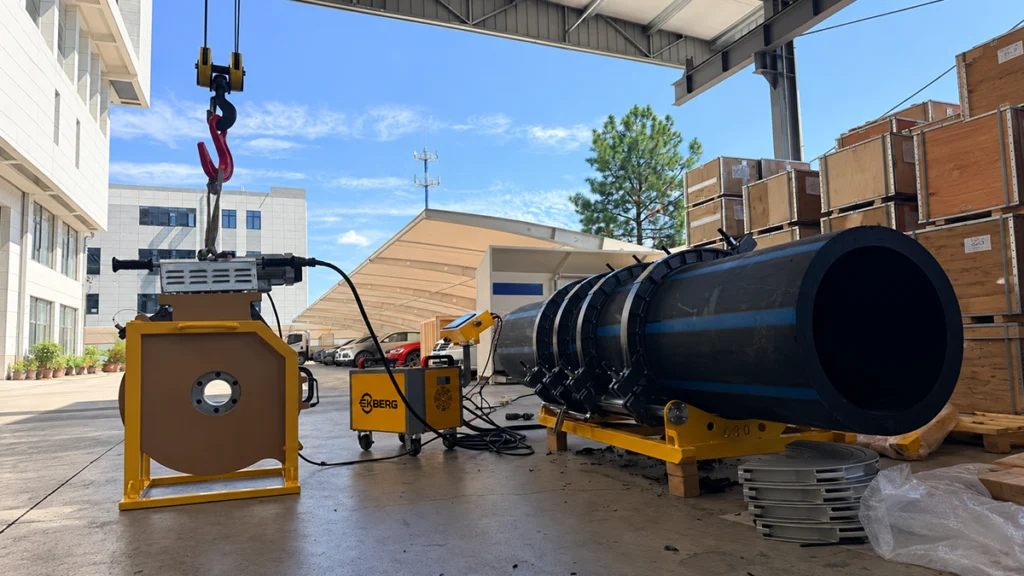
A butt fusion welding machine is a highly specialized thermofusion tool designed to permanently join thermoplastic pipes—think HDPE, PE, and PP-R. How does it work? By applying exact, controlled heat and hydraulic pressure to the perfectly squared ends of two pipes, the equipment melts the polymer chains. Those chains interlock, cooling into a single, continuous pipeline. You get a monolithic structure without touching mechanical fittings, gaskets, or messy glues.
Why is butt fusion preferred for pressure water pipelines?
Sourcing a reliable Butt Fusion Welding Machine in Colombia has become a top priority for modern infrastructure development. Why? Because thermofusion yields joints that actually outlast and outperform the HDPE pipe itself in sheer structural strength. This method completely eliminates mechanical transitions, which are notorious failure points in high-pressure networks. By stopping leaks before they start and keeping internal flow dynamics smooth, butt fusion effectively guarantees a 100-year operational lifespan for demanding municipal and industrial water systems.
What does a complete machine package usually include?
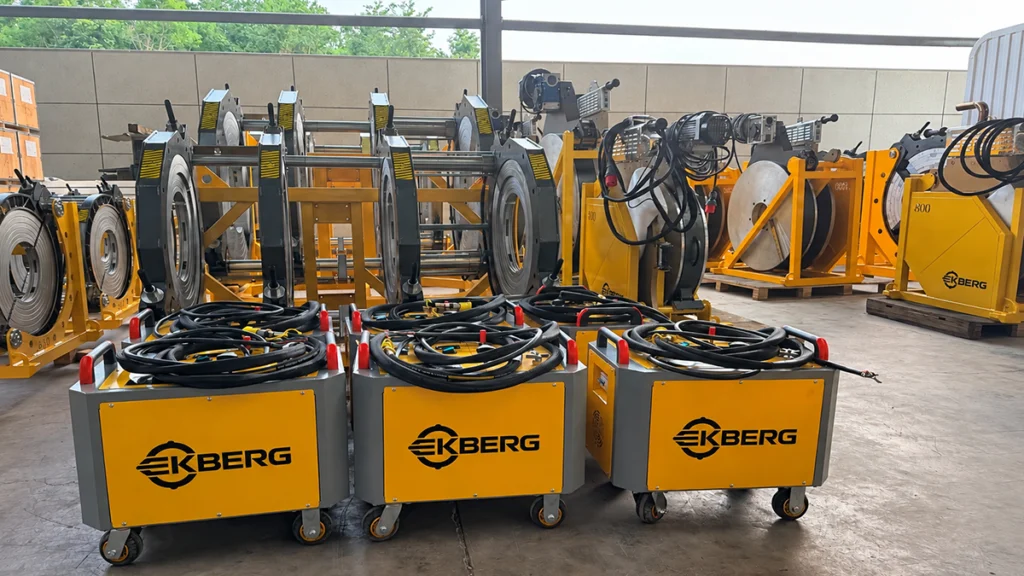
When you invest in a professional-grade butt fusion setup, you aren’t just getting one tool. You receive a fully synchronized system. At the core sits a corrosion-resistant aluminum alloy heating plate, engineered for rapid and uniform thermal conductivity. Next up is the electric milling cutter, armed with high-speed carbon steel blades to precisely face the pipe ends. The main chassis houses heavy-duty clamping blocks alongside robust hydraulic or pneumatic cylinders that deliver the exact fusion pressure required. Finally, operators manage the entire cycle through an integrated control station equipped with a thermostat, timer, pressure gauge, and ammeter.
How Butt Fusion Welding Works for Water Pipeline Joints
What are the main steps in the fusion cycle?
To guarantee joint integrity, the fusion process relies on a strict, step-by-step methodology. First, crews position and lock the pipe firmly inside the chassis clamps. The milling cutter then shaves the pipe ends down, guaranteeing perfectly parallel mating surfaces. Next, the heating plate drops in. The pipe ends absorb this heat until a specific polymer bead rolls back. Once that bead forms, the changeover phase begins—the plate is swiftly extracted. Finally, the HDPE pipe jointing machine drives the molten ends together under precise hydraulic force, maintaining that exact pressure profile throughout the crucial cooling phase.
How do temperature, pressure, and cooling time affect the joint?
You can’t just guess weld parameters. They are strictly dictated by the material’s melting point and international compliance standards like ISO 21307 or DVS 2207-1. Temperature needs to stay perfectly uniform across the plate to stop the polymer from degrading. Meanwhile, pressure must ramp up in a flash and hold rock-steady at a target value (such as P3 interfacial pressure). Because polyethylene is a poor thermal conductor and naturally shrinks as its temperature drops, the joint has to remain under sustained hydraulic pressure until it cools completely. Skip this step, and you invite micro-cracking and void formation.
How can operators confirm a consistent weld?
Today’s advanced hydraulic and CNC automatic butt fusion machines leverage built-in data loggers to track the entire fusion cycle. These digital watchdogs capture real-time metrics: drag pressure, heating plate temperature, bead width, interfacial pressure, and total cooling time. Pipeline engineers review this data to prove every single joint hits international compliance benchmarks. This level of oversight guarantees absolute traceability from the first weld to the final pipeline commissioning.
Factory-direct pricing with technical consultation included
Get Your Free QuoteWhich Machine Types Are Available, and What Pipe Sizes Do They Cover?
Manual, semi-automatic, or hydraulic: which one fits which project?
Picking the right HDPE pipe welding machine type boils down to three things: the scale of your pipeline, the skill level of your operators, and your project budget.
| Machine Type | Control Mechanism | Best Use Case | Portability |
|---|---|---|---|
| Manual | Human physical force | Light-duty, indoor plumbing, tight trenches | High |
| Semi-Automatic Hydraulic | Hydraulic pump station | Standard municipal water mains, field installations | Medium |
| Fully Automatic (CNC) | Computerized pressure/time control | Large professional teams, high-pressure gas/water | Low (Requires heavy transport) |
What pipe diameter range should buyers check first?
Aligning the HDPE pipe welding machine’s capacity with your project’s outside diameter (OD) is a mandatory first step. Manual models usually tackle the smaller end of the spectrum, spanning 63mm to 160mm. For standard municipal water projects, a typical hydraulic butt fusion welding machine handles dimensions from 90mm up to 315mm. Tackling massive infrastructure? Heavy-duty hydraulic and CNC rigs can scale up to 1200mm, 1600mm, or even an astounding 3000mm, depending on the manufacturer’s specific build.
When does a data logger or CNC control become useful?
On large-diameter, high-pressure pipelines, CNC controls and integrated data loggers shift from optional upgrades to absolute necessities. Major municipal force mains and water conservancy projects demand rigorous quality control. CNC automation strips human error right out of the heating and pressure cycles. Meanwhile, data loggers generate the hard digital weld records that municipal inspectors require before they will sign off on the pipeline.
What Technical Specifications Should Buyers Compare?
Which pressure, heating plate, and clamp specs matter most?
Focus heavily on the heating plate. It needs a PTFE-coated aluminum alloy construction to push heat evenly into the polymer without molten plastic sticking to the face. The clamping mechanism also requires serious scrutiny. It must be tough enough to anchor the pipe securely against high force. Specifically, your hydraulic system has to generate an applied pressure that comfortably exceeds the sum of the fusion pressure and the pipe’s natural drag pressure.
| Specification | Key Requirement | Impact on Welding |
|---|---|---|
| Heating Plate | PTFE-coated aluminum alloy | Prevents sticking, ensures uniform melting |
| Clamping System | High-grip inner blocks | Prevents pipe slippage under high hydraulic pressure |
| Hydraulic Cylinder | Smooth pressure ramping | Eliminates pressure spikes that deform the weld bead |
How important are frame rigidity and alignment accuracy?
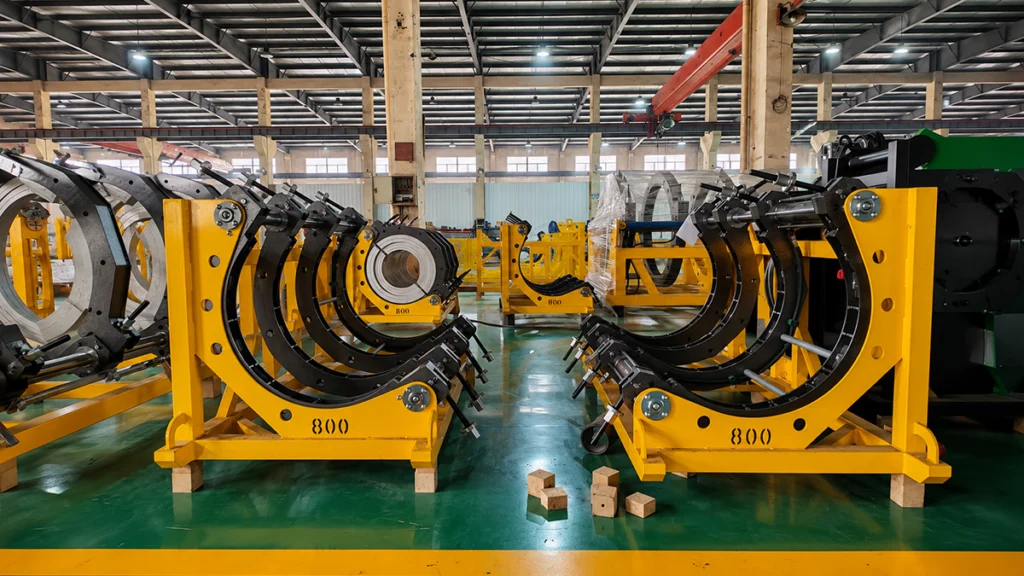
Frame rigidity is the backbone of alignment accuracy. Smart buyers prioritize HDPE pipe jointing machines engineered with a rugged, four-column structure shielded by electrostatic spraying. A flimsy chassis will inevitably flex under intense hydraulic pressure, leading to disastrous high-low misalignment at the joint. Paying upfront for high rigidity drastically slashes your total cost of ownership by saving you the nightmare of cutting out and re-doing botched welds.
What power supply and generator compatibility should be confirmed?
Remote jobsites live and die by portable power. Your on-site generator has to match the butt fusion machine’s input voltage perfectly—whether that’s 220V AC or 380V 3-phase. Even more critical is the continuous kW output. The generator must run the heating elements and hydraulic pumps simultaneously without triggering a voltage drop. Additionally, strict grounding protocols aren’t optional. They protect sensitive onboard electronics and keep your crew safe from electric shock in damp, muddy trenches.
Get detailed specs and custom configuration options
Request Technical SpecificationsWhere Are These Machines Used in Colombia?
How are they used in municipal water pipeline projects?
When upgrading urban infrastructure, contractors frequently deploy a Butt Fusion Welding Machine in Colombia to rip out and replace aging, leak-prone steel and concrete mains. Municipalities rely on this technology to roll out high-density polyethylene (HDPE) water distribution networks and sewage force mains. Unlike rigid mechanical fittings, these seamless, leak-free joints absorb traffic vibrations and ground settling with ease.
What changes in rural or remote installation sites?
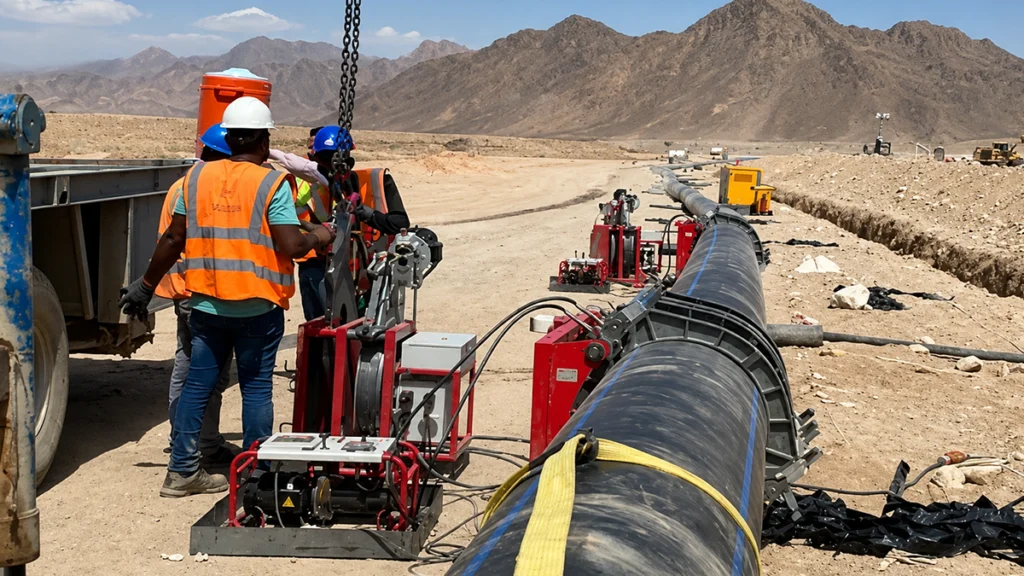
Pushing water access into remote territories demands tough, low-maintenance infrastructure. Out in these rugged environments, field crews depend on highly portable butt fusion welding machines. Hydraulic units deliver the raw fusion power needed for the job while staying nimble enough to bounce down unpaved access roads. They offer a highly cost-effective way to string PE80 and PE100 pipes across long distances, entirely bypassing the need for massive lifting cranes.
Which jobsite conditions make portability more important?
Unforgiving mountainous terrain and trenchless methods—like Horizontal Directional Drilling (HDD)—make equipment portability paramount. When you’re pulling pipe deep underground, the weld has to be flawlessly smooth and structurally perfect to survive the immense pulling stress. Mobile frames with self-aligning wheeled chassis let crews hustle the welding station rapidly down the pipeline right-of-way, dramatically boosting daily fusion output.
How Do You Choose the Right Machine for Your Project?
What pipe sizes and materials will you weld most often?
Smart procurement starts by nailing down your precise pipeline parameters. You need to identify the exact outside diameter (say, 63mm versus 630mm), the Standard Dimension Ratio (SDR) which controls wall thickness, and the specific material grade (HDPE, PE80, PE100). Buying a butt fusion welding machine capped at 315mm is a waste of capital if your very next phase demands fusing 400mm mains.
Should you prioritize automation, portability, or cost?
Juggling these three variables depends entirely on your construction timeline and the size of your workforce. Directing a massive professional crew laying miles of pipe? Prioritize a CNC automatic butt fusion machine to maximize daily production and lock down compliance. On the flip side, if your teams are handling quick municipal repairs or remote agricultural irrigation, a hydraulic butt fusion machine hits the sweet spot between budget and portability while still delivering precise pressure control.
Which accessories and spare parts are essential for daily use?
Equipment downtime absolutely shreds project margins. A well-rounded procurement package has to include quick-change mold assemblies and a comprehensive set of inner clamp blocks to handle every pipe spec within your pipe fusion machine’s range. Don’t forget to stock up on replacement high-speed carbon steel blades for the milling cutter. Dull blades chew up pipe faces, creating uneven surfaces that can ruin the entire thermofusion process.
What Do Price, Lead Time, and Supplier Terms Usually Include?
What drives the total cost beyond the machine price?
Analyzing the butt fusion machine price in Colombia means looking way past the initial sticker shock. A basic manual unit (63mm–160mm) might run you $500 to $1,500, whereas standard hydraulic models (90mm–315mm) sit between $2,799 and $5,700. Massive CNC rigs? Those can easily shatter the $90,000 mark. But the true lifecycle cost factors in international shipping, import duties, operator training, routine maintenance, and the looming financial threat of jobsite downtime. Premium HDPE pipe welding machines carry a higher upfront tag, yet they deliver massive ROI through sheer durability and energy efficiency.
How do warranty, spare parts, and training affect value?
An HDPE pipe butt fusion machine supplier in Colombia is only as valuable as their post-sale support. You need to lock in a crystal-clear warranty—usually 24 months—that covers both structural and hydraulic systems. The vendor must guarantee rapid access to spare parts, deliver system software updates for your data loggers, and provide hands-on technical training so your operators can fuse pipes safely and compliantly.
What should you ask about delivery time and MOQ?
Procuring heavy industrial equipment demands ironclad contract terms. Confirm the exact model numbers, establish the Minimum Order Quantity (MOQ) if you are outfitting an entire fleet, and get a guaranteed delivery timeline in writing. Customs bottlenecks or factory backlogs can bring your pipeline installation to a grinding halt. Always negotiate penalty clauses for late deliveries right into the purchase agreement.
What Common Buying Mistakes Create Weld Failures or Delays?
Which specification mistakes lead to poor weld quality?
The deadliest mistake a buyer can make is mismatching a butt fusion machine’s hydraulic pressure capacity with regional engineering standards. Picture this: applying an ISO-rated low-pressure machine to an ASTM high-pressure pipeline spec (which demands 60–90 psi interfacial pressure). The result? Cold welds and catastrophic joint blowouts during pressure testing. Always double-check the required standard—whether it’s ISO 21307, DVS 2207, or ASTM F2620—long before issuing a purchase order.
What supplier claims should be verified before purchase?
Never take glossy marketing brochures at face value. Dig deeper. Verify the supplier’s independent R&D footprint, their manufacturing certifications, and their true technical depth. Ask for concrete case studies or peer reviews from fellow contractors who have deployed the exact butt fusion welding machine for 160mm to 315mm HDPE pipe in similar climates. That is how you validate field reliability.
How can buyers avoid downtime caused by missing accessories or support?
Jobsite paralysis often hits because procurement ordered the base butt fusion machine but forgot the reducer inserts (inner clamp blocks) needed for specific pipe sizes. Or worse, they skipped the integrated data logger, only to find out the municipal inspector demands digital weld records before allowing construction to proceed. Always cross-reference your project’s technical blueprints with the supplier’s itemized packing list before you finalize the deal.
What Should You Confirm Before Placing an Order?
Which technical documents should the supplier provide?
A trustworthy manufacturer will hand over comprehensive documentation without hesitation. Demand the raw equipment performance metrics, CE/ISO manufacturing certificates, hydraulic pressure charts, and explicit written warranty policies. Your internal QA/QC team needs these documents, and you’ll definitely need them to prove equipment compliance to local pipeline authorities.
When should you request a demo or sample weld?
Before dropping serious capital on heavy butt fusion machinery, insist on a live demonstration or, at the very least, an unedited sample weld video using your exact pipe diameter and wall thickness. Seeing on-site test results and real-world performance data gives you undeniable proof of the machine’s true cycle times, milling efficiency, and alignment accuracy.
What checklist items should be confirmed before payment?
Run a meticulous final audit on the commercial invoice and contract. Ensure the exact equipment models, quantities of HDPE pipe jointing machines and accessories, delivery dates, and after-sales service commitments are spelled out in black and white. Make sure the contract legally guarantees the availability of replacement heating plates, milling blades, and hydraulic seals for a minimum of five years.
FAQ
Q1: How do I know which butt fusion machine size fits my HDPE pipe diameter?
Start by checking your project’s maximum outside diameter (OD). Manufacturers categorize these butt fusion machines by their maximum clamping capacity. So, if your largest pipe measures 315mm, you need a unit rated for 90mm–315mm. A smart rule of thumb? Always purchase a machine with a maximum capacity just slightly larger than your current requirements. This gives you breathing room for future infrastructure expansions.
Q2: What is the difference between hydraulic and manual butt fusion machines?
Manual butt fusion machines use human physical strength—transferred through a lever—to apply fusion pressure. This limits them strictly to smaller pipes (up to 160mm). Hydraulic butt fusion welding machines, on the other hand, rely on an electric pump and heavy-duty cylinders to deliver consistent, immense force. This hydraulic power is absolutely mandatory for fusing larger pipes and achieving repeatable, standards-compliant welds.
Q3: Is a butt fusion machine suitable for municipal water pipeline projects in Colombia?
Yes, absolutely. Butt fusion stands as the gold standard for joining HDPE pipes across municipal water and sewage networks. The process yields a seamless, leak-proof joint capable of absorbing high internal pressures and shifting ground terrain. This ensures the pipeline easily hits the 100-year lifecycle demanded by local municipal authorities.
Q4: What power supply or generator is needed on site?
Your on-site generator has to comfortably exceed the butt fusion machine’s total kilowatt (kW) rating to absorb the aggressive startup surges from the hydraulic pump and heating plate. The majority of field machines run on a stable 220V single-phase or 380V three-phase supply. Always cross-check the manufacturer’s specific kVA generator sizing recommendations to avoid dangerous voltage drops.
Q5: How much does a butt fusion welding machine cost in Colombia?
Pricing fluctuates wildly based on size and automation levels. Basic manual units (63-160mm) usually run from $500 to $1,500. Standard hydraulic setups (90-315mm) jump to between $2,799 and $5,700. Stepping up to large-diameter or fully CNC models? Expect to pay anywhere from $15,000 to well over $90,000. Remember to factor in shipping, import duties, and operator training when calculating your total cost.
Q6: What should be included in the supplier quotation?
A proper industrial quote must itemize everything: the base HDPE pipe jointing machine, heating plate, milling cutter, hydraulic station, all required reducer clamp blocks, spare blades, and data loggers if you requested them. It also needs to explicitly outline warranty terms, lead times, shipping responsibilities (Incoterms), and the exact scope of after-sales technical support.
Q7: How can I verify weld quality after fusion?
Visual inspection is your first line of defense; the weld bead should look perfectly uniform and rolled evenly against the pipe. For structural proof, pipeline operators rely on data loggers to verify that temperature, pressure, and cooling times perfectly matched standards like ISO 21307. For ultimate confirmation, contractors perform destructive testing (tensile pulls) on sample field welds.
Q8: Do I need operator training and spare parts support?
Without a doubt. Thermofusion is an exact science that demands strict adherence to pressure and temperature curves. Put an untrained operator on a machine, and you’ll get weak joints that blow out under pressure. Furthermore, having instant access to critical spare parts—such as milling blades, hydraulic seals, and PTFE plates—is the only way to prevent catastrophic jobsite downtime.
Conclusion
Choosing the right Butt Fusion Welding Machine in Colombia requires careful evaluation of pipe diameter, material grade, SDR, hydraulic performance, heating plate temperature control, automation level, and site conditions. Buyers should look beyond the initial purchase price and consider overall equipment reliability, technical support, spare parts availability, and long-term operating requirements.
For municipal water, gas, mining, and infrastructure projects, the machine should be selected according to actual pipeline specifications and applicable standards such as ISO 21307. Proper equipment selection and controlled welding procedures can help improve joint consistency, reduce rework, and support reliable pipeline performance.
Supplier capability is also important. Clear technical documentation, operator training, after-sales service, and timely spare parts support can help contractors and project owners reduce operational risks and improve project efficiency over the full service life of the equipment.
Let our experts help you choose the right equipment for your project
Contact Our Engineering Team