
Butt Fusion Machine in Venezuela: HDPE Welding Equipment for Infrastructure Projects
Table of Contents
Butt Fusion Machine in Venezuela explains how HDPE fusion equipment supports water, gas, and infrastructure projects, which machine types to compare, what specs matter, and how buyers can choose a reliable supplier.
What Is a Butt Fusion Machine and How Does It Work?
A butt fusion machine serves as highly specialized pipeline construction equipment, built to join thermoplastic pipes using exact heat and pressure. Ask any municipal utility contractor or industrial plant engineer, and they’ll tell you the same thing: this technology is the only reliable way to build a continuous, monolithic pipeline. You completely eliminate the need for mechanical fittings or vulnerable gaskets.
What components make up a butt fusion system?
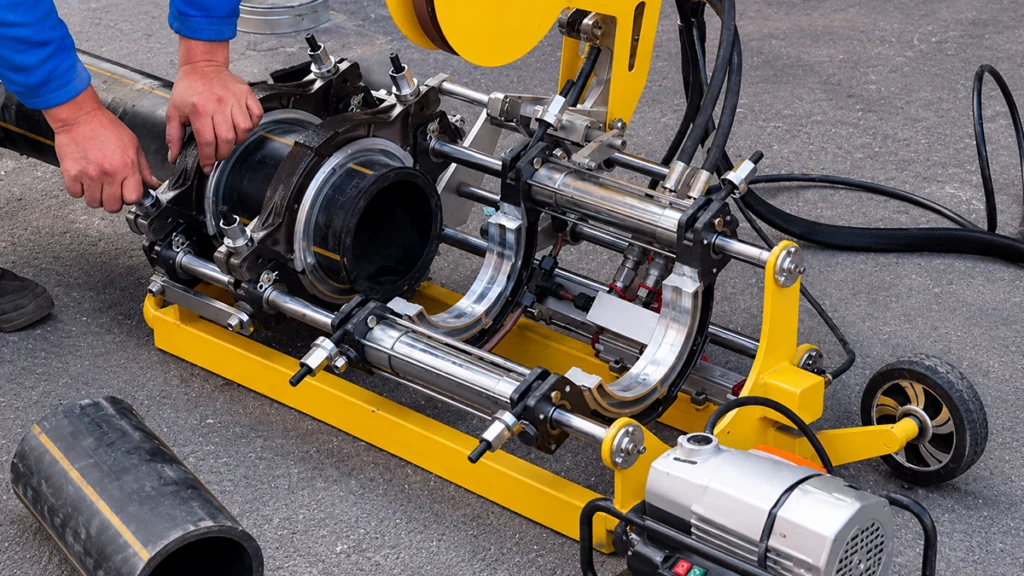
Industrial butt fusion setups rely on four core modules to get the job done. First, you have the heating plate. Cast from corrosion-resistant aluminum alloy, it features an anti-stick Teflon coating that stops melted polymer from making a mess. Next is the milling cutter, which uses high-speed carbon steel blades to shave pipe ends until they are perfectly flat. A rugged clamping and guiding chassis holds everything in strict alignment. Finally, the power source—which can range from simple manual levers to heavy-duty, high-pressure hydraulic units—delivers the raw mechanical force needed to push the pipes together.
How does the heating and cooling cycle work?
The fusion process isn’t random; it follows a rigid five-stage cycle mandated by global standards like ISO 21307 and DVS 2207-1.
1. Beveling: The milling cutter shaves the faces to eliminate any gaps between the pipe ends.
2. Heat Absorption: Under near-zero pressure, the heating plate melts the pipe ends. Temperatures typically hit 220–230°C, though specific polymer grades might need 260±5°C.
3. Transition: The operator rapidly removes the heater.
4. Welding: Hydraulic pressure forces the melted pipe ends together.
5. Cooling: The new joint sits under pressure until the plastic fully solidifies.
To put this in perspective, a small 20mm HDPE pipe needs exactly 5 seconds of heat, a quick 4-second transition, and 3 minutes to cool down.
Which pipe materials and sizes can be fused?
Engineers design these HDPE pipe welding machines to handle a specific family of thermoplastics. High-Density Polyethylene (HDPE) is the most common, followed closely by standard PE, PP-R, PP-C, and MDPE. Chassis configurations dictate the size limits. You can find compact units built for tiny 20mm distribution lines, all the way up to massive rigs that fuse 3000mm large diameter HDPE pipe for heavy municipal drainage and industrial outfalls.
Why is butt fusion preferred over mechanical joining for HDPE?
Butt fusion fundamentally alters the plastic, creating a homogeneous bond at the molecular level. This wipes out the mechanical interface entirely. The resulting weld actually matches—or even exceeds—the structural strength of the parent pipe. Operators get a permanent, maintenance-free joint. Because there is zero risk of gasket degradation, this method is an absolute necessity for underground infrastructure where digging up a broken pipe later is a logistical nightmare.
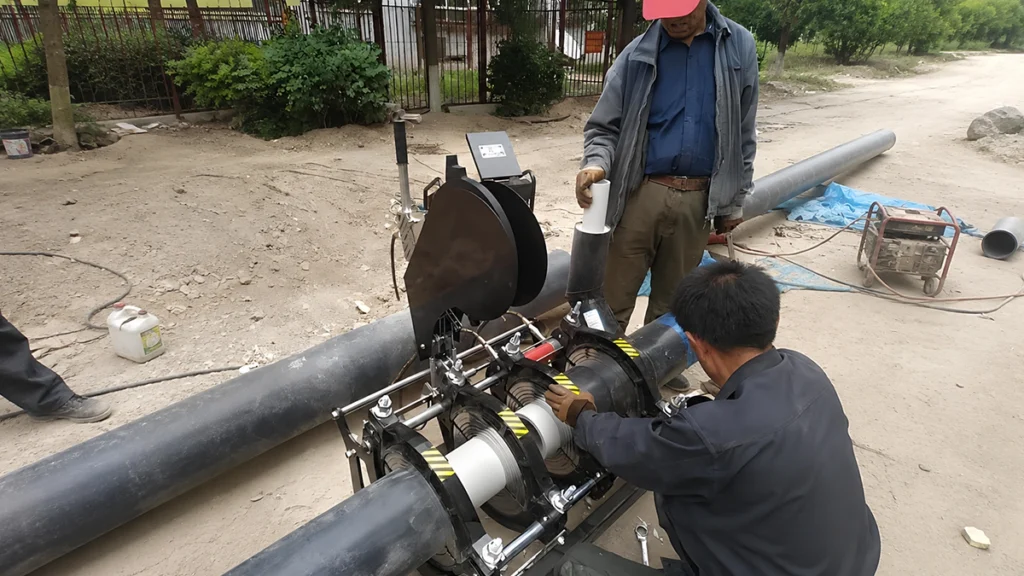
Why Butt Fusion Matters for Infrastructure Projects in Venezuela
Why is HDPE a practical choice for local infrastructure?
HDPE brings unmatched environmental resilience to the table, making it the go-to material for brutal climates. Take the Acueducto Bolivariano de Falcon project. Crews had to lay materials capable of surviving 55 kph sand-loaded desert winds. Beyond municipal water, HDPE’s natural flexibility and serious abrasion resistance make it a staple in Venezuela’s mining sector. These pipelines constantly transport highly abrasive slurry and aggressive, corrosive leachates without wearing thin.
Which project environments benefit most from butt fusion?
Large-scale municipal water networks depend heavily on this tech. Look at the massive 54-inch (1370mm) pipeline running between Coro and Punto Fijo. For a line that size, absolute joint integrity wasn’t just a preference; it was non-negotiable. Outside of city utility grids, you’ll see fused pipelines handling open-pit mine drainage, underground dewatering setups, and heavy-duty industrial slurry transport. These harsh environments demand the seamless internal flow characteristics that only a perfectly fused pipeline delivers.
What installation risks does fusion help reduce?
Firing up a butt fusion machine on a Venezuelan job site neutralizes major environmental installation risks, especially when dealing with submerged lines or severely uneven terrain. Fused HDPE is inherently flexible. The continuous pipe string can physically bend to match the natural curvature of a riverbed or sea floor while staying structurally sound and entirely leak-free. Try that with mechanical joints, and the dynamic bending stresses will tear them apart in no time.
How does joint quality affect long-term pipeline performance?
Nailing the exact heating times and drag pressures guarantees a solid joint. Properly fused HDPE prevents those dreaded internal shrinkage cavities and preserves the pipeline’s maximum pressure rating. This level of molecular integrity translates directly to a lifespan that easily exceeds 100 years. For utility operators, that means a drastically lower total cost of ownership over the long haul.
Factory-direct pricing with technical consultation included
Get Your Free QuoteButt Fusion Machine Types and Configuration Options
Manual vs hydraulic: what is the difference?
The main difference boils down to one simple factor: how the HDPE pipe jointing machine generates and holds welding pressure.
| Feature | Manual Butt Fusion Machine | Hydraulic Butt Fusion Machine |
|---|---|---|
| Pressure Source | Human operation via levers/handwheels | Hydraulic power unit |
| Ideal Pipe Size | Small diameters (up to 200mm) | Medium to large diameters (up to 3000mm) |
| Cost Profile | Lower initial cost; spare parts up to 80% cheaper | Higher capital investment; superior ROI on large jobs |
| Best Application | Low-pressure plumbing, tight indoor spaces | High-pressure municipal mains, heavy industrial lines |
When does semi-automatic control make sense?
Semi-automatic hydraulic systems take the guesswork out of heating plate insertion, temperature regulation, and hydraulic pressure application. However, they still need an operator to oversee the transition steps. This setup hits the sweet spot for medium-diameter municipal water and gas pipelines. You get the precision required for strict codes, but you avoid the massive price tag of full CNC automation. It drastically cuts down operational complexity, making it easier for crews with basic technical backgrounds to produce flawless welds.
Which machine setup fits small or large diameter pipe?
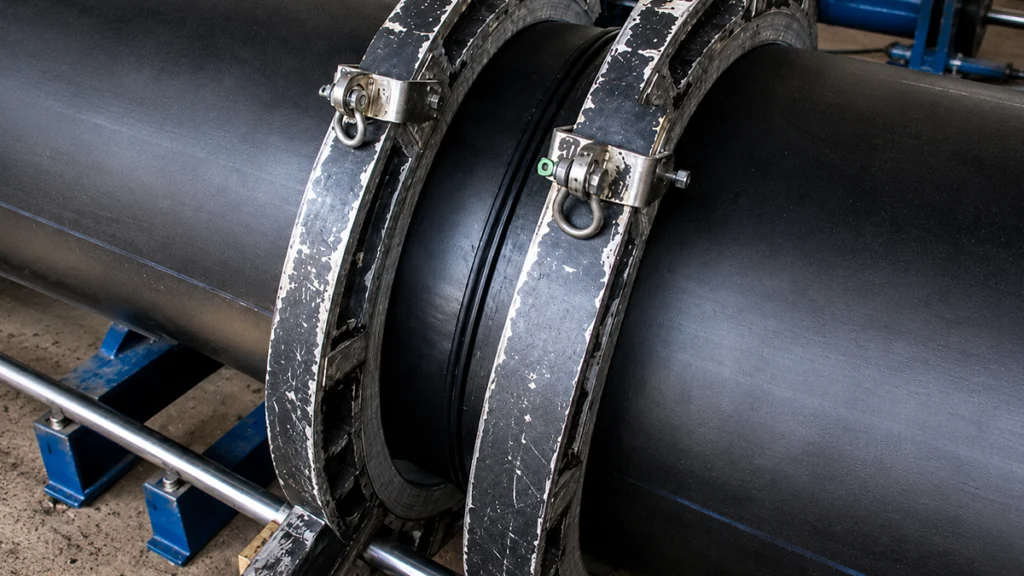
Versatility comes from interchangeable inner clamp blocks, often called reduction inserts. Manufacturers design a large chassis to handle a specific maximum outside diameter (OD). When you need to weld smaller pipes, you simply drop in the aluminum inserts to step down the clamping area. To keep the alignment force perfectly balanced, crews typically position the smaller die at the front of the carriage and the larger die at the rear.
What accessories are commonly required with the machine?
A bare fusion carriage won’t get you far in the field. You need a complete setup. Essential accessories include heavy-duty pipe cutters or guillotines for clean cuts, Allen wrenches to tweak clamp adjustments, and adjustable pipe stands (rollers) to minimize drag pressure. You should also pack ditch kits for tight in-trench welding and digital data loggers to record every parameter, proving your work meets strict quality assurance standards.
Key Specifications to Compare Before Buying
Which technical specs affect weld quality most?
Temperature control and electrical safety top the list. The heating head needs a highly accurate digital display that holds exactly 260±5°C across the entire plate. Cold spots will ruin a weld. On the safety side, specs must show an insulation resistance of ≥1MΩ and a leakage current of ≤5mA (AC RMS). Trench environments get wet and muddy, and these electrical safeguards keep your operators alive.
How do voltage and power requirements affect field use?
Your field generators must perfectly match the butt fusion welding machine’s electrical draw. Standard industrial units run on AC 176V to 245V at 50±1Hz. Before buying, verify that the equipment can actually survive your site’s ambient conditions. Premium butt fusion machines easily handle temperature swings from a bitter -20°C up to a scorching 50°C, while shrugging off relative humidity levels between 45% and 95%.
What pipe diameter range should you plan for?
Technical Parameter Table for Sizing:
| Chassis Size Category | Typical OD Range | Power Requirement | Heating Plate Max Temp | Portability |
|---|---|---|---|---|
| Small (Manual) | 63mm – 200mm | 1.5 kW – 2.5 kW | 270°C | Hand-carried |
| Medium (Hydraulic) | 90mm – 355mm | 3.5 kW – 5.8 kW | 270°C | Wheeled frame |
| Large (Hydraulic) | 500mm – 800mm | 12.0 kW – 16.5 kW | 270°C | Crane/Trailer required |
| Massive (Hydraulic/CNC) | 1000mm – 3000mm | 30.0 kW+ | 270°C | Heavy logistics required |
Which included tools, clamps, and heater controls matter most?
Tighten up your procurement specs. Mandate anti-stick Teflon-coated heating plates, self-aligning clamping systems, and centralized hydraulic control panels featuring built-in pressure gauges. Premium Western brands like McElroy and Ritmo, alongside top-tier Asian manufacturers like Riyang, include these features as standard. They stop pipe slippage dead in its tracks and guarantee parallel alignment when you hit that critical fusion phase.
Get detailed specs and custom configuration options
Request Technical SpecificationsTypical Applications in Venezuelan Infrastructure Projects
Where is butt fusion used in water distribution networks?
In the municipal sector, butt fusion remains the undisputed standard for cross-desert transmission mains and tricky underwater river crossings. Look at the Acueducto Bolivariano in Falcon State. They relied entirely on fused HDPE to stop water loss in an arid region. Had they used mechanical joints, ground shifting and harsh thermal expansion would have eventually ripped the pipeline apart.
How is it used in industrial and mining pipelines?
Mines depend on butt fusion to keep complex fluid management systems running. We’re talking about aeration lines in massive processing facilities and dual-containment setups for toxic leachate that absolutely cannot leak. Open-pit operations also use it for heavy-duty slurry transport networks. The smooth internal bore of a fused joint eliminates turbulence, heavily reducing abrasive wear from the slurry.
What project conditions change the machine choice?
Mini Case Example: Imagine a municipal contractor laying a 500mm water main on the coast, battling high winds and blowing sand. A basic manual butt fusion machine won’t cut it. They need a rugged hydraulic butt fusion machine featuring a fully enclosed hydraulic unit to keep sand out of the sensitive valves. They also need to pair it with a mobile welding shelter to stop the wind from rapidly cooling the heating plate.
Which applications require higher mobility or faster setup?
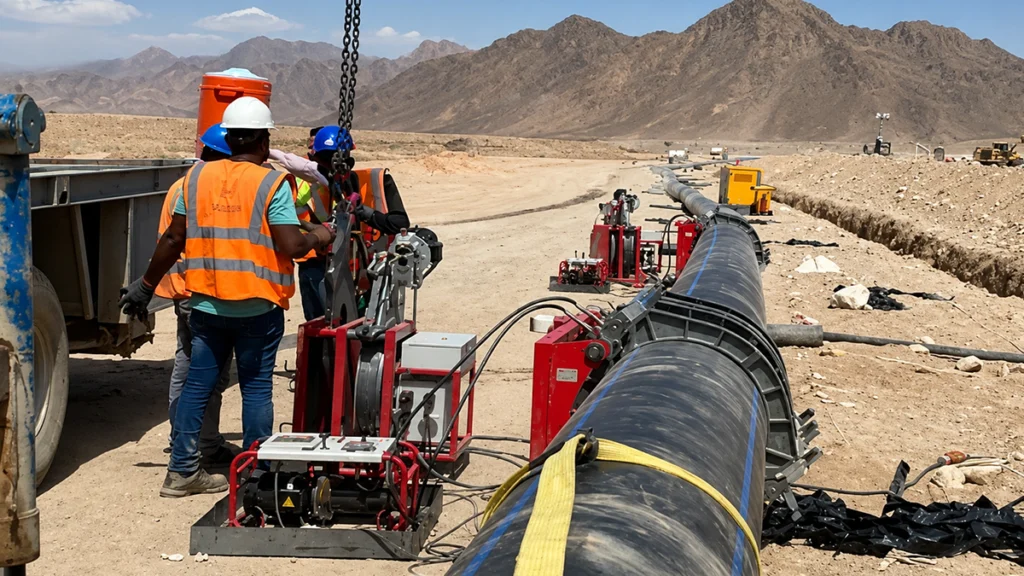
Remote mining sites carved into complex topography demand high mobility, as do municipal emergency repair crews. Wheeled or trailer-mounted hydraulic units rule these applications. They allow teams to deploy rapidly, set up in minutes, and demobilize the second the repair finishes. That speed drastically minimizes expensive pipeline downtime.
How to Choose the Right Model for Your Project
What machine size matches your pipe diameter?
Always select a chassis size where your project’s maximum pipe diameter sits comfortably below the butt fusion machine’s absolute limit. Say your largest pipe is 315mm; a 355mm butt fusion machine is your optimal choice. You can then drop in inner clamp blocks to step down the capacity for any smaller distribution lines on that same job. Continuously pushing a pipe fusion machine to its absolute maximum limit will rapidly accelerate hydraulic wear.
Should you prioritize portability or automation?
Portability wins when you tackle small, infrequent, or highly remote installations where getting heavy equipment on-site is impossible. In those cases, stick to manual or compact wheeled units. Conversely, if you are running a massive installation, prioritize automation—either CNC or semi-automatic hydraulic. You’ll need the speed, unvarying joint consistency, and strict data logging to satisfy strict municipal handover standards.
When is rental, purchase, or fleet expansion more practical?
Renting makes financial sense for a short-term, one-off emergency repair. But if you are a long-term infrastructure contractor, buying the equipment outright is the smartest move. You amortize that initial purchase price across thousands of permanent joints. Plus, owning your own fleet guarantees you’ll never face project delays just because the local rental yard ran out of butt fusion machines.
How do crew skill and training affect model selection?
Finding highly skilled pipeline welders isn’t always easy. If you’re short on seasoned talent, investing in CNC (Computer Numerical Control) or fully automatic butt fusion machines is your best defense against bad welds. These smart systems calculate the drag pressure, lock in the exact heating times, and automate the tricky hydraulic transition phase. They take human error out of the equation and stop inexperienced operators from ruining joints.
Pricing, MOQ, Lead Time, and Supplier Evaluation
What drives butt fusion machine price?
Cost and Sourcing Breakdown:
- Machine Capacity: Fusing larger diameters requires massive, heavy-duty steel chassis and high-flow hydraulic pumps. This exponentially drives up manufacturing costs.
- Automation Level: Manual butt fusion machines stay highly economical. Stepping up to a basic hydraulic unit adds moderate cost, while full CNC capability demands a premium investment.
- Brand Origin: Western legacy brands (like Georg Fischer or McElroy) command high capital costs. Meanwhile, reliable Asian manufacturers (like MM-Tech) deliver heavy-duty performance and an excellent ROI at a much lower price point.
What MOQ and lead time questions should buyers ask?
For industrial butt fusion machines, the standard Minimum Order Quantity (MOQ) is usually just 1 set. For standard, stocked sizes (up to 355mm), expect a brief lead time of 7 to 10 days. However, if you order massive 1000mm+ capacity plastic pipe welding machines or request custom voltage configurations, factory lead times easily stretch to 25–35 days before the equipment even hits the ocean freight terminal.
How do you evaluate a supplier for export to Venezuela?
Sourcing heavy butt fusion machinery for South America requires ruthless supplier vetting. Judge them on the total cost of ownership and proven equipment survival in high-temperature environments. Crucially, they must provide full ISPM-15 compliant export packaging to stop transit damage dead. Finally, verify they actually understand South American customs paperwork; otherwise, your butt fusion machine will sit delayed at the port for weeks.
What after-sales support and documentation should be confirmed?
Never wire a single dollar until you confirm the documentation package. Make sure the supplier commits to providing a flawless Commercial Invoice, a detailed Packing List, valid ISO 21307/CE certifications, and operation manuals in both English and Spanish. On top of that, confirm they stock ready-to-ship spare parts (like fresh Teflon plates and milling blades) and offer remote technical support for tricky hydraulic troubleshooting.
Operation, Testing, and Maintenance Best Practices
What does a correct fusion cycle look like?
Step-by-Step Fusion Process:
1. Milling: Shave the pipe ends until continuous, unbroken plastic ribbons emerge from both sides.
2. Alignment Inspection: Check for high-low misalignment. It absolutely must not exceed 10% of the pipe’s wall thickness.
3. Drag Pressure Measurement: Log the exact hydraulic pressure it takes to physically pull the carriage forward.
4. Heating: Drop in the plate and apply heat until the proper bead size forms on the pipe ends.
5. Fusion: Yank the plate out fast, then apply the joining pressure (which is your calculated joining pressure plus the drag pressure). Hold it there until the joint is totally cold.
How can weld quality be checked on site?
Eyeing the double roll-back bead is a good start, but modern job sites demand more proof. Today, roughly 60% of professional crews rely on built-in welding quality detection systems. They use digital data loggers to record every single parameter of the weld. Teams back this up with periodic destructive strength testing or non-destructive ultrasonic scans to guarantee the joint’s integrity.
What routine maintenance extends machine life?
Short Operational Maintenance Checklist:
- Hydraulics: Inspect the hydraulic oil condition every morning. Keep the level above 2/3 of the tank’s capacity, but do not overfill it.
- Milling Cutter: Check the blades. Swap them out the second they show signs of dulling to avoid gouging the pipe ends.
- Heating Plate: Wipe down the Teflon surface using a lint-free cloth and isopropyl alcohol—but only when the plate is completely cold. Never touch it with abrasives.
- Chassis: Wipe dirt off the guide rods and apply a light coat of butt fusion machine oil to stop the carriage from binding.
Which calibration and storage habits prevent failures?
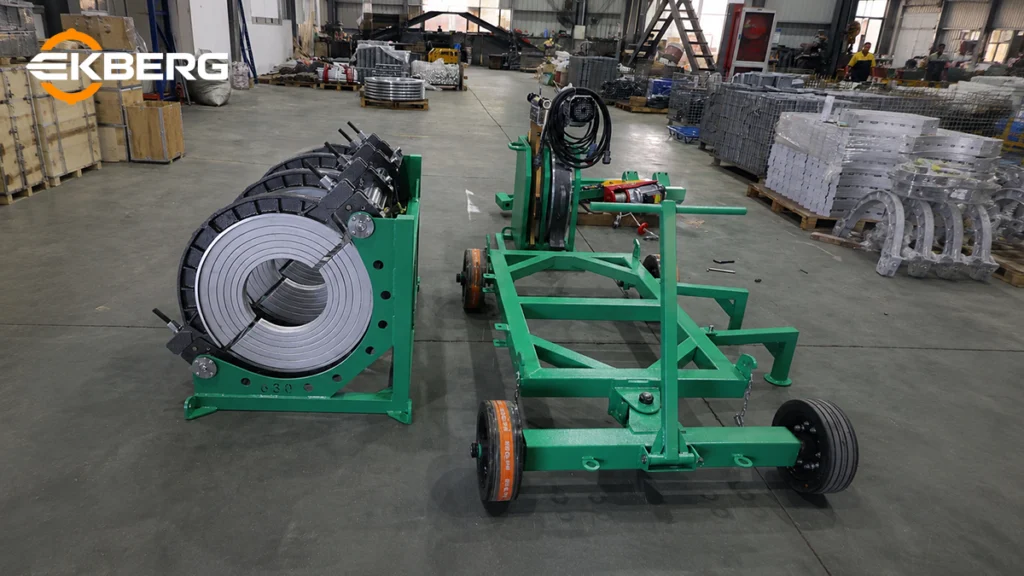
Grab a surface pyrometer and regularly check the heating plate for uniform temperature. Cold spots spell disaster. You also need to calibrate the hydraulic pressure control system once a year so the gauge reading matches the actual force applied to the pipe. When packing the butt fusion machine away, retract every hydraulic cylinder. This simple habit protects the exposed chrome rods from pitting dust and aggressive corrosion.
Common Mistakes and Final Procurement Checklist
What causes weak or failed joints?
Buyer Risk List: Common Operator Errors
- Incorrect Temperatures: Running the plate too hot degrades the polymer structure. Running it too cold stops the molecular bond from forming.
- Excessive Heating Time: Cooking the pipe too long creates internal shrinkage cavities and dangerously brittle joints.
- Misalignment: Allowing a twist angle over 5 degrees during alignment injects fatal stress concentrations right into the weld.
- Pipe Movement: Rotating the pipe as it touches the heater, or failing to lock the clamps down tight, guarantees an uneven, weak bead.
Which documents should buyers request before ordering?
Before you authorize a bank transfer, demand a highly detailed purchase contract. This isn’t just a formality. The contract must explicitly list the equipment model, exact clamping ranges, required voltage, itemized pricing, and a hard delivery timeframe to the loading port. Furthermore, lock down comprehensive after-sales terms, including the specific warranty duration covering all hydraulic and electrical components.
What should be confirmed before dispatch and installation?
Pre-Dispatch Verification Checklist:
- Verify the factory successfully completed an inherent stroke verification test.
- Confirm the heating plate temperature comes with a fresh factory calibration certificate.
- Ensure technicians pressure-tested the entire hydraulic manifold to check for leaks.
- Double-check that the factory actually packed all your requested reduction inserts (inner clamp blocks) into the shipping crate.
What final checklist should procurement teams use?
Project Selection Checklist:
1. Needs Analysis: Pin down your maximum/minimum pipe OD, the SDR (Standard Dimension Ratio), and the exact power availability on site.
2. Market Research: Weigh the pros and cons of manual versus hydraulic models based on your project’s scope.
3. Technical Evaluation: Scrutinize the heater plate quality, hydraulic pump reliability, and whether you need integrated data logging.
4. Commercial Evaluation: Balance the upfront price tag against lead times, ocean shipping costs, and the availability of local spare parts.
5. Contract Signing: Lock in your final terms with a fully vetted industrial supplier.
FAQs
Q1: What pipe diameters can a butt fusion machine handle?
These machines tackle a massive range of sizes, depending entirely on the chassis you select. Small manual units easily fuse 20mm up to 200mm pipes. Step up to a medium hydraulic rig, and you can handle 90mm to 355mm. For the truly big jobs, heavy-duty industrial machines are built to fuse massive infrastructure pipelines spanning 1000mm up to 3000mm.
Q2: Is a hydraulic model necessary for larger HDPE projects?
Absolutely. When dealing with large-diameter HDPE, a hydraulic model isn’t optional; it’s mandatory. The milling, heating, and transition phases require massive, sustained pressure. Human operators simply cannot generate or hold that kind of force using manual levers. Hydraulics deliver the precise, unwavering pressure required to pass strict ISO 21307 joint integrity tests on municipal mains.
Q3: What power supply is needed for field welding in Venezuela?
Most standard industrial butt fusion rigs run on an AC power supply between 176V and 245V at 50±1Hz. Power draw varies wildly. A small manual unit might pull just 1.5 kW, while a massive CNC machine demands 30.0 kW or more. Field contractors have to ensure their mobile generators can pump out stable, uninterrupted voltage. A sudden voltage drop will cool the heating plate and ruin the weld.
Q4: How do I compare weld quality across different suppliers?
Look past the marketing and dive straight into the technical specs. You want precise digital temperature controls that hold exactly 260±5°C without fluctuating. Insist on high-quality, Teflon-coated aluminum heating plates to stop polymer sticking, and demand stable hydraulic manifolds that won’t bleed pressure during the crucial cooling phase. For the ultimate quality assurance, choose machines that interface with digital data loggers.
Q5: What documents should I request before buying a machine?
Always request a formal purchase contract and a detailed commercial invoice that outlines the exact model, voltage, clamping range, and warranty terms. Don’t stop there. Ask the supplier for valid ISO/CE certifications, a comprehensive packing list, operation manuals in both English and Spanish, and fresh factory calibration certificates for the heating plate and pressure gauges.
Q6: How long does export delivery usually take for this equipment?
Factory lead times for standard, in-stock sizes (up to 355mm) usually run 7 to 10 days. If you need a custom voltage setup or a massive large-diameter rig, expect manufacturing to take 25 to 35 days. Once the crate hits the water, ocean freight transit to South American ports adds several more weeks. Procurement teams need to build this buffer into their project schedules.
Q7: Can one machine be used for water, drainage, and gas lines?
Yes, a single machine can fuse pipes across water, drainage, and gas sectors. The only rules are that the pipes must be compatible thermoplastics (like HDPE or MDPE) and fit within the machine’s clamping limits. Keep in mind, though, that gas pipeline regulators often demand CNC automation and strict data logging to meet elevated safety and compliance standards.
Q8: What maintenance does a butt fusion machine need to stay reliable?
Daily maintenance means checking the hydraulic oil (keep it above 2/3 capacity) and inspecting the milling cutter blades for dullness. When the heating plate is totally cold, clean it with isopropyl alcohol to protect the Teflon. On a yearly basis, you must calibrate the temperature sensors and hydraulic pressure gauges to ensure your welding parameters stay dead accurate.
Conclusion
Choosing the right butt fusion equipment requires careful consideration of pipe diameter, project conditions, operator experience, power supply, and required level of automation. Manual, hydraulic, semi-automatic, and CNC systems each have different advantages, so the best choice depends on the actual welding range and job-site requirements.
For demanding pipeline projects, stable temperature control, reliable hydraulic pressure, accurate clamping, and appropriate data logging can help improve welding consistency and reduce operator-dependent variation. Buyers should also consider machine mobility, power requirements, spare parts availability, calibration, and after-sales support before making a purchasing decision.
By matching the machine configuration to real project conditions and working with a supplier that can provide technical documentation and long-term support, procurement teams can reduce operational risk and improve overall project efficiency.
Let our experts help you choose the right equipment for your project
Contact Our Engineering Team