
Butt Welding Machine in Suriname: PE Pipe Welding Equipment for Water and Mining Projects
Table of Contents
Butt Welding Machine in Suriname helps buyers choose PE pipe welding equipment for water and mining projects, compare machine types and specs, and avoid costly joint failures in remote site conditions.
What Is a Butt Welding Machine for PE Pipe?
Think of a butt welding machine as the backbone of modern pipeline construction. This industrial fusion device joins thermoplastic pipes by melting their ends and then pressing them together using highly controlled hydraulic pressure. If you’re a contractor deploying a Butt Welding Machine in Suriname, this gear is absolutely essential. You’ll rely on it to build everything from sprawling water transmission networks to extreme-duty mining slurry lines.
How does PE butt fusion create a permanent joint?
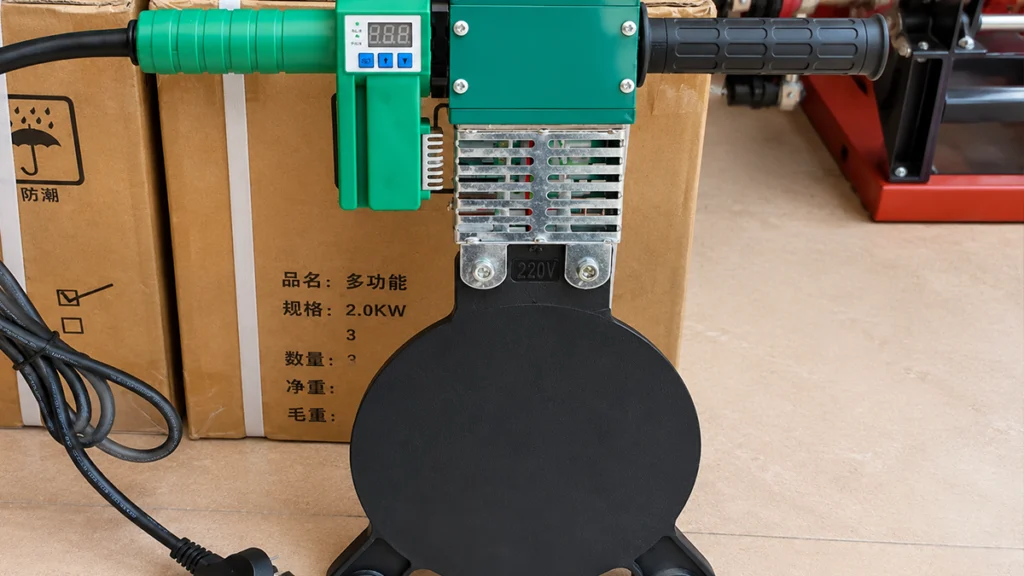
It all comes down to a temperature-controlled, PTFE-coated heating plate. First, the butt fusion machine firmly clamps the two pipe ends and mills them perfectly flat. Next, the operator inserts the heating plate to melt the polymer chains. Once the preset heating time wraps up, the plate pulls back. Hydraulic cylinders immediately drive the molten surfaces together. As the material cools under steady pressure, those polymer chains crosslink. The result? A single, homogeneous joint that frequently outlasts the pipe itself.
What materials can be welded with this equipment?
Manufacturers engineer industrial butt fusion equipment specifically for thermoplastic polymers. You’ll mostly see it used on standard Polyethylene (PE), High-Density Polyethylene (HDPE, PE100, PE80), Polypropylene (PP), and Polyvinyl Chloride (PVC). Because the equipment offers pinpoint temperature control, operators can easily adapt the heat to match the specific melt flow index of each polymer grade. That flexibility guarantees structural integrity across vastly different pipeline setups.
When is butt welding preferred over socket or electrofusion?
You want butt fusion for long, straight pipeline runs and massive diameters—anywhere from 63mm up to an imposing 1600mm or more. It delivers unmatched structural integrity alongside the lowest per-joint cost for large-scale networks. Electrofusion, on the other hand, works best in tight spaces. Contractors save it for complex repairs, elbows, or mismatched wall thicknesses where a bulky clamping frame simply won’t fit. Meanwhile, socket fusion remains strictly bound to small-diameter internal plumbing, generally under 110mm.
Why Butt Welding Matters for Water and Mining Projects in Suriname
Why are leak-free joints critical in long pipeline runs?
Mining tailings pipelines push highly abrasive slurries packed with water, fine minerals, and suspended solids. In these high-head pumping systems, a 100% leak-free, homogeneous joint isn’t just nice to have—it is mandatory. Even a single failure triggers severe environmental contamination, ridiculously expensive hazardous cleanups, and catastrophic pressure loss across the entire grid. Butt welding steps up by completely eliminating mechanical fittings, effectively wiping out the main points of failure in these brutal environments.
How do heat, humidity, and remote access affect project planning?
Suriname’s climate throws serious curveballs at pipeline construction. Sky-high humidity and sudden downpours constantly threaten fusion integrity. To prevent weak or “cold” joints, crews must fiercely protect the welded connections from water, wind, and dust during the vital heating and cooling phases. Out in remote areas, deploying portable PE pipe welding machine allows contractors to maintain strict ISO 21307 compliance—even when operating miles away from basic infrastructure.
What problems does poor fusion create in water and slurry lines?
A poor fusion creates a hidden time bomb. During the intense crosslinking and post-crystallization phases of PE100 pipe, a substandard joint becomes a localized weak link. Toss in the high flow velocity and particle hardness of mining slurries, and that joint will inevitably fail. In municipal water lines, these botched welds show up as slow leaks. Over time, they wash out road foundations and slash system pressure, driving up massive non-revenue water losses.
Factory-direct pricing with technical consultation included
Get Your Free QuoteWhich Butt Welding Machine Types Are Available?
What are the differences between manual, semi-automatic, and hydraulic models?
Picking the right configuration directly impacts your project’s efficiency and joint traceability.
| Machine Type | Control System | Best Application | Key Features |
|---|---|---|---|
| Manual | Hand-operated hydraulic pump | Small diameters, low-budget utility work | Basic operation; success relies heavily on the operator's skill level. |
| Semi-Automatic | Intelligent data control instruments | Standard water and mining projects | Calculates precise parameters, issues process reminders, and handles automatic data logging. |
| CNC / Fully Auto | Programmable Logic Controller (PLC) | High-pressure, strict QA environments | Locks parameters during fusion; any interruptions trigger a mandatory system restart. |
What pipe diameter range does each model suit?
Manufacturers categorize equipment based on maximum clamping capacity. Small to medium butt fusion welding machines tackle ranges like 63-200mm, 90-250mm, and 160-315mm. These units prove incredibly versatile for municipal distribution jobs. Large-scale butt fusion machines step up to handle 280-450mm, 400-630mm, and 710-1000mm pipes, which contractors primarily use for transmission mains. Need something bigger? Custom mining models are built for massive infrastructure, easily clamping pipes up to 1200mm or even 1600mm. Frequently, buyers hunt for a butt fusion welding machine for 160mm 200mm 315mm pipes just to cover standard utility dimensions in one go.
Which configuration fits field work versus workshop use?
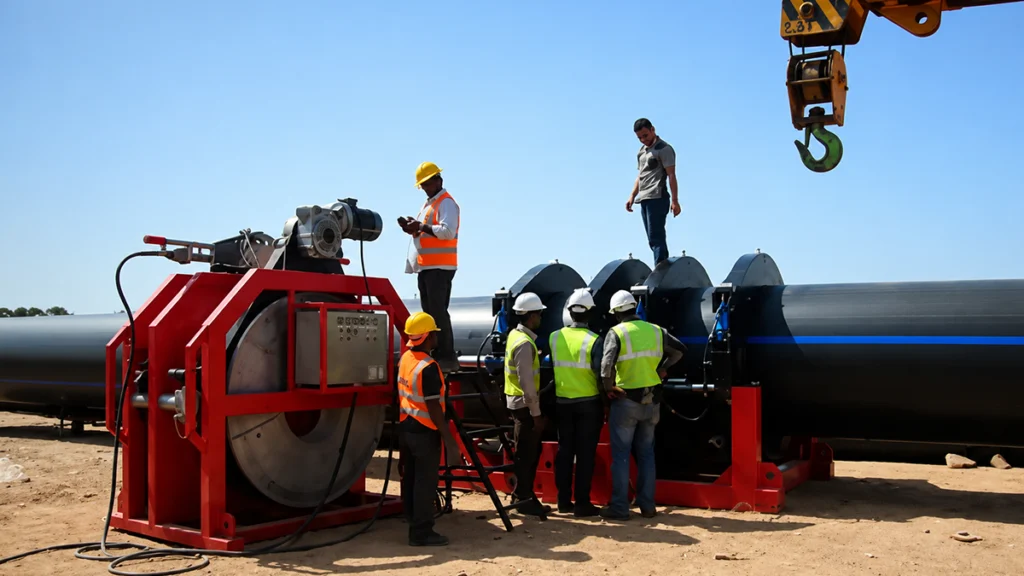
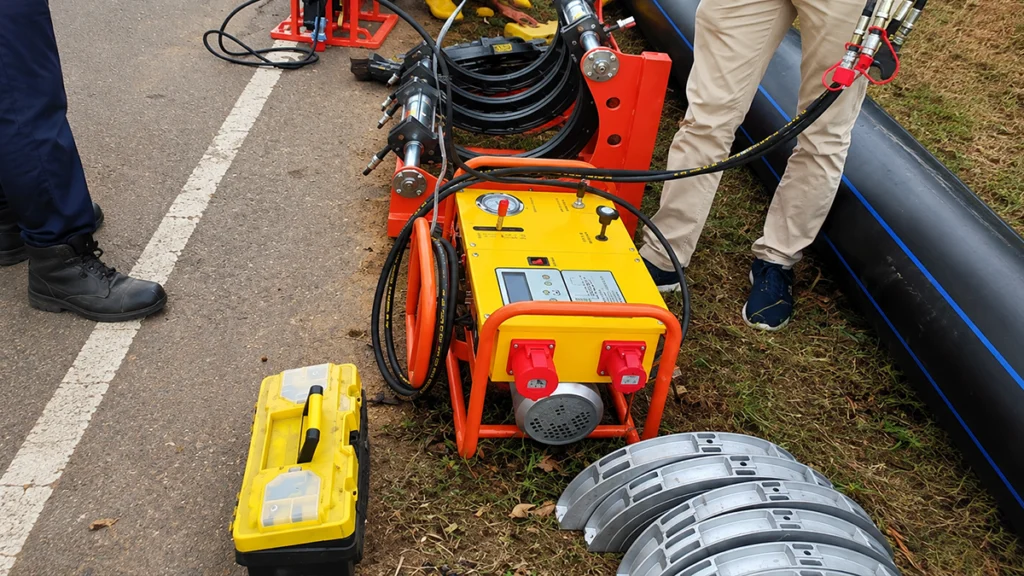
Field HDPE pipe welding machines boast mobile, heavy-duty frames. They come armed with shockproof pressure gauges and pull-out plate structures built to survive rugged, muddy job sites. Workshop machines, by contrast, stay bolted down. They focus entirely on extreme precision to fabricate segmented bends, tees, and crosses. While field units prioritize easy maneuverability and seamless generator compatibility, workshop units excel at multi-angle clamping and automated material handling.
What Technical Specifications Should You Check Before Buying?
Which voltage, power, and generator compatibility matter?
Power demands scale aggressively as pipe diameters grow. A small 250mm HDPE pipe jointing machine typically runs on a 220V, 50Hz single-phase supply, pulling about 4.21 kW of total power. Jump to a massive 800mm HDPE pipe welding machine, and you suddenly need a 380V, 50Hz three-phase supply drawing anywhere from 16.9 kW to 23.5 kW. When sourcing industrial PE pipe fusion equipment with generator compatibility, contractors must verify that their generator can handle the peak load during the heating plate’s initial warm-up phase. If it can’t, voltage drops will ruin the weld.
| Specification | Small/Medium Machine (e.g., 250mm) | Large Machine (e.g., 800mm) |
|---|---|---|
| Voltage | 220V, 50Hz (Single Phase) | 380V, 50Hz (Three Phase) |
| Total Power | ~4.21 kW | 16.9 kW – 23.5 kW |
| Temp Range | 0–270°C | 0–270°C |
| Pressure Range | 0–6.3 MPa | 0–16.0 MPa |
Why do heating plate temperature control and pressure accuracy matter?
Most heating plates offer a temperature control range of 0–270°C. However, the metric that actually matters is the deviation tolerance. It absolutely must stay within ±3°C to ±5°C across the entire plate surface. Uneven heating causes asymmetrical melting, which guarantees a joint failure down the road. Pressure accuracy is just as critical. System pressure adjustments range from 0–6.3 MPa for standard pipes up to a staggering 0–16 MPa for heavy-duty, thick-walled variants. This ensures the pipe fusion machine holds the exact drag and fusion pressure without flinching.
Which clamp range, reducer set, and hydraulic capacity should match your pipe sizes?
You don’t need a different butt fusion machine for every pipe size. A single unit handles multiple diameters using interchangeable reducer inserts. Take a 250mm HDPE pipe welding machine, for example: it ships with aluminum inserts for 110, 125, 140, 160, 180, 200, and 225mm outer diameters. Just make sure the machine’s hydraulic capacity easily exceeds the drag resistance of your heaviest pipe string. The cylinders must be strong enough to pull the pipe ends together lightning-fast during the critical changeover phase.
Get detailed specs and custom configuration options
Request Technical SpecificationsHow Do You Choose the Right Machine for Your Project?
What questions should procurement teams answer first?
Before figuring out how to choose butt welding machine for Suriname projects, procurement teams need to lock down a strict checklist:
1. What is the exact pipe Outer Diameter (OD) range?
2. What is the Standard Dimension Ratio (SDR) or wall thickness?
3. What is the required daily joint output?
4. Will the project follow ISO/DVS (low pressure) or ASTM (high pressure) welding standards?
How do pipe diameter, wall thickness, and daily output affect selection?
Thicker walls (which mean a lower SDR) demand longer heating and cooling times. This directly slashes your daily output. Upgrading to CNC automatic butt fusion machines helps claw that time back, bumping production from 24-48 joints per day up to a solid 40-70 joints on 4-8 inch pipes. Furthermore, pricing and selection hinge entirely on component quality. Smart buyers rigorously evaluate the origin of the hydraulic valves, the precision of the pressure sensors, and the reliability of the internal PLC control system to ensure high daily output isn’t derailed by sudden breakdowns.
What should you choose for a fixed plant, road project, or remote mining site?
Remote mining sites punish equipment. They demand pipe fusion machines with exponentially higher clamping force and incredibly rigid frames. An 800mm butt fusion welding machine, for example, needs a hydraulic cylinder piston area of at least 23,179 mm² just to handle the crushing weight of massive HDPE pipes. Fixed plants can easily get away with standard wheeled frames. Tricky road projects, however, benefit massively from tracked, self-propelled pipe fusion machines that completely eliminate the need for secondary lifting cranes.
Where Is a Butt Welding Machine Used in Suriname Projects?
How is it used in water transmission and distribution pipelines?
For municipal infrastructure, crews deploy an HDPE butt fusion machine for water projects to build sprawling water transmission mains and urban distribution networks. Because PE pipes flat-out refuse to corrode like steel, they completely eliminate the headache of cathodic protection and internal coatings. Butt welding ensures the entire network remains perfectly sealed against both groundwater infiltration and internal pressure leaks.
Where does it fit in mining water supply, tailings, and slurry transport lines?
Mining operations lean heavily on tough PE100 pipes thanks to their aggressive chemical resistance and sheer durability. A knowledgeable butt welding machine supplier for mining projects will always specify heavy-duty equipment for high-head water diversion, tailings pipeline systems, and slurry transport lines. Those homogeneous joints handle the harsh chemical makeup and intense density of mining slurries infinitely better than traditional flanged or mechanical connections.
Can it support temporary site utilities and contractor yards?
Absolutely. Adjustable welding positions and low start-up pressures make these butt fusion machines perfect for fabricating temporary site utilities, dewatering lines, and contractor yard fittings. Being able to rapidly mobilize a machine to weld temporary bypass lines means that your primary construction or mining activities won’t grind to a halt over sudden water management issues.
What Do Price, MOQ, Lead Time, and After-Sales Support Depend On?
Which options increase machine price?
The hydraulic butt fusion machine price in Suriname essentially boils down to automation levels and raw material quality. Basic models might kick off around 30,000 RMB, while high-end, advanced units easily blow past 100,000 RMB. Costs jump when you start adding CNC automation, premium PTFE coatings on the heating plate, high-grade tool steel milling cutters, and dual-channel timers. Throwing in data logging capabilities and cloud integration for QA traceability will also bump up your initial capital expenditure.
How do spare parts, training, and calibration support affect total cost?
Never look solely at the sticker price. The Total Cost of Ownership (TCO) is massively impacted by the availability of consumable spare parts like milling blades and pressure sensors. To maintain strict DVS 2207-1 or ASTM F2620 compliance, you must schedule annual professional equipment inspections, hydraulic calibration services, and PLC security upgrades. Skimping on local training support is a classic mistake—operator errors can easily cost thousands in scrapped materials and rework.
What should buyers confirm before placing an order?
Before signing any purchase orders, buyers need ironclad contracts detailing the exact equipment models, clamping ranges, and the precise quantity of reducer inserts. Always confirm the lead time (expecting 1-2 business days for standard parts shipping) and lock in warranty terms, like a 15-day return policy for defective components. Most importantly, demand clear documentation regarding electrical requirements and generator sizing right up front to avoid job site power failures.
How Does the Butt Fusion Process Work and How Is Quality Verified?
What is the correct welding sequence from preparation to cooling?
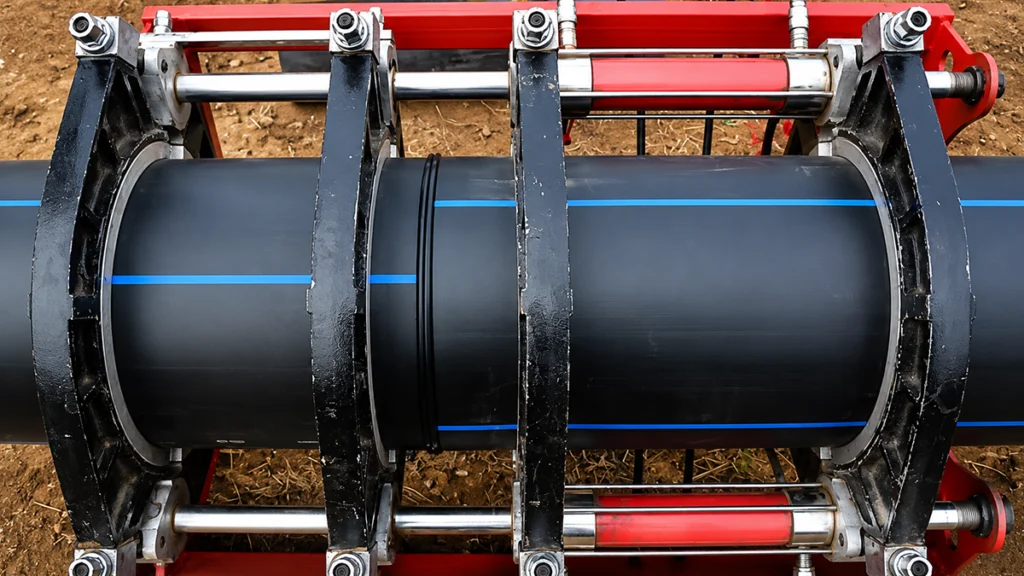
The butt fusion process relies on a highly regimented 5-stage sequence:
1. Beveling/Milling: The milling cutter shaves down the pipe ends to erase gaps and strip away any oxidation.
2. Heating: The operator inserts the plate at roughly 210°C. Initial pressure is applied until a bead forms, then it drops to a lower drag pressure (P2) for heat soaking.
3. Changeover/Transition: The heating plate pulls out. Crews must execute this stage lightning-fast to prevent critical heat loss.
4. Welding: The butt fusion machine presses the pipes together at the strictly calculated fusion pressure (P1).
5. Cooling: The joint stays locked under strict hydraulic pressure until it naturally drops back to ambient temperature.
How do you inspect bead shape, alignment, and pressure?
Visual inspection serves as the first line of defense in quality control. A flawless flared joint (the bead) must show a smooth, symmetrical roll-back around the entire circumference of the pipe. Critically, the lowest point of the flare cannot dip below the pipe’s outer surface. Inspectors hunt for any signs of impurities, tiny pinholes, or asymmetrical distortion. These red flags instantly point to misalignment or uneven heating.
What records should be kept for QA and handover?
Major water and mining projects demand an airtight joint traceability system. CNC automatic butt fusion machines handle this automatically. They log specific fusion parameters, the operator’s ID, the exact date, GPS coordinates, ambient temperature, and drag pressure measurements for every single joint. During project handover, contractors compile and submit these digital logs to mathematically prove full compliance with ISO or DVS standards.
What Are the Common Mistakes and Risks to Avoid?
How do bad preparation and contamination cause failure?
Skipping the proper cleaning of the V-groove or failing to shave off the oxide scale during milling actively stops the polymer chains from bonding. Worse, exposing the joint to water, wind, or dust during the heating or cooling phases virtually guarantees a fatal “cold fusion.” In Suriname’s highly humid environment, trying to weld without a protective tent is a fast track to compromising the entire pipeline.
Why do underpowered machines struggle on larger diameters?
Throwing an underpowered HDPE pipe welding machine at a heavy mining slurry line guarantees insufficient clamping force. During the crucial heat absorption stage, a heavy pipe string can actually rebound or slip inside the clamps, pulling away from the heating plate. If the hydraulic cylinders lack the required piston area, they simply cannot generate the rapid fusion pressure needed during the changeover phase. The end result? A dangerously weak, brittle joint.
What training gaps create rework and delays?
The most frequent operator error involves manually tweaking equipment parameters without engineering approval. Another fatal mistake is popping the pipe out of the butt fusion machine’s clamps before the cooling cycle fully finishes. Releasing that pressure prematurely places extreme stress on the still-warm polymer chains. This triggers immediate internal micro-cracking and guarantees eventual joint failure.
How Can Buyers Request the Right Quote and Model Recommendation?
Which project details should be included in a quotation request?
To score an accurate proposal for a butt welding machine for water pipeline contractors, buyers must hand over exact specifications. Your request needs to clearly list the exact pipe Outer Diameters (ODs), SDR ratings, material type (like PE100), and the specific regulatory standard demanded by project engineers (whether that’s ISO 21307, DVS 2207-1, or ASTM F2620).
What documents or drawings help suppliers respond accurately?
Handing over the overall pipeline pumping system guide, operating pressure specs, and anticipated surge pressures lets suppliers recommend the perfect butt fusion welding machine frame and hydraulic capacity. If your pipeline crawls up steep inclines or involves heavy dragging, share the topographical site plan. This allows the supplier’s engineering team to accurately calculate the necessary drag pressure compensation.
How do you compare two models before purchase?
When stacking quotes from different manufacturers side-by-side, look way past the base price. Scrutinize the total piston area of the hydraulic cylinders, check the kilowatt rating of the heating plate, and verify the quality of the PTFE coating. Ask if the butt fusion welding machine actually supports data logging and cloud integration for QA traceability. A rig with massive hydraulic capacity and automated data logging always delivers a superior long-term ROI by speeding up production and drastically slashing failure rates.
FAQ
Q1: What size butt welding machine do I need for PE pipe in Suriname?
The ideal size depends entirely on your pipe’s outer diameter (OD). For everyday municipal distribution, a 160-315mm machine usually does the trick. However, for large-scale transmission lines or heavy mining tailings, you’ll need heavy-duty rigs capable of clamping 630mm, 800mm, or even up to 1600mm. Always match the machine’s maximum capacity to the absolute largest pipe diameter on your site.
Q2: Is a hydraulic butt fusion machine better for mining projects?
Absolutely. Mining projects utilize thick-walled PE100 pipes laid across rugged terrain. A hydraulic machine delivers the massive, unrelenting clamping force necessary to pull those heavy pipe strings together during fusion. Manual machines simply can’t generate the required pressure for large-diameter mining slurry lines, which inevitably leads to catastrophic joint failures.
Q3: How much does a butt welding machine cost in Suriname?
Pricing swings wildly based on size and automation levels. A basic manual or small semi-automatic rig might start around 30,000 RMB. On the flip side, large-diameter CNC machines packed with advanced data logging and premium hydraulic sensors can easily top 100,000 RMB. Don’t forget that import duties, shipping fees, and essential spare parts will also bump up your final landed cost.
Q4: Can one machine weld both water pipeline and mining pipeline PE pipes?
Yes, as long as the pipe diameters fall safely within the machine’s clamping range and reducer set. The core fusion principles for water and mining PE/HDPE pipes remain exactly the same. Keep in mind, though, that mining pipes usually feature thicker walls (a lower SDR). Your machine must pack enough hydraulic capacity and heating horsepower to handle that heavier material.
Q5: What power supply is needed for a butt welding machine on remote sites?
Small to medium rigs typically run fine on a 220V single-phase generator pushing about 5 kW. Large-diameter machines, however, are power hungry. They demand a robust 380V three-phase generator capable of delivering anywhere from 17 kW to 25 kW or more. You must ensure the generator can absorb the peak heating load without voltage fluctuations, otherwise, you’ll lose precise plate temperature control.
Q6: How do I know if the welded joint meets quality requirements?
A top-tier joint showcases a smooth, perfectly symmetrical bead rolled back evenly around the entire circumference of the pipe. Crucially, the lowest point of that bead must never drop below the pipe’s outer surface. Advanced CNC automatic butt fusion machines verify this quality on the spot by recording temperatures, fusion pressures, and cooling times, generating a digital log that mathematically proves you hit standards like DVS 2207-1.
Q7: Should I choose butt fusion or electrofusion for PE pipes?
Go with butt fusion for long, straight pipeline runs and large diameters. It’s significantly faster and far more cost-effective per joint. Save electrofusion for confined spaces, tricky trench repairs, installing elbows, or joining pipes with mismatched wall thicknesses—basically, anywhere a bulky butt welding frame physically cannot fit.
Conclusion
Choosing the right butt welding machine in Suriname requires careful consideration of pipe diameter, SDR, site conditions, power supply, and project requirements. For municipal water, mining, industrial, and other HDPE pipeline applications, stable temperature control, reliable hydraulic pressure, accurate alignment, and suitable machine capacity all contribute to consistent fusion quality.
Buyers should also evaluate data logging, generator compatibility, spare parts availability, operator training, calibration support, and compliance with relevant ISO or DVS welding requirements. Rather than focusing only on the initial machine price, comparing the total cost of ownership can help project teams select equipment that better matches long-term operating needs.
For demanding site conditions, a well-matched butt fusion machine with reliable technical support can improve welding consistency, reduce downtime, and support more efficient pipeline installation.
Let our experts help you choose the right equipment for your project
Contact Our Engineering Team