
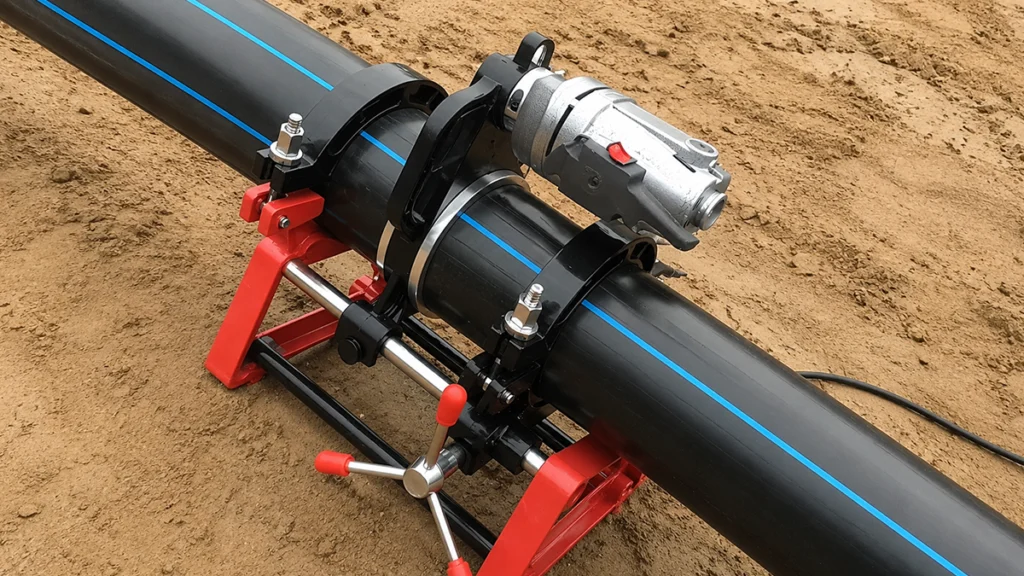
Manual vs Hydraulic vs Automatic Butt Fusion Machines: Which One Should You Buy?
Table of Contents
This guide compares manual, hydraulic, and automatic butt fusion machines across pipe size, pressure control, cost, certification, and project fit, helping B2B buyers, contractors, and procurement managers choose the right HDPE pipe welding machine with confidence.
What Is a Butt Fusion Machine and How Does It Work?
Think of a butt fusion machine as the heavy-duty workhorse of thermoplastic pipe joining. These electromechanical devices tackle a highly specific job: facing, melting, and pressing two pipe ends together under strictly controlled pressure. The result? A seamless, leak-proof bond. In fact, a properly fused joint frequently ends up stronger than the original pipe itself.
Definition of a butt fusion machine
At a fundamental level, this equipment acts as the primary joining tool for continuous pipeline construction. It perfectly aligns the pipe ends before applying intense thermal energy through a PTFE-coated heating plate. From there, mechanical or hydraulic force drives the melted ends together to forge a homogeneous joint—completely eliminating the need for chemical solvents or additional filler materials.
How does the butt fusion welding process work?
To guarantee joint integrity, the butt fusion welding process follows a rigid, non-negotiable five-step sequence:
1. Positioning and Clamping: Operators secure the pipes directly into the butt fusion machine chassis to lock in perfect axial alignment.
2. Milling and Beveling: A high-speed planer shaves down the pipe ends. This removes oxidation and eliminates any gaps, leaving perfectly parallel faces.
3. Heating and Heat Absorption: The operator inserts the heating plate. The butt fusion welding machine presses the pipe ends against this hot surface until a specific melt bead forms. Pressure then drops to almost zero, letting the heat penetrate deeply into the polymer.
4. Heater Removal: The plate gets yanked out quickly. Minimizing this transition time is crucial so the melted plastic doesn’t start cooling prematurely.
5. Cooling Under Pressure: Finally, the machine drives the melted ends together at a carefully calculated interfacial pressure. The pipes remain stationary under this force until the joint cools down to ambient temperature.
Which pipe materials and sizes are compatible?
Manufacturers engineer these butt fusion welding machines specifically to handle thermoplastic polymers. That means you can weld Polyethylene (PE), High-Density Polyethylene (HDPE), Polypropylene (PP), PP-R, PP-C, and Polyethylene of Raised Temperature Resistance (PERT). Depending on how you configure the chassis and clamps, a single unit might tackle anything from a small DN40 pipe right up to massive DN3000 municipal conduits.
Manual vs Hydraulic vs Automatic Butt Fusion Machines: Quick Comparison
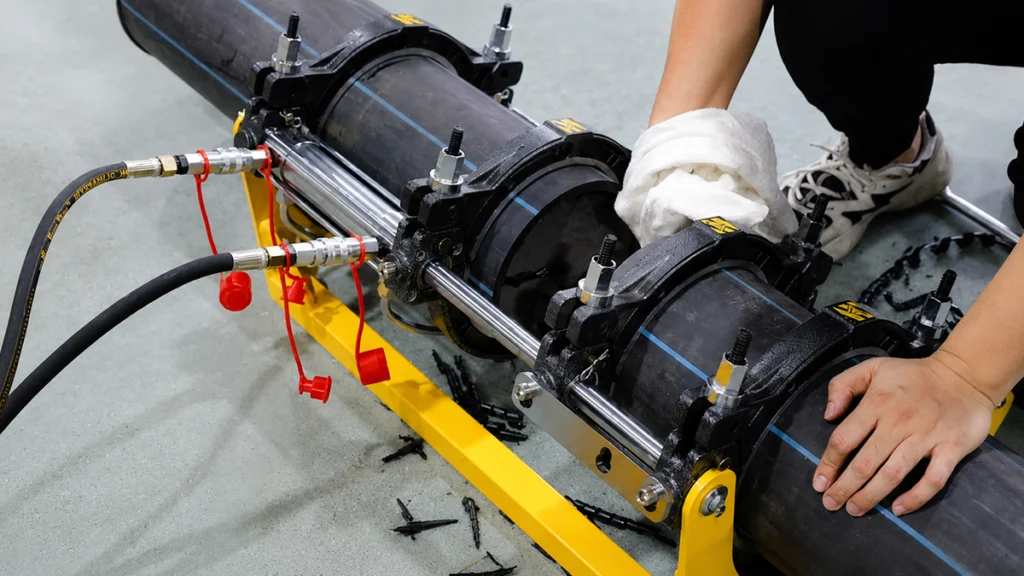
A manual vs hydraulic butt fusion machine comparison helps buyers understand the key differences in cost, labor input, weld quality, and project suitability. When automatic CNC units are added to the comparison, it becomes easier to see which butt fusion machine is best for different HDPE pipe welding applications. The main difference between these machine types lies in how they generate, control, monitor, and record interfacial pressure throughout the fusion process.
Side-by-Side Comparison: Manual, Hydraulic, and Automatic CNC Butt Fusion Machines
| Feature | Manual Butt Fusion Machine | Hydraulic Butt Fusion Machine | Automatic CNC Butt Fusion Machine |
|---|---|---|---|
| Operation Mode | Manual carriage movement and joining-force control | Hydraulic carriage movement and fusion-pressure control | Hydraulic operation with computerized process control |
| Typical Pipe Range | Approximately 40–160 mm | Varies by model; suitable for medium and large pipe diameters | Approximately 160–630 mm |
| Pressure Control | Mainly controlled by the operator | More stable hydraulic fusion-pressure control | Automated control of selected welding parameters |
| Data Logging | Usually requires manual welding records | Manual or optional digital records, depending on configuration | Automatic or optional digital data logging, depending on the model |
| Productivity | Suitable for occasional and small-scale welding work | Suitable for regular municipal, industrial, and infrastructure projects | Suitable for high-volume and traceability-focused projects |
| Best Fit For | Repairs, irrigation, and small-diameter pipelines | Municipal water, industrial, mining, drainage, and infrastructure pipelines | Utility and infrastructure projects requiring repeatability and weld records |
| Main Limitation | Greater dependence on operator experience | Heavier equipment and requires a suitable hydraulic power unit | Higher initial investment and requires trained technical support |
Actual pipe ranges, automation functions, data-recording capabilities, power requirements, and machine configurations vary by model and manufacturer.
Which type is best for small contractors, large projects, or factories?
Manual units are the go-to for smaller contractors handling localized repairs or low-pressure agricultural irrigation on a tight budget. Step up to medium-to-large civil engineering jobs—like municipal water distribution or heavy mining infrastructure—and hydraulic units become the industry standard. However, if you are tackling large-scale utility contracts, gas distribution networks, or running a factory-based prefab workshop, fully automatic (CNC) units aren’t just an option; they are mandatory. In those environments, absolute traceability and zero-defect tolerances leave no room for compromise.
Key differences in pressure control and weld consistency
When you compare different butt fusion types—or even weigh a butt fusion machine vs electrofusion machine—pressure control stands out as the ultimate defining metric. Manual machines rely entirely on human muscle, which naturally leads to inconsistent welds. Hydraulic units step up the power using an open-loop system with manual directional valves. They deliver massive force, but the operator still has to manually adjust for drag. CNC automatic machines fix this by using a closed-loop system packed with electronic feedback sensors. They automatically compensate for drag and maintain exact interfacial pressure, completely cutting human error out of the equation.
Factory-direct pricing with technical consultation included
Get Your Free QuoteManual Butt Fusion Machine: Features, Advantages, and Limitations
A manual butt fusion machine uses mechanical levers, handwheels, or other manually operated mechanisms to move the carriage and apply joining force. Its simple construction makes it suitable for smaller-diameter HDPE pipes, repairs, irrigation systems, and projects with relatively low welding volumes.
Typical Pipe Size Range and Operating Method
Manual butt fusion machines are generally designed for smaller pipe diameters, although the exact range varies by model and manufacturer. Many common units cover approximately 40–160 mm, while some larger manual models may support additional sizes. Operators must manually manage carriage movement, alignment, heating time, joining force, and cooling time according to the selected fusion procedure.
Advantages: low cost, portability, simple maintenance
Manual machines usually require a lower initial investment than hydraulic or CNC models. Their compact structure and lower weight make them easier to transport between job sites, especially in areas with limited access. Maintenance is also relatively straightforward, but the heater plate, facer, clamps, guide rails, fasteners, and electrical components still require regular inspection and cleaning.
Limitations: weld consistency, operator dependency, productivity
Manual butt fusion machines require more operator involvement throughout the welding cycle. Joint consistency depends on correct pipe preparation, alignment, heating, joining force, and cooling time. Most manual models do not include automatic parameter control or integrated data logging, and productivity may be lower during repetitive or high-volume work.
When Should You Buy a Manual Butt Fusion Machine?
A manual butt fusion machine may be suitable for small-diameter pipelines, farm irrigation, maintenance work, repairs, and occasional welding projects where portability and lower investment are priorities. For frequent welding, larger pipe diameters, demanding project documentation, or more consistent pressure control, a hydraulic or automatic machine may be more appropriate.
Hydraulic Butt Fusion Machine: Features, Advantages, and Limitations
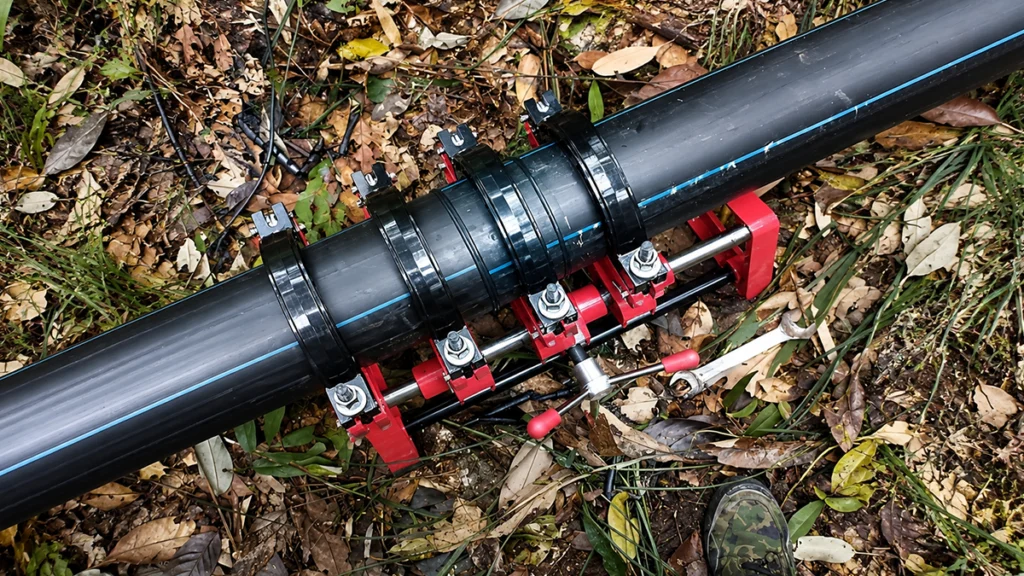
A hydraulic butt fusion machine uses a hydraulic power unit to move the carriage and apply controlled fusion pressure. Compared with a manual machine, it provides more stable pressure control and is commonly used for municipal water, industrial, mining, drainage, and infrastructure pipeline projects.
How Does the Hydraulic Clamping and Pressure System Work?
The hydraulic power unit supplies pressurized fluid to the machine cylinders, which control carriage movement and joining pressure. The operator uses the control valves and pressure gauge to manage alignment, drag pressure, fusion pressure, and cooling pressure according to the selected welding procedure. Hydraulic-system design, clamp materials, connectors, and control functions vary by model and manufacturer.
Pipe Size Ranges and Common Configurations
Hydraulic butt fusion machines are available in a wide range of sizes. Smaller models may cover pipe diameters such as 63–250 mm or 160–315 mm, while heavy-duty machines can be designed for much larger pipes. The actual welding range, reducing inserts, machine weight, power requirements, and site configuration should be confirmed from the manufacturer’s technical specifications. For trench or confined-space work, some systems allow the hydraulic unit to be positioned separately from the main clamping chassis.
Advantages: precise pressure, faster cycles, larger diameters
Hydraulic operation provides more consistent carriage movement and fusion-pressure control, helping operators follow the required heating, joining, and cooling stages. It can also reduce physical effort and improve productivity during repeated welding work. Hydraulic machines are particularly suitable for medium- and large-diameter pipes, including thicker-walled or lower-SDR pipe systems.
Limitations: weight, operator training, manual data recording
Hydraulic machines are generally heavier and more complex than manual models. Operators still need training to calculate or confirm drag pressure, set welding parameters, monitor the process, and inspect the completed joint. Some models require manual welding records, while others can be equipped with timers, data loggers, or digital control systems. Larger machines may also require lifting equipment, suitable power supplies, and regular hydraulic-system maintenance.
Get detailed specs and custom configuration options
Request Technical SpecificationsAutomatic CNC Butt Fusion Machine: Features, Advantages, and Limitations
An automatic CNC butt fusion machine combines hydraulic operation with computerized process control. Depending on the model, it can control selected stages such as heating, changeover, fusion pressure, and cooling while recording key welding parameters. Automation can reduce operator-related variation, but trained personnel are still required for pipe preparation, alignment, cleaning, machine setup, and final inspection.
PLC Control, Automatic Welding Cycle, and Data Logging
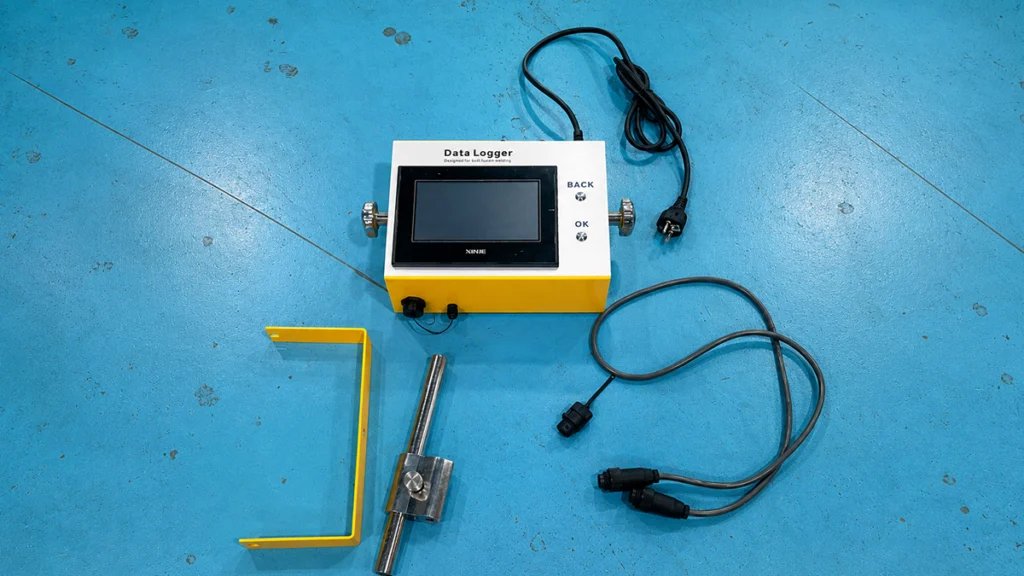
The control system allows the operator to enter or select information such as pipe diameter, material grade, SDR, and the applicable welding procedure. The machine then manages the supported process parameters and may record temperature, pressure, time, and joint information for quality documentation. Available functions—such as USB export, printer output, cloud transfer, alarms, and displacement monitoring—vary by model and configuration.
Compliance with ISO 12176 and Applicable Welding Procedures
ISO 12176-1 specifies general characteristics and performance requirements for equipment used for butt fusion jointing of PE piping systems. DVS 2207-1 provides guidance for heated-tool welding of PE-HD pipes and pipeline components. Compliance should be verified through the machine’s technical documentation, calibration records, and the requirements of the specific project.
Advantages: traceability, weld quality, reduced human error
Automatic CNC machines can improve process repeatability and simplify welding documentation by controlling selected parameters and recording joint data. These functions are particularly useful for projects requiring quality records, traceability, and consistent procedures across a large number of welds. However, automation cannot guarantee defect-free joints or eliminate the need for trained operators and inspection.
Limitations: higher CAPEX and training requirements
Automatic CNC machines generally have a higher initial cost than standard hydraulic models because they include additional controllers, sensors, software, and data-recording components. Operators and maintenance personnel require training in system setup, calibration, diagnostics, and data management. Spare-part availability, software support, sensor replacement, and after-sales service should therefore be confirmed before purchase.
Application Scenarios: Which Machine Fits Which Project?
Choosing the right equipment architecture requires matching the butt fusion welding machine’s capabilities directly to your project’s demands. It is a delicate balancing act between maintaining engineering compliance and keeping your budget intact.
Water supply and irrigation pipelines
For agricultural irrigation, gravity mains, and standard water distribution networks, you rarely need more than a manual or standard hydraulic machine. These lines usually operate at pressures well below 10 bar. Standard hydraulic units easily forge joints strong enough to handle these loads, saving you the expense of premium CNC data logging features.
Gas distribution and high-risk pipelines
Gas networks are a completely different beast. Operating under volatile conditions, a single joint failure here can trigger a catastrophic event. Because of this massive liability, most jurisdictions legally require a CNC automatic butt fusion machine for gas and water pipelines. The automated data logger acts as your insurance policy, providing the verifiable proof of joint integrity that utility regulators demand.
Mining, dredging, and industrial applications
Industrial applications like dredging operations and mining slurries push equipment to the absolute limit, pumping highly abrasive materials under extreme pressure. You must use thick-walled HDPE pipes (think SDR 7.4 or SDR 9) to survive these conditions. Only heavy-duty hydraulic or CNC butt fusion machines can generate the massive interfacial pressure required to forge leak-proof joints in these harsh environments.
Prefab HDPE fittings workshops and fabrication shops
Step inside a factory fabricating tees, wyes, and elbows, and you will see a relentless demand for geometric precision and high throughput. Workshop-based CNC HDPE pipe jointing machines dominate these environments. They join pipe segments under highly controlled conditions, ensuring that every fabricated fitting easily clears strict factory QA testing long before it ever ships out to the field.
Key Technical Specifications to Compare Before You Buy
When you sit down to evaluate a butt fusion machine manufacturer and supplier, ignore the glossy marketing brochures. Procurement managers need to dig into the hard engineering specs. These numbers ultimately dictate both your weld quality and the butt fusion machine’s operational lifespan.
Pipe diameter range (OD min/max) and SDR compatibility
Always verify the exact butt fusion machine size range mm. A unit rated for DN315 usually comes with reducing inserts so you can weld all the way down to DN90. But do not stop at the diameter—check the SDR compatibility. Pushing a thick-walled pipe like SDR 9 requires drastically more hydraulic cylinder force than a thin-walled SDR 26 pipe, even if both share the exact same outside diameter.
Heating plate temperature accuracy and PTFE coating
Your heating plate needs to be cast from fast-conducting aluminum alloy (specifically the ZL104 standard) to guarantee perfectly uniform heat distribution. Scrutinize the temperature accuracy specs. The plate must hold its setpoint (usually between 200°C and 230°C for HDPE) with a tight variance of no more than ±5°C. Finally, a premium, non-stick PTFE coating is absolutely mandatory. Without it, molten polymer will stick to the plate during the crucial removal phase, ruining the weld.
Planer power, blade type, and safety interlock
The planer—or milling cutter—needs high-speed carbon steel blades that can aggressively shave thick HDPE without bogging down the motor. Always look for a rugged chain drive system; weak belt drives will eventually slip and fail under heavy loads. Also, confirm the planer incorporates a safety micro-switch interlock. This vital feature ensures the motor will not spin unless the unit is securely seated inside the HDPE pipe welding machine chassis, preventing serious job site injuries.
Hydraulic pressure range, gauges, and data logging features
Dig deep into the butt fusion machine specifications and pressure capabilities. The hydraulic pump must effortlessly hit and hold the DVS standard interfacial pressure of 0.15 N/mm² (≈ 1.5 bar), plus have enough overhead to overcome the drag pressure of the heavy pipe. If you are buying a CNC model, double-check that its displacement detection system can measure pipe melt-down accurately down to the millimeter during the heating phase.
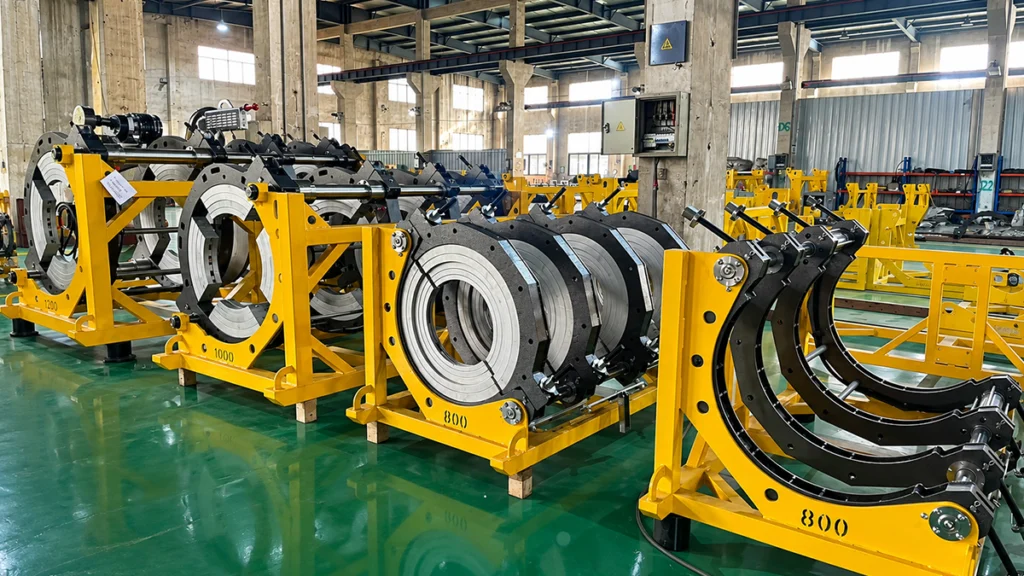
Cost, MOQ, Lead Time, and Total Cost of Ownership
Smart pipeline equipment procurement means looking far beyond the initial invoice. You have to analyze the upfront capital expenditure alongside the long-term operational costs of labor, routine maintenance, and the devastating financial impact of potential rework.
Price range comparison: manual, hydraulic, and CNC automatic
Capital costs jump significantly as you add automation. You can pick up a manual unit for anywhere from a few hundred to a thousand dollars. A standard hydraulic butt fusion welding machine price usually sits between $2,000 and $8,000, scaling up with its diameter capacity. Want a fully automatic CNC automatic butt fusion machine? Prepare to pay three to four times more than a basic hydraulic model. Large-diameter CNC units easily push into the $15,000 to $40,000 range.
MOQ, lead time, and shipping considerations
Most heavy butt fusion machinery manufacturers set a Minimum Order Quantity (MOQ) of just a single unit. Expect standard factory lead times to hover between 15 and 30 days for assembly and final calibration. If you are importing the equipment, run the math carefully on your shipping terms. Whether you choose FOB (Free on Board) or CIF (Cost, Insurance, and Freight), the sheer weight of heavy-duty hydraulic chassis and power units will heavily impact your ocean freight costs.
Spare parts, heating plate replacement, and maintenance cost
Industrial equipment wears down. Heating elements naturally degrade and need routine electrical resistance testing. The non-stick PTFE coating will eventually scratch, meaning you must either recoat or entirely replace the heating plate every 12 to 18 months, depending on your field volume. You also need to keep the guide pillars oiled and periodically drain the hydraulic oil-gas separators to stave off sudden system failures.
How to calculate total cost of ownership per welded joint
Never judge a HDPE pipe welding machine by its price tag alone. Instead, calculate your Total Cost of Ownership (TCO) per welded joint. Upgrading from a manual hydraulic setup to a fully automated CNC process might seem expensive upfront. However, on a standard six-month infrastructure project, a CNC automatic butt fusion machine can easily save you $20,000 to $30,000. It slashes cycle times, wipes out manual data entry hours, and prevents the catastrophic costs associated with joint failures and trench re-excavation.
Common Mistakes and Hidden Risks When Buying a Butt Fusion Machine
Buying capital equipment is a minefield of hidden risks that can easily inflate budgets and ruin tight pipeline schedules. Steer clear of these common procurement pitfalls.
Choosing the wrong size range for actual project pipes
Buyers frequently make the mistake of selecting a butt fusion machine based entirely on the maximum pipe OD, completely ignoring the SDR (wall thickness). Let’s say you buy a machine rated for DN315 SDR 17. If your project suddenly requires heavier DN315 SDR 9 pipe, your machine’s hydraulic cylinders simply won’t have the force to overcome the massive drag and interfacial pressure requirements. Suddenly, your expensive equipment is useless for the job at hand.
Ignoring welding standards (ISO 12176, DVS 2207, EN 12007)
If you fail to verify that a HDPE pipe welding machine is calibrated to strict standards like ISO 21307, EN 12007, or DVS 2207-1, you are practically guaranteeing joint failures. If the hydraulics cannot precisely lock in that crucial 0.15 N/mm² cooling pressure, your welds will fail ultrasonic testing. Municipal inspectors will immediately reject the work, halting your project in its tracks.
Underestimating after-sales, spare parts, and training
Your HDPE pipe jointing machine is only as dependable as the supply chain backing it up. If you buy from a vendor that won’t guarantee long-term spare parts availability, you are taking a massive gamble. A single scratched heating plate or a blown solenoid could paralyze a multi-million dollar pipeline job for weeks while you wait for proprietary replacement parts to ship.
Red flags when evaluating suppliers and quotations
Watch out for suppliers who lack their own R&D teams or refuse to hand over documented equipment calibration certificates. Review their quotation closely. If it lacks exact engineering details—like the specific PLC brand, the hydraulic pump displacement, or confirmation of ZL104 heating plate alloy—walk away. Vague quotes are a glaring red flag that you are dealing with low-grade, off-the-shelf assembly rather than professional industrial manufacturing.
How to Choose the Right Butt Fusion Machine: Final Recommendation
Nailing down the perfect fusion equipment is a high-stakes strategic move. You have to balance strict project compliance against upfront capital costs. Use a structured, logical approach to lock in your final procurement strategy.
Decision checklist: 6 questions to ask before purchase
Before signing off on any purchase order, force the supplier to answer these six crucial questions:
1. Does the manufacturer employ an independent R&D and engineering support team?
2. Will they provide official pre-shipment calibration certificates?
3. Do they offer ongoing software and system upgrades for their CNC models?
4. Will they give you a written guarantee ensuring spare parts availability for the next 5 to 10 years?
5. What exactly does the warranty cover, and for how long?
6. Can they prove the machine’s pressure output explicitly meets your local welding standards (such as ASTM, ISO, or DVS)?
Recommended machine type by buyer profile
If you are figuring out how to choose a butt fusion welding machine, start by matching your company profile to the right technology tier. Small contractors executing quick, localized water repairs should stick to manual butt fusion machines. Medium-to-large civil construction firms handling mining infrastructure or municipal water mains need to invest heavily in standard hydraulic butt fusion machines. Finally, gas network installers, utility companies, and professional prefab factories have no choice—they must purchase fully automatic CNC butt fusionmachines to ensure absolute traceability and regulatory compliance.
When to request a customized configuration
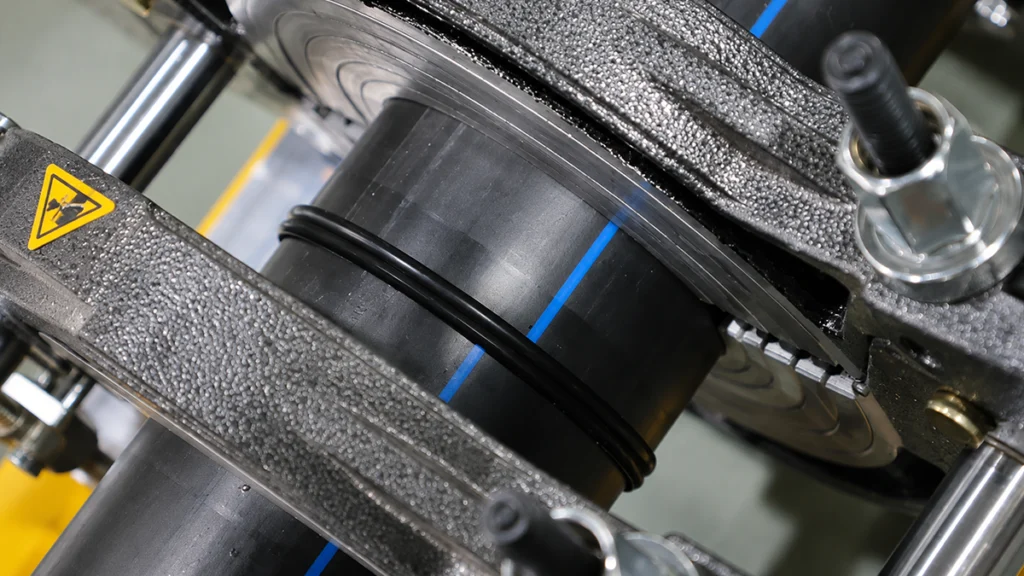
Never force a standard butt fusion machine to do a custom job. If your pipeline involves unique SDR ratios, non-standard plastic components, or operates in brutally extreme ambient temperatures, demand a custom build. Savvy buyers routinely request specialized configurations—think upgraded heating elements, custom inner clamp blocks, or modified mold sizes—to guarantee the equipment operates flawlessly under punishing field conditions.
Frequently Asked Questions
Q1: What is the difference between a butt fusion machine and an electrofusion machine?
A butt fusion machine heats prepared pipe ends with a heater plate and joins them under controlled force or hydraulic pressure. An electrofusion machine supplies electrical energy to resistance wires embedded inside specialized fittings. Butt fusion is commonly used for long, accessible pipeline runs, while electrofusion is useful for repairs, tie-ins, confined spaces, and locations where a butt fusion machine cannot be positioned.
Q2: What size butt fusion machine do I need for HDPE pipe welding?
Choose a machine whose rated welding range covers the smallest and largest pipe outside diameters required for the project. Also check the pipe SDR, wall thickness, required fusion force, reducing inserts, site access, and power supply. Selecting a model with your most frequently welded sizes near the middle of its range can improve practicality, but the manufacturer’s technical specification should remain the final reference.
Q3: How much does a hydraulic butt fusion machine cost?
The price depends on the welding range, hydraulic configuration, reducing inserts, power supply, data-recording functions, accessories, warranty, and after-sales support. Freight, import duties, commissioning, training, and spare parts also affect the total landed cost. A model-specific quotation is more reliable than a fixed online price range.
Q4: Is a CNC automatic butt fusion machine worth the higher price?
An automatic CNC machine may be worthwhile for high-volume projects or contracts requiring repeatable parameter control, welding records, and joint traceability. Automation can reduce operator-related variation and simplify quality documentation, but it does not eliminate the need for trained personnel, pipe preparation, inspection, and maintenance. The return on investment depends on workload, labour costs, documentation requirements, and the cost of potential rework.
Q5: Which butt fusion machine is required for gas pipeline welding?
There is no universal rule requiring every gas pipeline project to use a fully automatic CNC machine. The required equipment depends on local regulations, utility specifications, pipe diameter, welding procedure, and documentation requirements. Some gas projects may require approved data logging and enhanced traceability, while others may permit qualified hydraulic equipment operated by certified personnel. Always confirm the project specification and local authority requirements before selecting the machine.
Q6: What standards should a butt fusion machine comply with?
ISO 12176-1 specifies general characteristics and performance requirements for PE butt fusion equipment. The welding procedure may also need to follow ISO 21307, ASTM F2620, DVS 2207-1, or another standard required by the project. Compliance should be verified through technical documents, calibration records, and project-specific requirements rather than assumed from the machine type alone.
Q7: How long does it take to weld an HDPE pipe with a butt fusion machine?
The complete cycle includes clamping, facing, alignment, heating, changeover, joining, and cooling. Total time depends on pipe diameter, SDR, wall thickness, ambient conditions, equipment configuration, and the selected welding procedure. Cooling is often one of the longest stages, and the joint must remain clamped for the period specified by the applicable procedure.
Q8: Can one butt fusion machine weld both HDPE and PP pipes?
Some butt fusion machine frames may be used for both PE and PP pipes when the manufacturer confirms compatibility. However, PE and PP require different welding parameters, heater temperatures, pressures, and procedures. The heater plate, control system, clamps, and software must support the selected material, and PE should not be directly fused to PP unless an approved transition connection is used.
Conclusion
Choosing the right butt fusion machine requires evaluating pipe diameter, SDR, welding volume, site conditions, power supply, quality-control requirements, and long-term operating costs. Manual machines may be suitable for smaller pipes, repairs, and occasional work, while hydraulic machines are generally better suited to regular municipal, industrial, mining, and infrastructure projects.
Automatic CNC machines are valuable when projects require repeatable parameter control, weld-data recording, and greater process traceability. Buyers should also review the machine’s welding range, heater temperature control, hydraulic performance, calibration records, spare-parts availability, training, warranty, and after-sales support before making a purchase.
Need help choosing the right butt fusion machine for your project?
Request a Machine Recommendation