
Butt Fusion Welding Machine in Guyana: HDPE Pipeline Welding Guide for Contractors
Table of Contents
Butt Fusion Welding Machine in Guyana: HDPE Pipeline Welding Guide for Contractors explains machine types, key specifications, jobsite applications, pricing factors, and buying criteria so contractors can choose the right equipment with confidence.
What Is a Butt Fusion Welding Machine?
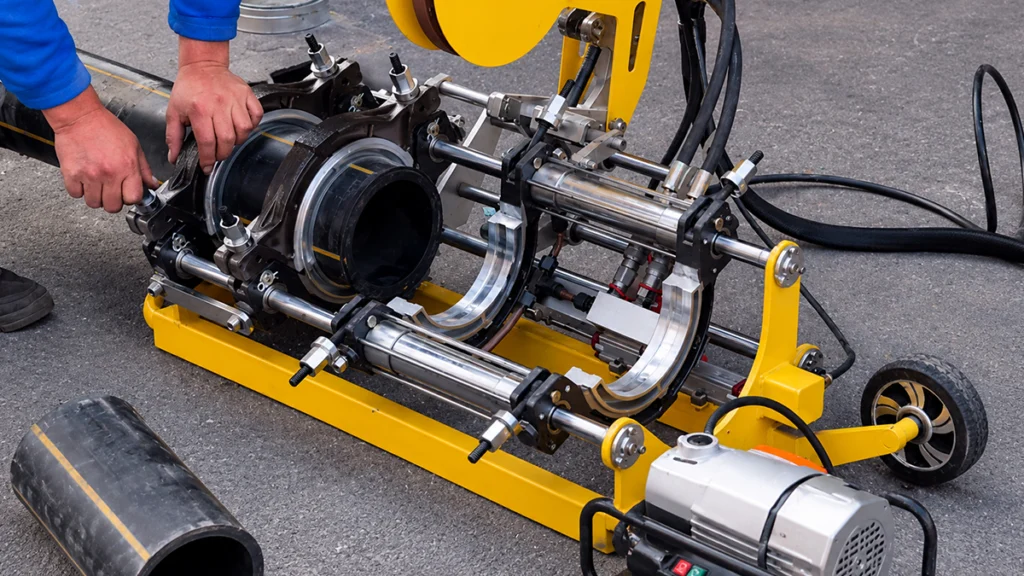
A butt fusion welding machine is a highly specialized piece of industrial equipment built to seamlessly join thermoplastic pipes through electrothermal melting. By heating the squared ends of two pipes until they reach a molten state, and then pressing them together under precise hydraulic or manual pressure, this machinery produces a permanent, leak-proof joint.
How does butt fusion welding work?
The entire process hinges on exact temperature and pressure management across four distinct phases: preheating, fusion butt welding, pressure holding, and cooling solidification. First, the butt fusion machine uses a PTFE-coated heating plate to bring the pipe ends up to a specific melting point. Once the polymer turns molten, the operator rapidly extracts the heating plate. The HDPE pipe welding machine’s carriage then drives the heated pipe ends together. Finally, the joint remains under strict interfacial pressure until the plastic completely cools and solidifies, resulting in a single, continuous pipeline.
What materials can be joined with this machine?
Pipeline contractors primarily rely on this equipment to fuse High-Density Polyethylene (HDPE) and standard Polyethylene (PE) networks. Beyond standard PE, these butt fusion machines are exceptionally effective at joining Polypropylene (PP) and Polyvinylidene Fluoride (PVDF) piping. You will typically see these specialized materials used in chemical processing plants and high-stakes fluid transport applications.
Why is butt fusion preferred over mechanical joints?
Butt fusion creates a monolithic joint. The resulting connection boasts a tensile strength that matches—and often exceeds—the original pipe. Unlike traditional mechanical fittings, flanged connections, or rubber gaskets, a flawlessly executed butt fusion weld entirely eliminates potential leak paths. This continuous, solid structure prevents internal scaling and easily withstands ground movement. Ultimately, it extends the pipeline’s operational lifespan by decades, making a butt fusion welding machine in Guyana a highly strategic investment for permanent infrastructure projects.
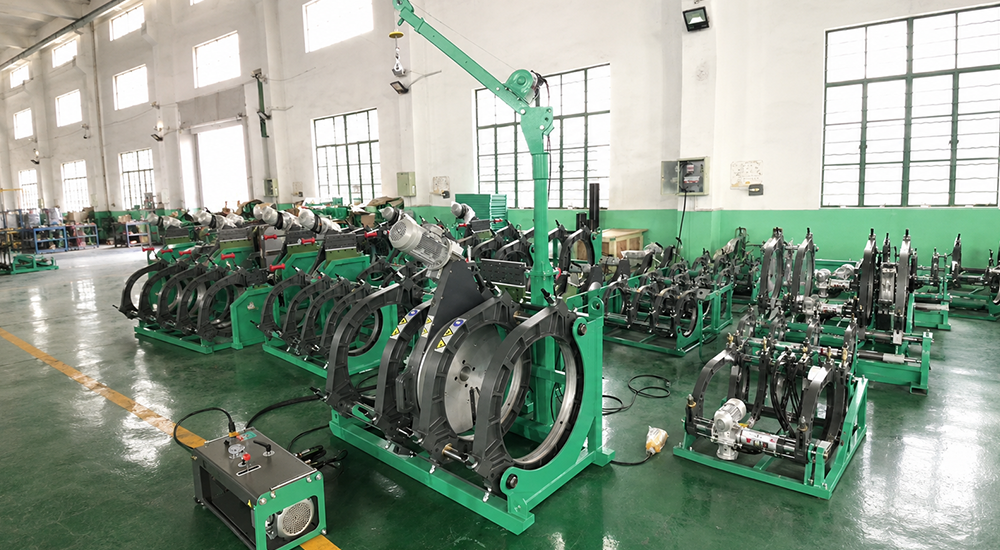
Why Butt Fusion Matters for HDPE Projects in Guyana
Which Guyana project types rely on HDPE pipelines?
HDPE pipelines form the structural backbone of modern infrastructure development across Guyana. You will see these heavy-duty networks driving major municipal water supply expansions, complex sewage and drainage systems, and extensive gas distribution grids. Additionally, mining operations heavily depend on them for critical fluid transport. Thanks to its unmatched flexibility and durability, HDPE remains the go-to material for both massive public works and private industrial builds.
What performance advantages does fusion welding deliver in tropical environments?
Tropical climates throw unique engineering hurdles at contractors. Fortunately, fusion-welded HDPE joints naturally resist the bacterial growth, scaling, and aggressive corrosion typically triggered by high humidity and relentless rainfall. The rugged, monolithic nature of fused HDPE also allows crews to install pipelines across challenging, heavily forested, or uneven terrain. Because the continuous pipe flexes alongside natural soil settlement, contractors avoid the joint separation disasters that frequently plague traditional mechanical couplings.
Why do contractors choose welded joints for long-term reliability?
Smart contractors prioritize welded joints because they deliver a vastly superior lifecycle return on investment (ROI). A properly welded HDPE network guarantees zero-leak performance and exceptional resistance to environmental stress cracking. By choosing fusion, project managers wipe out the recurring maintenance costs tied to replacing rotted gaskets or constantly tightening mechanical fittings. The pipeline simply stays operational for decades, even under relentless internal pressure.
Factory-direct pricing with technical consultation included
Get Your Free QuoteTypes of Butt Fusion Welding Machines Contractors Should Know
Manual, hydraulic, and automatic models
Finding the right equipment boils down to your specific automation needs and the physical force required for the job.
- Manual Butt Fusion Machines: These rely completely on human muscle, using a lever or handwheel to push the pipes together. They are highly cost-effective but offer only basic temperature adjustments. The final weld quality rests entirely on the operator’s skill and experience.
- Hydraulic Butt Fusion Machines: These step up the game by using a hydraulic power unit to automate pressure application and drive the carriage. If you are working with medium-to-large pipes, hydraulic assistance isn’t just nice to have—it is mandatory, as manual pressure becomes physically impossible to sustain.
- Fully Automatic Butt Fusion Machines: CNC models come equipped with Programmable Logic Controllers (PLCs) that strictly dictate heating times, interfacial pressure, and cooling cycles. By removing human error from the equation, these advanced systems guarantee consistent, standard-compliant welds every single time.
| Machine Type | Pressure Mechanism | Best For | Defect Control Level |
|---|---|---|---|
| Manual | Human Force (Lever/Wheel) | Low-budget, non-critical repairs | Low |
| Hydraulic | Hydraulic Power Unit | Standard municipal infrastructure | High |
| CNC Automatic | PLC-Controlled Hydraulics | Gas lines, industrial pipelines | Maximum (Data Logged) |
Which pipe diameter ranges do different machines support?
Manufacturers engineer butt fusion machine chassis to accommodate specific outer diameter (OD) ranges. Small-diameter manual or light-hydraulic machines usually handle pipes from 63mm up to 160mm. For medium-diameter jobs, standard hydraulic butt fusion machines comfortably fuse pipes between 315mm and 630mm. When tackling massive infrastructure, heavy-duty industrial models support 710mm to 1000mm. Some specialized mega-scale units even push the limits to 2000mm or 3000mm for major transmission mains.
When is a portable machine better than a heavy-duty unit?
A lightweight, portable butt fusion machine wins out when crews have to work inside cramped trenches, execute small-diameter municipal repairs, or operate in remote, off-grid locations where hauling heavy HDPE pipe welding machinery is a logistical nightmare. On the flip side, heavy-duty units are absolutely non-negotiable for large construction outfits. When fusing massive infrastructure pipelines, you need the sustained high pressure, rock-solid stability, and rigorous data logging that only a heavy-duty chassis can provide.
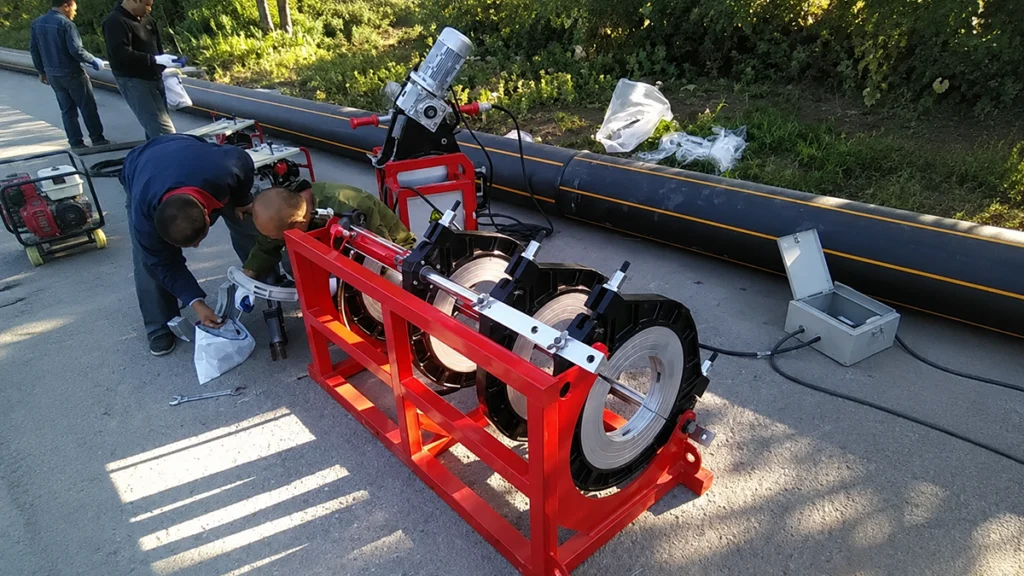
Key Technical Specifications to Compare Before Buying
Which pipe sizes and SDR ranges matter most?
Before signing any purchase orders, cross-check the butt fusion welding machine’s effective fusion dimensions against your project’s specific OD requirements. Standard Dimension Ratio (SDR) compatibility is just as critical. The HDPE pipe jointing machine’s hydraulic cylinder must generate enough output force to match the pipe’s SDR, which determines its wall thickness. Thicker walls (which mean a lower SDR) demand significantly higher interfacial pressure to achieve a solid, compliant fusion.
What power supply, heating plate, and pressure control specs should you check?
Always verify that the pipe fusion machine matches your job site’s available power (for instance, 220V single-phase versus 380V three-phase). The heating plate needs independent temperature controls—usually adjustable between 190°C and 240°C—and must feature a premium, non-stick PTFE coating. On the pressure control side, look for a system capable of executing low starting pressures (which is vital for fusing smaller fittings). It should also include a large-dial, highly accurate shockproof pressure gauge.
Do you need data logging, PLC control, or basic manual operation?
Basic manual or hydraulic operation works perfectly fine for standard water lines. Advanced projects, however, demand PLC control. Today’s automatic butt fusion machines leverage Siemens S7-200 PLCs alongside A/D conversion modules to keep a constant watch on temperature and pressure. These smart units can even transmit data remotely to cloud platforms, giving project managers full traceability and undeniable proof of compliance with strict international welding standards.
| Specification Category | Key Parameters to Evaluate |
|---|---|
| Heating Plate | Temp Range: 190°C–240°C, PTFE Coating Quality, Wattage |
| Hydraulic System | Max Pressure (MPa/bar), Low Starting Pressure, Shockproof Gauge |
| Power Requirements | Voltage (220V/380V), Phase, Total Power Consumption (kW) |
| Automation | CNC/PLC Integration, Data Logging, Cloud Connectivity |
Get detailed specs and custom configuration options
Request Technical SpecificationsHow to Choose the Right Machine for Your Project
How do project size and duty cycle affect your choice?
High-volume pipeline installations punish equipment, demanding machines built for intense duty cycles. If your project requires dozens of welds every single day, you need hydraulic butt fusion machines fitted with high-wattage heaters. Faster heat-up times shrink the overall fusion cycle. This instantly accelerates your project timeline and prevents the severe operator fatigue associated with manual pumping.
What should contractors buy for water supply jobs versus industrial pipelines?
*Case Example:* A contractor laying a 400mm municipal water line in Georgetown can easily get the job done using a standard hydraulic machine. But if that exact same contractor wins a bid for a high-pressure slurry pipeline at a remote mining site in Guyana’s interior, they have to upgrade to a fully automatic (CNC) butt fusion welding machine. Industrial and gas pipelines mandate rigorous defect control and automated data logging to satisfy safety-critical standards like ASTM F2620 or DVS 2207-1.
Which features reduce welding errors and rework?
To slash rework rates, hunt for butt fusion welding machines equipped with independent dual-channel timers that separately track both the heating and cooling phases. Automatic drag pressure measurement and inherent stroke verification are also lifesavers. These smart features stop operators from miscalculating the drag force of heavy pipes, prevent premature cooling, and completely eliminate alignment issues during the make-or-break joining phase.
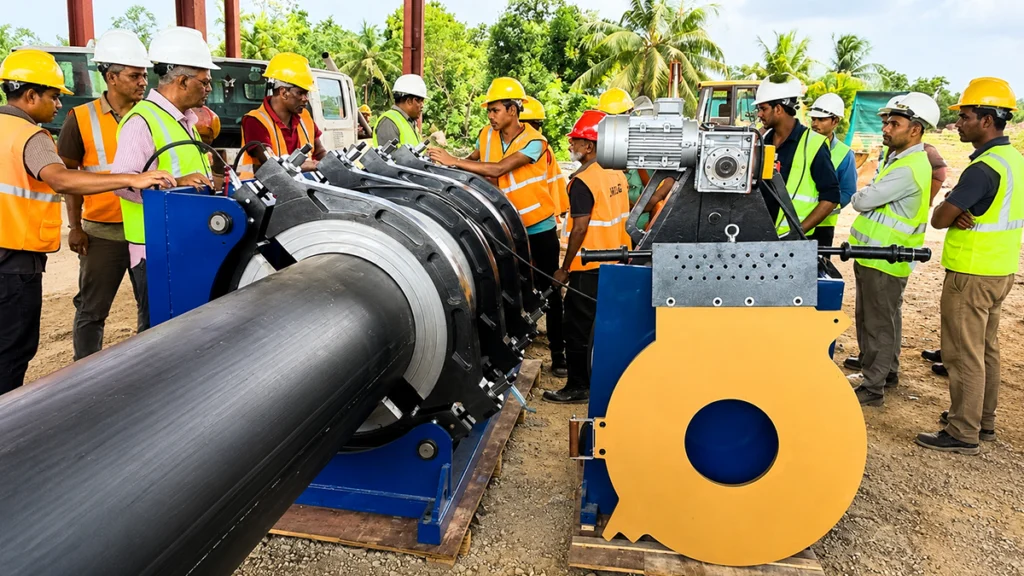
Step-by-Step HDPE Butt Fusion Welding Process
How should pipe ends be prepared?
1. Securing: First, rigidly lock the pipes into the butt fusion machine’s clamps to eliminate any chance of lateral movement.
2. Milling: Next, an electric facing tool (the cutter) equipped with double-edged tool steel blades mills the pipe ends. You run this until continuous ribbons of plastic shave off, guaranteeing perfectly parallel faces.
3. Alignment: The operator then pulls out the facer and brings the pipe ends together for a strict visual check. They are looking for high-low misalignment, which absolutely cannot exceed 10% of the pipe’s total wall thickness.
What are the heating, joining, and cooling stages?
1. Heating: The operator inserts the PTFE-coated heating plate and presses the pipe ends against it at temperatures between 190°C and 240°C. Time and pressure are carefully managed to keep the polymer from thermally degrading.
2. Joining: As soon as the correct melt bead forms, the heating plate is pulled out in a flash. The butt fusion welding machine’s carriage instantly drives the molten ends together at a precise interfacial pressure (for example, 60-90 PSI for ASTM standards, or 0.15 N/mm² for DVS).
3. Cooling: The freshly joined pipe sits under continuous hydraulic pressure until the plastic fully solidifies. This vital step stops internal stresses from tearing the new weld apart.
What quality checks should be done after each weld?
Post-weld inspection separates a good job from a future failure. The operator has to visually inspect the melt beads (protrusions) that form between the pipes. This double bead needs to be uniform in size and shape around the entire circumference, reaching the specific height mandated by the pipe manufacturer. If you spot an uneven bead, you are looking at a flawed heating or alignment process that needs immediate correction.
Common Welding Mistakes and Quality Risks to Avoid
What causes weak or uneven fusion joints?
Hardware failures are usually the main culprits behind weak joints. Burnt heating tubes, loose internal wiring, or deep gouges in the PTFE coating stop the plate from hitting or holding the target temperature. This creates dangerous cold spots on the pipe face. Ultimately, those localized weak points will blow out under operational pressure.
How do alignment and temperature errors affect weld quality?
- Temperature Errors: Not applying enough heat results in “cold fusion.” The heat fusion column ends up far too thin or short, meaning the joint will likely snap apart the second you remove it from the clamps.
- Alignment Errors: Poor alignment or mismatched wall thicknesses cause uneven stress distribution across the joint. One side might melt perfectly while the opposite side barely fuses, leaving behind a massive structural vulnerability.
What operator training gaps create the most rework?
Most process failures trace right back to poor operator training. The classic blunders include forgetting to measure and add drag pressure to the baseline joining pressure, completely ignoring terrible weather conditions (like heavy wind or rain cooling down the heating plate), and popping the pipe out of the clamps before the mandatory cooling cycle actually finishes.
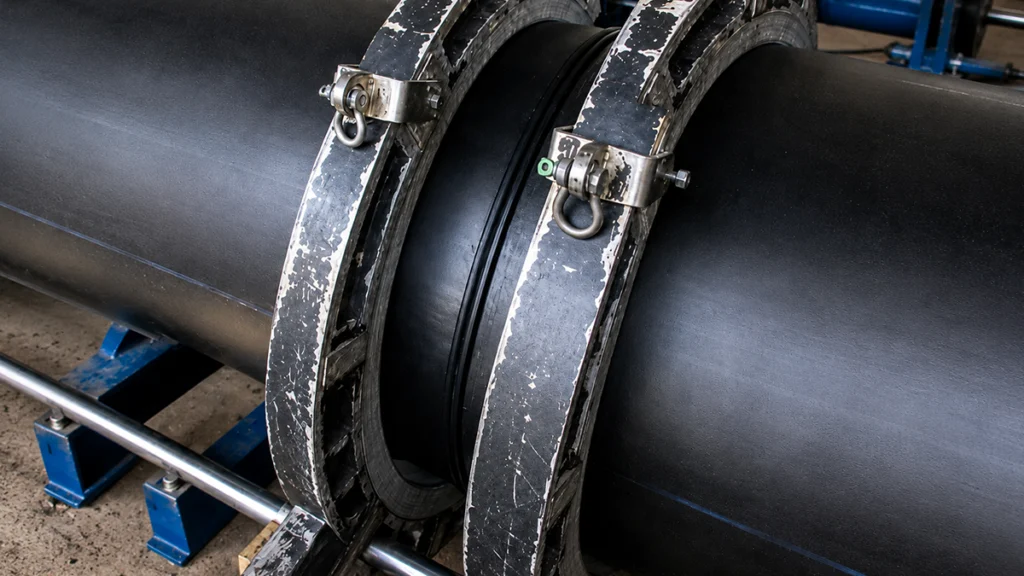
Price, Lead Time, and Supplier Evaluation in Guyana
What affects butt fusion welding machine price?
The price of a butt fusion welding machine in Guyana swings wildly depending on its diameter capacity and level of automation.
- Small-diameter manual or light hydraulic rigs (63-160mm) will set you back anywhere from $1,500 to $12,000.
- Medium-diameter standard hydraulic units (315-630mm) usually land between $8,000 and $35,000.
- Large-diameter or fully automatic CNC machines (710-1200mm and up) carry premium price tags, ranging from $18,000 to over $90,000.
The main cost drivers include hydraulic pressure capacity, PLC control integration, and the inclusion of cloud-based data-logging tech.
How should buyers compare lead time, warranty, and spare parts support?
Procurement managers need to target suppliers with a solid dealer footprint and reliable shipping routes into South America. Look hard at the availability of consumable spare parts—things like interchangeable milling blades and replacement PTFE plates. Furthermore, a comprehensive warranty that covers both the hydraulic cylinders and the sensitive PLC components isn’t just a perk; it is a non-negotiable requirement to protect your capital investment.
What questions should you ask a supplier before ordering?
Before handing over your money, grill the supplier on their technical capabilities:
- Does this butt fusion machine’s hydraulic system support both low-pressure (ISO/DVS) and high-pressure (ASTM) welding standards?
- Is the cloud-based data logging hardware built-in, or is it an expensive optional add-on?
- Exactly how long is the warranty for the electrical and hydraulic systems?
- Do you offer remote or on-site operator training programs for our crew?
Practical Buying Checklist for Contractors
Does the machine match your pipe diameter range?
- Double-check the butt fusion machine’s minimum and maximum effective fusion dimensions (for example, Min: 350mm / Max: 762mm).
- Ensure the hydraulic cylinder can actually pump out enough interfacial pressure for the heaviest SDR pipe your crew plans to install.
Are accessories, clamps, and cutters included?
- Make sure the package includes an electrostatic spraying frame so operators can safely store hot components.
- Check that the electric milling cutter ships with reversible, double-edged tool steel blades.
- Verify that you are getting a full set of reducing inserts (liner clamps). You need these to securely lock smaller pipe diameters into the main chassis.
Is training, maintenance support, and after-sales service available?
- Get a detailed, written maintenance schedule from the supplier.
- Confirm they provide clear documentation for annual inherent stroke verification and drag pressure calibration.
- Ensure you have a direct line to technical support in case you run into nasty hydraulic faults or mysterious PLC errors.
Final Recommendation for HDPE Pipeline Buyers
Which buyers should choose a manual system?
Manual systems really only make sense for independent technicians operating on tight capital budgets with minimal automation needs. They are perfectly adequate for small-diameter, non-critical water lines or low-pressure agricultural irrigation setups where passing a strict regulatory defect inspection isn’t part of the job description.
When is a hydraulic or automated machine the better investment?
If you run a large professional construction crew, a municipal utility department, or a mining operation, a hydraulic or fully automated CNC machine is hands-down your best investment. When you are dealing with high-pressure industrial pipelines, you simply cannot compromise. Strict defect control, peak operational efficiency, and automated data logging are mandatory for passing inspections and getting the project signed off. The ROI proves itself quickly through zero rework costs and the newfound ability to bid on highly lucrative government contracts.
What should you request before confirming an order?
Talk to your industry peers to get real-world reliability data before issuing that purchase order. Demand a live or video demonstration of the PLC interface to see if it is actually user-friendly. Most critically, force the supplier to provide documented proof that the butt fusion machine complies with international welding standards (like ISO 21307, DVS 2207, or ASTM F2620). This guarantees the hardware will meet the stringent engineering specs of your pipeline project.
FAQ
Q1: What pipe sizes can a butt fusion welding machine handle?
Machines are built for specific size brackets. Small units tackle 63mm to 160mm, medium hydraulic rigs handle 315mm to 630mm, and heavy-duty industrial models fuse massive pipes spanning from 710mm all the way to 3000mm. You have to pick a chassis that aligns perfectly with your project’s outer diameter (OD) needs.
Q2: How do I know if I need a manual or hydraulic butt fusion machine?
If you are fusing anything larger than 160mm, step up to a hydraulic butt fusion machine. Human physical force simply cannot hit the required interfacial pressure for larger pipes. Manual but fusion welding machines are strictly for small-diameter, budget-conscious, non-critical water lines that don’t require surgical pressure control.
Q3: What affects the quality of an HDPE butt fusion joint?
A solid joint relies on hitting the exact temperature window (190°C–240°C), applying accurate interfacial pressure tailored to the pipe’s SDR, and adhering to strict cooling times. Hardware defects like a scratched PTFE coating, cold fusion from insufficient heat, or high-low misalignment exceeding 10% of the wall thickness will instantly ruin the joint’s integrity.
Q4: How much does a butt fusion welding machine usually cost?
Pricing scales with size and tech. Small manual units run from $1,500 to $12,000. Medium hydraulic setups sit between $8,000 and $35,000. If you need a fully automatic CNC HDPE pipe welding machine for large-diameter industrial pipelines, expect to pay anywhere from $18,000 to well over $90,000.
Q5: Can one machine be used for water, drainage, and industrial pipelines?
Absolutely, as long as you are using a hydraulic or CNC model that can hit the high pressure and temperature benchmarks required for industrial jobs. While basic water lines might let you get away with semi-automatic operation, industrial gas grids and mining slurry lines strictly require fully automatic butt fusion machines equipped with data logging.
Q6: What should contractors check before ordering a machine for Guyana?
Contractors need to verify that the equipment matches their specific pipe OD and SDR demands. Beyond that, double-check the power supply compatibility (voltage and phase), make sure reducing inserts and cutters are part of the package, and confirm the supplier provides robust spare parts support alongside a solid warranty on the hydraulics.
Q7: How long does a typical butt fusion welding cycle take?
Cycle times depend entirely on the pipe’s diameter and wall thickness. The heating phase can take several minutes. This is followed by a lightning-fast joining phase, and finally, a cooling cycle where the pipe must remain under pressure. Naturally, larger and thicker pipes demand substantially longer heating and cooling windows.
Q8: What maintenance does a butt fusion welding machine need?
Routine upkeep involves cleaning the PTFE-coated heating plate to stop polymer buildup, inspecting and swapping out dull milling blades, and monitoring hydraulic fluid levels. You also need to run annual drag pressure calibrations and inherent stroke verifications to keep your pressure readings dead accurate.
Conclusion
Choosing the right butt fusion welding machine in Guyana requires careful evaluation of pipe diameter, SDR, project scale, working conditions, power supply, and applicable standards. Manual machines can be suitable for smaller pipe sizes and occasional repair work, while hydraulic or CNC butt fusion machines are better suited to larger municipal, mining, water supply, and infrastructure projects.
For demanding applications, stable temperature control, accurate fusion pressure, reliable machine construction, and optional data recording can help improve welding consistency and reduce the risk of rework. Buyers should also consider spare parts availability, technical support, operator training, and after-sales service when selecting a supplier.
By matching the equipment configuration to the actual pipeline requirements, contractors can improve installation efficiency, joint reliability, and long-term project performance.
Let our experts help you choose the right equipment for your project
Contact Our Engineering Team