
Table of Contents
HDPE pipe welding equipment for mining pipelines must handle large diameters, harsh sites, and strict standards. This guide explains machine types, key specs, selection criteria, costs, and risks—helping engineers and procurement teams choose reliable equipment for slurry, tailings, and dewatering applications.
What Is HDPE Pipe Welding Machine and Why It Matters in Mining
Definition: HDPE Pipe Welding Machine in 60 Seconds
HDPE pipe welding Machine joins high-density polyethylene pipes using a precise mix of heat and pressure. The result? A single, continuous pipeline. It works by melting the plastic molecules at the ends of the pipe, forcing them together, and letting them cool back into their original state. You get a monolithic structure without touching a single mechanical fitting, solvent, or adhesive.
Why Mining Pipelines Demand Specialized Welding Machine
Mines can’t afford downtime. Fluid transport systems have to run around the clock while keeping the surrounding environment safe. That’s why you can’t just use standard plumbing gear. Mining demands purpose-built fusion butt fusion machine to handle a few harsh realities:
- Abrasive Material Transport: Slurry lines haul highly abrasive mineral concentrates. Seamless fusion eliminates internal ridges that would otherwise cause localized wear and tear.
- Chemical Resistance: Acidic tailings routinely drop to a brutal pH of 2.5, chewing through carbon steel in months. Properly fused HDPE, however, delivers a 100-year design life completely immune to this kind of corrosion.
- High-Pressure Containment: Dewatering systems push water under massive pressure. When executed correctly, a butt-fusion joint actually becomes stronger than the pipe wall itself.
What Happens When the Wrong butt fusion Machine Is Used Underground or On-Site?
Bring the wrong—or poorly calibrated—gear to a job site, and you’re asking for catastrophic pipeline failure. Fusion requires a strict heating window of 220°C to 240°C. Miss that mark, and the joint fails. Drop below 220°C, and the molecules never fully integrate. Push past 240°C, and you oxidize and scorch the plastic. Add weak hydraulic pressure to the mix, and you’ll end up with invisible voids trapped inside the weld. Engineering tests show that missing beads or internal defects slash a pipe’s creep life by 50% under a 10 MPa load. In a critical dewatering or tailings line, that translates directly to massive, costly leaks.
Main Types of HDPE Pipe Welding Machine Used in Mining
Butt Fusion Welding Machines (Hydraulic and Manual)
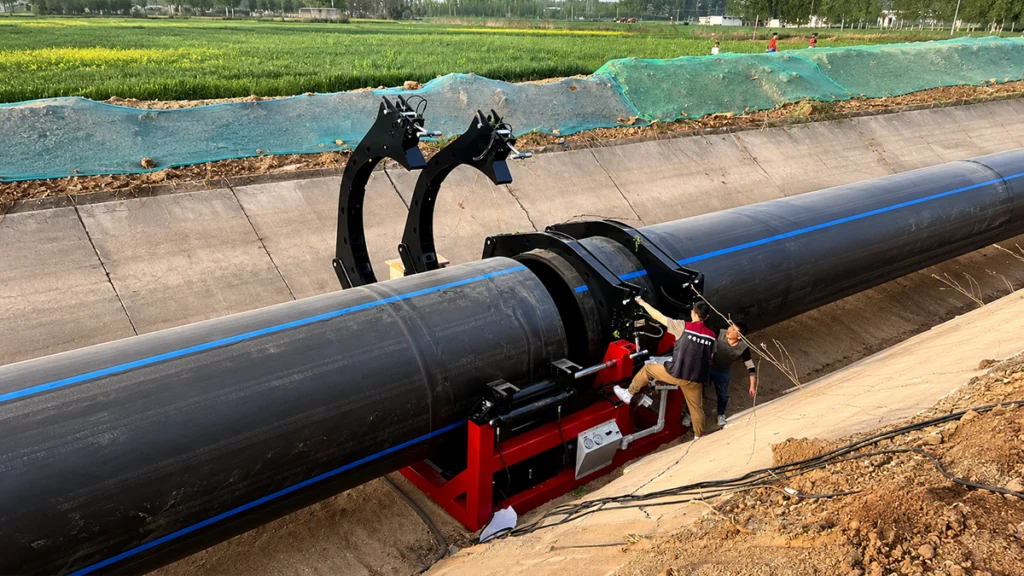
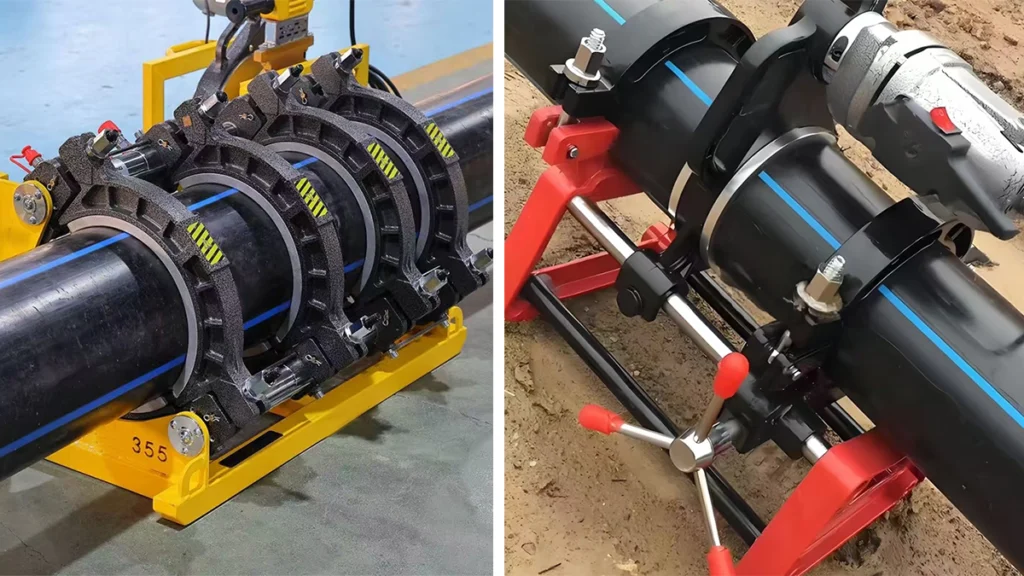
For large-diameter PE pipes in mining infrastructure, butt fusion is the go-to method. These rigs pair a precision hot plate with heavy-duty hydraulic cylinders to force melted pipe ends together. Manual hydraulic butt fusion machine rely on an open-loop setup, meaning the operator has to actively adjust the valves. On the flip side, advanced CNC automatic butt fusion machine run on a closed-loop system. They use electronic feedback and solenoid valves to hold pressure at exact, unwavering levels.
Electrofusion Welding Units for Fittings and Repairs
Think of electrofusion as an inside-out welding job. It uses a specialized fitting packed with internal electric heating coils. Hook it up to a control unit, and the coils melt the fitting and the pipe into one solid piece. This setup shines when you’re dealing with smaller HDPE pipes or navigating cramped underground tunnels where a bulky butt fusion rig simply won’t fit.
Sidewall Fusion and Saddle Fusion Equipment
Need to add a branch to an active line? Sidewall and saddle pipe fusion machines let you fabricate reduced branch fittings directly onto the main pipe—no cutting required. This gear is an absolute necessity when you have to tap into main water manifolds or extend ventilation shafts deep underground without shutting down the primary flow.
Which Welding Method Is Best for Slurry, Tailings, and Dewatering Lines?
“`html| Welding Method | Typical Mining Diameter Range | Best Mining Use Case | Automation Level | Relative Cost |
|---|---|---|---|---|
| Butt Fusion | 63mm to 1600mm+; commonly 250mm+ for main mining pipelines | Primary slurry, tailings, and dewatering lines | Manual to Full CNC | Moderate to High |
| Electrofusion | 63mm to 315mm common; larger sizes available depending on fittings | Underground repairs, tight access, complex routing | Automated welding cycle; manual preparation required | Low (Machine) / High (Fittings) |
| Sidewall Fusion | Branch outlets typically 20mm to 160mm; larger saddle branches available | Branch connections, service taps, water supply manifolds, drainage branch lines | Manual to Semi-Auto | Low to Moderate |
Factory-direct pricing with technical consultation included
Get Your Free QuoteKey Working Principles and Core Components
How Butt Fusion Welding Works Step by Step
1. Preparation: Check the pipe, lock it into the butt fsuin machine clamps, and fire up the planer. Shaving the ends perfectly square guarantees 100% surface contact. Wipe the ends clean of all dust and dirt.
2. Heating: Drop in the heating plate, fully preheated to that critical 220°C–270°C window. Apply initial pressure just until a bead forms, then back off the pressure to let the heat soak in. A good rule of thumb for melting time? Multiply the wall thickness by 10 seconds.
3. Fusing: Pull the heating plate out fast. Immediately hit the pipe with the required interfacial pressure (usually between 0.2 MPa and 0.4 MPa) to smash the melted ends together.
4. Connecting: Hold that hydraulic pressure steady while the joint cools down. This locks the plastic molecules into a seamless, permanent bond.
Critical Components: Heating Plate, Planer, Clamps, Hydraulic Unit
- Heating Plate: Coated in non-stick Teflon, this component must distribute heat perfectly evenly. Cold spots mean weak joints.
- Planer (Facing Tool): Equipped with dual-sided blades, it shaves both pipe ends at the same time to ensure parallel alignment.
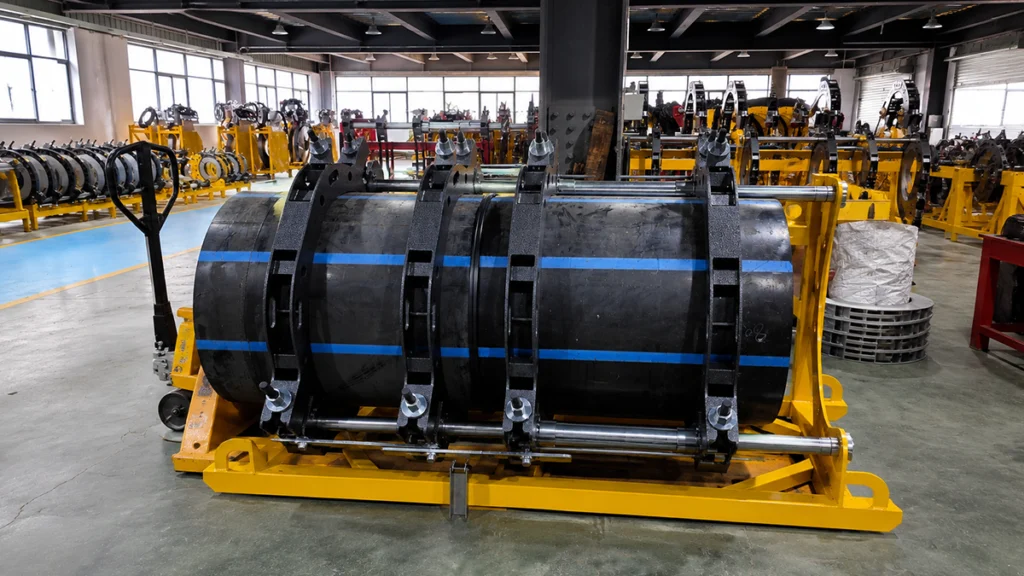
- Clamps: Built from heavy-duty aluminum or steel, these inserts grip the pipe like a vise to maintain dead-center concentricity.
- Hydraulic Unit: The muscle of the operation. It drives the carriage and delivers the exact interfacial pressure needed to make the weld stick (think 0.15 N/mm² for DVS or 60-90 psi for ASTM).
Why Temperature and Pressure Control Determine Joint Strength
A fusion joint lives or dies by its temperature and pressure metrics. Run it too hot, and you destroy the PE molecules. Too cold, and the material won’t diffuse. Pressure is just as vital. If your hydraulic system loses pressure while the weld is cooling, air bubbles and voids will form inside the plastic. Top-tier CNC butt fusion machines bypass this risk entirely. They run a drag test before every single weld, calculating the exact force needed to move the heavy pipe and compensating for ground friction. The result is flawless interfacial pressure every time.
Mining Pipeline Applications: Where Each Butt Fusion Machine Fits Best
Slurry and Tailings Transport Pipelines
Slurry lines take a beating from abrasive materials like iron ore and copper tailings. Today’s operators swap out easily corroded carbon steel for heavy-duty HDPE (like PE100-RC) to survive acidic pH 2.5 environments. Butt fusion isn’t optional here—it’s mandatory. You need high-pressure hydraulic cylinders to fuse the thick-walled pipes required to handle that extreme internal scouring.
Mine Dewatering and Water Supply Lines
Pumping millions of gallons of water straight up out of a deep pit demands zero pressure loss and absolutely no leaks. Butt fusion joints deliver unmatched sealing performance. Better yet, they easily shrug off the violent water hammer effects triggered when massive submersible pumps cycle on and off.
Compressed Air, Ventilation, and Gas Lines
Moving compressed air and ventilation gases safely through a subterranean mine requires airtight infrastructure. Butt fusion creates leak-proof connections that render mechanical fittings obsolete. Mechanical joints tend to rattle loose under the constant vibration of heavy ventilation fans. Fusion locks the system down tight.
Surface vs Underground Welding Environments
Up on the surface, you’ll usually see all-terrain, track-mounted HDPE pipe welding machines rolling alongside excavators over brutal landscapes. Underground is a different story. Tight tunnels demand compact, modular gear. Furthermore, you have to execute underground welds inside controlled staging areas. If airborne rock dust contaminates the weld interface, the joint will fail.
Get detailed specs and custom configuration options
Request Technical SpecificationsTechnical Specifications and Decision Criteria
Pipe Diameter Range: 63mm to 1600mm and Beyond
A standard mining butt fusion machine handles core infrastructure, usually sitting in the 250mm to 450mm range. But for massive water diversion projects, you have to bring in the heavy artillery: custom large-diameter welders capable of tackling outer diameters up to 1200mm or even 1600mm. When you scale up the pipe size, the HDPE pipe welding machine’s clamping force, frame rigidity, and hydraulic capacity have to scale exponentially to handle the crushing weight.
Power Supply, Generator Compatibility, and IP Rating
Industrial welders pull serious power, typically running on 220V or 380V (50/60 Hz) systems. A mid-sized unit easily draws 2.95 kW or more. Since most mining pipes get fused out in the middle of nowhere, your equipment needs advanced voltage regulation to handle the unpredictable output of diesel generators. Don’t forget the IP rating, either. High dust and moisture resistance is non-negotiable if you want the onboard electronics to survive the mine.
Compliance Standards: ISO 21307, DVS 2207, ASTM F2620
- ISO 21307: The heavyweight international standard for metric regions, covering both high and low-pressure fusion parameters.
- DVS 2207-1: The European playbook. It outlines a low-pressure technique requiring an interfacial fusion pressure of 0.15 N/mm² (roughly 1.5 bar).
- ASTM F2620: The North American standard, which leans on a high-pressure technique demanding 60–90 psi of interfacial pressure.
What Specifications Are Non-Negotiable for Mining Use?
“`html| Specification Parameter | Recommended Mining Requirement |
|---|---|
| Drag Pressure Compensation | Essential for accurate force application on large or heavy pipes |
| Hydraulic System | Stable hydraulic pressure control to maintain fusion and cooling pressure |
| Data Logging | Digital welding records for QA, traceability, and project compliance |
| Heating Plate Coating | Industrial-grade PTFE coating to reduce PE residue buildup |
How to Choose the Right HDPE Welding Machine for Your Mine
Step 1: Define Pipe Size, SDR, and Material Grade
Start by nailing down the exact outer diameter (OD) and Standard Dimension Ratio (SDR) of your pipeline. The HDPE pipe welding machine’s hydraulic muscle and clamps have to match the pipe’s wall thickness perfectly. If you’re running high-grade materials like PE100-RC, you’ll need specific temperature profiles—usually hovering around 230°C—to trigger optimal molecular diffusion. As for the bead height? That’s dictated by the wall thickness, calculated as 1 + 0.15 × wall thickness (mm).
Step 2: Match Site Conditions (Altitude, Temperature, Power)
The weather plays a massive role in fusion. Cold ambient temperatures actively fight the heating plate’s ability to stay in that 220°C-240°C sweet spot. If you’re heading to high altitudes or sub-zero sites, spec your pipe fusion machine with oversized heating elements. Terrain dictates mobility: track-mounted butt fusion weleding machines dominate rough surface routes, while wheeled or skid-mounted frames make more sense for flat underground staging areas.
Step 3: Evaluate Automation Level (Manual, Semi-Auto, CNC)
Manual butt fusion welding machines put the entire burden on the operator to calculate drag friction and tweak open-loop hydraulic valves. CNC (Automatic) pipe fusion machines change the game entirely. Packed with programmable logic controllers (PLCs) pre-loaded with ISO, DVS, or ASTM standards, they actively manage pressure and temperature in real-time through closed-loop systems. It takes human error completely out of the equation.
Step 4: Verify Supplier Certifications and After-Sales Support
Don’t buy blindly. Make sure the manufacturer strictly adheres to CE and ISO production standards. Look closely at their output capacity—top-tier factories push out 1,500+ units a year, which is a solid indicator of reliability. Most importantly, check their after-sales network. When a electrofusion welding machine goes down on a remote site, fast spare parts delivery and sharp technical support are the only things standing between you and massive downtime.
Cost, MOQ, Lead Time, and Supplier Evaluation
Typical Price Ranges by Butt Fusion Machine Class and Diameter
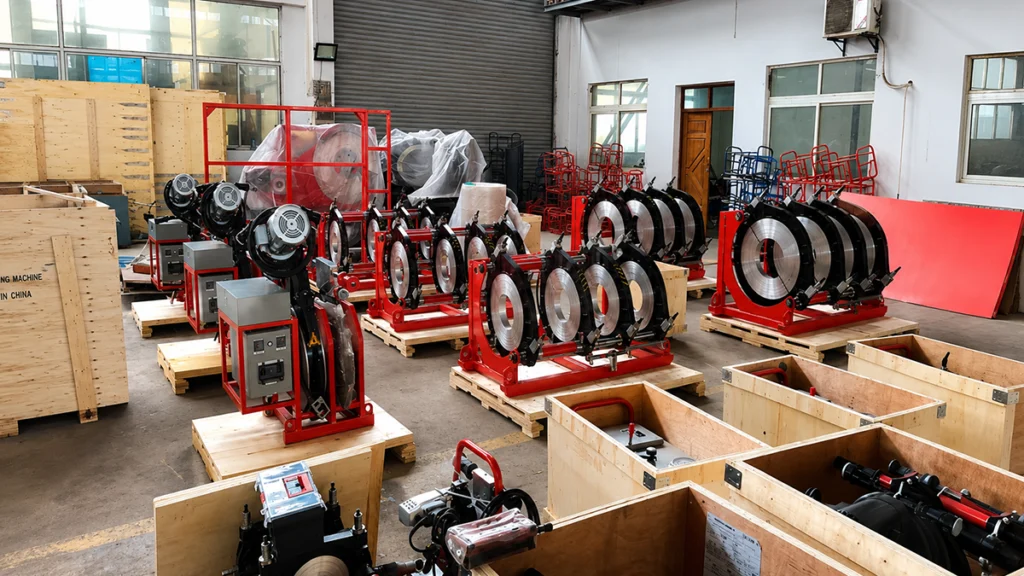
If you’re looking at basic manual hydraulic butt fusion machines for the 250mm to 450mm range, expect to spend between $1,000 and $1,900 USD from competitive overseas builders. Step up to fully automated CNC automatic butt fusion machines, and the price jumps 3 to 4 times higher thanks to the PLCs, precision sensors, and solenoid valves. At the top of the spectrum, track-mounted all-terrain rigs demand a heavy capital investment, but they pay for themselves in off-road mobility.
Lead Time, MOQ, and Shipping Considerations for Mining Projects
For industrial HDPE pipe welding gear, the Minimum Order Quantity (MOQ) almost always sits at 1 set. Domestically, you can sometimes get a crated HDPE pipe jointing machine delivered in as little as two business days. International ocean freight, however, requires careful timeline planning. Fortunately, mid-range hydraulic and control units pack down relatively small—roughly 50cm x 50cm x 40cm—making them straightforward to truck into remote mining camps via standard logistics.
How to Audit an HDPE Welding Equipment Manufacturer
Before signing a purchase order, audit the factory’s annual production capacity to ensure they won’t bottleneck your EPC project deadlines. Ask if they offer OEM customization; sometimes you need a tweaked chassis or specialized electrical components to survive your specific mine. Above all, verify that the HDPE pipe welding machine’s onboard software natively runs the exact welding standards mandated by your regional mining authority.
Total Cost of Ownership: Spare Parts, Training, and Downtime
The sticker price is just the beginning. Look at the bigger picture: swapping a labor-intensive manual unit for an automated CNC butt fusion machine can easily save $20,000 to $30,000 in labor on a six-month pipeline build. Now factor in the risk. The cost of a single blown weld in a tailings line—including environmental cleanup, fines, and halted production—will eclipse the purchase price of a premium CNC rig in a matter of hours.
Common Mistakes and Hidden Risks in Mining Pipeline Welding
Underestimating Ambient Temperature and Dust Contamination
Failing to clean the pipe ends is the number one reason joints fail. Mine dust acts like a barrier, physically blocking molecular fusion. You have to fuse in a clean environment, which often means pitching protective tents over the weld zone. Cold weather is another silent killer. Freezing air strips heat from the plate faster than it can recover, resulting in a cold weld and a catastrophically weak bond.
Skipping Operator Certification and Welding Logs
Put an uncertified operator behind the controls, and you’re asking for trouble. They routinely misjudge heating times—burning the plastic—or fail to dial in enough fusion pressure. Without rigorous data logging, you have zero proof that a joint met DVS 2207 or ISO 21307 standards. If that pipeline bursts, mining inspectors will demand the logs. If you don’t have them, the liability falls entirely on you.
Why Cheap Equipment Often Costs More in Mine Downtime
Bargain-bin manual butt fusion machines don’t feature drag pressure compensation. Because heavy pipes create massive friction against the ground, the pressure reading on the gauge is much higher than what’s actually hitting the weld interface. Worse, their open-loop hydraulics can’t automatically correct pressure drops during the cooling phase. You might save a few bucks upfront, but the resulting failed joint will bleed your budget dry through repairs and halted operations.
Maintenance, Operator Training, and Quality Assurance
Daily and Periodic Maintenance Checklist
- Daily: Scrub the equipment down after every single shift. Get the abrasive rock dust and leftover PE residue off the clamps and chassis.
- Periodic: Check the hydraulic fluid levels. Inspect the heating plate’s Teflon coating rigorously—deep scratches will trap dirt and ruin your heat transfer.
- Calibration: Put the hydraulic pressure gauges and digital temperature sensors through regular calibration to keep them locked into ISO/DVS parameters.
How to Train Operators for ISO-Compliant Welds
Your crew needs to know exactly how to calculate drag pressure and stack it on top of the baseline interfacial pressure (like 0.15 N/mm²). Training should heavily emphasize visual inspections; operators must know how to read the bead height to confirm a proper heat soak. Safety is equally critical. Heating plates max out at 270°C, making heavy heat-resistant gloves and safety glasses absolute requirements on the site.
Weld Traceability and Data Logging for Mining Audits
Today’s CNC automatic butt fusion machines don’t just weld; they record. They track the exact temperature, pressure, and duration of every joint. If a parameter slips out of the acceptable range—say, a sudden pressure drop during cooling—the butt fusion welding machine instantly flags the weld as a failure. It then exports everything as an encrypted PDF, giving you the bulletproof traceability that Tier 1 mining and utility contracts demand.
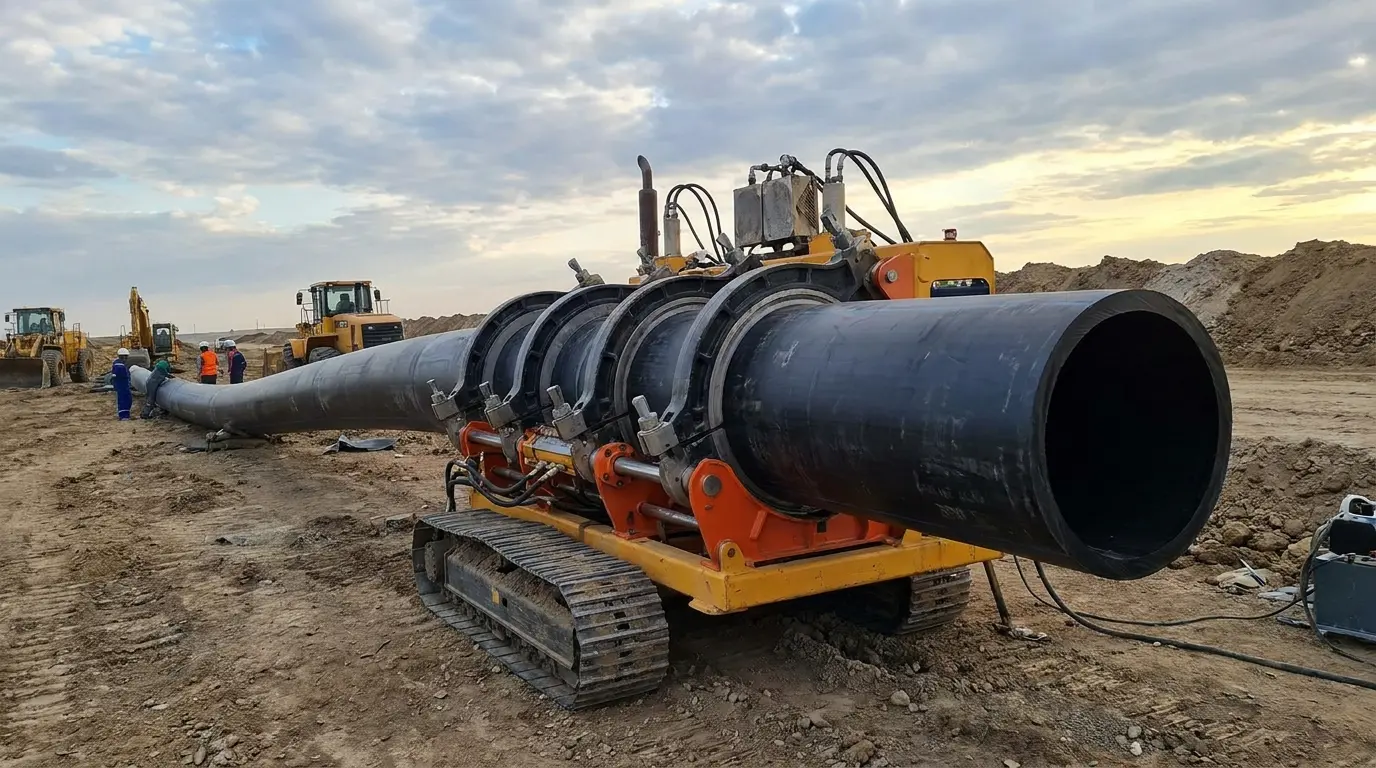
HDPE pipe welding equipment for slurry transport
Final Recommendations: What Matters Most When Buying HDPE Welding Machine for Mining
Top 5 Criteria Mining Buyers Should Prioritize
1. Automation and Data Logging: Non-negotiable for quality control and ironclad traceability.
2. Drag Pressure Compensation: You can’t move massive mining pipes accurately without it.
3. Standard Compliance: Verify the software natively runs ISO 21307, DVS 2207, or ASTM F2620.
4. Environmental Durability: Look for rugged, closed-loop hydraulics and high IP ratings to fight off the dust.
5. Total Cost of Ownership: Look past the initial price tag. Automated labor savings and leak prevention offer a far better ROI.
When to Choose Hydraulic CNC Machines Over Manual Units
If you’re building critical infrastructure—like acidic slurry lines or high-pressure dewatering networks where a leak equals a disaster—go with CNC. It’s also the smartest play in regions with high labor costs. The operational savings generated over a standard six-month deployment will easily cover the premium you paid for the HDPE pipe welding machine. Reserve manual units strictly for low-pressure, low-risk jobs.
Next Step: How to Request a Mine-Specific Equipment Proposal
Ready to get a quote? Don’t just ask for a price list. Give the manufacturer your exact pipe outer diameter (OD) and SDR. Tell them the material grade (like PE100-RC) and exactly what kind of fluid you’re pumping. Finally, lay out the site conditions—extreme altitudes, wild temperature swings, and the maximum power output of your generators. The more details you provide, the more accurate the engineering proposal will be.
FAQ
Q1: What type of welding equipment is used for HDPE pipes in mining?
Hydraulic butt fusion machines do the heavy lifting for large-diameter slurry and dewatering pipelines. When you’re dealing with smaller pipes, tight underground repairs, or tricky fittings, electrofusion machines step in. Finally, sidewall fusion gear is deployed to tap into ventilation or water mains without severing the primary line.
Q2: What is the difference between butt fusion and electrofusion for HDPE mining pipelines?
Butt fusion relies on a hot plate and hydraulic force to press two pipe ends together, forming a seamless, incredibly strong bond perfect for abrasive slurry. Electrofusion takes a different approach, running an electric current through coils hidden inside a special fitting to melt everything together from the inside out. It’s the better option for confined underground spaces.
Q3: How much does an HDPE pipe welding machine for mining cost?
A basic manual hydraulic butt fusion setup for 250mm to 450mm pipes will run you anywhere from $1,000 to $1,900 USD. If you want a fully automated CNC rig with closed-loop hydraulics and data logging, expect to pay three to four times that amount. Massive track-mounted HDPE pipe welding machines for rough terrain require an even steeper capital investment.
Q4: What is the maximum HDPE pipe diameter that can be welded on-site?
Standard mining welders usually max out around 450mm or 630mm. However, custom large-diameter HDPE pipe welding machines can handle massive pipes up to 1200mm and 1600mm right on the job site. You’ll typically see these giants deployed for major tailings infrastructure or high-volume water diversion projects.
Q5: Which international standards apply to HDPE welding in mining (ISO 21307, DVS 2207)?
ISO 21307 rules the global stage, covering about 95% of metric HDPE butt welding. In Europe, DVS 2207-1 sets the benchmark with a low-pressure technique (0.15 N/mm²). North America follows ASTM F2620, which dictates a high-pressure approach (60-90 psi). A high-quality CNC butt fusion machine will have all these standards pre-programmed into its software.
Q6: How long does it take to weld a large diameter HDPE pipe joint?
It all comes down to the wall thickness. You generally calculate the heating phase by multiplying the wall thickness by 10 seconds. Once you factor in the prep work, facing, heating, and that crucial under-pressure cooling window, a single large-diameter joint can take anywhere from 20 to 45 minutes to finish correctly.
Q7: What certifications should an HDPE welding machine supplier have?
Look for suppliers backed by ISO 9001 quality management certifications and CE manufacturing standards. Beyond the hardware, ensure the pipe fusion machine’s software is certified to execute and log welds according to ISO 21307, DVS 2207, or ASTM F2620, complete with encrypted PDF reporting.
Q8: Can HDPE welding equipment be used in underground or high-altitude mines?
Absolutely, but you need the right setup. High-altitude sites demand voltage-regulated power supplies to handle the drop in diesel generator efficiency. Underground work requires compact, modular plastic pipe welding machines that can maneuver through tight shafts. Plus, underground welding must happen in a clean staging area so airborne rock dust doesn’t ruin the weld interface.
Conclusion
Picking the right HDPE pipe welding machine isn’t just a procurement task; it’s a critical engineering decision that dictates your mine’s uptime, environmental compliance, and bottom line. When you’re pushing abrasive slurry, acidic tailings, or high-pressure water, you need flawless, monolithic joints. That level of reliability only comes from exacting temperature and pressure control.
While budget-friendly manual butt fusion machines might look appealing, they introduce dangerous variables like human error and lack the necessary drag pressure compensation for heavy pipes. Stepping up to closed-loop CNC automation wipes out those risks, guaranteeing every weld hits ISO 21307, DVS 2207, or ASTM F2620 standards perfectly. Add in the encrypted data logging that Tier 1 audits require, and the choice becomes clear. By investing in automation, rugged durability, and strong supplier support, mining operators can drastically cut their total cost of ownership and protect their pipeline networks from catastrophic failure.
Let our experts help you choose the right equipment for your project
Contact Our Engineering Team