
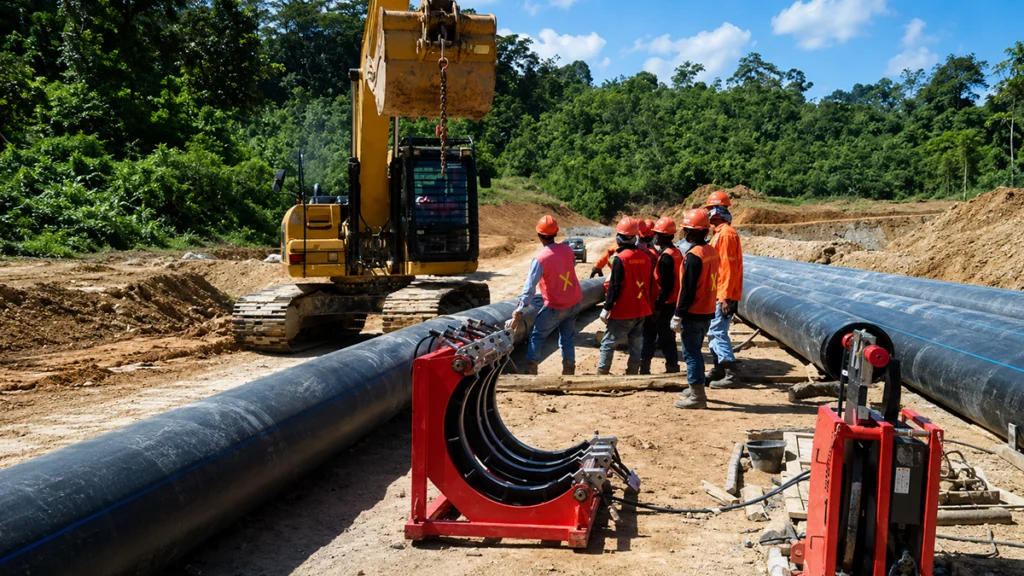
Complete HDPE Pipe Welding Machine List for Field Construction
Table of Contents
HDPE Pipe Welding Equipment guide for field construction, covering machines, tools, accessories, specifications, selection criteria, and supplier checks to build a reliable project-ready welding setup.
What Is HDPE Pipe Welding Machine?
When we talk about HDPE pipe welding machine, we’re referring to the specialized machinery and tooling built to permanently fuse high-density polyethylene pipes using heat. A typical field setup goes well beyond the welder itself. You’ll usually need primary pipe fusion machines, pipe prep tools, alignment rigs, robust power supplies, heavy handling gear, safety equipment, and testing devices to guarantee the pipeline’s long-term integrity.
Core equipment used to join HDPE pipes
The backbone of joining thermoplastic lines involves butt fusion machines, electrofusion welders, socket fusion tools, and extrusion welders. These core units deliver a precise mix of heat and pressure. This melts the pipe ends or fittings, forcing the polymer chains to interlock permanently. Supporting this operation are hydraulic power units, electric facing tools, and PTFE-coated heating plates—all working seamlessly together to produce repeatable, code-compliant welds.
How HDPE welding differs from mechanical pipe joining
Mechanical joints rely on flanges, gaskets, or threaded fittings. Fusion welding takes a completely different approach by melting and bonding the actual pipe material. The result? A monolithic, seamless joint that boasts structural strength equal to—or even greater than—the original pipe. You don’t need welding rods, solvents, glues, or mechanical fasteners. Instead, you get a 100% leak-proof connection capable of withstanding the severe pull-out forces caused by shifting soil or high-pressure flows.
When field construction requires specialized welding machine
Contractors absolutely need specialized gear when tackling large-diameter pipelines, high-pressure gas and water mains, or industrial chemical networks. Think about demanding environments like mining slurry lines or sprawling municipal infrastructure. You simply can’t use traditional manual arc or gas welding here; thermoplastics require a different approach entirely. Purpose-built pipe fusion machines guarantee that operators maintain critical interfacial pressure and heating times, even when battling harsh field conditions.
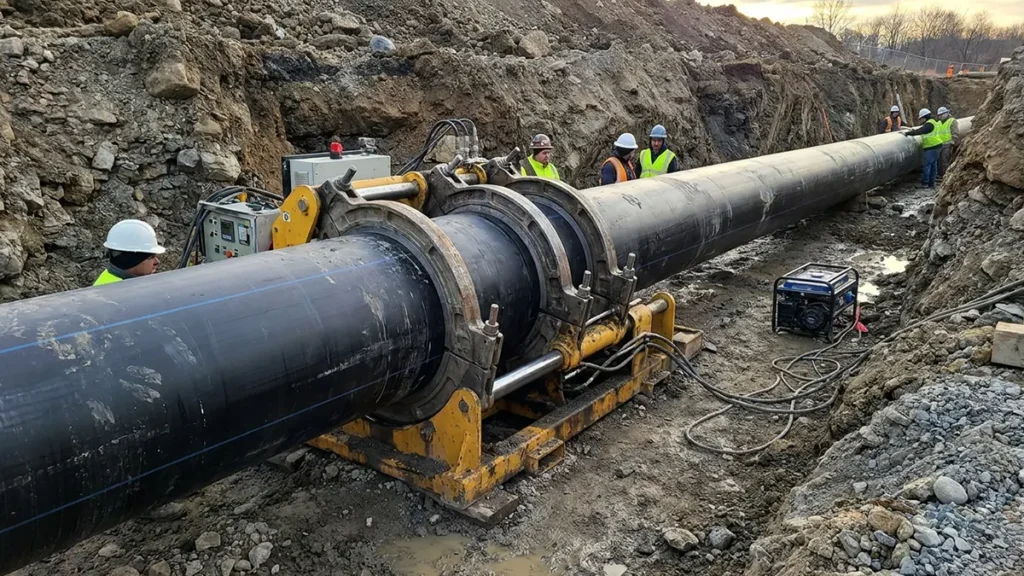
Complete HDPE Pipe Welding Equipment List for Field Construction
Primary welding machines
Every HDPE pipe welding equipment list starts with the primary pipe fusion machine. Your project scope dictates the choice. Long, straight pipeline runs call for a hydraulic butt fusion machine. Conversely, tight spaces, repair jobs, and gas distribution networks demand an electrofusion welder. Nailing down the right primary machine drives your power requirements and dictates the accessory tooling for the entire site.
Pipe preparation and alignment tools
Skip proper pipe prep, and your joint will fail. It’s that simple. Essential gear includes alignment frames built with a four-clamp sleeve structure to lock pipes in place. You also need electric milling cutters (facers) rigged with safety limit switches and double-edged reversible blades. Beyond that, manual scrapers and rerounding tools are absolute must-haves. They strip away surface oxidation and fix pipe ovality long before the electrofusion process kicks off.
Power supply, handling, and site support equipment
Field welding demands serious power and handling infrastructure. We’re talking dedicated hydraulic stations that range from 0.75KW for nimble 250mm butt fusion welding machines all the way up to 3.0KW for massive 1000mm rigs. Contractors have to bring in single-phase 220V or three-phase 380V generators delivering rock-solid voltage. Don’t forget the heavy lifting gear. A 1000mm butt fusion welding machine frame easily tips the scales at 2600kg, meaning you’ll need cranes or heavy-duty excavators just to maneuver it into position.
Inspection, testing, and documentation tools
Meeting international standards means deploying rigorous documentation tools. Modern job sites rely on digital data loggers, highly accurate shockproof pressure gauges, and independent dual-channel timers to track both heating and cooling phases. Add displacement detection systems for exact beveling control, and you have a foolproof setup. These tools guarantee every single weld parameter is captured, logged, and fully traceable for future audits.
| Equipment Category | Essential Tools & Machinery |
|---|---|
| Primary Machines | Butt fusion machines, electrofusion welders, extrusion welders |
| Preparation Tools | Electric facers, manual/rotary scrapers, rerounding clamps |
| Alignment & Handling | Four-clamp frames, pipe rollers, lifting slings, excavators |
| Power & Support | Hydraulic stations, 380V/220V generators, weather shelters |
| Inspection & Data | Welding recorders, pressure gauges, dual-channel timers |
Factory-direct pricing with technical consultation included
Get Your Free QuoteMain Types of HDPE Pipe Welding Machine
Butt fusion welding machines
For pipes larger than 110mm in diameter, butt fusion machines are the go-to solution. Manufacturers categorize them into manual pressure, hydraulic semi-automatic, and fully automatic CNC models. The process is straightforward yet highly controlled: the HDPE pipe jointing machine faces the pipe ends, heats them against a PTFE-coated plate, and presses them together under precise hydraulic pressure. This creates a continuous pipeline ready to handle intense internal pressures.
Electrofusion welding machines
Electrofusion welders span a wide range, from basic transformer-style units to manual digital, semi-automatic, and fully automatic variants. Rather than applying heat directly to the pipe ends, these butt fusion machines shoot energy into heating coils embedded inside specialized fittings. Today’s electrofusion units use barcode scanners to instantly read welding parameters. This smart feature ensures precise energy delivery and completely eliminates the risk of manual calculation errors.
Extrusion welding machine
Fabricating custom fittings, tackling complex pipe repairs, and welding geomembranes mostly rely on extrusion welding equipment. These handheld or semi-portable devices pump molten polyethylene straight into a prepared V-groove or joint. They prove incredibly useful for building custom manifolds or sealing tight access points where a bulky butt fusion machine simply won’t fit.
Socket fusion tools for smaller pipe sizes
Engineered specifically for pipes under 90mm, socket fusion tools run at a rigid, continuous temperature of 220°C. These handheld heaters melt the exterior of the pipe and the interior of a fitting at the exact same time. Once heated, the operator pushes the pipe into the fitting. The result is a robust, localized bond perfectly suited for residential water lines and internal building plumbing.
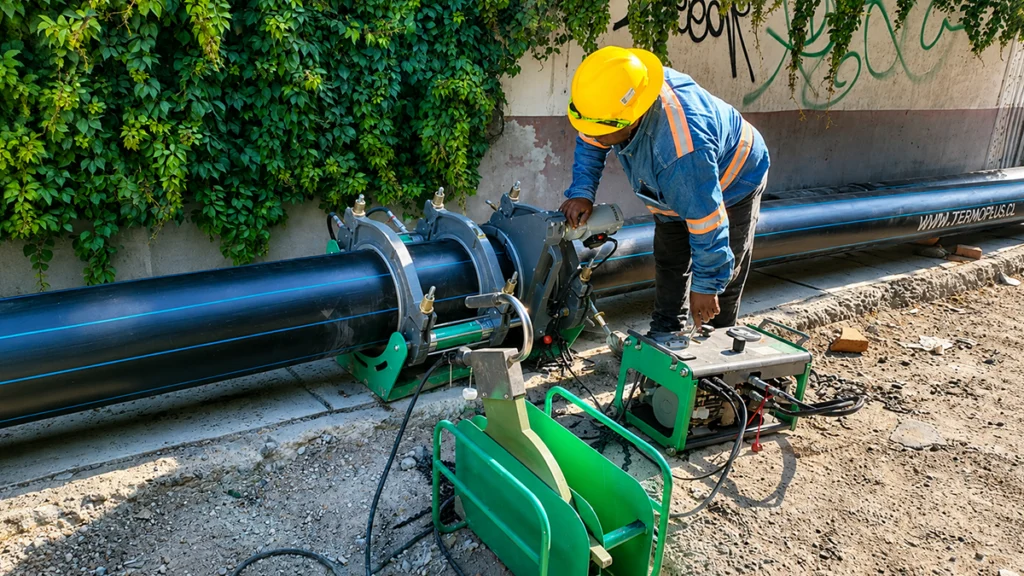
Essential Butt Fusion Machine and Accessories
Hydraulic clamps and pipe alignment frames
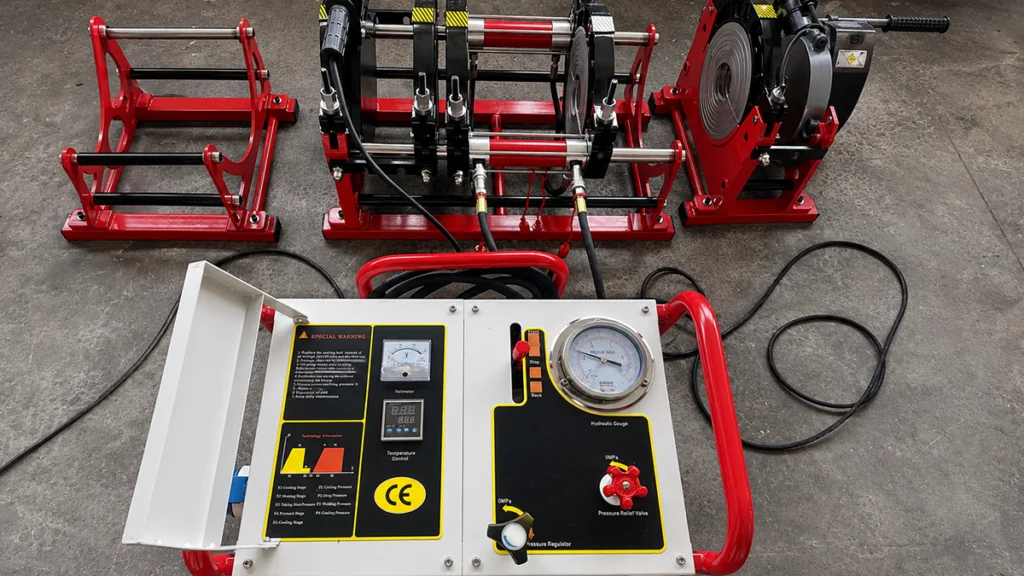
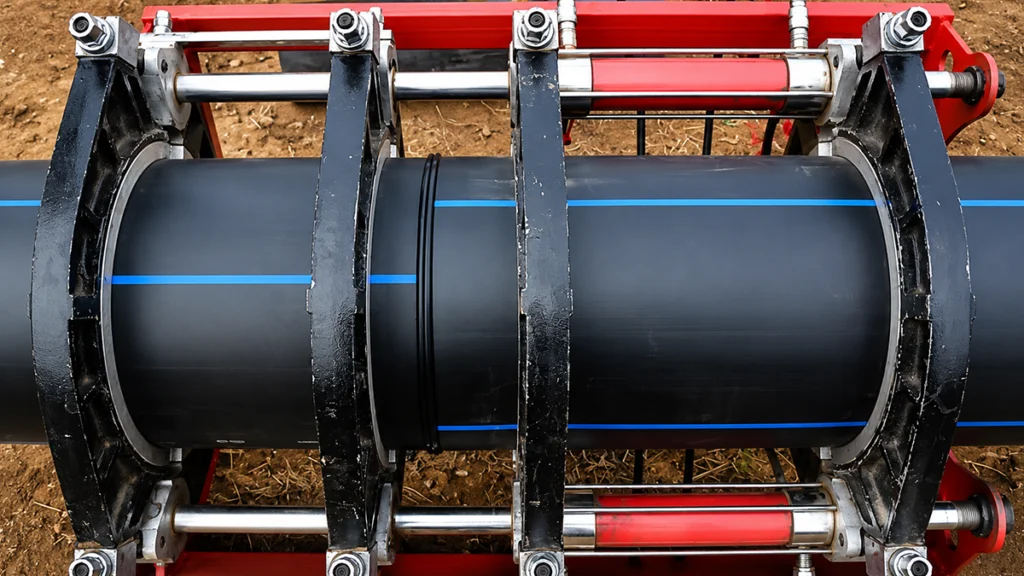
Think of the alignment frame as the structural heartbeat of butt fusion. It utilizes heavy-duty hydraulic clamps to secure the pipe, iron out minor ovality, and guarantee flawless axial alignment. The hydraulic system has a tough job. It must overpower the drag resistance of the heavy pipe while simultaneously applying pinpoint interfacial pressure—a critical factor for hitting DVS 2207-1 or ASTM F2620 compliance.
Heating plates and temperature control
Heating plates should have a clean, non-stick PTFE-coated surface to prevent molten polyethylene from sticking during the fusion process. Stable electronic temperature control is also important, because uneven heating can affect bead formation and joint quality.
High-quality butt fusion equipment should maintain the required heating plate temperature according to the selected welding standard, pipe material, and wall thickness. A controlled temperature deviation, such as ±3°C to ±5°C, helps support more consistent heat distribution and reliable welding performance.
Facing tools, trimmers, and pipe scrapers
Electric milling cutters—often called facing tools—rely on high-grade tool steel inserts to shave pipe ends until they are flawlessly flat and parallel. Power requirements scale with the butt fusion machine. A 250mm facer might draw 1.36KW, while a massive 1000mm unit demands up to 3.0KW. Proper facing is non-negotiable; it guarantees zero gap between the pipe ends before the heating phase even begins.
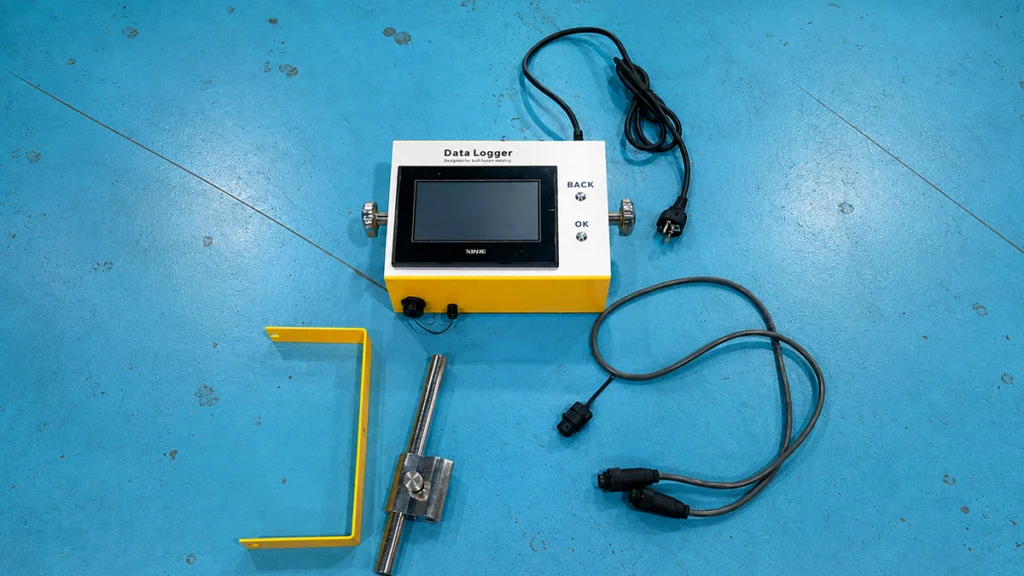
Data loggers and welding recorders
On critical infrastructure jobs, data loggers aren’t optional. They capture everything: ambient weather, temperatures, welder ID codes, joint numbers, drag pressure, welding pressure, changeover times, and cooling durations. This wealth of data compiles into a locked, secure report. It’s your ultimate proof that the job meets strict TSG D2002-2006 and ISO 21307 standards.
Get detailed specs and custom configuration options
Request Technical SpecificationsElectrofusion Welding Machine Needed on Site
Electrofusion control units and barcode scanners
The control unit acts as the brain behind electrofusion, carefully managing the voltage and time needed to melt the fitting’s internal coils. Barcode scanners serve as vital accessories here. By scanning the parameters printed right on the fitting, they automatically program the control unit. This bypasses manual data entry, preventing human error and applying the perfect energy profile to the joint.
Couplers, saddles, reducers, and fittings
Electrofusion welding machine demands unique fittings packed with embedded heating coils. The lineup includes straight couplers for linear connections, tapping saddles for branching off live mains, and reducers to bridge different pipe diameters. To maintain chemical and thermal harmony, manufacturers must forge these fittings from the exact same material grade as the host pipe.
Pipe scrapers, clamps, and rerounding tools
Before sliding an electrofusion HDPE pipe fitting into place, operators must strip away the oxidized layer on the pipe’s surface. Rotary pipe scrapers deliver a consistent peel depth, drastically outperforming manual scraping methods. Next, rerounding tools and alignment clamps step in to fix any deformation. They keep the pipe perfectly round and totally stationary throughout the critical heating and cooling cycles.
When should contractors use electrofusion instead of butt fusion?
Contractors typically pivot to electrofusion for gas distribution networks, emergency repairs, or work inside cramped underground vaults. It’s also the mandated approach when navigating around existing underground utilities or working indoors. In these scenarios, the bulky frame and hydraulic carriage of a standard butt fusion machine simply won’t fit.
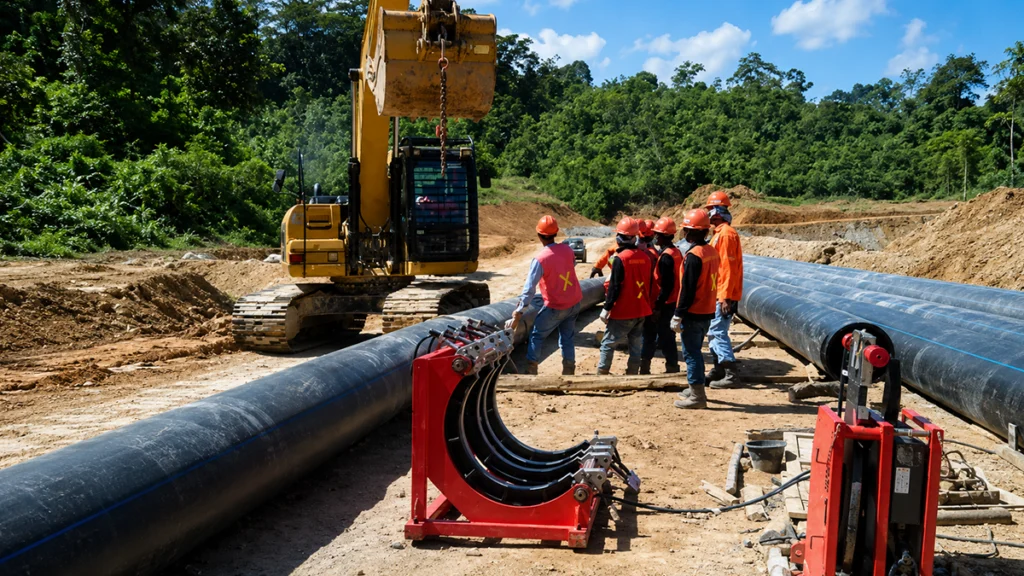
Field Support Machine for HDPE Pipe Welding
Generators, extension cables, and voltage stability
Pipe Fusion machines pack sensitive electronic temperature controllers alongside power-hungry hydraulic motors. Trying to run a large 450mm-800mm butt fusion machine (which pulls 8.2KW to 16.9KW) on a weak power supply spells disaster. Voltage drops lead to flawed welds and fried electronics. Contractors need to bring appropriately sized generators and heavy-gauge extension cables to ensure a continuous, stable power feed.
Pipe rollers, lifting equipment, and trench support
Pipe rollers are absolute lifesavers on site. By elevating the pipe off the dirt, they drastically cut down sliding drag pressure under no-load conditions. If drag pressure spikes too high, the hydraulic system struggles to apply the precise interfacial pressure the weld needs. Of course, you also need heavy lifters—like sidebooms or excavators rigged with specialized slings—to safely muscle those massive pipe strings around.
Shelters, wind protection, and weather control
Mother Nature doesn’t care about your project deadline. When temperatures plunge below freezing or high winds kick up, environmental control becomes mandatory. Contractors must set up welding tents or shelters. Wind can strip heat from the plate or pipe ends in seconds during the changeover phase. If that happens, the surfaces won’t hit the fusion temperatures required for proper polymer chain entanglement.
Consumables and spare parts to keep on site
Field delays burn through money, so a fully stocked consumables kit is a must. Crews need plenty of clean, lint-free cotton cloths and high-purity isopropyl alcohol to prep heating plates and pipe ends. Don’t forget the physical spares, either. Keep extra hydraulic oil, backup PTFE slip covers, replacement facer blades, and spare temperature sensors readily available.
How to Select HDPE Pipe Welding Machine by Project Requirement
Pipe diameter and SDR range
Picking the right gear starts with two numbers: the pipe’s outside diameter (OD) and its Standard Dimension Ratio (SDR). A butt fusion machine built for DN160-315 simply can’t clamp a 400mm pipe. Furthermore, low-SDR pipes have thicker walls. They demand greater clamping forces and higher hydraulic pressures to hit the target interfacial pressure, meaning you’ll need a much heavier-duty butt fusion welding machine frame.
Manual, hydraulic, and CNC operation options
Manual pressure machines serve a narrow niche: small-diameter, low-pressure residential water lines. For municipal pipes over 110mm, hydraulic butt fusion machines take over, giving operators precise pressure control. But for critical infrastructure? CNC (Computer Numerical Control) automatic butt fusion machines are the gold standard. They automate parameter locking, drive the carriage mechanically, and log data flawlessly, effectively removing human error from the fusion equation.
Water, gas, mining, irrigation, and industrial pipeline use cases
Different sectors play by different rules. Gas networks demand CNC butt fusion or electrofusion to guarantee absolute safety and traceability. Mining sites require brutally tough hydraulic butt fusion machines that can handle highly abrasive tailings pipes while surviving punishing terrain. On the flip side, agricultural irrigation projects might get by with lighter, semi-automatic hydraulic units where extreme pressure ratings aren’t the primary concern.
Decision checklist for contractors and procurement teams
Before signing a purchase order, procurement teams need to weigh several factors. A solid decision checklist defines the maximum and minimum pipe diameters, wall thickness (SDR), and total joint count. It should also factor in the environmental conditions, project timeline, budget limits, and the actual technical expertise of the field crew operating the butt fusion machinery.
Key Specifications to Check Before Buying
Welding range, clamping capacity, and pressure control
Standard equipment ranges usually fall into buckets like DN160-315, DN280-450, and DN710-1000. Buyers need to ensure the HDPE pipe welding machine’s pressure adjustment range aligns with their specific code requirements. A smaller rig might only need 0-6.3MPa, while a massive HDPE pipe jointing machine requires 0-16MPa to hit that critical 0.15 N/mm² (DVS) or 60-90 psi (ASTM) interfacial fusion pressure.
Heating plate temperature range and accuracy
For HDPE pipe butt fusion welding, the heating plate must maintain the required working temperature according to the selected welding standard, pipe material, and wall thickness. Although some machines can reach higher maximum temperatures, stable control in the actual welding range is more important than maximum heat output.
A clear digital display and accurate surface temperature control help operators monitor the heating process more reliably. High-quality equipment should keep temperature variation within a controlled range, such as ±3°C to ±5°C, helping reduce uneven heating, poor bead formation, and unreliable joint quality.
Power requirements and site compatibility
Procurement has to match the HDPE pipe welding machine’s power appetite to what the site can actually provide. A DN315 welder might run just fine on a standard 220V single-phase generator. Step up to a DN800 butt fusion machine, however, and you absolutely need a 380V three-phase supply. Ignore power compatibility, and you’ll end up with blown fuses, fried electronics, and a dead construction site.
Standards, calibration, and welding data traceability
Compliance is everything. Equipment must meet strict national and international codes, including ISO 21307, DVS 2207-1, ASTM F2620, and TSG D2002-2006. Smart buyers verify that the butt fusion machine automatically locks parameters during the fusion cycle and spits out tamper-proof digital reports. Finally, demand annual calibration certificates from the manufacturer for all pressure gauges and temperature controllers.
| Specification Parameter | Technical Requirement |
|---|---|
| Temperature Deviation | ≤ ±3°C to ±5°C |
| Interfacial Pressure | 0.15 N/mm² (DVS) or 60-90 psi (ASTM) |
| Data Logging | Ambient temp, drag pressure, cooling time |
| Power Input | 220V Single-Phase / 380V Three-Phase |
| Standard Compliance | ISO 21307, ASTM F2620, TSG D2002-2006 |
Cost, Lead Time, and Supplier Evaluation
What affects HDPE pipe welding equipment price?
Price tags fluctuate based on pipe capacity, automation levels, and the quality of internal components. A basic, small-diameter hydraulic fusion machine might run $15,000, while a massive infrastructure model easily clears $100,000. Fully automatic CNC butt fusion machines cost three to four times more than their manual counterparts. However, the ROI usually justifies the upfront hit by slashing labor costs and eliminating the nightmare of rejected welds.
Rental vs purchase for field construction projects
Renting makes a lot of sense for short-term gigs. It lets contractors tap into the latest CNC tech without eating long-term maintenance costs. But if your company lands pipeline contracts consistently, buying is the smarter financial play. The capital expense pays for itself across multiple jobs, especially since fusion welding frees you from buying endless supplies of welding rods and mechanical fittings.
Spare parts, training, and after-sales service
The sticker price is just the beginning; keeping the butt fusion machine running is what actually matters. Industry surveys reveal that 90% of contractors expect 24/7 online technical support, and 60% prioritize a rock-solid supply chain for wear parts. After all, a high-tech butt fusion welding machine becomes a massive liability if a broken $50 milling blade shuts down a million-dollar project for three weeks.
Supplier checklist for contractors and distributors
When vetting manufacturers—such as Ekberg Welding—buyers need to hunt for real technological advantages. Look for features like independent dual-channel timers and displacement detection systems. Your supplier checklist should also demand remote video troubleshooting, lightning-fast global shipping for parts, thorough on-site operator training, and clear, transparent annual calibration programs.
Common Mistakes When Preparing an HDPE Welding Equipment List
Forgetting pipe preparation tools
Leaving pipe rollers off your equipment list is a massive unforced error. Dragging heavy HDPE pipes across the dirt skyrockets drag pressure. Since your total welding pressure is calculated by adding drag pressure to the theoretical welding pressure, artificially high drag completely throws off the HDPE pipe jointing machine’s hydraulics. The end result? Weak, substandard joints.
Using undersized machines for pipe diameter or SDR
Contractors love to push butt fusion machinery to its absolute limits, especially when dealing with thick-walled, low-SDR pipes. But an undersized hydraulic system simply cannot generate the necessary interfacial pressure across a dense cross-sectional area. You’ll end up with terrible bead formation and a joint guaranteed to fail once the pipeline is pressurized.
Ignoring power supply and environmental conditions
A classic field blunder is plugging a heavy-draw 380V pipe fusion machine into an undersized generator, or leaving the welding zone exposed to wind and rain. Another major mistake? Forgetting to scrub the heating plate with isopropyl alcohol. This traps dust and oil inside the polymer matrix, destroying the molecular bond—no matter how expensive your butt fusion welding machine is.
Skipping test equipment and welding records
Failing to log your parameters—or dumping hydraulic pressure too early during the cooling phase—will trigger immediate alarms on a CNC automatic butt fusion machine and violate codes like TSG D2002-2006. Skipping data loggers to save a few bucks upfront is a terrible strategy. It leaves you with zero proof of joint integrity, meaning you’ll fail municipal inspections and have no defense against future liability claims.
FAQ
Q1: What equipment is required for HDPE pipe welding on a construction site?
For HDPE pipe welding on site, you usually need a butt fusion machine or electrofusion processor, pipe rollers or supports, a pipe facer, a PTFE-coated heating plate, a hydraulic power unit, and a stable power supply or generator. Supporting tools may include pipe scrapers, approved cleaning wipes or alcohol, alignment tools, a weather shelter, and a data logger when welding records are required.
Q2: What is the difference between butt fusion and electrofusion equipment?
Butt fusion equipment uses a heated plate to melt the pipe ends before pressing them together under controlled pressure. It is commonly used for straight pipe joints and larger-diameter HDPE pipelines.Electrofusion equipment works with special fittings that contain embedded heating wires. When electrical current is applied, the fitting inner surface and pipe outer surface melt together to form the joint. Many electrofusion processors can also read welding parameters through a barcode scanner.
Q3: How do I choose the right HDPE pipe welding machine size?
Choose the machine according to the pipe’s outside diameter, wall thickness, SDR rating, and project requirements. The machine’s working range must cover the largest pipe size used on site, and the clamps or reducing inserts should match the pipe diameter.For larger or thicker pipes, the equipment should also provide stable alignment, sufficient hydraulic pressure capacity, and reliable temperature control to support the required welding procedure.
Q4: Do HDPE pipe welding machines need calibration?
Yes. Regular calibration helps ensure accurate heating plate temperature, hydraulic pressure, and welding data records. Calibration is especially important for municipal, gas, water supply, and infrastructure projects where welding quality and traceability are required.The calibration frequency should follow the project specification, welding standard, equipment manufacturer’s instructions, and actual usage conditions. Proper calibration helps reduce welding defects caused by incorrect temperature or pressure settings.
Q5: What accessories are needed besides the welding machine?
Besides the main welding machine, common accessories include pipe rollers, pipe supports, alignment clamps, pipe scrapers, lifting slings, rerounding tools, and approved cleaning wipes or alcohol. Contractors may also need spare facer blades, hydraulic oil, sealing rings, reducing inserts, cables, and heating plate maintenance parts depending on the jobsite conditions.
Q6: Is it better to rent or buy HDPE pipe welding equipment?
For short-term or one-off projects, renting may be more cost-effective because it reduces upfront investment and maintenance responsibility. For contractors who handle HDPE pipeline projects regularly, buying equipment is usually more practical because it improves availability, scheduling control, and long-term operating efficiency.
Q7: What safety equipment is needed for HDPE pipe fusion work?
Operators should use heat-resistant gloves, safety glasses, protective workwear, and steel-toed boots when working with HDPE pipe fusion equipment. Hard hats and high-visibility vests are also commonly required on construction sites, especially when working around lifting equipment, moving pipe sections, and hydraulic machinery.
Q8: How much does HDPE pipe welding equipment cost?
HDPE pipe welding equipment prices vary widely depending on pipe size, automation level, configuration, brand, and after-sales support. Small manual or hydraulic butt fusion machines may start from a few thousand dollars, while larger hydraulic units and CNC butt fusion equipment can cost significantly more.For large-diameter or fully automatic machines, the price should be evaluated together with welding capacity, pressure control, data logging, spare parts availability, and technical support. A lower initial price may not always mean lower long-term project cost.
Conclusion
Picking the right HDPE pipe welding equipment isn’t just a purchasing task; it’s a core engineering decision that makes or breaks the safety, lifespan, and profitability of your entire pipeline project. Real-world field environments are brutal. They demand machinery capable of hitting exact interfacial pressures and temperatures—like those mandated by ISO 21307 and ASTM F2620—while shrugging off harsh weather and rugged terrain.
Smart procurement teams know to look past the primary fusion machine. A complete equipment list has to include critical support infrastructure. High-quality pipe rollers, precision electric facers, rock-solid generators, and tamper-proof data loggers matter just as much as the hydraulic carriage. If you ignore pipe prep tools or underestimate your power needs, you’re guaranteeing weak joints, failed inspections, and massive delays. By aligning your equipment specs with the pipe diameter, SDR, and site conditions, you set your crew up for success. The result? Perfectly traceable, monolithic joints that deliver decades of flawless, leak-free performance.
Let our experts help you choose the right equipment for your project
Contact Our Engineering Team