
HDPE Pipe Welding Machine Philippines: Buying Guide for Water and Drainage Projects
Table of Contents
This HDPE Pipe Welding Machine Philippines buying guide helps contractors, distributors, and project engineers choose the right butt fusion or electrofusion machine for water supply and drainage projects, covering types, specifications, standards, price ranges, supplier evaluation, and common sourcing mistakes.
What Is an HDPE Pipe Welding Machine?
Think of an HDPE pipe welding machine as the backbone of modern pipeline construction. This specialized industrial equipment joins high-density polyethylene (HDPE) pipes using a process called thermofusion. The result? A permanent, leak-proof bond that is structurally identical to the pipe itself. Here in the Philippines, infrastructure takes a beating. We deal with frequent seismic activity, punishing monsoon rains, and unpredictable soil conditions. That makes this equipment absolutely vital for building resilient municipal water grids and heavy-duty drainage networks that actually last.
Definition and Core Function of an HDPE Pipe Welding Machine
At a fundamental level, an HDPE welding machine aligns, heats, and fuses two pipe ends together. It relies on strictly controlled hydraulic or mechanical pressure to get the job done. The system uses a PTFE-coated heating plate to bring the plastic to its melting point—usually somewhere between 200°C and 220°C. Once the material reaches that molten state, the operator removes the plate and forces the ends together. As the plastic cools, the polymer chains interlock. The finished joint isn’t just a weak patch; it’s practically indestructible, often stronger than the original pipe walls.
Why HDPE Welding Is the Standard for Water and Drainage Networks in the Philippines
HDPE pipe systems are widely used in Philippine water supply, drainage, irrigation, and infrastructure projects because they combine corrosion resistance, flexibility, lightweight handling, and heat-fused joints. Compared with rigid metallic piping, HDPE can better accommodate ground movement and challenging installation conditions when properly designed and installed.
Butt fusion and electrofusion create continuous or restrained joints without relying solely on conventional mechanical couplings. This can help reduce potential leakage points, although joint quality still depends on correct pipe preparation, welding parameters, equipment condition, operator training, and inspection.
Project requirements may reference DPWH specifications, local water-utility standards, or approved international standards depending on the application. Contractors should therefore confirm the required pipe material, SDR or DR, pressure rating, joining procedure, and testing requirements before selecting an HDPE pipe welding machine.
Which Philippine Projects Typically Require HDPE Welding Equipment?
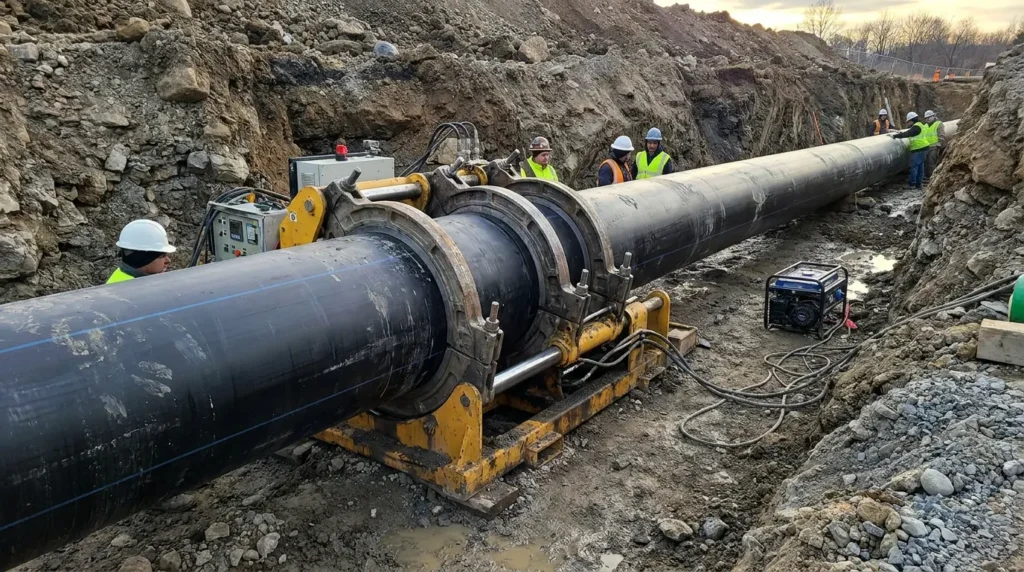
Contractors deploy these butt fusion machines across a massive variety of infrastructure sites. You’ll see them working on bulk water supply lines that link reservoirs to treatment facilities. They are a staple in municipal distribution grids run by local water districts, as well as the massive flood control systems protecting Metro Manila and low-lying provinces. Beyond public works, private sectors rely heavily on them too. Industrial parks, active mining operations down in Mindanao, and vast agricultural irrigation setups all depend on a reliable HDPE pipe fusion machine for water supply projects Philippines to keep high-pressure fluids moving without interruption.
Main Types of HDPE Pipe Welding Machines Available in the Philippines
Picking the right plastic pipe welding machine architecture completely dictates your project timeline, joint quality, and labor costs. The local market breaks down into distinct tiers based on the diameter of the pipe and how much automation you need.
| Machine Type | Typical Pipe Range | Control Level | Typical Use Case | Indicative Price Position |
|---|---|---|---|---|
| Manual Butt Fusion | Usually up to DN160–DN200 | Manual Lever or Handwheel | Small water lines, irrigation, repairs, and light-duty projects | Entry-Level |
| Hydraulic Butt Fusion | Model-dependent, from small to large diameters | Manual Hydraulic or Semi-Automatic | Municipal water, drainage, mining, and industrial pipelines | Mid-Range to High |
| CNC / Automatic Butt Fusion | Model-dependent | Automatic Parameter Control and Data Logging | Regulated projects requiring repeatability and weld traceability | High |
| Electrofusion Welder | Depends on fitting size and machine output capacity | Barcode-Controlled or Data-Logging | Repairs, tie-ins, branch connections, confined spaces, water, and gas networks | Entry-Level to High |
Note: Pipe ranges and prices vary by manufacturer, machine configuration, included reducing inserts, power supply, automation level, freight, and local import costs. Buyers should request a model-specific quotation based on the required pipe outside diameter and SDR or wall thickness.
Manual Butt Fusion Welding Machines (63–160mm)
Manual units rely entirely on human muscle. An operator uses a hand lever or rotary wheel to generate welding pressure. Because they lack hydraulic cylinders, these pipe fusion machines Philippines are strictly meant for small-diameter pipes (topping out at 160mm) and low-pressure plumbing. They are incredibly portable and budget-friendly, making them popular for subdivision utilities or farm irrigation. However, they carry a high risk of human error since the operator has to guess the fusion pressure by feel.
Semi-Automatic Hydraulic Butt Fusion Machines (90–315mm and 315–630mm)
If there is a workhorse for local contractors, it’s the hydraulic butt fusion machine 63-315mm Philippines standard. These setups use a dedicated hydraulic pump to apply exact, unwavering drag and fusion pressure. You input the parameters from a standard welding chart, and the machine holds the exact bar/MPa needed throughout the heating and cooling cycles. You absolutely need this level of consistency if you want your municipal pipeline projects to pass strict LWUA and DPWH pressure tests.
Fully Automatic CNC Butt Fusion Machines for Large Diameter Projects
Computer Numerical Control (CNC) units take the guesswork out of the fusion cycle by automating everything. The operator simply punches in the pipe diameter, SDR (Standard Dimension Ratio), and material grade. From there, the butt fusion machine calculates the exact heating time, changeover window, and required pressure. Even better, CNC models log every single parameter for each weld, creating a traceable digital record. High-stakes EPC (Engineering, Procurement, and Construction) contracts and bulk water transmission lines increasingly demand this kind of strict documentation.
Electrofusion Welding Machines for Fittings and Tight Spaces
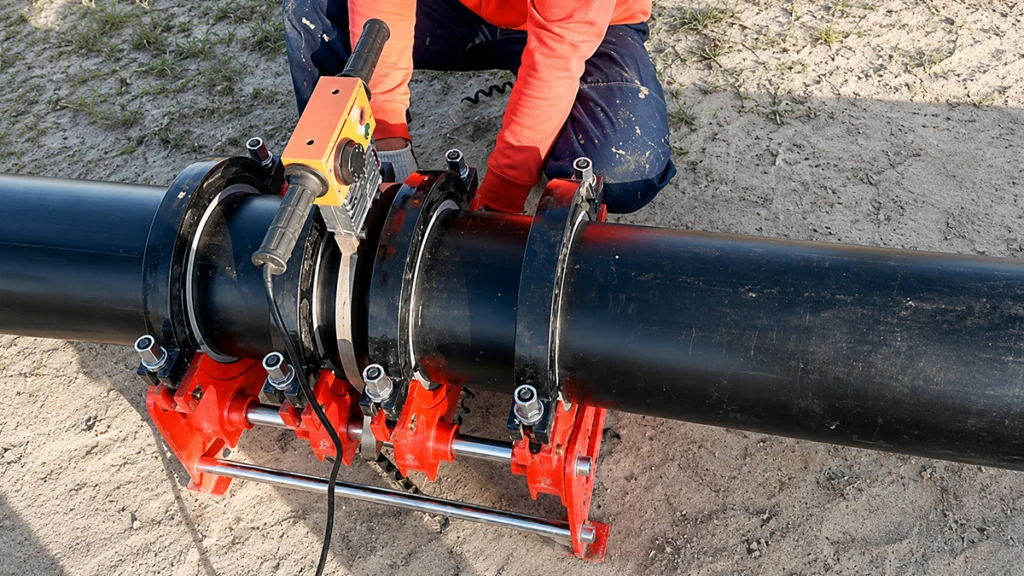
An electrofusion welding machine for HDPE pipe Philippines tackles the job from a completely different angle. Instead of a heating plate, this method uses specialized fittings packed with electrical resistance coils. The machine fires a precise electrical current into the fitting, simultaneously melting the inside of the fitting and the outside of the pipe. You can’t beat this technology when you’re working in vertical shafts, cramming into tight trench repairs, or making final tie-ins where a standard butt fusion chassis simply won’t fit.
Factory-direct pricing with technical consultation included
Get Your Free QuoteHow an HDPE Butt Fusion Welding Machine Works: Key Components and Process
Pulling off a flawless weld means understanding how the butt fusion machine’s mechanics interact with the thermodynamics of the plastic.
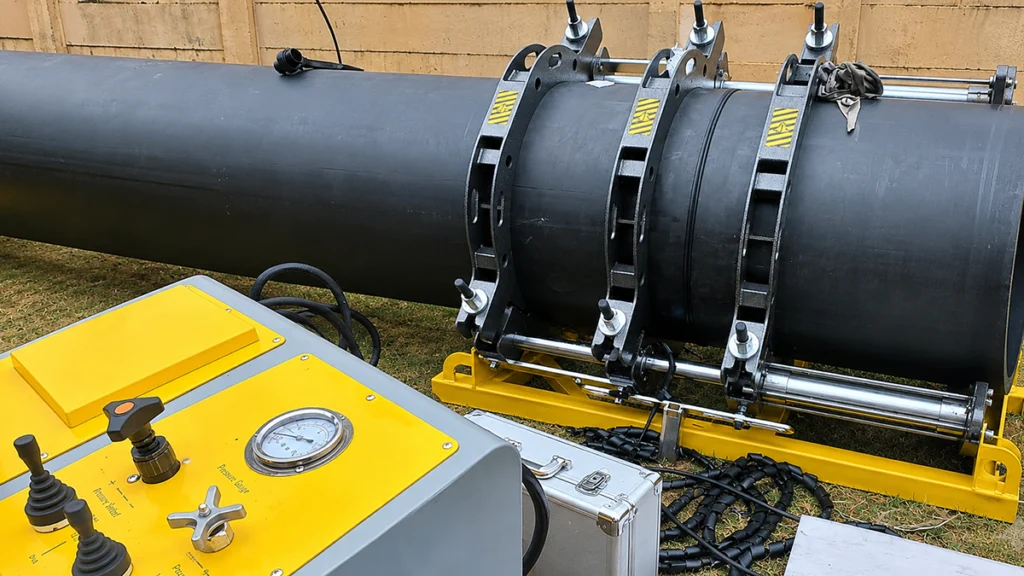
Core Components: Clamps, Heating Plate, Planer, and Hydraulic Unit
1. Basic Frame and Clamps: Think of this as the skeleton. The rigid aluminum or steel chassis locks the pipe ends into perfect axial alignment. Even a slight misalignment (known as high-low) will ruin the joint’s strength.
2. Planer (Facer): This electric rotary tool spins cutting blades to shave down the pipe ends. It ensures the faces are perfectly parallel, stripping away any oxidation or dirt.
3. Heating Plate: A precisely calibrated, PTFE-coated element. It brings the pipe ends up to their melting point without letting the sticky plastic adhere to the metal.
4. Hydraulic Unit: The powerhouse. It drives the clamps and dictates the exact pressure applied during both the heating and cooling phases.
The 5-Stage Butt Fusion Welding Process Explained
1. Preparation and Planing: Operators clamp the pipes in place. The planer then shaves both faces until continuous, clean ribbons of plastic fall away.
2. Alignment Check: The freshly planed ends are pushed together under pressure. The goal here is to confirm zero gaps and flawless alignment.
3. Heating (Bead-Up): The operator drops in the heating plate and applies initial pressure until a uniform bead of melted plastic forms around the edges. The pressure then drops to a lower “heat-soak” level.
4. Changeover and Jointing: The plate is pulled out quickly. You have to minimize this changeover time so the plastic doesn’t cool. The pipe ends are instantly slammed together at the calculated fusion pressure.
5. Cooling: The new joint sits under constant hydraulic pressure until its core temperature drops safely below the melting point. Releasing that pressure too early is a guaranteed way to cause joint failure.
What Parameters Affect Weld Joint Strength?
The survival of your weld boils down to three strict variables: Temperature, Pressure, and Time. If the plate runs too cold, the polymer chains simply won’t mobilize. Run it too hot, and the plastic degrades and burns. Mess up the pressure during the cooling phase, and you’ll create internal voids and microscopic stress fractures. Global standards like DVS 2207 exist specifically to provide exact mathematical formulas for these parameters based on your pipe’s wall thickness.
Typical Application Scenarios in the Philippines
Because these butt fusion machines are so versatile, you’ll find them working hard across almost every sector of Philippine infrastructure.
Municipal Water Supply and NAWASA/LWUA-Type Distribution Projects
Local water districts lay down miles of SDR 11 or SDR 13.6 pipes to handle highly pressurized potable water. Contractors deploy hydraulic butt fusion machines to weld continuous stretches of 110mm to 315mm lines. This ensures water travels from pumping stations to residential branches without a single drop lost to leaks.
Drainage, Sewerage, and Flood Control Pipelines
Gravity-fed drainage and sewerage systems demand massive pipes—often corrugated or solid-wall HDPE ranging from 400mm up to 1000mm or more. An HDPE pipe welding machine for drainage and sewerage Philippines needs a seriously heavy-duty frame. It has to withstand the extreme weight and drag force of these giant pipes to forge watertight seals that keep groundwater totally safe from contamination.
Industrial, Mining, and Agricultural Irrigation Applications
Up in Benguet or down in Surigao, mining operations pump harsh, abrasive slurries and corrosive chemicals all day long. Fused HDPE handles that aggressive wear far better than traditional steel joints. Over in the agricultural sector, crews drag portable manual or semi-automatic welders across rough, off-grid terrain to lay kilometers of vital irrigation lines.
Subdivision, Real Estate, and Building Utility Installations
Private real estate developers lean heavily on smaller footprint equipment (usually in the 63mm to 160mm range) to hook up subdivision mains and commercial building utilities. Electrofusion units shine in these environments because urban construction sites are notoriously cramped.
Get detailed specs and custom configuration options
Request Technical SpecificationsTechnical Specifications and Standards to Check Before Buying
Procurement managers need to look past the marketing brochures and rigorously evaluate technical specs. That’s the only way to ensure the gear actually meets project demands and local regulations.
| Technical Parameter | Manual Machine (160mm) | Hydraulic Machine (315mm) | CNC Machine (630mm) |
|---|---|---|---|
| Welding Range (OD) | 63–160 mm | 90–315 mm | 315–630 mm |
| Heating Plate Max. Temperature | 270°C | 270°C | 270°C |
| Pressure Adjusting Range | N/A | 0–8 MPa | 0–10 MPa |
| Total Power | Model-dependent | 5.85 kW | Approx. 10.1 kW* |
| Power Supply | Model-dependent | 380V / 50Hz / 1 Phase | 380V / 50Hz / 3 Phase |
Note: Manual and CNC machine specifications may vary by model and configuration. Confirm the final power supply, total power, pressure range, and included components against the manufacturer’s technical datasheet before ordering. *The CNC 630mm power value is based on the standard 630mm machine configuration and may vary with the control system.
Welding Diameter Range: Matching Machine Size to Pipe OD
Manufacturers categorize butt fusion machines by their maximum outer diameter (OD) capacity—think 160, 250, 315, 450, or 630mm. A 315mm unit doesn’t just weld 315mm pipes; it can handle anything down to 90mm by snapping in reducing inserts. Take a hard look at your project’s bill of materials. Buy a butt fusion welding machine whose sweet spot covers the pipe sizes you handle most frequently.
Heating Plate Temperature Control and PTFE Coating Quality
Your heating plate needs to hold a rock-steady surface temperature, varying no more than ±5°C across the entire metal face. Cheap machines are notorious for cold spots, which directly cause weak, brittle welds. Additionally, the PTFE (Teflon) coating has to be heavy-duty industrial grade. If it isn’t, molten polyethylene will stick to the plate, ruining the joint and forcing your crew to cut the pipe and start the planing process all over again.
Hydraulic Pressure, Clamping Force, and Frame Rigidity
You want hydraulic cylinders that deliver smooth, consistent pressure without sudden spikes. Just as importantly, the HDPE pipe jointing machine’s frame needs to be built from high-grade aluminum or reinforced steel. High clamping forces will easily warp a flimsy frame. If the chassis flexes even a millimeter during the fusion phase, the pipes will shift out of alignment, and the inspector will reject the weld.
Compliance With ISO 12176, DVS 2207, and PNS Standards
Don’t buy equipment that lacks ISO 12176-1 compliance (the global spec for butt fusion machines). Furthermore, the welds it produces must hit DVS 2207-1 parameters, the absolute benchmark for PE welding worldwide. Don’t forget local rules, either. Philippine government projects frequently mandate strict adherence to specific Philippine National Standards (PNS) for plastic piping systems.
How to Choose the Right HDPE Pipe Welding Machine for Your Project
Finding the perfect equipment is a balancing act. You have to weigh the actual project specs against your job site conditions and your budget.
Step 1: Define Pipe Diameter, SDR, and Daily Weld Volume
Start by identifying the absolute largest and smallest pipe diameters you need to join. Next, check the SDR (wall thickness). Thicker pipes demand significantly higher hydraulic pressure and much longer cooling times. Finally, figure out your daily production targets. If you need to crank out high volumes fast, manual butt fusion machines won’t cut it—you’ll need hydraulic or CNC models to keep cycle times down.
Step 2: Match Machine Class — Manual, Hydraulic, or CNC
Reserve manual butt fusion machines strictly for non-critical, low-pressure lines under 160mm. Step up to semi-automatic hydraulic units for your everyday municipal water and drainage contracts. If you are bidding on high-pressure gas lines, massive bulk water transmissions, or any job that demands strict digital weld data logging, CNC automatic butt fusion machines are your only viable option.
Step 3: Evaluate Power Supply, Portability, and Site Conditions in the Philippines
Let’s be real: Philippine job sites frequently struggle with unstable power grids. Verify that the butt fusion machine’s voltage (whether 220V single-phase or 380V three-phase) plays nicely with your site generators. Think about mobility, too. If you’re working through the rainy season on muddy, uneven terrain, you will absolutely need a machine with a rugged wheeled chassis or heavy-duty tracks.
Manual vs Hydraulic vs CNC: Quick Comparison for Contractors
| Feature | Manual Butt Fusion | Semi-Auto Hydraulic | Fully Automatic CNC |
|---|---|---|---|
| Pressure Control | Operator physical force | Hydraulic pump & gauge | Computer-controlled |
| Data Logging | None | Optional external logger | Built-in automatic |
| Operator Skill Needed | High (to guess pressure) | Medium (reads charts) | Low (machine calculates) |
| Best For | Irrigation, small plumbing | Municipal water lines | Critical infrastructure |
HDPE Pipe Welding Machine Price, MOQ, and Lead Time in the Philippines
Nailing down the costs and logistics of importing or buying locally is critical if you want your project bids to be accurate.
Price Ranges by Machine Type and Diameter Range (USD/PHP Reference)
*Keep in mind that prices fluctuate based on component quality, brand reputation, and daily exchange rates.*
- 160mm Manual: $300 – $500 (roughly PHP 17,000 – PHP 28,000)
- 315mm Hydraulic: $1,800 – $2,500 (roughly PHP 100,000 – PHP 140,000)
- 630mm Hydraulic: $5,500 – $7,000 (roughly PHP 310,000 – PHP 395,000)
- Electrofusion (up to 315mm): $1,000 – $1,500 (roughly PHP 56,000 – PHP 85,000)
MOQ, Payment Terms, and Common Incoterms (FOB, CIF Manila/Cebu/Davao)
Most overseas manufacturers set a Minimum Order Quantity (MOQ) of just 1 set for these industrial units. Standard payment terms usually run 30% T/T in advance, with the remaining 70% cleared before the ship leaves the dock. Philippine contractors heavily favor CIF (Cost, Insurance, and Freight) terms to major hubs like Manila, Cebu, or Davao. This smartly shifts the heavy lifting of shipping and insurance over to the supplier.
Lead Time, Shipping, and Customs Clearance in the Philippines
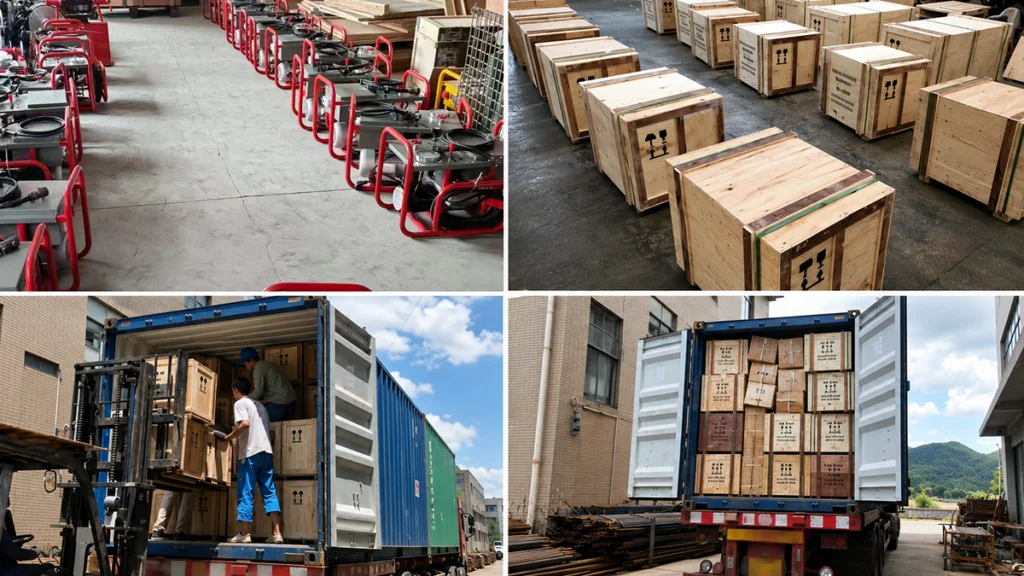
Standard units up to 315mm are usually sitting in stock, taking about 3 to 7 days to dispatch from the factory floor. Ocean freight from Asian manufacturing hubs to Manila generally eats up another 7 to 14 days. Once the crate hits the port, Philippine customs clearance adds a typical 5 to 10 days to your timeline. If you’re ordering massive 800mm+ CNC automatic butt fusion machines, brace yourself for a 30 to 45-day factory lead time.
Warranty, After-Sales Support, and Local Service Availability
A solid standard warranty should cover non-consumable parts for 12 to 18 months. The best HDPE welding machine brand for contractors Philippines goes beyond basic warranties. They provide rapid air-freight dispatch (via DHL or FedEx) for critical spares like hydraulic seals and temperature controllers, backed up by live video tech support to help your crew troubleshoot in the trench.
Buying vs Renting: Which Option Fits Your Contracting Business?
Every contractor eventually faces this dilemma: do you eat the capital expenditure to buy, or pay the premium for the operational flexibility of renting?
When Renting Makes Financial Sense
Renting is a smart move for short sprints (anything under three months) or weird, one-off installations. If you only need to fuse a single 800mm storm drain crossing, don’t buy the butt fusion machine. Renting wipes out maintenance headaches, storage fees, and depreciation. Just be warned: daily rental rates in the Philippines are notoriously steep. If your project hits a delay, those fees will chew through your profit margins fast.
When Owning Delivers Better ROI on Long Water and Drainage Projects
If your business regularly bids on DPWH or local water district pipelines, buying outright yields a massively better Return on Investment (ROI). Owning a standard 315mm hydraulic rig usually pays for itself in just 3 to 4 months of steady use compared to what you’d pay a rental yard. Plus, owning your gear means you can mobilize the second you win a contract, rather than waiting for a rental unit to become available.
Hidden Costs of Renting: Downtime, Availability, and Weld Quality Risk
Rental fleets get abused. A rented butt fusion machine with a deeply scratched PTFE plate, leaky hydraulic cylinders, or busted temperature sensors is going to produce weak welds. Think about the nightmare scenario: the cost of excavating a paved road to dig up and replace a failed underground joint easily dwarfs whatever money you saved by renting instead of buying.
Common Mistakes and Hidden Risks When Sourcing HDPE Welding Machines
Making a bad call during procurement doesn’t just cost money upfront. It translates directly to blown pipelines, massive project delays, and brutal financial penalties.
Buying Under-Sized Machines to Save Cost
Contractors frequently try to save a buck by buying a HDPE pipe welding machine that perfectly matches their current maximum pipe size—like grabbing a 160mm butt fusion machine for a 160mm pipe. Running a machine at its absolute maximum capacity all day puts immense strain on the hydraulic unit and the frame. Smart engineering practice dictates buying one size up (like a 250mm machine). It guarantees longevity and gives you breathing room for future jobs.
Ignoring Heating Plate Quality and Temperature Uniformity
Cheap heating plates are plagued by severe temperature gradients. If the dead center reads 220°C but the outer edges are only hitting 190°C, you are going to forge a “cold joint.” That uneven weld will inevitably crack under pressure. Premium plates use thick aluminum castings and high-end PTFE coatings to ensure the heat stays perfectly uniform.
Overlooking Operator Training and Weld Traceability Requirements
You can buy the most expensive electrofusion welding machine on the market, and it will still fail if the operator doesn’t know what they’re doing. Skipping supplier-provided operational training is a massive unforced error. Also, if you ignore the strict weld data logging requirements on critical government projects, the consulting engineer has every right to reject your entire pipeline installation.
Choosing Suppliers Without Spare Parts and Technical Backup
Buying from a generic trading company instead of a dedicated manufacturer usually means you get zero after-sales support. Imagine a hydraulic valve blowing out on a remote site in Mindanao. If you have to wait weeks for a middleman to hunt down a replacement part, your entire project grinds to an expensive halt.
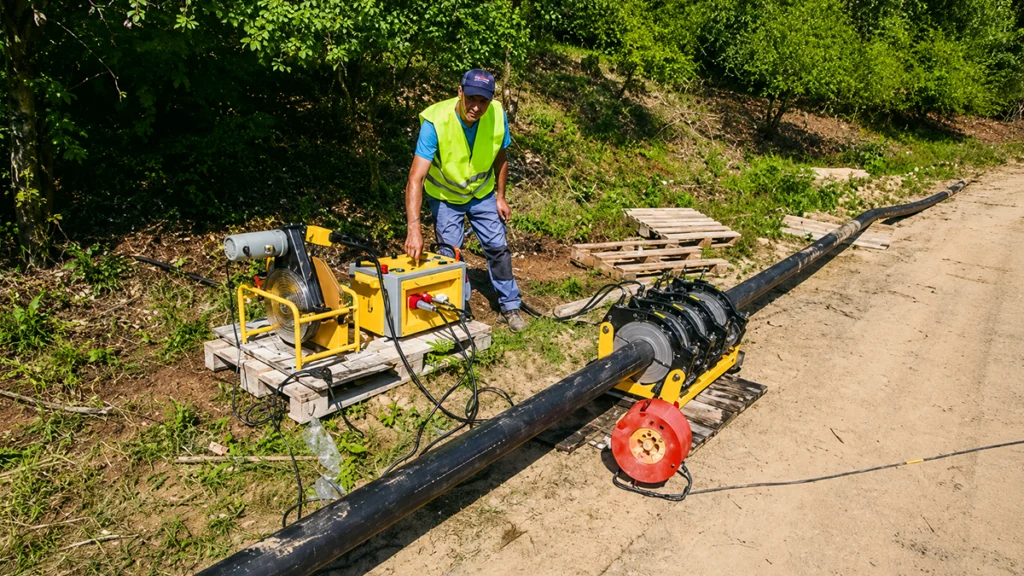
Supplier Evaluation Checklist for Philippine Buyers
Don’t wire any money until you’ve run potential manufacturers through this vetting process to secure your supply chain.
Factory Capability, Certifications, and Export Experience to the Philippines
- Confirm you are dealing with a direct factory manufacturer, not a middleman or trader.
- Ask to see their ISO 9001 certification for the manufacturing facility.
- Verify their track record of exporting to the Philippines. They need to understand local voltage realities and the logistics of shipping into Manila or Cebu.
Documentation: CE, ISO, Test Reports, and Operating Manuals
- Demand CE marking to prove the equipment meets rigorous European safety standards.
- Ask for third-party weld test reports showing their butt fusion machines consistently hit DVS 2207-1 parameters.
- Make sure they provide comprehensive, easy-to-read English operating manuals and clear hydraulic schematics.
After-Sales: Training, Remote Support, and Local Service Partners
- Find out if they offer live video training sessions for your trench operators.
- Check their spare parts policy (look for guarantees like 48-hour dispatch).
- Ask if they have authorized local service partners or distributors operating within the Philippines for emergency on-site fixes.
Reference Projects and Case Studies in Southeast Asia
- Request actual case studies showing their HDPE pipe jointing machines surviving tropical, high-humidity environments.
- Ask for reference contacts from municipal water or drainage projects in Southeast Asia. You want proof the gear holds up under heavy, real-world use.
How to Choose the Right Machine for Philippine Projects
To get the most out of your budget and maximize ROI, you need to tailor your procurement strategy directly to your contracting profile.
Recommended Setup for Small Contractors and Subdivision Projects
If your bread and butter is residential plumbing, tight subdivisions, and low-pressure farm irrigation, grab a 160mm or 250mm Manual Butt Fusion Machine. Pair that with a small Electrofusion Welder (up to 160mm). This combo gives you incredible portability and keeps your initial capital costs extremely low.
Recommended Setup for Municipal Water and Drainage Contractors
Mid-sized firms tackling LWUA water distribution networks and standard LGU drainage jobs need the 315mm and 630mm Semi-Automatic Hydraulic Butt Fusion Machines. These workhorses deliver the exact hydraulic pressure control required to pass harsh government pressure-testing standards, yet they remain light enough to transport easily between messy job sites.
Recommended Setup for Large Infrastructure and EPC Companies
Top-tier EPC giants building bulk water transmission lines, massive flood control interceptors, and high-pressure industrial grids have no choice: they must invest in Fully Automatic CNC Butt Fusion Machines (630mm to 1200mm+). The automated heating parameters and digital weld traceability aren’t just nice features—they are mandatory for passing international audits and guaranteeing a 50-year, zero-leak lifespan.
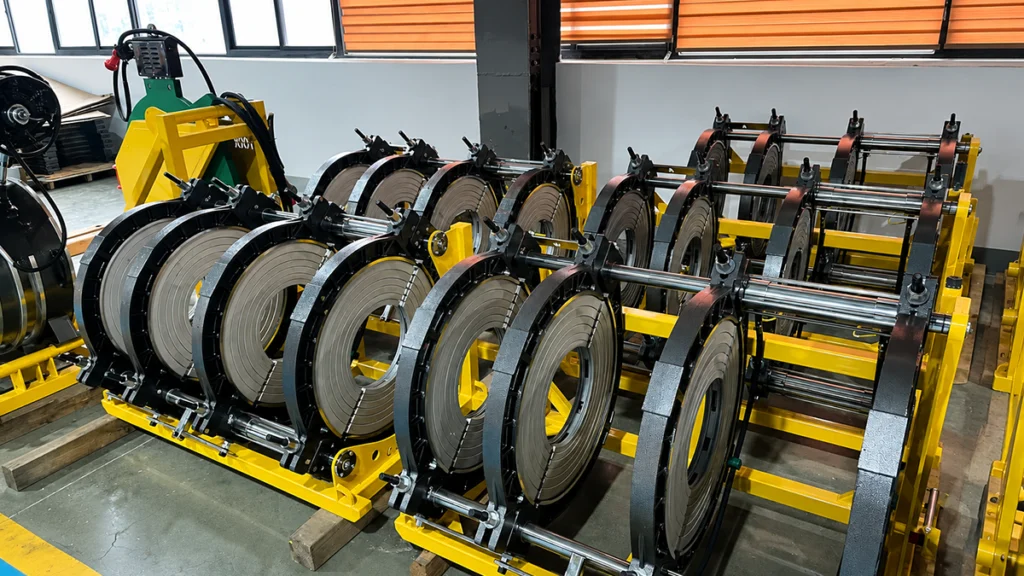
FAQ
Q1: How much does an HDPE pipe welding machine cost in the Philippines?
Pricing heavily depends on the size and the level of automation. You can pick up a small manual unit (up to 160mm) for roughly $300 to $800 (PHP 17k–45k). If you need a standard hydraulic machine for municipal jobs (up to 315mm), expect to spend between $1,500 and $2,500 (PHP 85k–140k). Massive CNC machines built for heavy infrastructure easily push past $10,000 (PHP 560k+), depending on your specific requirements and shipping terms.
Q2: What size of HDPE butt fusion machine do I need for 110mm to 315mm water pipes?
A 315mm hydraulic butt fusion machine is exactly what you need. These units ship with a complete set of reducing inserts (clamps). You snap these inserts into the main chassis, allowing you to securely grip and weld smaller diameters like 90mm, 110mm, 160mm, 200mm, 225mm, 250mm, and 280mm without buying a separate machine.
Q3: Is electrofusion or butt fusion better for drainage projects in the Philippines?
For long, straight runs of drainage pipe, butt fusion is far better and much cheaper because you don’t have to buy expensive specialized fittings. However, electrofusion absolutely dominates when you are working in confined spaces, repairing existing trenches, or dropping vertical shafts where a bulky butt fusion chassis simply won’t fit around the pipe.
Q4: Which HDPE welding machine standards should Philippine contractors follow?
Always verify that your equipment meets ISO 12176-1 specifications for butt fusion machinery. As for the actual welding execution, strictly adhere to DVS 2207-1 parameters (which dictate exact temperature, pressure, and time). Following these rules ensures your joints will pass the rigorous inspections demanded by the DPWH and local water utilities.
Q5: Can I import an HDPE welding machine directly from China to the Philippines?
Absolutely. In fact, many local contractors buy directly from Chinese factories to drastically cut out middleman markups. You’ll typically arrange CIF shipping terms to ports in Manila, Cebu, or Davao. Just make sure you hire a reliable local customs broker to manage the import duties, VAT, and final port clearance so the machine gets delivered smoothly to your yard.
Q6: How long does it take to weld one HDPE joint on a 200mm water pipe?
For a standard 200mm SDR 11 pipe, expect the entire cycle to take about 20 to 25 minutes. That window covers planing the ends, checking alignment, heating the plastic (roughly 2-3 minutes), and the vital pressure-cooling phase (usually 15-20 minutes). Never rush that cooling phase, or you’ll guarantee a joint failure.
Q7: Do I need certified operators to use an HDPE butt fusion machine in the Philippines?
While private residential projects might not legally require it yet, major government infrastructure jobs under the DPWH or LWUA increasingly demand documented operator certification. Proper training ensures your crew actually understands the hydraulic pressure charts and temperature limits, which drastically cuts down your risk of catastrophic pipeline blowouts.
Q8: What is the typical warranty and after-sales support for HDPE welding machines shipped to the Philippines?
Trusted industrial manufacturers usually back their equipment with a 12 to 18-month warranty covering all non-consumable parts. Great after-sales support should include digital operating manuals, live remote video troubleshooting, and the ability to rapidly air-freight critical replacement parts (like sensors or hydraulic seals) via DHL or FedEx to keep your downtime to an absolute minimum.
Conclusion
Finding the perfect HDPE pipe welding machine for your Philippine operations boils down to honestly evaluating your project specs, pipe sizes, and long-term business goals. When building critical water and drainage networks, thermofusion is the only way to guarantee a resilient, zero-leak system that can survive earthquakes—but only if your equipment delivers dead-on temperature and hydraulic pressure control.
Contractors need to align their machinery with their actual workload. Use manual units for light, low-pressure plumbing. Rely on semi-automatic hydraulic machines for everyday municipal pipelines. Step up to fully automatic CNC systems when tackling massive EPC infrastructure that demands strict weld traceability. Prioritizing gear that meets ISO 12176 and DVS 2207 standards is the easiest way to ensure your joints pass DPWH and LWUA inspections on the first try.
Ultimately, dodging common procurement traps—like buying undersized rigs, settling for cheap heating plates, or choosing suppliers who vanish after the sale—protects your profit margins and prevents underground disasters. Treat your welding machine as a strategic business asset rather than a disposable tool. Doing so allows Philippine contractors to speed up installation times, nail regulatory compliance, and drive a massive return on investment.
Let our experts help you choose the right equipment for your project
Contact Our Engineering Team