
Butt Fusion Machine South Africa: Buying Guide for HDPE Projects
Table of Contents
Butt Fusion Machine South Africa buying guide for HDPE pipeline projects: compare manual, hydraulic, and CNC machines, review key specifications, costs, supplier criteria, and standards to select the right welding machine for water, mining, and gas applications.
What Is a Butt Fusion Machine and How Does It Work in HDPE Pipeline Projects?
When you need to join high-density polyethylene (HDPE) pipes, a butt fusion machine is your go-to industrial tool. It uses a highly controlled thermo-mechanical process to get the job done. If you’re a contractor or utility engineer looking for a Butt Fusion Machine South Africa, getting a grip on how this equipment actually works is your first step toward building a bulletproof pipeline. The setup uses a pull-out plate structure combined with electric heating. This transfers exact thermal energy right to the pipe ends, melting the thermoplastic. From there, calculated hydraulic pressure forces the surfaces together to form a permanent bond.
Definition: What a butt fusion machine does in an HDPE pipeline
Think of this butt fusion machine as a way to create a monolithic, seamless joint that often outlasts and outperforms the pipe itself. You aren’t relying on mechanical couplings or messy chemical solvents here. Instead, the equipment physically alters the polyethylene’s molecular structure. By applying specific heat and pressure, it bonds two separate lengths of pipe end-to-end. The result? A continuous, leak-proof conduit that handles high-pressure water, volatile gases, and heavy mining slurries with ease.
How the heat-and-pressure fusion process works step by step
To guarantee a certified joint, the SABS-approved welding procedure demands four strict phases. First up is positioning. Operators secure the pipes in heavy-duty clamps and align them to wipe out any high-low mismatch. Next comes the milling phase, where a rotating planer shaves the pipe ends until they are perfectly flat and parallel. The third step is heating. A PTFE-coated heater plate melts the pipe faces at precise temperatures—usually hitting between 200 and 220°C—until a specific bead size forms. Finally, during the cooling phase, the HDPE pipe jointing machine holds the fused joint under sustained pressure. It stays locked in place until the plastic completely solidifies, locking in maximum tensile strength.
Key components: clamps, heater plate, planer, and hydraulic unit
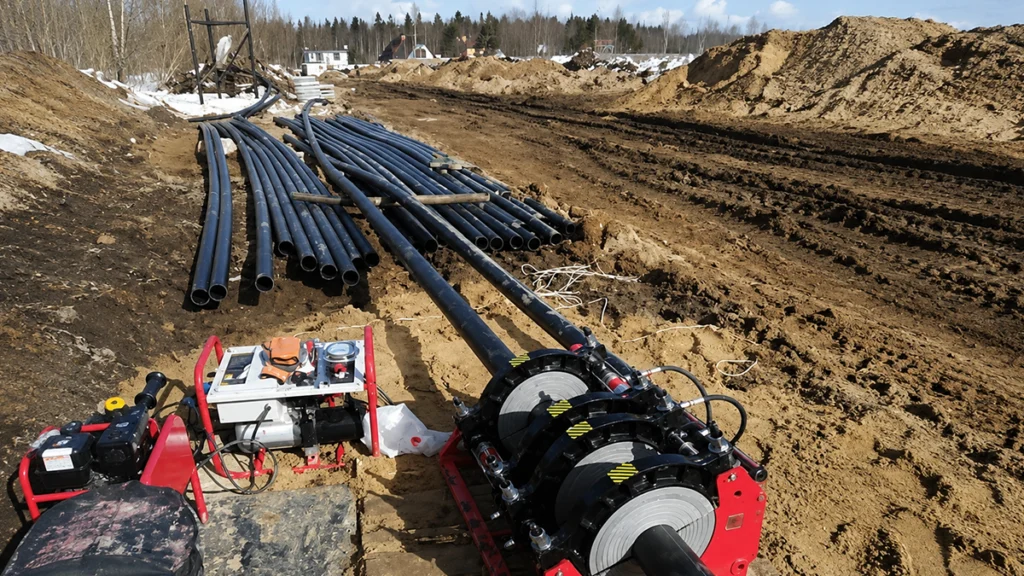
Four main sub-systems drive these industrial butt fusion welding machines. The clamping fixture locks the pipe down, keeping axial alignment tight throughout the pressure cycle. Then you have the heater plate. This component boasts an independent, high-precision temperature controller—ranging from 0 to 300°C with a tight error margin of ≤±3°C—and features a premium polytetrafluoroethylene (PTFE) coating so melted plastic won’t stick. You also need a planer, or facing tool, equipped with high-speed carbon steel blades to trim the pipe faces. Finally, the hydraulic unit steps in to regulate the exact pressure during the fusion and cooling stages. This hydraulic control is non-negotiable for both semi-automatic and fully automatic setups.
Why butt fusion is the standard jointing method for HDPE in South Africa
Why do South African infrastructure projects lean so heavily on this method? Simple: it offers massive material savings and unmatched structural integrity, especially when you’re dealing with large-diameter pipelines. Unlike socket fusion or mechanical fittings, butt fusion creates a single, continuous pipe string. That string can easily endure the brutal environmental extremes of the Highveld or the unstable, shifting soils found in local mining regions. These high-quality welded joints drastically extend the pipeline’s lifespan while practically eliminating the root causes of underground leaks.
Why Butt Fusion Machines Matter for HDPE Pipeline Projects in South Africa
When you are moving hazardous mining tailings or highly pressurized municipal water, pipeline failure simply isn’t an option. Choosing the right HDPE welding machine South Africa ultimately decides how long your entire infrastructure will survive.
South African HDPE pipeline demand: water, mining, and gas sectors
Three massive sectors drive the demand for HDPE pipelines across South Africa. Municipalities depend on large-diameter pipes for bulk water supply and critical sewage upgrades. Meanwhile, the mining sector rolls out aggressive SDR-rated lines for slurry transport, dewatering, and heap leaching. Finally, the gas distribution network demands absolutely zero-leakage systems to safely move volatile resources through urban areas. Every single one of these industries requires rugged fusion equipment that won’t quit when faced with extreme heat, choking dust, and isolated locations.
How SANS/SABS standards influence machine selection
Local engineering specs don’t leave room for guesswork. They strictly point to SANS 4427 for water applications and SANS 10268 for welding guidelines, laying out the exact parameters for joining HDPE. Procurement teams have to buy equipment that can hold the precise pressures and temperatures these standards demand. If a pipe fusion machine lacks accurate hydraulic gauges or a trustworthy temperature controller, it will churn out non-compliant welds. Site inspectors will reject that work immediately.
What happens when a project uses the wrong fusion machine?
Bring a substandard or improperly sized butt fusion machine to the job site, and you’re asking for trouble. You’ll end up with inconsistent weld quality, brittle cold joints, and uneven flange formation. Under operational pressure, these defects trigger catastrophic blowouts. The fallout? Massive maintenance bills, brutal environmental fines for toxic leaks, emergency repair scrambles, and the endless headache of replacing ruined pipe sections.
Manual butt fusion machines (small diameter, 63–160 mm)
If you’re tackling small-scale agricultural irrigation or running low-pressure conduits, manual butt fusion machines are a great, budget-friendly starting point. Instead of hydraulics, these units use a mechanical lever system, relying on human muscle to apply fusion pressure. They work well for tight budgets and pipe diameters between 63mm and 160mm. Just keep in mind that the final weld quality rests squarely on the operator’s personal experience, technique, and physical endurance.
Factory-direct pricing with technical consultation included
Get Your Free QuoteMain Types of Butt Fusion Machines for HDPE Pipe
To keep procurement efficient, you need to match your HDPE pipe jointing machine’s automation level to the strictness of your project. The market generally splits this equipment based on how it handles pressure and temperature data during the fusion cycle.
Semi-automatic hydraulic machines (90–630 mm)
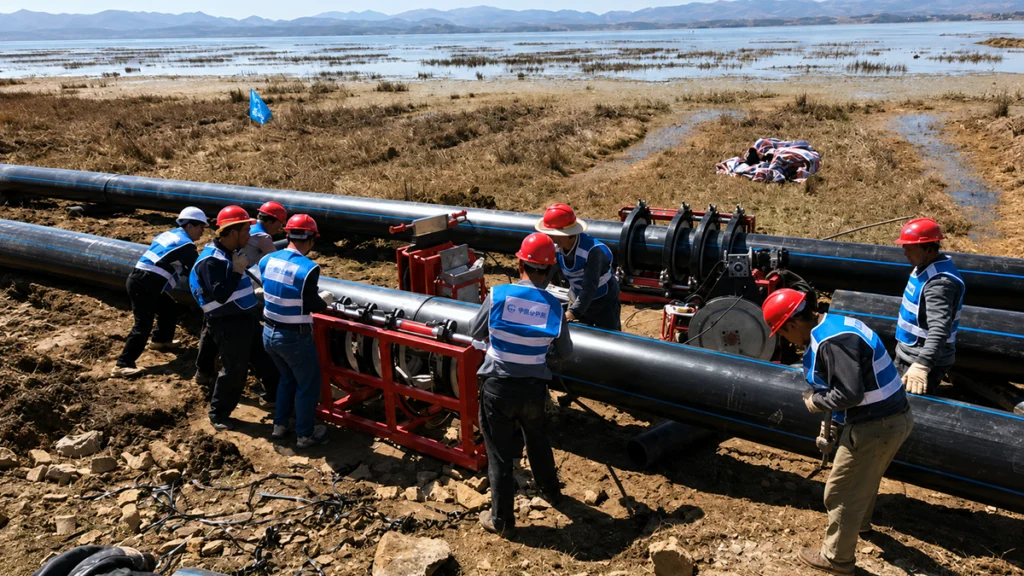
Stepping up from manual levers, a hydraulic butt fusion machine for HDPE pipe uses a motorized pump and cylinder system. This setup delivers consistent, highly measurable pressure control. Today’s semi-automatic units pack intelligent data control instruments that calculate your process parameters, flash timely reminders, and walk the operator through the required heating and cooling timelines. Unsurprisingly, they serve as the everyday workhorses for standard water and mining jobs.
Fully automatic CNC butt fusion machines with data logging
Want to eliminate human error entirely? Fully automatic butt fusion machines are the answer. They run a closed-loop control system that monitors time, temperature, and pressure without operator intervention. These high-end units come loaded with built-in welding standards, automatic drag pressure detection, GPS tracking, and remote data transmission. If any parameter drifts out of spec, the machine automatically kills the weld. That guarantees 100% compliance with the toughest engineering codes.
Which type suits mining, municipal, or on-site trenchless projects?
High-risk, heavily regulated pipelines—like gas distribution networks and critical municipal bulk water mains—strictly demand fully automatic CNC butt fusion machines because mandatory data logging is non-negotiable. For mining slurry lines and everyday civil works, hydraulic butt fusion machines hit the sweet spot. Manual machines, however, belong only on low-pressure, small-diameter jobs like farm irrigation or basic internal plumbing.
Pipe diameter range and wall thickness (SDR) compatibility
You can’t use a one-size-fits-all approach here. Every butt fusion welding machine is rated for a specific diameter range (say, 160–315mm) and a maximum wall thickness, known as the Standard Dimension Ratio (SDR). Buyers have to double-check that the pipe fusion machine’s cylinder piston area and peak clamping force are strong enough. If they aren’t, the machine won’t overcome the heavy drag resistance of thick-walled, low-SDR pipes scraping across rough terrain.
Key Butt Fusion Machine Specifications to Compare
When sourcing an HDPE butt fusion welding machine supplier South Africa, procurement managers need to look past the sticker price. You have to dig into the core engineering specs that actually determine how long the butt fusion machine will last and how strong the welds will be.
Heater plate temperature control and PTFE coating quality
The heater plate drives the entire fusion process. Your specs must guarantee an independent, high-precision temperature control system that holds steady between 0 and 300°C, with a maximum error of ≤±3°C. On top of that, the PTFE surface coating needs to be true industrial-grade. It has to survive hundreds of heating cycles without flaking or degrading. Once that Teflon wears out, plastic sticks to the plate, ruining your welds instantly.
Hydraulic system pressure, drag pressure, and clamp force
Weak hydraulics will kill a project. A standard 250mm butt fusion machine needs a pressure adjusting range of 0–6.3MPa, while massive units (710–1000mm) demand up to 0–16MPa. Just as importantly, the system must be capable of a very low starting pressure. This ensures you get a reliable, precise seal when welding smaller fittings or running the machine at the bottom end of its capacity.
Power supply requirements: 220V vs 380V for South African sites
Out in remote South African locations, power availability dictates what gear you can run. Small to medium butt fusion welding machines (up to 250mm) usually run on a single-phase 220V supply, pulling about 3.7kW. But once you step up to large diameter machines (450mm–1000mm), you need a serious three-phase 380V setup. That means hauling in dedicated diesel generators that can push between 8.2kW and 23.5kW of continuous, uninterrupted power.
Cost per joint: butt fusion vs electrofusion
Looking at the long-term ROI of pipeline economics, butt fusion wins hands down. Yes, the initial capital outlay for the pipe fusion machine is steep. However, your cost per joint drops down to just labor and generator fuel. Electrofusion, on the flip side, forces you to buy an expensive, single-use consumable fitting for every single connection. For long, continuous pipeline runs, that consumable cost becomes completely prohibitive.
Get detailed specs and custom configuration options
Request Technical SpecificationsButt Fusion Machine vs Electrofusion: Which Is Right for Your Project?
Both methods create incredibly strong HDPE joints, but choosing between them depends entirely on your site’s physical constraints, the pipeline design, and your budget.
Speed, portability, and site condition considerations
Electrofusion gear is lightweight, highly portable, and fast to set up, making it a lifesaver in tight trenches or vertical shafts. The catch? It demands a pristine working environment. A speck of dust, a drop of moisture, or slight pipe ovality will cause that fitting to fail. Butt fusion equipment takes up more space and weighs a lot more, but it is incredibly robust and easily shrugs off the dusty, gritty conditions of a typical job site.
When electrofusion is the better choice for HDPE fittings
Sometimes, electrofusion really is the better tool for the job. It’s the gold standard for emergency repairs where digging a massive trench to fit a butt fusion machine just isn’t viable. It also shines when you need to connect crossing pipes, execute final tie-ins on active gas networks, or install complex manifold fittings inside cramped pump stations.
Comparison table: butt fusion vs electrofusion at a glance
| Feature | Butt Fusion | Electrofusion |
|---|---|---|
| Cost per Joint | Very Low (No fittings required) | High (Requires consumable fittings) |
| Equipment Cost | High (Capital investment) | Low to Medium |
| Space Required | Large (Needs trench clearance) | Minimal (Fits in tight spaces) |
| Environmental Tolerance | High (Handles dusty conditions well) | Low (Requires absolute cleanliness) |
| Best Application | Long, continuous pipeline runs | Emergency repairs, tie-ins, confined spaces |
Municipal water and bulk water supply pipelines
Big municipal networks need continuous pipe strings to cut down on potential leak points. For these massive bulk water supply systems, butt fusion is the undisputed heavyweight champion. Contractors rely on heavy-duty butt fusion machines capable of handling diameters from 315mm all the way past 1000mm to push huge volumes of water across vast distances.
Application Scenarios: Where Butt Fusion Machines Are Used in South Africa
A quality HDPE pipe jointing machine South Africa proves its worth across several heavy industries. Different sectors leverage this technology to tackle their own unique fluid transport headaches.
Mining slurry, dewatering, and tailings lines
South African mines are brutal, corrosive environments. Engineers use HDPE pipes for slurry transport and dewatering because the plastic fights off chemical attacks and heavy abrasion. Out on the tailings dams and deep in the pits, butt fusion machines weld thick-walled pipes together, ensuring the line can handle highly pressurized, abrasive sludge without a single joint failing.
Gas distribution and industrial process piping
In the natural gas sector, safety regulations offer zero margin for error. Fully automatic hot-melt butt welding machines are mandatory for these distribution networks. Their strict data logging capabilities mean every single weld parameter gets recorded and tracked. This guarantees full compliance with TSG D2002-2006 standards and keeps the public safe.
Trenchless installation and HDD pipeline projects
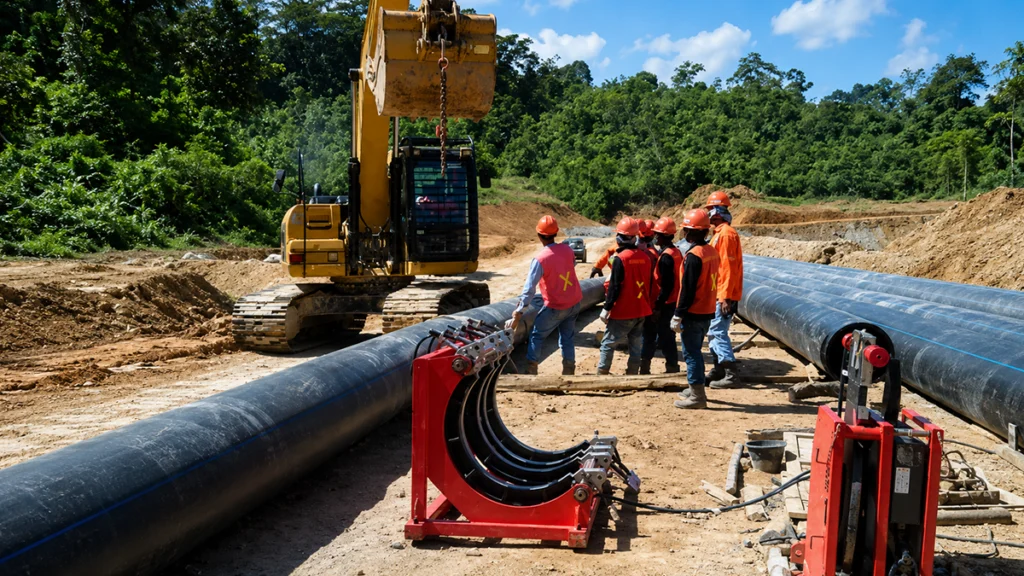
Techniques like Horizontal Directional Drilling (HDD) and pipe-bursting require pulling the pipeline through tight underground cavities. For trenchless installs, butt fusion isn’t just an option—it’s mandatory. It creates a completely smooth, flush external profile. If you tried using electrofusion or bulky mechanical fittings, they would snag on rocks and soil, tearing the pipeline apart during the pull-back.
Typical price ranges by machine capacity (ZAR and USD indication)
Smart capital allocation means forecasting your costs accurately. While the final price tag swings wildly based on hydraulic configurations and automation levels, buyers have to budget based on butt fusion welding machine capacity. It’s all about balancing that heavy upfront cost against the sheer volume of welding the project demands.
Butt Fusion Machine Cost, MOQ, and Lead Time in South Africa
Buying heavy industrial gear means dealing with international logistics, import duties, and unpredictable manufacturing schedules. Getting a handle on these variables early will save your project from expensive delays.
MOQ, shipping to Durban/Cape Town, and import duty considerations
For large hydraulic butt fusion machines, most industrial manufacturers set a Minimum Order Quantity (MOQ) of just one unit, though you can usually score bulk discounts if you’re upgrading a whole fleet. If you are importing a Butt Fusion Machine South Africa, factor in sea freight lead times to major hubs like Durban or Cape Town—usually taking 4 to 6 weeks. Don’t forget to calculate the South African Revenue Service (SARS) import duties applied to heavy machinery, either.
Lead time for manufacturing, delivery, and on-site commissioning
Major distributors usually keep standard semi-automatic machines in stock for quick local dispatch. However, if you need a fully automatic CNC rig or a custom large-diameter unit (800mm and up), expect a manufacturing lead time of 15 to 30 days. Once it arrives, block out at least an extra week for proper on-site commissioning and operator training.
Rental vs purchase: when does each make financial sense?
Opting for a butt fusion machine rental Johannesburg makes a lot of financial sense if you’re looking at a short-term contract, a sudden emergency repair, or a job that needs an oversized machine for just a few weeks. But for municipalities and contractors laying continuous pipelines year-round, buying the equipment outright delivers a vastly superior ROI. You easily amortize that capital cost over years of flawless, leak-free installations.
Certifications to demand: ISO 9001, CE, SANS/SABS compliance
A cheap HDPE pipe jointing machine is worthless if it fails a strict site inspection. Procurement officers must demand hard proof of certification. That means asking for ISO 9001 for manufacturing quality, CE marks for electrical safety, and documented evidence that the machine’s operational parameters line up perfectly with SANS/SABS welding guidelines.
How to Evaluate a Butt Fusion Machine Supplier
The right supplier is more than just a vendor; they are your long-term technical partner. When vetting an HDPE butt fusion welding machine supplier South Africa, look past the initial handshake. You need to evaluate their engineering expertise and check if they will be around to support you years down the line.
After-sales support, spare parts availability, and training in South Africa
Every hour of downtime on a pipeline project burns through thousands of Rands. Buyers have to gauge the supplier’s ability to handle future maintenance, system upgrades, and independent R&D. Most importantly, the supplier must guarantee that critical spare parts—like PTFE plates, hydraulic seals, and planer blades—are available locally at a moment’s notice, alongside comprehensive training for your operators.
Red flags: low-price traps, missing calibration reports, and unclear warranties
Watch out for substandard equipment hiding behind aggressively low prices. Major red flags include vendors who refuse to hand over factory testing data, lack proper hydraulic calibration reports, or dodge questions about warranty terms. Also, if a butt fusion machine doesn’t have a displacement detection system to track precise welding data, cross it off your list immediately.
Supplier evaluation checklist for HDPE pipeline projects
1. Does the pipe fusion machine meet TSG D2002-2006 automated data standards?
2. Are independent hydraulic calibration reports provided?
3. Is the heater plate temperature error margin ≤±3°C?
4. Does the supplier guarantee local spare parts delivery?
5. Is the hydraulic starting pressure low enough for small fittings?
6. Does the automatic model feature GPS and remote data transmission?
7. Are comprehensive operation manuals and WPS training provided?
8. Does the butt fusion welding machine have sufficient clamping layers for the target SDR?
9. Is the warranty clear, documented, and supported locally?
10. Can the data logger export via USB or direct print?
Undersizing the machine for future project scope
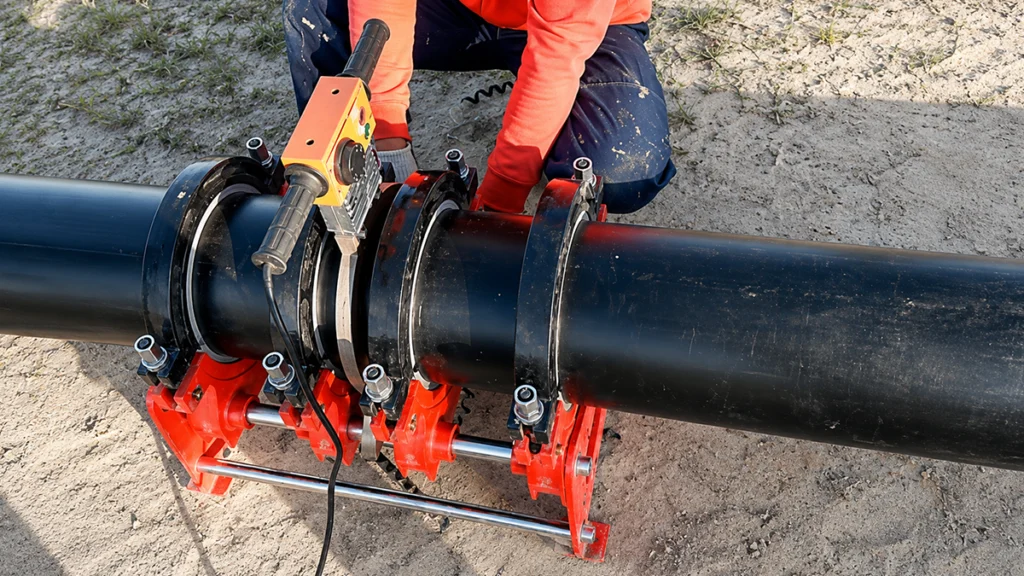
A frequent procurement mistake is buying a butt fusion machine that lacks enough clamping layers for heavy-duty pipe. For instance, machines drawing under 400 amps should only have a maximum of 3 clamping layers. This prevents uneven flange formation and makes sure the hydraulic force distributes properly across thick-walled mining pipes.
Common Mistakes and Hidden Risks When Selecting a Butt Fusion Machine
Even if you buy the best equipment on the market, operational blunders can ruin the entire pipeline. Recognizing these hidden risks early ensures your butt fusion machine performs exactly how it was engineered to.
Ignoring hydraulic drag pressure calibration requirements
Failing to calibrate the hydraulic drag pressure is a massive error. Before every shift, operators need to inspect and record the sliding drag pressure under no-load conditions. Skip this calibration, and the pressure applied during the heat absorption phase might blow past the peak drag pressure. This squeezes out all the molten material, leaving you with a weak, brittle joint that will fail under stress.
Overlooking operator training and welding procedure specifications (WPS)
If you’re running manual or automatic butt fusion machines, your weld quality relies entirely on the operator following the Welding Procedure Specifications (WPS) to the letter. Skipping formal training leads to disastrous shortcuts—rushed cooling times, wrong heating temperatures, and sloppy pipe alignment. Proper training ensures the crew actually understands the thermodynamics of the polyethylene they are working with.
Skipping data logging on regulated water and gas projects
Trying to run a regulated project without data logging is a fast track to failed inspections and uninsurable pipelines. Real CNC automatic butt fusion machines automatically capture at least five vital metrics: fusion management data, specific equipment info, pipeline component details, exact welding parameters, and the final fusion results.
Step 1: Define pipe size range, SDR, and project volume
Smart procurement starts by perfectly matching the butt fusion machine to the pipe. First, define your exact weldable range (for example, sourcing a butt fusion machine for 315mm HDPE pipe South Africa) and confirm the pipe’s SDR. Make sure the machine’s cylinder piston area and clamping force are heavily engineered to handle the specific weight and wall thickness of the pipes you’ll be joining.
How to Choose a Butt Fusion Machine in South Africa
Wading through technical specs requires a solid game plan. Use this structured framework to cut through the noise, narrow down your options, and secure the perfect HDPE pipe fusion machine for your operational environment.
Step 2: Match machine type to site power and mobility needs
Take a hard look at your typical site conditions. If you operate in remote areas without stable grid power, verify that your generators can handle the equipment’s load. Small butt fusion welding machines need a steady 220V (around 3.7kW), but large-diameter infrastructure machines demand heavy-duty 380V three-phase generators. These generators must deliver up to 23.5kW continuously, without any voltage drops during the critical heating phase.
Step 3: Shortlist suppliers using the evaluation checklist
Run your potential vendors through the 10-point checklist we covered earlier. Give priority to suppliers who hand over transparent calibration certificates, offer seamless data export options (like USB or direct print), and prove they are committed to stocking spare parts in the South African market long-term.
Final recommendation: matching machine class to project category
Ultimately, you need to align your capital investment with the risk profile of your project. Grab manual or basic semi-automatic butt fusion machines for low-pressure farm irrigation. Step up to heavy-duty semi-automatic hydraulic rigs for rugged mining slurry and general civil works. But for gas distribution, hazardous chemical lines, and highly regulated municipal bulk water jobs? Mandate fully automatic CNC machines with bulletproof data logging.
FAQ
Q1: How much does a butt fusion machine cost in South Africa?
The price depends on pipe range, machine type, automation level, power configuration, and included accessories. Buyers should request a current quotation covering reducing inserts, tooling, freight, import charges, spare parts, training, warranty, and after-sales support.
Q2: What size HDPE pipe can a butt fusion machine weld?
Each machine has a rated pipe-diameter and wall-thickness range. Reducing inserts allow one frame to handle several diameters, but buyers must also confirm that the clamps, facer, heater, and hydraulic system are suitable for the required pipe OD, SDR or DR, and fusion procedure.
Q3: Is butt fusion better than electrofusion for HDPE pipelines?
Neither method is best for every connection. Butt fusion is generally economical for long, accessible pipeline sections and repeated joints, while electrofusion is useful for repairs, tie-ins, branch connections, and confined spaces. Selection should consider pipe size, access, project specifications, and installed cost.
Q4: Do butt fusion machines in South Africa need to comply with SANS or SABS standards?
Project requirements may reference applicable SANS standards, municipal specifications, or approved international fusion procedures. Buyers should confirm which pipe, fitting, installation, electrical, and welding requirements apply to the project. The equipment should support the approved procedure and provide suitable pressure, temperature, and control accuracy.
Q5: How long does it take to make a butt fusion joint on HDPE pipe?
Cycle time depends on pipe diameter, wall thickness, fusion procedure, ambient conditions, machine setup, and required cooling time. Smaller pipes generally take less time, while large, thick-wall pipes require longer facing, heating, changeover, fusion, and cooling stages. Follow the approved parameter table rather than a universal time estimate.
Q6: Can I rent a butt fusion machine in South Africa instead of buying one?
Rental may be available from selected local equipment providers, but availability depends on location, machine size, and project dates. Renting can suit short-term or unusual-diameter work, while purchasing may be more economical for contractors with frequent projects. Compare rental duration, transport, inserts, maintenance, and downtime risk.
Q7: What certifications should a butt fusion machine supplier have?
Buyers should check the supplier’s quality-management system, machine documentation, inspection and calibration records, warranty, spare-parts support, and operator-training capability. The supplier should also explain how the equipment supports the project’s approved fusion procedure and applicable electrical requirements.
Q8: What are the most common welding defects in HDPE butt fusion and how are they prevented?
Common defects include incomplete fusion, excessive or uneven beads, contamination, misalignment, and premature movement during cooling. Prevention requires clean and properly faced pipe ends, verified heater temperature, measured drag pressure, correct fusion parameters, stable alignment, and completion of the specified cooling cycle.
Conclusion
Selecting the right butt fusion machine for projects in South Africa requires careful consideration of pipe diameter, SDR or DR, application, site conditions, power supply, and required level of automation. Municipal water, mining, industrial, and infrastructure projects may require different machine capacities and control features.
Buyers should evaluate hydraulic performance, heater temperature control, available reducing inserts, data-recording functions, calibration support, spare-parts availability, and after-sales service. The selected equipment should support the approved fusion procedure and applicable project requirements.
By comparing machine capacity, technical documentation, delivery scope, maintenance needs, and total cost of ownership, contractors can choose equipment that supports consistent welding quality and reliable long-term operation.
Let our experts help you choose the right equipment for your project
Get a Machine Recommendation