
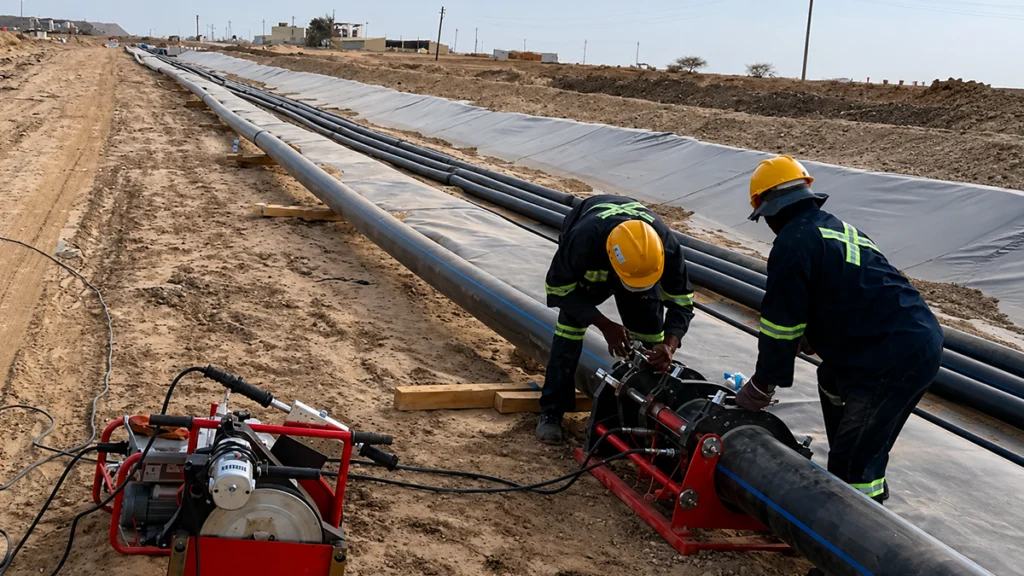
HDPE Pipe Jointing Machine in Benin: Guide for Water Supply Projects
Table of Contents
HDPE Pipe Jointing Machine in Benin buyers can use this guide to compare machine types, specifications, pricing factors, supplier checks, and welding quality needs for water supply projects.
What Is an HDPE Pipe Jointing Machine and Why Is It Used in Benin?
When contractors in Benin lay down new water infrastructure, they rely heavily on HDPE pipe jointing machines. These specialized electromechanical tools apply heat to melt thermoplastic pipes—like PE, HDPE, PP, and PVDF—along with their fittings. The goal? Creating a permanent, leak-proof bond. Mechanical couplings depend on rubber gaskets that eventually fail. Thermal fusion, however, permanently merges the polymer chains of two pipe ends into a single continuous piece.
Definition of an HDPE pipe jointing machine
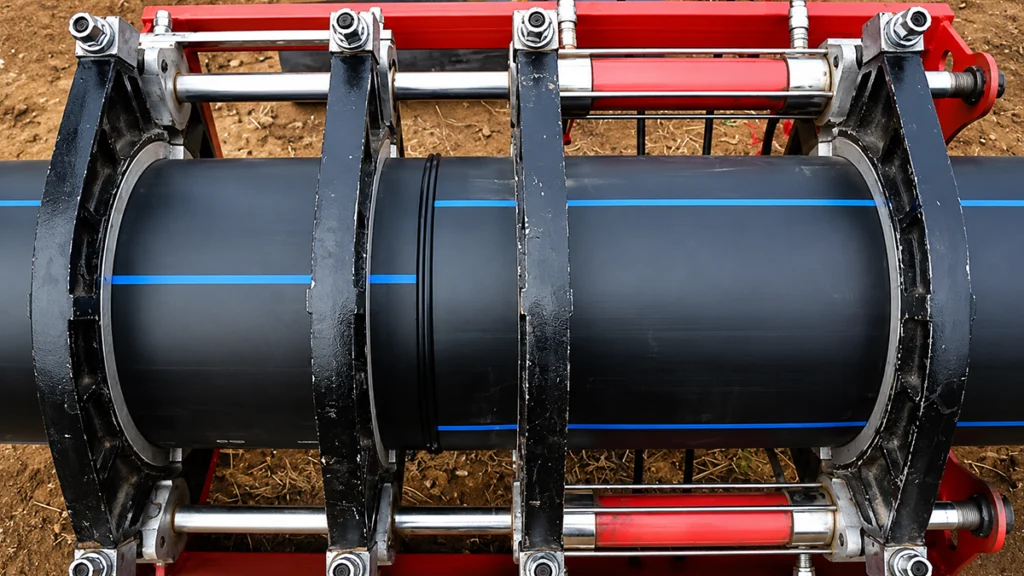
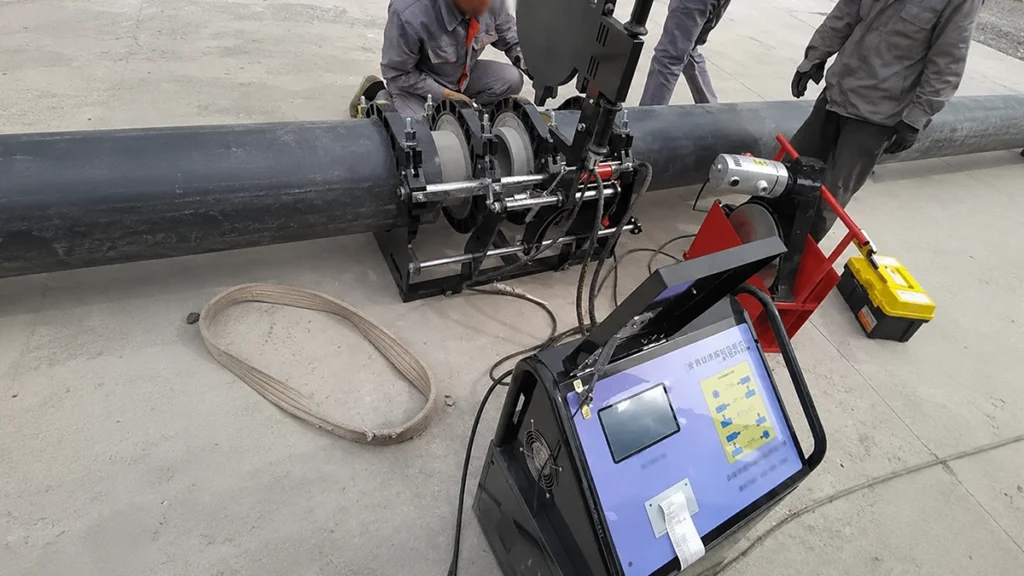
Think of it as a precision forge for plastics. The butt fusion machine applies exact temperatures and mechanical pressure to the ends of high-density polyethylene pipes. A clamping frame securely locks the pipes in place. Next, an electric milling cutter shaves the ends so they sit perfectly parallel. A PTFE-coated heating plate then melts the plastic, and a hydraulic system drives the molten ends together under sustained force. The resulting joint ends up just as strong—if not stronger—than the original pipe.
Why HDPE pipe fusion is preferred for water supply pipelines
HDPE materials boast incredible deformation plasticity and top-tier weldability. For municipal water networks, ditching mechanical joints eliminates the most common failure points for underground leaks. Butt fusion essentially builds a monolithic pipeline. This seamless structure easily absorbs ground shifts, hydraulic shock, and sudden internal pressure spikes. Ultimately, municipalities see a massive drop in non-revenue water loss.
Where these butt fusion machines are commonly used in Benin
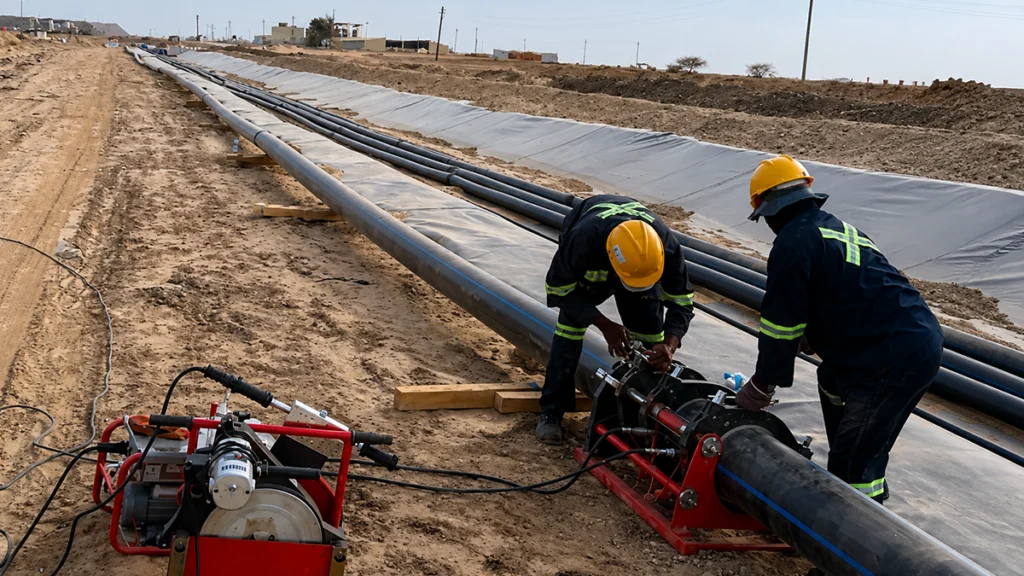
Across West Africa’s rapidly expanding infrastructure, these welding units are everywhere. You will find them expanding urban water grids, laying municipal gas lines, and building massive agricultural irrigation networks. Contractors deploy them deep within cramped city trenches and far out in remote rural villages. In every scenario, absolute pipeline integrity remains the top priority.
What makes a good HDPE pipe joint for pressurized water systems?
A flawless joint requires melting the pipe faces at high, optimal temperatures—usually hovering around 260±5°C—and pressing them together under calculated force. The weld must then cool and harden while maintaining that exact pressure. You know you have a solid weld when you see a uniform, double-rolled bead wrapping around the entire circumference. This bead proves the heat distributed evenly, the alignment was spot-on, and the operator followed ISO 21307 pressure standards.
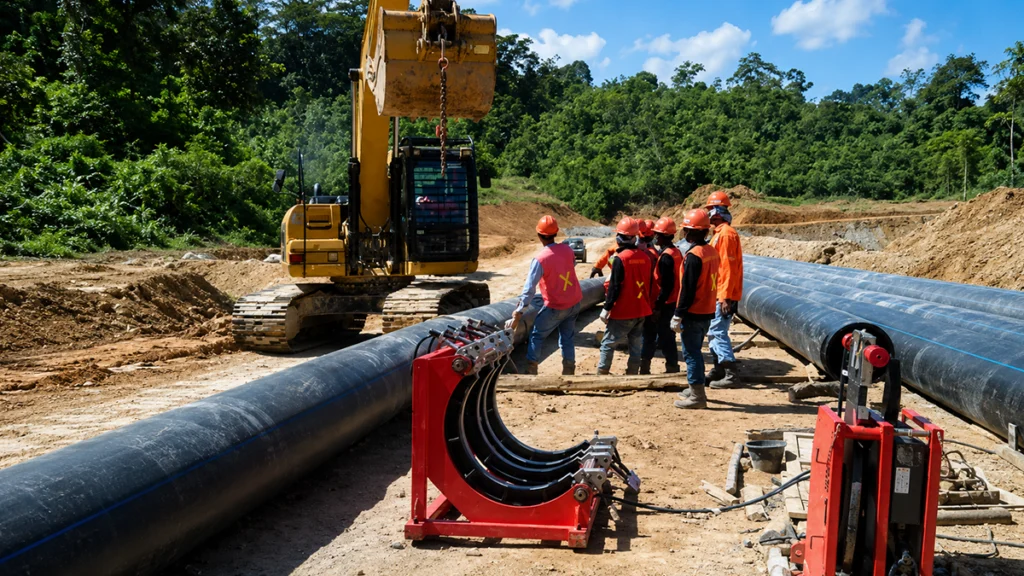
Main Types of HDPE Pipe Jointing Machines for Water Supply Projects
Manual HDPE pipe jointing machines for small-diameter pipes
Manual units rely entirely on the operator’s physical strength to apply fusion pressure using a handwheel or lever. They are highly portable and budget-friendly. However, they demand serious skill to keep the pressure consistent. These butt fusion machines max out at around 160mm. They are strictly meant for small-diameter, low-pressure lines like indoor plumbing or residential water tie-ins.
Hydraulic butt fusion machines for municipal and contractor projects
Step up to hydraulic butt fusion machines, and you get semi-automatic power. A motorized hydraulic station controls the pressure and displacement with pinpoint accuracy. Built to handle larger pipes—from DN160 all the way past DN1000—these units deliver the massive force necessary to fuse thick-walled HDPE. If you are trenching for municipal water or managing heavy civil contracts, this is your standard tool. Manual pressure simply cannot handle these dimensions safely or legally.
CNC or data-logging fusion machines for quality-controlled projects
Fully automatic CNC welders take the guesswork out of the equation. Featuring a programmable logic controller (PLC), these automatic butt fusion machines handle automatic drag pressure compensation and precise displacement tracking. They manage the heating, soaking, and cooling cycles autonomously. Better yet, they print data logs for every single weld and tag them with GPS coordinates. For strict municipal jobs or international NGO projects requiring absolute traceability, CNC is the only way to go.
Which type is best for rural water supply, urban networks, and irrigation?
| Project Type | Recommended Machine Type | Typical Pipe Diameter Range | Key Advantage |
|---|---|---|---|
| Rural Water Supply | Manual or Light Hydraulic | DN63–DN250 | Portable, easy to transport, and suitable for job sites with limited power availability. |
| Urban Water Networks | Standard Hydraulic | DN160–DN800 | Provides controlled fusion pressure and consistent joint quality for municipal pipelines. |
| Regulated Municipal or NGO Projects | CNC or Data-Logging Hydraulic | DN160–DN1000+ | Offers automated parameter control, weld data recording, and improved traceability. |
| Agricultural Irrigation | Manual or Light Hydraulic | DN63–DN315 | Cost-effective and portable for small- to medium-diameter irrigation pipelines. |
Note: Machine selection should also consider pipe SDR or DR, wall thickness, power supply, welding standard, project frequency, and job-site conditions.
Factory-direct pricing with technical consultation included
Get Your Free QuoteHow an HDPE Butt Fusion Jointing Machine Works
Clamping, facing, heating, fusion, and cooling steps
Butt fusion demands a rigid sequence. First, operators lock the pipes into the clamping frame and align them perfectly. The electric facer then steps in, milling the ends until they are flat and parallel. Next, a PTFE-coated heater plate drops in to melt both pipe faces at once. Once a proper melt bead rolls back, the operator quickly yanks the heater out. The hydraulic system immediately drives the molten ends together. Finally, the clamps hold the joint under strict pressure until the plastic cools and solidifies.
Key components: frame, facer, heater plate, hydraulic unit, and inserts
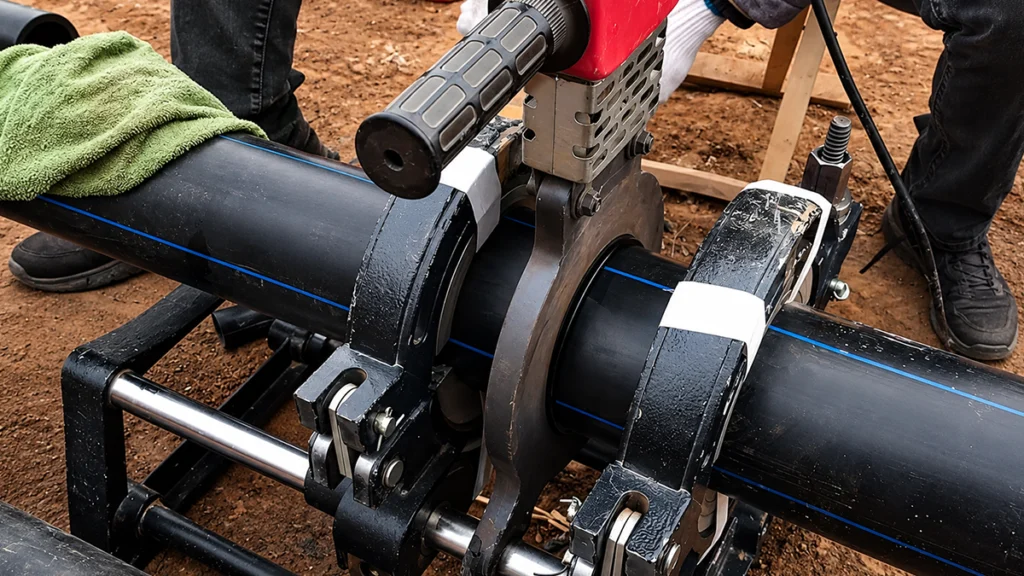
A standard hydraulic setup relies on five main parts. The frame grips the pipes and keeps them axially aligned. The facer (an electric milling cutter) uses high-speed carbon steel blades to prep the plastic faces. The heater plate features a PTFE-coated aluminum alloy base to ensure heat spreads evenly without sticking. The hydraulic control station dictates system pressure. Lastly, aluminum reduction inserts allow one butt fusion welding machine frame to grip several smaller pipe diameters tightly.
Why temperature, pressure, and cooling time affect joint strength
A joint survives solely based on molecular entanglement. Drop the heater plate below 255°C, and the polymer chains won’t melt enough to interlock. Push the hydraulic pressure too high, and you squeeze all the molten material right out of the joint, creating a brittle “cold weld.” Proper cooling under pressure gives those polymer chains time to lock into a permanent matrix. Release that pressure too early, and you instantly introduce stress fractures.
Common operator errors during the welding process
Human error causes the vast majority of joint failures. Misaligning the two pipes (creating a high-low mismatch) is a classic mistake. Loose clamping lets the pipes slip the moment pressure hits. Operators also frequently dial in the wrong temperature or pressure for a specific wall thickness (SDR). Dirt is another massive threat. Skipping the cleaning phase for the pipe ends or the heater plate traps contaminants inside the weld, destroying its structural integrity.
Key Specifications to Check Before Buying in Benin
When procuring an HDPE Pipe Jointing Machine in Benin, buyers must verify technical specifications against project requirements to ensure operational success and equipment longevity.
Pipe diameter range and SDR compatibility
Manufacturers categorize these butt fusion welding machines by their clamping ranges—think 110-250mm, 160-315mm, or massive 710-1000mm units. Always verify the equipment fits your project’s specific outer diameter (OD) and matches the pipe’s Standard Dimension Ratio (SDR). Heavy-walled pipes built for high pressure demand aggressive hydraulic cylinders that can push massive drag and fusion forces.
Hydraulic pressure range and welding force control
Your hydraulic station needs enough muscle to drag heavy pipes and hit the required interfacial pressure. Mid-sized units usually range from 0 to 6.3 MPa, while large-diameter rigs push up to 16 MPa. You absolutely need precise pressure control valves and large, liquid-filled gauges. You cannot afford to guess when applying fusion force.
Heater plate temperature accuracy and coating quality
The heating element makes or breaks the melt. Target a temperature control range of 0-270°C, and insist on a surface differential of no more than ±3°C to ±5°C across the entire plate. The heater must also sport a premium Polytetrafluoroethylene (PTFE) coating. Without it, molten polyethylene sticks to the bare aluminum, ruining the weld face and grinding your trench work to a halt.
Power supply requirements for Benin project sites
Unstable power is a daily reality on West African job sites. Smaller rigs usually run on a 220V 50Hz single-phase supply, pulling about 4.21 kW. Massive pipe fusion machines, however, need a heavy-duty 380V three-phase setup that can draw over 23.5 kW. Make sure the equipment handles voltage swings (AC 176V to 245V) to survive erratic diesel generators. Proper grounding is also non-negotiable to prevent dangerous leakage currents.
Get detailed specs and custom configuration options
Request Technical SpecificationsHow to Choose the Right Machine for Water Supply Projects
Choosing by pipe diameter and project scale
Buy for today, but plan for tomorrow. If your current contract caps at 250mm, spend a little extra on a 160-315mm HDPE pipe welding machine. That slight bump in upfront cost opens doors for larger bids later. Keep in mind that butt fusion isn’t allowed for pipes under 63mm or with walls thinner than 6mm. You need electrofusion or socket fusion for those tiny lines.
Choosing by site conditions: urban, rural, remote, or generator-powered
Your job site dictates the gear. Cramped city trenches or indoor basements call for compact manual butt fusion machines. Wide-open municipal trenches or remote rural runs require heavy hydraulic machines with detachable clamping stations. Running off a diesel generator? Double-check that your machine’s starting wattage aligns perfectly with the generator’s continuous output rating.
When should buyers choose hydraulic instead of manual equipment?
If you are fusing large-diameter or thick-walled pipes, hydraulic power is not optional—it is mandatory. Pipes over 160mm require immense, sustained pressure during the milling, heating, and cooling phases. No human operator can maintain that force manually. Trying to muscle a large pipe on a manual butt fusion welding machine guarantees uneven pressure, failed hydro-tests, and catastrophic leaks.
Decision checklist for contractors, NGOs, and water authorities
- Pipe Specifications: What is the exact OD range and SDR rating for your pipeline?
- Power Availability: Will the crew rely on grid power or a diesel generator? (Confirm 220V vs 380V).
- Automation Needs: Do the project engineers demand printed data logs for weld traceability?
- Terrain: Does the butt fusion machine need a wheeled chassis to navigate rough trench-side dirt?
- Standards: Does the rig comply with strict internal codes like DVS 2207 or TSG D2002-2006?
HDPE Pipe Jointing Machine Price Factors in Benin
Machine size, automation level, and included accessories
Clamping capacity and automation drive the price tag. Manual HDPE pipe welding machines get you in the door cheaply. Standard hydraulic rigs sit comfortably in the mid-tier. At the top end, fully automatic CNC automatic butt fusion machines loaded with PLCs, GPS, and data printers command premium prices. Tacking on specialized accessories, like crane hoists for massive heater plates, will also bump up your initial capital investment.
Shipping, customs, spare parts, and after-sales support costs
The factory sticker price barely tells half the story. You have to calculate the total landed cost. That covers heavy ocean freight, import duties, and trucking the gear inland to your site. Veteran buyers know that securing a solid spare parts pipeline—stocking up on backup hydraulic seals and milling blades—heavily impacts your long-term operating budget.
Training and maintenance costs buyers should budget for
Smart budgeting includes cash for operator training and routine upkeep. Flawless welds require certified hands. Set aside funds for operation manuals, video guides, and on-site supplier training if possible. Your maintenance budget needs to cover hydraulic oil inspections, fluid swaps to prevent pressure drops, and recoating services for scratched PTFE heater plates.
Why the cheapest machine may increase project risk
Hunting for rock-bottom prices usually ends in disaster. Cheap butt fusion welding machines often use weak aluminum alloys that warp under intense heat. Their bargain-bin hydraulic valves bleed pressure right when the weld is trying to cool. A single blown joint on a municipal water main can trigger thousands of dollars in excavation costs, repairs, and delay penalties. That easily wipes out whatever you saved on the purchase price.
Quality Control Requirements for Reliable HDPE Pipe Welding
Visual inspection criteria for finished HDPE joints
Visual checks are your first line of defense. Inspectors judge the weld geometry right in the trench. A passing joint features a smooth, symmetrical, double-rolled bead wrapping entirely around the pipe. The bead’s height and width must align with standard SDR tables. Notice a sharp V-notch between the beads? See irregular sizing or trapped dirt? That weld gets rejected immediately.
Welding parameter records and data logging
Visual checks aren’t enough for critical municipal grids. You need absolute traceability, and that is where data logging shines. CNC automatic butt fusion machines track temperature, pressure, and displacement in real time, spitting out a printed receipt for every single joint. This hard data proves to water authorities that your crew nailed the exact time, temp, and pressure parameters from day one.
Operator training and standard welding procedures
Consistency requires strict protocols. Operators must train on specific industry standards like ISO 21307 or DVS 2207. A trained tech knows how to calculate drag pressure accurately. They know how to tweak heating times when ambient weather shifts (usually operating safely between -20°C and 50°C). They also know exactly when a dull milling blade needs swapping out.
Pressure testing and site acceptance before commissioning
You never bury and commission a pipeline without a professional hydrostatic pressure test. Crews fill the line with water, crank the pressure well past standard operating levels, and watch for drops over a set timeframe. In special cases, authorities might even demand destructive testing on sample welds to guarantee the pipeline meets engineering codes.
Supplier Evaluation: What Benin Buyers Should Verify
Machine documentation, manuals, certificates, and test videos
Serious suppliers don’t hide their paperwork. Demand detailed operation manuals, electrical schematics, and hydraulic diagrams upfront. Check for valid CE or ISO manufacturing certificates. Before you wire the final payment, ask for a factory acceptance test (FAT) video. Watch your specific butt fusion machine clamp, mill, and fuse a pipe at its maximum rated diameter.
Availability of spare parts, heaters, cutters, clamps, and hydraulic seals
Trench downtime bleeds money. Make sure your supplier can ship parts fast. Before buying an HDPE pipe jointing machine for Benin, confirm they stock replacement PTFE plates, carbon steel cutter blades, aluminum reduction inserts, and full hydraulic seal kits. Honestly, buying a comprehensive spare parts package on day one is the smartest move you can make.
Warranty terms, technical support, and remote troubleshooting
Modern crews need instant answers when things go sideways in the field. Most serious buyers expect 24/7 online technical support. Read the warranty terms closely so you know exactly which parts are covered and for how long. The manufacturer must offer remote troubleshooting—like live video calls—to help your trench techs fix electrical faults or recalibrate hydraulic pumps on the fly.
Questions to ask before confirming an order
- What is the exact surface temperature differential of the heating plate?
- Do you provide a recommended spare parts package for 2 years of operation?
- Are the reduction inserts made of solid aluminum or cheaper cast materials?
- Can the butt fusion machine’s electrical system withstand generator voltage fluctuations?
- What are the specific terms of the warranty regarding hydraulic pump failure?
Common Buying Mistakes and Project Risks to Avoid
Buying a machine with the wrong pipe size range
Buyers frequently lock themselves into a corner by purchasing a HDPE pipe welding machine that only fits their current contract. If you buy a rig that stops at 160mm, you are instantly locked out of bidding on next month’s 200mm pipeline job. Always weigh the small cost to upgrade to the next size bracket. It drastically improves your equipment’s long-term ROI.
Ignoring local power supply and generator compatibility
Electrical realities catch a lot of contractors off guard. Running a heavy 380V buttf usion machine requires a rock-solid three-phase generator. If you ignore voltage stability (AC 176V to 245V for 220V rigs) or skip proper grounding, you will fry the pipe fusion machine’s electronics or risk lethal leakage currents. Match the machine’s peak power draw to your generator’s continuous running wattage.
Underestimating operator training requirements
Handing a hydraulic butt fusion machine to an untrained laborer is a massive risk. Most construction veterans agree that rigorous training is non-negotiable. If an operator doesn’t know how to calculate drag pressure, track cooling times, or manage ambient humidity limits, they will pump out weak joints that explode during hydro-testing.
Skipping spare parts and maintenance planning
Ignoring maintenance wrecks premium equipment. Skip inspecting the hydraulic tank, and contaminated oil will cause pressure spikes during the fusion phase. Run the rig with dull blades or a scratched heater plate, and your weld surfaces will be terrible. If you don’t buy a spare parts kit upfront, you will eventually halt your entire project while waiting weeks for a replacement part to clear customs.
How to Choose an HDPE Pipe Jointing Machine in Benin
Best machine choice for small, medium, and large water supply projects
- Small Projects (Residential/Light Irrigation): A manual or light hydraulic unit (up to 160mm) does the job perfectly. It offers great portability and runs easily on small generators.
- Medium Projects (Municipal Distribution): The standard hydraulic butt fusion machine (160mm to 315mm) is your daily workhorse. It delivers the high pressure needed for thick-walled pipes while remaining easy to handle in standard trenches.
- Large Projects (Main Transmission Lines): Heavy-duty hydraulic or CNC rigs (450mm to 1000mm+) are absolutely mandatory. CNC models are the best route if local water authorities demand digital weld traceability.
Minimum information to prepare before requesting a quotation
To get an accurate quote, your procurement team needs to hand the supplier hard data. Provide the exact outer diameters (OD) of your pipes and the Standard Dimension Ratio (SDR) or wall thickness. Detail your site’s power situation (grid vs. generator, voltage/phase). Finally, clarify your delivery timeline to the specific West African port or inland job site.
Recommended next step for procurement teams
Take a hard look at your project demands, the equipment specs, and the supplier’s track record for after-sales support. Ensure your purchase contract clearly locks in the model, quantity, price, delivery window, and warranty details. Do yourself a favor: mandate that a one-to-two-year consumable spare parts package ships inside the same container to protect your project schedule.
Frequently Asked Questions
Q1: What size HDPE pipe jointing machine is suitable for water supply projects in Benin?
The correct machine depends on the pipe outside diameter, SDR or wall thickness, project scale, and site conditions. Manual or light hydraulic machines are commonly used for smaller rural water pipelines, while larger municipal transmission projects normally require hydraulic equipment with greater clamping and fusion capacity.
Q2: How much does an HDPE pipe jointing machine cost in Benin?
The price depends on pipe range, machine type, automation level, accessories, and power configuration. Buyers should also consider freight, customs clearance, inland transport, spare parts, training, and after-sales support when calculating the total landed cost.
Q3: Is a manual or hydraulic HDPE pipe welding machine better for municipal pipelines?
Hydraulic machines are generally more suitable for medium- and large-diameter municipal pipelines because they provide controlled pipe movement and fusion pressure. Manual machines may be appropriate for smaller pipes and lighter-duty work, depending on the project requirements and approved welding procedure.
Q4: What power supply is needed for an HDPE butt fusion machine on remote project sites?
Power requirements vary by machine size and configuration. Smaller machines may use single-phase power, while larger hydraulic systems often require three-phase power and higher generator capacity. Buyers should confirm voltage, frequency, phase, rated power, and starting load before selecting a generator.
Q5: How can buyers check the quality of HDPE pipe fusion joints?
Quality inspection starts with checking pipe preparation, alignment, bead shape, cleanliness, heating parameters, fusion pressure, and cooling time. Data logging can improve traceability, while additional testing and inspection should follow the applicable project standard and approved welding procedure.
Q6: What spare parts should be ordered with an HDPE pipe jointing machine?
Common spare parts include facer blades, hydraulic seals, temperature sensors, electrical components, hoses, connectors, and heating-plate recoating materials. The recommended spare-parts package should be based on the machine model, expected usage, and availability of replacement parts in Benin.
Q7: Can one HDPE welding machine handle different pipe diameters and SDR ratings?
Yes, within the machine’s rated capacity. Reducing inserts allow one frame to clamp several pipe diameters, while the hydraulic settings can be adjusted for different welding parameters. Buyers must still confirm that the machine, facer, heater, and clamps can handle the required diameter and wall thickness.
Q8: What information should I provide to get an accurate quotation for Benin?
Provide the minimum and maximum pipe outside diameters, SDR or wall thickness, material grade, project application, required automation level, local voltage and frequency, and delivery destination. This information helps the supplier recommend a suitable machine configuration and calculate the delivery cost accurately.
Conclusion
Selecting the right HDPE pipe jointing machine for projects in Benin requires matching the equipment’s pipe range, clamping capacity, automation level, power requirements, and site conditions with the actual project needs. Hydraulic or CNC systems are generally more suitable for larger municipal pipelines and projects that require repeatable fusion control and weld data recording.
Buyers should also consider generator capacity, spare-parts availability, operator training, maintenance requirements, and after-sales support. Choosing equipment with suitable heating control, hydraulic performance, and compatible accessories can help reduce installation problems and improve long-term operating efficiency.
By evaluating machine capacity, project frequency, power supply, documentation, and total cost of ownership, contractors can select a practical solution for water supply and infrastructure projects in Benin.
Let our experts help you choose the right equipment for your project
Request a Quote for Your Benin Project