
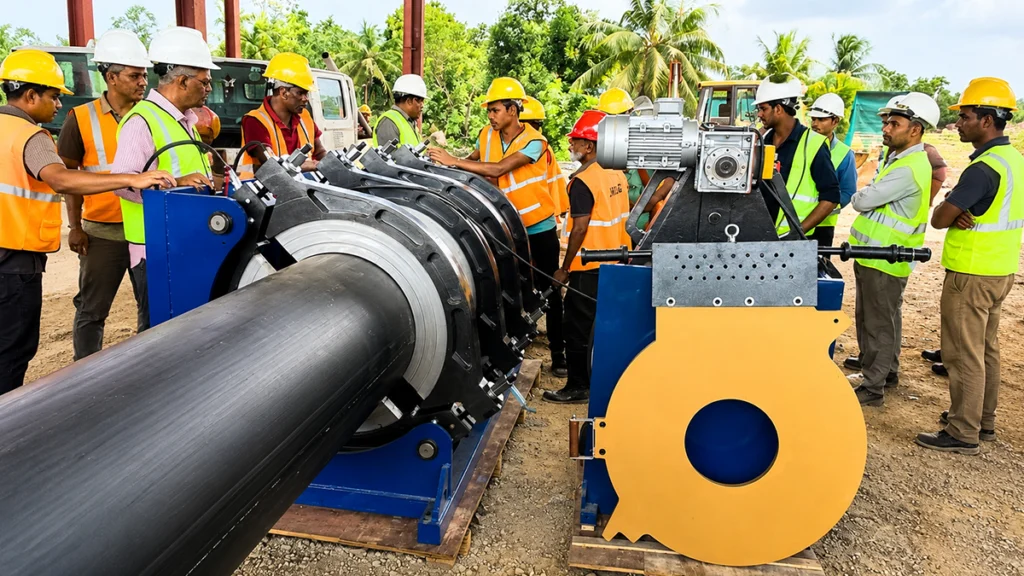
HDPE Butt Fusion Welding Parameters: Temperature, Pressure, and Cooling Time
Table of Contents
HDPE Pipe Butt Fusion Welding parameters determine joint strength. This guide explains temperature, pressure, cooling time, standards, defects, and machine selection for safer pipeline projects.
What Are the Key HDPE Butt Fusion Welding Parameters?
Reliable HDPE pipe fusion depends on accurately controlling temperature, pressure, and cooling time. These HDPE butt fusion welding parameters must be selected according to the pipe diameter, SDR or wall thickness, material grade, machine configuration, and approved welding procedure. Correct settings help produce consistent joints while reducing the risk of incomplete fusion, excessive bead formation, or premature movement during cooling.
The three parameters that control joint strength
The three core HDPE butt fusion welding parameters are heating temperature, fusion pressure, and time. Temperature softens the pipe ends to the required condition, while controlled pressure brings the molten surfaces together without displacing excessive material. Heating, changeover, and cooling time must also follow the applicable procedure so the joint can form and solidify correctly.
Why parameter settings are not one-size-fits-all
You simply can’t use the same welding parameters for every project. Operators must adjust settings dynamically based on the pipeline’s unique physical traits. Key variables include the Outer Diameter (OD), wall thickness, Standard Dimension Ratio (SDR), and the specific material grade—like PE80 versus PE100. Furthermore, weather plays a massive role. Ambient temperature, wind speed, and humidity force crews to tweak heating and cooling intervals to dodge issues like rapid heat loss or uneven crystallization.
Quick reference: temperature, pressure, and cooling time ranges
For HDPE, crews must strictly hold the heating plate temperature at 210±5°C. Interfacial fusion pressure, however, shifts depending on your governing standard. You’ll typically see 0.15 N/mm² (roughly 1.5 bar) under ISO and DVS low-pressure guidelines, while ASTM high-pressure standards demand 60–90 psi. Cooling times scale directly with wall thickness. A solid rule of thumb is 11 minutes of continuous pressure per inch of pipe wall.
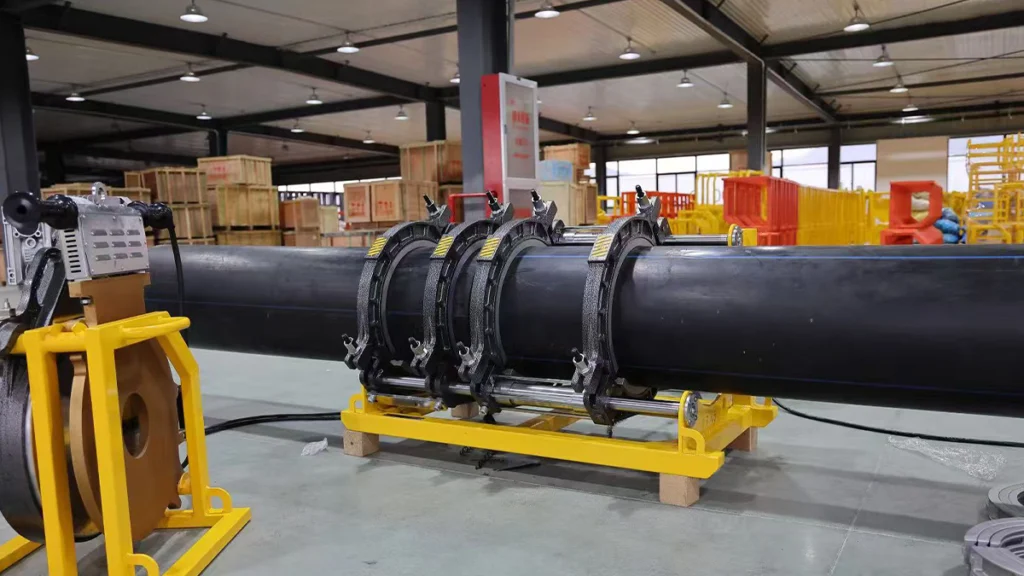
How HDPE Pipe Butt Fusion Welding Works
What happens during facing, alignment, heating, changeover, fusion, and cooling
The welding process follows a rigid sequence of mechanical and thermal steps:
- Facing: A rotating trimmer shaves the pipe ends until the gap shrinks to ≤0.3mm. This guarantees perfectly parallel surfaces.
- Alignment: Crews secure the pipes in heavy-duty clamps, making sure radial misalignment stays below 10% of the wall thickness.
- Heating & Soak: The operator inserts the heater plate. The pipe ends press against it to create an initial melt bead, and then the pressure drops to let the heat soak deep into the wall.
- Changeover: The heater plate is pulled out quickly. This transition needs to be lightning-fast to stop a cold skin from forming over the molten ends.
- Fusion: The butt fusion welding machine drives the pipes together under a carefully calculated joining pressure.
- Cooling: The joint remains under steady pressure until the polymer matrix hardens completely.
How heat and pressure create a molecular bond
Once HDPE hits that viscous flow state, its long polymer chains start moving freely. As hydraulic pressure pushes the two melted surfaces together, these chains cross the boundary line and tangle up with one another. This molecular diffusion essentially erases the seam between the two pipes. But be careful—applying too much pressure can squeeze the best molten material right out of the fusion zone. That hinders entanglement and ultimately weakens the joint.
Where welding parameters are controlled on a butt fusion machine
Today’s fusion equipment isolates parameter controls to maximize precision. Dual independent controllers regulate temperature for the upper and lower zones of the heating plate, holding exact setpoints up to 600°C. Meanwhile, a hydraulic control box handles the pressure, using finely tuned valves to ramp up force or bleed it off. Finally, integrated digital timers or automated PLC systems track the time, logging every single phase of the weld for quality assurance.
Factory-direct pricing with technical consultation included
Get Your Free QuoteRecommended HDPE Butt Fusion Welding Temperature
Typical heater plate temperature range for HDPE pipe
When working with HDPE materials, the target surface temperature for the heater plate is a non-negotiable 210±5°C. Other thermoplastic welding methods might give you a wide thermal buffer, but HDPE pipe welding procedure temperature pressure time requirements demand a very tight window. This exact range prevents material degradation while ensuring the melt depth goes deep enough.
How PE80, PE100, SDR, and wall thickness affect heating
PE80 and PE100 carry different thermal stabilities and melt flow indexes. Because of this, you cannot directly butt-weld them together without using specialized transition protocols. Additionally, pipes featuring thicker walls (which means lower SDR numbers) need exponentially longer heating times. This extra time ensures the heat penetrates deep enough to build a solid weld zone without scorching the outer surface.
How to check heater plate temperature before welding
Before kicking off the first weld of a shift, operators have to verify the heating plate’s surface temperature using a calibrated surface pyrometer or a reliable digital thermometer. Trusting the HDPE pipe welding machine’s internal thermostat alone is risky. Cold spots, a damaged Teflon coating, or even a chilly jobsite rapidly cooling the exposed metal can all lead to severe defects if left unchecked.
What happens if the welding temperature is too high or too low?
Drop the temperature below 210°C, and only the outermost layer melts. You end up with a “cold weld” that lacks structural integrity and is virtually guaranteed to fail catastrophically under active pipeline pressure. On the flip side, pushing the temperature past the upper limit degrades the polymer. The pipe’s inner diameter shrinks due to excessive melt flow, leaving the joint brittle, stressed, and highly vulnerable to cracking.
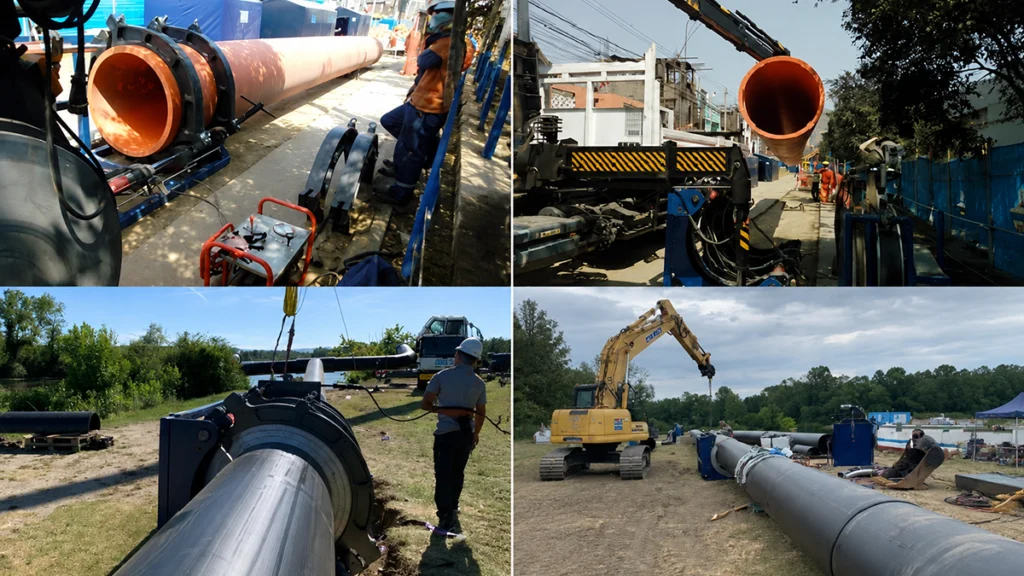
HDPE Butt Fusion Pressure: Drag, Bead-Up, and Fusion Pressure
What is drag pressure and why must it be measured first?
Drag pressure represents the hydraulic force needed to overcome the mechanical friction of the butt fusion machine’s movable carriage, plus the dead weight of the pipe being pulled. Since the pipe gets heavier as the pipeline extends, drag pressure shifts constantly. Operators must measure this dynamic force and add it to the baseline fusion pressure before making every single weld. This ensures the actual force hitting the pipe interface is dead-on.
How to calculate or confirm fusion pressure
Here is a crucial distinction: the pressure gauge on a hydraulic butt fusion machine displays the internal pressure of the hydraulic cylinders, not the actual interfacial pressure at the pipe ends. To calculate accurate HDPE butt fusion pressure, you need this formula: Total Machine Pressure = (Target Interfacial Pressure × Pipe Cross-Sectional Area / Cylinder Area) + Drag Pressure. Fortunately, machine manufacturers provide pre-calculated charts that make this math much easier out in the field.
Bead-up pressure vs soak pressure vs joining pressure
The required pressure profile shifts dramatically throughout the weld cycle:
- Bead-up pressure: This initial force pushes the pipe ends firmly against the heater plate until a specific melt bead size appears.
- Soak pressure: The force drops to near-zero (a key requirement in DVS standards). This lets heat soak deep into the wall thickness without squeezing the molten polymer outward.
- Joining pressure: The HDPE pipe jointing machine ramps the force up to the final fusion pressure (like 0.15 N/mm² or 60-90 psi) to forge the bond tightly during the cooling phase.
Common pressure errors that weaken HDPE joints
Forgetting to factor drag pressure into the total calculation is a massive mistake that starves the joint of necessary joining force. Another frequent blunder is keeping the pressure too high during the heat soak phase. Doing this squeezes the essential molten material completely out of the fusion zone. You are left with cooler, un-melted plastic at the interface, which destroys any chance of proper molecular entanglement.
Get detailed specs and custom configuration options
Request Technical SpecificationsHDPE Pipe Cooling Time After Butt Fusion Welding
Why cooling time directly affects weld strength
Allowing the joint to cool under steady hydraulic pressure gives the molten polymer chains time to re-crystallize into a solid, uniform structure. If an operator releases the pressure too early, the solidifying material shrinks unevenly. This creates severe internal stress concentrations that wreck the joint’s tensile strength and create perfect starting points for long-term leaks.
How pipe diameter and wall thickness influence cooling time
Heavy, thick pipe walls hold onto heat much longer than thinner ones. ASTM F2620-11 guidelines dictate calculating cooling time under pressure at 11 minutes per inch of pipe wall thickness. When dealing with massive diameters featuring low SDR ratings, you might be looking at extended cooling phases that stretch well past 45 minutes per joint.
When can the clamp be released after welding?
Keep the pipe clamped tightly under the calculated fusion pressure until the specified cooling time runs out completely and the external bead hardens. You should be able to touch the bead and feel that it is cool. It also needs to resist indentation if you press a fingernail into it. Only then is it safe to bleed off the hydraulic pressure and open the clamps.
Cooling time risks in cold, hot, or windy jobsite conditions
Extreme weather wreaks havoc on the natural cooling curve. Damp air, freezing temperatures, or heavy winds make the outside of the pipe cool down fast while the inside stays molten, generating dangerous thermal stresses. Whenever conditions turn harsh, contractors have to set up wind covers or specialized welding tents to control the ambient temperature surrounding the fusion equipment.
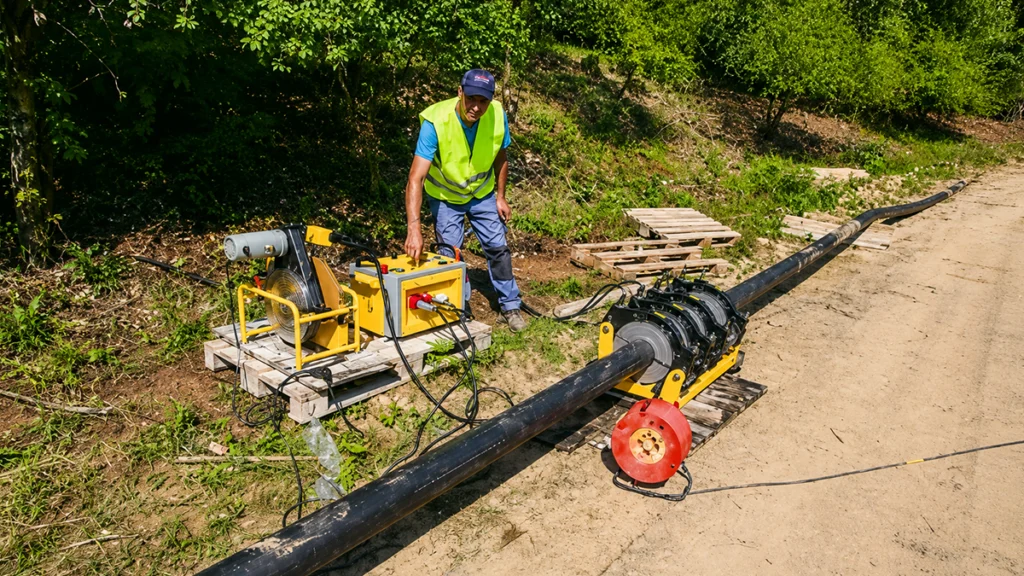
HDPE Pipe Butt Fusion Welding Parameter Table
Sample parameter table by pipe diameter and SDR
The table below outlines baseline heating and cooling times for typical municipal pipe sizes, drawn from standard engineering data. Keep in mind that these are just illustrative benchmarks meant for ideal conditions.
| Pipe Diameter (OD) | Heating Time (approx.) | Cooling Time Under Pressure |
|---|---|---|
| 20mm | 5 seconds | 3 minutes |
| 32mm | 8 seconds | 4 minutes |
| 63mm | 24 seconds | 6 minutes |
Which values must come from the machine manufacturer or project specification?
Grabbing a generic HDPE pipe butt fusion welding temperature chart off the internet won’t replace certified, project-specific documentation. For instance, the exact cylinder area needed for pressure math has to come directly from the butt fusion welding machine manufacturer’s spec sheet. Similarly, exact heating times, soak times, and cooling intervals must be pulled from the pipe manufacturer’s SDR charts or the overarching engineering specifications for the job.
How to use a parameter chart safely on site
Field operators need to verify both the exact Outer Diameter (OD) and the Standard Dimension Ratio (SDR) against the chart. Applying parameters meant for a different SDR guarantees failure—you will either end up with terrible heat penetration or a sloppy, excessive melt. Best practice? Laminate your charts and zip-tie them directly to the hydraulic control unit so they are always in sight.
Standards and Welding Procedures for HDPE Butt Fusion
Relevant standards: ISO 21307, DVS 2207, ASTM F2620, and project specifications
The global pipeline industry anchors itself to three main standards. DVS 2207-1 rules the European market, detailing the low-pressure method (0.15 N/mm²). Across North America, ASTM F2620 sets the rules for the high-pressure method (60–90 psi). Meanwhile, ISO 21307 bridges global practices by outlining three reliable methods for pipes with wall thicknesses up to 70mm.
What should be included in an HDPE butt fusion welding procedure?
A comprehensive Welding Procedure Specification (WPS) leaves nothing to chance. It has to spell out pipe preparation, surface cleaning rules, facing gap limits (≤0.3mm), and the exact heater plate temperature. It also needs to mandate drag pressure verification, target bead-up size, soak time, maximum allowable changeover speed, fusion pressure, and the strict cooling duration.
Why operator training and machine calibration affect compliance
You could have the most precise HDPE butt fusion welding standards ISO 21307 parameters in hand, but they are worthless if your HDPE butt fusion welding machine is out of calibration. Hydraulic gauges must tell the absolute truth about the force hitting the pipe. Furthermore, tossing untrained operators onto semi-automatic welders usually results in cut corners—like skipping the drag pressure check or shaving minutes off the cooling time just to hustle production along.
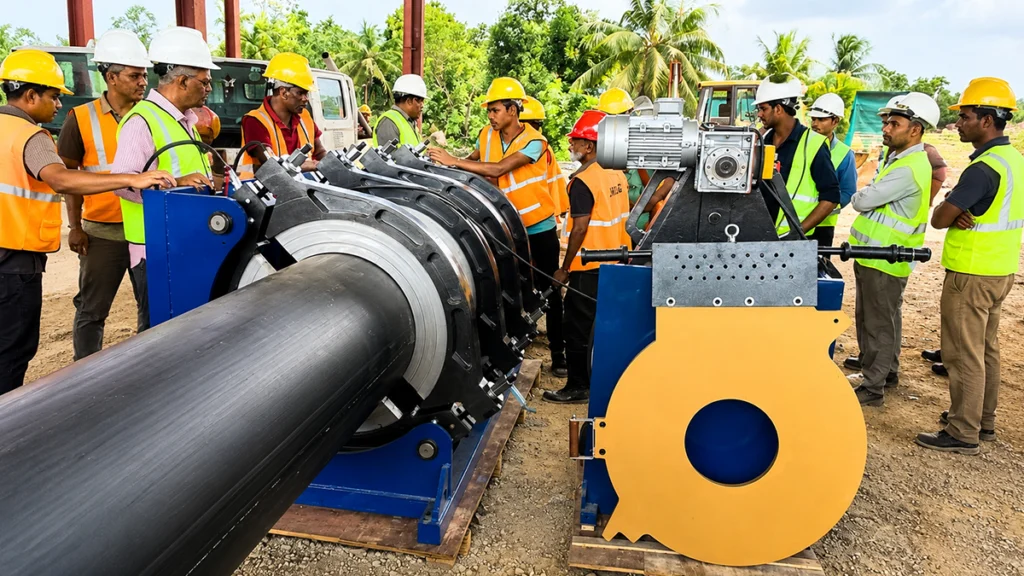
Common HDPE Butt Fusion Welding Defects and Parameter-Related Causes
Small bead, oversized bead, and uneven bead formation
Get the parameters right, and you’ll see a smooth, symmetrical double bead rolled perfectly over the pipe’s surface. See a small, narrow bead? You likely didn’t heat it long enough, or your fusion pressure was too weak. An oversized bead screams excessive heat or way too much joining pressure. If the bead is lopsided—larger on one half than the other—you are dealing with severe pipe misalignment or a faulty heater plate.
Cold welds, overheated joints, and contamination defects
Cold welds pop up when the heater temp dips below 210°C or the changeover drags on too long, letting the melted plastic harden before joining. Overheated joints happen when you blast past the temperature limit, cooking the polymer until it becomes brittle. Contamination defects are entirely preventable; they occur when crews forget to wipe away dirt, moisture, or oil from the pipe ends and the Teflon plate using ethanol.
Misalignment and ovality problems before fusion
If the pipes sit crooked in the butt fusion machine clamps, that high-low mismatch acts as a stress riser, severely undercutting the joint’s pressure rating. Operators must keep misalignment strictly under 10% of the pipe’s wall thickness. If you are working with coiled pipe that suffers from severe ovality, you have to fix it with rerounding clamps before you even think about facing and fusing.
How to identify parameter mistakes during visual inspection
Visual inspection acts as your frontline defense for quality control. Good inspectors hunt for asymmetrical flange curling, sharp V-notches buried between the beads, or any bubbles, depressions, and pitting on the surface. These visual clues tie directly back to parameter blunders—like dumping the pressure too soon or neglecting to clean the heater plate properly.
How Machine Selection Affects Butt Fusion Parameters
Machine selection by pipe diameter, SDR, and jobsite application
Machine categories are defined strictly by their welding range. Standard municipal water and gas jobs usually call for equipment covering 50–630mm. Shift over to heavy industrial sites, mining operations, or desalination plants, and you’ll need massive carriage setups built to fuse pipes up to 2000mm. Always ensure the butt fusion welding machine’s chassis is rugged enough to manage the thickest SDR pipe your project demands.
Manual vs hydraulic vs CNC butt fusion machines
Manual and basic hydraulic units run on open-loop systems. They rely completely on the operator’s ability to monitor gauges and turn valves. Fully automatic butt fusion machines, however, operate on closed-loop systems packed with solenoid valves, PLCs, and sensors. Yes, a CNC machine demands a higher upfront investment. But swapping out manual guesswork for automated precision can easily save $20,000 to $30,000 in labor on a six-month job by slashing rework and accelerating cycle times.
Why data logging matters for pipeline quality records
Today’s municipal and gas infrastructure contracts demand absolute traceability. Advanced hydraulic and CNC automatic butt fusion machines come with built-in data logging that tracks temperature, pressure, and time for every single joint you fuse. This digital paper trail proves you complied with the required welding standards, shielding contractors from massive liability if a pipeline ever fails down the road.
Questions to ask a supplier before buying or renting equipment
When you’re sizing up HDPE butt fusion machine settings for SDR pipe capabilities, grill your suppliers with technical questions. Make sure the gear complies with ISO 12176 equipment standards. Ask whether the hydraulic system features automatic drag pressure compensation. Also, check if they supply the right reducing clamps for varying pipe sizes, and don’t forget to ask about lead times for replacement Teflon heater plates.
Best Practices for Reliable HDPE Pipe Butt Fusion Welding
Pre-welding checklist for pipe, machine, and environment
- Confirm the input voltage is rock-steady (AC 220V/380V) so the heater plate doesn’t fluctuate.
- Wipe down the V-groove, pipe ends, and heater plate using ethanol and lint-free rags.
- Lock in the correct reducing clamps for your specific OD.
- Set up pipe roller supports to cut down on drag resistance and protect the pipe exterior.
- Pitch a welding tent if the weather turns windy, rainy, or freezing.
During-welding checklist for temperature, pressure, and timing
- Keep an eye on the heater plate to guarantee it holds steady at 210±5°C.
- Measure and document the drag pressure right before starting the heat soak.
- Pull off the changeover phase as fast as you safely can.
- Make sure the fusion pressure climbs smoothly and holds steady without any hydraulic pressure bleeding off.
Post-welding inspection and handling checklist
- Leave the clamps alone and don’t move the butt fusion welding machine until the cooling timer hits zero.
- Visually inspect the bead to verify it is symmetrical, rolled over correctly, and totally free of contamination.
- Stow the heating plate in its dedicated stand to avoid fire risks and keep the Teflon coating safe from scratches.
Final recommendation for project managers and contractors
Real quality control demands ongoing validation. Project managers need to insist on a daily test weld out on the site before actual production kicks off. Taking that sample joint and running it through a destructive bend test proves that your equipment calibration, operator technique, and parameter settings are dialed in perfectly for that day’s unique weather conditions.
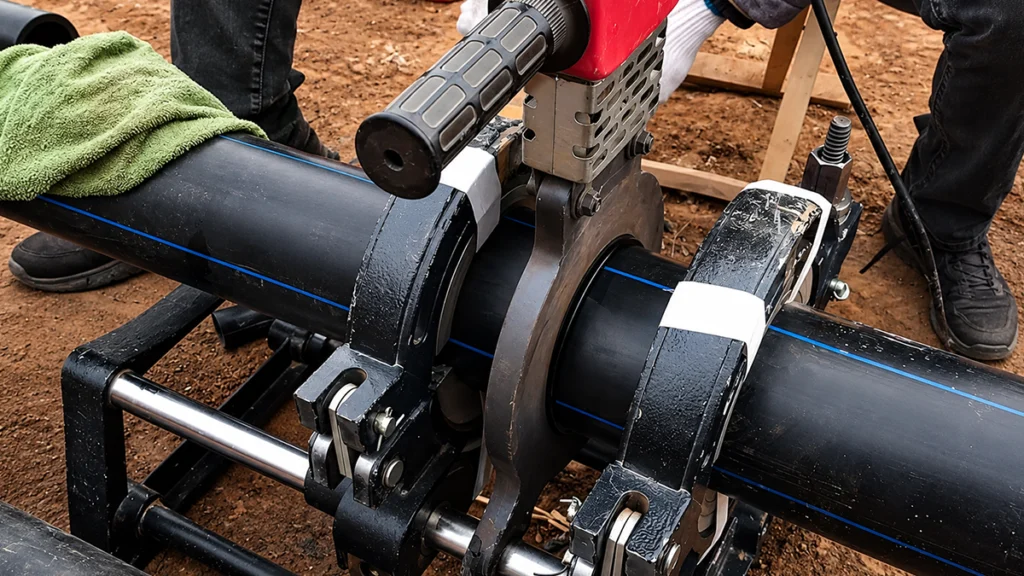
FAQ
Q1: What temperature should be used for HDPE pipe butt fusion welding?
The recommended heater plate temperature for HDPE pipe butt fusion welding is typically 210±5°C. The exact setting depends on pipe material, wall thickness, welding standard, and environmental conditions. Always follow the manufacturer’s welding procedure to achieve a reliable joint.
Q2: How do you calculate butt fusion pressure for HDPE pipe?
HDPE pipe fusion pressure depends on pipe size, wall thickness, machine hydraulic capacity, and welding standard. The required fusion pressure is calculated from the recommended interfacial pressure plus the measured drag pressure. Standards such as ASTM F2620, DVS 2207-1, and ISO 21307 provide guidance.
Q3: How long should HDPE pipe cool after butt fusion welding?
HDPE pipe cooling time depends on wall thickness, pipe diameter, welding standard, and site conditions. The pipe should remain clamped and under pressure until the recommended cooling period is completed to avoid joint stress and failure.
Q4: What causes HDPE butt fusion joints to fail?
Common causes include incorrect temperature, pressure, heating time, poor pipe preparation, contamination, misalignment, or removing clamps too early. Proper machine calibration and following the correct welding procedure are essential for strong joints.
Q5: Can HDPE pipe be butt fused in cold or windy weather?
Yes, but environmental conditions must be controlled. Cold temperatures, wind, and rain can affect heat transfer and cooling speed. Welding tents or wind shields are recommended to maintain stable conditions during the fusion process.
Q6: What standards apply to HDPE butt fusion welding?
Common HDPE pipe butt fusion welding standards include ISO 21307, DVS 2207-1, and ASTM F2620. These standards define requirements for welding temperature, pressure, heating time, and cooling procedures.
Q7: How do you inspect an HDPE butt fusion weld?
A good butt fusion weld should have a uniform bead, proper alignment, and no visible defects such as cracks, contamination, or sharp notches. Inspection should follow the applicable welding specification and project requirements.
Q8: Is a hydraulic butt fusion machine better than a manual machine?
A hydraulic HDPE pipe butt fusion welding machine is preferred for large-diameter and industrial projects because it provides stable pressure control. Manual machines are suitable for smaller pipes and projects requiring portability and lower investment.
Conclusion
Nailing a reliable HDPE Pipe Butt Fusion Welding job requires precise control of engineered welding parameters rather than operator assumptions. The balance of temperature, pressure, and cooling time directly affects the integrity of the welded joint. By maintaining the recommended heater plate temperature around 210±5°C, calculating fusion pressure correctly with drag pressure considered, and following proper cooling procedures based on wall thickness, contractors can significantly improve joint reliability and pipeline service life.
For procurement teams and project managers, equipment selection plays an important role in maintaining welding quality. Investing in a suitable hydraulic or CNC HDPE pipe butt fusion welding machine helps ensure consistent pressure control, accurate parameter management, and reliable welding records through data logging. Whether following ISO, DVS, or ASTM standards, proper machine calibration, environmental control, and operator training are essential for reducing defects and achieving long-term leak-free pipeline performance.
Let our experts help you choose the right equipment for your project
Contact Our Engineering Team