
Butt Fusion Welding Machine in Cambodia: Buying Guide for HDPE Pipe Contractors
Table of Contents
Butt Fusion Welding Machine in Cambodia helps HDPE pipe contractors compare machine types, pipe-size ranges, pricing, and supplier support so they can choose the right equipment for water, irrigation, and infrastructure jobs.
What a Butt Fusion Welding Machine Does and Why It Matters in Cambodia
What is a butt fusion welding machine?
Think of a butt fusion welding machine as a heavy-duty thermal-bonding powerhouse. It joins thermoplastic pipes by melting the ends and forcing them together under highly controlled hydraulic pressure. Heat transfers straight from an electric plate to the plastic, with temperatures often running anywhere from 0°C up to 600°C. Once the plastic hits that perfect molten state, the operator pulls the plate out, and the machine presses the pipes into one continuous, leak-proof joint. If you are sourcing this equipment for Cambodian projects, your main job is matching these thermal specs directly to the realities of your job site.
Why do HDPE contractors use butt fusion instead of mechanical joints?
Butt fusion delivers a joint that actually matches—or exceeds—the strength of the pipe itself. When dealing with massive pipelines, this method cuts down on material costs and makes field fabrication a lot smoother. Mechanical joints lean on gaskets and bolts. Those eventually degrade. They loosen. A properly fused HDPE joint, on the other hand, leaves zero room for leaks. You get incredible reliability, slash your long-term maintenance downtime, and completely dodge the steep repair bills that come when underground mechanical fittings inevitably fail.
What makes the Cambodia buying context different?
Working in Southeast Asia throws a unique set of environmental and logistical hurdles at contractors. Think extreme heat, suffocating humidity, and thick dust. Your butt fusion machine needs serious armor, which translates to a strict IP55 protection rating. On top of that, plenty of remote agricultural and municipal sites lack anything close to stable grid power. Your gear has to run perfectly off portable diesel generators. So, when you buy a butt fusion welding machine for the Cambodian market, you aren’t just looking at welding parameters. You have to prioritize rugged environmental resilience and highly adaptable power setups.
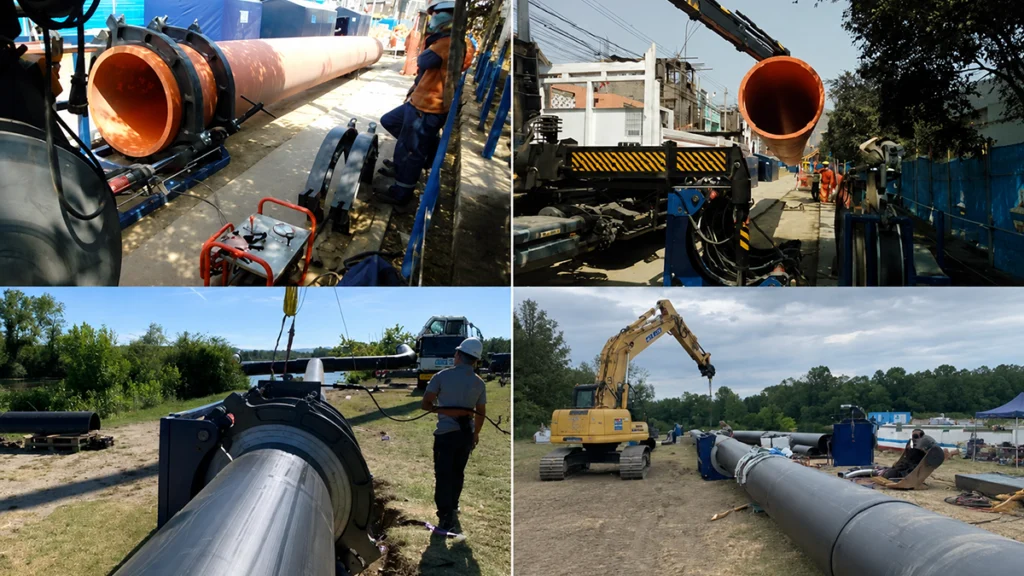
How Butt Fusion Welding Works: Main Parts and Welding Steps
Which components does the machine use?
A standard fusion setup relies on four core pieces of hardware. First, the clamping device grabs and aligns the pipe ends. Next comes the milling cutter—often called the facer. This tool shaves the pipe ends down to guarantee perfectly parallel contact. Then you have the heating plate. Packed with a three-phase solid-state relay and highly sensitive temperature sensors, this plate handles the melting phase. Finally, the operating platform takes charge. Whether you use a manual, electronic, or hydraulic setup, this console dictates the pressure and timing for the entire fusion cycle.
What are the basic welding steps from clamping to cooling?
The whole process follows four rigid phases to hit international benchmarks like ISO 21307 and DVS 2207.
1. Positioning: You lock the pipes into the chassis and get them perfectly aligned.
2. Milling: The cutter shaves down the ends. You keep going until continuous plastic ribbons peel off, ensuring a flawless, zero-gap fit.
3. Heating: Drop the heating plate in. The butt fusion machine presses the pipe ends against the hot metal until a specific bead forms, leading right into a crucial heat-soak phase.
4. Cooling: Pull the plate out. The HDPE pipe welding machine rams the molten ends together under hydraulic pressure and holds them dead still until the new joint cools to ambient temperature.
Which process variables affect joint strength?
Joint integrity boils down to three things: temperature, pressure, and time. Temperature accuracy is non-negotiable. Industrial standards demand a maximum variance of ±5°C, though top-tier units use solid-state relays to tighten that window to ±3°C. Hydraulic cylinder pressure—usually sitting between 0 and 16 MPa—needs careful calibration to deliver the exact force required by the pipe’s wall thickness. Finally, dual-channel timers keep a strict watch on heat absorption and cooling periods. Rush the cooling phase, and you risk putting premature stress on the weld.
Factory-direct pricing with technical consultation included
Get Your Free QuoteWhich Machine Type Fits Your Project: Manual, Automatic, or Hydraulic
Manual vs Automatic vs Hydraulic: What Is The Difference?
Manual butt fusion machines require the operator to move the carriage, apply joining force, and control the heating and cooling stages. They are compact and economical, but welding consistency depends more heavily on operator experience.
Hydraulic butt fusion machines use a hydraulic unit to control carriage movement and fusion pressure more consistently. They are suitable for regular municipal, industrial, mining, and larger-diameter pipeline projects.
Automatic butt fusion machines combine hydraulic operation with computerized process control. Depending on the model, the system can manage pressure, heating time, changeover, and cooling while recording key welding data. This helps reduce operator-related variation, but trained personnel are still required for pipe preparation, alignment, inspection, and equipment setup.
What pipe diameter range suits each machine type?
The suitable pipe range depends on the machine model, required fusion force, pipe wall thickness, and project standard. Manual machines are commonly used for smaller diameters and lower-volume work. Hydraulic machines cover a much wider range and are generally preferred for medium- and large-diameter pipelines.
Automatic butt fusion machines are often selected for projects that require repeatable welding parameters, traceability, and data records. Available ranges vary by manufacturer, so buyers should confirm that the selected machine covers the required pipe diameter, SDR, power supply, and welding procedure.
Which type is better for small crews or larger civil projects?
| Feature | Manual Butt Fusion Machine | Automatic Butt Fusion Machine | Hydraulic Butt Fusion Machine |
|---|---|---|---|
| Typical Pipe Range | Commonly used for smaller pipe sizes, depending on the machine model | Commonly available in ranges such as 160–630 mm | Available for medium and large pipe sizes, with some models covering up to 2250 mm |
| Crew Size | Usually 1–2 trained operators | Usually 1–2 trained operators | Usually 2–3 operators, depending on pipe size and site conditions |
| Operation & Control | Operator controls carriage movement, joining force, heating, and cooling | Computerized control of selected pressure, heating, changeover, and cooling stages | Hydraulic control of carriage movement and fusion pressure |
| Best Suited For | Small-diameter pipes, repairs, irrigation, and low-volume projects | Municipal, utility, and infrastructure projects requiring repeatability and welding records | Municipal mains, industrial pipelines, mining projects, and large-diameter pipe installation |
| Main Advantages | Compact, economical, and easy to transport | Improved process consistency, automated parameter control, and optional data logging | Stable fusion pressure, wide welding range, and durable field performance |
| Key Limitations | More dependent on operator control and less efficient for frequent welding | Higher initial investment and requires trained operators and technical support | Heavier equipment and requires a suitable power supply and transport arrangement |
| Portability | High portability for smaller models | Medium portability, depending on welding range and control-unit configuration | Varies from portable field units to heavy large-diameter systems |
Actual pipe ranges, crew requirements, machine weight, and automation functions vary by model, pipe SDR, project standard, and manufacturer specifications.
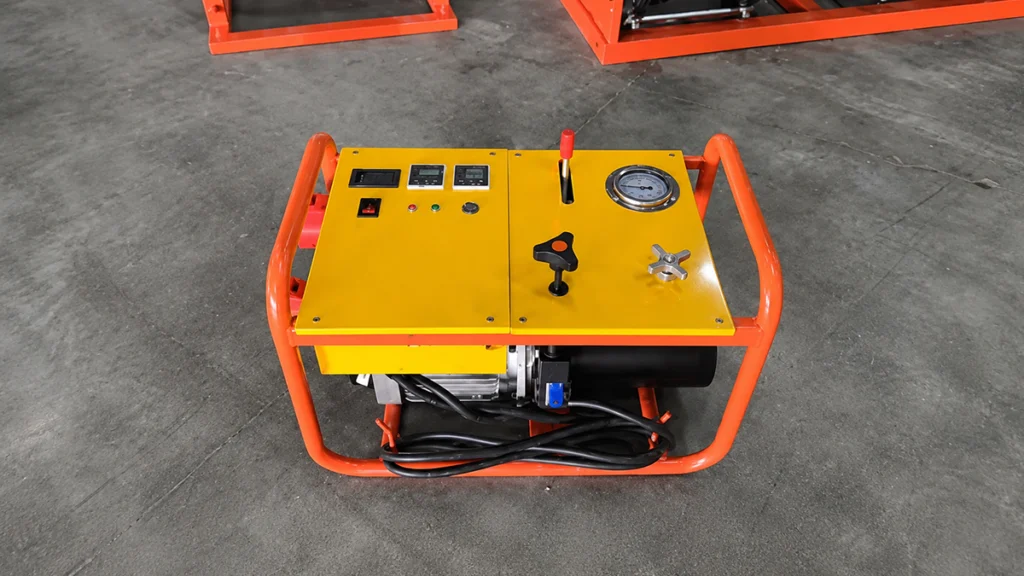
What Technical Specs Should HDPE Contractors Compare Before Buying
Which specifications should appear on a supplier datasheet?
When sizing up heavy-duty hydraulic gear (like the 710-1000mm range), contractors need to scrutinize the power and pressure numbers. A solid, compliant datasheet must spell out:
- Total Power: 23.5 KW
- Heating Plate Power: 17.5 KW
- Milling Cutter Power: 3.0 KW
- Hydraulic Station Power: 3.0 KW
- Pressure Adjustment Range: 0-16 MPa
- Operating Voltage: 380V (for massive units) or 220V AC (for smaller, portable setups)
What parameters influence weld quality most?
Temperature control accuracy takes the top spot. Ask any professional construction crew, and 90% will tell you they refuse to work with a temperature error margin wider than ±5°C. Drift past that limit, and the HDPE material either degrades from excessive heat or fails to melt enough, leaving you with brittle, high-risk joints. Beyond temperature, your hydraulic system has to hold pressure dead steady. Any drifting during that long cooling phase will compromise the weld.
Which accessories and consumables should be included?
Buying a pipe fusion machine isn’t just about the main chassis. You need the full package. Smart buyers make sure the supplier throws in high-pressure hydraulic hoses, leak-proof quick-connect fittings, and a comprehensive set of reducing inserts (or heating molds) so you can actually weld different pipe sizes. Don’t forget the upper and lower plastic cooling molds. You also absolutely need a dedicated storage stand to safely house the scorching hot heating plate and the sharp facer during site operations.
Get detailed specs and custom configuration options
Request Technical SpecificationsWhere Butt Fusion Welding Machines Are Used in Cambodian Projects
Where are these machines used in Cambodia?
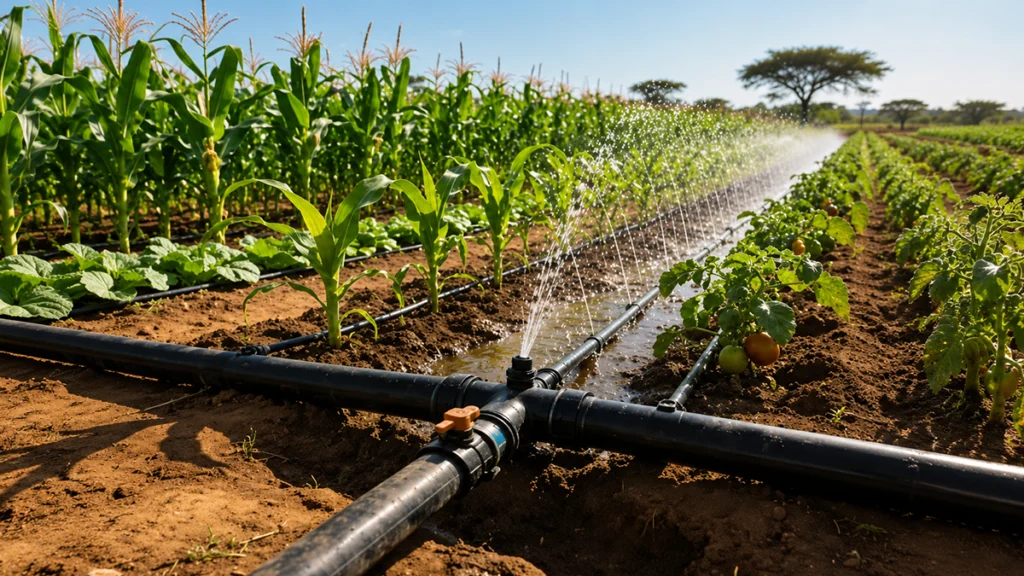
HDPE butt fusion technology forms the backbone of modern fluid transport across the region. You will see these HDPE pipe jointing machines working hard on municipal water grids, drainage networks, and natural gas lines. They are heavily deployed in massive agricultural irrigation setups as well. Urban developers also rely on them for city heating networks and to fuse the tough protective conduits that house underground high-voltage cables.
Which projects need higher output or portability?
Standard trench jobs—like running neighborhood water mains or farm irrigation lines—demand serious portability. Crews need equipment they can easily drag along the trench line as the day progresses. On the flip side, heavy civil projects like national water transmission pipelines or industrial plant builds care about raw output and automated data logging. Mobility takes a backseat here, and contractors bring in massive, stationary frame butt fusion machines to handle the heavy workload.
What pipe materials and diameters are most common?
This gear primarily handles Polyethylene (PE), High-Density Polyethylene (HDPE), and Polypropylene (PP) piping. If you look at general municipal and agricultural bids, the Dn160-315mm diameter range dominates the spec sheets. But once you step up to heavy infrastructure and main transmission lines, those diameters skyrocket. That is when contractors have to mobilize heavy-duty rigs built to clamp and fuse 710-1000mm pipes.
How to Choose the Right Machine for Pipe Diameter, Power, and Jobsite Conditions
How do you match machine size to pipe diameter and workload?
Picking the correct chassis size keeps you from straining your equipment and stalling your project. For everyday trench work using Dn160-315mm pipes, grab a butt fusion machine with separate clamping and operating systems so you can position it easily in tight spaces. Scaling up to 1000mm pipes? You need heavy-duty frames. These giants can span 2200x1800x1700mm and weigh a staggering 2600 kg. You won’t be moving them by hand; you will need heavy lifting equipment just to get them into position on site.
Is generator compatibility or site power important?
Power supply will make or break your butt fusion welding machine’s viability out in the field. Smaller manual and semi-automatic units usually run fine on standard 220V AC single-phase power, which a compact portable generator handles effortlessly. Large hydraulic butt fusion machines are a different story. They demand a 380V three-phase setup to push out up to 23.5 KW of power. Contractors have to size their site generators meticulously, making sure to account for the massive startup surge triggered by the hydraulic pump and the milling cutter.
When does portability matter more than automation?
If your team specializes in rapid deployment—repairing busted urban water lines or laying out distributed irrigation—mobility is your best friend. Industry numbers show that 80% of workers in these fast-paced sectors want HDPE pipe welding machines under 200 kg, fitted with heavy-duty wheels and rugged lifting handles. Additionally, 70% of buyers insist on an IP55 rating. They know that without it, sensitive electrical components simply won’t survive the brutal dust and humidity of a Southeast Asian job site.
Butt Fusion Welding Machine Price in Cambodia: Cost Drivers and Budget Ranges
What drives the purchase price?
Two main factors dictate the price tag: how automated the HDPE pipe jointing machine is, and how large of a pipe it can handle. Fully automatic models carry a premium because they pack computerized brains, data logging sensors, and highly precise hydraulic valves. Likewise, expanding your diameter capacity means paying for exponentially larger heating plates, massive structural steel frames, and beefed-up hydraulic stations. All of that extra metal and tech drives up both manufacturing and shipping expenses.
How should you compare machine cost vs total ownership cost?
Looking strictly at the initial sticker price is a classic procurement trap. Fully automatic hydraulic units definitely hit your wallet harder upfront, but they aggressively slash your Total Cost of Ownership (TCO). Automated timers and pressure controls strip operator error out of the equation. That speeds up your cycle times and boosts daily output. More importantly, perfect fusion joints eliminate the endless replacement costs of mechanical fittings and protect you from the catastrophic excavation and repair liabilities of a blown pipeline.
When is a supplier quote more useful than a catalog price?
Catalog prices are practically useless for heavy industrial equipment because they never show the final landed cost. A customized supplier quote breaks down the real variables: ocean freight, import duties, inland trucking to remote provinces, and the specific reducing inserts your project requires. Since heavy-duty frames can tip the scales at over two tons, logistics and shipping will consume a massive chunk of your final procurement budget.
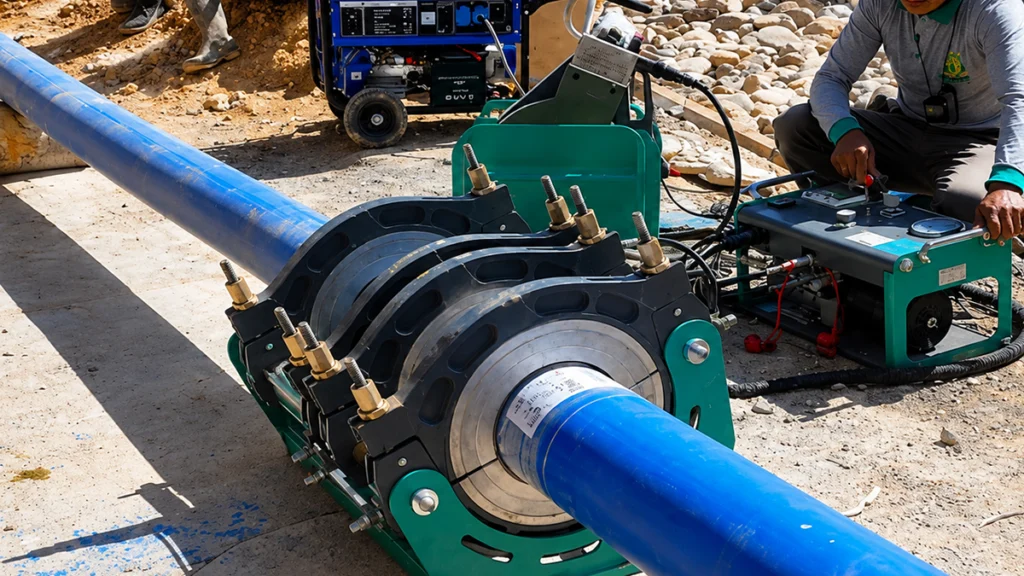
How to Evaluate Suppliers, Warranty, Spare Parts, and Training
What should you check in a supplier?
A solid equipment supplier should feel like a long-term project partner. When vetting a vendor for the Cambodian market, procurement managers need to demand 24-hour online technical support and a rock-solid warranty. If a butt fusion machine faults out in the field and halts your pipeline crew, fast response times are the only thing standing between you and massive daily losses.
How do warranty, training, and spare parts affect uptime?
Uptime is the lifeblood of project profitability. Standard industrial agreements should offer a 1-year warranty paired with lifetime maintenance and free parts replacement for anything not caused by human error. Roughly 85% of contractors expect their gear to survive 3,000 hours of brutal, continuous use. To hit that mark, you need immediate access to spare parts. Six out of ten buyers prioritize vendors who maintain a steady pipeline of consumables—like Teflon-coated heating plates and sharp facer blades. Beyond that, 75% of contractors demand thorough operation manuals, video guides, and on-site training to stop operators from breaking the equipment in the first place.
Which documents or questions should you request before ordering?
Never sign a purchase order without requesting this documentation first:
- Official safety certifications (CE or ISO).
- Granular technical datasheets proving power specs and IP ratings.
- A comprehensive packing list showing every reducing insert and tool included in the crate.
- The supplier’s explicit written warranty policy and their lead times for spare parts.
- Proof of built-in safety features, like two-handed “green button” operation and protective light curtains.
Common Buying Mistakes and a Final Contractor Checklist
What are the most common buying mistakes?
The biggest blunder is chasing the lowest upfront price instead of looking at the actual demands of the job. Contractors frequently try to use cheap manual butt fusion machines on large-diameter pipes. The result? Exhausted crews and alarmingly weak welds. Another classic mistake is ignoring the IP55 rating. Do that, and you will face catastrophic electrical shorts during monsoon season. Finally, buyers often forget to verify whether their site generator can actually handle the pipe fusion machine’s peak KW surge during the heating cycle.
Which checks belong in a final pre-purchase checklist?
Before you wire the funds or fire up the equipment, run through this technical checklist:
1. Inspect the power cords for integrity, verify proper grounding, and confirm 380V/220V compatibility.
2. Test the hydraulic air pressure gauges and physically trigger every emergency stop switch.
3. Check the heating plate’s balance and temperature consistency using a digital thermometer or pressure-sensitive paper.
4. Demand proof of a legitimate IP55 rating to guarantee the butt fusion machine survives outdoor conditions.
5. Count your reducing inserts. Make sure you have the exact sizes needed for your current pipe diameters.
When should you consider rental, local stock, or a larger machine?
If you are tackling a short-term, one-off job, renting or buying local stock makes sense so you don’t trap your capital in idle steel. But if you are a utility contractor holding multi-year municipal contracts, buying a fully automatic hydraulic butt fusion welding machine outright is hands-down the smartest financial play. Anticipating larger municipal bids down the road? Spend a bit more now to get a butt fusion machine with a broader diameter range (say, up to 315mm instead of maxing out at 160mm). That built-in scalability pays off quickly.
FAQ
Q1: What size butt fusion welding machine do I need for HDPE pipe work in Cambodia?
The required machine size depends on the largest pipe diameter, SDR, wall thickness, project type, and site conditions. A 160–315 mm hydraulic butt fusion machine is commonly used for municipal water, irrigation, and general pipeline work, while larger infrastructure or transmission projects may require 450–1000 mm or larger models. Always confirm that the machine’s rated welding range and reducing inserts match the required pipe sizes.
Q2: Is a hydraulic butt fusion machine better than a manual one for contractors?
Hydraulic butt fusion machines are generally more suitable for contractors handling frequent welds, larger diameters, or thicker-walled pipes because they provide more consistent carriage movement and fusion-pressure control. Manual machines remain practical for smaller diameters, repairs, and lower-volume projects. The best option depends on the pipe range, workload, site access, and operator experience.
Q3: How much does a butt fusion welding machine cost in Cambodia?
The cost depends on the welding range, machine type, automation level, included reducing inserts, power configuration, data-recording functions, and after-sales support. Buyers should also consider freight, import duties, local delivery, commissioning, training, and spare parts. A model-specific quotation is more reliable than a general catalogue price.
Q4: Can one butt fusion machine handle multiple pipe diameters?
Yes. Butt fusion machines use interchangeable reducing inserts to clamp different pipe diameters within the machine’s rated range. For example, a 160–315 mm machine may support 160, 200, 225, 250, 280, and 315 mm pipes when the correct inserts are installed. Exact supported sizes should be confirmed from the machine specification.
Q5: What power supply is required for a butt fusion welding machine?
Power requirements vary by machine size and configuration. Smaller models may use single-phase power, while larger hydraulic or automatic machines commonly require three-phase power. Generator capacity should be calculated from the heater plate, facer, hydraulic unit, voltage, phase, frequency, and motor-starting allowance rather than pipe diameter alone.
Q6: What should I ask a supplier before buying a machine?
Confirm the welding range, supported pipe material and SDR, heater-temperature control, hydraulic system, reducing inserts, voltage, phase, frequency, total power requirement, machine weight, calibration records, warranty, spare-parts availability, training, and technical support. The required electrical protection rating should be selected according to the actual site conditions.
Q7: How can I avoid weak or misaligned HDPE welds on site?
Use trained operators and follow the approved fusion procedure. Pipe ends should be securely clamped, properly faced, aligned, and kept clean. Operators must use the correct heater temperature, drag pressure, fusion pressure, changeover time, and cooling time, while protecting the welding area from dust, wind, rain, and movement.
Conclusion
Choosing the right butt fusion welding machine for a project in Cambodia requires balancing pipe diameter, SDR, welding volume, site conditions, power supply, and technical support. Buyers should review the machine’s welding range, heater temperature control, hydraulic performance, reducing inserts, power configuration, calibration records, and compatibility with the selected fusion procedure.
Manual machines may be suitable for smaller pipes and occasional work, while hydraulic machines are generally preferred for regular municipal, industrial, and infrastructure projects. Automatic butt fusion machines are useful when consistent parameter control, traceability, and welding data records are required. Reliable spare-parts supply, operator training, warranty coverage, and after-sales support should also be considered before purchase.
Need help selecting the right butt fusion machine for your project in Cambodia?
Request a Machine Recommendation