
Butt Fusion Machine in Côte d’Ivoire: HDPE Pipe Welding Equipment Buying Guide
Table of Contents
This guide explains how to choose a butt fusion machine in Côte d’Ivoire for HDPE pipe welding — covering machine types, working principle, technical specs, pricing, import costs to Abidjan, supplier evaluation, and a practical buying checklist for water, mining, gas, and irrigation projects.
What Is a Butt Fusion Machine and Why It Matters for HDPE Projects in Côte d’Ivoire
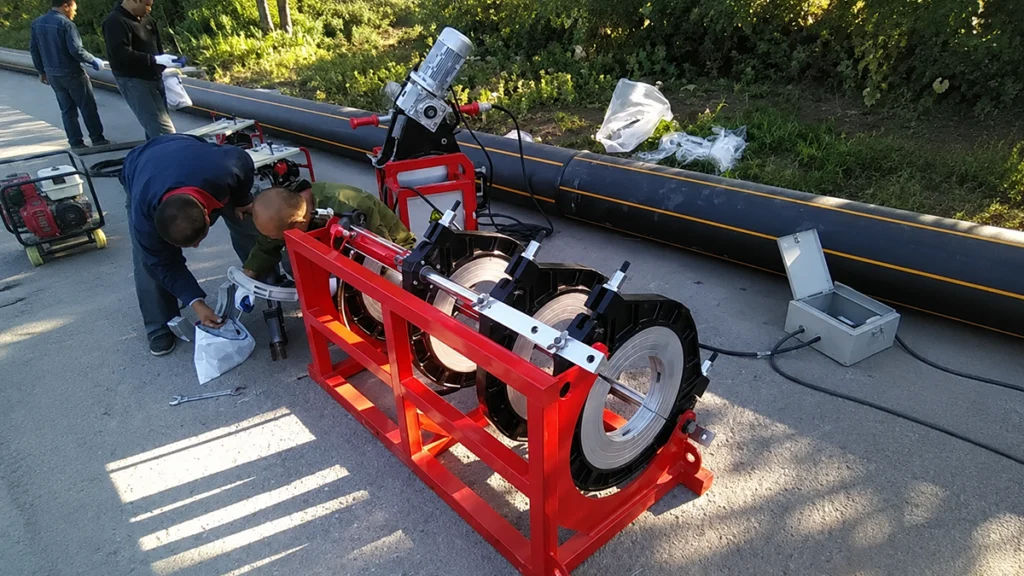
Think of a butt fusion machine as the backbone of modern thermoplastic pipeline construction. This specialized electromechanical tool joins pipes by leveraging a pull-out plate design and electric heating. It transfers intense thermal energy directly to the pipe ends, melting the plastic surfaces just enough before driving them together under tightly controlled hydraulic pressure. When it comes to Ivorian infrastructure development, picking the correct Butt Fusion Machine in Côte d’Ivoire is the only way to guarantee leak-proof networks that align with tough international engineering standards.
Definition and Core Function of a Butt Fusion Welding Machine
Thermofusion drives the entire process. First, the equipment locks two high-density polyethylene (HDPE) pipes into place. A rotary cutter then shaves the ends to guarantee flawless alignment, making way for a thermostatically controlled aluminum heating plate. The moment the plastic hits its precise melt transition phase, the operator (or automated system) pulls the plate and forces the molten ends together. What you get is a completely homogeneous joint. In fact, that welded seam often boasts higher tensile strength than the original pipe.
Why HDPE Pipe Welding Demand Is Growing in Côte d’Ivoire
West Africa is booming. Rapid urbanization and aggressive industrial expansion have sparked a massive need for fluid transport networks that actually last. Because of its incredible corrosion resistance, flexibility, and 50-year lifespan, HDPE has practically pushed old-school steel and PVC out of the market. Naturally, this shift has caused a spike in demand for reliable HDPE pipe welding machine Côte d’Ivoire setups. Smart contractors no longer trust mechanical fittings. They leak. They cause pressure drops. Instead, crews are moving exclusively toward permanent thermofusion joints to secure zero-leakage performance despite the punishing tropical heat.
Which Industries in Ivory Coast Rely on Butt Fusion Equipment?
You will spot this butt fusion machinery across a huge range of critical sectors. Take municipal water authorities, for example. They desperately need heavy-duty pipe jointing machine Ivory Coast solutions to overhaul decaying urban distribution grids. Up north, the mining industry leans heavily on rugged fusion rigs to build slurry and tailings lines that can survive highly abrasive materials. Let’s not forget agriculture—vast irrigation networks depend on these welds. Even the energy sector trusts them to secure high-pressure, highly volatile gas distribution lines.
Main Types of Butt Fusion Machines Available in Côte d’Ivoire
Manual Butt Fusion Machines (63–160mm)
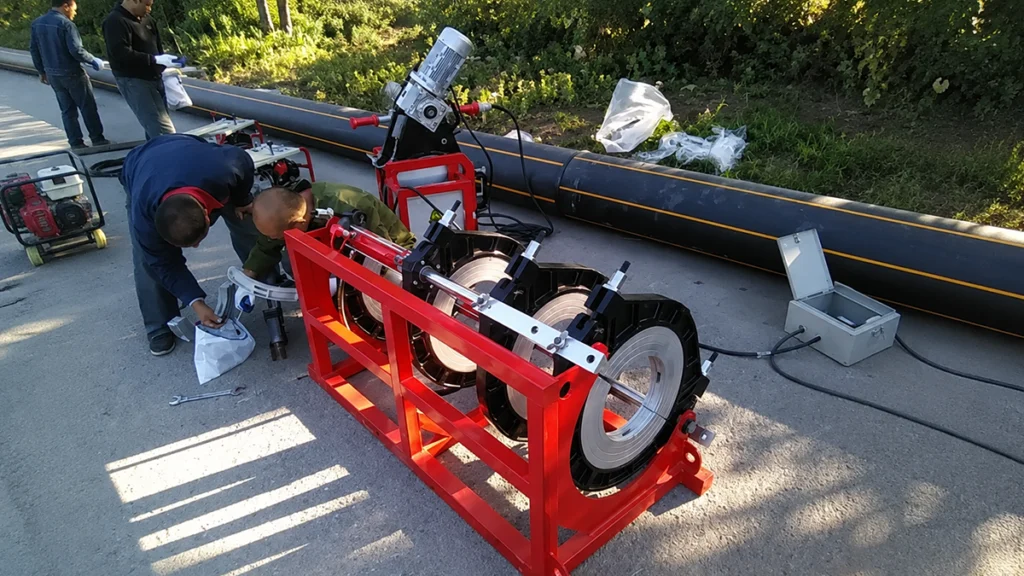
Manual butt fusion machines are compact, economical, and suitable for smaller-diameter pipes, repairs, irrigation systems, and low-volume projects. Operators manually control carriage movement, joining force, heating time, and cooling time, so welding consistency depends heavily on training and experience. Power requirements vary by model and should be confirmed from the machine specification. For larger diameters or frequent welding work, hydraulic equipment is generally more practical.
Hydraulic Butt Fusion Machines (160–630 mm)
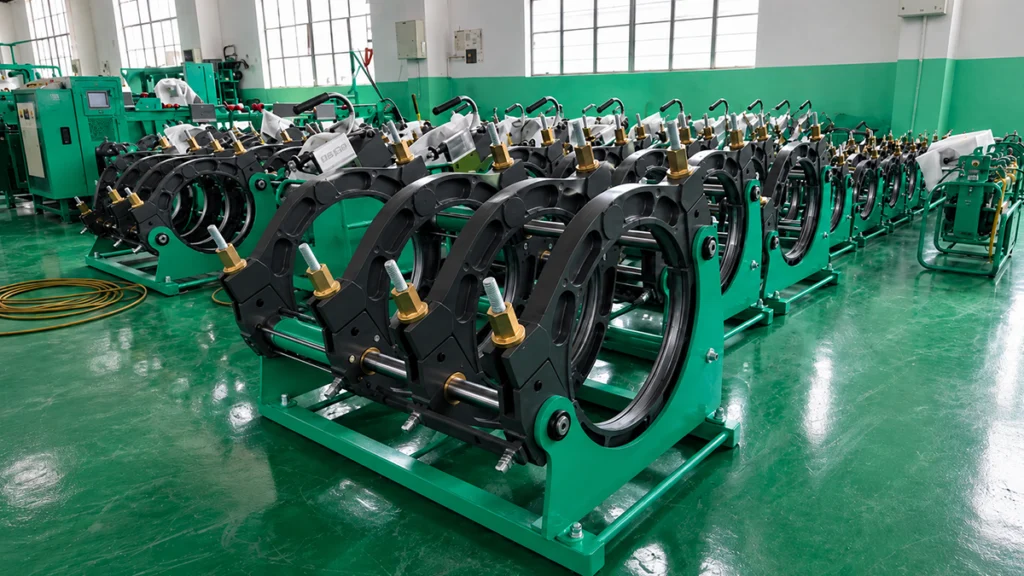
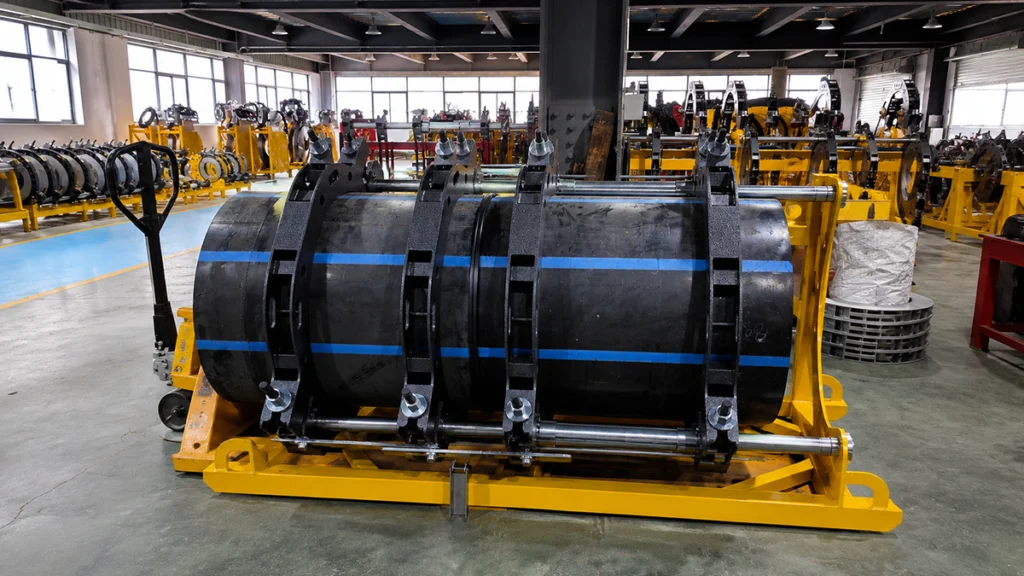
Hydraulic butt fusion machines are suitable for medium- and large-diameter HDPE pipeline projects, including municipal water, industrial, mining, drainage, and infrastructure applications. An external hydraulic unit provides controlled carriage movement and fusion pressure, helping operators manage pipe drag and maintain stable joining conditions throughout the welding cycle.
Available welding ranges, power requirements, machine weight, and configuration vary by model. Smaller hydraulic machines are commonly used for urban pipeline work, while heavy-duty systems are designed for large-diameter pipes up to 3200 mm. Buyers should select the machine according to the required pipe diameter, SDR, site conditions, power supply, transport requirements, and applicable welding procedure.
Automatic CNC Butt Fusion Machines (450–1600mm)
Automatic butt fusion machines combine hydraulic operation with computerized process control. Depending on the model, the system can manage key stages such as heating, changeover, fusion pressure, and cooling while recording welding parameters for traceability and quality documentation. These machines can reduce operator-related variation, but trained personnel are still required for pipe preparation, alignment, cleaning, inspection, and equipment setup. Actual welding range, machine weight, voltage, and total power consumption should be confirmed from the manufacturer’s technical data.
Which Machine Type Fits Small, Medium, and Large HDPE Projects?
Selecting the right butt fusion machine depends on pipe diameter, SDR, welding volume, site conditions, and quality-control requirements. Manual machines are generally suitable for smaller-diameter pipes, repairs, farm irrigation, and occasional welding work.
Hydraulic butt fusion machines cover a wider range and are commonly used for municipal water, industrial pipelines, mining, drainage, and medium- to large-scale infrastructure projects. Automatic CNC machines are better suited to projects that require repeatable parameter control, welding data records, and greater process traceability.
The final selection should be based on the required pipe range, power supply, transport conditions, welding standard, and project documentation requirements.
Factory-direct pricing with technical consultation included
Get Your Free QuoteWorking Principle and Key Components of a Butt Fusion Welding Machine
The 5 Stages of the Butt Fusion Welding Process
To guarantee a joint that will not burst under pressure, the fusion process breaks down into five non-negotiable stages:
1. Positioning: Locking the pipes tightly into the chassis to achieve perfect concentricity.
2. Milling (Facing): Shaving down the pipe ends with a rotary cutter. This strips away oxidized plastic and leaves perfectly parallel, clean mating surfaces.
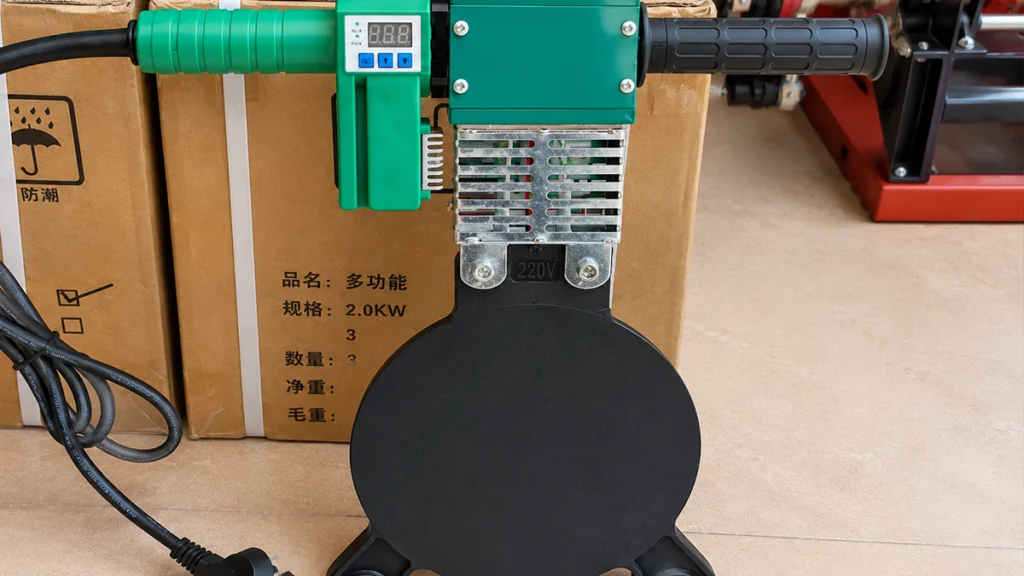
3. Heating: Pressing the PTFE-coated heating plate against the ends to form a uniform melt bead, then dropping the pressure for a deep heat soak.
4. Flanging (Joining): Pulling the heating plate out incredibly fast and slamming the molten pipe ends together at a precisely calculated hydraulic pressure.
5. Cooling: Maintaining static pressure on the joint until the thermoplastic entirely solidifies. This step is critical to prevent microscopic internal stress fractures.
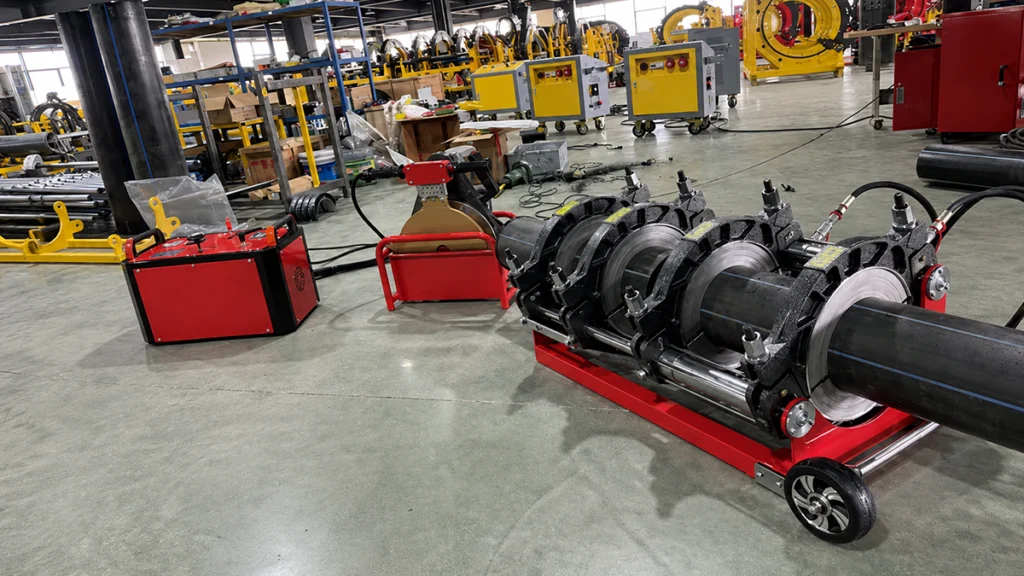
Core Components: Frame, Hydraulic Unit, Heating Plate, Planer, Control Box
Any professional-grade fusion rig relies on four to five primary components. First, the clamping chassis (the frame) grips the pipe and guides all directional movement. Next, the planer (or milling cutter) uses high-speed carbon steel blades powered by a heavy-duty chain drive to prep the pipe. The heating plate itself is cast from ZL104 corrosion-resistant aluminum alloy, ensuring flawless heat distribution. Finally, the hydraulic unit pumps out the heavy joining force, while the control box safely houses your electrical relays, independent dual-channel timers, and digital temperature readouts.
How Temperature, Pressure, and Cooling Time Affect Weld Quality
You cannot guess these variables. Precision is absolutely non-negotiable. HDPE requires a strict heating window between 220°C and 230°C, and your gear must hold that temperature within a tight ±5°C margin. Crank the heat too high, and the polymer carbonizes and deforms. Run it too cold, and you get brittle, weak joints practically begging to fail under load. Hydraulic pressure requires careful calculation based on the pipe’s specific cross-sectional area plus its drag resistance. And if an operator gets impatient and dumps the pressure early during the cooling phase? They will inject micro-fractures straight into the weld, instantly destroying the pipeline’s pressure rating.
Typical Application Scenarios in Côte d’Ivoire
Urban Water Supply and SODECI-Related Projects
Across Abidjan and its neighboring urban hubs, expanding the municipal water grid means laying miles of HDPE piping to slash non-revenue water loss. Any PE pipe butt fusion machine for water supply projects Ivory Coast contractors deploy has to balance extreme mobility with serious power. It must deliver rock-solid hydraulic pressure while crammed into tight urban trenches. Because these jobs heavily feature DN110 to DN315 pipes, semi-automatic hydraulic butt fusion machines remain the go-to standard for fast, reliable joint production.
Mining Slurry and Tailings Pipelines in Northern Côte d’Ivoire
Mining operations up north face brutal, abrasive conditions. A single pipeline failure here can instantly paralyze production. Moving slurry and tailings demands massive, thick-walled HDPE pipes—usually SDR9 or SDR11. To handle this, contractors roll out heavy-duty CNC butt fusion machines that can grip pipes up to 1000mm in diameter. The automated data logging on these rigs isn’t just a luxury; it is a strict requirement for proving structural weld integrity to hard-nosed mining safety inspectors.
Gas Distribution and Industrial Fluid Transport
Pumping natural gas requires flawless joint integrity. The risks of a leak are simply too catastrophic to ignore. That is why any butt fusion machine for mining and gas pipeline Côte d’Ivoire projects must meet punishing ISO standards. In this sector, CNC automatic butt fusion machines are the only acceptable choice. By entirely removing the operator from the fusion equation, the computer guarantees every single weld hits the exact temperature and pressure targets while generating a permanent digital paper trail for the entire network.
Agricultural Irrigation and Rural Infrastructure
Down in the rural zones where cocoa and cashews drive the economy, consistent irrigation is life or death for crops. Rural water systems usually rely on smaller HDPE pipes ranging from 63mm to 160mm. This is exactly where manual butt fusion machines prove their worth. They are incredibly affordable, a breeze to haul across rugged terrain, and draw very little power. In fact, a small portable generator is usually all you need to keep a manual rig running smoothly in the most remote agricultural setups.
Get detailed specs and custom configuration options
Request Technical SpecificationsTechnical Specifications and Decision Criteria to Compare Before Buying
Welding Diameter Range and SDR Compatibility
Picking the right gear always starts with knowing your pipe diameter and Standard Dimension Ratio (SDR). A butt fusion welding machine 63-315mm Côte d’Ivoire contractors typically buy easily handles the most popular municipal sizes. Keep in mind, however, that engineering codes strictly forbid butt fusing pipe components with a diameter (dn) ≤ 63mm or a wall thickness (e) < 6mm. If you find yourself needing to join pipes from different SDR series, you either have to butt fusion machine them to match wall thicknesses perfectly, or abandon butt fusion entirely and use electrofusion.
Hydraulic Pressure, Heating Plate Temperature, and Power Requirements
What kind of power do you have on-site? That answer dictates your butt fusion machine choice. Smaller manual and hydraulic rigs run perfectly fine on standard 220V single-phase power. Large CNC units, on the other hand, demand a heavy 380V three-phase supply just to fire up heating plates that pull more than 17kW. You also need a hydraulic system that can push a pressure range from 0 all the way up to 16 MPa. On top of that, the heating plate requires a high-end digital thermostat to lock the temperature at 220–230°C, refusing to fluctuate even when cold ambient winds whip through the trench.
Compliance with ISO 12176, DVS 2207, and Local Standards
Procurement teams cannot afford to gamble on non-compliant equipment. Buying an ISO 12176 certified butt fusion machine Ivory Coast buyers trust provides a hard guarantee that the butt fusion welding machine’s construction, safety features, and data logging hit global benchmarks. Beyond the hardware, the actual welding procedures must strictly follow DVS 2207 (the gold-standard German code for thermoplastic welding) alongside local equivalents like TSG D2002-2006. If the pipe fusion machine cannot meet these codes, your pipeline will almost certainly fail its hydrostatic pressure tests.
Which Specifications Actually Matter for Ivorian Site Conditions?
Operating in West Africa means fighting high ambient heat, choking dust, and notoriously unstable power grids. For Ivorian job sites, the specs that actually matter are wide voltage tolerance, a bulletproof hydraulic sealing system (always insist on imported seals to block dust), and rock-solid thermal stability in the heating plate. Do not overlook the hose fittings either. Flat-type quick connectors on your hydraulic lines are an absolute must, as they stop dirt from contaminating the fluid every time you disconnect a hose in the dirt.
Manual vs Hydraulic vs CNC Butt Fusion Machines: Which One to Choose?
Comparison Table: Cost, Diameter Range, Weld Quality, Operator Skill
| Feature | Manual Butt Fusion Machine | Hydraulic Butt Fusion Machine | Automatic CNC Butt Fusion Machine |
|---|---|---|---|
| Typical Pipe Range | Approximately 63–160 mm | Approximately 160–3200 mm, depending on the model | Approximately 160–630 mm |
| Operation Method | Manual carriage movement and joining-force control | Hydraulic carriage movement and fusion-pressure control | Hydraulic operation with computerized process control |
| Operator Requirements | High operator involvement throughout the welding cycle | Trained operator required to set and monitor welding parameters | Trained operator required for preparation, setup, and inspection |
| Process Control | Parameters and timing are controlled mainly by the operator | More consistent pressure control with operator-managed timing | Automated control of selected pressure, heating, changeover, and cooling stages |
| Weld Traceability | Usually requires manual welding records | Manual or optional digital recording, depending on configuration | Automatic or optional data logging, depending on the model |
| Typical Applications | Small-diameter pipelines, repairs, irrigation, and occasional welding | Municipal water, drainage, industrial, mining, and large-diameter pipelines | Utility and infrastructure projects requiring repeatability and welding records |
| Main Consideration | Lower investment, but greater dependence on operator experience | Wide application range with stable fusion-pressure control | Higher investment with improved parameter control and traceability |
Actual welding ranges, functions, power requirements, and data-recording capabilities vary by machine model, pipe SDR, project standard, and manufacturer configuration.
When Manual Machines Are Enough for Your Project
Running a manual vs hydraulic butt fusion machine comparison quickly highlights a simple truth: manual units only make sense for small-diameter, thin-walled pipes. The required drag and fusion pressures must be low enough for a human to push manually. If you are laying low-pressure gravity drains, pulling rural irrigation lines under 160mm, or doing tight indoor plumbing where large machines simply will not fit, a manual rig is easily your most cost-effective bet.
When Hydraulic or CNC Machines Are a Better Long-Term Investment
Hydraulic butt fusion machines are often a better choice for contractors handling frequent welding, medium- or large-diameter pipes, and projects that require more consistent fusion-pressure control. Their wider operating range and stable hydraulic performance can improve productivity and reduce dependence on manual force.
CNC butt fusion machines are particularly valuable when projects require repeatable welding parameters, automatic process control, data logging, and joint traceability. Although the initial investment is higher, these functions can help reduce operator-related variation, simplify quality documentation, and lower the risk of rework over long-term or high-volume projects.
Cost, MOQ, Lead Time, and Import Considerations for Côte d’Ivoire Buyers
Typical Price Range by Machine Size (USD, EXW and CIF Abidjan)
The butt fusion machine price in Côte d’Ivoire swings wildly depending on the size and the level of automation. A small manual unit will generally set you back between $500 and $1,500 EXW. Step up to a mid-sized semi-automatic hydraulic rig (say, in the 250mm to 315mm range), and you are looking at $2,000 to $5,000 EXW. Monster CNC automatic butt fusion machines for 1000mm pipes easily push past $15,000 to $30,000 EXW. A pro tip for buyers: always demand CIF Abidjan pricing on your quotes. That ensures the supplier bundles in the ocean freight and marine insurance needed to actually land the gear in West Africa.
MOQ, Lead Time, and Payment Terms from Chinese and European Suppliers
Fortunately, most heavy equipment manufacturers do not force a strict Minimum Order Quantity (MOQ) on fusion machines. Contractors are usually free to buy a single unit for a specific job. Expect standard lead times of about 10 to 15 days for factory production, plus another 30 to 45 days for the vessel to reach West Africa. On the financial side, standard payment terms require a 30% T/T deposit to kick off the order, while the 70% balance is settled right before shipping or against the Bill of Lading.
Import Duties, VAT, and Customs Clearance at Port of Abidjan
Getting heavy butt fusion machinery into Côte d’Ivoire means surviving the customs maze at the Port of Abidjan. You have to factor in the Common External Tariff (CET) applied across the ECOWAS region for industrial equipment. On top of those import duties, expect a flat 18% Value Added Tax (VAT) slapped onto the combined CIF value and duties. To keep things moving and dodge brutal port demurrage penalties, hiring a highly experienced, registered local clearing agent is basically required.
How to Calculate Total Landed Cost in Côte d’Ivoire
If you are weighing a butt fusion machine rental vs purchase Côte d’Ivoire scenario, you need the true landed cost to make a smart choice. Use this formula: EXW Price + Inland Freight to the Origin Port + Ocean Freight & Insurance (which gives you the CIF Abidjan value) + Import Duties + 18% VAT + Port Handling and Clearing Fees + Final Inland Transport to your trench. Nailing down this exact breakdown stops nasty budget surprises and gives you a crystal-clear ROI on equipment ownership.
How to Evaluate Butt Fusion Machine Suppliers Serving Côte d’Ivoire
Certifications to Require: ISO 9001, CE, ISO 12176
Vetting a supplier starts with hard compliance checks. Any reputable HDPE pipe welding machine supplier Ivory Coast buyers deal with will happily hand over an ISO 9001 certificate for their factory, along with CE markings proving electrical safety. Dig deeper, though: the specific butt fusion machine models you buy must comply with ISO 12176. That specific standard governs exactly how polyethylene fusion equipment performs and logs data. Bringing uncertified gear onto a public infrastructure project is a massive, unforgivable liability.
Warranty, Spare Parts Availability, and On-Site Training
Trench conditions are brutal, so after-sales support isn’t optional. Top-tier manufacturers will back their rigs with a solid 1-year warranty on all non-human-induced damage, plus lifetime technical support. You also need a guarantee that the factory can air-freight critical spare parts—like fresh PTFE-coated heating plates, milling blades, or replacement hydraulic seals—directly to Abidjan at a moment’s notice. Finally, ask about training. Whether it is digital or on-site, your crew needs to fully grasp the strict SDR11 HDPE butt fusion welding parameters West Africa projects demand before they touch a pipe.
How to Verify a Supplier’s Track Record in West Africa
Never sign a purchase order without asking for reference cases in West Africa. A manufacturer that actually knows the market will gladly show you case studies of their butt fusion machines surviving the exact same climatic extremes you face—namely, blistering heat and choking laterite dust. Check to see if their rigs have already successfully completed regional municipal water expansions or handled thick slurry lines in the local mining sector.
Red Flags When Sourcing from Overseas Manufacturers
Watch out for quotes that sit suspiciously below the market average. Dirt-cheap pricing usually means the factory is cutting corners with thin-gauge chassis steel, cheap heating plates that warp instantly, or low-grade hydraulic seals guaranteed to blow out in a dusty trench. Another glaring red flag? If the supplier cannot hand you a highly detailed technical data sheet breaking down exact power draws, maximum pressure ranges, and explicit compliance with TSG D2002-2006 and GB/T 20674.1 standards, walk away immediately.
Common Mistakes and Hidden Risks When Buying a Butt Fusion Machine
Choosing the Wrong Diameter Range for Future Projects
Procurement teams make this mistake all the time: buying a butt fusion machine that maxes out at the exact diameter of their current contract. If you buy a 315mm rig for a 315mm pipeline, you are instantly boxed in. Strategic buyers always size up. Grabbing a 450mm butt fusion welding machine instead gives you breathing room for sudden design changes, oversized fittings, and bigger future bids, all without forcing you to buy a brand-new machine next year.
Underestimating Power Supply and Site Voltage Stability
Ignoring the massive electrical appetite of large fusion equipment is a fast track to disaster. A CNC rig working on 1000mm pipes easily pulls 23.5kW at 380V. If your site generator is too weak or the local grid voltage is jumping around, the heating plate will never stabilize in that critical 220–230°C window. The result? Weak cold welds, blown deadlines, and a frantic rush to buy expensive voltage stabilizers to save the project.
Ignoring Operator Training and Weld Data Recording Requirements
Dropping cash on high-end hydraulic or CNC gear means nothing if your field crew is just guessing. Skipping formal training practically guarantees operators will drop the pressure too early or fail to clean the V-groove properly, leading directly to joint failure. Worse, if you ignore the butt fusion machine’s automated data recording features, you have zero proof of weld integrity. When sharp inspectors review the site, you risk massive rejections and frozen payments on strict municipal or mining contracts.
Practical Buying Checklist and Final Recommendation for Ivorian Contractors
Pre-Purchase Checklist: 10 Questions to Ask Every Supplier
1. What pipe diameter range and SDR values can the machine handle?
2. How is the heater-plate temperature controlled, displayed, and calibrated?
3. What materials and surface coating are used for the heater plate?
4. How does the hydraulic system maintain stable fusion pressure, and what seals and connectors are used?
5. Which fusion procedures and equipment standards does the machine support, such as ISO 12176-1 or the project’s required standard?
6. Does the machine provide timers, alarms, automatic parameter control, or weld-data recording?
7. What voltage, phase, frequency, and total power supply are required?
8. What is included in the EXW, FOB, or CIF Abidjan quotation?
9. What are the warranty terms, exclusions, technical-support services, and operator-training options?
10. Which spare parts are supplied with the machine, and how quickly can additional parts be shipped to Côte d’Ivoire?
Recommended Machine Configurations by Project Type
If you are tackling rural irrigation or small-scale plumbing (anything up to 160mm), manual butt fusion machines deliver the highest ROI. Pushing into municipal water networks and standard industrial fluid lines (160mm to 450mm)? Semi-automatic hydraulic butt fusion machines are the absolute baseline for securing joint integrity. Finally, for massive mining slurry lines, high-pressure gas networks, and major infrastructure demanding hard weld data (450mm to 1600mm), fully automatic CNC automatic butt fusion machines stand as the only serious engineering choice.
Next Step: Request a Tailored Quote for Your HDPE Project
Ready to move forward? The final step is locking down a tailored quotation. Give your supplier the exact pipe diameters, SDR ratings, your target automation level (whether hydraulic or CNC), and confirm the destination as the Port of Abidjan. Feeding them this specific technical data guarantees you get pinpoint-accurate CIF pricing, exact power requirements, and a realistic timeline covering factory production all the way to West African delivery.
FAQ
Q1: How much does a butt fusion machine cost in Côte d’Ivoire?
The price depends on the welding range, manual, hydraulic, or CNC configuration, included reducing inserts, power supply, data-recording functions, and after-sales support. Buyers should also consider ocean freight, insurance, customs clearance, inland delivery, commissioning, and spare parts. Request both an EXW or FOB price and a CIF Abidjan quotation for an accurate comparison.
Q2: Which butt fusion machine is best for 110mm to 315mm HDPE pipes?
A hydraulic butt fusion machine covering 90–315 mm, 110–315 mm, or 160–315 mm may be suitable, depending on the actual pipe sizes required. Hydraulic operation provides more consistent carriage movement and fusion-pressure control than a manual system. Buyers should also confirm the SDR, reducing inserts, fusion procedure, power supply, and site conditions.
Q3: Can I import a butt fusion machine directly to Abidjan port, and what are the customs duties?
Yes, butt fusion equipment can be shipped to the Port of Abidjan. However, customs duties and taxes depend on the machine’s HS classification, customs value, origin, and the current ECOWAS Common External Tariff. Côte d’Ivoire Customs publishes the applicable tariff schedule, so buyers should confirm the classification and total landed charges with a licensed customs broker before shipment.
Q4: What is the difference between manual and hydraulic butt fusion machines?
Manual machines require greater operator involvement in carriage movement and joining-force control, making them more suitable for smaller pipes and occasional work. Hydraulic machines use a hydraulic power unit to control carriage movement and fusion pressure more consistently, so they are commonly selected for frequent welding and medium- or large-diameter pipelines.
Q5: Do butt fusion machines sold in Côte d’Ivoire meet ISO 12176 standards?
Compliance should be verified for each machine rather than assumed. ISO 12176-1:2017 specifies general characteristics and performance requirements for equipment used for butt fusion jointing of PE piping systems. Buyers should request the supplier’s compliance documents, technical data, calibration information, and any certification required by the project.
Q6: How long does it take to weld an HDPE pipe using a butt fusion machine?
The complete welding cycle includes clamping, facing, alignment, heating, changeover, fusion, and cooling. Total time depends on pipe diameter, SDR, wall thickness, ambient conditions, equipment type, and the selected welding procedure. Cooling is often one of the longest stages, and the joint should remain clamped for the time specified by the applicable procedure.
Q7: Is it better to rent or buy a butt fusion machine for a one-off project in Ivory Coast?
Renting may be practical for a short project when a suitable machine, trained operator, and technical support are available locally. Purchasing may be more economical for contractors with recurring municipal, agricultural, mining, or industrial pipeline work. The decision should compare rental duration, purchase price, freight, maintenance, availability, workload, and future projects.
Q8: What spare parts and after-sales support should I request from the supplier?
Ask the supplier to clearly state the warranty period, exclusions, technical-support process, training options, and spare-parts delivery time. Recommended spare parts may include facer blades, heater-plate coatings or replacement plates, hydraulic seals, quick connectors, temperature sensors, electrical components, and commonly used fasteners. The exact spare-parts package should match the machine model and expected operating conditions.
Conclusion
Choosing the right butt fusion machine for a project in Côte d’Ivoire requires careful consideration of pipe diameter, SDR, welding volume, site conditions, power supply, transport requirements, and quality-control needs. Manual machines may suit smaller pipes and occasional work, while hydraulic machines are generally preferred for regular municipal, agricultural, industrial, and mining pipeline projects. CNC machines are useful where repeatable parameter control, welding records, and greater process traceability are required.
Buyers should also compare the complete landed cost, including equipment configuration, reducing inserts, freight to Abidjan, customs clearance, inland delivery, training, spare parts, and after-sales support. Reviewing technical documents, warranty terms, calibration information, and compliance with the project’s required welding procedures can help reduce procurement risk and support reliable long-term operation.
Let our experts help you choose the right equipment for your project
Request a Machine Recommendation