
180mm-450mm HDPE Butt Fusion Machine: Features and Industrial Applications
Table of Contents
450mm Butt Fusion Machine guide covering 180-450mm pipe welding features, working principle, industrial applications, technical specifications, selection criteria, and buying factors for PE and HDPE projects.
What Is a 180mm-450mm HDPE Butt Fusion Machine?
What pipe size range does 180-450mm cover?
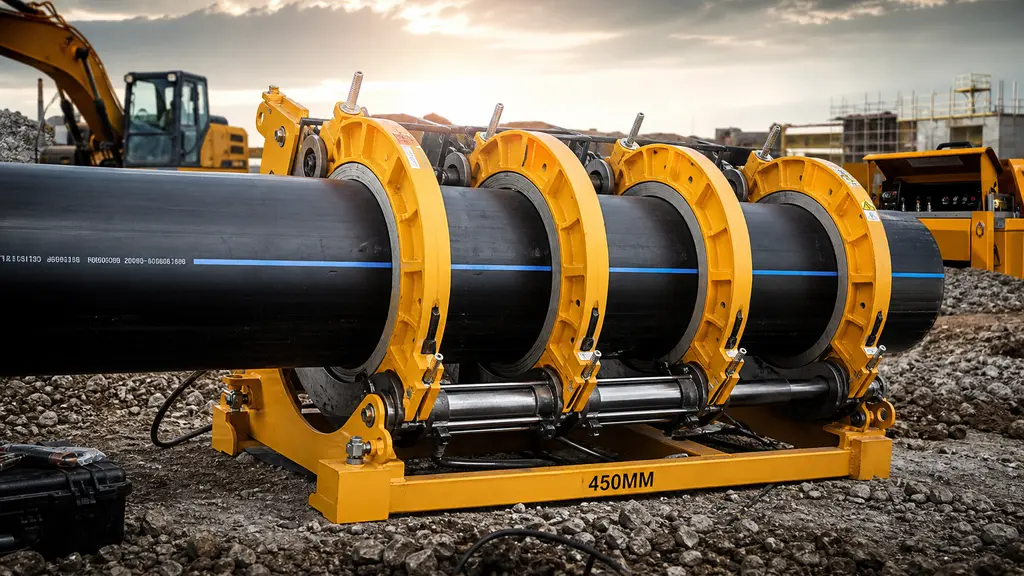
Think of the 180mm-450mm butt fusion machine as the heavy-hitting workhorse of thermoplastic welding. Built specifically for demanding civil infrastructure and industrial piping, this mid-to-large tier equipment tackles outside diameters (OD) spanning 180mm to 450mm. In North American terms, that translates perfectly to 6-inch through 18-inch IPS (Iron Pipe Size). But it’s not just about width. These machines handle serious wall thicknesses, easily accommodating pipes up to SDR 11. To put that in perspective, an SDR 11 rating on a 450mm pipe means you’re fusing a solid 40.9mm wall. Ultimately, this size bracket perfectly bridges the gap between everyday commercial plumbing and massive main transmission pipelines.
Which materials is it designed for?
You’ll use this equipment exclusively for thermoplastic pipe materials. The usual suspects include Polyethylene (PE), High-Density Polyethylene (HDPE), Polypropylene (PP), and Polyvinylidene Fluoride (PVDF). It seamlessly handles modern, high-performance municipal network grades like PE80 and PE100. There is, however, one unbreakable rule. A 450mm butt fusion machine demands that both pipe ends share the exact same material composition and wall thickness (SDR). Try fusing dissimilar materials or mismatched SDRs without a specialized transition fitting, and you’ll guarantee uneven heat distribution—and an eventual joint failure.
How does it differ from smaller portable fusion units?
Compared with smaller portable fusion machines, a 450mm butt fusion machine typically uses a hydraulic drive system to provide the clamping and fusion pressure required for larger HDPE pipes. Its heavier-duty frame, multi-clamp structure, and larger heating and facing components are designed to handle greater pipe weight and higher welding loads.
Because of its size and weight, a 450mm machine is usually less portable than small manual or compact hydraulic units. On job sites, operators may use wheeled frames, lifting equipment, or other handling tools to position the machine and pipe safely. These design differences make 450mm butt fusion machines more suitable for municipal water, drainage, mining, industrial, and other medium-to-large diameter HDPE pipeline projects.
Key Features and Core Components
What do the frame, clamps, heater, and trimmer do?
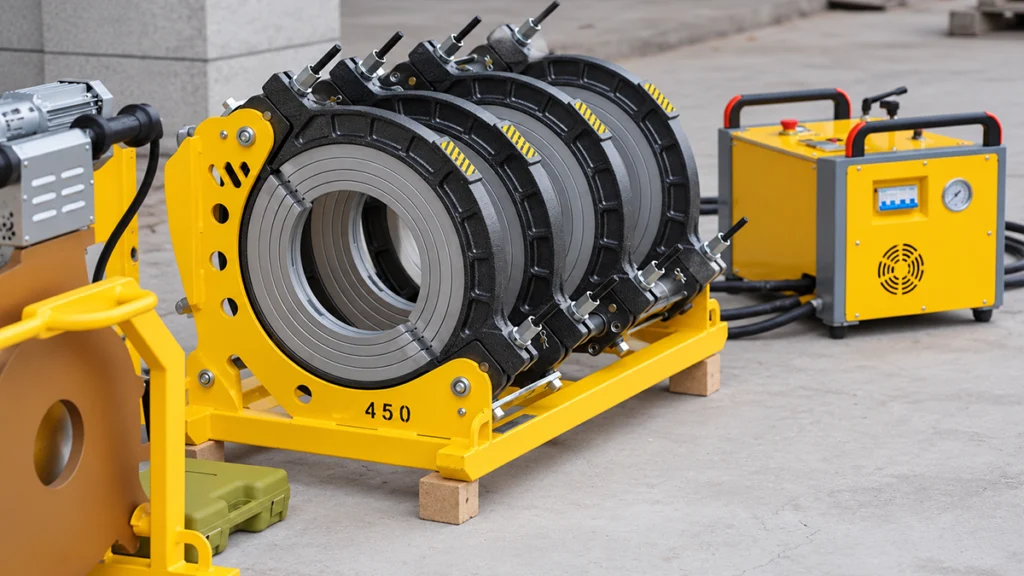
he frame, clamps, heating plate, and trimmer are the core components of a butt fusion machine, and each plays a specific role in achieving a consistent HDPE pipe joint.
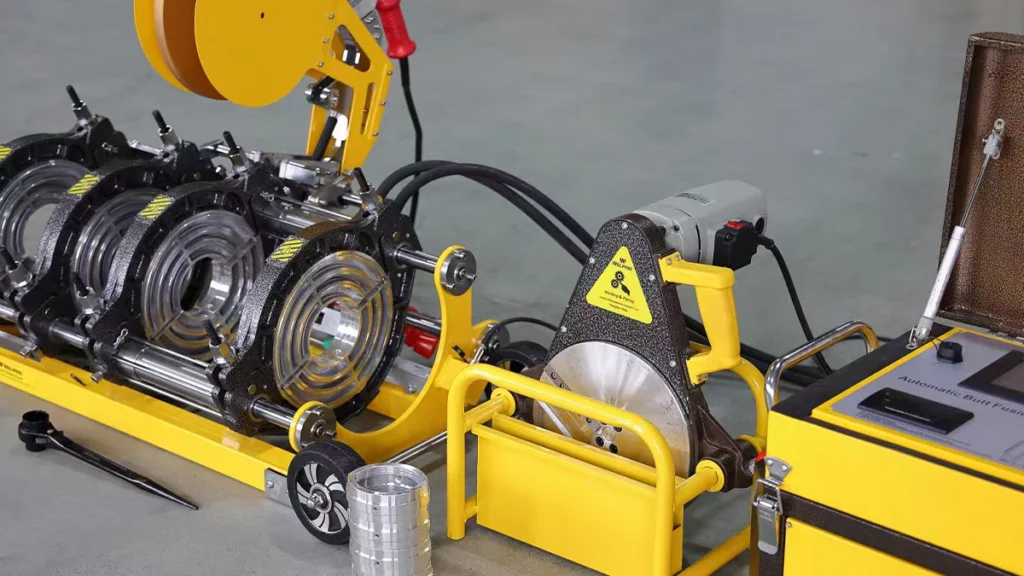
The frame and clamps hold the HDPE pipe securely during alignment, facing, heating, and fusion. A rigid multi-clamp structure helps minimize pipe movement and makes it easier for operators to correct vertical or horizontal misalignment before welding.
The heating plate provides controlled, even heat to the prepared pipe ends. Depending on the machine design, it is typically made from aluminum alloy and coated with a non-stick PTFE surface to reduce adhesion during the heating stage.
The trimmer, also known as a facer, removes a thin layer from both pipe ends to create clean, flat, and parallel fusion surfaces. On many hydraulic butt fusion machines, safety interlocks or limit switches are used to reduce the risk of accidental operation when the trimmer is not correctly positioned.
Why do hydraulic pressure and alignment control matter?
Hydraulic pressure drives the entire drag, bead-up, and fusing sequence. Get the pressure wrong, and the joint fails. Apply too little force, and you end up with a weak, unbonded connection. Push too hard, and the butt fusion welding machine squeezes the molten polymer entirely out of the fusion zone, leaving behind a brittle “cold weld.” Alignment control is just as critical. The two pipe ends must remain perfectly coaxial. Under industry standards, if misalignment exceeds 10% of the pipe’s wall thickness, structural integrity drops and the joint must be rejected. To prevent this, advanced hydraulic stations now feature displacement detection systems that monitor and dictate the exact degree of preheating and beveling right from the start.
Which control options are available: manual, semi-automatic, or PLC?
| Control Option | Operational Mechanism | Best Application Scenario |
|---|---|---|
| Manual / Hydraulic | The operator physically actuates hydraulic levers while monitoring analog pressure gauges and timers. | A cost-effective route for highly experienced welders working on unregulated private jobs. Not recommended for 450mm pipes at high SDRs. |
| Semi-Automatic | Automates both temperature control and timer alerts. The operator still manually inserts and removes the heater and trimmer. | Ideal for contractors balancing tight budget constraints against the need for consistent heating parameters. |
| Fully Automatic (CNC/PLC) | Pre-sets optimal parameters based on pipe diameter, SDR, and material. Automates pressure sequences and logs data via GPS. | Absolutely mandatory for heavily regulated municipal water and gas distribution networks where 100% traceability is required. |
Factory-direct pricing with technical consultation included
Get Your Free QuoteHow the Butt Fusion Process Works
What happens in the facing, heating, fusing, and cooling stages?
Butt fusion follows a rigid, four-stage thermodynamic sequence. During facing, the electric trimmer shaves the pipe ends. You run it until continuous ribbons of HDPE peel off both sides, leaving clean, virgin, perfectly parallel surfaces. Next comes heating. The PTFE-coated plate drops in, and the operator applies initial pressure until a specific melt bead forms around the circumference. Pressure then drops to a “heat soak” level, letting molecular diffusion penetrate the pipe wall. Fusing demands speed. The heater is quickly extracted, and the pipe ends are slammed together under targeted hydraulic pressure, forcing the molten polymer chains to intermingle. Finally, during cooling, the joint remains completely static under pressure until the plastic fully solidifies.
Which temperature, pressure, and timing factors affect weld quality?
Weld integrity hinges on a strict matrix of temperature, pressure, and time. The heating plate has to hold a tight window of 204°C to 232°C (400°F – 450°F). For standard PE100, you want to aim right at 220°C–230°C. Interfacial pressure depends entirely on your governing standard. DVS 2207-1 (Low Pressure) requires 0.15 N/mm² (± 0.01), while ISO 21307 (High Pressure) demands 0.52 MPa (± 0.1 MPa). Timing is the final puzzle piece. The changeover time—the window where you remove the heater and apply fusion pressure—must be lightning fast to stop the molten faces from cooling prematurely. Cooling time itself dynamically shifts based on the pipe’s SDR and the ambient temperature on site.
What does a standard field workflow look like?
A standard field workflow for a 450mm HDPE butt fusion machine thrives on preparation and strict sequencing.
1. Preparation: Operators wipe down the pipe ends with ethanol, load them into the clamps, and lock down the chassis.
2. Execution: The trimmer faces the pipes. The crew then performs a “dummy close” to check for high-low misalignment, tweaking the clamps as needed. Next, the heater goes in. Bead-up pressure is applied, followed immediately by the heat soak. The operator then swiftly removes the heater, engages the fusion pressure, and holds it steady through the entire cooling cycle.
3. Quality Control: Once fully cooled, operators visually inspect the bead. They check that it is uniform and properly rolled over onto the pipe surface. Finally, they log the weld data directly through the butt fusion machine’s CNC module.
Industrial Applications and Typical Use Cases
Why is it used in municipal water and drainage projects?
When it comes to municipal water and drainage infrastructure, a leak-proof system is non-negotiable. Butt fusion delivers a monolithic joint that is structurally as strong as—if not stronger than—the parent pipe itself. Because of this strength, trench installation becomes much simpler; you no longer need concrete thrust blocks at directional bends or tees. Better yet, a properly executed HDPE butt fusion joint guarantees a 100-year design life. This virtually eliminates non-revenue water loss and wipes out the endless, cyclic maintenance costs associated with traditional mechanical bell-and-spigot joints.
Where does it fit in gas, irrigation, mining, and chemical pipelines?
The 180-450mm size range acts as the central nervous system for critical mid-stream gas distribution networks, an industry where leak-free, high-pressure performance faces heavy regulation. In mining and chemical processing, crews deploy these machines to build aggressive chemical transport networks and heavy-duty slurry lines. Because butt fusion relies purely on thermodynamics—skipping adhesives, solvents, or mechanical gaskets entirely—the finished pipeline retains the absolute chemical resistance of the native HDPE material across every single joint.
What project scenarios justify this size range?
Project scale and surrounding terrain dictate when you bring in a butt fusion welding machine of this caliber.
- Scale: This specific range shines when expanding urban water mains, routing regional gas gathering lines, or laying down high-volume cooling water systems for industrial plants.
- Terrain: Rugged environments demand tough equipment. In open-pit mines or cross-country agricultural irrigation setups, heavy-duty track-mounted or trailer-integrated HDPE pipe welding machines handle long, continuous pipe pulls. In these scenarios, traditional mechanical joints would easily shear or fail under high tensile drag stresses.
Get detailed specs and custom configuration options
Request Technical SpecificationsTechnical Specifications to Check Before Buying
What fusion range and pipe standards must match your project?
Procurement choices must align perfectly with the regional engineering standards set by the project owner. The HDPE Pipe welding machine’s hydraulic output has to support specific regulations, whether that’s ISO 21307 (Global High Pressure), DVS 2207-1 (European Low Pressure), or ASTM F2620 (North America). Range flexibility matters just as much. Make sure your equipment package includes a complete set of reducing inserts—usually 180, 200, 225, 250, 280, 315, 355, and 400mm. Having these inserts allows a single 450mm chassis to tackle the entire spectrum of pipe sizes on your job site.
What voltage, power, and heater temperature should you verify?
Industrial fusion gear in this diameter pulls serious electricity. A 450mm class butt fusion welding machine typically demands a 380V (3-phase) power supply just to run the high-wattage heating plate, hydraulic station, and electric facer simultaneously. When testing the heater, verify that the element can continuously hold 220°C–230°C. Furthermore, ensure the maximum temperature deviation across the entire surface area of the PTFE plate never exceeds ±3°C to ±5°C.
What accessories and tooling should be included in the package?
A field-ready package needs to deliver far more than a bare frame.
Standard Equipment Package:
- Main 4-clamp multi-column chassis
- Enclosed hydraulic control station
- Electric milling cutter (trimmer)
- PTFE-coated heating plate
- Dedicated storage bracket for safe heater and trimmer placement
Advanced Tooling Options:
- CNC data loggers for GPS traceability and weld parameter tracking
- Stub-end device for welding flange adapters straight to the pipe
- Single-size clamp inserts that guarantee perfect coaxial alignment on specific outside diameters
How to Choose the Right Model for Your Project
Should you choose manual, hydraulic, or automatic control?
Your choice of control mechanism dictates the overall consistency of the pipeline. Completely manual butt fusion machines fall short in the 450mm range; the extreme physical force required, combined with the strict pressure tolerances of large-diameter pipes, makes them a liability. Semi-automatic hydraulic machines serve as the industry standard for contractors with highly experienced welding crews, offering a solid balance between budget and hydraulic force. However, fully automatic (CNC) control is strictly mandatory for highly regulated municipal and gas projects. CNC systems remove the human factor entirely, ensuring every weld is 100% repeatable, fully documented, and easily traceable.
How do pipe diameter, SDR, and operator skill affect the choice?
Heavy wall pipes (ranging from SDR 7.4 to SDR 11) demand high-pressure hydraulic cylinders capable of hitting 0.52 MPa (ISO 21307 SHP). A low-pressure hydraulic butt fusion welding machine simply cannot generate the force needed to fuse these heavy SDRs. Operator skill introduces another major risk variable. CNC machines mitigate the dangers of unskilled labor by automatically calculating complex T/P/B (Time, Pressure, Bead) formulas. This stops operators from guessing fusion pressures or heat soak times based on shifting ambient weather conditions.
What should you compare across suppliers and brands?
The global fusion market breaks down into distinct tiers driven by technology and price. Premium brands like McElroy (USA) and Georg Fischer (Switzerland) deliver unmatched automation, global field support, and track-mounted mobility—though they require a massive capital expenditure. Mid-tier brands like Ritmo (Italy) stand out with self-aligning technology and highly intuitive user interfaces. Meanwhile, high-ROI value brands like Riyang, MM-Tech, and Ekberg (China) offer heavy-duty hydraulic performance, robust CNC options, and OEM customization at highly accessible 450mm butt fusion machine price points. These value-tier options are perfect for contractors looking for rapid equipment amortization.
Cost, MOQ, Lead Time, and Supplier Evaluation
What drives the price of a 180-450mm butt fusion machine?
Automation levels act as the primary price driver. Stepping up from a basic hydraulic unit to a fully automated CNC rig—complete with digital data logging, GPS tracking, and automated pressure sequencing—causes the initial capital cost to jump significantly. Build quality also plays a massive role. butt fusion welding machines engineered with aviation-grade aluminum (like the ZL104 standard) for the chassis, multi-layer PTFE coatings, and imported European hydraulic seals cost a premium to manufacture. However, that upfront cost drastically reduces long-term maintenance overhead.
How do customization, MOQ, and lead time affect procurement?
For distributor stocking or large-scale procurement, Asian manufacturers often provide comprehensive OEM/ODM services. This flexibility lets buyers localize language panels on the CNC interface, customize voltage inputs, and even brand the frame colors—features you rarely see from Western off-the-shelf brands. While standard butt fusion welding machines usually require a Minimum Order Quantity (MOQ) of just a single unit, custom OEM runs demand longer lead times. You have to factor in the extra weeks required for specialized manufacturing, rigorous testing, and international sea freight logistics.
What should a reliable quotation include?
To avoid unexpected delays in the field, a comprehensive supplier quote needs to be completely transparent. It should explicitly detail the main frame, heater, facer, hydraulic power unit, and every single reducing insert from 180mm up to 400mm. Beyond the hardware, the quote must outline the warranty terms (12 to 24 months is the industry standard), specify the packaging (look for export-grade wooden crating), and define the exact scope of after-sales technical support—including easy access to replacement hydraulic seals and fresh PTFE plates.
Operating Tips, Maintenance, and Common Quality Risks
What are the most common welding mistakes to avoid?
1. Contamination: Neglecting to wipe down the pipe ends with 90%+ isopropyl alcohol or ethanol. Introducing any moisture, oil, or dirt into the fusion zone guarantees catastrophic joint failure once the pipe is pressurized.
2. Mismatched Pipes: Trying to butt fuse pipes with different SDRs (wall thicknesses) without utilizing a properly HDPE pipe welding machined transition fitting.
3. Improper Changeover: Taking too long to pull the heating plate and engage the fusion pressure. If the molten polymer cools below its melt state before you apply pressure, you’ll create a weak, brittle “cold weld.”
What daily maintenance keeps the machine accurate and safe?
Routine maintenance guarantees the machine hits its temperature and pressure targets without fail. You must clean the PTFE heating plate with ethanol before every single shift to stop polymer buildup in its tracks. On the mechanical side, operators need to lubricate guide pillars with machine oil, drain accumulated water from the oil-gas separator, and inspect hydraulic hoses for micro-leaks. For electrical safety, technicians should routinely verify that leakage current remains ≤5mA and the system’s insulation resistance holds at ≥1MΩ.
When should a fusion joint be rejected?
A joint must be cut out and completely rejected the moment it fails visual inspection. Reject the weld if the melt bead isn’t uniform around the entire pipe circumference, or if it fails to roll over completely onto the pipe surface. A deep V-shaped groove in the center of the bead is another massive red flag, indicating insufficient heat or pressure. Finally, if the high-low misalignment between the two pipe ends exceeds 10% of the pipe’s wall thickness, the joint is compromised and must go.
When a 180mm-450mm HDPE Machine Is the Right Investment
Which buyers get the most value from this range?
Regional gas distribution companies, municipal water authorities, and mid-sized civil contractors pull the absolute highest value from this equipment class. The ROI is undeniable. Owning a 450mm butt fusion machine wipes out exorbitant daily rental fees—which easily range from $275 to over $1,000 a day depending on automation levels and location. It also eliminates project delays tied to equipment availability. When paired with the right pipe handling rollers, ownership can push field productivity from a modest 12-24 joints a day up to an impressive 20-34 joints per day.
When should you upgrade to a larger model?
Contractors need to step up to a larger chassis when shifting from mid-stream distribution networks to massive main transmission pipelines. If your project bids consistently call for pipe diameters of 630mm, 800mm, or 1200mm, upgrading is mandatory. The 450mm mark represents the absolute physical limit for this specific hydraulic cylinder configuration and structural frame.
What should you confirm before placing an order?
Pre-Procurement Checklist:
- Confirm the exact pipe ODs and SDRs required by your regional engineers.
- Verify your on-site power supply (make sure generators can sustain the 380V/high KW draw without suffering voltage drops).
- Ensure the butt fusion welding machine’s hydraulic pressure output matches your required standard (DVS low-pressure vs. ISO high-pressure).
- Confirm that the package includes all necessary reducing inserts to cover both current and future project demands.
FAQ
Q1: What pipe materials can a 180-450mm butt fusion machine weld?
This equipment is built exclusively for thermoplastic piping, specifically Polyethylene (PE), High-Density Polyethylene (HDPE), Polypropylene (PP), and Polyvinylidene Fluoride (PVDF). It handles high-performance modern grades like PE100 and PE80 with ease, as long as the two pipes being joined share the exact same SDR and material composition.
Q2: How do I choose the right voltage and power for site conditions?
Machines in this heavy-duty class generally require a 3-phase, 380V power supply to handle the massive wattage of the hydraulic station and heating plate. You need to confirm that your on-site generators can sustain this high output continuously. Any voltage drops will cause the heating plate to dip below the critical 220°C-230°C temperature window.
Q3: Is a 180-450mm machine suitable for both water and gas projects?
Absolutely. This specific range serves as the industry standard for both mid-stream gas distribution and municipal water mains. Keep in mind, however, that gas projects carry far stricter regulations. For gas, a fully automatic (CNC) machine equipped with GPS data logging is usually mandatory to guarantee leak-free, 100% traceable joints.
Q4: What affects butt fusion joint strength the most?
Joint strength relies heavily on rapid changeover times, strict temperature adherence (204°C–232°C), and precise interfacial pressure (like 0.52 MPa for ISO 21307). Fusing mismatched SDRs, or allowing dirt and moisture to contaminate the fusion zone, will instantly compromise the weld’s structural integrity.
Q5: What is included in a typical butt fusion machine set?
A standard industrial setup features the main four-clamp frame, an electric milling cutter (trimmer), an enclosed hydraulic control station, a PTFE-coated heating plate, a safety storage bracket, and a comprehensive set of reducing inserts (usually spanning 180mm to 400mm) to handle various pipe diameters.
Q6: How much does a 450mm butt fusion machine cost?
Brand tier and automation levels drive the final price. Basic semi-automatic hydraulic models from value-tier brands offer incredible cost-effectiveness. Conversely, fully automated, track-mounted CNC machines from premium Western manufacturers demand a much higher initial capital investment.
Q7: How long does a butt fusion welding cycle take?
Cycle times depend entirely on ambient temperature and the pipe’s wall thickness (SDR). Facing and heating only take a few minutes, but the cooling phase requires the joint to remain under static pressure until it completely solidifies. Naturally, thick pipes in the heat of summer take much longer to cool than thinner pipes in freezing winter conditions.
Q8: What should I check before accepting a machine from the supplier?
Ensure all requested reducing inserts are in the crate. Inspect the heating plate’s PTFE coating for scratches, test the hydraulic station to ensure it holds pressure without leaking, and verify that the CNC data logging and electrical insulation operate exactly as stated in the factory testing report.
Conclusion
Securing the right 450mm butt fusion machine demands a hard look at your operational budget, project specifications, and regional engineering standards like ISO 21307 or DVS 2207-1. For contractors handling heavy-walled HDPE pipes in strict municipal water or gas applications, upgrading to a fully automatic (CNC) hydraulic butt fusion machine is essential. CNC integration provides traceable data logging for every joint, guarantees regulatory compliance, and effectively neutralizes the risk of human error.
While premium Western brands dominate the market with advanced track-mounted mobility, emerging global manufacturers now offer customizable, highly competitive alternatives. These value-tier options maximize ROI by slashing the total cost of ownership and cutting out expensive daily rental fees. Ultimately, regardless of the badge on the HDPE pipe welding machine, delivering a leak-free, 100-year pipeline comes down to strict daily maintenance, flawless surface preparation, and an operator’s unwavering adherence to the thermodynamic rules of temperature, pressure, and time.
Let our experts help you choose the right equipment for your project
Contact Our Engineering Team