
HDPE Pipe Welding Equipment for Mining Pipeline Projects: Complete Guide
Table of Contents
HDPE Pipe Welding Equipment for Mining helps contractors and mine operators choose suitable fusion machines, compare specifications, control weld quality, and reduce pipeline installation risks.
Think of HDPE pipe welding equipment as the backbone of any serious mining infrastructure project. These specialized industrial machines join high-density polyethylene pipes using controlled thermal fusion, creating the heavy-duty, leak-proof networks that modern mines rely on. You’ll find them at the center of everything from process water distribution and massive dewatering systems to aggressive slurry transport lines.
Core function of HDPE pipe welding equipment
At its core, this butt fusion machine performs a highly precise thermal operation. It heats the prepped ends of polyethylene pipes to a strict temperature window—usually between 210°C and 240°C. Once the plastic molecules reach a molten state, the machine applies exact hydraulic pressure to force the two ends together. As the material cools, it forms a monolithic, continuous pipeline. The resulting joint isn’t just a seal; it becomes structurally equal to, or even stronger than, the original pipe.
Why fusion welding is preferred for mining pipelines
Mining environments subject infrastructure to relentless mechanical and chemical abuse.Pipe fusion welding takes the top spot for pipe joining simply because it ditches vulnerable mechanical connections, adhesives, and flanges. Instead, you get completely leak-proof joints that shrug off highly acidic conditions—frequently handling process water with a pH dropping to 2.5. At the same time, these fused connections easily endure the abrasive scraping that comes standard with heavy mineral transport.
Where welding equipment fits in a mining pipeline project
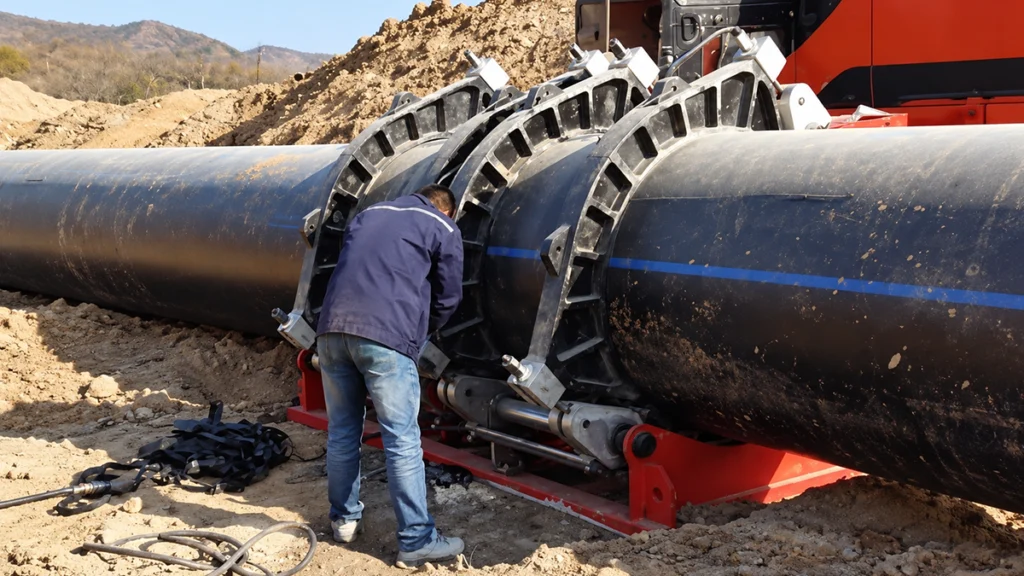
You’ll typically see HDPE pipe welding equipment for mining roll out during the main infrastructure build-out and later expansion phases of a mine’s lifecycle. Engineering and procurement teams spec these butt fusion machines for mining specifically to build deep-pit dewatering setups, extensive dust suppression grids, tailings networks, and cross-country slurry lines. Depending on the terrain, the gear operates right down in the trench or mounts on mobile skids to travel alongside the pipeline route.
Reducing leakage risk in slurry and dewatering lines
Heat fusion tackles leakage risks head-on by producing joints with massive tensile strength and unbeatable sealing capabilities. Mechanical couplings tend to vibrate loose or break down when pressure spikes hit, but heat-fused joints hold their ground. That absolute integrity makes them ideal for the brutal realities of underwater, aboveground, or buried mining pipelines, where a single leak can instantly derail production.
Why HDPE Pipe Welding Matters in Mining Pipeline Projects
How weld quality affects mine site uptime
A mine’s operational continuity lives and dies by its pipeline integrity. Just one blown joint can easily trigger $15,000 or more in immediate downtime, emergency cleanup, and repair costs. If a dewatering system or slurry line fails because of a shoddy weld, the entire processing or extraction circuit usually grinds to a halt until crews can get the pipe back online.
Why mining conditions require stronger joint reliability
Municipal water lines have it easy compared to the brutal internal dynamics of a mining pipeline. HDPE pipe mining take a constant beating from highly abrasive materials like copper tailings and iron ore, not to mention the aggressive flow of corrosive process water. The joints have to absorb aggressive pressure surges from heavy slurry pumps, thermal expansion on exposed surface lines, and endless mechanical vibration.
The cost of poor fusion joints in remote operations
That $15,000 direct repair bill is just the beginning. Poor fusion joints carry massive secondary liabilities, especially in remote, off-grid locations. Sending heavy lifting gear and repair crews out to fix a blown connection turns into a logistical nightmare. Worse, a pipeline failure threatens severe environmental contamination from toxic tailings. That kind of spill triggers catastrophic regulatory fines and guarantees a failed Tier 1 safety audit.
Hydraulic butt fusion welding machines
To mitigate these extreme risks, pipeline contractors turn to hydraulic butt fusion machines. These units are critical for holding the precise contact pressures demanded by global standards throughout the entire fusion cycle—like the 60-90 psi required by ASTM F2620. Only a true hydraulic system can generate and maintain the unrelenting clamping force needed to fuse thick-walled PE100-RC mining pipes without dropping pressure during the vital cooling phase.
Main Types of HDPE Pipe Welding Equipment Used in Mining
| Machine Type | Best Mining Use Case | Primary Advantage | Limitation |
|---|---|---|---|
| Hydraulic Butt Fusion | Standard dewatering and water supply lines | Reliable, cost-effective for standard SDR pipes | Relies on operator skill for parameter control |
| CNC / Automatic Fusion | High-risk slurry and tailings pipelines | Eliminates human error, provides full data logging | Higher initial capital expenditure |
| Electrofusion Units | Confined space repairs, complex fittings | Highly precise, excellent for tight trenches | Consumable fittings increase per-joint cost |
| Tracked Portable Units | Remote, off-grid, rough terrain pipelines | Self-propelled mobility across mud and rock | Heavy transport weight, high maintenance |
Automatic and CNC-controlled fusion machines
Computer Numerical Control (CNC) fusion machines set the gold standard for pipeline jointing. Outfitted with automatic pressure control valves, Programmable Logic Controllers (PLCs), and digital weld data storage, these units handle the heavy lifting. By fully automating the temperature and pressure calculations, CNC technology removes the unpredictable “operator variable.” The result? Every single joint strictly complies with ASTM or ISO standards.
Electrofusion equipment for fittings and repairs
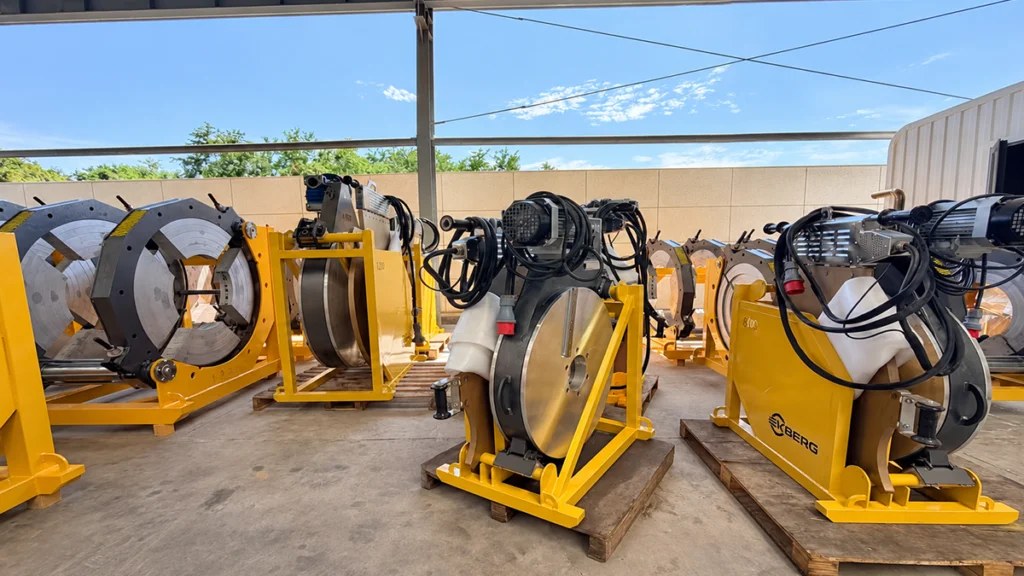
Electrofusion relies on an electric heating melt head built straight into specialized pipe fittings. The HDPE pipe equipment for mining pipelines pushes a precise electrical current into the internal coils, heating them to 220°C–240°C to melt the fitting and pipe together. Because this gear is incredibly compact, it shines in scenarios where bulky butt fusion machines just won’t fit—like complex directional layouts, tight trench repairs, and smaller diameter lines.
Portable field welding machines for remote mine sites
On sprawling, remote mine sites, mobility equals productivity. Portable field welders range from compact wheeled setups to massive, heavy-duty tracked machines. The tracked variants are game-changers, delivering self-propelled mobility right across muddy, rocky, off-grid terrain. Because they don’t require secondary lifting HDPE welding equipment for mining pipeline to drag the butt fusion machine for mining from one joint to the next, daily production rates skyrocket.
Pipe alignment, facing, heating, fusion, and cooling
No matter which specific butt fusion machine for mining you roll out, every piece of HDPE mining welding equipment has to execute a flawless, five-step process. Dictated by strict standards like ISO 21307, the machine must first secure and align the pipes. Next, it mechanically faces the ends for perfect parallel contact. Then, the heating plate applies thermal energy to form a melt bead. Finally, the machine fuses the ends under exact pressure and holds that force steady through a carefully calculated cooling cycle.
Factory-direct pricing with technical consultation included
Get Your Free QuoteHow HDPE Pipe Welding Equipment Works
1. Preparation & Alignment: Heavy-duty hydraulic clamps lock down the pipe ends. The operator verifies there is no high-low misalignment and secures everything to prevent slippage under pressure.
2. Facing: A rotating mechanical facer shaves the pipe ends, exposing fresh, unoxidized material and ensuring the mating surfaces are perfectly parallel.
3. Heating: The operator inserts a PTFE-coated heating plate. The pipe ends press against it to create an initial melt bead, followed by a pressure reduction that lets the heat soak deep into the polymer walls.
4. Changeover & Fusion: The heating plate pulls out rapidly (minimizing changeover time is critical), and the hydraulic cylinders slam the molten pipe ends together at a highly specific fusion pressure.
5. Cooling: The butt fusion machine for mining holds that hydraulic pressure steady while the joint drops to ambient temperature, giving the polymer chains time to permanently entangle.
What parameters control a reliable HDPE weld?
Nailing a reliable weld boils down to three things: strict control over time, temperature, and pressure. Heating plate stability is non-negotiable; it has to stay within a ±3°C window. Run it too hot, and the polymer suffers thermal degradation and oxidation. Run it too cold, and the plastic molecules never reach the state needed to integrate. That leaves you with a brittle, cold weld guaranteed to snap under pipeline stress.
Why pressure, temperature, and cooling time must be controlled
Different parts of the world rely on different fusion methodologies. Europe’s DVS 2207-1 standard uses a low-pressure technique, demanding 0.15 N/mm² of interfacial pressure at 200–220°C. Meanwhile, North America’s ASTM F2620 standard pushes a high-pressure approach: 60-90 psi at 400–450°F (204–232°C). Cooling time carries just as much weight. You have to maintain interfacial pressure until the molten plastic completely cures. Otherwise, internal voids form, destroying the structural seal.
Common differences between manual and automatic welding processes
When welding manually, the operator has to physically calculate drag pressure—the force needed to drag the heavy pipe—and add it to the baseline fusion pressure, tweaking hydraulic valves by hand. CNC automatic systems take a smarter route. They calculate drag pressure dynamically on the fly, compute the precise bead-up height, and lock in the mandatory cooling time based on your chosen standard. This guarantees flawless repeatability, whether you are welding ten joints or ten hundred.
Slurry transportation pipelines
Apply these principles to slurry transportation lines, and the parameters get intensely demanding. Slurry networks rely on thick-walled pipes—like SDR 9 or SDR 11 PE100-RC—to fight off severe mineral abrasion. To handle this, the HDPE welding equipment for mining pipelines needs high-capacity hydraulic cylinders that can generate massive force. That power is the only way to overcome the heavy drag weight of these pipes and hit the target interfacial fusion pressure.
Mining Applications for HDPE Pipe Welding Equipment
Mine dewatering and drainage systems
Underground and open-pit mines fight a never-ending battle against groundwater. Crews deploy mining pipe welding equipment to construct massive dewatering and drainage networks, pulling together river diversion lines and pit depressurization systems. These setups demand rapid installation and bulletproof joint integrity to survive the high-volume, nonstop pumping required to keep extraction zones safe and dry.
Tailings and process water pipelines
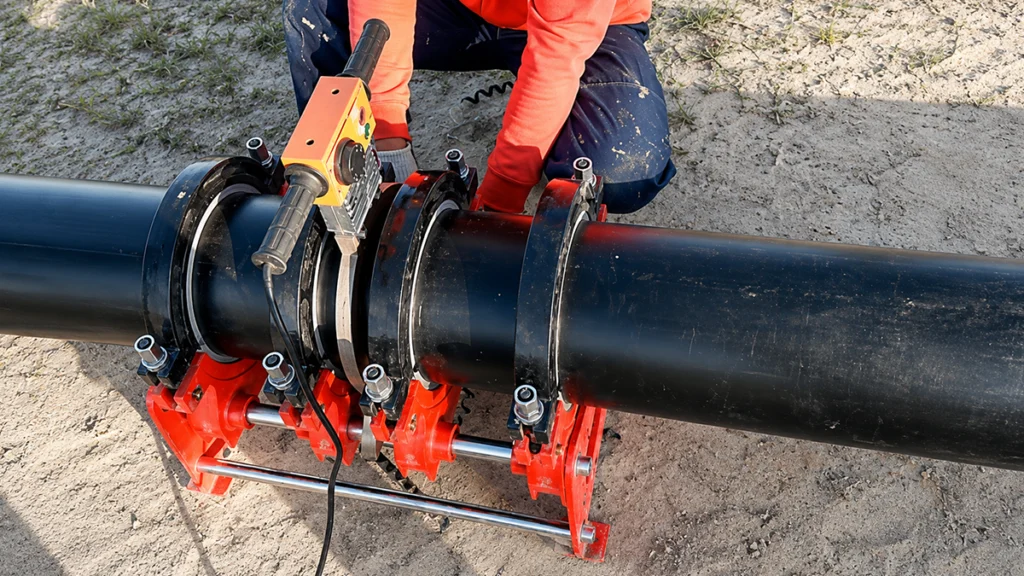
Moving highly acidic, abrasive tailings from a processing plant to a storage facility ranks among the most hazardous pipeline jobs in mining. These lines carry toxic slurry and heap leaching solutions, meaning they demand 100% leak-proof, monolithic joints. If substandard mining pipe welding equipment leaves behind a weak weld, the corrosive process water will find it, tear it open, and trigger a major environmental breach.
Temporary and mobile pipeline installations
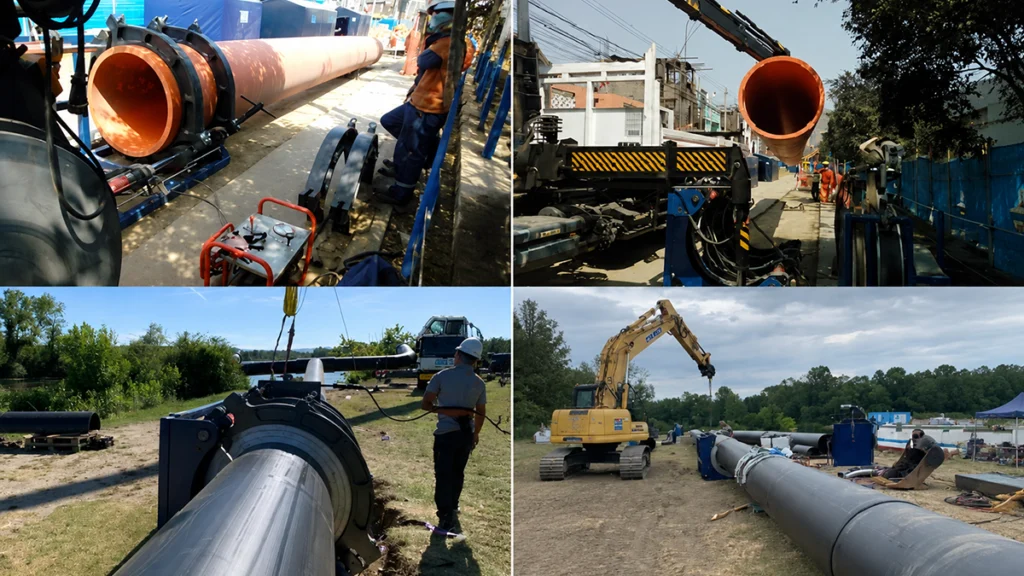
Mines constantly need temporary bypass lines to route water away from active blast zones or fresh excavation sites. The mining pipe welding equipment tackling these jobs must be highly mobile and ready to execute fast, solid welds in less-than-ideal trench conditions. Once the temporary work wraps up, crews often cut, relocate, and re-weld these HDPE lines using the exact same machinery.
Pipe diameter and wall thickness capacity
Mining operations move massive volumes of fluid, so the HDPE Pipe welding equipment for mining has to handle extreme pipe dimensions. Standard municipal utility lines might cap out around 315mm, but mining machines routinely tackle 500-800mm diameters. For Tier 1 processing plants pushing massive throughput, it’s common to see this equipment scaled up to fuse pipes reaching 1600mm, 2000mm, or even an incredible 3000mm.
Get detailed specs and custom configuration options
Request Technical SpecificationsKey Specifications to Check Before Buying HDPE Pipe Welding Equipment
| Specification Item | Why It Matters | What to Verify Before Purchase |
|---|---|---|
| Heating Plate Accuracy | Prevents polymer degradation or cold welds | Independent control, 210°C–230°C range, ±3°C stability |
| Hydraulic Cylinder Capacity | Ensures adequate fusion pressure for heavy pipes | Ability to overcome drag pressure of thick-walled SDR 9/11 |
| Clamping Mechanism | Prevents pipe slippage during high-pressure fusion | 4-clamp system with heavy-duty aluminum or steel inserts |
| Data Logging (CNC) | Required for Tier 1 mining safety audits | ISO 12176-4 compliance, encrypted PDF reporting |
Heating plate temperature control and accuracy
The heating plate drives the crucial polymer state transition. Before purchasing, procurement teams need to verify that the HDPE piep welding equipment for mining boasts an independent temperature control system. It must hold the target temperature (usually 210°C–230°C) with a rigid ±3°C accuracy across the plate’s entire surface. Uneven heating zones are a death sentence for a pipe, causing asymmetrical melting and guaranteed joint failure.
Hydraulic pressure range and clamping stability
Mining pipes are incredibly heavy and stiff. Your mining pipe welding equipment needs a hydraulic pressure range wide enough to handle both low-pressure (DVS) and high-pressure (ASTM) fusion techniques. Clamping stability is equally critical. The HDPE pipe welding equipment for mining absolutely must use a heavy-duty 4-clamp chassis to lock the pipe in place. If there is even microscopic slippage when the cylinders apply maximum fusion pressure, the weld is compromised.
Power supply, generator compatibility, and field mobility
You won’t find stable grid power running alongside a remote pipeline route. Mining pipe welding equipment has to play nice with diesel generators, utilizing hardened electrical components that can shrug off minor voltage spikes without dropping the heating plate temperature or resetting the PLC. On top of that, the chassis needs to be ruggedized—either self-propelled tracked or heavy-duty wheeled—to guarantee reliable off-grid mobility.
Match machine capacity to pipe diameter and SDR
Buyers frequently overlook the Standard Dimension Ratio (SDR), and it costs them. A HDPE pipe welding equipment for mining built to fuse a 1000mm thin-wall (SDR 17) pipe might completely lack the hydraulic cylinder force needed to fuse a 1000mm thick-wall (SDR 9) pipe. You have to ensure the machine’s hydraulic capacity can conquer the massive drag pressure and deliver the correct interfacial pressure for heavy mining pipes.
How to Choose the Right HDPE Pipe Welding Equipment for Mining
Choose manual, hydraulic, or automatic control based on project risk
If you’re running low-risk, temporary water diversion lines, standard hydraulic butt fsion machines get the job done cost-effectively—provided you have a highly skilled operator. But if you’re building high-risk chemical transport, slurry, or tailings lines, CNC automatic control is the only logical choice. CNC systems lock out human error, enforce strict cooling times, and guarantee compliance with the rigorous Tier 1 safety audits demanded by global mining corporations.
When should mining contractors choose portable equipment?
Contractors need to invest in self-propelled, tracked portable HDPE pipe welding equipment for mining whenever the pipeline cuts across steep, muddy, or jagged terrain. If you have to constantly reposition the machine over miles of rough landscape, tracked units free you from relying on cranes or excavators to move the gear. Gaining that logistical independence dramatically speeds up your construction schedule.
Selection checklist for procurement teams
- Verify the machine can handle the lowest SDR and maximum required pipe OD.
- Confirm ISO 9001 manufacturing standards and CE certification.
- Check that the software comes pre-loaded with ASTM F2620, DVS 2207, and ISO 21307 parameters.
- Evaluate the setup for diesel generator-compatible power inputs.
- Assess the supplier’s lead times and spare parts inventory for critical items like hydraulic seals and PTFE plates.
What affects the price of HDPE pipe welding equipment?
Price hinges heavily on the level of automation and pipe diameter capacity. A unit built to fuse 1200mm pipe demands significantly more hydraulic power and structural steel than a 630mm model. Additionally, CNC automated systems run about 30-50% more upfront than manual hydraulic versions. However, that initial capital hit pays for itself quickly, delivering a superior ROI over a three-year project by completely eliminating costly rework.
Cost, Lead Time, and ROI Factors for Mining Pipe Welding Equipment
| Cost Factor | Impact on Mining Pipeline Project |
|---|---|
| Capital Expenditure | CNC machines cost 30-50% more but eliminate $15,000 joint failure risks. |
| Rental vs Purchase | Renting costs ~$275/day + operator. Purchasing yields ROI in < 6 months. |
| Productivity Gains | Automated handling increases output from 20 to 29 joints per day. |
| Rework Savings | Saves an estimated $5,185 per 100 joints by preventing failed welds. |
Purchase cost vs. rental cost for mining projects
Procurement teams constantly debate buying versus renting. Renting heavy-duty fusion gear runs about $275 daily, plus another $480 a day for a certified operator. For a quick, short-term repair, renting is a smart move. But if you’re looking at a pipeline construction project spanning several months, buying the butt fusion equipment outright is far more cost-effective. Plus, it keeps the asset on hand for future site expansions.
Lead time, spare parts, and after-sales support
HDPE pipe welding equipment for mining downtime in the mining sector is financially brutal. When vetting suppliers, look past the initial price tag and focus on after-sales support. Prioritize suppliers offering a robust spare parts inventory, a minimum 24-month warranty, and a chassis built to last over a decade. Getting hit with a three-week lead time on a replacement hydraulic valve or heating plate can stall your entire project.
How better welding equipment can reduce rework costs
Spending the money on high-tier automated butt fusion machine directly eliminates the catastrophic $15,000 joint failures caused by manual operator errors. Pair advanced CNC fusion machines with the right pipe handling gear (like hydraulic rollers), and you can push daily production from 20 joints up to 29. That kind of efficiency saves roughly $5,185 per 100 joints, putting the equipment’s ROI on the fast track.
Welding parameter records and traceability
Modern mines operate on absolute accountability. CNC automatic butt fusion machines deliver ISO 12176-4 compliant data logging and encrypted PDF reports for every single weld. This traceability captures the operator ID, cooling time, pressure, and exact temperature. If an anomaly pops up in the pipeline three years down the road, this data is your shield—proving compliance, protecting contractors from liability, and validating the asset’s ROI.
Quality Control and Safety Requirements for HDPE Pipe Welding in Mining
Visual inspection and destructive testing considerations
Quality control kicks in the second the pipe leaves the machine. Crews must conduct strict visual inspections to confirm the melt bead is uniform, without any cracks, bubbles, or contamination. Visuals are just the start; sample welds go through destructive testing (like tensile pull tests), and the entire completed pipeline undergoes hydrostatic pressure testing to prove the ultimate integrity of every connection.
Operator training and certification requirements
Even the smartest machinery needs competent human oversight. Operators require formal training and certification on specific global standards (ASTM, DVS, or ISO) based on project specs. They also have to follow rigid mining safety protocols. That means wearing the right Personal Protective Equipment (PPE)—including flameproof clothing, safety glasses, and heavy heat-resistant gloves—to navigate site hazards safely.
Field safety risks during pipe fusion operations
Pipe fusion is heavy industrial work, and the field safety risks are real. Crews face struck-by hazards from massive pipes shifting on uneven ground, severe pinch points inside the clamping chassis, and stored energy risks from highly pressurized hydraulic lines. Add in a heating plate running at 240°C, and you have a severe burn hazard that demands strict perimeter control during the changeover phase.
Buying equipment with insufficient diameter capacity
Trying to use undersized machines on thick-walled mining pipe is a disaster waiting to happen. If the gear lacks the hydraulic muscle to pull the pipe’s heavy drag weight, it won’t apply enough clamping or interfacial fusion force. The direct result is a weak, cold weld. Put that compromised joint in a high-pressure dewatering or slurry system, and it becomes a prime candidate for a catastrophic blowout.
Common Mistakes When Selecting HDPE Pipe Welding Equipment for Mining
Ignoring site power and transport limitations
Buyers often make the mistake of procuring HDPE pipe welding equipment for mining based solely on pipeline specs, totally ignoring the physical reality of the mine. Failing to plan for massive temperature swings, extreme dust, and a lack of stable grid power guarantees equipment failure. Likewise, buying a heavy wheeled machine for a route that crosses jagged, steep mud will trigger massive logistical headaches compared to just buying a tracked unit.
Choosing low-cost machines without parameter control
Procurement teams hyper-focused on upfront capital often grab budget manual machines lacking digital parameter control and dynamic drag pressure compensation. It’s a massive false economy. Without automation, operators will inevitably miscalculate fusion pressures or rush cooling times. The resulting failed joints cost exponentially more to dig up and fix than the initial price difference of a CNC machine.
Overlooking spare parts, service, and operator training
Treating heavy welding machinery like a basic commodity purchase is a huge mistake. If you fail to mandate operator training, confirm local spare parts availability, or secure a 24-month warranty, you are setting yourself up for massive project delays when wearable parts eventually give out. A machine sitting idle for three weeks waiting on a hydraulic seal is actively delaying the launch of a multi-million-dollar pipeline.
FAQ
Q1: What type of welding machine is best for HDPE mining pipelines?
CNC automatic hydraulic butt fusion machines take the top spot for mining pipelines. They completely remove human error by automatically managing cooling times, temperature, and drag pressure calculations. If your route covers remote, off-grid terrain, self-propelled tracked machines are your best bet to ensure mobility without needing excavators to move the gear.
Q2: Can HDPE pipe welding equipment be used for slurry pipelines?
Absolutely. HDPE pipe welding equipment for mining is vital for building slurry lines. But because these lines rely on thick-walled, heavy pipes (like SDR 11 or SDR 9) to fight abrasion, your machine must have high-capacity hydraulic cylinders. You need that power to generate the massive interfacial pressure required for a proper fusion joint.
Q3: What pipe sizes can mining HDPE fusion machines weld?
Built for massive fluid transfer, mining fusion machines handle extreme pipe diameters. Standard utility models usually max out around 315mm to 800mm, but specialized mining gear easily fuses pipes up to 1600mm, 2000mm, and even 3000mm to support the massive throughput of Tier 1 processing facilities.
Q4: How do you control weld quality on a remote mining site?
You lock down weld quality by using CNC fusion machines featuring ISO 12176-4 compliant data logging. These units record the exact cooling time, pressure, and temperature for every single joint, spitting out encrypted PDF reports. Pair that data with strict visual inspections of the melt bead and final hydrostatic pressure testing, and you guarantee joint integrity anywhere on the map.
Q5: Is automatic HDPE pipe welding equipment better than manual equipment?
Yes, automatic (CNC) butt fusion equipment wins hands down for mining applications. It physically stops operators from applying the wrong pressures or cutting cooling times short. By locking in fusion parameters based on ASTM or ISO standards, CNC technology guarantees perfect repeatability, virtually wiping out the $15,000 risk of a joint blowout.
Q6: What factors affect the price of HDPE pipe welding equipment for mining?
Price comes down to three main things: the maximum pipe diameter capacity, the chassis style (self-propelled tracked vs. wheeled), and the level of automation (CNC vs. manual hydraulic). CNC units will cost you 30-50% more upfront, but they deliver a vastly superior ROI by accelerating daily production and eliminating expensive rework.
Q7: What safety precautions are needed when welding HDPE pipes in mines?
Operators need to wear strict PPE, including safety glasses and heat-resistant gloves, to shield against the 240°C heating plate. On top of that, crews have to manage stored energy hazards from high-pressure hydraulics, stay clear of severe pinch points in the chassis, and properly secure heavy pipes to avoid struck-by accidents on uneven ground.
Q8: How long does an HDPE pipe fusion joint take to cool before handling?
Cooling times depend entirely on the specific fusion standard used (ASTM, DVS, or ISO), wall thickness (SDR), and pipe diameter. The machine must hold hydraulic pressure steady until the joint completely cures to ambient temperature. If you rush the cooling phase, you will create internal voids, practically guaranteeing the joint will fail under pressure.
Conclusion
Choosing the right HDPE pipe welding equipment for a mining project isn’t just a basic procurement task; it’s a critical engineering decision that dictates project ROI, environmental safety, and overall site uptime. Mining environments are brutal, demanding uncompromising joint integrity to survive extreme mechanical stress, acidic tailings, and aggressive slurries.
To dodge the massive financial fallout of a pipeline failure, mine operators and contractors have to prioritize machinery that delivers dynamic parameter control, heavy-duty hydraulic clamping force, and dead-on heating plate accuracy. Stepping up from manual hydraulic setups to CNC automated machines guarantees strict compliance with ASTM, DVS, and ISO standards—giving you the exact data traceability required to pass Tier 1 safety audits. Furthermore, factoring in site-specific logistics, like the need for generator compatibility or tracked mobility, prevents massive construction delays. By matching the machine’s capacity to your exact SDR and pipe diameters, and backing it up with strong after-sales support, you can build resilient, leak-proof pipelines ready to conquer the industry’s harshest environments.
Let our experts help you choose the right equipment for your project
Contact Our Engineering Team