
630mm HDPE Pipe Welding Machine: Complete Guide for Large Diameter Fusion
Table of Contents
630mm HDPE Pipe Welding Machine helps buyers understand large-diameter butt fusion, key specifications, operating steps, pricing factors, and supplier selection so they can choose a reliable machine for industrial projects.
What Is a 630mm HDPE Pipe Welding Machine?
Think of a 630mm HDPE Pipe Welding Machine as the heavy-duty workhorse of modern pipeline construction. Engineered to join large-diameter high-density polyethylene (HDPE) pipes, it relies on the thermal butt fusion process. You’ll find these butt fusion machines at the heart of major infrastructure projects. They apply extreme heat and massive hydraulic pressure to melt and fuse pipe ends together. The result? A single, monolithic joint that often boasts greater structural integrity than the original pipe itself.
What pipe sizes and wall thicknesses can it handle?
A standard 630mm unit tackles outer diameters (OD) spanning from 315mm all the way up to 630mm. Depending on the chassis layout and the specific reducing inserts you use, some setups shift this range slightly to cover 400mm to 630mm. These rigs easily adapt to various Standard Dimension Ratios (SDR). Whether you are fusing thin-walled pipes for low-pressure municipal drainage or heavy, thick-walled lines for high-pressure natural gas transmission, the butt fusion machine gets the job done—as long as its hydraulic cylinders can push out the necessary interfacial pressure.
Is it a butt fusion machine or a different welding method?
This equipment operates strictly as a 630mm butt fusion machine. It relies entirely on the hot-plate butt fusion technique. Operators heat the squared-off pipe ends using a PTFE-coated plate, melting the polymer before forcing the faces together under tightly controlled pressure. Make no mistake: this is entirely different from electrofusion, which relies on electrical coils embedded inside a separate fitting, or socket fusion, a method usually kept for small-scale plumbing jobs.
Manual, hydraulic, or CNC: which version is common at this size?
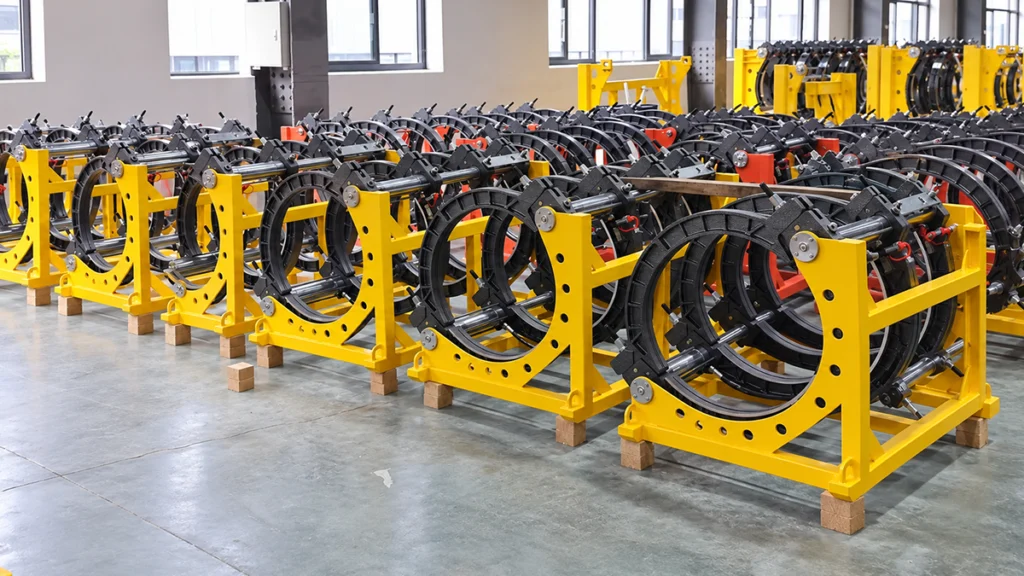
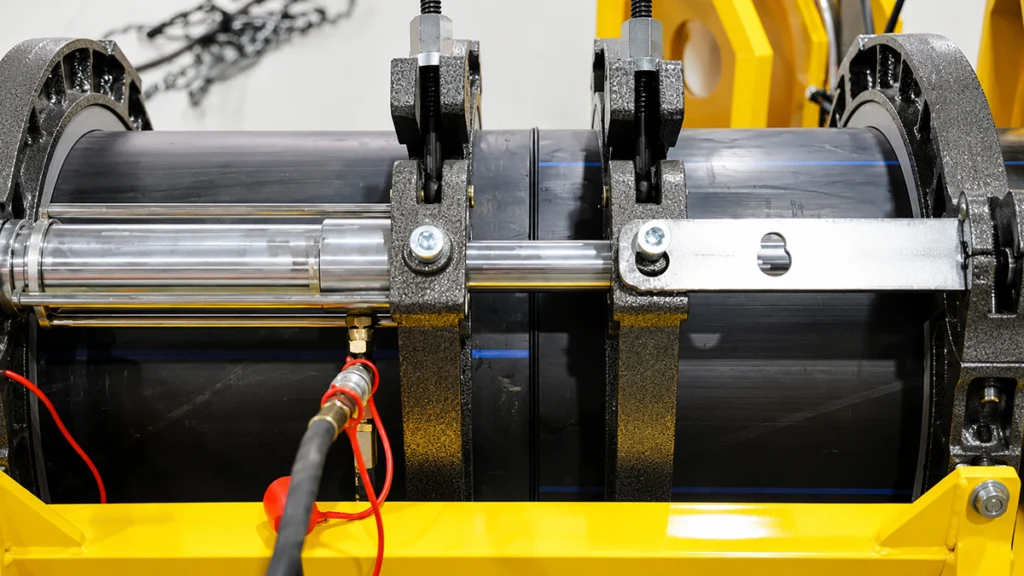
Try operating a 630mm butt fusion machine manually, and you’ll quickly realize it’s physically impossible. Overcoming the sheer drag of a 630mm pipe and applying the massive fusion pressure required demands serious mechanical muscle. That is why HDPE pipe jointing machines in this class are exclusively Hydraulic (semi-automatic) or CNC (fully automatic). Premium 630mm plastic pipe fusion setups feature frames cast from virgin ZL104 aviation-grade aluminum alloy. This ensures the chassis remains completely rigid, even when subjected to extreme hydraulic loads.
Why Large-Diameter Fusion Quality Matters
Why are alignment and pressure control critical at 630mm?
Handling 630mm HDPE pipes is no small feat—they are incredibly heavy and awkward to maneuver. The hydraulic system must dial in the butt pressure with pinpoint accuracy to keep the force stable and uniform across the pipe’s entire face. Alignment deviation is practically unforgiving here; it must stay strictly within ≤0.2mm to ≤0.3mm. Let it slip past that tolerance, and stress concentrates on just a tiny fraction of the joint. Over time, those structural weak points will rupture under active operational pressure.
What happens if temperature or cooling time is wrong?
For high-density polyethylene, the heating plate needs to hold a rock-steady temperature—usually between 210°C and 230°C. If the plate runs too cold, or if an impatient operator cuts the cooling phase short, the polymer’s molecular chains won’t diffuse and tangle correctly. You end up with a brittle, cold weld. It might look perfectly fine to the naked eye, but it severely lacks the internal cohesion required to hold up under stress.
How does joint quality affect long-term pipeline performance?
Large pipelines move massive volumes of municipal water or natural gas, operating around the clock under immense pressure. A structural failure triggered by a sloppy fusion joint isn’t just an inconvenience. It can lead to catastrophic blowouts, severe environmental contamination, and crippling repair costs. Conversely, when fusion is executed flawlessly—strictly following ISO 21307 or DVS 2207 standards—the pipeline will deliver a leak-free operational lifespan lasting anywhere from 50 to 100 years.
Factory-direct pricing with technical consultation included
Get Your Free QuoteMain Components and Working Principle
What are the heating plate, trimmer, clamps, and hydraulic unit?
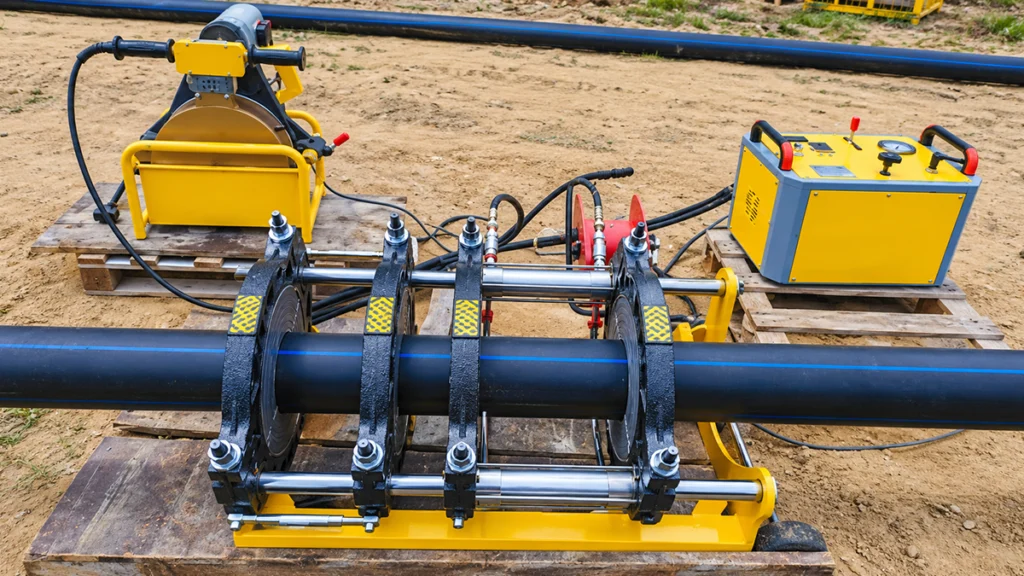
Every 630mm HDPE pipe butt fusion welding machine operates using four core components:
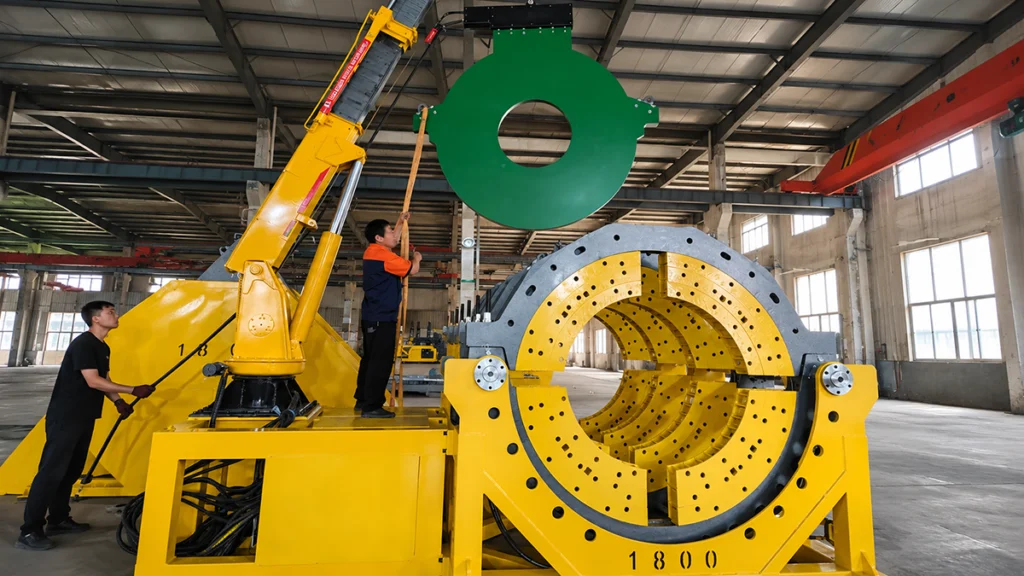
1. Frame and Clamps: Built around a rugged four-clamp sleeve design, this structure firmly grips and perfectly aligns the heavy pipes.
2. Heating Plate: Coated in high-grade PTFE (Teflon) to keep melted polymer from sticking. It features an independent, hyper-accurate temperature control system.
3. Trimmer (Milling Cutter): An electric cutter armed with double-edged, interchangeable tool-steel blades and a safety limit switch. It shaves the pipe ends perfectly flat.
4. Hydraulic Station: The brain of the operation. It houses the motor, pump, pressure regulation valves, and a dual-channel timer to oversee both the fusion and cooling stages.
How does the butt fusion cycle work step by step?
The fusion cycle follows a rigid, standardized protocol. First, operators clamp and position the pipes. Next, they lower the trimmer to mill the ends until continuous, unbroken plastic shavings curl off. After removing the trimmer, the heating plate drops in. The pipe ends press against the hot plate under a specific pressure to absorb heat. Once a proper bead forms, the carriage opens, and the operator swiftly pulls the plate out (the changeover phase). Finally, the hydraulic system forces the molten ends together at the required fusion pressure, holding them completely stationary until the cooling cycle finishes.
Which parts need the most routine inspection?
Keeping this equipment in peak condition requires a sharp eye. Operators should constantly check the heating plate’s PTFE coating for scratches or wear. Over at the hydraulic station, the oil-gas separator needs regular water drainage to ward off internal corrosion. You also need to verify that the trimmer blades remain razor-sharp. Finally, keep the main frame’s guide pillars consistently lubricated so the carriage glides smoothly without binding.
Key Technical Specifications to Check Before Buying
Which technical parameters should buyers confirm first?
Procurement teams must drill down into the foundational specs that define a large diameter butt fusion machine’s capabilities. Start with the exact pipe diameter range and the maximum SDR compatibility. Next, look closely at the total power draw and the specific control mode (CNC vs. hydraulic). Nailing down these details guarantees the equipment aligns perfectly with your engineering requirements and the power infrastructure available at your job site.
How should power supply, pressure range, and plate temperature be checked?
A standard 630mm rig demands a heavy-duty 380V, 50Hz, three-phase power supply. Expect the total power consumption to hover around 12.2 KW. On the hydraulic side, the pressure adjustment range usually stretches from 0 to 6.3 MPa, with actual operating pressures comfortably sitting between 4 and 6 MPa. As for the heating plate? It must be capable of reaching up to 270°C while maintaining a tight temperature deviation of just ±3°C to ±5°C across its entire surface.
What does a useful spec sheet or parameter table look like?
A professional HDPE pipe welding machine specification sheet leaves no room for guesswork. It provides granular, actionable data. Here is a solid baseline table for a premium 630mm unit:
| Specification Category | Technical Parameter |
|---|---|
| Welding Range (OD) | 315mm, 355mm, 400mm, 450mm, 500mm, 560mm, 630mm |
| Total Power Consumption | ~12.2 KW (380V, 50Hz, 3-Phase) |
| Heating Plate Power | 9.2 KW |
| Milling Cutter Power | 1.5 KW |
| Hydraulic Station Power | 1.5 KW |
| System Pressure Range | 0 – 6.3 MPa |
| Cylinder Piston Area | ~22,306 mm² |
| Temperature Range / Accuracy | 0 – 270°C / ±3°C to ±5°C |
Get detailed specs and custom configuration options
Request Technical SpecificationsTypical Applications for 630mm HDPE Pipe Fusion
Which projects commonly use 630mm HDPE pipe?
Pipes of this massive scale form the critical arteries of major civil and industrial infrastructure. You will see them deployed in municipal water supply mains, primary natural gas transmission networks, and sprawling agricultural irrigation systems. They are also heavily utilized in urban district heating grids and for discharging heavy industrial effluent.
Is it suitable for water, gas, drainage, and mining lines?
Absolutely. Thermal butt fusion yields a joint that is completely impervious to leaks, making it a perfect match for high-pressure gas and potable water lines. Out in the mining sector, crews frequently rely on 630mm HDPE to transport fine solid materials and highly abrasive slurries. Because operators can control or completely remove the internal weld bead, flow restriction drops to near zero—a critical advantage for heavy drainage and slurry applications.
When does a 630mm machine become the right capacity choice?
Stepping up to a 630mm butt fusion welding machine makes sense the moment your project’s maximum pipe OD hits 630mm (roughly 24″ IPS). Trying to weld a 630mm pipe on an undersized or borderline rig is asking for trouble; it compromises both job site safety and joint integrity. The 630mm chassis delivers the sheer clamping force, structural rigidity, and expansive heating area that smaller machines simply cannot safely provide.
How to Choose the Right 630mm Machine for Your Project
Should you choose hydraulic or CNC control?
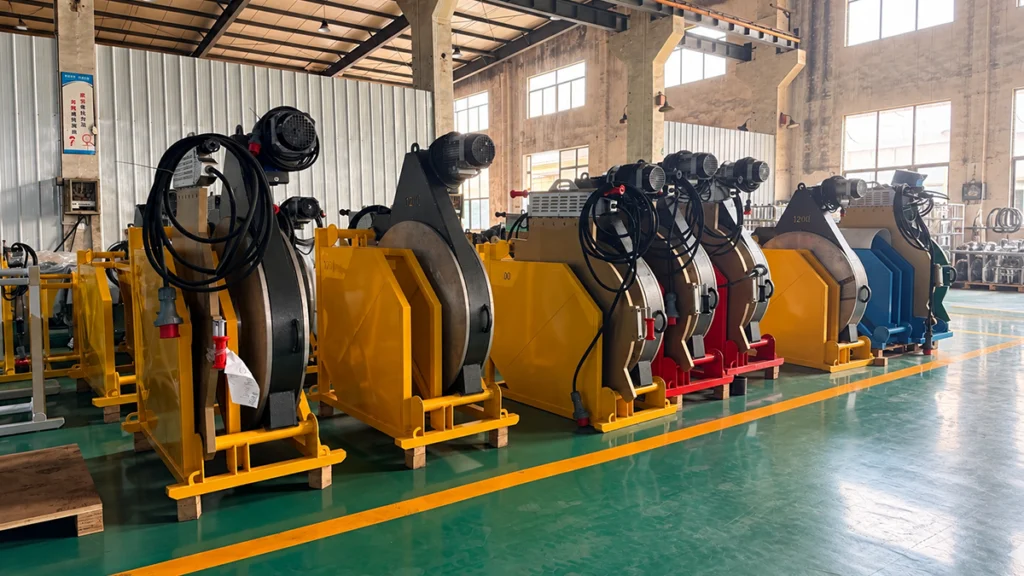
Deciding between a semi-automatic hydraulic model and a fully automatic CNC system comes down to strict project compliance. If you are laying natural gas lines or tackling municipal projects that demand rigorous data logging, ISO 12176-4 compliance, and remote data transmission, CNC is your only viable route. It takes operator error out of the equation by automating pressure math and timer controls. On the flip side, a hydraulic butt fusion machine is fantastic for standard water and drainage jobs, offering high performance at a much more accessible capital cost.
| Feature | Semi-Automatic Hydraulic | Fully Automatic CNC |
|---|---|---|
| Pressure Control | Manual valve adjustment | Automated via software |
| Data Logging | External/Manual | Integrated (ISO 12176-4) |
| Best Application | Water, Drainage, Mining | Natural Gas, Regulated Utilities |
| Cost Profile | Moderate | High |
How do you compare clamping force, alignment accuracy, and accessories?
When sizing up different butt fusion welding machines, pay close attention to the frame’s rigidity. A “split-type” design is incredibly useful, allowing crews to detach the upper clamps to maneuver the machine into tight trenches. You also want a rig with a low starting pressure, which guarantees the carriage will move reliably even when dragging heavy loads. Finally, demand certification that the maximum butt joint deviation stays strictly at ≤0.2mm.
When is a universal machine better than a dedicated 630mm unit?
Investing in a universal butt fusion welding machine outfitted with a complete set of reducing inserts (like 315, 355, 400, 450, 500, and 560mm) beats a dedicated, single-size unit every time. Real-world pipeline projects almost never stick to one uniform diameter from start to finish. A universal rig gives contractors unmatched versatility, empowering them to tackle massive mainlines and large branch connections without buying a second machine.
Step-by-Step Welding Process and Operator Checklist
How should pipe ends be prepared before fusion?
Flawless preparation sets the stage for a successful weld. Once the pipes are locked into the clamps, the operator drops the electric trimmer and mills the ends until long, continuous plastic ribbons shave off both sides. After milling, the operator brings the ends together to verify perfect alignment. Next comes measuring the “drag pressure”—the exact hydraulic force needed to overcome friction and physically move the carriage. This measurement is then added to the baseline fusion pressure.
What are the standard heating, changeover, fusion, and cooling steps?
1. Heating: The operator inserts the PTFE plate and applies initial pressure until a specifically sized bead forms against the metal. Pressure then drops to a lower “heat soak” level, letting the heat deeply penetrate the pipe walls.
2. Changeover: The carriage opens, and the plate is quickly pulled out. Speed is critical here to stop the melted polymer from cooling down.
3. Fusion: The carriage snaps closed, driving the molten ends together at the precise, calculated fusion pressure.
4. Cooling: The new joint remains locked under constant pressure until the timer completely runs out.
Which operator mistakes cause weak or uneven joints?
A few common missteps can ruin an otherwise perfect joint. Touching the molten end faces during changeover immediately introduces contaminants. Forgetting to clean the heating plate between welds leaves behind degraded, scorched plastic that will sabotage the next joint. However, the absolute worst mistake is releasing the clamping pressure before the cooling timer finishes. Doing so creates microscopic internal stress fractures that are guaranteed to fail under active operational loads.
630mm HDPE Pipe Welding Machine Price, MOQ & Lead Time
What factors drive machine price and total landed cost?
The price tag on a 630mm HDPE pipe welding machine fluctuates wildly based on material quality and the level of automation. Top-tier CNC units can run anywhere from $45,000 to $90,000 globally. Base costs are largely dictated by the volume of virgin ZL104 aviation-grade aluminum used in the chassis and the high-purity copper packed into the electrical components. When calculating your total landed cost, do not forget to factor in international freight, customs duties, and a comprehensive spare parts package.
How do MOQ, shipping, and lead time affect project planning?
Most manufacturers set the Minimum Order Quantity (MOQ) at just 1 set. Because these rigs easily weigh over a ton and demand heavy-duty crate packaging, they ship via sea freight (either LCL or FCL). Expect transit times of 3 to 6 weeks, depending on your global location. While expedited air freight is technically possible, the cost is astronomical. Procurement managers need to build these lead times into their project schedules early to prevent crippling job site delays.
What supplier documents should be checked before payment?
Never wire funds without verifying a supplier’s paperwork. Reputable industrial HDPE pipe fusion machine manufacturers will readily supply CE certification to prove safety compliance, along with ISO 9001 certificates for manufacturing quality. Take the time to read through the warranty terms—a 1-year warranty paired with lifetime maintenance support is the industry standard. Lastly, insist on seeing factory calibration certificates for both the heating plate and the pressure gauges.
Common Problems, Quality Risks, and Maintenance Tips
Why do misalignment, overheating, and weak welds happen?
Misalignment usually traces back to worn-out clamp locking mechanisms, dirt trapped inside the reducing inserts, or a warped aluminum frame caused by improper crane lifting. Overheating typically stems from a fried temperature sensor or a busted solid-state relay. As for weak welds? They are the direct consequence of a cold plate, weak hydraulic pressure, or a filthy PTFE coating that prevents proper heat transfer.
How do you diagnose heating plate or hydraulic system issues?
Troubleshooting requires a calm, systematic approach.
| Symptom | Probable Cause | Diagnostic Action |
|---|---|---|
| Heating Plate Fails to Heat | Burnt heating tube or loose wiring | Use a multimeter to check heating tube resistance and continuity. |
| Loss of Hydraulic Pressure | Leaking seals or air in lines | Check the oil-gas separator, inspect cylinder seals, and bleed the system. |
| Trimmer Will Not Start | Safety limit switch disengaged | Verify the limit switch is fully depressed when the trimmer is seated. |
What maintenance schedule helps extend machine life?
Sticking to a rigorous 630mm HDPE pipe welding machine maintenance schedule is the best way to prevent catastrophic site breakdowns. Daily chores should include wiping down the PTFE plate with a lint-free cloth and a non-alcohol solvent before making the first weld. Weekly, operators need to lubricate the guide pillars with light butt fusion machine oil and top off hydraulic fluid levels. Once a year, the entire rig should undergo a complete hydraulic oil flush and factory recalibration.
Final Buying Checklist and Recommendation
What should be confirmed before placing an order?
Before signing off on a purchase order, strictly verify your project’s exact pipe outer diameter range and wall thickness (SDR) requirements. Double-check that your local job site can actually support the hefty 380V, 3-phase power requirements. Finally, confirm that the HDPE pipe jointing machine’s pressure output fully complies with your region’s specific welding standards, whether that happens to be ISO 21307, DVS 2207, or ASTM F2620.
Which testing, training, and spare parts items should be included?
A rock-solid quotation needs to include the main chassis, hydraulic station, heating plate, and trimmer, plus a full set of reducing inserts. Make sure the vendor throws in a high-precision shockproof pressure gauge, an independent dual-channel timer, and backup tool-steel trimmer blades. It is also smart to request digital operation manuals and comprehensive video training materials for your field crews.
When should you request a trial weld or pre-shipment inspection?
Always demand a factory trial weld video or a formal Factory Acceptance Test (FAT) before the supplier nails the shipping crate shut. This pre-shipment inspection is your final chance to prove the heating plate actually hits that promised ±3°C temperature accuracy, and that the chassis alignment deviation stays strictly at ≤0.2mm when placed under maximum hydraulic load.
FAQ
Q1: What pipe sizes can a 630mm HDPE pipe welding machine handle?
A standard 630mm HDPE pipe welding machine comfortably handles outer diameters ranging from 315mm up to 630mm. By swapping in specific reducing inserts, operators can securely clamp and perfectly align intermediate sizes like 355mm, 400mm, 450mm, 500mm, and 560mm. This makes the rig incredibly versatile for diverse pipeline projects.
Q2: Is a 630mm HDPE welding machine suitable for gas pipeline projects?
Yes, as long as it meets rigorous regulatory standards. For natural gas pipelines, a CNC (fully automatic) 630mm HDPE pipe welding machine is strongly recommended. CNC models comply with ISO 12176-4, delivering automated pressure control and integrated data logging to document and guarantee the integrity of every single high-pressure gas joint.
Q3: What is the difference between butt fusion and electrofusion for HDPE pipes?
Butt fusion relies on a hot plate to melt squared-off pipe ends, pressing them directly together under heavy hydraulic force to create a seamless joint. Electrofusion, on the other hand, utilizes a separate manufactured fitting packed with embedded electrical coils; these coils melt the pipe and fitting together from the inside out. Generally, butt fusion proves far more cost-effective for large-diameter, long-haul pipelines.
Q4: How long does a 630mm butt fusion joint usually take?
The exact timeframe depends on the pipe’s wall thickness (SDR) and the specific standard you are following (such as ISO or ASTM). However, a complete cycle for a 630mm pipe—covering milling, heating, heat soak, fusion, and the mandatory under-pressure cooling phase—usually takes anywhere from 45 to 70 minutes per joint.
Q5: What voltage or power supply does a 630mm machine need?
Thanks to the massive heating plate and robust hydraulic motors, a 630mm HDPE pipe welding machine demands a serious industrial power supply. It typically operates on 380V, 50Hz, three-phase power, pulling a total electrical load of roughly 12.2 KW.
Q6: What should be included in a quotation from a 630mm machine supplier?
A comprehensive quotation must outline the 630mm HDPE pipe welding machine chassis, hydraulic station, heating plate, and electric milling cutter. It should also clearly list the full set of reducing inserts, spare trimmer blades, warranty terms, CE/ISO certifications, packaging specifics, and the exact lead time for delivery.
Q7: How can I tell whether a fusion joint has passed inspection?
A visually sound joint will display a uniform, double-rolled bead wrapping around the entire circumference of the pipe. This bead needs to be smooth, completely free of pores, and uniformly sized. For highly critical applications, crews use ultrasonic testing or data-logger printouts to verify the internal integrity of the fusion.
Q8: What maintenance does the heating plate or hydraulic system need?
The heating plate demands daily cleaning with a clean, lint-free cloth to safeguard the delicate PTFE coating. The hydraulic system requires regular fluid level checks, periodic draining of the oil-gas separator to stop moisture buildup, and an annual hydraulic fluid replacement to guarantee consistent pressure delivery.
Conclusion
Buying a 630mm HDPE Pipe Welding Machine is a major capital investment that directly influences the safety, efficiency, and lifespan of large-scale pipeline infrastructure. Whether you are laying municipal water mains or high-pressure natural gas networks, the survival of a 50-year pipeline hinges on the precision of your fusion equipment. Smart decision-makers prioritize 630mm HDPE pipe welding machines built from aviation-grade aluminum, demanding uncompromising hydraulic stability alongside tight temperature control (±3°C).
Choosing between a semi-automatic hydraulic unit and a fully automatic CNC system ultimately comes down to your project’s specific data logging and compliance needs. No matter which control mode you select, make sure the rig comes with a full set of reducing inserts, verifiable CE/ISO certifications, and a rock-solid warranty to shield your project from expensive downtime. By carefully weighing the total landed cost, verifying all technical specs, and holding operators accountable to strict maintenance routines, contractors can maximize their return on investment and consistently produce flawless joints in the field.
Let our experts help you choose the right equipment for your project
Contact Our Engineering Team