
800mm HDPE Pipe Fusion Machine: Equipment Selection for Infrastructure Projects
Table of Contents
800mm HDPE Pipe Fusion Machine selection guide for infrastructure projects, covering machine types, technical specs, applications, cost factors, and supplier evaluation so buyers can choose the right equipment with less risk.
What Is an 800mm HDPE Pipe Fusion Machine?
How does butt fusion work on large-diameter HDPE pipe?
Butt fusion creates a seamless joint between two high-density polyethylene (HDPE) pipes through a precise mix of heat and controlled mechanical force. When you are dealing with an 800mm HDPE pipe fusion machine, the operation breaks down into four critical phases: preheating, butt welding, pressure holding, and cooling. First, the equipment faces the pipe ends so they sit perfectly parallel. Next, a heated plate melts the polymer matrix. Finally, powerful hydraulic cylinders push the molten ends together, locking them in place at a strictly regulated interfacial pressure.
What components make up a standard fusion machine setup?
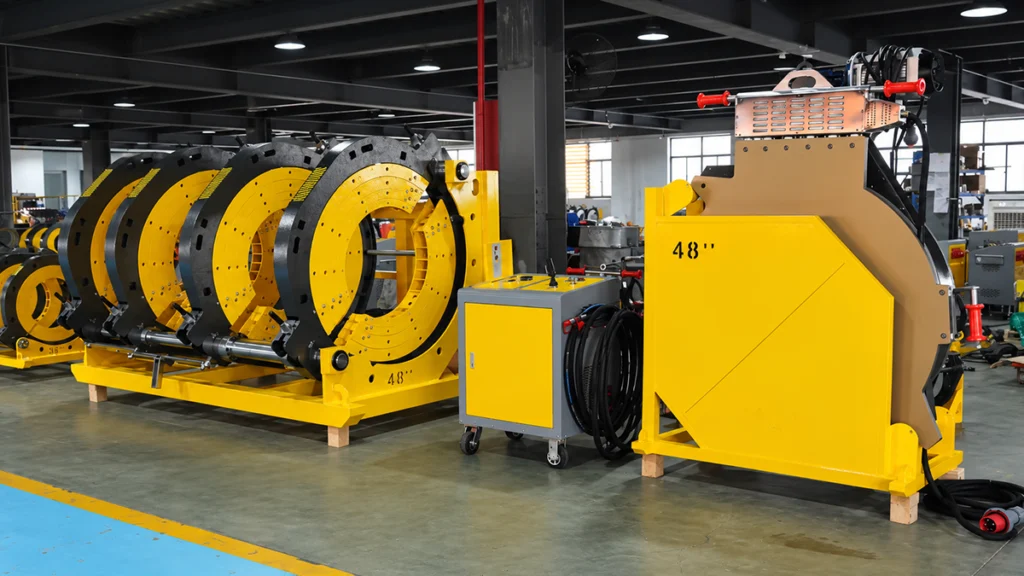
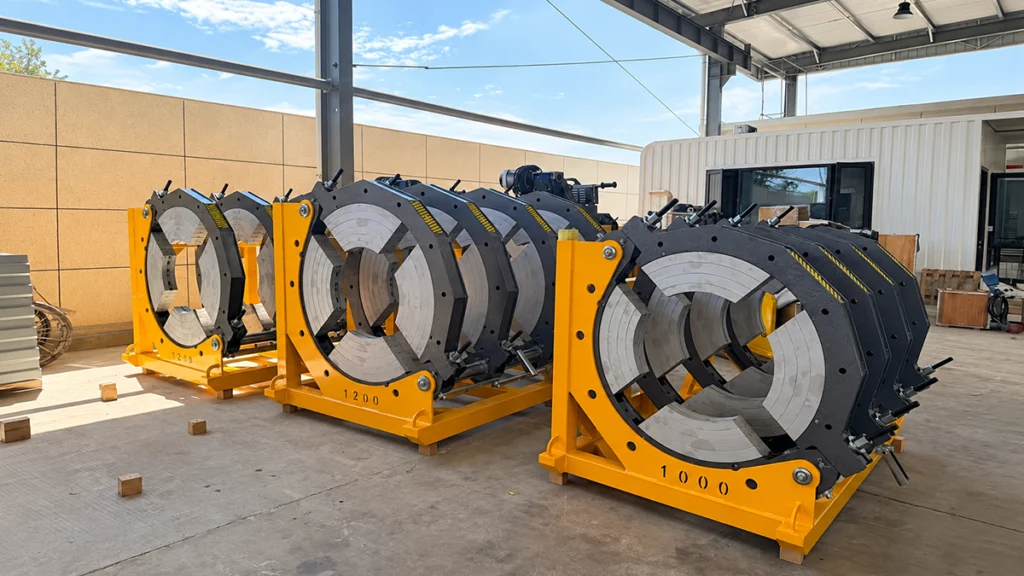
You will typically find four core components driving a large-diameter setup. The heavy-duty frame, or clamping device, locks the pipe into place to guarantee strict axial alignment. Then there’s the PTFE-coated heating plate. This part delivers the uniform temperature needed to melt the pipe ends without sticky polymer buildup. A milling cutter—often called a trimmer—shaves down the pipe ends, stripping away oxidation to leave a flush, clean surface. Tying it all together is the operating platform. This station houses the electronic and hydraulic controls that dictate the pressure and timing, ensuring every weld meets rigorous international standards.
Why is 800mm considered a heavy-duty diameter class?
Stepping up to the 800mm threshold puts you squarely in heavy-duty territory. You simply cannot generate the interfacial pressure needed to mill, heat, and cool these massive pipes by hand. Consider an 800mm pipe with a standard dimension ratio (SDR) of 11: you are looking at a wall thickness well over 72mm. Maneuvering and securing these giant thermoplastic cylinders demands incredibly powerful hydraulic systems. The butt fusion machine frame itself must offer extreme structural rigidity. Otherwise, the sheer operational load will cause the equipment to flex and ruin the weld.
Why Infrastructure Projects Need the Right Fusion Equipment
What happens when machine capacity does not match pipe size?
Deploying underspecified gear for 800mm HDPE pipes almost always leads to an immediate structural failure. Without enough clamping force or sheer frame mass, the butt fusion machine will inevitably bend when trying to grip thick-walled SDR 9 or SDR 11 pipes. That mechanical distortion transfers straight to the pipe ends, triggering severe joint misalignment. Even the slightest frame deflection can cause a high-low mismatch that completely blows past the strict tolerances set by DVS and ISO welding standards.
How does fusion quality affect long-term pipeline reliability?
The lifespan of an entire pipeline network hinges directly on the integrity of its thermofusion joints. When contractors use subpar equipment, they run into uneven weld bead heights, incomplete polymer fusion, and insufficient flange roll. But when an 800mm HDPE fusion unit holds exact temperatures and applies uniform hydraulic pressure, the finished weld boasts a tensile strength equal to—or even greater than—the pipe itself. Poor fusion, on the other hand, leaves behind weak spots that practically invite stress cracking and catastrophic blowouts under everyday surge pressures.
Which project risks increase when equipment is underspecified?
Using equipment that falls short of the project specs destroys weld integrity and slashes the pipeline’s overall pressure rating. For municipal water and gas lines, this dramatically shrinks the operational lifespan and creates massive failure risks. On the financial side, underspecified 800mm butt fusion machines break down constantly. This stretches out project timelines and sends labor costs through the roof. Failing to hit standard-compliant welds also means failing hydrostatic pressure tests, forcing crews into expensive, time-draining cut-outs and re-welds.
Factory-direct pricing with technical consultation included
Get Your Free QuoteMain Types of 800mm HDPE Fusion Machines
Hydraulic butt fusion machines vs. manual systems
Manual fusion tools depend entirely on human muscle. Because of this, they are strictly reserved for small-diameter jobs and are flat-out impossible to use on 800mm pipes. Hydraulic butt fusion machines, however, pack a dedicated hydraulic station. This setup generates the tremendous mechanical force necessary to handle large-diameter welding.
| Feature | Manual Fusion Systems | Hydraulic Butt Fusion Machines |
|---|---|---|
| Diameter Limit | Up to 250mm (typically) | 630mm to 1200mm+ |
| Pressure Generation | Operator physical force | Hydraulic station (4-6 MPa working pressure) |
| Control Level | Visual/Manual | Semi-automatic or CNC fully automatic |
| Suitability for 800mm | Impossible | Mandatory |
Skid-mounted, trailer-mounted, and workshop-based configurations
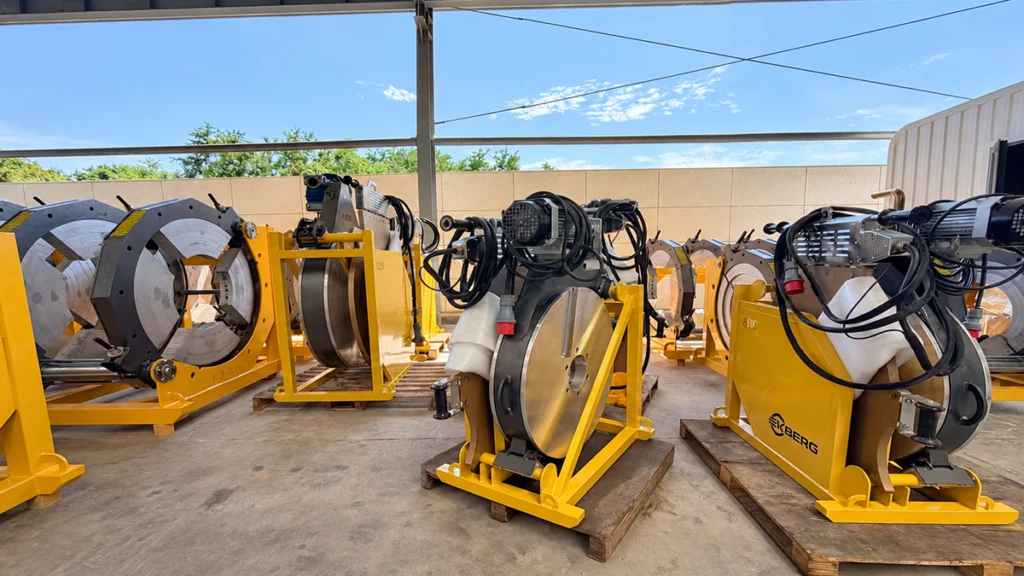
How a large diameter butt fusion machine is built dictates where and how you can use it. Skid-mounted units feature a low-profile frame built for in-trench welding, letting crews fuse pipes right in the ditch. Trailer-mounted systems sit on a wheeled chassis. This setup offers rapid mobility along linear pipeline routes, eliminating the need to bring in heavy lifting cranes for every single joint. Finally, workshop-based configurations use a stationary, highly rigid four-column design. These are built for high-volume, precision fabrication of manifolds, spools, and fittings inside a controlled factory setting.
Which machine type is better for field construction?
Wheeled or trailer-mounted setups are the undisputed champions of active field construction. Industry data shows that 80% of construction teams prefer HDPE jointing machines with built-in mobility to speed up linear progress. Field work also demands serious durability. Around 70% of operators stress the need for an IP54 or IP55 protection rating. This shielding protects vital hydraulic and electrical components from the mud, dust, and heavy moisture you always find in outdoor trench environments.
Key Technical Specifications to Compare Before Buying
What diameter range and pressure capacity should you check?
A standard 800mm HDPE pipe fusion machine usually handles a welding range from 630mm up to 800mm. Specialized large-frame variants can push that capacity from 710mm to 1000mm. When looking at pressure capacity, the hydraulic system needs to hold a continuous working pressure between 4 and 6 MPa to hit standard interfacial requirements. Top-tier hydraulic stations will offer adjustable settings pushing up to 16 MPa. You need this extra power to overcome the extreme drag forces that happen when dragging long, heavy strings of pipe.
| Technical Parameter | Standard Specification Requirement |
|---|---|
| Welding Range | 630mm – 800mm (Standard) / 710mm – 1000mm (Extended) |
| Hydraulic Working Pressure | 4 – 6 MPa (Adjustable up to 16 MPa max) |
| Heater Plate Temperature | 0 – 270°C (Accuracy ≤±3°C to ±5°C) |
| Trimmer Motor Power | 2.2 KW – 3.0 KW |
| Total Power Consumption | 16.9 KW – 23.5 KW |
How do heater plate, trimmer, and clamp alignment specs matter?
The heater plate absolutely must have a premium PTFE coating. Without it, molten polyethylene sticks to the metal, ruining the weld interface. You also need independent temperature control that maintains a strict variance of ≤±3°C to ±5°C across the plate’s entire surface. For the trimmer, look for a high-torque motor (between 2.2KW and 3.0KW) powering double-edged reversible blades. It has to smoothly plane thick SDR pipe walls without stalling out. Clamp alignment specs are just as important; they dictate the frame’s overall structural integrity and guarantee exact concentricity while holding pressure.
What power supply, voltage, and generator compatibility are required?
Fusing large-diameter pipe draws a massive amount of energy. An 800mm HDPE pipe fusion machine generally needs a 380V, 50Hz three-phase power supply to run properly, with total power consumption sitting between 16.9 KW and 23.5 KW. The heating plate by itself pulls anywhere from 12.5 to 17.5 KW. The hydraulic station and trimmer each demand roughly 2.2 to 3.0 KW. Contractors have to make sure their mobile generators are up to the task—usually requiring a minimum 30 kVA to 40 kVA generator. If the generator is undersized, the initial surge draw will cause voltage drops, which can easily crash CNC data logging systems or destabilize your heating temperatures.
Get detailed specs and custom configuration options
Request Technical SpecificationsHow to Match the Machine to Your Project Requirements
How many joints per day does your project need?
Your production targets have to match the physical limits of large-diameter thermofusion. A crew might crank out 18 to 20 joints per 10-hour shift on a 500mm pipe. An 800mm (31-inch IPS) pipeline is a completely different story. The cooling phase alone takes 30 to 40 minutes per joint to let the polymer matrix properly solidify under pressure. Because of this, project managers should plan for a realistic yield of 10 to 15 joints a day. To hit the higher end of that spectrum, look for a butt fusion welding machine equipped with automated pressure controls and rapid-heating stainless steel molds.
Should you prioritize portability or production speed?
Choosing between speed and portability comes down to the job site. Linear infrastructure setups, like long-distance cross-country water mains, demand serious portability. Trailer-mounted units are perfect here because they slash setup and tear-down times between welds. On the flip side, if you are pre-fabricating manifolds or complex spools in a staging yard, you want repeatability and raw speed. A fully automatic, stationary CNC workshop 800mm HDPE pipe fusion machine will give you maximum throughput while completely removing operator fatigue from the equation.
What machine configuration suits municipal, irrigation, or industrial pipelines?
Municipal gas and water networks require absolute traceability. For these jobs, CNC automatic butt fusion machines featuring ISO 21307 or TSG D2002-2006 compliant data logging are non-negotiable. Agricultural irrigation builds usually happen in remote locations with less red tape. Here, you can rely on tough, semi-automatic hydraulic machines that are easy to maintain in the field. Mining and industrial pipelines demand something else entirely: ultra-heavy-duty frames built to endure the massive drag forces of thick-walled SDR pipes in highly abrasive environments.
Typical Applications in Infrastructure Projects
Water supply and distribution networks
Massive municipal water mains lean heavily on 800mm HDPE pipes because of their leak-free joints and excellent corrosion resistance. Fusion equipment used on these networks must produce flawless welds. This is the only way to stop non-revenue water loss and handle the relentless hydrostatic pressure pumping through urban distribution grids.
Sewage, drainage, and wastewater pipelines
High-capacity stormwater drainage and gravity-fed sewage trunk lines rely on large-diameter HDPE pipe to move huge volumes of fluid. Since wastewater infrastructure usually sits deep underground, the structural integrity of every butt fusion weld is vital. A perfect joint prevents groundwater contamination, stops root intrusion, and guards against ground subsidence over a 50-to-100-year design life.
Mining, industrial, and energy infrastructure
Out in the mining sector, crews use 800mm pipes for chemical transport networks and highly abrasive slurry lines. These setups demand extreme tensile strength to stop catastrophic chemical leaks. In the energy sector, gas transmission pipelines, urban heating networks, and industrial fire loops need uncompromising joint reliability. You can only achieve that level of safety with heavy-duty, data-logged fusion equipment.
Cost Factors, MOQ, Lead Time, and Procurement Considerations
Which features have the biggest impact on price?
The biggest factors affecting 800mm Butt Fusion Machine Price are component quality, hydraulic system configuration, and the level of automation. Stepping up from basic hydraulic control to a fully automated CNC system with integrated data logging and displacement detection will increase the initial equipment cost. Likewise, machines equipped with premium hydraulic seals, reliable electrical components, and high-grade PTFE-coated heating plates generally carry a higher price than standard configurations.
How do MOQ and customization affect procurement planning?
When you are buying heavy industrial butt fusion welding machinery, the Minimum Order Quantity (MOQ) is almost always just one unit. Customization, however, will heavily impact your procurement timeline. If you need specialized data export interfaces for municipal compliance, custom voltage setups for specific generators, or unique clamp insert sizes, expect to pay a larger upfront deposit. These bespoke requests will also extend the manufacturing and engineering phases.
What lead time should buyers expect for project deployment?
A standard 800mm hydraulic butt fusion machine built by a highly efficient Asian manufacturer typically starts around $7,500 USD (FOB). Since these standard configurations are often kept in stock, you can usually expect rapid delivery, with pre-shipping lead times as short as 7 to 14 days. But if you order a highly customized CNC unit or a butt fusion welding machine requiring special third-party certifications, lead times can easily stretch to 30 or 45 days. Contractors need to finalize these orders long before they plan to break ground.
Common Fusion Mistakes and Hidden Risks to Avoid
Why alignment and temperature control are critical
Pipeline integrity drops off a cliff the moment you ignore temperature and alignment parameters. Clamping a pipe with a twist angle greater than 5 degrees triggers severe high-low misalignment, instantly creating a dangerous stress concentrator at the joint. Temperature is just as crucial and must stay locked between 200°C and 220°C. Drop below that, and you get cold welds with incomplete fusion. Go above it, and the polymer degrades, leaving you with a brittle, granular defect guaranteed to fail under pressure.
How poor pipe preparation affects weld integrity
Rushing or entirely skipping the beveling stage leaves uneven gaps between the pipe ends and the heating plate. This creates erratic heat absorption. Some sections over-melt while others stay too cold to achieve molecular entanglement. Furthermore, if you forget to wipe away moisture, mud, or dirt before heating, you are baking contaminants straight into the polymer matrix. This instantly destroys the structural integrity of the final weld.
What supplier claims should be verified before purchase?
Infrastructure buyers need to aggressively fact-check supplier claims regarding precision. Never settle for vague promises like “accurate heating.” Demand proof that the temperature control accuracy is certified at ≤±5°C across the entire heating plate. You also need to verify that the HDPE jointing machine’s data logging actually meets industry standards. It must record final weld results, equipment IDs, pipeline parameters, and fusion management data in a completely unalterable format.
Supplier Evaluation Checklist for Infrastructure Buyers
Which documents and test reports should you request?
Procurement teams should always base their decisions on hard compliance documents, not glossy marketing brochures. Ask for official certificates proving compliance with global standards like ASTM F2620, DVS 2207-1, or ISO 21307. If you are buying automated CNC gear for municipal contracts, demand explicit verification of TSG D2002-2006 compliance. This ensures the data logging system will hold up during regulatory audits.
How to evaluate after-sales support and spare parts availability
Equipment downtime on a major infrastructure job burns through thousands of dollars a day. Make sure your supplier offers 24-hour online technical support—a feature that 90% of industrial buyers now consider mandatory. Dig into their spare parts supply chain. Ask about lead times for hydraulic seals, trimmer blades, and replacement PTFE plates. A solid supplier will back their equipment with comprehensive video tutorials and a warranty stretching from the standard 12 to 24 months, up to 5 years on premium parts.
What questions should procurement teams ask before ordering?
To cut down on procurement risks, buyers need to ask suppliers a few targeted questions:
- What do your internal quality control and R&D capabilities look like?
- Do you provide expedited shipping for urgent project rollouts?
- Can you supply on-site training for our field pipeline operators?
- Do you support live-video factory acceptance testing (FAT) before we release the final payment?
Final Recommendation: How to Specify the Right Machine for Your Project
A simple decision path for first-time buyers
Buying heavy-duty fusion equipment for the first time requires a methodical approach. First, pin down your project’s exact diameter requirements and pipe SDR. Second, research the market to balance your budget against the level of automation you actually need. Third, ask for detailed video demonstrations or on-site testing of the HDPE jointing machine running your specific pipe size. Fourth, weigh the price-to-performance ratio, keeping long-term labor efficiency in mind. Finally, lock in a procurement contract that spells out after-sales support terms in crystal-clear detail.
When to request a customized configuration
Off-the-shelf butt fusion welding machines handle about 90% of infrastructure jobs, but certain situations demand a custom build. You will need a tailored configuration if your project uses non-standard pipe sizes that require specialized reduction inserts. Customization is also a must if local municipal regulators require specific data export interfaces (like direct cloud integration), or if your site relies on unique generator voltages outside the standard 380V 3-phase power.
What information to prepare before asking for a quote?
Project Scenario: Let’s say an infrastructure contractor is gearing up to bid on a municipal water main replacement. Before reaching out to suppliers for an accurate quote, they need to gather a few key specs:
- Pipe Material: Clearly specify PP or HDPE.
- Diameter Range: For example, 630mm to 800mm.
- Wall Thickness: Provide the SDR rating (like SDR 11 / 72.7mm).
- Compliance Standard: Note the required ASTM, DVS, or ISO parameters.
- Power Availability: Confirm the capacity of your on-site generators (e.g., 380V, 3-phase, 50Hz).
Frequently Asked Questions
Q1: What size of project needs an 800mm HDPE pipe fusion machine?
Heavy-duty infrastructure projects are the main consumers of this equipment. You will see them on urban sewage trunk lines, municipal water supply mains, gas transmission pipelines, industrial wastewater networks, and rugged mining slurry lines. Any job running HDPE pipe with an outer diameter between 630mm and 800mm requires these massive hydraulic butt fusion machines to guarantee joint integrity.
Q2: How do I choose the right butt fusion machine for 800mm HDPE pipe?
Your choice comes down to compliance needs and the working environment. For linear trenching, grab a skid-mounted or trailer-mounted hydraulic unit. If you are handling municipal water or gas jobs that demand strict traceability, you need a fully automatic CNC butt fusion welding machine with built-in data logging. Just make sure the equipment matches your available generator power and the pipe’s SDR rating.
Q3: What technical specifications matter most for large-diameter HDPE fusion?
The most vital specs are the structural rigidity of the clamping frame, the heater plate’s temperature accuracy (it needs a ≤±5°C variance), and the hydraulic system’s working pressure (which must sustain 4-6 MPa). Pay close attention to total power consumption, too—usually between 16.9 KW and 23.5 KW—to ensure it plays nicely with your mobile field generators.
Q4: Can one machine handle different pipe diameters besides 800mm?
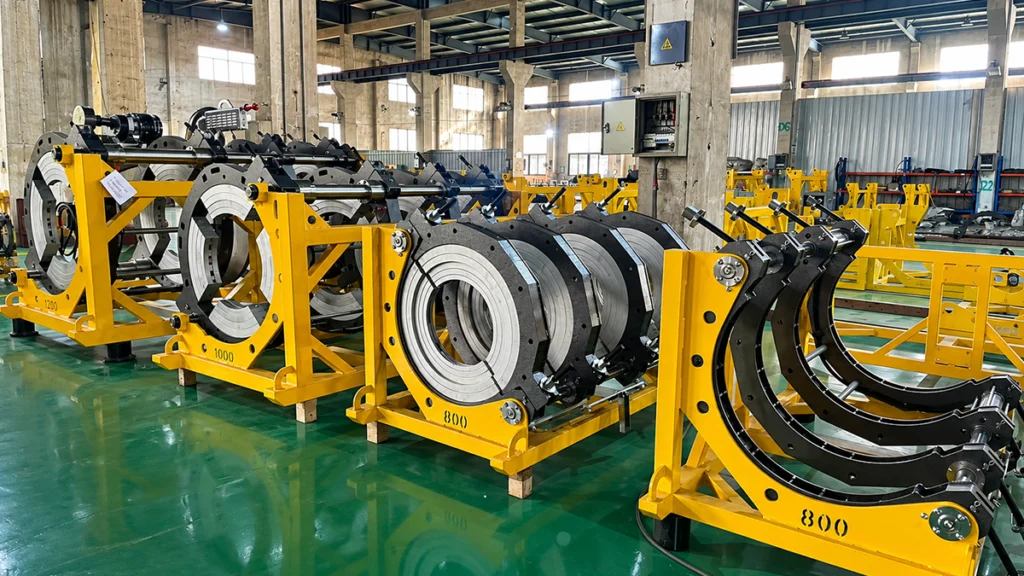
Absolutely. A standard 800mm hydraulic pipe fusion machine uses a system of layered reduction inserts inside the main frame. This setup allows a single unit to securely clamp and weld smaller diameters, typically hitting 630mm, 710mm, and 800mm. Certain extended frames can even push up to 1000mm if you have the right inserts.
Q5: What is the difference between hydraulic and manual fusion machines?
Manual butt fusion machines rely on human muscle to push the pipe ends together, restricting them to small diameters (usually under 250mm). Hydraulic machines pack a motorized hydraulic station. This station generates the massive interfacial pressure (4-6 MPa) you need to plane, heat, and fuse thick-walled, large pipes like 800mm HDPE, ensuring every weld meets industry standards.
Q6: How much does an 800mm HDPE pipe fusion machine usually cost?
Pricing swings based on component origin and automation levels. A solid, standard hydraulic HDPE pipe fusion machine from a trusted Asian manufacturer generally starts around $7,500 USD (FOB). If you step up to fully automated CNC units, custom trailer-mounted builds, or machines with premium European hydraulics, expect a significantly higher capital investment.
Q7: What should buyers check before ordering from a supplier?
Always verify the supplier’s compliance certifications (like DVS 2207-1 or ISO 21307), check spare parts availability, and review warranty terms (look for a 12 to 24-month minimum). It is also crucial to confirm the exact accuracy of the heater plate controls and ensure the manufacturer offers 24/7 technical support alongside video training for your field crews.
Q8: How do I avoid weld defects when fusing 800mm HDPE pipe?
You can dodge defects by strictly following alignment and temperature parameters. Make sure the heater plate holds steady at 200-220°C. Never skip the milling stage; perfectly flush ends prevent erratic heating. Lastly, shield your welding zone from wind, moisture, and dust, and always let the joint cool under hydraulic pressure for the full 30 to 40 minutes.
Conclusion
Choosing an 800mm HDPE pipe fusion machine requires careful evaluation of project conditions, machine configuration, welding accuracy, and long-term operating requirements. For large-diameter pipeline projects, buyers should focus on frame rigidity, hydraulic pressure control, heating plate temperature stability, alignment accuracy, and compatibility with applicable DVS or ISO welding standards.
Project teams should also consider site mobility, operator skill requirements, data logging needs, spare parts availability, and after-sales technical support. Hydraulic and CNC systems may suit different project environments, depending on the level of automation, traceability, and field control required.
A properly selected 800mm butt fusion machine can help improve welding consistency, reduce rework, and support efficient installation across municipal water, mining, gas, and industrial pipeline projects.
Let our experts help you choose the right equipment for your project
Contact Our Engineering Team