
1000mm HDPE Pipe Fusion Machine: Guide for Large Pipeline Construction
Table of Contents
1000mm HDPE Pipe Fusion Machine helps buyers and project teams understand large-diameter fusion equipment, core specs, operating steps, selection criteria, safety checks, and supplier evaluation for pipeline construction.
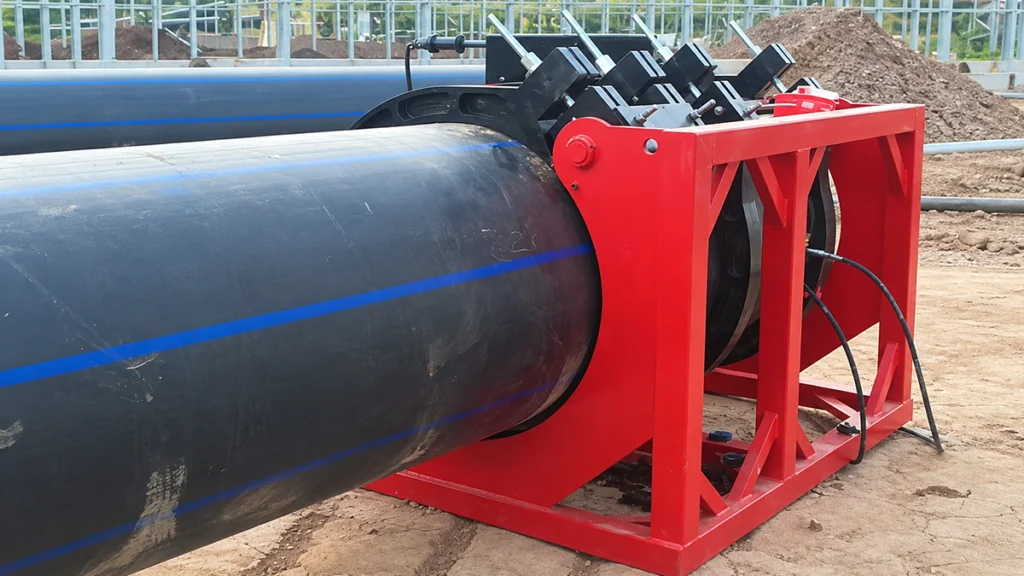
A 1000mm HDPE Pipe Fusion Machine represents the heavy-duty tier of industrial pipeline equipment. Its primary job is permanently joining massive thermoplastic pipes through butt fusion welding. The butt fusion machine secures two perfectly squared pipe ends, heats them until they reach a precise molten state, and drives them together using controlled hydraulic force. The result? A homogeneous, completely leak-proof joint. You’ll find this class of machinery tackling massive material weights, fighting extreme drag forces, and consistently meeting strict international welding standards.
What does 1000mm mean in practical project terms?
In the field, 1000mm dictates the absolute maximum outer diameter (OD) the equipment can grip. That translates to roughly 39.37 inches. Contractors exclusively deploy pipes of this sheer size for heavy infrastructure projects. Working with a 1000mm pipe means wrestling with incredible wall thicknesses. Take an SDR 11 pipe, for instance, which is rated for PN16 (16 bar pressure). At a 1000mm OD, its wall thickness easily surpasses 90mm. Moving that much heavy thermoplastic material requires serious power. The HDPE pipe welding machine must generate massive hydraulic pressure to beat the ground drag force while sustaining exact interfacial pressure throughout the entire cooling cycle.
Is this the same as a butt fusion machine?
Yes, absolutely. This equipment relies entirely on butt fusion technology—the golden standard for connecting high-density polyethylene pipelines without relying on extra fittings, glues, or solvents. The process is straightforward but demands precision. First, a mechanical trimmer squares off the pipe ends. Next, a PTFE-coated heater plate melts the exposed surfaces. Finally, the operator removes the plate and rams the molten ends together. When done right and aligned with ISO 21307 or ASTM F2620 protocols, the finished butt fusion joint becomes just as strong as the original pipe. Often, it’s even stronger.
Which HDPE pipe grades and standards can it handle?
A high-quality 1000mm HDPE pipe butt fusion machine easily manages today’s advanced thermoplastic materials. This includes standard PE80 and PE100, alongside the newer PE100-RC (Resistance to Crack) variants. The equipment also tackles a wide spectrum of Standard Dimension Ratios. It effortlessly welds heavy-duty, thick-walled SDR 11 pipes meant for high-pressure municipal water mains. At the same time, it can step down to handle thinner-walled SDR 17 (PN10) materials used in gravity feeds or low-pressure industrial effluent lines. Joints created by these plastic pipe welding machines satisfy demanding global benchmarks, covering ASTM D3035, ASTM F714, and AWWA C906 specifications for waterworks systems spanning 4 to 65 inches.
Why It Matters in Large Pipeline Construction
Why does large-diameter fusion demand tighter process control?
Pushing DN1000 pipes together creates a compounding series of physical hurdles. You are dealing with gigantic wall thicknesses, incredibly heavy joint weights, and fierce drag forces against the trench floor. If you use undersized or poorly calibrated butt fusion machinery, you risk a hydraulic stall. The HDPE pipe jointing machine simply fails to hold the required interfacial pressure while the pipe joins and cools. Strict, unwavering control over temperature, pressure, and time is non-negotiable here. Even a minor temperature drop or a slight loss of hydraulic pressure during the transition phase guarantees cold fusion. Under hydrostatic pressure, that weak joint will suffer a catastrophic failure.
Which projects depend on 1000mm fusion equipment?
Critical infrastructure sectors that move massive fluid volumes rely heavily on this equipment. Primary use cases include municipal water mains, industrial effluent conduits, massive stormwater drainage networks, and high-capacity gas distribution lines. You will frequently see these machines deployed for horizontal directional drilling (HDD). When contractors pull a continuous, seamless pipeline through subterranean channels for river crossings or wastewater treatment outfalls, structural weak points are simply not an option.
What are the cost and schedule risks of a poor weld?
The financial stakes on a DN1000 pipeline project are staggering. A single failed joint on a buried or submerged 1000mm line triggers tens of thousands of dollars in emergency excavation, dewatering, operational downtime, and environmental cleanup. Often, fixing one bad weld costs more than buying a premium CNC automatic butt fusion machine in the first place. Relying on sub-par equipment—especially machines lacking automated pressure retention or reliable data logging—directly threatens your project timeline. It also exposes the pipeline contractor to massive liability.
Main Components and Working Principle
What does the main frame and clamp system do?
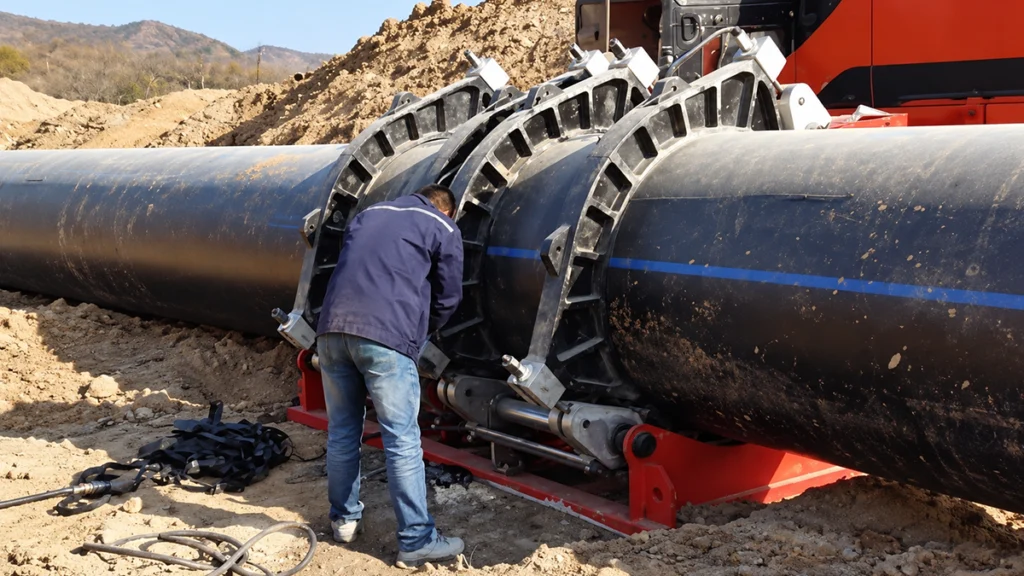
The main frame supplies the brute structural rigidity needed to align and secure massive pipes against intense hydraulic forces. Manufactured from 4-column die-cast aluminum (meeting the ZL104 standard), the frame easily resists torsion when clamping heavy loads. The clamp system itself relies on a series of inner clamp blocks and reduction inserts. These inserts scale down the butt fusion welding machine’s capacity, empowering a 1000mm frame to tightly grip smaller diameters—like 710mm, 800mm, and 900mm—without any slippage during the critical high-pressure joining phase.
How do the heater plate, trimmer, and hydraulic unit work together?
These three active components coordinate seamlessly to execute the perfect fusion sequence:
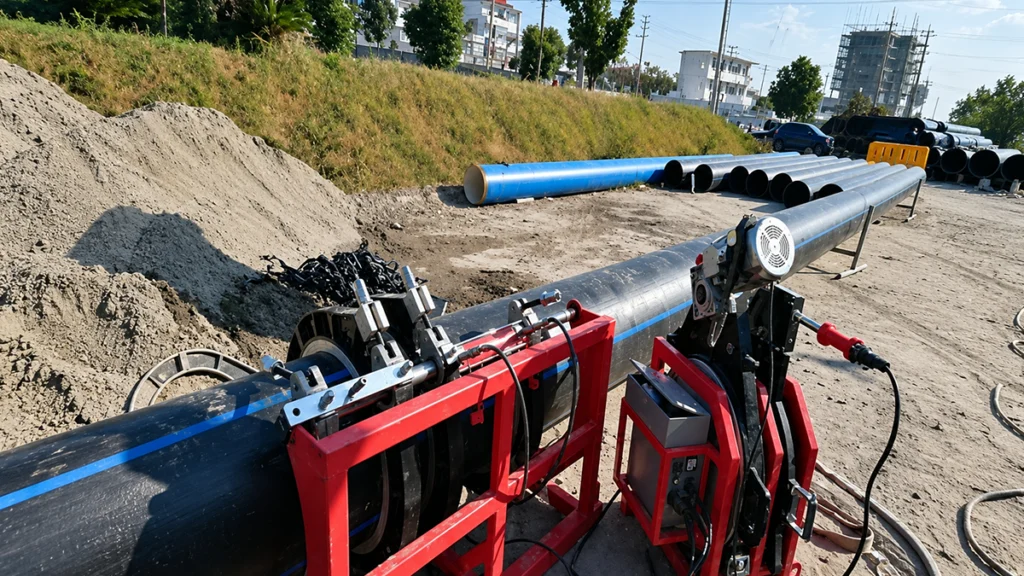
- Trimmer (Milling Cutter): Driven by a heavy-duty chain and equipped with high-speed carbon steel blades, the trimmer planes the pipe ends until they are perfectly square. A built-in safety limit switch prevents any accidental startups.
- Heater Plate: Built from a rugged aluminum alloy and coated in non-stick PTFE, this plate delivers independent temperature control. It operates between 0-270°C with an impressive ±3°C accuracy, ensuring the squared ends melt uniformly.
- Hydraulic Unit: This component provides the sheer driving force necessary to manipulate the clamps. It offers a pressure adjustment range of 0-16 MPa. By utilizing flat-type quick connectors, the system prevents environmental contamination while maintaining rock-steady pressure throughout the long cooling cycle.
Which accessories are standard, and which are optional?
Standard packages usually bundle the basic reduction inserts, core structural supports, and a straightforward hydraulic control station. However, optional accessories become vital if you need to meet advanced project compliance. Think about adding CNC data loggers to capture ISO/DVS compliance metrics. Motorized crosshairs also prove invaluable for dialing in precision alignment. Furthermore, specialized overhead cranes or hoists integrated directly into the chassis make safe pipe loading possible in remote, rugged environments.
Factory-direct pricing with technical consultation included
Get Your Free QuoteKey Technical Specifications to Evaluate
Before signing off on a 1000mm HDPE Pipe Fusion Machine, pipeline engineers must scrutinize specific mechanical and electrical parameters. Getting this right ensures site compatibility and guarantees standard compliance.
| Technical Parameter | Specification Range |
|---|---|
| Clamping Range | 710mm, 800mm, 900mm, 1000mm |
| Hydraulic Pressure Range | 0 – 16 MPa (Closed-loop retention) |
| Heater Plate Temperature | 0 – 270°C (±3°C accuracy) |
| Total Power Supply | 23.5 kW – 24.5 kW |
| Operating Voltage | 380V (3-phase) |
| Total Machine Weight | Approx. 2600 kg |
| Control Mode | Manual, Semi-Automatic, or CNC / Fully Auto |
Which clamping range, pressure range, and heater size matter most?
The clamping range determines the equipment’s versatility on the job site. A true workhorse butt fusion welding machine must securely step down from 1000mm to 710mm to accommodate shifting pipeline segments. On the pressure side, the hydraulic system must hold up to 16 MPa without suffering from micro-leaks, satisfying the stringent high-pressure joining rules of ASTM F2620. Finally, the heater plate requires substantial thermal mass. It must deliver perfectly uniform heat distribution across its massive surface area. If it doesn’t, the 1000mm pipe face won’t melt evenly, creating localized cold spots that ruin the weld.
How much power supply and generator capacity is needed?
A standard 1000mm unit pulls between 23.5 kW and 24.5 kW total (breaking down to 17.5 kW for the heater, 3.0 kW for the trimmer, and 3.0 kW for the hydraulic station). This setup demands a robust 380V 3-phase power supply. Sizing your generator, however, requires serious headroom. While a 35.0 kVA generator acts as the absolute minimum, stepping up to 45.0 kVA is highly recommended. Why? The trimmer motor creates an aggressive inrush current spike of up to 9.0 kW the moment you start it. If your generator is undersized, you will experience a severe voltage sag. That sag disrupts the heater plate’s temperature stability, ultimately compromising the integrity of your weld.
What documents should you request from the supplier?
Smart procurement teams demand comprehensive documentation to limit equipment failure risks. Always ask for CE Certification. You also need compliance logs that verify the 1000mm HDPE pipe fusion machine adheres to ISO 21307 or DVS 2207 standards. Finally, insist on closed-loop hydraulic feedback test reports. These documents prove the system can actually hold 16 MPa over those long, grueling cooling periods without any pressure decay.
How the Fusion Process Works Step by Step
How should pipe ends be prepared before fusion?
Flawless preparation dictates the success or failure of large-diameter fusion. You must elevate the pipes on heavy-duty pipe rollers. This eliminates ground friction and drastically cuts down the drag force fighting against your hydraulic cylinders. Next, clamp the pipe ends into the HDPE pipe welding machine chassis and insert the trimmer. Shave the faces until you see continuous ribbons of polyethylene peeling off both sides. Once milling is complete, the operator needs to measure and record the dynamic drag pressure required to physically move the pipe. This critical value gets added directly to the baseline fusion pressure.
What is the correct fusion sequence from alignment to cooling?
1. Bead-up: The operator inserts the heater plate and presses the pipes against it under initial pressure until a highly specific bead size forms on the lip.
2. Heat Soak: Pressure drops down to near-zero. This lets the heat penetrate deep into the pipe wall without squeezing all the molten material out of the weld zone.
3. Transition: The pipes pull apart, and the operator quickly extracts the heater plate. This phase must happen in mere seconds. Any delay allows the molten faces to cool down.
4. Joining: The butt fusion machine rams the pipe ends together at the exact calculated fusion pressure (which is your baseline pressure plus the drag pressure).
5. Cooling: The joint remains clamped under constant pressure. The DVS 2207 standard mandates roughly 1.2 minutes of cooling for every millimeter of wall thickness. For a massively thick 1000mm pipe, this clamped cooling phase routinely stretches past 60 minutes.
How do you inspect the joint before releasing the line?
Inspection requires both visual proof and hard data verification. First, look at the double roll-back bead. It must look completely uniform in size and shape across the entire circumference of the 1000mm joint. Next, the operator checks the inherent stroke verification to guarantee the pipe didn’t slip backward in the clamps. Finally, review the automated data logger output. You must confirm that the temperature, transition time, and cooling pressure stayed strictly inside the ISO/DVS standard tolerances before you ever touch the hydraulic release valves.
Get detailed specs and custom configuration options
Request Technical SpecificationsWhere 1000mm HDPE Fusion Machines Are Used
Which industries and projects use 1000mm HDPE pipes?
These gigantic pipelines form the absolute backbone of high-capacity fluid transport. Municipalities lean on them for primary water transmission lines and massive wastewater outfalls. The petrochemical sector trusts them for critical cooling water intake systems. In the mining industry, operators deploy 1000mm pipes to move abrasive slurries and manage tailings, simply because high-density polyethylene easily outlasts traditional steel in these harsh environments.
Project Scenario: During a recent horizontal directional drilling (HDD) river crossing, a pipeline contractor deployed a CNC-controlled 1000mm HDPE pipe fusion machine to fuse 800 meters of SDR 11 pipe. Because they were pulling the entire string beneath the riverbed under extreme tensile load, the CNC system provided the guarantee that every single joint met DVS 2207 standards. This completely eliminated the nightmare risk of a subterranean pipeline rupture.
When is a field machine better than a workshop setup?
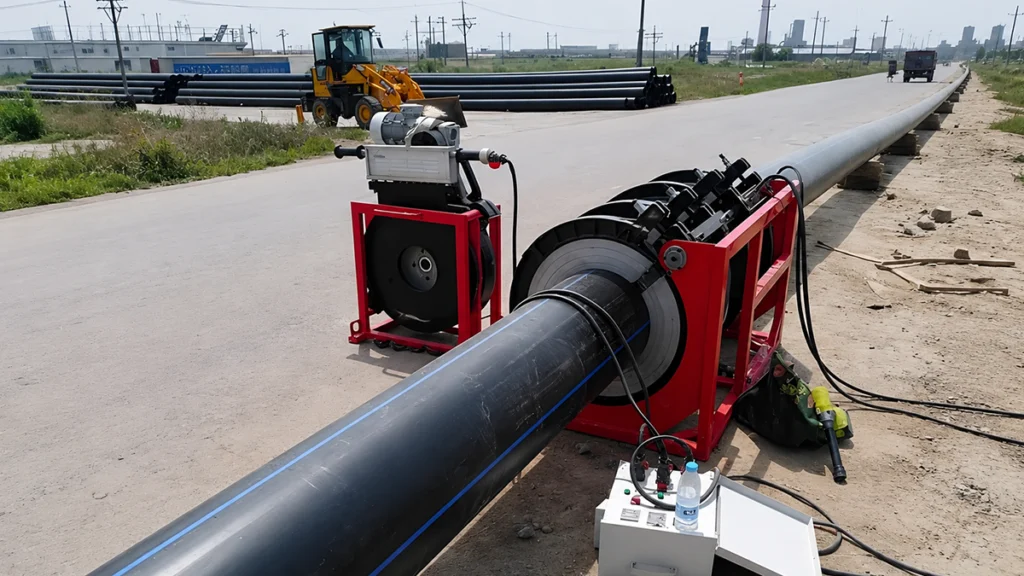
Field butt fusion welding machines feature ruggedized skid mounts or heavy-duty tracks. Engineers design them specifically to operate down in the trenches or across uneven right-of-ways. However, they do require external weather protection canopies. Wind and rain will rapidly strip thermal energy away from the heater plate, ruining the weld. On the flip side, workshop machines are stationary, ultra-precise CNC setups. Fabricators use them indoors to build complex fittings like tees, elbows, and segmented bends. Inside a controlled factory environment, ground drag forces are virtually non-existent.
What site conditions make large-diameter fusion harder?
Maneuvering a 1000mm HDPE pipe demands serious heavy equipment. You need excavators or overhead cranes just to load the pipe into the butt fusion machine’s chassis. Uneven terrain acts as the primary enemy of large-diameter fusion, causing severe high-low misalignment between the two pipe faces. Beyond the dirt, extreme ambient temperatures, high winds, or heavy precipitation force contractors to deploy environmental enclosures. Without a tent, maintaining the thermal integrity of the heating and transition phases becomes almost impossible.
How to Evaluate an HDPE Fittings Supplier in Kenya
Which machine configuration fits your diameter range and site layout?
| Configuration Type | Mobility Profile | Best Application | Price Impact |
|---|---|---|---|
| Skid-Mounted Hydraulic | Requires crane/forklift to move | Stationary field setups, long linear pipeline trenches | Baseline cost |
| Track-Mounted (Mobile) | Self-propelled via remote control | Rough terrain, frequent machine repositioning | High premium |
| Workshop / CNC Fabrication | Stationary, bolted to concrete | Factory production of fittings and spools | Moderate to High |
How do manual, semi-automatic, and fully automatic models compare?
Manual and semi-automatic systems put the burden squarely on the operator. A human must manually tweak hydraulic valves, perfectly time the heat soak, and flawlessly calculate drag pressure. When dealing with a 1000mm pipe, this introduces an unacceptable level of human error and massively skyrockets the risk of joint failure. Fully automatic (CNC) models take over entirely. They automatically govern heating time and pressure, lock in the parameters during the fusion cycle, and instantly abort the process if pressure slips or transition times drag out. For large-diameter critical infrastructure, the industry widely considers CNC automation mandatory.
What should be standard equipment versus optional equipment?
When sizing up a large diameter HDPE pipe fusion machine, your baseline standard equipment must feature the ZL104 aluminum frame, a high-quality PTFE-coated heater, a carbon steel trimmer, and a robust hydraulic station. As for optional equipment, several upgrades demand serious consideration. A DataLogger is essentially mandatory if you want municipal project sign-off. Motorized crosshairs save hours of frustration by simplifying the precise alignment of heavy pipes. Finally, customized roller stands are crucial for managing the extreme drag forces generated by long 1000mm pipe strings.
Cost, Lead Time, and Supplier Evaluation
What drives the total purchase cost?
The total price tag heavily depends on your chosen level of automation (CNC versus Manual) and the brand’s geographic origin.
Cost Breakdown:
- Machine Base Price: Fluctuates wildly depending on the manufacturer.
- Tooling & Inserts: You need adapters to handle 710mm, 800mm, and 900mm pipe sizes.
- Automation: Adding CNC control units and DataLoggers significantly bumps up the cost.
- Shipping & Logistics: Sea freight is expensive for a massive 2600 kg footprint.
- Consumables: Factor in spare PTFE plates and replacement trimmer blades.
Western retail plastic pipe welding machines (like the McElroy MegaMc series) carry massive market premiums. On the other hand, sourcing direct from the factory can slash your costs by 50% to 70%. This approach drops procurement expenses by tens of thousands of dollars while still delivering identical ISO/DVS compliance and rugged structural integrity.
How do MOQ, packaging, and lead time affect procurement?
The standard Minimum Order Quantity (MOQ) for this heavy-duty equipment class is just 1 set. Because a 1000mm HDPE Pipe Fusion Machine tips the scales at roughly 2600 kg and eats up a massive cubic meter (CBM) footprint (the frame alone measures 2200x1800x1700mm), air freight is off the table. Sea freight is mandatory. This reality introduces lead times stretching from 30 to 60 days, depending heavily on your destination port. Procurement teams must aggressively factor this long transit window into their project kick-off schedules.
Which supplier questions reduce delivery and quality risk?
To shield your project from risk when buying HDPE pipeline fusion equipment, grill your supplier with these questions:
1. Can you provide raw video evidence of a 16 MPa pressure retention test performed on the hydraulic unit?
2. Does the DataLogger interface operate natively in English, and does it export secure, unalterable PDF reports?
3. What is your actual stock availability and lead time for critical spare parts—specifically PTFE heater plates and trimmer blades?
4. Do you offer remote technical support to help with the initial field commissioning?
Common Risks, Safety Checks, and Maintenance
What defects appear most often in large pipe fusion?
The most frequent defects plaguing 1000mm pipe fusion include severe misalignment (where the high-low mismatch exceeds 10% of the wall thickness), cold fusion triggered by sloppy, extended transition times, and joint contamination from site dust or moisture. Operators also run into “carbon black windows.” These occur when degraded polyethylene creates brittle zones inside the joint, usually caused by overheating the material or using a dirty, contaminated PTFE heater plate.
What safety checks should be done before each shift?
- Two-Handed Operation: Confirm that the hydraulic control actually requires both hands to actuate. This simple check prevents devastating pinch hazards.
- Cleanliness: Inspect the V-groove and clamp inserts. They must be completely free of mud, grease, and debris to stop the pipe from slipping under pressure.
- Electrical Integrity: Run a visual check on all cables and electrodes to spot any dangerous abrasion damage.
- Thermal Hazards: Verify that no flammable materials, harsh solvents, or unprotected personnel are anywhere near the blazing 270°C heater plate.
How should the machine be cleaned, calibrated, and stored?
Sticking to a routine maintenance schedule guarantees the equipment’s longevity and ensures every weld is repeatable:
- Grab a multimeter and regularly measure the heating element resistance to verify even heat distribution.
- Wipe down the PTFE plate with a lint-free cloth and an approved solvent before every single weld. This stops slag buildup, which destroys heat transfer.
- Apply high-grade machine oil to lubricate the guide pillars and all moving mechanical components.
- Routinely drain the oil-gas separator on the hydraulic station to block internal rust and corrosion.
- When the butt fusion machine isn’t actively working, store it indoors or wrap it securely under a heavy-duty waterproof tarp.
FAQ
Q1: Is a 1000mm HDPE pipe fusion machine suitable for butt fusion only?
Yes, engineers designed this specific machine exclusively for butt fusion welding. It aligns, heats, and presses the perfectly squared ends of two pipes together using immense hydraulic pressure. It cannot perform electrofusion, socket fusion, or extrusion welding. For pipelines of this massive diameter, butt fusion remains the only viable method for creating structurally seamless joints.
Q2: What power supply is needed for a 1000mm HDPE fusion machine?
A standard 1000mm HDPE pipe fusion machine draws between 23.5 kW and 24.5 kW, requiring a robust 380V (3-phase) power supply. If you are operating out in the field, you need a minimum 35.0 kVA generator. However, upgrading to a 45.0 kVA generator is strongly recommended. The extra capacity absorbs the 9.0 kW inrush current spike from the trimmer motor, preventing dangerous voltage sags.
Q3: How long does it take to fuse a 1000mm HDPE pipe joint?
Fusion time hinges entirely on the pipe’s wall thickness. The DVS 2207 standard dictates about 1.2 minutes of cooling for every millimeter of wall thickness. If you are working with a thick-walled 1000mm pipe (like an SDR 11), the total cycle time—covering milling, heating, transition, and clamped cooling—can easily stretch beyond 60 to 75 minutes per joint.
Q4: Can one machine handle multiple pipe sizes below 1000mm?
Yes. The equipment utilizes a modular clamping design. By bolting layered aluminum reduction inserts directly into the main frame, a 1000mm HDPE pipe fusion machine can tightly clamp and weld smaller diameters. Typically, it steps down to 900mm, 800mm, and 710mm. This modularity lets contractors rely on a single machine for various pipeline segments.
Q5: How do you check whether a fusion joint has passed quality inspection?
Quality inspection relies on a mix of visual checks and digital verification. Visually, the double roll-back bead must look uniform, perfectly smooth, and correctly sized around the joint’s entire circumference. Digitally, the operator must check the CNC DataLogger report. This confirms that the heating temperature, transition speed, and hydraulic cooling pressure never strayed outside strict ISO 21307 or DVS 2207 tolerances.
Q6: What should be checked before buying a large-diameter pipe fusion machine?
Buyers need to verify that the hydraulic system can successfully hold 16 MPa without any pressure decay. You should also scrutinize the frame’s build material (ZL104 die-cast aluminum is the gold standard), check for CNC automation and data logging capabilities, confirm generator sizing requirements, and assess the supplier’s ability to quickly ship spare parts like PTFE plates and trimmer blades.
Q7: What is the difference between hydraulic and manual alignment on large pipes?
Manual alignment forces the operator to use physical strength or basic hand cranks. For pipes weighing several tons, this is physically impossible and incredibly dangerous. Hydraulic alignment, on the other hand, utilizes high-pressure cylinders to smoothly maneuver, align, and press the massive pipe ends together. This guarantees precise interfacial pressure while easily overpowering the extreme drag forces generated by 1000mm pipes.
Conclusion
Buying a 1000mm HDPE Pipe Fusion Machine represents a major capital investment. It is a decision that directly influences the safety, timeline, and ultimate profitability of any large-diameter pipeline project. Achieving success at this massive scale requires HDPE pipe fusion machinery built to conquer extreme drag forces, penetrate thick pipe walls, and strictly adhere to ISO 21307 and DVS 2207 standards.
When you evaluate your options, put your focus on closed-loop hydraulic systems that can comfortably sustain 16 MPa. Look for heavy-duty ZL104 aluminum frames. Most importantly, prioritize CNC automation to completely remove human error from the critical transition and cooling phases. Don’t overlook the basics, either. Proper generator sizing (aim for 45.0 kVA) and meticulous site prep using heavy-duty pipe rollers are vital for keeping the machine running at peak efficiency. By mastering these technical specs, tracking your total cost drivers, and enforcing rigid pre-shift safety and maintenance routines, pipeline contractors can confidently secure the best equipment. The result? Flawless, leak-proof infrastructure projects that maximize your long-term return on investment.
Let our experts help you choose the right equipment for your project
Contact Our Engineering Team