
Butt Welding Machine in Peru: HDPE Pipe Fusion Equipment for Water Supply Projects
Table of Contents
Butt Welding Machine in Peru: a practical guide to HDPE pipe fusion equipment for water supply projects, covering machine types, key specs, pricing factors, selection criteria, and procurement tips.
What Is a Butt Welding Machine and Why Is It Used for HDPE Water Pipelines?
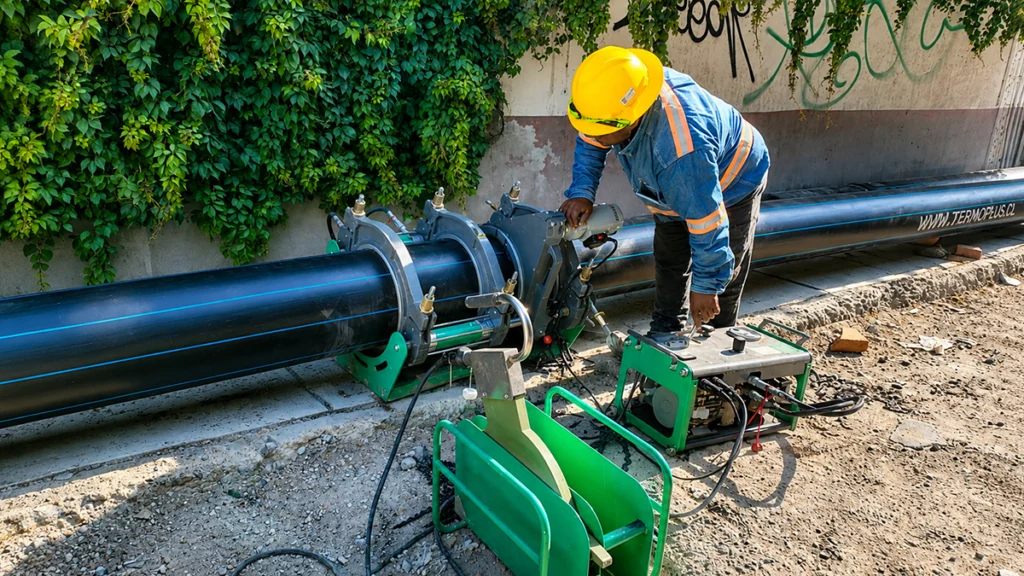
A butt fusion machine acts as the backbone for joining thermoplastic pipes. It works by melting the pipe ends and fusing them together using precisely calculated hydraulic pressure. If you’re a contractor or municipal planner tackling infrastructure upgrades, tracking down a reliable Butt Welding Machine in Peru guarantees leak-free, permanent joints. You won’t need extra fittings, messy adhesives, or welding rods. The best part? The fused joint ends up just as strong—if not stronger—than the pipe itself. That’s exactly why this technology drives modern, high-pressure water distribution networks.
How does butt fusion differ from electrofusion or solvent welding?
Heat and mechanical pressure do all the heavy lifting in butt fusion to create a perfectly homogeneous joint. First, the HDPE pipe welding machine in Peru shaves the pipe ends completely flat. Next, it heats those ends to an exact melting point before hydraulic cylinders drive them together. Electrofusion takes a different route. It relies on pricey, specialized fittings packed with electrical heating coils and needs barcode scanners to dial in the fusion settings. Then there’s solvent welding, which uses chemical adhesives to melt plastic surfaces together. Don’t even think about using solvent welding for high-pressure municipal HDPE water mains—it suffers from chemical degradation and simply can’t handle the required pressure ratings.
Why is HDPE widely used in water supply infrastructure?
High-Density Polyethylene (HDPE) absolutely dominates today’s water supply projects. Why? It boasts an impressive 50 to 100-year lifespan and shrugs off soil corrosion and chemical damage. Inside, the HDPE pipe is incredibly smooth, boasting a Manning coefficient of just 0.009. This slick surface slashes fluid friction, which in turn drives down continuous pumping energy costs. Plus, HDPE bends without breaking. That inherent flexibility makes it the go-to material for trenchless installations like horizontal directional drilling (HDD). Contractors love it because they can easily dodge surface obstacles during tricky urban rehab jobs.
What pipe materials and diameter ranges are typically compatible?
You’ll see butt fusion mostly used for HDPE, but the equipment easily handles Medium-Density Polyethylene (MDPE), Polypropylene (PP), PP-R, Polyamide 11 (PA11), and PA12. Size-wise, crews typically break out the butt fusion gear for pipes with an Outside Diameter (OD) over 90mm. The machines themselves scale wildly depending on the job. You might use a compact 110mm manual unit for a small fix, or roll out a massive hydraulic beast to fuse 1000mm, 1200mm, or even larger diameters on major municipal trunk lines.
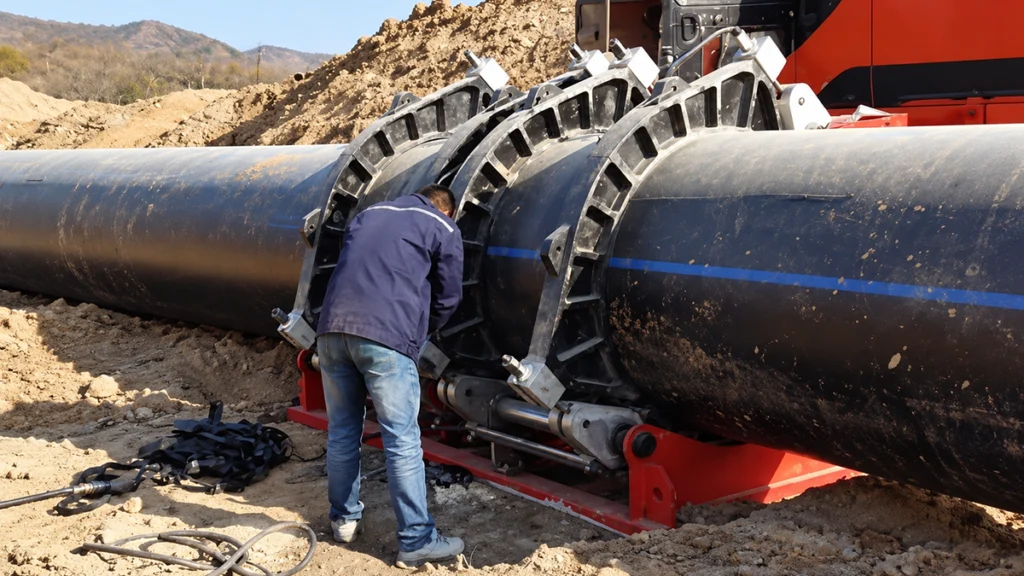
How HDPE Butt Fusion Welding Works: Main Steps and Components
What happens during heating, alignment, fusion, and cooling?
The butt fusion process demands strict adherence to four distinct phases:
1. Preheating: A precision heating plate brings the shaved pipe ends up to 200–220°C (following DVS/ISO standards) or 204–232°C (for ASTM F2620 compliance).
2. Alignment: Operators clamp the pipes coaxially inside the butt fusion machine chassis. You cannot afford sloppiness here; allowable misalignment maxes out at strictly under 10% of the pipe’s wall thickness.
3. Fusion: During the rapid changeover phase, the heating plate pulls out. Instantly, the butt weilding machine presses the molten ends together under carefully calculated hydraulic pressure.
4. Cooling: The joint stays locked under pressure until it completely solidifies. Industry standards require roughly 11 minutes of cooling time for every inch of pipe wall thickness.
Which pipe fusion machine components influence weld consistency the most?
Three main subsystems drive weld consistency. First, the heating plate needs a high-grade PTFE-coated aluminum build. This ensures heat spreads evenly and stops molten polymer from sticking to the metal. Next comes the milling cutter, or facer. It relies on high-speed carbon steel double-edged blades to shave the pipe ends perfectly square without leaving gouges. Finally, you have the hydraulic station. Ranging from a modest 0.75KW on 250mm units up to a robust 3.0KW on 1000mm butt fusion machines, this station must deliver stable, repeatable drag pressure. Any pressure drops during the critical cooling phase will ruin the weld.
What operator mistakes usually cause weak joints?
The deadliest mistake an operator can make? Dragging out the transition (changeover) period between removing the heating plate and applying fusion pressure. Wait too long, and a brittle “cold skin” forms over the molten polymer. This skin totally blocks molecular chains from diffusing across the joint interface. Other project-killing errors include failing to clean the pipe ends properly—which introduces deep, structural porosity—and botching the hydraulic pressure calculations. Get the pressure wrong, and the HDPE pipe welding machine will either squeeze out too much molten material or fail to forge the joint altogether.
Factory-direct pricing with technical consultation included
Get Your Free QuoteMain Types of Butt Fusion Machines in Peru
Manual, hydraulic, and CNC models explained
Picking the right automation level dictates how fast, accurate, and traceable your pipeline installation will be.
| Machine Type | Pressure Mechanism | Parameter Control | Best Use Case | Risk of Human Error |
|---|---|---|---|---|
| Manual | Operator leverage | Purely manual | Non-critical, low-pressure lines | Very High |
| Hydraulic | Hydraulic cylinders | Manual tracking | General distribution networks | Moderate |
| Fully Automatic (CNC) | Closed-loop hydraulic | Automated execution & data logging | High-pressure municipal trunk lines | Near Zero |
Which type fits contractors, municipalities, and distributors?
Independent contractors tackling agricultural irrigation or secondary distribution lines usually lean toward standard hydraulic butt fusion machine in Peru. These units strike a solid balance between equipment cost and field capability. Meanwhile, municipalities and engineering firms managing critical urban water infrastructure demand Fully Automatic (CNC) models. CNC automatic butt fusion machines detect drag pressure on the fly, sound alarms if parameters drift, and spit out printed data logs that prove project traceability. Distributors supplying the South American market generally stock a healthy mix of semi-automatic and hydraulic units to cover the widest range of buyer needs.
When is a portable machine enough for field work?
You can get away with a portable manual or lightweight hydraulic model when laying small-diameter rural distribution networks. They also shine during tight-space repairs where bulky pipe fusion machinery simply won’t fit. If your project involves pipes under 250mm SDR17 and nobody is asking for automated quality assurance logs, a portable unit gives you plenty of agility. However, don’t try to cheat the system. Using lightweight portable gear on heavy-wall municipal pipes guarantees alignment failures and dangerously low fusion pressure.
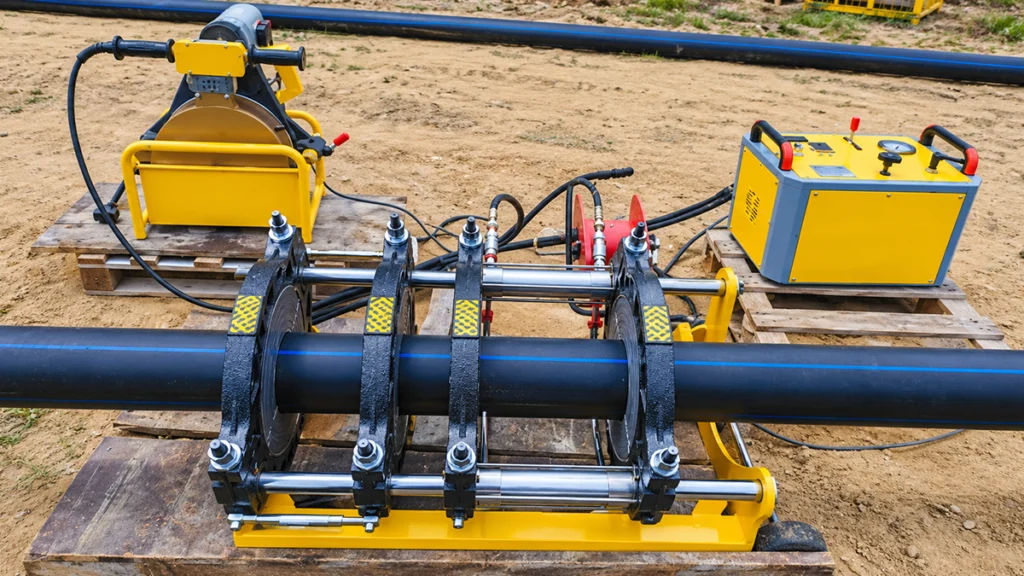
Key Specifications of Hydraulic Butt Fusion Machines
Which pipe diameter range do you need for the project?
The clamping chassis dictates a pipe fusion machine’s true capacity. Small-range models usually handle 110mm to 250mm pipes. They plug into a standard 220V 50Hz power supply, pull about 4.21 KW, and offer a pressure range of 0-6.3 MPa. Massive infrastructure jobs push those limits, demanding butt fusion machine machines that accommodate 710mm to 1000mm pipes. These heavy-duty beasts need a serious 380V 50Hz three-phase power source. They draw roughly 23.5 KW, crank out pressures up to 16 MPa, and tip the scales at over 2600 kg.
Why do voltage, heating plate control, and pressure accuracy matter?
Voltage stability dictates whether your heating plate can hold its core temperature. When reviewing spec sheets, insist on a heating plate temperature deviation of strictly ±3°C to ±5°C. Anything outside that tight window starts degrading the polymer chains. Pressure accuracy holds just as much weight. A top-tier hydraulic system must feature an exceptionally low starting pressure. This allows the equipment to safely weld the smaller-diameter pipes within its range without crushing the pipe walls under too much initial force.
Should you compare frame rigidity, clamps, and data logging features?
Absolutely. Frame rigidity is non-negotiable. The chassis has to absorb immense hydraulic forces while maintaining a butt joint deviation of ≤0.2mm. Flimsy frames flex under pressure. That flex causes misalignment, which instantly ruins the weld. High-end CNC models step it up by incorporating displacement detection systems to precisely control preheating and beveling depths. Furthermore, data logging capabilities record the exact time, temperature, and pressure for every single weld. This lets contractors hand over bulletproof, verifiable quality reports to municipal inspectors.
Get detailed specs and custom configuration options
Request Technical SpecificationsHDPE Pipe Welding Machine Applications in Peru Water Supply Projects
Municipal trunk lines and distribution networks
Upgrading aging infrastructure in cities like Lima and Arequipa means dropping in massive municipal trunk lines. Crews frequently work with 900mm to 1000mm SDR11 HDPE pipes on these jobs. A rugged Butt Welding Machine in Peru is absolutely vital for these high-stakes urban upgrades. Deep burial depths and trenchless river crossings demand joints tough enough to survive decades of shifting soil and punishing internal water pressure.
Rural water systems and remote installations
Pushing water networks into the Peruvian Andes—like the projects out in Shiringamazu—brings extreme operational hurdles. Contractors find themselves fusing kilometers of pipe across brutal, uneven mountain terrain. High altitudes and freezing winds suck the heat right out of a butt fusion welding machine’s heating plate. Out there, you have to use environmental protection tents. You also need pipe fusion machines equipped with hyper-responsive, closed-loop temperature controls to fend off thermal shock and prevent cold welds.
Pump stations, reservoirs, and rehabilitation work
Butt fusion isn’t just for new trenches; it plays a massive role in rehabilitation work. Contractors fuse incredibly long, continuous strings of flexible HDPE above ground. They then slip-line those strings straight into decaying concrete or steel water mains. Over at pump stations and reservoirs, precision hydraulic butt welding machines in Peru for water pipelines build out complex manifold connections. These fabricated joints must absorb aggressive pressure surges and violent water hammer effects without springing a leak.
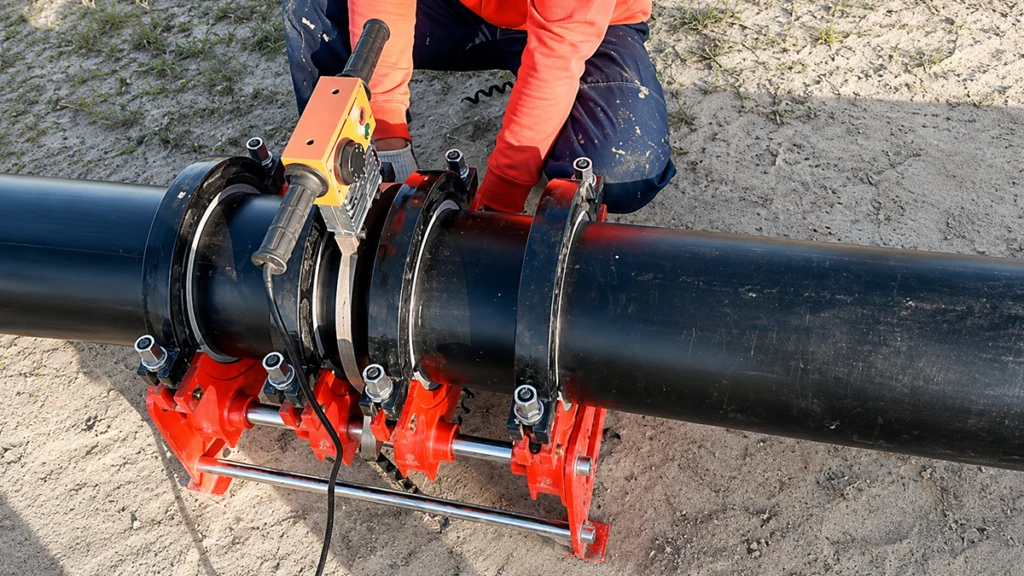
How to Choose the Right Butt Welding Machine for Your Peru Project
How do you match machine capacity to pipe size and material?
Matching capacity isn’t a guessing game. You have to calculate the hydraulic cylinder’s total piston area against the drag force required for the pipe’s physical weight and Standard Dimension Ratio (SDR). Take a 450mm butt fusion machine, for instance. It might feature a piston area of 2237 mm². Step up to an 800mm butt welding machine in Peru, and you need a staggering 23179 mm² to muscle that heavier pipe around. If the hydraulic output falls short of the heavy-wall HDPE pipe’s drag force, the pipe fusion machine won’t hit the critical interfacial fusion pressure.
What project conditions in Peru should influence the choice?
Ambient temperature changes everything about your fusion parameters. High summer heat along the coast forces operators to extend cooling times before safely releasing the clamps. Flip the script to the freezing Andean mountains, and cooling times drop. However, the cold demands higher initial plate temperatures to fight off rapid heat loss during the changeover phase. Smart buyers look for HDPE pipe welding machines with “Dual-Standard Intelligence.” This feature lets operators seamlessly toggle between ISO/DVS and ASTM parameters depending on local weather extremes.
What documents, training, and spare parts should you ask for?
Never sign off on equipment without a bulletproof documentation package. Demand calibration certificates, ISO compliance paperwork, and the exact specs of the installed transducers. Push for a minimum 1-year warranty, lifetime maintenance guarantees, and free replacements for any non-human-induced damaged parts. On the operational side, confirm the pipe fusion machine has an independent dual-channel timer for heating and cooling. Finally, make sure the supplier provides rigorous operator training, specifically on how to calculate drag pressure in the field.
HDPE Pipe Fusion Equipment Price, MOQ, and Supplier Evaluation
What drives the purchase price of a butt fusion machine?
A butt fusion machine price in Peru swings wildly from 30,000 RMB up to over 100,000 RMB. It all comes down to capacity and automation tier. The real cost drivers? Output accuracy and component sourcing. Butt fusion machines loaded with premium Japanese or American pressure transducers and temperature sensors carry a steeper price tag. Yet, those exact components determine whether a weld breezes past municipal inspection or fails catastrophically.
How do MOQ, shipping, and lead time affect total cost?
Total Cost of Ownership (TCO) goes way beyond the factory sticker price. Standard Minimum Order Quantities (MOQ) for large butt welding machines usually sit at one unit, but moving heavy equipment changes the math. Shipping a 2600 kg CNC unit built for 1000mm pipes radically inflates the landed cost in Peru. You have to budget for ocean freight, customs clearance, and inland transport out to remote job sites. Don’t forget lead times—waiting around for equipment to clear the port can rack up hidden costs if it derails your project schedule.
How can you judge supplier support, warranty, and spare parts availability?
Vet any HDPE pipe welding machine supplier for Peru by checking their dedication to standardized, internationally recognized components. If a manufacturer cuts corners with proprietary, unbranded sensors or hard-to-find hydraulic seals, a simple breakdown will trigger catastrophic downtime. Reliable suppliers bring remote diagnostic support to the table. They maintain fully stocked spare parts catalogs and write transparent warranty terms that protect your capital long after the crate leaves the factory.
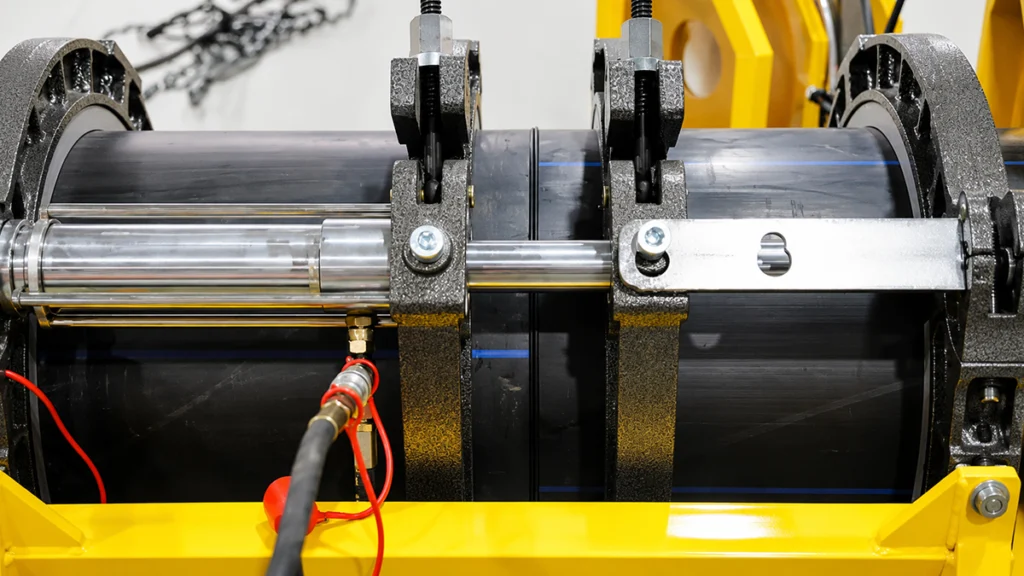
Common HDPE Butt Fusion Problems and How to Prevent Them
How do misalignment and contamination affect the weld?
Pushing pipe misalignment past 10% of the wall thickness creates massive stress concentrations at the joint interface. This instantly torpedoes the pipeline’s pressure rating. Contamination wreaks just as much havoc. Out in the windy Peruvian landscape, any moisture, dust, or oil left on the pipe ends will flash-boil into steam the second it hits the heating plate. That trapped gas leaves the joint riddled with internal porosity. Those microscopic voids act as fracture points, practically guaranteeing a blowout under operational pressure.
What temperature or pressure errors are most common?
Running temperatures below 200°C stops the polymer from hitting its required melt flow index. The result is a dangerously small column head and a brittle “cold weld.” On the flip side, scorching the pipe at over 260°C breaks down the polymer chains. This thermal oxidation wipes out the material’s structural integrity. When it comes to pressure, operators usually mess up by forgetting to add the pipe’s drag pressure to the baseline fusion pressure. Do that, and you end up with a weak, under-compressed joint.
Why is cooling time critical for joint strength?
Thermoplastic molecular chains need static pressure and time to properly intermingle and recrystallize. Trying to rush the 11-minute-per-inch cooling rule to artificially speed up production is a recipe for disaster. If you bleed off the hydraulic pressure before the cooling cycle finishes, you inject severe mechanical stress right into the soft polymer. Once the municipality pressurizes that water main, that stressed joint will rupture prematurely.
Final Recommendation: What to Prioritize for Reliable Water Supply Welding
When should you prioritize automation over lowest price?
When tackling municipal water projects and high-pressure trunk lines, you have to prioritize CNC or Fully Automatic butt fusion machines over a bargain-basement price tag. The power to automatically compensate for drag pressure, log every data point, and strip human error out of the equation delivers an exponentially higher ROI. Think about the fallout. A single blown joint on a 1000mm municipal water line triggers massive excavation costs, emergency downtime, and brutal environmental fines. That easily dwarfs the price gap between a cheap manual rig and an advanced automatic unit.
What should a buyer confirm before final approval?
Before signing the purchase order, verify that the butt fusion machine fully supports your required engineering standards, whether that’s ISO 21307, DVS 2207, or ASTM F2620. Double-check that the rig includes a displacement detection system, imported high-precision transducers, and a heavy-duty shockproof pressure gauge. Locking in these exact technical specs ensures your equipment will pump out leak-free HDPE joints capable of handling decades of relentless water distribution.
FAQ
Q1: What is the difference between a butt welding machine and an electrofusion machine?
A butt welding machine relies on a heating plate to melt pipe ends, using hydraulic cylinders to forge the joint without any extra materials. Electrofusion machines take a different approach. They require costly, specialized plastic fittings packed with internal electrical heating coils. Generally, butt fusion wins out on cost-efficiency for long, straight pipeline runs. Electrofusion makes more sense for tight-space repairs or complex tie-ins.
Q2: Which butt welding machine is best for HDPE water pipelines in Peru?
For sprawling municipal water pipelines in Peru, a CNC (Fully Automatic) butt welding machine is the top choice. It locks in precise pressure control and generates the printable data logs required for quality assurance. If you’re outfitting smaller, rural distribution networks up in the Andes, a semi-automatic or high-tier hydraulic butt fusion machine in Peru hits the sweet spot. They balance portability and affordability while still delivering reliable mechanical pressure.
Q3: What pipe sizes can a butt fusion machine handle?
A HDPE pipe welding machine’s clamping frame dictates its capacity. Small portable units easily handle diameters from 90mm up to 250mm, while mid-range machines tackle 315mm to 630mm. Heavy-duty infrastructure machines step up to the plate for massive municipal trunk lines, managing outer diameters of 710mm, 1000mm, 1200mm, and beyond. You simply have to match the machine’s chassis to your specific project diameter.
Q4: How much does a butt fusion machine cost in Peru?
Base prices for a butt fusion machine range anywhere from 30,000 RMB to well over 100,000 RMB. That spread depends heavily on the pipe diameter capacity and whether you want standard hydraulics or full CNC automation. But buyers in Peru need to look at the Total Cost of Ownership. You must factor in heavy ocean freight, import duties, inland transportation, and the long-term cost of spare parts and supplier warranties.
Q5: Does butt fusion require special training or certification?
Absolutely. CNC machines might automate the heavy math for pressure and temperature, but operators still need specialized training. They have to know how to properly face the pipes, sanitize the fusion zones, calculate drag force, and adjust for environmental factors like wind and ambient temperature. In fact, many municipal projects legally mandate that operators carry specific certifications tied to ISO or ASTM fusion standards to guarantee pipeline integrity.
Q6: What voltage do HDPE butt welding machines use?
Voltage demands scale right alongside the butt welding machine’s size and heating element power. Small to mid-sized units—usually covering up to 250mm or 315mm—run fine on standard 220V 50Hz single-phase power. Large industrial machines, like the 710mm to 1000mm behemoths, require a heavy-duty 380V 50Hz three-phase power supply to run their massive heating plates and high-capacity hydraulic stations.
Q7: How do you choose a supplier for a water supply project?
Base your choice on the supplier’s commitment to international manufacturing standards and high-end components. Hunt for suppliers utilizing PTFE-coated aluminum heating plates, high-speed carbon steel cutters, and imported pressure transducers from Japan or the US. Beyond the hardware, prioritize manufacturers backing their gear with independent dual-channel timers, at least a one-year warranty, remote diagnostic support, and guaranteed spare parts availability.
Q8: What should be checked before accepting a butt fusion machine delivery?
Before you sign off on a delivery, inspect the pipe fusion machine’s frame rigidity to ensure it meets the strict ≤0.2mm deviation standard. Examine the heating plate for a flawless, scratch-free PTFE coating. Boot up the control panel to verify it functions perfectly, and confirm the temperature deviation stays locked within ±3°C to ±5°C. Lastly, make sure the crate includes all required calibration certificates, operation manuals, and your specified spare parts.
Conclusion
Expanding Peru’s water infrastructure requires reliable and repeatable pipe welding equipment. When selecting a butt welding machine, buyers should look beyond the initial purchase price and compare key technical factors such as heating plate temperature control, hydraulic pressure capacity, frame rigidity, pipe diameter range, and data recording functions.
For municipal water supply projects, CNC or automated systems can help improve welding consistency, reduce operator-related variation, and support traceable quality control. Equipment should also be selected according to pipe size, SDR, working environment, and applicable standards such as ISO, DVS, or ASTM.
Matching the machine configuration to actual project conditions—whether in coastal areas or high-altitude regions—can help improve installation efficiency, joint reliability, and long-term HDPE pipeline performance.
Let our experts help you choose the right equipment for your project
Contact Our Engineering Team