
Butt Welding Machine in Chile: HDPE Pipe Welding Guide for Mining Projects
Table of Contents
Butt Welding Machine in Chile helps mining teams choose and use HDPE pipe fusion equipment for water, slurry, and dewatering lines, with practical guidance on machine types, specifications, pricing, supplier selection, and quality control.
What Is a Butt Welding Machine and Why Is It Used in Chile Mining Projects?
What does a butt welding machine do?
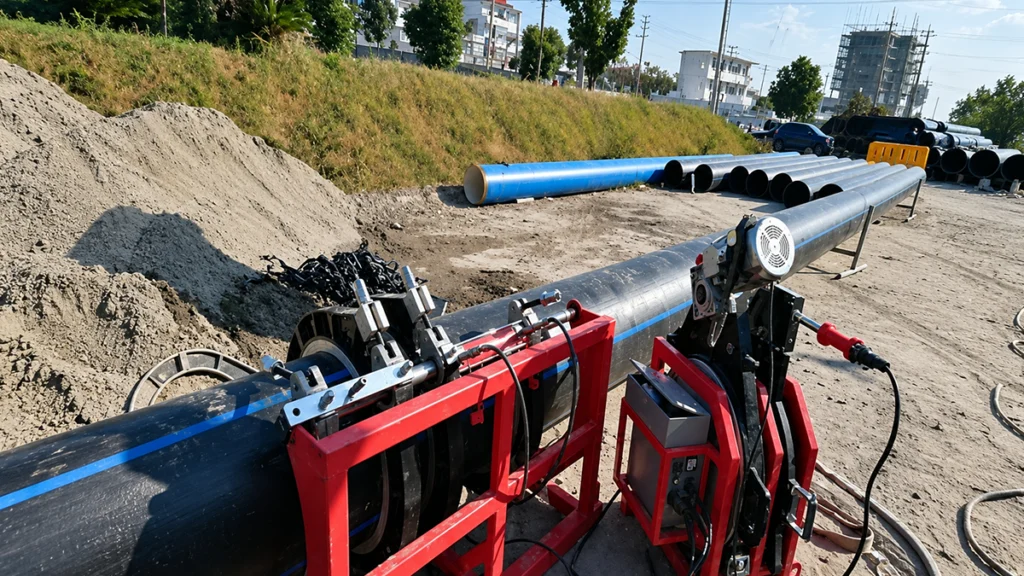
At its core, a butt fusion machine fuses high-density polyethylene (HDPE) pipes. It does this through a precise sequence of heating, facing, and pressing the pipe ends together under strictly controlled pressure. This thermal fusion process doesn’t just glue the pipes; it creates a solid, monolithic joint that matches—or even exceeds—the strength of the original pipe. As the polymer chains melt, they interlock during the cooling phase. The result? You completely eliminate the need for mechanical fittings and guarantee a 100% leak-free pipeline network.
Why is HDPE fusion preferred for mining pipelines?
Walk onto almost any modern mine site, and you’ll see HDPE. It dominates the industry thanks to its rugged toughness, flexibility, and unmatched resistance to corrosion. When executed correctly, a butt fusion joint easily handles highly abrasive slurries. It also withstands extreme pressure environments pushing past 24 bar. HDPE’s chemical resistance plays a major role in leaching operations and cyanide transport, where pipeline integrity remains a non-negotiable safety and environmental standard. Plus, since fused joints lack rubber gaskets or bolts, aggressive acid mine drainage (AMD) simply can’t degrade them.
Where is this equipment typically used on mine sites?
In Chilean mining operations, crews deploy this equipment heavily for process water supply, tailings transport, mine dewatering, and slurry pumping lines. Up in the high-altitude Andes Mountains—at massive sites like Collahuasi and Michilla—engineers depend on a heavy-duty Butt Welding Machine in Chile to build heap leaching irrigation grids and aquifer depressurization networks. These HDPE pipe welding equipment for mining thrive in rugged environments. Out there, constant ground movement and seismic activity demand the natural flexibility that only fused HDPE pipes can provide.
How Butt Fusion Welding Works for HDPE Pipe
What are the main steps in the fusion cycle?
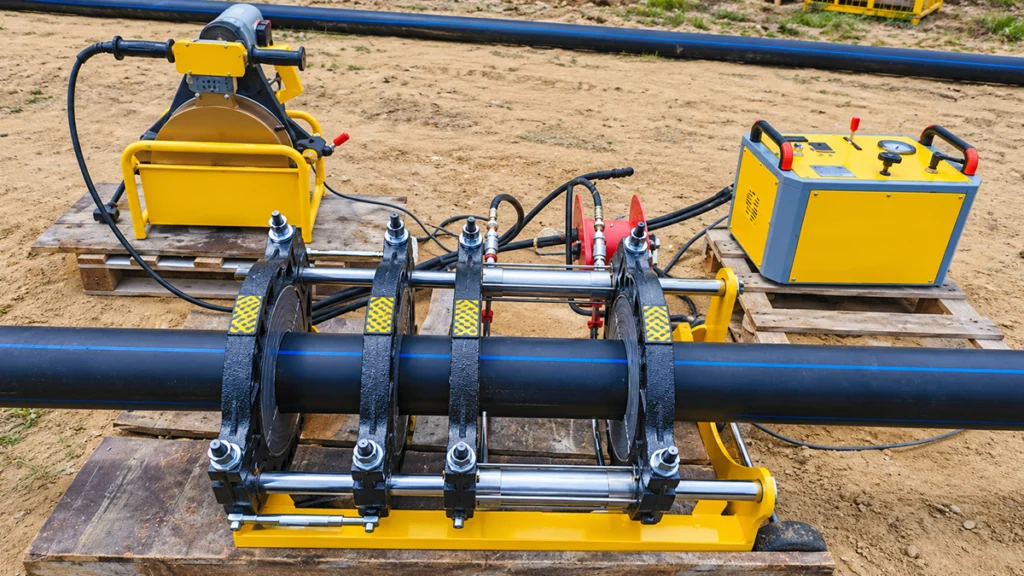
The butt fusion process relies on a strict five-stage cycle: Preparation/Adjustment, Heating, Transition (Switching), Fusion (Pressurization), and Cooling. First, operators secure and align the pipes. They mill the ends to guarantee perfectly parallel faces and check the drag pressure. Next comes the heating plate, which melts the pipe ends. Once heated, operators rapidly pull the plate out during the transition phase. Finally, the PE pipe welding machine in Chile presses the pipe ends together at a carefully calculated fusion pressure, holding the joint tight until it cools completely.
Which parts of the machine control temperature, pressure, and alignment?
A standard butt fusion setup hinges on four main components. The heating plate uses built-in sensors and internal elements to keep temperatures tightly controlled. Meanwhile, hydraulic cylinders handle both drag and fusion pressure, forcing the molten polymer together precisely. To keep everything straight, the clamping device—built with heavy-duty steel or aluminum inserts—grips the pipe rigidly. This ensures flawless alignment while minimizing bending stresses. Finally, the milling cutter (or facer) shaves down the pipe ends, stripping away oxidation to reveal perfectly matched surfaces.
How do heating, facing, and cooling affect weld quality?
Heating parameters make or break polymer chain entanglement. Temperatures absolutely must follow strict standards like DVS 2207-1 (200–220°C for low pressure) or ASTM F2620 (204–232°C for high pressure). Facing is equally critical. It has to narrow the gap between butted ends to under 0.3mm to stop cold spots in their tracks. Because plastic transfers heat poorly, cooling takes time. You have to keep the weld clamped under sustained pressure throughout the entire cooling phase. If you rush it, you risk material shrinkage, internal voids, and weak cold welds.
Factory-direct pricing with technical consultation included
Get Your Free QuoteTypes of Butt Welding Machines and Key Technical Specifications
Manual, automatic, and hydraulic models compared
| Machine Type | Operation Mechanism | Best Application | Data Logging |
|---|---|---|---|
| Manual | Lever or hand-crank pressure | Small diameters, low-pressure non-critical lines | None |
| Semi-Automatic (Hydraulic) | Hydraulic pressure with manual switching | Standard mining water lines, municipal supply | Optional/Add-on |
| Fully Automatic (CNC) | Automated pressure, hot plate lift-off, digital control | High-pressure slurry lines, critical gas, deep dewatering | Integrated (ASTM F3124) |
Which pipe diameters can each machine handle?
Manufacturers build standard hydraulic butt fusion machines in specific ranges to maximize clamping force. You’ll typically see ranges like 63-160mm, 90-250mm, and 160-315mm. Heavy-duty mining rigs tackle much bigger infrastructure, easily managing massive diameters from 200mm up to 800mm. Need to go bigger? Advanced CNC models designed for enormous tailings lines can fuse pipe diameters up to a staggering 3000mm. Picking the right frame size matters. It stops excessive drag forces from ruining smaller pipes while delivering the raw fusion pressure needed for thick-walled, large-diameter lines.
What technical specs should buyers check before ordering?
Before signing off on an order, project engineers need to dig into the technical specs. Always verify the exact welding range (DN/OD) and the hydraulic unit’s peak clamping force. To meet ISO 21307 standards, the heating plate’s temperature variance cannot stray beyond ±3°C. Don’t forget to check the power specs. Make sure the voltage requirements (like 220V or 380V 3-phase) actually match your on-site generators. Finally, confirm the hydraulic unit can hold a steady working pressure of 2-4 MPa without dropping during the critical cooling cycle.
HDPE Pipe Welding Applications in Chilean Mining Projects
Water supply and process water lines
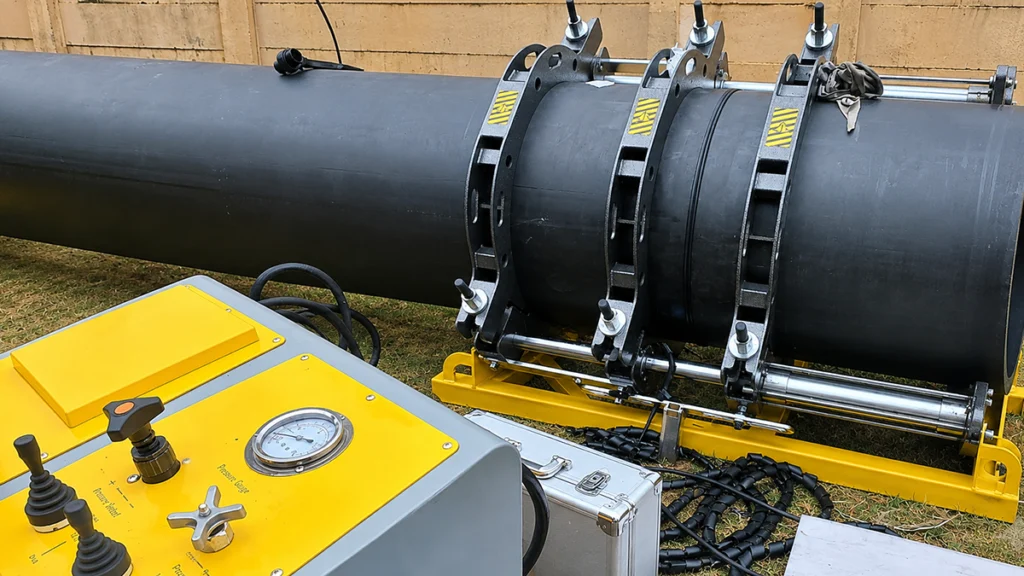
Mines consume massive amounts of clean water for washing facilities, dust suppression, and ore processing. Using top-tier HDPE pipe welding equipment for Chile mining water lines guarantees that sprawling water transport networks stay leak-free for decades. These monolithic joints lock down water loss. In bone-dry regions like the Atacama Desert, conserving every drop isn’t just a goal—it’s a strict operational mandate.
Dewatering, tailings, and slurry-related pipelines
Slurry and tailings pipelines take a brutal beating from high pressures and extreme internal abrasion. Fused HDPE pipelines step up as the critical backbone for transporting acid mine drainage and iron ore tailings. Down in deep open-pit operations, dewatering lines frequently face pressures surging past 24 bar. The butt fusion process ensures every joint can handle that severe hydraulic shock alongside the relentless wear and tear of heavy slurry pumping.
Remote site and temporary installation scenarios
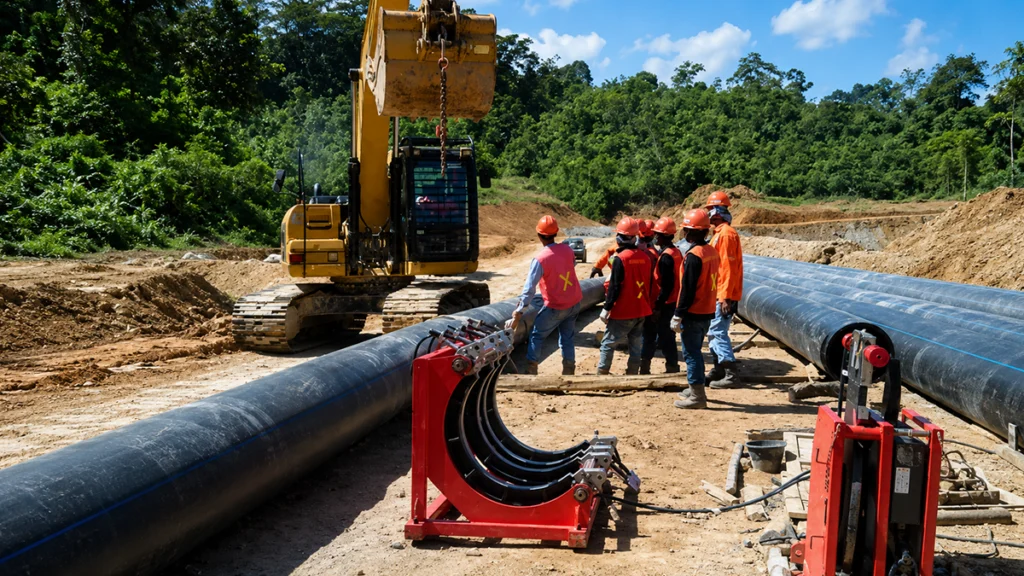
Chile’s rugged mining terrain constantly demands temporary bypasses or the relocation of tailings storage facilities. HDPE’s natural flexibility shines here. Crews can install it in straight or coiled lengths, letting the pipe hug uneven ground without relying on complicated mechanical fittings. Bringing a portable butt welding machine for remote mining sites into the mix allows for rapid deployment and on-the-fly field modifications. As the mine’s footprint grows, engineering teams can easily pivot and adjust pipeline routes.
Get detailed specs and custom configuration options
Request Technical SpecificationsHow to Choose the Right Butt Welding Machine for Your Project
How pipe diameter and wall thickness determine machine size
Smart buyers always choose a butt fusion machine frame that handles pipes slightly larger than the project’s current maximum diameter. This simple move builds in room for future expansion. Wall thickness (the SDR rating) directly dictates your heating time and required hydraulic pressure. Keep in mind that industry standards ban butt fusion for pipe components with a nominal diameter (dn) of 63mm or less, or a wall thickness (e) under 6mm. For those smaller specs, you have to use electrofusion instead.
What site conditions should influence the choice?
The Andes Mountains throw everything at you: high altitudes, freezing temperatures, and howling winds. These brutal conditions must drive your equipment choices. Specify butt welding machines in Chile armed with robust heating plates that deliver rapid heat recovery in the bitter cold. Look for systems with separate clamping and hydraulic controls. This allows operators to run the fusion process from a safe distance while the frame sits down in the trench. Also, never skip the accessories—protective welding tents and heavy-duty wind shields are absolute lifesavers in these environments.
When should buyers consider portability, automation, or rental?
Are you laying critical chemical slurry lines or high-pressure gas mains? If so, CNC automation is non-negotiable. It provides the digital weld traceability required to meet ASTM F3124. Portability takes the spotlight when you’re navigating steep gradients where heavy lifting gear simply can’t reach the trench. Renting makes sense for quick municipal repairs. However, for sprawling, long-term mining infrastructure, buying the equipment outright is the only way to guarantee availability and maintain total control over your maintenance schedules.
Price, Lead Time, and Supplier Evaluation in Chile
What affects the price of a butt fusion machine?
The butt fusion machine price in Chile heavily depends on two factors: maximum pipe diameter capacity and automation level. A fully automated CNC rig loaded with integrated data logging will naturally cost more than a basic semi-automatic hydraulic model. Other details drive the price up, too. Expect to pay a premium for high-end hydraulic components, PTFE-coated heating plates, and custom chassis designs built for track-mounted, all-terrain mobility.
How should buyers compare local and imported options?
Procurement managers face a tough balancing act: upfront capital costs versus long-term ROI. Direct imports often look cheaper on paper, but import tariffs and currency depreciation quickly inflate the final landed cost. You also have to ask if an imported machine’s lifespan justifies the long shipping lead times. Generally, premium imported butt fusion welding machines featuring CNC automation deliver the best ROI. Over a 10-to-15-year lifespan, they prevent disastrous pipeline leaks and save tens of thousands of dollars in specialized labor.
What service, training, and spare parts support should be confirmed?
Choosing an HDPE pipe welding machine supplier in Chile demands rigorous vetting of their after-sales support. Insist on at least a 24-month warranty. Dig into their local inventory to ensure they actually stock critical spare parts like heating elements, milling blades, and hydraulic seals. On top of that, your supplier must provide factory-trained technicians for on-site commissioning and operator training. This hands-on support is the only way to guarantee your crew meets strict international welding standards.
Common Welding Mistakes and Quality Risks to Avoid
Why do misalignment and poor surface preparation cause failures?
Pipe misalignment should never cross the 10% threshold of the pipe’s wall thickness. If operators fail to secure the clamping frame correctly, the resulting high-low misalignment creates massive stress concentrations right at the joint. Worse, if the gap between the milled ends stretches beyond 0.3mm, the heating plate won’t make uniform contact. Skipping proper surface preparation is another fatal error. Leaving dirt or oxidation on the pipe face blocks polymer chain entanglement, drastically cutting the joint’s service life.
How do incorrect temperature or pressure settings affect the joint?
Stray outside the approved temperature range, and you invite catastrophic joint failure. Crank the heat too high, and the polymer degrades, leaving you with brittle inclusions and porosity. Run it too cold, and the material won’t melt properly, creating a dangerous false weld. Pressure matters just as much. If you ramp up the hydraulic pressure too fast during the joining phase, the pipe ends slam together. This high-speed collision forces molten material straight out of the fusion zone, leaving behind a classic “cold weld” destined to blow apart under operational pressure.
What inspection checks should be completed after each weld?
Post-weld inspections aren’t optional; they are the backbone of quality assurance. Operators need to visually inspect the bead, looking for a perfectly symmetrical flare free of impurities or sharp V-notches between the melt rolls. Before moving to production, crews should run destructive testing—like the bend-back tests outlined in ASTM F2620 X4.1—on sample welds. Finally, quality inspectors must scrutinize the data-logger records for every single joint to catch any hidden pressure or temperature spikes that occurred during the fusion cycle.
Step-by-Step Best Practices for Safe and Reliable Operation
Pre-operation equipment checks
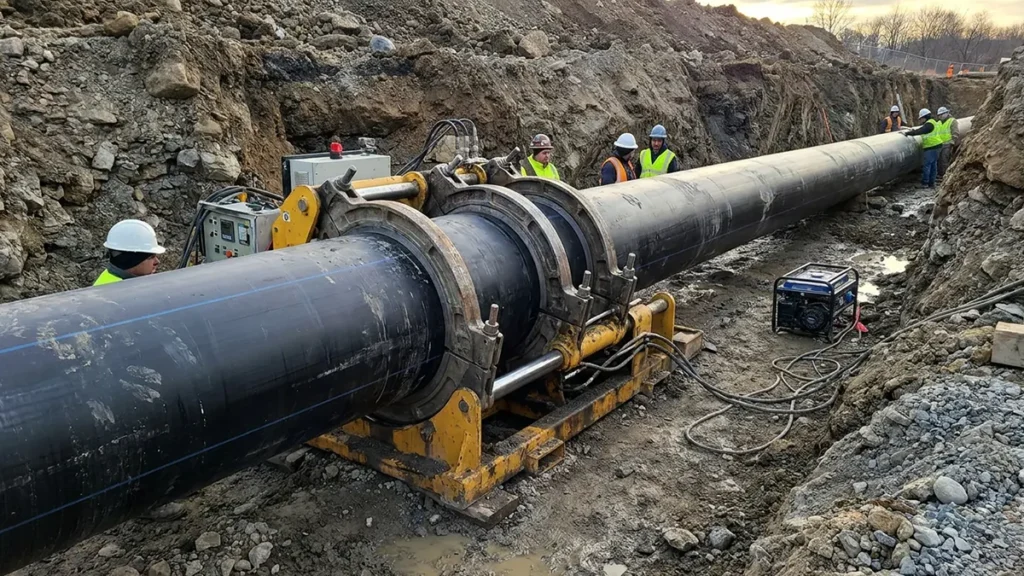
Before striking a single weld, operators must review a comprehensive butt fusion machine maintenance and operation guide. Check the hydraulic oil; the tank should be over two-thirds full, but take care not to overfill it. Inspect the milling cutter to confirm the blades remain sharp and free of damage. Double-check every structural fastener on the clamping frame for tight security. Lastly, wipe down the heating plate with an approved solvent and a lint-free cloth to strip away moisture, dust, and leftover polymer residue.
Step-by-step welding and cooling sequence
1. Clamp the pipes securely, mill the ends until you see continuous shavings, and verify perfect alignment.
2. Drop in the heating plate and apply initial pressure for full contact, then back off to soak pressure. Heat the ends to the target temperature (typically 260°C–280°C depending on specific PE standards) until you achieve the correct bead height.
3. Yank the heating plate out quickly, making sure you stay strictly within the maximum allowable transition time limit.
4. Bring the pipe ends together smoothly. Ramp up to the final welding pressure (p₃) gradually to avoid a high-pressure collision.
Post-weld inspection and documentation
Welded joints need to cool naturally while locked under full welding pressure. Operators must shield the cooling joint from dust, wind, and water using proper site tents. Never move the pipe or apply external mechanical forces while it cools. Once the timer finishes, release the pressure, unclamp the pipe, and immediately record the exact joint parameters into the site’s quality log.
Final Buying Advice for Mining Contractors in Chile
Which buyer profile should choose which machine?
Major mining contractors tackling massive tailings, slurry, or high-pressure dewatering projects need to bite the bullet and invest in large-diameter CNC automated butt fusion machines. This upfront capital expense pays off massively by eliminating operator errors and stopping catastrophic leaks before they happen. On the flip side, smaller contractors working on temporary low-pressure bypasses or municipal water lines can get fantastic results with budget-friendly semi-automatic hydraulic models—as long as they enforce ruthless manual quality control.
What should be confirmed before placing an order?
Before you pull the trigger and buy a butt welding machine in Chile for mining contractors, ensure the hardware and software meet strict international benchmarks—specifically ASTM F2620, DVS 2207-1, and ISO 21307. Double-check that the hydraulic power unit aligns with your specific site voltage. Insist on a built-in data logger to guarantee digital weld traceability and quality detection. Finally, cross-reference the clamping insert sizes to make sure they fit every pipe diameter on your project schedule.
When is it better to request a custom quote?
Standard catalog butt fusion machines handle the vast majority of jobs. However, if you’re pushing boundaries with extreme high-pressure applications (like >24 bar dewatering lines) or running non-standard SDR series pipes, you need a custom engineering quote. You should also request custom pricing if your project demands specialized cloud integration and IoT for remote fleet tracking, or if you need the rig mounted on a heavy-duty tracked chassis to navigate brutal terrain.
FAQ
Q1: What size butt welding machine do I need for HDPE pipe in a mining project?
Machine size depends entirely on the maximum outer diameter (OD) of the pipe you plan to weld. Standard hydraulic machines usually cover ranges like 160-315mm, whereas heavy-duty mining rigs tackle 200-800mm, or even up to 3000mm. Always choose a frame that goes slightly larger than your maximum required diameter so you’re ready for future project expansions.
Q2: How does butt fusion welding work for HDPE pipelines?
Butt fusion works by clamping two HDPE pipe ends tightly, milling them down to create perfectly flat faces, and pushing them against a precision heating plate. Once the polymer melts, you remove the plate and use hydraulic cylinders to press the pipe ends together under strict pressure. The material then cools into a single, monolithic joint.
Q3: What is the difference between manual and hydraulic butt welding machines?
Manual machines require the operator to apply fusion pressure physically using hand-cranks or levers, making them fit only for small, low-pressure pipes. Hydraulic machines use a motorized pump to deliver massive, precise clamping and fusion pressure. This hydraulic power is absolutely mandatory for large diameters and thick-walled mining pipes.
Q4: How much does a butt welding machine cost in Chile?
The price of a Butt Welding Machine in Chile fluctuates based on automation levels and diameter capacity. Small hydraulic units for basic water lines are very affordable, while massive CNC machines with integrated data logging demand serious capital. When budgeting, always factor in shipping, import duties, and the long-term savings of automated leak prevention.
Q5: What should buyers check before choosing a supplier for a mining project?
Always verify that the supplier provides at least a 24-month warranty and keeps a strong local inventory of critical spare parts like blades, heating elements, and seals. You also need access to factory-trained technicians. Finally, confirm that their equipment strictly complies with ASTM F2620 and ISO 21307 standards.
Q6: Can a butt welding machine be used for remote or high-altitude mine sites?
Absolutely, but cold-weather and high-altitude environments demand special adaptations. Your machines need heavy-duty heating plates that recover heat rapidly. Operators must also set up protective welding tents to block freezing temperatures and high winds, ensuring the polymer cools at the right speed.
Q7: What are the most common causes of bad HDPE butt welds?
The usual suspects for joint failure include poor surface cleaning, inadequate milling that leaves gaps over 0.3mm, and high-low pipe misalignment exceeding 10% of the wall thickness. Getting the temperature wrong or failing to hold hydraulic pressure through the entire cooling cycle will also leave you with porous, weak, or “cold” welds.
Conclusion
Choosing the right Butt Welding Machine in Chile requires careful consideration of pipe diameter, SDR, project conditions, operating environment, and required welding capacity. For mining applications, stable hydraulic pressure, accurate temperature control, reliable data recording, and durable machine construction can help improve joint consistency and reduce the risk of rework.
Procurement teams should also evaluate supplier experience, spare parts availability, technical support, warranty terms, and compliance with relevant welding standards. Matching the machine configuration to the actual pipeline and site requirements can improve installation efficiency, welding reliability, and long-term project performance in demanding Chilean mining environments.
Let our experts help you choose the right equipment for your project
Contact Our Engineering Team