
Butt Fusion Machine in Bolivia: Guide for Mining and Water Pipeline Projects
Table of Contents
Butt Fusion Machine in Bolivia explains how to choose and apply the right pipe welding equipment for mining and water pipeline projects, covering machine types, specs, costs, risks, and supplier selection.
What Is a Butt Fusion Machine and How Does It Work?
What parts make up a butt fusion machine?
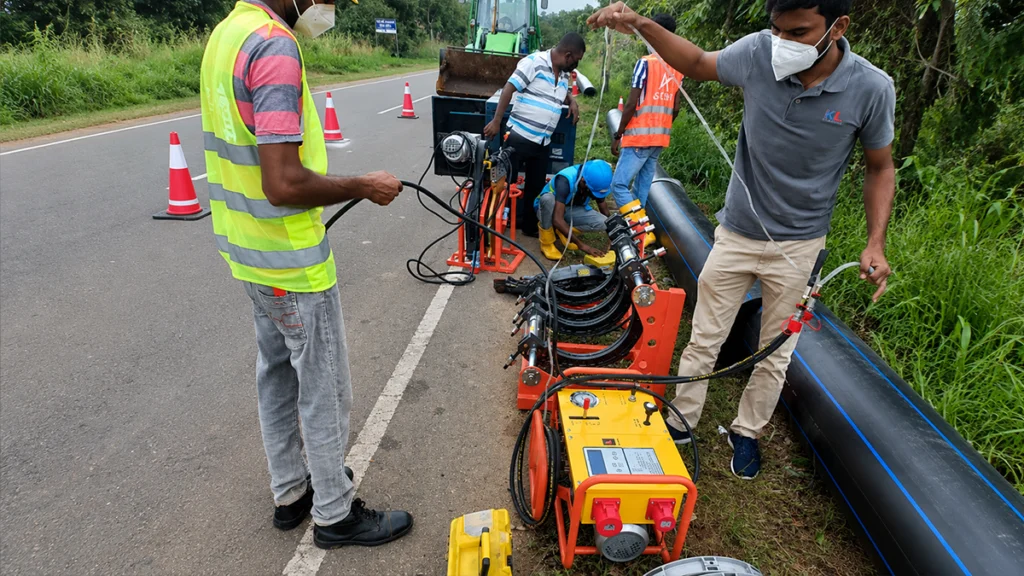
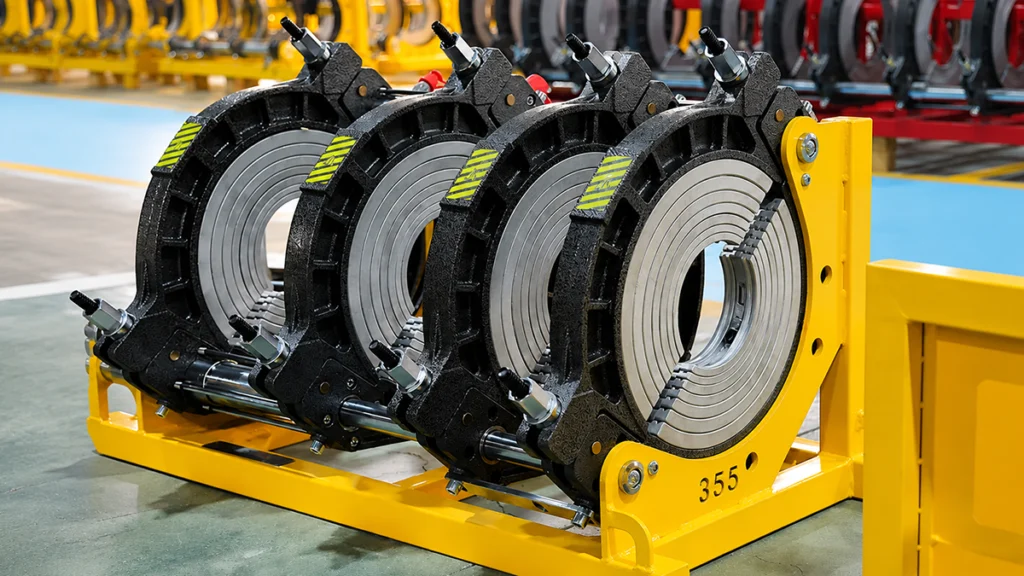
Built for the punishing realities of heavy-duty pipeline construction, a standard butt fusion machine combines raw power with pinpoint accuracy. At its core sits a Teflon-coated aluminum alloy heating plate. This component usually packs six internal heating tubes to guarantee heat spreads evenly across the surface. You’ll also find a high-speed carbon steel milling cutter—often called a facer—designed to shave pipe ends down to perfectly flat surfaces. A rigid steel chassis holds heavy-duty hydraulic clamps and guides that lock the pipes firmly into alignment. Finally, a centralized control panel acts as the brain of the operation. It dictates hydraulic pressure, dials in temperatures, and manages cycle times so every weld meets strict international standards.
How does the heating, alignment, and joining cycle work?
The process kicks off the moment operators lock the polyethylene pipes into the chassis clamps. The facer spins up, shaving the pipe ends until they reveal smooth, virgin plastic. After a quick alignment check, the operator drops the heating plate between the two ends. The system then heats the polymer to a precise 400°F–450°F (204°C–232°C) under controlled pressure until a uniform melt bead rolls back. Next comes the critical changeover phase. The plate pulls out quickly, and hydraulic cylinders slam the molten ends together at a carefully calculated interfacial pressure. The butt fusion welding machine holds that joint under steady pressure until the plastic fully cools.
Why is butt fusion preferred for HDPE and PE pipelines?
Thermoplastic pipeline engineers lean heavily on this method for one simple reason: it delivers a permanent, monolithic joint. Do it right, and the molecular bond at the fusion zone actually matches—or even exceeds—the strength of the parent pipe. Mechanical joints rely on gaskets, bolts, or threads that eventually wear out. A properly fused polyethylene joint strips away those weak links, effectively eliminating all potential leak paths. That kind of structural integrity is non-negotiable when you need to maintain fluid velocity and pressure over decades of relentless operation.
What project risks does butt fusion help reduce?
Rolling out a reliable butt fusion machine in Bolivia tackles several massive operational headaches head-on. First, it wipes out the need for mechanical fittings. Those fittings corrode, shift, and degrade over time thanks to soil stress. Fusing the pipe creates a continuous, unbroken string. In high-pressure applications, this drastically slashes the risk of catastrophic blowouts or those slow, invisible leaks that ruin project margins. It keeps toxic spills out of local ecosystems and saves contractors from the nightmare of expensive, unplanned downtime.
Why Butt Fusion Matters for Mining and Water Pipeline Projects in Bolivia
Why are leak-free joints critical in remote or high-load sites?
Up in the Andean mining sectors, pipelines do the heavy lifting. They transport primary slurry, highly abrasive tailings, and aggressive dewatering fluids. A single leak in these high-volume lines can trigger massive environmental fallout and grind entire extraction operations to a halt. In these high-load environments, leak-free joints aren’t just a nice-to-have—they are mandatory. A continuous fused pipeline absorbs the extreme tensile stresses, shifting ground, and heavy mechanical impacts inherent to rugged terrain. The result? Zero fluid loss, even when internal pressures spike and plummet.
Which Bolivia project conditions make fusion welding the better choice?
Bolivia throws unique topographical and environmental hurdles at contractors. Take regions like Potosí or Oruro. The extreme altitude suffocates standard combustion engines, draining their power output. Equipment up here has to adapt. Fusion welding stands out because the resulting joints actually flex alongside the natural seismic shifts and thermal expansion of the Andean landscape. Beyond that, deploying an HDPE pipe jointing machine for mining projects in Bolivia lets crews pre-assemble massive pipe strings on flat ground. Once welded, they drag the continuous line into trenches—a logistical lifesaver in steep, hard-to-reach valleys.
Factory-direct pricing with technical consultation included
Get Your Free QuoteMain Types of Butt Fusion Machines and Their Differences
Manual, hydraulic, and fully automatic models
Getting the right gear on site means understanding the three distinct tiers of automation:
- Manual Butt Fusion Machines: Lightweight and budget-friendly. Operators use raw physical force via a handwheel or lever to apply pressure. Because human strength has its limits, these units are strictly for small-diameter, low-pressure jobs.
- Hydraulic Butt Fusion Machines: The industry workhorse. These semi-automatic setups use a dedicated hydraulic power pack to generate the massive clamping force required for larger pipes. Operators manually flip the valves and keep a close eye on the pressure gauges.
- Automatic Butt Fusion Machines: The top tier. Driven by CNC control panels, these models run the entire DVS 2207 or ISO 21307 welding cycle on autopilot. They feature displacement detection for flawless beveling and lock down the parameters so operators can’t tamper with the settings.
Stationary vs portable machines for field work
Real-world pipeline installations rarely happen inside a clean, controlled workshop. That is why a portable butt fusion machine for field pipeline installation usually features a “split-type” design. This modular setup lets you detach the heavy steel clamping chassis from the hydraulic power unit and the control panel. Breaking the pipe fusion machine down is an absolute must when you have to lower equipment down a steep mine shaft or haul it through dense rural brush where cranes simply cannot go.
How to match machine type to pipe size and project scale
Your procurement strategy hinges entirely on project scale. Everyday mining operations generally deal with pipes ranging from 250mm to 450mm OD. For those, robust hydraulic models hit the sweet spot. But when contractors tackle massive municipal water diversion projects, they bring in large diameter pipe butt fusion equipment for mining and civil works. We’re talking butt fusion machines that scale up to 1200mm or even 1600mm. At those extreme sizes, the sheer hydraulic capacity and the rigidity of the steel frame become the make-or-break factors in your buying decision.
Key Technical Specifications to Check Before You Buy
Which pipe diameter range do you need?
Manufacturers categorize these HDPE pipe jointing machines strictly by their maximum outer diameter (OD) capability. You’ll typically see industrial classes like 160mm, 250mm, 315mm, 630mm, 1000mm, and 1600mm+. Because you can always weld smaller pipes using reducing inserts (liners), smart buyers size their chassis based on the absolute largest pipe the current project demands—while leaving a little breathing room for future expansions.
What heating plate, pressure, and power details matter most?
Precision makes or breaks a weld. Your heating plate needs to be built from high-grade aluminum alloy (think ZL104 standard) and hold a tight temperature variance of just ±5°C across every inch of its surface. On the pressure side, the hydraulic system has to deliver and sustain immense interfacial force. Premium models push up to 24 MPa capacity, which is exactly what you need to wrangle thick-walled SDR 7 or SDR 9 pipes.
Should you check voltage, generator compatibility, and climate tolerance?
When you start evaluating butt fusion machine price and specifications for Bolivia, power requirements demand your full attention. High altitudes choke generators, causing severe derating. The golden rule? Size your generator at 1.5 to 2.5 times the butt fusion machine’s total power draw. Take a 315mm butt fusion machine drawing 5.85 kW. You need an 8.5 kVA generator at minimum, though 10.0 kVA is far safer at altitude to keep the heating plate’s PID controllers stable. Stepping up to a 630mm butt fusion machine (10.1 kW)? You’ll need at least an 18.5 kVA generator. Ignore this, and voltage drops will guarantee weak, cold welds.
Which accessories and clamps should be included?
Don’t sign off on a procurement package until you verify the extras. You need a complete set of inner clamp blocks (liners) to fit every SDR and pipe size within the butt fusion machine’s operating range. Industrial buyers must also check for flat-type quick connectors on the hydraulic hoses, a heavy-duty hoist or crane for maneuvering massive heating plates, and an integrated data logger. If you want to comply with ISO 12176 traceability standards, that data logger and printer combo is mandatory.
Get detailed specs and custom configuration options
Request Technical SpecificationsWhere Butt Fusion Machines Are Used in Bolivia
Mining water supply and dewatering pipelines
Bolivia’s mineral-rich zones run on heavy-duty fusion equipment. A Butt Fusion Machine in Bolivia is the primary tool for laying down 250mm and larger HDPE networks. These lines do the dirty work: hauling primary slurry, managing toxic tailings, and keeping the mines dewatered. Because fused HDPE boasts incredible chemical resistance, the highly acidic and abrasive fluids churning through the system won’t eat away at the infrastructure.
Municipal and rural water distribution projects
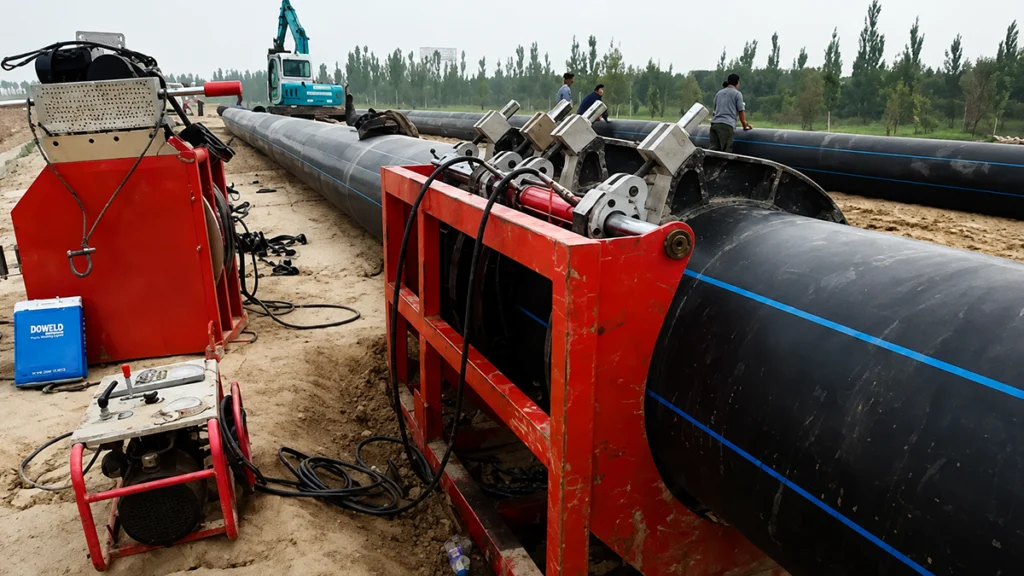
The extraction industry doesn’t have a monopoly on this tech. A butt fusion machine in Bolivia sees heavy action in civil infrastructure, too. Government agencies and municipal contractors lean on these units to construct sprawling water diversion networks and rural distribution grids. These builds often rely on massive polyethylene pipes—sometimes reaching 1200mm—to transport clean, leak-proof water across vast, punishing landscapes.
Industrial and agricultural pipeline installations
The agricultural sector relies on this equipment to push irrigation networks further into arid zones, while industrial plants use it to build out robust fluid transport systems. Deploying a polyethylene pipe welding machine for water supply networks ensures high-pressure irrigation lines stay perfectly intact. It locks down the water supply in dry regions and guarantees that harsh chemicals move safely through industrial processing facilities.
How to Choose the Right Machine for Your Project
How do you choose based on pipe diameter and wall thickness?
Picking the right gear means crunching the numbers on both the outer diameter and the Standard Dimension Ratio (SDR). The hydraulic cylinders have to generate enough raw force to drag heavy, thick-walled pipes and hit the target interfacial pressure. Wall thickness also dictates your heat soak time—a good rule of thumb is 4.5 minutes per inch of wall thickness. You need to know that the plastic pipe welding machine’s control system can hold those prolonged heating cycles dead-steady without the temperature drifting.
When is a manual machine enough, and when is automation worth it?
Manual butt fusion machines do the trick for small-diameter, low-budget lines where a joint failure won’t trigger a safety hazard or environmental disaster. But run an automatic vs hydraulic butt fusion machine comparison, and CNC automation wins easily when strict data logging enters the picture. If project engineers demand hard proof of compliance with DVS 2207-1 or ISO 21307 standards, a fully automatic butt fusion machine pays for itself. It strips operator error out of the equation and hands you printable, indisputable weld traceability.
What should you consider for remote field installation?
Figuring out how to choose a butt fusion machine for Bolivia means letting remote field logistics drive your decision. Put heavy-duty steel frames at the top of your list—they need to resist twisting and warping when dragged across jagged rocks. Look for a split-type portable design so your crew can actually move the thing by hand if needed. Finally, double-check your generator math. If you don’t account for high-altitude combustion power loss, you’ll be dealing with mid-cycle electrical failures in the middle of nowhere.
Cost, Lead Time, and Supplier Evaluation Factors
What affects butt fusion machine price the most?
Machine costs jump exponentially as diameter capacity goes up. Upgrading from a 315mm unit to a 1200mm beast demands massive upgrades in steel frame thickness, hydraulic cylinder bore, and heating plate wattage. Automation levels also drive the price tag; CNC automatic rigs cost noticeably more than standard hydraulic models. However, smart buyers often bypass legacy Western brands and secure direct-to-factory wholesale pricing from manufacturers like Ekberg Welding. This route offers a highly cost-effective alternative that aggressively drives down the total cost of ownership.
How do MOQ, packaging, and shipping affect total landed cost?
When tracking down a butt fusion machine supplier for Bolivia projects, procurement teams have to look past the sticker price and calculate the total landed cost. That math includes the base factory price, export packaging (you need rugged wooden crates to survive transit), sea freight to South American ports, and the grueling overland haul into landlocked Bolivia. Always clarify the Minimum Order Quantities (MOQ) for spare parts, and make sure your supplier optimizes the crate dimensions to keep volumetric shipping weights under control.
What supplier documents and support terms should you request?
Never sign a purchase order for industrial welding gear without verifying technical compliance first. Demand to see ISO 9001 manufacturing certificates and CE marks for electrical safety. Even more critically, ask for hard documentation proving the HDPE pipe welding machine’s operating parameters align with ISO 21307, DVS 2207, or ASTM F2620. A supplier worth their salt will hand over comprehensive operation manuals in both English and Spanish, alongside transparent warranty terms that actually cover the hydraulic pumps and PID controllers.
Common Welding Mistakes and Hidden Risks to Avoid
What causes poor fusion quality or joint failure?
The absolute biggest culprit behind joint failure is a “cold weld.” This happens when the heating plate drops below the critical 200°C–230°C window—usually because the site is running an undersized generator. Another major red flag is dragging out the changeover time. If you take too long to pull the heating plate and press the pipes together, the plastic starts to cool. Both of these blunders ruin the molecular entanglement process, leaving you with a brittle joint that will inevitably crack under a pressure surge or tensile stress.
How do dust, temperature, and operator error affect results?
Environmental contamination quietly destroys pipelines. Leave a little moisture, dust, or oil on the pipe ends, and you physically block the polymer chains from fusing together. Working in high ambient humidity? Water trapped on the pipe surface turns into steam the second it hits 215°C, injecting microscopic voids and porosity straight into the melt zone. Throw in operator errors—like forgetting to wipe down the facer or heating plate—and you directly compromise the structural integrity of the entire line.
Which inspection steps should be completed before commissioning?
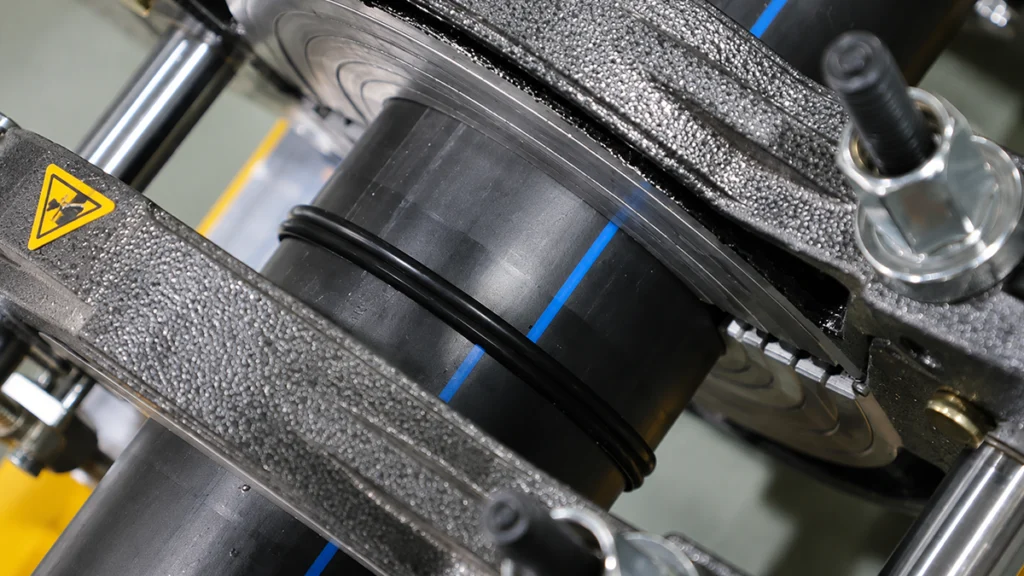
Before anyone turns on the pumps and pressurizes the line, operators need to visually inspect every single joint. They are looking for a uniform, double-rolled bead that folds over symmetrically and touches the pipe surface perfectly. If a bead looks lopsided, you immediately know there was physical misalignment during clamping, or the liner inserts are shot. Furthermore, operators must factor in drag pressure. If they fail to measure the kinetic friction of dragging a heavy pipe string and add that to the baseline interfacial pressure, the joint will be dangerously under-pressurized.
Maintenance, Training, and Long-Term Operating Best Practices
What routine maintenance keeps the machine stable?
Keeping that crucial ±5°C temperature variance intact requires technicians to regularly hit the heating element with a multimeter to check resistance. The Teflon heating plate needs constant cleaning to remove plastic residue, but crews must only use non-abrasive wooden or cotton tools to keep the coating pristine. On the mechanical side, operators should routinely wipe down and oil the chassis guide pillars, monitor hydraulic fluid levels, and bleed the oil-gas separator so the cylinders actuate smoothly.
What operator training should be required before field use?
You can buy the most advanced Butt Fusion Machine in Bolivia, but it still needs a skilled hand at the controls. Training programs must drill operators on how to calculate exact interfacial pressures. They need to know how to take standard guidelines (like 0.15 N/mm² or 60-90 PSI) and convert them into the specific gauge pressure their butt fusion welding machine’s hydraulic cylinders require. Furthermore, operators must learn to rigidly follow the mandated heat soak and cooling times based on the pipe’s SDR. Project deadlines never justify rushing the cooling cycle.
How do spare parts and service support reduce downtime?
When a HDPE pipe welding machine goes down on a mining site, you bleed thousands of dollars every hour. Smart procurement managers order critical spare parts the same day they buy the plastic pipe welding machine. Stock up on spare heating tubes, replacement Teflon coatings, hydraulic seals, and extra liner inserts. Worn liners are the number one reason pipes misalign and beads form asymmetrically. Keeping these consumables on site, backed by a manufacturer that actually answers the phone for technical support, guarantees your pipeline schedule stays on track.
Frequently Asked Questions
Q1: What size pipe can a butt fusion machine handle?
Manufacturers categorize machines by their maximum capacity. You’ll find compact 160mm units all the way up to massive 1600mm+ frames built for heavy civil engineering. By using reducing liners, a single butt fusion machine can comfortably weld several smaller pipe diameters within its specific range.
Q2: Is a hydraulic butt fusion machine better for mining projects?
Yes. Mining operations rely on large, thick-walled HDPE pipes (usually 250mm and up). A hydraulic butt fusion machine delivers the raw mechanical force needed to overcome heavy pipe drag and lock in the strict 0.15 MPa (21.75 PSI) interfacial pressure required for a bulletproof joint.
Q3: Can one machine be used for both water pipelines and mining pipelines?
Absolutely. As long as the pipe material (HDPE/PE) and diameter fit within the butt fusion machine’s rated specifications, you can seamlessly swap the equipment between municipal water distribution jobs and aggressive mining fluid transport.
Q4: What voltage or power supply is needed for field use in Bolivia?
Depending on the size, these butt fusion machines run on either 220V or 380V. However, because of Bolivia’s extreme altitudes, you must oversize your generators by 1.5x to 2.5x the machine’s rated kW. This compensates for combustion power loss and prevents weld-ruining voltage drops.
Q5: How do I compare butt fusion machines by diameter range and automation level?
Start by identifying the largest pipe OD and wall thickness your project requires—this dictates your chassis size. Next, select your automation tier (manual, semi-automatic hydraulic, or full CNC) based on how strictly your project mandates data logging and compliance with standards like ISO 21307.
Q6: What should I ask a supplier before placing an order?
Always ask for proof of ISO 9001 certification, CE electrical marks, and DVS 2207 compliance. Dig into the total landed costs to Bolivia, verify spare parts availability, check the warranty on hydraulic components, and confirm whether a data logger is included.
Q7: How often does a butt fusion machine need maintenance?
Daily tasks include cleaning the Teflon plate and inspecting the hydraulic quick-connects. Weekly, crews should lubricate the guide pillars and check the liner inserts for wear. Also, always test the electrical resistance of the heating plate before kicking off a new project phase.
Q8: What are the most common causes of weak fusion joints?
The usual suspects are “cold welds” caused by low heating plate temperatures, dragging out the changeover time, failing to calculate and add drag pressure, and letting environmental contaminants like dust, oil, or moisture sit on the pipe ends before fusion.
Conclusion
Getting the right Butt Fusion Machine in Bolivia on site is a high-stakes technical decision. It directly dictates the safety, environmental compliance, and long-term survival of both mining and municipal water builds. To get it right, you have to match the HDPE pipe welding machine’s hydraulic muscle and diameter capacity to the exact SDR of your pipeline, all while factoring in harsh environmental realities like high-altitude generator derating.
Whether you are sourcing a rugged hydraulic rig for remote Andean dewatering or a fully automated CNC system for municipal water diversion, focus on the fundamentals. Prioritize equipment that locks in strict temperature control (±5°C variance) and delivers pinpoint interfacial pressure. Contractors who avoid rookie mistakes—like running undersized generators, ignoring drag pressure calculations, or letting Teflon heating plates degrade—will consistently produce permanent, leak-free networks. By vetting suppliers on their adherence to ISO 21307 and DVS 2207 standards, optimizing total landed costs, and securing critical spare parts upfront, you slash downtime and aggressively protect your project’s bottom line.
Let our experts help you choose the right equipment for your project
Contact Our Engineering Team