
HDPE Pipe Welding Machines with Rapid Lead Times
Table of Contents
Introduction
If the HDPE pipe welding machine shows up two weeks late, it’s not just an inconvenience—it’s a financial disaster. For a pipeline contractor, that delay can bleed over $50,000 in daily penalties and idle crew costs. In the high-pressure world of municipal infrastructure and industrial piping, equipment availability is often the thin line between a profitable project and a lawsuit over liquidated damages.
While you can’t compromise on technical specs—ISO 21307 compliance and 0–16.0 MPa pressure ranges are non-negotiable—the logistics of getting that heavy iron to the job site are just as vital.
This guide cuts through the supply chain noise. We will examine the strategic value of speed, how to handle Minimum Order Quantities (MOQ) without overextending, and the technical checkpoints required to validate a butt fusion machine before you sign the invoice. Whether you are a wholesale distributor or an end-user, we’ll walk you through balancing rapid delivery with rigorous pre-shipment inspections.
By the end, you’ll have a solid framework for selecting the right gear for DN63–DN2600mm HDPE pipe projects—avoiding the specification errors that kill timelines. Ekberg Welding merges deep inventory with factory-direct logistics to bypass typical industry bottlenecks, ensuring your welding assets are on the ground and running exactly when your schedule demands it.

—
The Strategic Importance of Fast Lead Times in Pipeline Projects
Analyze the cost of downtime in municipal water and gas distribution projects
In pipeline infrastructure, time isn’t just money; it’s survival. When a project manager calculates the ROI for a new fleet of fusion equipment, the “Cost of Delay” is the variable that matters most. On a standard municipal water main project using DN450 HDPE, a stalled worksite burns capital fast. Industry data suggests a single day of downtime caused by missing equipment can cost anywhere from $15,000 to $50,000, depending on crew size and penalty clauses.
That figure isn’t just a guess. It includes idle labor (welders, excavators, safety officers), heavy equipment rental (cranes, generators sitting silent), and strict municipal fines for traffic disruption. If a contractor is left waiting on a shipment stuck in customs or caught in a manufacturer’s backlog, the financial hit often eclipses the purchase price of the butt fusion welding machine itself. Procurement officers need to look for suppliers who guarantee dispatch within 24 to 48 hours for standard models, rather than the sluggish 8 to 12-week lead times typical of generalist suppliers.
Compare “Just-in-Time” delivery vs. maintaining distributor stock for HDPE pipe welding machines
“Just-in-Time” (JIT) manufacturing works wonders for building cars, but it’s a risky gamble for pipeline construction. Relying on JIT delivery for critical assets like the HDPE pipe welding machine leaves contractors exposed to the chaos of global supply chains.
For distributors, the strategy needs to shift from JIT to “Strategic Stock Buffering.” Ekberg Welding advises partners to keep a baseline inventory of high-turnover models—specifically the Medium Series (160mm–630mm)—to satisfy immediate local needs. While JIT saves on warehousing, the opportunity cost of losing a tender because you can’t deploy immediately is far higher. Usually, a hybrid approach wins: keep local stock for standard DN ranges, but rely on the manufacturer’s air-freight speed for the Extra Large Series (up to 2600mm).
Research the impact of seasonal demand spikes on global equipment availability
Construction doesn’t happen in a vacuum; it happens in weather windows. In the Northern Hemisphere, the rush for fusion equipment hits hard from April to October. Conversely, in markets like Australia or South America, the peak aligns with their dry months.
During these windows, lead times from major brands can balloon from 4 weeks to 20 weeks. Smart procurement means forecasting these spikes. Buyers who lock in orders for automatic hdpe pipe welding machine units during the off-season (typically January–February) secure better pricing and guaranteed slots. However, emergencies happen. When unplanned needs arise during peak season, partnering with a manufacturer that holds a “rolling stock” of finished goods—rather than building to order—is the only way to bypass the seasonal bottleneck.
Case Study: How rapid equipment deployment accelerates emergency pipeline repair
Picture a catastrophic failure in a DN630 sewage transmission line. The utility company needs to replace a 200-meter section with HDPE immediately. The incumbent contractor’s gear is tied up elsewhere, and local rentals don’t meet the strict CNC data logging requirements for environmental compliance.
In this exact scenario, Ekberg Welding triggered its “Emergency Dispatch Protocol.” A DN630 CNC automatic butt fusion machine, pre-calibrated to ISO 21307 standards, was crated and on a plane within 18 hours. It arrived on-site 48 hours later. If the utility had relied on a standard supplier with a “build-to-order” policy, the six-week lead time would have forced them to install temporary bypass pumping systems costing upwards of $100,000. Rapid logistics isn’t a luxury—it’s an operational necessity for critical infrastructure.
—
Navigating the Ordering Process: Wholesale, Custom, and Low MOQ Options
Define “HDPE pipe welding machine minimum order quantity” policies for distributors vs. end-users
Understanding HDPE pipe welding machine minimum order quantity (MOQ) policies can be tricky for international buyers. Most manufacturers split their policies based on who is buying. For end-users—construction firms or utility departments—the MOQ is almost always one unit. This allows you to buy exactly what the project needs without tying up cash in dead stock.
For distributors wanting wholesale pricing, MOQs are usually about shipping logic, not production limits. A typical wholesale MOQ might be 3–5 units to fill a container efficiently. However, Ekberg Welding takes a flexible approach: we allow “Mixed Container” orders. A distributor can hit the wholesale threshold by mixing Small Series (63-160mm) and Large Series (1000-2000mm) butt fusion machines, rather than being forced to buy five of the exact same model.
Step-by-step guide to the “HDPE pipe welding machine ordering process”
Efficiency in the automatic pipe welding machine ordering process prevents technical mismatches. To avoid headaches later, follow this engineering-verified path:
1. Technical Inquiry: Define the pipe diameter range (e.g., DN160–315), material (PE100, PP, PVDF), and the standard you need to meet (ISO 21307 or DVS 2207).
2. Voltage Verification: Check the site power. Is it 220V Single Phase or 380V/415V 3-Phase? Getting this wrong is the most common error we see.
3. Proforma Invoice (PI) & Specs Confirmation: The manufacturer issues a PI detailing the CNC controller version, hydraulic cylinder stroke, and included inserts.
4. Production/Dispatch: Once the deposit lands, the butt fusion machine is pulled from stock or entered into the production queue.
5. Pre-Shipment Inspection (PSI): Video verification of your specific butt fusion welding machine performing a test weld cycle.
6. Logistics Arrangement: Booking Ex-Works, FOB, or CIF shipping terms.
Strategies for distributors to buy automatic HDPE pipe welding machine wholesale effectively
When distributors look to buy automatic HDPE pipe welding machine wholesale, it’s all about the landed cost per unit. The best play here is “Container Load Planning.” Shipping heavy machinery individually via LCL (Less than Container Load) is a recipe for damage and inflated freight bills.
A 20ft container can comfortably hold roughly 20-30 units of the Small Series (160mm) or 4-6 units of the Large Series (1200mm). Distributors should work with the manufacturer to use Computer-Aided Load Planning to mix hdpe fusion machine sizes, ensuring zero wasted space. Also, smart wholesale buyers negotiate for a spare parts package (hydraulic seals, heating plates, planner blades) to be tucked into the container. This creates an immediate after-sales support inventory for a fraction of what air freight would cost later.
Finding HDPE pipe welding machine suppliers low moq without compromising on machine quality
There is a trap when hunting for HDPE pipe welding machine suppliers low moq. Some manufacturers offering low MOQs do so because they are desperate for volume, which often signals weak quality control or non-standardized production.
To find a reliable supplier with low MOQs, look for established factories that offer “Trial Orders.” A reputable manufacturer like Ekberg allows a single-unit order at a near-wholesale rate for qualification. Verify that the supplier enforces the same Pre-Shipment Inspection (PSI) standards for that single unit as they would for a full container. Run away from suppliers who offer to waive ISO compliance checks or data logger calibration just to speed up a small order.
—
Technical Criteria: What to Look for When Ordering Automatic Welders
Detail the CNC control system specifications: Data logging capacity and interface languages
The brain of an HDPE pipe welding machine is its CNC control unit. In modern infrastructure, simple automation isn’t enough; you need data integrity. Buyers must verify that the onboard data logger can store at least 2,000 weld records. On long-haul pipeline projects, this capacity means you don’t have to export data every single day, reducing the administrative load.
The interface also needs to speak your language—literally. A butt fusion welding machine sent to a mine in Peru needs Spanish logic, while that same unit in Angola needs Portuguese. Ekberg’s CNC systems come pre-loaded with major global languages and offer encrypted USB export, thermal printer output, and Cloud upload capabilities. This ensures your weld data is tamper-proof and traceable.
List specific welding parameter compliance: ISO 21307 and DVS 2207-1 standards
A butt fusion machine is only as good as its adherence to global standards. The two benchmarks that matter are ISO 21307 (High Pressure) and DVS 2207-1 (German Welding Society).
- ISO 21307: The hdpe fusion machine must handle High Pressure (SHP) welding, often requiring fusion pressures up to 0.17 MPa plus drag pressure. The hydraulic system has to be robust enough to hold this without flinching.
- DVS 2207-1: This standard demands precise temperature uniformity. The heating plate must maintain a surface temperature between 200°C and 230°C (for PE100) with a deviation of no more than ±3°C across the entire plate.
Analyze the hydraulic system components: Pressure sensor accuracy and stability
The hydraulic system is the muscle of the operation. If the pressure application is off, you get “cold welds” or brittle joints. When ordering, specify that the pressure sensor accuracy must be within ±1%.
Crucially, the system must feature “Pressure Maintenance” during the cooling phase. For a DN630 pipe, cooling can take over 45 minutes. As the plastic cools and contracts, pressure drops. The hydraulic system must automatically sense this and compensate. Ekberg butt fusion machines use a closed-loop control system with cartridge valves that detect drops as small as 0.2 bar, automatically engaging the pump to restabilize the joint so weld integrity is never compromised.
Compare voltage and power requirements for different global markets
Voltage incompatibility is a classic cause of commissioning delays.
- Small/Medium Series (63mm–1000mm): Typically need 220V/50Hz single-phase power. Total draw is usually 3 kW to 8 kW.
- Large Series (1200mm–2600mm): Require 380V 3-phase power. Consumption can exceed 25 kW.
You also have to account for generator stability. Field generators are notorious for fluctuating. High-quality CNC welders include built-in voltage stabilizers or rectifiers to shield sensitive computer boards from the “dirty power” found on remote sites.
—
Selection Guide: Matching Machine Capabilities to Project Scope
Compare Automatic (CNC) vs. Semi-Automatic vs. Manual machines: ROI analysis
Choosing between Manual, Semi-Automatic, and Fully Automatic (CNC) models comes down to economics.
- Manual: Lowest upfront cost, but the highest risk of operator error. We don’t recommend these for pressure pipes (gas/water).
- Semi-Automatic: Hydraulic assist cuts down on fatigue, but the operator still controls the phase transitions. Fine for non-critical drainage.
- Fully Automatic (CNC): Highest upfront cost, but the best ROI for pressure pipelines. Automation cuts labor costs by roughly 25% (one operator vs. two) and boosts throughput by 40% thanks to optimized cooling cycles. The “Zero-Defect” logic eliminates the nightmare of cutting out and re-welding failed joints—a mistake that can cost $2,000 per incident on large diameter pipes.
Custom automatic pipe welding machine orders: Options for extended chassis or ruggedized frames
Standard butt fusion machines cover 90% of jobs, but custom HDPE pipe welding machine orders are essential for the other 10%.
- Mining: You need “Ruggedized Frames” with reinforced skid plates and all-terrain wheels to survive dragging over abrasive rock.
- Fabrication: Workshop machines might need an “Extended Chassis” to weld fittings (elbows, tees) that standard clamps can’t grip.
- Coatings: Specific chemical applications (PVDF) may require specialized heating plate coatings, different from the standard PTFE used for HDPE.
Selection checklist by pipe diameter: From small distribution to large transmission mains
- Distribution (DN63–DN160mm): Focus on portability. Two men should be able to lift it.
- Feeder Mains (DN160–DN355mm): The workhorse range. Speed and rapid heating plate ejection are your priorities here.
- Transmission (DN450–DN1000mm): Focus on hydraulic power and drag pressure compensation. You’ll need a crane to move these.
- Mega Pipes (DN1200–DN2600mm): These are bespoke projects. The hydraulic butt fusion machine needs massive structural rigidity to prevent the frame from flexing under high fusion pressures.
Evaluate the importance of integrated report generation for establishing weld traceability
In regulated industries like Gas, Potable Water, or Nuclear, the rule is simple: “If it isn’t documented, it isn’t welded.” Integrated report generation is mandatory. The HDPE pipe welding machine must record:
1. Operator ID
2. GPS Coordinates (for GIS mapping)
3. Ambient Temperature
4. Drag Pressure (measured, not assumed)
5. Time/Pressure/Temperature graph
This data creates a digital passport for every joint, allowing asset owners to trace a specific weld back to the butt fusion welding machine and operator years down the line.
—
Manufacturing Excellence, Quality Control & Global Logistics
Describe Ekberg’s factory capabilities: Monthly production capacity and stock buffering
To deliver on the promise of fast lead times, Ekberg Welding runs a facility capable of churning out 150+ units a month. But speed isn’t magic; it’s inventory. We employ a “Stock Buffering Strategy,” maintaining a rolling inventory of semi-finished chassis and hydraulic units for our most popular sizes (DN160, DN250, DN315). This allows us to assemble, calibrate, and dispatch a standard hdpe fusion machine in as little as 24 hours, blowing the industry standard of 3-4 weeks out of the water.
Explain the Pre-Shipment Inspection (PSI) process
Speed never comes at the expense of quality. Every HDPE pipe welding machine undergoes a rigorous Pre-Shipment Inspection (PSI):
- Temperature Mapping: We use a digital pyrometer to verify the heating plate stays within ±3°C uniformity.
- Pressure Holding Test: The hydraulic system is pressurized to 1.5x max operating pressure and held for an hour to sniff out seal leaks.
- Electrical Safety: Earth leakage and insulation resistance testing to CE standards.
- Functional Weld: A “dry run” of the full CNC cycle to verify the software logic and sensor inputs are talking to each other correctly.
Detail packaging and logistics: Reinforced wooden crates and freight options
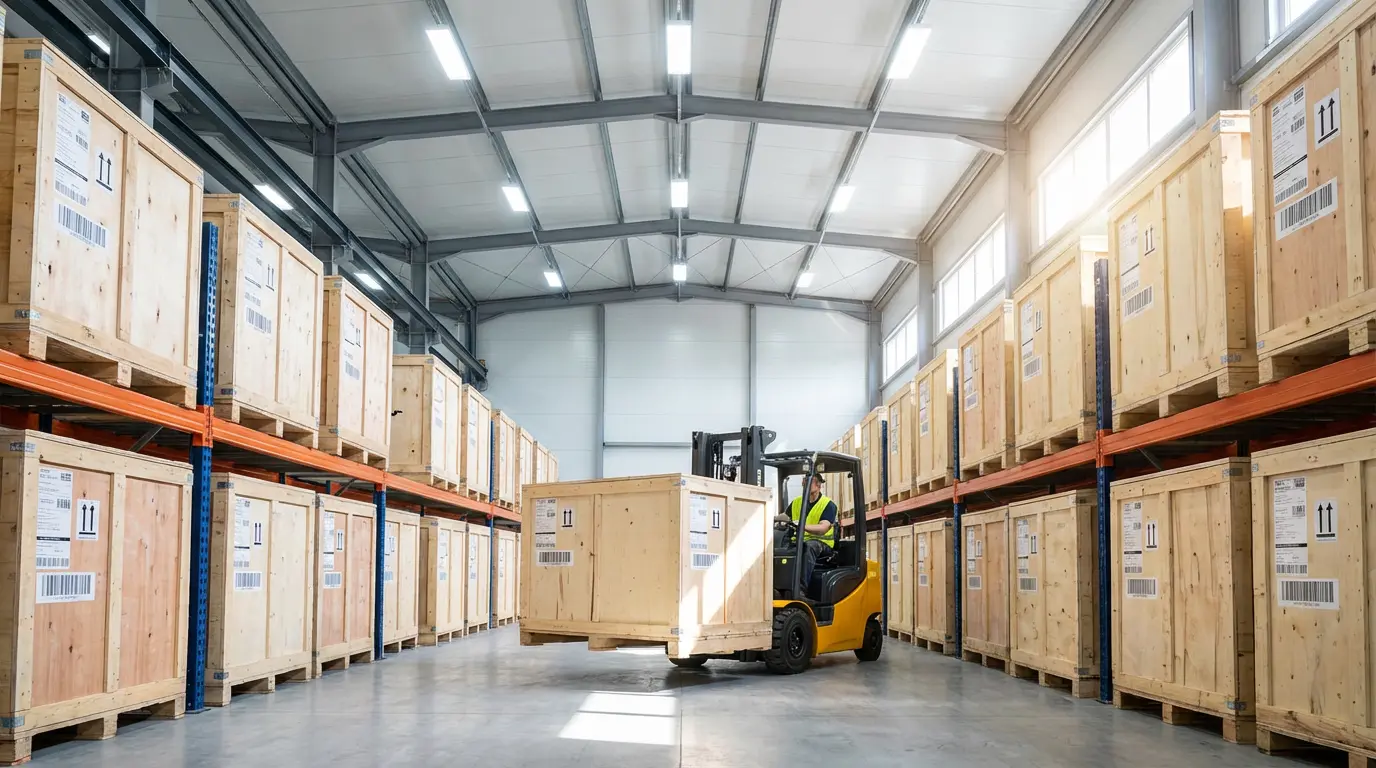
Shipping heavy industrial equipment demands protection. Butt fusion machines are packed in fumigated, reinforced wooden crates built to withstand the shocks of ocean freight and the vibration of air cargo. Inside, the hydraulic unit is vacuum-sealed to prevent moisture ingress (rust) while at sea.
- Express Air Freight: 3-7 days transit. Best for emergency replacements or high-value CNC units.
- Sea Freight: 20-40 days. The most cost-effective route for wholesale container orders.
After-sales support infrastructure: Availability of spare parts and remote diagnostics
The relationship doesn’t end when the truck leaves the dock. Ekberg Welding supports international clients with a dedicated spare parts inventory. Critical consumables—hydraulic seals, heating elements, and planer blades—are stocked for immediate courier dispatch (DHL/FedEx). Furthermore, our CNC automatic butt fusion machines feature remote diagnostic capabilities. If a machine throws an error code, our technicians can analyze the data log file remotely to guide on-site repairs, keeping downtime to a minimum.
—
Frequently Asked Questions
Q1: What is the typical lead time for a standard HDPE pipe welding machine order?
For standard models (DN63–DN630), Ekberg Welding typically maintains stock ready for dispatch within 24–48 hours. For larger, non-standard sizes (DN800+) or customized orders, production lead times generally run 10 to 15 days. Air freight can get the unit to most global destinations within 5–7 days, while sea freight depends on your region.
Q2: Can Ekberg accommodate custom pipe welding machine orders with specific branding?
Yes, we accept custom automatic pipe welding machine orders for distributors and large fleet owners. This includes OEM branding (custom colors, logo placement on the chassis and CNC interface) as well as technical mods like extended frames or specific voltage configurations. Custom paint and assembly usually add a little time to the schedule.
Q3: How does the warranty coverage work for international shipments?
We offer a comprehensive 1-year standard warranty on all butt fusion machines. This covers the free replacement of non-human damaged parts, such as hydraulic sensors, screens, or motor components. We ship these parts via express courier at our expense. Once the warranty expires, we provide lifetime technical support, charging only for the material cost of spare parts.
Q4: What are the shipping terms (FOB, CIF, DDP) available for wholesale buyers?
We offer flexible Incoterms to match your logistics setup. FOB (Free on Board) is common if you have your own freight forwarders. CIF (Cost, Insurance, and Freight) is what we recommend for most clients, as we handle the shipping and insurance to your destination port. DDP (Delivered Duty Paid) is available in select regions for a complete door-to-door service.
Q5: Is training provided for operating the CNC automatic systems?
Yes. While the CNC interface is designed to be intuitive, we back it up with extensive training resources. This includes digital operation manuals, step-by-step video tutorials, and remote video conference sessions. For large fleet purchases, we can even arrange on-site technical training to ensure your crew is certified to operate the equipment safely and efficiently.
—
Conclusion
Success in modern pipeline construction requires a balance of engineering precision and supply chain agility. Selecting the right HDPE pipe welding machine involves more than just comparing pressure specs; it requires a partner who understands that a machine on a boat cannot weld a pipe in a trench.
By prioritizing measurable compliance with ISO standards, insisting on robust data logging for traceability, and choosing a supplier with a proven “Stock Buffering Strategy,” you insulate your projects from the costly risks of downtime. Whether you need a single unit for an emergency repair or a container load for wholesale distribution, the logistics behind the butt fusion machine are just as important as the hydraulics inside it.
Don’t let equipment delays dictate your project timeline. Contact Ekberg Welding today to request a factory-direct quote, check our current stock availability for immediate dispatch, and secure the welding technology your infrastructure projects demand.