
HDPE Pipe Welding Machine with Flexible Custom Solutions
Table of Contents
HDPE pipe welding machine technology, operating at precise parameters—such as 220°C heating plate temperatures and 0.15 MPa fusion pressure—is the linchpin of modern polyethylene infrastructure. Yet, for distributors and specialized contractors, procuring this equipment often creates a frustrating dilemma: do you accept rigid, capital-intensive Minimum Order Quantities (MOQs) from major manufacturers, or do you risk project failure with low-quality generic units?
This guide explores how flexible manufacturing strategies are changing that narrative. We will show you how to secure high-specification CNC fusion equipment tailored to your specific project needs without the financial anchor of massive inventory. From navigating regional power standards to understanding the economics of Just-in-Time heavy butt fusion welding machine procurement and the strict technical compliance required for ISO 21307 and DVS 2207, we cover it all.

The Strategic Advantage of Flexible MOQ for Distributors and Contractors
In the heavy equipment sector, the ability to source butt fusion welding machine based on immediate demand rather than quarterly guesses is a massive competitive edge. For those distributing plastic pipe welding equipment, inventory fluidity is just as critical as the technical reliability of the butt fusion machines themselves.
Reducing Inventory Risk with Low MOQ Entry
For regional distributors, stocking high-value capital equipment carries significant financial risk. A standard container load of butt fusion machines can easily tie up hundreds of thousands of dollars. Flexible MOQs flip this script, allowing distributors to enter new markets or test specific hdpe fusion machine series with low initial volume—sometimes as few as 1 to 5 units.
This approach drastically reduces exposure to market volatility. For example, a distributor can order a mixed batch of the HDPE pipe welding machine price range leaders—typically the DN160–DN315 sizes—without being forced to commit to slower-moving large-diameter units (DN2600mm). By lowering the barrier to entry, capital can be reallocated toward technical training and local service infrastructure rather than warehousing costs. This agility allows businesses to jump on local tender opportunities immediately, supplying specific models that competitors locked into rigid stock cycles simply cannot provide.
Project-Specific Procurement for Contractors
Large-scale infrastructure projects, such as municipal water mains or mining slurry pipelines, often come with unique specifications that off-the-shelf inventory cannot meet. A contractor might win a bid for a 50km pipeline requiring DN1200 welding capability. Purchasing such massive equipment for a single project is a heavy CapEx decision.
Flexible procurement models allow contractors to order exact quantities of specialized butt fusion welding machines for “Just-in-Time” delivery. Instead of forcing a standard fleet to work on a unique project, contractors can specify the exact size range (e.g., 1200mm–1600mm) and pressure capabilities (up to 16.0 MPa system pressure) required for that specific job site. This ensures the HDPE pipe welding machine arriving on-site is optimized for the specific pipe wall thickness and environmental conditions, slashing the likelihood of equipment-related delays.
Scaling Up: From Sample Orders to Container Loads
The partnership between a manufacturer like Ekberg and a global distributor typically follows a growth curve. It starts with sample orders—single units subjected to rigorous field testing to validate hydraulic seal integrity, heating plate uniformity (≤ ±3°C), and software logic. Once technical validation is confirmed, the relationship scales to palletized orders and eventually Full Container Loads (FCL).
Price breaks are structured to reward this growth. While single-unit custom orders command a slight premium to cover engineering setup, volume orders unlock significant economies of scale. The real value proposition, however, is the manufacturer’s willingness to support that early “sample” phase with the same engineering rigor as the “container” phase, ensuring the transition from pilot project to mass distribution is seamless.
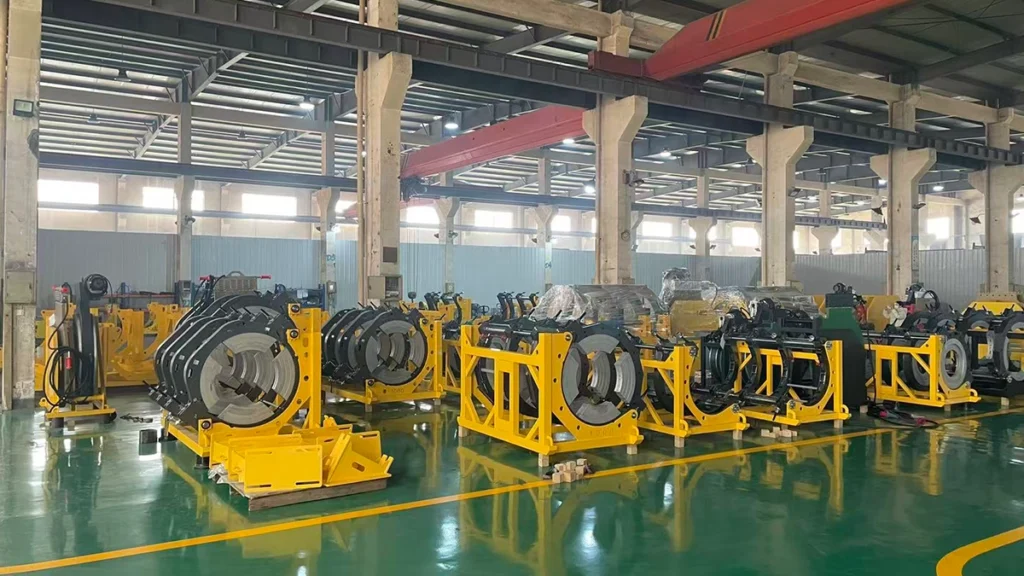
Customization Scope: Tailoring HDPE Pipe Welding Machine to Market Needs
Standardization ensures consistency, but customization ensures applicability. In diverse global markets, a butt fusion machine often fails to meet local electrical, environmental, or branding requirements.
OEM Branding and Private Labeling
Building brand equity is essential for distributors who provide local warranty and support. OEM (Original Equipment Manufacturer) services go far beyond slapping a sticker on the chassis. Deep customization involves applying specific RAL color codes to match the distributor’s corporate identity, casting logos directly into metal components, and configuring startup splash screens on CNC controllers.
This level of branding transforms a generic butt fusion welding machine into a proprietary product line. It protects the distributor’s territory; when a butt fusion machine requires service or parts, the end-user contacts the brand on the chassis. This ensures recurring revenue from maintenance and spare parts. For the end-user, a localized brand signifies that the equipment is backed by a local entity responsible for its performance, rather than a distant, anonymous factory.
Technical Adaptation for Regional Power Standards
Electrical standards vary drastically across key markets, and using transformers or adapters on high-amperage welding equipment is a safety risk. A robust customization strategy involves re-engineering the electrical system at the factory level.
- North America: Construction sites often utilize 110V/60Hz single-phase power for smaller tools. A 160mm hydraulic butt fusion machine must be wound specifically for this voltage to prevent motor burnout or insufficient heating.
- Europe/Industrial: Larger HDPE pipe welding machines (DN315 and above) typically require 380V/50Hz 3-phase power. However, specific plugs (Red 5-pin vs. Blue 3-pin) and phase rotation protection must be installed to match local grid configurations.
- Mining Operations: High-voltage environments may require 480V or even 575V capability.
Modifying these inputs requires changing contactors, circuit breakers, and heating elements. Factory-level customization ensures these changes are compliant with safety loads, avoiding the dangerous hazards of field-modified electrical systems.
Software and Interface Localization
The human-machine interface (HMI) is where the operator interacts with the HDPE pipe welding machine. If the CNC software is only available in English or Chinese, the risk of operator error skyrockets. Customization includes translating the entire operating system—prompts, error codes, and menus—into local languages such as Spanish, Russian, or Arabic.
Beyond language, the data logging format often needs adaptation. Some municipal utilities require welding reports to output specific fields, such as Operator ID or Project GPS Coordinates in a fixed layout. Custom firmware can enforce these inputs before the welding cycle begins, ensuring that every joint report generated meets the specific bureaucratic requirements of the local water or gas authority.
Component Upgrades for Harsh Environments
Standard hydraulic seals and electrical components are rated for typical temperate climates (-5°C to +40°C). However, pipelines are often built in extremes.
- Arctic Conditions: For projects in Siberia or Canada, butt fusion welding machines require “Arctic Kits” featuring silicone heating pads for hydraulic oil reservoirs, low-temperature aerospace-grade seals, and insulated control boxes to function at -40°C.
- Desert/Mining: In high-dust environments like Australian iron ore mines, standard IP54 ratings are insufficient. Customization involves upgrading to IP65-rated enclosures, adding heavy-duty dust filters to cooling fans, and using corrosion-resistant stainless steel fittings instead of galvanized steel.
Price Analysis and ROI: Balancing Cost vs. Customization
Procurement decisions ultimately hinge on value. Understanding the cost structure of automated welding equipment helps buyers justify the investment to stakeholders.
Decoding the HDPE Pipe Welding Machine Price Range
The price spectrum for butt fusion equipment is wide. A manual DN160 unit might cost significantly less than a fully automatic CNC equivalent. The premium for automation lies in the closed-loop control systems: pressure transducers, temperature probes, and the onboard computer that manages the welding algorithm.
- Small Range (DN160–500): The HDPE pipe welding machine price range typically falls between $3,500 and $8,000 USD. The cost variance depends on the inclusion of data logging and the quality of the hydraulic components.
- Medium Range (DN630–1000): Prices range from $12,000 to $25,000 USD. At this size, the cost of the chassis steel and hydraulic cylinders becomes a larger factor.
- Large Range (1200–2600): These heavy-duty units range from $35,000 to over $65,000 USD. The cost is driven by massive power requirements (up to 23.5 kW) and the engineering required to handle forces exceeding 10 tons.
ROI Calculation: Automatic vs. Manual Welding
To calculate the HDPE pipe welder return on investment, one must look beyond the purchase price to operational efficiency. Consider a hypothetical 5km water pipeline project using DN315 pipe.
- Manual Welding: An operator averages 20 minutes per joint plus 10 minutes for setup and cooling monitoring. At 2 joints per hour, with a typical industry failure rate of 5% due to human error (inconsistent pressure), the cost of rework is high.
- Automatic Welding: The butt fusion machine executes the cycle precisely. With optimized cooling phases (ISO 21307), the cycle drops to 15 minutes + 5 minutes setup. This yields 3 joints per hour—a 33% gain in productivity.
- The Verdict: On a project with 500 joints, the HDPE pipe welder saves approximately 83 labor hours. Furthermore, reducing the failure rate from 5% to <1% saves the cost of excavating and re-welding 20 joints. At an estimated $200 per repair (labor + material), the savings ($4,000) contribute significantly to offsetting the butt fusion welding machine’s capital cost in just one project.
The Cost of Customization vs. Standard Models
Custom orders do impact the robotic pipe welding system price list, but often less than buyers expect. Cosmetic customizations (color, branding) usually incur a small setup fee that vanishes with volume. Technical customizations (voltage, software) may add 5-15% to the unit cost due to non-standard component procurement.
However, for distributors, this higher unit cost is offset by higher margin potential. A specialized, branded butt fusion machine that meets local utility standards can be sold at a premium compared to a generic grey market import that requires aftermarket modification to be legal.
Lifecycle Costs and “Cost of Orbital Pipe Welding Machine” Clarification
It is important to clarify industry terminology. While “orbital” welding often refers to TIG welding of steel pipes, in the plastics industry, high-end automatic butt fusion offers similar precision. The lifecycle cost of orbital pipe welding machine equivalents in the plastic sector includes maintenance.
Over a 5-year period, an automatic HDPE pipe welding machine requires annual calibration (pressure and temperature verification) and hydraulic oil changes. However, the automated process reduces physical wear on the chassis caused by operator misuse (e.g., over-pressurizing). Consequently, automatic butt fusion machines often retain 40-50% of their resale value after 5 years, whereas manual machines, often subjected to rougher handling, may retain only 20%.
Ensuring Technical Compliance: Standards Behind Custom Orders
Customization must never compromise compliance. In the pipeline industry, adherence to standards is not optional—it is a legal and safety requirement.
Adhering to ISO 21307 and DVS 2207 in Custom Builds
Even when a butt fusion welding machine is customized for a specific market, the core welding physics must align with global standards.
- ISO 21307: This standard defines “Single High Pressure” (SHP) welding, requiring interfacial pressures of 0.52 MPa ±0.1 MPa. Custom hydraulic pumps must be sized to deliver this pressure consistently, even on the largest pipe sizes.
- DVS 2207-1: The German standard for “Low Pressure” welding requires a soak time calculation of 10 × Wall Thickness (seconds).
Any custom software logic must rigidly enforce these parameters. For example, if a buyer requests a “fast mode” that violates the minimum cooling time defined by ISO 21307, a responsible manufacturer like Ekberg will refuse the modification. The butt fusion welding machine’s firmware acts as a compliance guardian, preventing operators from bypassing critical soak or cool phases.
Data Logging and Traceability Requirements
Modern utility companies demand total traceability. Custom CNC automatic butt fusion machines are equipped with data loggers that record temperature, pressure, and time every second of the welding cycle. This data is encrypted to prevent tampering.
For custom orders, the output format of these logs is often tailored. Some markets require a simple PDF printout, while others require a CSV file upload to a central cloud database. The crucial element is that the data must be irrefutable proof that the joint was fused according to the standard. GPS coordinates provided by Beidou or standard GPS modules are often integrated into these reports to map the exact location of every joint in the pipeline.
Safety Standards and CE Certification
Modifying a hdpe fusion machine’s electrical system or motor configuration can impact its safety certification. For European markets, CE marking is mandatory. This certifies that the equipment meets safety requirements regarding moving parts, electrical insulation, and electromagnetic compatibility.
When Ekberg customizes a butt fusion machine—for instance, changing a motor from 220V to 110V—the engineering team validates that the new configuration still adheres to the safety margins required for CE certification. This ensures that the distributor is not importing a liability risk.
Factory Capability, Certification & Global Support
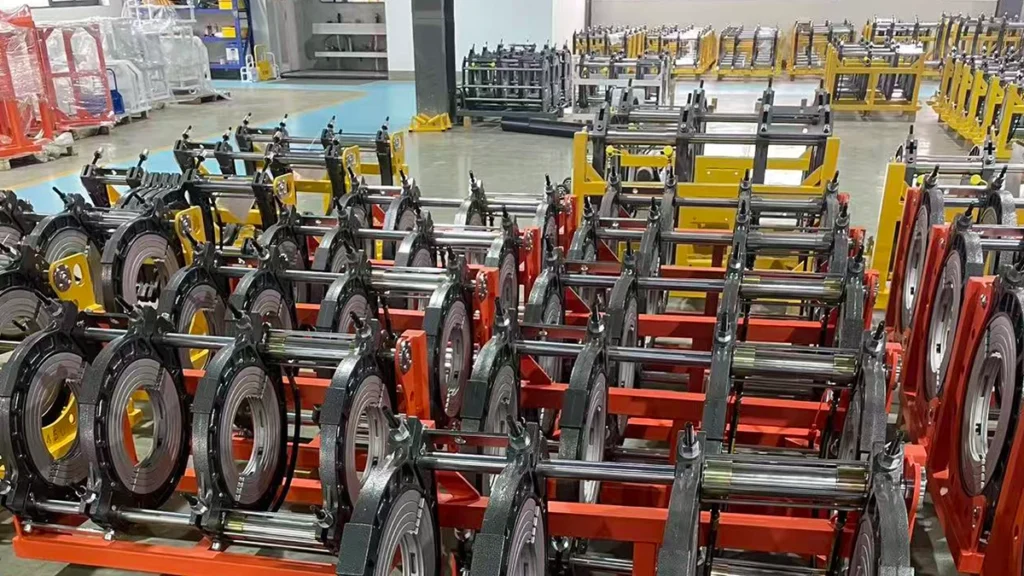
The ability to offer flexible MOQs and deep customization relies entirely on the manufacturer’s production agility and quality control infrastructure.
Ekberg’s Agile Manufacturing Process
Traditional assembly lines are designed for mass production of identical units. Ekberg utilizes a cellular manufacturing approach that allows for mixed-model assembly. This means a standard 250mm hydraulic butt fusion machine can be assembled alongside a custom DN630 OEM unit without causing bottlenecks. This agility is what allows for lead times of 15-25 days for custom orders, rather than the industry standard of 8-12 weeks.
Quality Control for Custom Batches
Every butt fusion machine, whether part of a 100-unit order or a single custom prototype, undergoes the same rigorous testing.
1. Heating Plate Uniformity: Verified to be within ±3°C across the entire surface using thermal imaging.
2. Pressure Holding: The hydraulic system is pressurized to maximum capacity (e.g., 6.3 MPa for small units, 16.0 MPa for large) and monitored for 24 hours to detect micro-leaks.
3. Software Simulation: The CNC unit runs simulated welding cycles to verify that the custom language interface and data logging triggers function correctly.
Global Spare Parts and Technical Support
A common fear regarding custom equipment is the availability of spare parts. Ekberg addresses this by maintaining a “Standard Core, Custom Shell” design philosophy. While the chassis color, voltage, or software may be unique, the critical mechanical components—hydraulic seals, quick couplers, planing blades, and temperature probes—are standardized across the range. This ensures that distributors can stock a basic kit of spares that services their entire fleet, regardless of customization level.
Frequently Asked Questions
Q1: What is the typical lead time for a custom-branded HDPE pipe welding machine order?
For custom OEM orders involving specific colors or branding, the typical lead time is 15 to 25 days. Standard stock models (DN160–315) can often ship within 3 to 7 days. Large-scale custom orders or non-standard voltages may require slightly longer for component procurement, but our agile manufacturing ensures delays are minimized compared to rigid assembly lines.
Q2: How does the HDPE pipe welding machine price range change for orders under 5 units?
Orders under 5 units generally carry a small premium to cover butt fusion welding machine setup and custom engineering costs (e.g., logo casting or software flashing). However, this premium is marginal compared to the capital cost of the hdpe fusion machine. The flexibility to order small quantities preserves your cash flow, offering a better total financial position than being forced into a large bulk order.
Q3: Can you customize the CNC software to support languages other than English?
Yes. We can program the CNC interface to support almost any language, including Spanish, Russian, French, and Arabic. We can also customize the data logger output to match specific local inspection formats. This ensures your operators can use the butt fusion welding machine safely and that your reports meet local municipal utility standards.
Q4: Do you offer specific welding parameters for non-standard pipe materials (e.g., PP-R or PVDF)?
Absolutely. While HDPE (PE100) is standard, our CNC systems allow for material selection. We can pre-load parameters for PP-R (210°C–225°C) or PVDF (230°C–240°C). For PVDF, we also recommend specific high-temperature liners and ensuring the heating plate PTFE coating is rated for higher thermal stress.
Q5: How do I calculate the “automatic pipe welder return on investment” for my specific rental fleet?
To calculate ROI, compare the daily rental rate of an automatic unit vs. a manual one against the maintenance and lifespan. Automatic HDPE pipe welding machines command 30-50% higher rental rates due to the data logging capability required by contractors. Additionally, automatic pressure control reduces physical abuse on the butt fusion machine, extending its rental lifespan by 2-3 years compared to manual units.
Conclusion
In the competitive landscape of pipeline infrastructure, the ability to source the right equipment at the right time is as valuable as the machinery itself. Flexible MOQs allow distributors to manage cash flow and test new markets without heavy risk, while deep customization ensures that contractors receive an HDPE pipe welding machine perfectly adapted to their environmental and regulatory challenges.
Whether you need a single 1200mm unit for a mega-project or a container of private-labeled DN250 hydraulic butt fusionmachines for local distribution, the value lies in partnering with a manufacturer that combines engineering rigor with commercial agility.
Ready to configure your fleet?
Don’t settle for off-the-shelf limitations. Contact Ekberg Welding today to request a factory-direct quote, receive a comprehensive robotic pipe welding system price list, or discuss your specific OEM requirements with our engineering team. Let’s build your next pipeline project on a foundation of precision and reliability.