
Leading Butt Fusion Machine Factory for Direct Sourcing
Table of Contents
Introduction
Choosing the right butt fusion machine suppliers isn’t just another procurement task. It’s a high-stakes call. A single compromised DN400 joint can easily bleed contractors for over $15,000 in emergency excavation and repair costs. When you’re dealing with high-pressure gas distribution or municipal water networks running at 1.6 MPa, equipment failure means catastrophic leaks, blown deadlines, and massive financial liabilities. In this guide, we will show you exactly how to spot top hdpe butt fusion machine manufacturers. We’ll look at hard technical specs, like ±5°C heating plate variance and 24 MPa hydraulic system capacities. We’ll unpack ISO 21307 and DVS 2207 compliance mandates, break down the real total cost of ownership, and weigh the financial upside of direct-to-factory wholesale buying.
By the time you finish reading, procurement managers and pipeline engineers will have a bulletproof, data-driven framework. You’ll know how to decode those complex price lists and spec out the exact gear required for DN40mm to DN2600mm infrastructure jobs. Get ready to bypass opaque supply chains and lock in reliable machinery that secures pipeline integrity for the next 50 to 100 years.

Why Sourcing from Top HDPE Butt Fusion Machine Manufacturers Matters
Assess the cost of equipment failure
A butt fusion machine’s true financial footprint goes way beyond the initial purchase price. You have to measure it by the massive financial exposure of a potential breakdown. HDPE pipe joints in municipal water and high-pressure gas networks are engineered to survive 50 to 100 years. But what happens when a subpar butt fusion welding machine introduces microscopic defects? Cold welds from weak heating or uneven bead formation from pressure drops are ticking time bombs. These invisible flaws inevitably grow into cracks under constant fatigue loading and system pressure spikes.
Suddenly, a century-long design life shrinks to a fraction of that time. Sure, renting or buying a basic, unverified butt fusion welding machine might run you anywhere from $500 to $4,000. But the fallout from a single joint failure in a live municipal water line easily tops tens of thousands of dollars. Think emergency excavation, specialized repair crews, and heavy environmental remediation.
For gas pipelines, the risk profile explodes exponentially. A failed joint triggers severe safety hazards, combustion risks, and crippling regulatory fines. Buying your gear exclusively from top-tier manufacturers guarantees the precise hydraulic pressure and thermal stability needed to wipe out these catastrophic risks entirely.
Detail compliance requirements with international welding standards
Any supplier worth their salt builds equipment that strictly adheres to international welding standards. These codes dictate every single phase of the fusion cycle. The global benchmark is ISO 21307, which governs both high- and low-pressure fusion parameters. It demands absolute control over heating time, thermal soak time, and controlled cooling rates so the polymer chains entangle flawlessly across the joint interface.
Working in the chemical, mining, or industrial sectors? Then you’ll likely face the DVS 2207 standard. This unforgiving German protocol requires extremely high-precision welds and pinpoint temperature controls. Thermal fluctuation simply isn’t an option. Over in North America, ASTM F2620 dominates gas projects, placing a heavy emphasis on sustained pressure integrity during the cooling phase.
To meet these rigorous standards, industry baselines require heating plates calibrated to 210°C ± 10°C. Premium manufacturers, however, push past those minimums. Take Ekberg Welding. Their butt fusion welding machines hold a tight temperature variance of just ±3°C to ±5°C. That micro-level thermal stability guarantees a perfectly uniform polymer melt across the entire pipe face—a hard requirement for DVS 2207 compliance and long-lasting joints.
Analyze the supply chain and cost benefits of buying direct from factory manufacturers vs. third-party trading companies
Third-party trading companies frequently bloat the global supply chain for industrial pipeline welding equipment. These middlemen routinely slap 30% to 50% markups on the final price. The worst part? They offer zero tangible technical value, engineering support, or warranty backing. Buying direct from factory manufacturers (OEM/ODM) completely flips this procurement dynamic.
Teaming up directly with a manufacturer like Ekberg Welding cuts out the middleman markup, slashing the initial capital expenditure (CapEx) for both contractors and distributors. But the benefits extend beyond upfront savings. This direct pipeline gives buyers immediate access to the actual engineers who designed and built the HDPE fusion welding machine.
Direct buyers lock in highly transparent wholesale pricing. Better yet, direct procurement ensures critical spare parts are authentic and provides high-level technical support the second a field issue pops up. Streamlining the supply chain like this drastically lowers your Total Cost of Ownership (TCO) while beefing up your operational support.
Key Capabilities to Look for in Wholesale Butt Fusion Machine Suppliers
Evaluate production capacity, inventory levels, and accurate lead times for bulk wholesale orders and distributor stocking
Scaling international operations or filling out a regional distributorship requires a hard look at a supplier’s raw production capacity. Top-tier manufacturers run fully integrated facilities. They can process massive bulk wholesale orders without letting their strict quality control standards slip. Your supplier needs the muscle to rapidly scale the production of complex hydraulic and electrical systems.
Ekberg Welding holds robust, strategic inventory levels. This setup guarantees expedited shipping on all standard plastic pipe welding machine models. That capability is an absolute lifesaver for pipeline contractors who can’t afford to pay crews to sit around waiting for delayed equipment. When urgent, high-stakes projects hit, reliable suppliers step up with rapid on-site services. They can even dispatch specialized backup equipment tailored to your exact requirements, ensuring supply chain hiccups never derail project momentum.
Research supplier product range depth
You can gauge a supplier’s technical chops and market reliability directly by the depth of their product catalog. A premier manufacturer has to offer a comprehensive equipment lineup if they want to act as a true single-source partner. This starts with manual butt fusion machines. These are perfect for small-diameter, low-budget, or remote jobs where power is scarce.
But when municipal-scale projects demand high fusion pressure, hydraulic butt fusion machines become non-negotiable. Ekberg’s hydraulic roster covers a massive footprint, spanning DN160-315, DN450/630/800, and heavy-duty DN1000-2600 configurations.
At the very top of the pipeline technology food chain sit CNC automatic butt fusion machines. These fully automated systems wipe out human error entirely. We’re talking 10-inch color touchscreens, up to four distinct temperature zones, and automated axial compression devices that deliver up to 10 N of axial pressure during the welding phase. To effectively support a diverse infrastructure portfolio, top suppliers must cover the entire diameter spectrum—from DN40mm all the way up to DN2600mm.
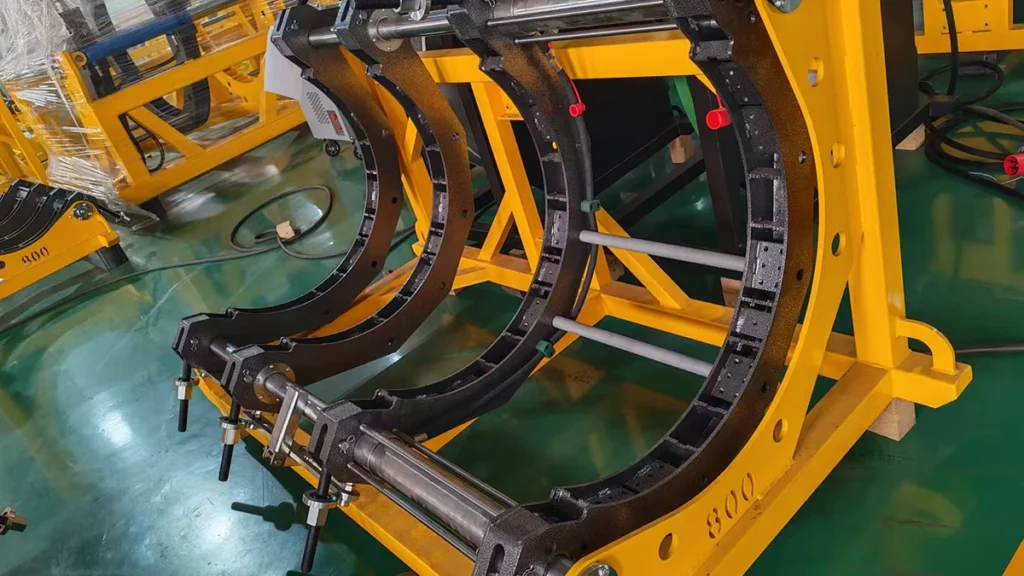
Investigate technical support capabilities
Equipment downtime kills profitability in the pipeline construction industry. Over 90% of construction teams need rock-solid, 24-hour online technical support to keep operations moving across global time zones. Elite suppliers build a comprehensive technical infrastructure designed to solve field issues the moment they happen.
What does this look like? Real-time video diagnostics and remote troubleshooting led by qualified engineers. Top manufacturers also provide on-site contractor training. Operators need to master the complex nuances of hydraulic drag pressure calculations and polymer heat absorption times. Rapid spare parts dispatch is another non-negotiable. Suppliers must immediately replenish common consumables—like PTFE-coated heating plates and hardened milling blades—to prevent costly site shutdowns.
Analyze global warranty terms, maintenance agreements, and after-sales service infrastructure for international buyers
Warranty terms tell you exactly how confident a manufacturer is in their own engineering and materials. The baseline industry standard hovers around a weak 12 months. Premium wholesale suppliers offer much stronger shields. Ekberg Welding backs its butt fusion welding machine with up to a 3-year warranty for non-human-induced damage, alongside lifetime maintenance support.
Top manufacturers also roll out structured maintenance agreements. They provide major clients with annual complimentary on-site maintenance and enforce strict service intervals—like full system calibrations every 2000 interfaces or 12 months. This routine care keeps pressure sensors and temperature gauges dialed in, guaranteeing decades of reliable, code-compliant field service.
Technical Specs & Equipment Quality Selection Checklist
Detail heating plate temperature stability specs
The heating plate is the literal heartbeat of a butt fusion machine. Cheap plates degrade the polymer through overheating or yield weak, cold joints because of poor thermal transfer. The plate’s coating must use high-quality Polytetrafluoroethylene (PTFE). This non-stick surface stops molten HDPE from sticking to the metal, allowing for a clean, smooth retraction right before the pipes press together.
A solid plate effortlessly sustains a 0-270°C range. Advanced models push up to 300°C to handle specialized materials like PVDF. But thermal stability is the real game-changer. Standard butt fusion welding machines drift by ±10°C. Ekberg, however, deploys high-precision electronic thermostats that lock temperature deviation down to a tight ±3°C to ±5°C. This micro-level stability is absolutely critical for hitting and holding the exact 200-230°C range needed for flawless HDPE fusion, effectively stopping localized material degradation in its tracks.
Define hydraulic system reliability and pressure control
Relying on physical strength alone won’t cut it for joining large-diameter pipes; hydraulic precision is a hard engineering requirement. The hydraulic station must provide a rock-solid adjusting range of 0 to 6.3 MPa. For massive pipe diameters, heavy-duty systems must handle up to 24 MPa.
The lifespan of the hydraulic unit comes down to internal component quality. Ekberg relies on premium imported hydraulic sealing systems. These prevent any pressure bleed-off during the critical cooling phase, where holding steady pressure is essential for proper joint crystallization. Butt fusion machines need large-dial, high-precision shockproof pressure gauges to track both drag pressure and theoretical welding pressure accurately. Flat-type quick connectors are also used to ensure environmental compatibility and guarantee zero hydraulic fluid leaks in the trench.
Explain the critical role of precision electric planers/facers and robust aluminum die-cast clamping jaws
Pipe alignment and facing set the physical foundation for the entire fusion process. If the pipe ends aren’t milled perfectly parallel, the joint will suffer from uneven stress distribution and eventually fail. Milling cutters (planers) require high-torque motors. A 250mm hydraulic butt fusion machine, for example, needs a 1.36KW motor driving double-edged, interchangeable reversible blades crafted from high-quality tool steel. Safety limit switches and a self-locking mechanism are mandatory to protect operators and prevent accidental start-ups.
To stop pipe slippage under massive hydraulic pressure, the main frame and clamping jaws must be incredibly rigid. They should be built from robust aluminum die-cast material, specifically meeting the ZL104 standard. This high-tensile build guarantees an alignment deviation of ≤0.3mm under maximum load. The result? A perfectly flush, structurally sound joint every single time.
Equipment Quality Selection Checklist:
- Thermal Stability: Verify electronic thermostats maintain ±5°C to ±7°C variance.
- Plate Coating: Ensure high-grade PTFE coating for zero polymer adhesion.
- Hydraulic Seals: Confirm the use of imported seals to prevent pressure bleed-off.
- Chassis Material: Require ZL104 aluminum die-cast frames for ≤0.3mm alignment deviation.
- Milling Safety: Check for self-locking mechanisms and safety limit switches on planers.
How to Evaluate a Butt Fusion Machine Suppliers Price List
Break down the total cost of ownership
Looking at a butt fusion machine suppliers price list means procurement teams must see past the initial sticker shock. The only metric that truly matters is the Total Cost of Ownership (TCO). Here is the formula: *Initial Wholesale Price + (Annual Maintenance Cost × Lifespan) + Consumables (Blades/PTFE) – Labor Savings from Automation*.
A hdpe fusion welding machine built with ZL104 aluminum and premium imported hydraulic seals will easily hit a 10-to-15-year lifespan. Budget accurately for maintenance every 2000 welds or 12 months of continuous use. On the flip side, budget butt fusion machines packed with inferior domestic seals demand full hydraulic overhauls every six months. That quickly wipes out any upfront savings and skyrockets the TCO through relentless downtime.
Compare European/US premium brands vs. direct factory OEM/ODM wholesale options
The global welding equipment market splits heavily by price and brand perception, demanding sharp financial analysis. Western premium brands carry massive markups. Take a McElroy 2LC Butt Fusion Machine Package—it usually retails around $4,325. Brands like Georg Fischer (Switzerland) and Ritmo (Italy) demand similarly steep prices. Why? Mostly brand legacy, marketing overhead, and expensive Western labor.
Direct factory OEM/ODM wholesale options, however, deliver maximum cost-efficiency. Chinese factory-direct wholesale prices for highly capable hydraulic butt fusion machines run from $375 to $2,361, depending on diameter capacity (e.g., 63-160mm vs. 400-630mm). By tapping into integrated R&D and massive manufacturing scale, Ekberg produces butt fusion welding machines with identical—and often superior, like the ±3°C variance—technical specs at a mere fraction of the CapEx.
Calculate ROI: Compare machine capital expenditure against labor savings and reduced failure rates
Dropping capital on a high-quality hydraulic or CNC automatic butt fusion machine delivers a fast Return on Investment (ROI). Industry data points to a 20-25% jump in operational efficiency over a 3-to-5-year window when contractors ditch manual setups for automated or advanced hydraulic systems.
Where do the labor savings come from? Independent dual-channel timers and automated pop-up heating plates drastically cut the man-hours needed per joint. CNC automatic butt fusion machines also pack secure datalogging capabilities (holding up to 1000 records) that operators cannot manually alter. This guarantees 100% compliance with ISO 21307, wiping out the risk of failed inspections and nasty rework—which can easily drain $10,000 per failed municipal joint. Typically, a premium wholesale butt fusion welding machine pays for itself by the end of your first major pipeline project.
Ekberg Welding: Manufacturing Excellence & Global Support
Detail Ekberg’s ISO-certified factory capabilities, advanced CNC machining centers, and strict multi-stage quality control
Ekberg Welding is one of the rare manufacturers that fully integrates production, research and development, and technical operations. Operating from a massive ISO-certified facility, Ekberg leverages advanced CNC machining centers to mill their ZL104 aluminum frames to uncompromising, exact tolerances.
Their quality control protocols are ruthless and driven entirely by data. Core automation technologies are co-developed alongside Australian engineering firms, and internal PLC systems undergo mandatory, regular security upgrades. Before a single unit ships out, it faces punishing multi-stage testing. This verifies that the three core fusion parameters—Pressure, Time, and Temperature—match the actual output values flawlessly, guaranteeing the equipment is field-ready.
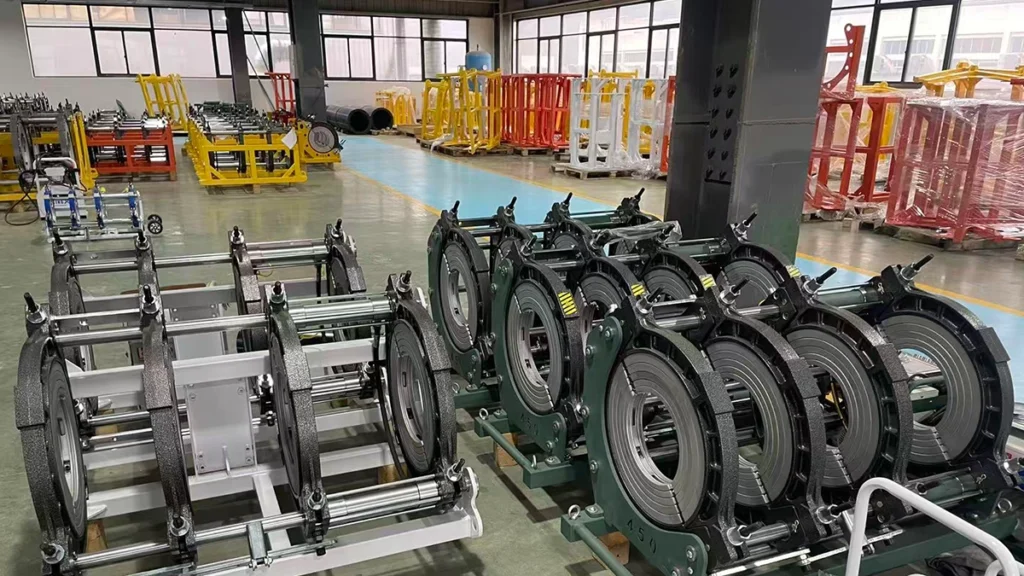
Highlight specific competitive advantages of Ekberg butt fusion machines
Ekberg’s main competitive edge stems from undeniable component superiority. On the hydraulic front, integrating imported sealing systems ensures absolutely zero pressure loss during the long cooling phase, locking in joint integrity.
Electrically, top-tier imported parts guarantee stable power delivery even under heavy loads. Look at the SHBD250 model: its 4.21KW total power output is split perfectly between the heating plate, milling cutter, and hydraulic station to prevent power surges. Operators also benefit from large-dial, shock-resistant pressure gauges that deliver crystal-clear readings. Rated at an IP54 protection level, the entire system easily survives harsh, wet, and dusty trench environments without suffering electrical faults.
Outline Ekberg’s wholesale distributor partnership programs and flexible OEM/ODM customization services
Ekberg runs highly structured, lucrative partnership programs for global wholesale buyers and regional distributors. They provide flexible OEM/ODM customization services, empowering distributors to tailor equipment specifically to their local markets. This includes altering heating copper blocks (like 5*20 or 7*18 dimensions), matching the hdpe fusion welding machine paint to your company’s brand colors, and modifying electrical plug standards (220V/110V) to comply with local regulations.
Backed by hyper-efficient global logistics, Ekberg guarantees bulk orders arrive strictly on time. They even roll out strategic trade-in services for older butt fusion machines. This lets partners keep their rental fleets and contracting gear continually modernized and fiercely competitive.
Frequently Asked Questions
Q1: What is the average lead time for wholesale butt fusion machine orders from top suppliers?
Standard butt fusion welding machine models sit in robust inventory, ensuring immediate or highly expedited shipping. Even for massive bulk wholesale orders or custom OEM/ODM requests, lead times stay lean thanks to Ekberg’s fully integrated in-house production capabilities. Plus, Ekberg supplies backup equipment for urgent jobs, ensuring contractors face zero downtime.
Q2: Do reputable manufacturers provide calibration certificates and datalogging capabilities for their welding equipment?
Yes. Premium fully automatic butt fusion machines pack internal storage capable of holding up to 1000 welding records. These logs track real-time anomalies, cannot be tampered with by operators, and easily export via USB or remote transmission. This guarantees full traceability to satisfy the strictest municipal inspectors.
Q3: How do I choose between hydraulic and CNC butt fusion machines based on my project scale and local regulations?
Manual and basic hydraulic butt fusion machines work fine for standard jobs with highly trained crews. But if you’re tackling large-scale municipal projects, high-pressure gas lines, or working in regions demanding strict DVS 2207 compliance, CNC automatic butt fusion machines are non-negotiable. They erase human error by automatically adjusting for ambient temperature and dictating precise pressure ramp-up times.
Q4: Can wholesale suppliers customize machines (OEM/ODM) with our company brand colors, logos, and specific electrical plug standards?
Absolutely. Top manufacturers like Ekberg Welding provide deep OEM/ODM services for bulk buyers. You can customize the HMI touchscreen interfaces, match the aluminum chassis paint to your branding, and adapt internal electrical components (220V/110V, 50Hz/60Hz) to fit specific regional codes.
Q5: What standard safety and manufacturing certifications (CE, ISO) should a reliable butt fusion machine supplier hold?
A credible supplier needs current ISO 9001 manufacturing certifications and CE marks to validate electrical safety. Beyond that, the equipment must be physically proven and documented to produce welds that strictly comply with ISO 21307, DVS 2207, and ASTM F2620 pipeline standards.
Conclusion
Finding the best butt fusion machine suppliers goes far beyond hunting for the lowest sticker price. It requires a strategic calculation of Total Cost of Ownership, engineering reliability, and long-term risk mitigation. When contractors prioritize strict manufacturing standards—like a ±3°C heating plate thermal variance, ZL104 die-cast aluminum frames, and imported zero-leak hydraulic seals—they guarantee their pipelines will easily hit the 50-to-100-year lifespan municipal authorities demand.
Stacking Western premium brands against direct-factory heavyweights uncovers a clear, data-driven strategy for maximizing procurement ROI. Manufacturers like Ekberg Welding deliver identical, and often superior, technical specs and automated datalogging tools at a fraction of the wholesale cost. Add in up to 3-year warranties and 24/7 global support, and the choice becomes obvious. Partnering with a reliable manufacturer delivers massive long-term value; after all, your equipment is the literal linchpin holding your high-pressure pipeline infrastructure together.
Take Action: Don’t leave your next critical pipeline project to chance. Contact Ekberg Welding today to request a comprehensive butt fusion machine suppliers price list. Explore highly profitable wholesale OEM/ODM partnership options, or consult directly with a senior engineer about the specific demands of your high-pressure pipeline project.