
Table of Contents
If you’re comparing an Ekberg with a McElroy HDPE pipe welder, the decision usually comes down to what your projects ask of you — how much mobility you need on site, and how much precise control you want to maintain. McElroy has long been a familiar name in rugged, all-terrain work, with a track-mounted range designed for difficult ground; Ekberg tends to appeal to contractors whose work rewards hydraulic accuracy and a direct, factory-level supply relationship. This guide walks through the differences that actually affect a contractor’s working day.
Ekberg vs McElroy HDPE Pipe Welder: The Short Answer for Contractors
McElroy’s strength sits at the top of the diameter range and off the tarmac. Its largest track-mounted model, the TracStar 1200i, fuses pipe up to 1,200mm (48″) OD, and the Talon 2000 extends that to 2,000mm (78″). Ekberg’s hydraulic butt fusion machine range covers 63mm to 2,250mm OD from a single factory, with 2,600mm available as a custom build, and it is usually the lower-capital route. So: if your pipe is very large and your ground is difficult, McElroy’s tracked machines are built for exactly that; if your work is precision-led and on accessible ground, Ekberg is normally the closer fit.
Two Contractor Profiles: Small Crews vs Large-Diameter Pipeline Work
Most buyers arrive at this comparison from one of two directions — a small crew welding distribution pipe, or a pipeline contractor working in large diameters. The requirements are different enough that they deserve separate answers.
Which HDPE pipe welder should a small crew choose?
Small crews working with 1-inch to 6-inch pipe frequently weigh the McElroy Pit Bull against the hydraulic EKY250. The EKY250 covers 63mm to 250mm in one frame and draws 5.05 kW total on a 380V single-phase supply, so it suits the practical realities of short municipal repair jobs: a modest power requirement, a carriage that works in a trench, and a machine that can be repositioned as the run progresses. On this class of work, the joint count your crew achieves in a day matters more than the headline specification.
Which HDPE pipe welder brand fits large-diameter municipal and pipeline projects?
Large-diameter municipal jobs call for serious clamping force and high-pressure fusion. McElroy’s TracStar line is a familiar sight on cross-country pipeline work, and its largest model, the TracStar 1200i, handles pipe up to 1,200mm (48″) OD; for diameters beyond that, McElroy’s Talon 2000 extends the range to 2,000mm (78″) OD. Ekberg serves this space with the 2250mm hydraulic butt fusion machine, built to weld HDPE pipe up to 2,250mm in diameter, with custom solutions available for anything larger. Either machine can hold its own on critical municipal infrastructure — the practical question is simply the largest diameter your projects actually involve.
Decision snapshot: budget, pipe size range, documentation needs, service access
| Decision axis | McElroy | Ekberg |
|---|---|---|
| Budget & TCO | Large rental fleet availability | Lower CapEx; direct factory pricing |
| Pipe size range | TracStar 1200i up to 1,200mm (48″) OD; Talon 2000 up to 2,000mm (78″) OD | EKY hydraulic series 63mm–2,250mm OD; 2,600mm available as a custom build |
| Documentation | DataLogger Vault for joint records | Built-in traceability coding and data logging on CNC models |
| Service access | Global distributor network | Direct factory support with on-site commissioning |
What an HDPE Pipe Welder Is and Which Fusion Methods Contractors Actually Use
An HDPE pipe welder is a machine that joins polyethylene pipe ends under controlled heat, pressure and time, producing a joint that performs like a continuous length of pipe. Three methods cover most site work: butt fusion, electrofusion and socket fusion. Which machine class you need is decided by the method and the pipe size, not by the brand.
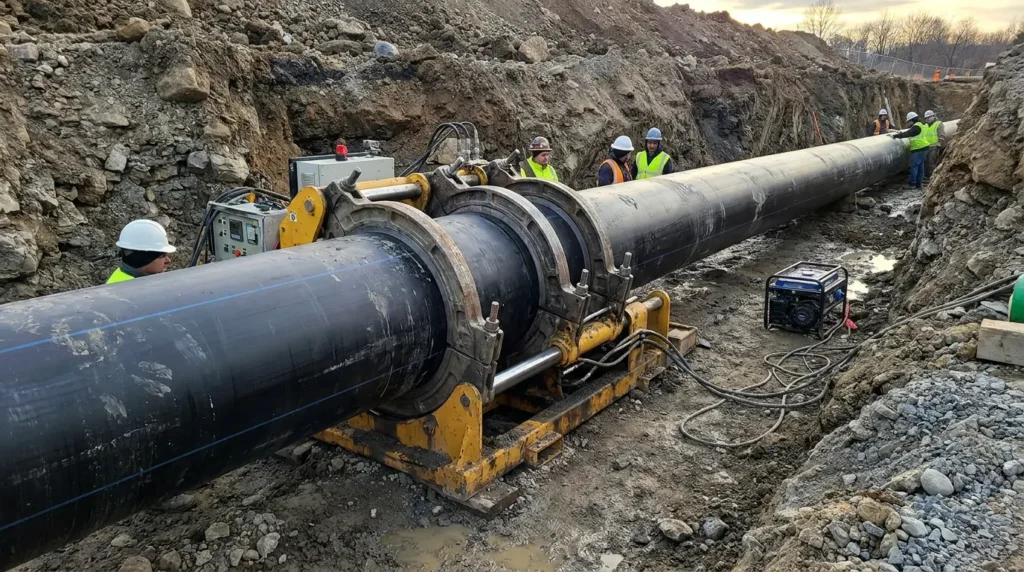
Manual, hydraulic, and CNC automatic butt fusion welding machine tiers explained
Manual: Highly portable and budget-friendly, relying entirely on the operator’s skill. Ekberg manufactures a 20kg portable unit suited to fast field repairs.
Hydraulic: A hydraulic station with a pressure range that runs from 0–8 MPa on the smaller models up to 0–16 MPa on the largest, delivering the drag and fusion pressure required for consistent joints.
CNC / fully automatic: Parameters are locked in from facing through cooling. This removes premature pressure relief and takes day-to-day variation out of the process.
Which fusion method matches your pipe size and project spec
For continuous, long-run pipelines above 90mm, butt fusion is the usual choice: it produces a monolithic joint without the cost of additional fittings. Electrofusion comes into its own for tie-ins, emergency repairs and cramped urban trenches where a machine carriage cannot be positioned around the pipe. Socket fusion connects the pipe’s outer diameter to the fitting’s inner diameter and is largely reserved for residential and commercial work under 4 inches. The selection rule is straightforward: match the method to the physical constraints of the jobsite, then choose the machine.
Which fusion method matches your pipe size and project spec?
For continuous, long-run pipelines above 90mm, contractors overwhelmingly choose butt fusion. It delivers massive tensile strength without the added expense of extra fittings. Electrofusion steps in for tie-ins, emergency fixes, and cramped urban trenches where bulky equipment becomes a liability. The golden rule? Always match your fusion method to the physical constraints of your jobsite.
Pipe OD and SDR coverage by machine tier
Hydraulic machines commonly handle SDR11 through SDR17 pipe across their rated OD range. Because clamp inserts are interchangeable, one HDPE pipe welder can cover several sizes — a 250mm machine can step down to weld 110mm pipe, which keeps a small fleet versatile without buying a second unit.
Power supply, generator sizing, and jobsite electrical constraints
Generator sizing is one of the most common causes of rejected welds, because voltage drops during the heating phase affect plate temperature. For context, the EKY250 draws 5.05 kW total on a 380V single-phase supply, and the EKY630 draws 10.1 kW on 380V three-phase. Size the generator’s continuous output comfortably above the machine’s total draw, and check the supply arrangement on site before the crew mobilises.
Factory-direct pricing with technical consultation included
Get Your Free QuoteHDPE Pipe Welder Range and Capacity Compared: Diameter, Pressure Rating, and Power
Capacity figures are where buyers most often under-spec or over-pay, so it is worth reading them from the manufacturer’s own specification table rather than from a summary. The table below compares two HDPE pipe welder models that cover most utility work.
| Specification | EKY250 | EKY630 |
|---|---|---|
| Pipe OD range | 63mm – 250mm | 315mm – 630mm |
| Voltage / total power | 380V / 5.15 kW | 380V / 10.1 kW |
| Heating plate | 2.3 kW | 7.5 kW |
| Trimmer | 2.0 kW | 1.5 kW |
| Hydraulic pressure range | 0–8 MPa | 0–10 MPa |
Machine weight, footprint, and transport implications
Trench mobility affects your daily joint count, and therefore your labour cost. A machine that can be moved along the pipe as the run progresses keeps the crew welding; one that has to be lifted into position by plant keeps them waiting. Size the frame to the pipe you weld most days, and weigh transport requirements — including the vehicle needed to move it between sites — as part of the purchase decision rather than an afterthought.
Scenario: matching machine capacity to a 200mm to 630mm water main project
Take a municipal water main upgrade requiring continuous welding of 200mm to 630mm SDR11 pipe. The EKY630 is built for that environment: a 7.5 kW heating plate and a 1.5 kW trimmer give it the thermal capacity and facing power to work through heavier wall thicknesses without slowing the cycle, and the 315–630mm range covers the bulk of the run. For the 200mm sections, either a second smaller machine or additional clamp inserts handle the transition. This is typical of water supply and distribution work, where the mix of diameters across a single contract often decides the machine configuration.
Automatic parameter control vs operator-dependent fusion cycles
Operator-dependent cycles require the technician to calculate drag pressure and track cooling times by hand, which introduces variation between operators and between shifts. Automatic parameter control manages the hydraulic valves directly, holding fusion pressure steady through the cooling period. On long runs where consistency is audited, that difference matters more than any single specification on the datasheet.
How does weld data logging support project acceptance and audits?
Increasingly, projects require proof of joint integrity before sign-off. CNC machines capture project numbers, operator IDs and joint data automatically, and cloud-connected units upload it as the work proceeds, which supports both audit and progress payment. If your client’s specification includes weld records — and many municipal and gas contracts now do — data logging capability should be treated as a requirement rather than an upgrade.
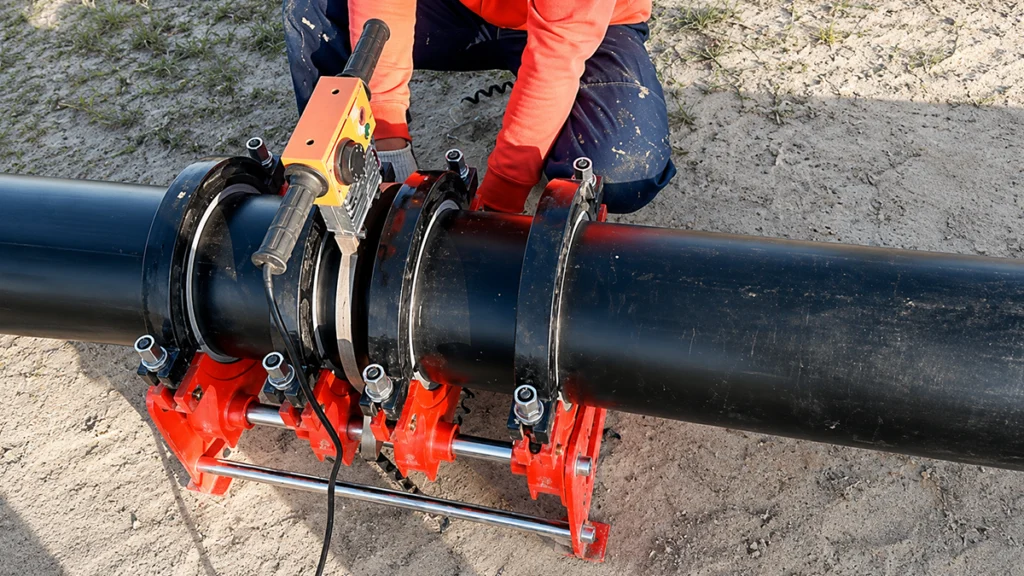
Weld Quality, Control Systems, Data Logging, and Standards Compliance
Consistent weld quality depends on a machine that can hold the parameters your project specification calls for, and on records that show it did. The table below sets out what each machine tier typically delivers.
| Feature | Manual / standard hydraulic | CNC / fully automatic |
|---|---|---|
| Parameter control | Operator calculated | System calculated and locked |
| Data logging | None, or an external logger | Built-in traceability coding and data logging |
| Standards support | Operator-dependent execution | Pre-programmed ASTM and ISO procedures |
Meeting ASTM F2620, ISO 21307, and local utility specifications
In the US, ASTM F2620 sets out the standard practice for heat fusion joining of polyethylene pipe, covering the fusion pressure and cooling time to be applied for a given pipe size and wall thickness. ISO 21307:2017 is the international counterpart; it specifies three butt fusion procedures — single low-pressure, dual low-pressure and single high-pressure — together with the assessment of the completed joint. Which procedure applies is determined by your project specification rather than by the machine. What matters at procurement stage is that the equipment can execute the required parameters and that the resulting records are in a form your inspector accepts.
What causes joint failures even on a good machine?
Even capable machines produce failures when the basics are skipped. Misalignment is a frequent cause and should not exceed 10 percent of the pipe’s wall thickness. Poor facing — where chip thickness falls outside the recommended range — will also compromise a joint. Add in changeover times long enough to let a cold skin form on the molten polymer, and the result is a weak interface. These are procedure issues, which is why welding parameters and operator discipline matter as much as the equipment itself.
How long does setup and clamp insert changeover take?
On a well-engineered hydraulic HDPE pipe welder, changing clamp inserts generally takes under 15 minutes. Quick-release mechanisms and precision-machined reduction inserts mean that shifting from a main 315mm run to a 250mm branch does not require a lengthy recalibration. On projects with mixed diameters, this is a measurable productivity factor rather than a detail.
In-ditch and confined-space fusion considerations
Pipeline tie-ins often have to be welded inside a restrictive trench. Machines that separate the clamping carriage from the power unit — connected by quick-connect hydraulic hoses — allow the carriage to be lowered into the ditch while the power unit and operator remain safely at the surface. If your work regularly involves trenches, this configuration is worth specifying up front.
Get detailed specs and custom configuration options
Request Technical SpecificationsJobsite Usability: Setup Time, Portability, Trenching, and Operator Training
The butt fusion cycle follows four phases: facing, heating, fusion and cooling. The trimmer faces the pipe ends to produce parallel mating surfaces; the heater plate melts them under initial pressure and then through a heat-soak phase; the plate retracts and the hydraulic cylinders bring the molten ends together, holding them under steady pressure until the polymer cools. Every usability factor below affects how well that cycle can be repeated, joint after joint.
Operator learning curve and certification requirements
Running an HDPE pipe welder requires genuine technical proficiency, not just mechanical operation, and the learning curve is steepest around drag pressure and cooling times. Manufacturers typically support this with training material and on-site commissioning; Ekberg, for example, dispatches technicians for commissioning when the equipment arrives. For contractors, the practical point is to confirm what training and documentation support is included before you place the order, especially if your operators need to meet certification requirements on a specific project.
Cold weather, dust, and humidity: field durability factors
Environmental conditions affect weld quality directly. Sub-freezing temperatures reduce HDPE impact resistance, and high winds cause uneven cooling, which is why standard practice requires blocking pipe ends against wind effects on the heater plate. Dust and humidity call for cleaning of the PTFE-coated plate before each fusion cycle. Machines that tolerate these conditions with minimal intervention save time on every joint.
What drives the price gap between comparable HDPE pipe welder models?
HDPE pipe welder prices across the industry range from around $3,000 for basic manual units to over $50,000 for heavy-duty track-mounted CNC systems. The gap comes down to hydraulic valve stability, structural rigidity and sensor accuracy — components that determine whether a machine can hold fusion pressure repeatably over many years of service. When comparing quotes, ask which of these components are specified, because that is where the difference in price is actually located.
Consumables, heater plate replacement, and hydraulic maintenance costs
Heating plates are the consumable that most affects running cost. Lower-quality plates develop hot spots, which lead to rejected joints and replacements that typically run from $800 to $2,000 per element. Ekberg uses corrosion-resistant aluminium alloy plates with PTFE coatings to extend plate life. Whatever HDPE pipe welder you buy, confirm the price and lead time for a replacement plate before purchase — it is a recurring cost, not a one-off.
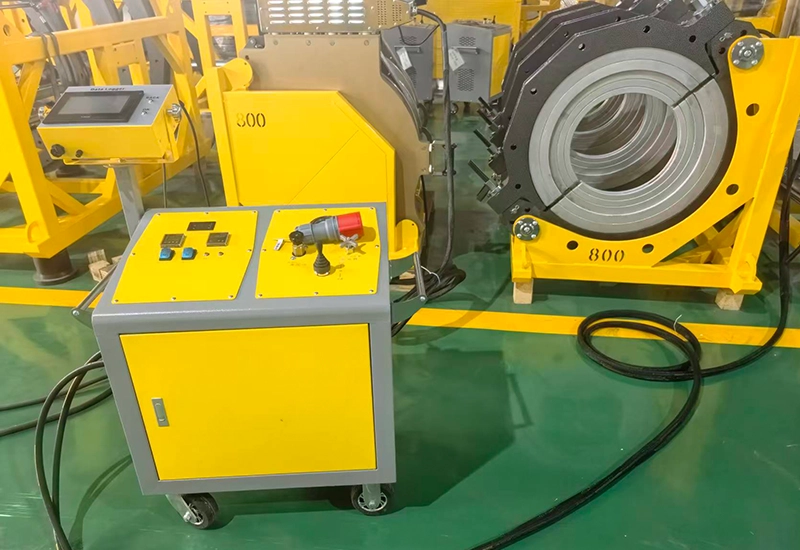
Total Cost of Ownership: Purchase Price, Consumables, Spares, and Downtime
Total cost of ownership is determined less by the purchase price of the HDPE pipe welder than by the cost of the days it is not working. The table below sets out where the difference shows up.
| Cost category | Budget machine | Premium machine |
|---|---|---|
| Purchase price band | Low initial outlay | Moderate to high CapEx |
| Heater plate lifespan | More frequent replacement | Longer-life PTFE coating |
| Hydraulic maintenance | Higher seal degradation | Industrial-grade valves |
| Downtime cost | Higher risk of failure | Lower rework and stoppage |
Cost of a one-day jobsite stoppage vs cost of a spare parts kit
Consider the arithmetic on a mid-size project: an idle five-person crew working alongside a rented excavator can easily cost more than $2,000 a day in wages and plant hire. If a failed thermocouple takes three days to arrive, the loss is several times the cost of the spare itself. That comparison is why a stocked spare parts kit — thermocouples, cutter blades, hydraulic fittings and a backup plate — is normally cheaper than the downtime it prevents.
Rental, lease, or purchase: which makes sense per project volume?
Purchase is the more economical route for contractors with continuous, multi-year utility contracts, where the machine is working most weeks. Rental makes sense for one-off large-diameter jobs or seasonal peaks. The crossover point depends on your annual joint volume rather than on the size of any single project; our rent vs buy analysis sets out how to calculate it. A useful compromise for growing contractors is to own the machine that covers daily work and rent for the outliers.
Typical lead time and MOQ expectations for HDPE fusion equipment
Standard manual and hydraulic machines usually ship from existing inventory, with lead times of roughly 15 to 30 days depending on model and destination. Custom CNC builds and oversized machines take longer. If your schedule is tight, confirm both lead time and the minimum order quantity in writing — Ekberg, for instance, accepts a single set as a minimum order on standard units.
How fast can you get a replacement heater plate or hydraulic unit?
When a machine goes down on site, parts availability decides how long the crew stands idle. Manufacturers that hold their own parts inventory ship directly to the jobsite, whereas distributor networks add a link to the chain. Before purchase, ask for current lead times on the specific consumables your machine will need, and ask where they ship from.
Supplier Evaluation: Lead Time, MOQ, Warranty, Spare Parts, and Local Service
A supplier’s reliability carries as much weight as the machine’s specification, particularly for contractors working to fixed schedules. The total cost of ownership of an HDPE pipe welder is decided partly by how the supplier performs after the sale.
What documentation should you request before issuing a PO?
Before signing a purchase order, request the conformity documentation your project requires: CE documentation where applicable, ISO certificates, risk assessments, confirmation of spare clamp insert availability, and a clear statement of warranty exclusions. Establishing this at quotation stage avoids disputes later.
Warranty scope, training support, and commissioning assistance
Warranty terms vary more than most buyers expect, so it is worth reading them side by side rather than comparing only the number of years. McElroy, for example, publishes a five-year warranty across its equipment line. Ekberg’s standard terms cover one year, during which non-human damage is replaced free of charge, followed by a lifetime maintenance policy that continues to waive labour charges. The practical questions are what is covered, where spare parts ship from, and how quickly a technician can reach your site — years alone do not answer those.
Small utility contractor with mixed 63mm to 315mm work
Small utility crews handling mixed diameters will find a good match in the automatic butt fusion welding machine, which covers DN160 to 315mm. Its four-clamp sleeve structure balances acquisition cost against clamping force and the mobility needed in urban work, and the range spans the most common distribution sizes without a second unit.
Municipal or gas utility contractor with strict traceability requirements
Municipal and gas contractors work to zero-leak tolerances and audit trails. For these projects, CNC machines with built-in data logging are the practical choice: every parameter and joint is recorded and exportable for inspectors. Where a utility specifies traceability coding, ISO 12176-4 sets out the encoding system for data on components, assembly methods and jointing operations used in traceability systems — it is a useful reference when writing your documentation requirements. For how the records are produced and checked, see our butt fusion welding procedure guide.
Which HDPE Pipe Welder Fits Your Contractor Profile? A Decision Matrix
The right machine tier depends on your daily work rather than your most ambitious project. The matrix below maps common contractor profiles to sensible equipment choices.
| Contractor profile | Recommended tier | Priority specification |
|---|---|---|
| Small utility (63–315mm) | Standard hydraulic | Trench mobility, four-clamp structure |
| Municipal / gas utility | CNC / fully automatic | Data logging and traceability |
| Large pipeline | Heavy-duty hydraulic | Clamping force, hydraulic capacity |
| Distributor / rental fleet | Standard hydraulic | Universal clamp inserts, rugged frame |
Distributor or rental fleet owner buying multiple units
Rental fleet operators need machines that survive use by operators of varying experience. Their priorities are universal clamp insert availability, robust frame geometry, and a manufacturer able to fulfil spare parts orders in bulk and at short notice. These factors drive fleet utilisation, which in turn drives rental revenue.
Which specification should you prioritize when the budget is fixed?
When the budget is fixed, prioritise heating plate quality and hydraulic accuracy over touchscreen interfaces. Inaccurate pressure control undermines the machine’s purpose and leads to failed joints and rework, which is the most expensive outcome a contractor can face. Features that do not affect the joint should be the last items on the list, not the first.
Buying on maximum diameter instead of daily working diameter
Purchasing a very large HDPE pipe welder for daily mid-size work is a common and expensive mistake: transport costs, handling and trench access all become harder. The better approach is to buy for your daily working diameter and rent or subcontract the occasional outlier — a comparison our guide to large-diameter butt fusion welding covers in more detail. If your daily work does sit above 800mm, the 800mm pipe fusion machine is a more sensible entry point than an oversized frame.
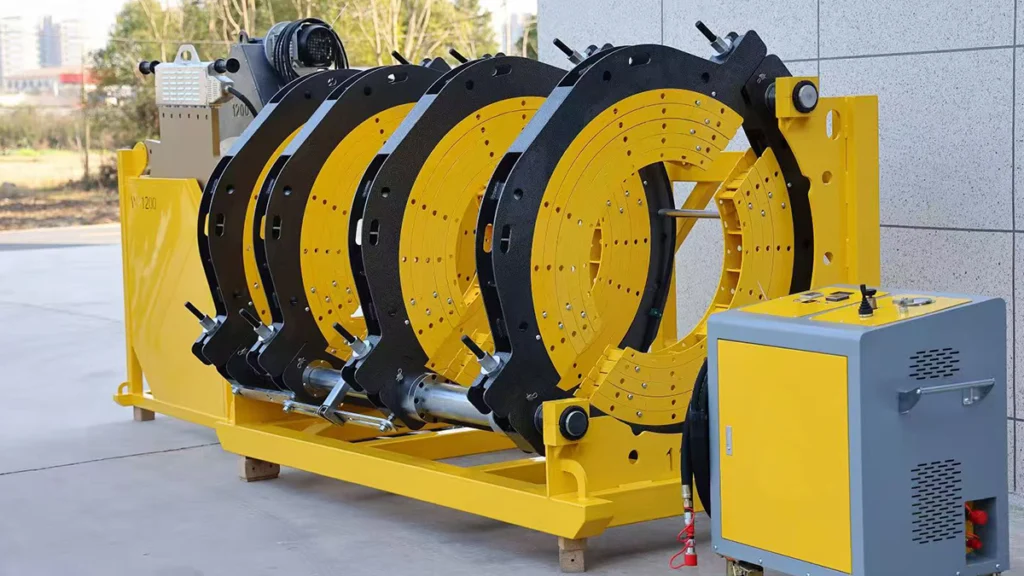
Ignoring clamp insert availability for odd pipe sizes
Clamp insert availability for non-standard pipe sizes is easy to overlook at quotation stage and expensive to discover on site — a machine that arrives without the inserts you need leaves the crew waiting for parts. Ekberg configures custom clamp sizes against exact requirements before the machine ships, and it is worth confirming the same with any supplier before you commit.
Common Mistakes and Hidden Risks When Buying an HDPE Pipe Welder
Procurement errors on fusion equipment tend to surface months later, in rework or in a failed audit. The two below are the most common.
Why is the cheapest quote often the most expensive over three years?
Budget-tier machines frequently require replacement within five to seven years because of structural fatigue, and a sticking hydraulic valve can ruin a large-diameter joint. The cost of cutting out a bad weld, replacing a pipe section and paying an idle crew usually exceeds the premium paid for an industrial-grade machine in the first place. The three-year view is the one worth calculating, not the invoice.
Overlooking spec-required weld reports until the inspection stage
Discovering at inspection stage that your machine cannot produce the weld records the utility requires is an expensive way to learn the requirement. If the specification calls for digital logs, machines without data logging cannot demonstrate compliance, and the resulting rework is usually unbillable. Confirm the record format required by the inspector before choosing the machine.
Final Recommendation and Pre-Purchase Checklist
Recommendation summary by project type and crew size
For utility work driven by tight budgets and mixed diameters, standard hydraulic machines such as the EKY630 offer the most practical balance of cost, mobility and capability. For spec-heavy municipal gas and water projects, CNC models with data logging are the appropriate choice, because traceability is a contractual requirement rather than an option. Matching the tier to the contract is what protects the margin.
10-point checklist before you approve the purchase order
1. Confirm the heating plate temperature uniformity your project specification requires, and compare it with the figure published for the machine.
2. Confirm the total welding pressure equals drag pressure plus theoretical welding pressure.
3. Ensure the HDPE pipe welding equipment supports the ASTM F2620 or ISO 21307 procedure your specification names.
4. Check for independent timers for the heating and cooling phases.
5. Verify that the data logging output matches the format your inspector requires.
6. Inspect all hydraulic quick-connect fittings for unobstructed flow.
7. Confirm your generator sizing comfortably exceeds the machine’s total kW draw.
8. Request spare parts pricing on heater plates, thermocouples and cutter blades.
9. Review warranty terms closely to distinguish parts coverage from labour coverage.
10. Confirm that operator training and on-site commissioning are included.
Questions to ask any HDPE pipe welder supplier
Two questions reveal more than a specification sheet: “What is your response protocol when a machine goes down mid-project?” and “What lead time applies to the consumables this machine will need?” The answers indicate whether you are dealing with a supplier set up for equipment support, or simply a seller.
FAQ
Q1: How much does an HDPE pipe welding machine cost?
Prices for HDPE pipe welding machines span a wide range, starting around $3,000 for basic manual units and climbing past $50,000 for heavy-duty, track-mounted CNC systems. This massive price gap reflects differences in hydraulic valve stability, structural rigidity, and advanced data logging capabilities. While budget machines tempt buyers with low initial capital expenditure, premium models invariably deliver a much lower total cost of ownership over a typical 15-year lifecycle.
Q2: Can one HDPE pipe welder cover several pipe diameters?
Yes. Interchangeable clamp inserts let a single machine cover a range of diameters — a 250mm machine welds from 63mm to 250mm, and a 630mm unit covers 315mm to 630mm. Always confirm insert availability for the specific OD and SDR combinations your project requires.
Q3: When should I use butt fusion instead of electrofusion?
For long, continuous runs of large-diameter HDPE pipe, butt fusion is the usual choice because it produces a monolithic joint without consumable fittings. Electrofusion is generally preferred for tie-ins, emergency repairs and confined trench work, where a machine carriage cannot be positioned around the pipe.
Q4: Do operators need certification to weld HDPE pipe?
On most municipal and industrial pipeline projects, yes. Operators are typically required to hold valid certification demonstrating understanding of drag pressure calculations, cooling times and the applicable standard such as ASTM F2620. Many manufacturers support this with on-site training and commissioning.
Q5: How long does a single butt fusion joint take?
It depends on wall thickness and the standard being followed. Cooling alone accounts for a substantial part of the cycle, and when facing, heating and clamp changeovers are included, a large-diameter heavy-wall joint can take between 30 and 60 minutes. On smaller diameters the cycle is considerably shorter.
Q6: Can I run an HDPE pipe welder from a portable generator?
Yes, provided the generator is correctly sized. Its continuous output must comfortably exceed the welder’s total kW draw, otherwise voltage drops during the heating phase will affect plate temperature and joint quality. Check the machine’s total power figure against the generator’s continuous rating, not its peak rating.
Q7: What spare parts should I keep on the truck?
Thermocouples, cutter blades, hydraulic quick-connect fittings and a backup PTFE-coated heating plate cover most field failures. The cost of a stocked kit is small compared with the daily cost of an idle crew.
Q8: How do I prove weld quality to an inspector?
Records are the usual route. CNC machines with built-in data logging capture temperature, fusion pressure and cooling time for each joint and export them as reports that can be reviewed against ISO 21307 or ASTM F2620. Where your contract requires traceability coding, ISO 12176-4 sets out the encoding system used across the industry.
Conclusion
Choosing an HDPE pipe welder means balancing capital outlay against long-term reliability and the specifications your contracts actually impose. For contractors working on difficult, all-terrain infrastructure, track-mounted systems such as McElroy’s TracStar and Talon lines deliver mobility that is hard to match. For contractors who prioritise hydraulic control, verifiable weld records and a competitive total cost of ownership, Ekberg’s hydraulic and CNC ranges cover 63mm to 2,600mm, with larger sizes available as custom builds.
The deciding factors are usually practical ones: the diameter you weld most days, the traceability your inspector requires, and how quickly spare parts can reach your site. HDPE pipe welders with durable PTFE-coated plates, stable hydraulic output and built-in data logging reduce both downtime and rework. And because support matters as much as specification, the supplier’s parts availability, warranty scope and response time deserve the same scrutiny as the datasheet.
Let our experts help you choose the right equipment for your project
Contact Our Engineering Team