
Butt Fusion Machine in DRC: HDPE Welding Equipment for Mining and Water Projects
Table of Contents
This guide explains how to select the right butt fusion machine in DRC for HDPE pipe welding in mining, dewatering, and water supply projects. It covers machine types, specifications, welding procedures, costs, shipping to Congo, and supplier evaluation to support confident B2B procurement.
What Is a Butt Fusion Machine and Why It Matters for DRC Projects
When you need to permanently join high-density polyethylene (HDPE) pipes, a Butt Fusion Machine in DRC is the specialized industrial equipment you rely on. The process utilizes highly controlled thermofusion. By applying exact temperatures and hydraulic pressure, the machine melts the pipe ends and seamlessly fuses them together. What is the result? A monolithic joint that actually boasts more structural strength than the original pipe. In the unforgiving, demanding environments of the Democratic Republic of the Congo, having this equipment on hand is absolutely critical for building leak-proof fluid conveyance networks.
How does a butt fusion machine join HDPE pipes?
Joining these pipelines boils down to four distinct stages: positioning, milling, heating, and cooling. First, operators clamp and align the pipes. An electric facer then mills the ends to guarantee they sit perfectly parallel to one another. Next comes the heating phase. A PTFE-coated heating plate drops into place, bringing the interface material to a viscous state and triggering molecular diffusion. This simply means the polymer chains of both pipe ends entangle. Once the heating plate is removed, hydraulic cylinders push the molten ends together under a specific pressure. The joint is held there until it fully cools and solidifies.
Why is butt fusion the preferred jointing method in DRC mining and water sectors?
Pipeline engineers strongly prefer butt fusion because it completely removes mechanical fittings from the equation. For mining and water infrastructure projects, choosing the right butt fusion machine in DRC is essential for producing strong, leak-free joints with excellent sealing performance and tensile strength. Unlike mechanical fittings, which can fail under high pressure or corrosive conditions, fused joints provide greater long-term reliability. For contractors working in remote areas, butt fusion also helps reduce maintenance costs and supports safe pipeline operation in harsh industrial environments.
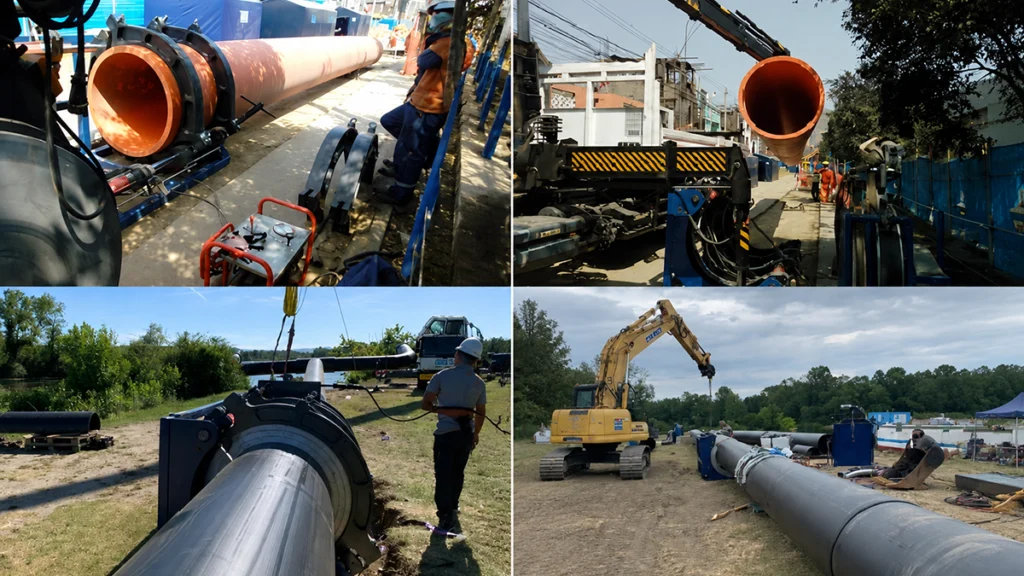
Key components: heating plate, hydraulic unit, clamps, and facer
Look closely at an industrial-grade butt fusion machine, and you will find four main components. The heating plate relies on a tough aluminum alloy covered in high-quality PTFE. This coating stops molten polymer from sticking and ensures heat distributes evenly. Then you have the hydraulic unit, which handles either semi-automatic or fully automatic pressure control. To keep the pipe perfectly aligned, a four-clamp sleeve structure locks everything down. Finally, the electric facer uses high-speed carbon steel blades to execute the milling phase and prep the pipe faces.
Mining applications: slurry, tailings, and dewatering pipelines in Katanga and Lualaba
Heavy-duty HDPE pipe jointing machines are a common sight across the copper and cobalt belts of Katanga and Lualaba. These massive pipelines carry highly abrasive tailings, aggressive chemical slurries, and huge volumes of groundwater pulled from pits during dewatering operations. Because thermofusion creates monolithic joints, it prevents toxic environmental leaks. These welds easily handle the intense internal pressures generated by high-capacity slurry pumps running 24/7 in active mining zones.
Main Applications of Butt Fusion Machines in DRC
HDPE pipes are incredibly versatile, making thermofusion equipment a staple across various infrastructure sectors in the Congo. Whether you are upgrading urban utilities or extracting resources in the bush, your specific application will dictate the machine capacity, pressure output, and automation level you need.
Municipal and rural water supply projects (REGIDESO, NGO, and donor-funded)
An HDPE pipe welding machine for water projects DRC is the backbone of expanding clean water access. State utilities like REGIDESO and various international NGOs rely on these units to lay down durable municipal water grids and rural agricultural irrigation systems. Butt fusion is inherently leak-proof. This drastically reduces non-revenue water loss—a major performance metric for donor-funded infrastructure upgrades that operate under rigid efficiency mandates.
Gas, industrial, and mine-site utility networks
These pipe fusion machines do much more than handle water and slurry. They also build out complex utility networks inside major industrial plants. Think petrochemical fluid lines, compressed air systems, and chemical processing networks. Because HDPE is chemically inert, pairing it with flawless fusion joints guarantees the safe transport of hazardous industrial fluids across massive mine-site processing facilities.
Which application scenarios require hydraulic vs manual machines?
Figuring out your manual vs hydraulic butt fusion machine DRC needs usually comes down to pipeline diameter and pressure requirements. Milling, heating, and cooling large-diameter pipes require serious force—sometimes pushing up to 16 MPa. Hydraulic machines are an absolute must here because no human operator can manually generate or hold that kind of pressure. Manual machines are strictly for low-pressure, small-diameter jobs where basic physical leverage does the trick.
Manual butt fusion machines (63–250 mm) for small water lines
Manual butt fusion machines depend entirely on human operators turning a hand-operated lever or wheel to apply pressure. They are built specifically for small-scale water lines ranging from 63mm to 250mm. Because they lack a bulky hydraulic power unit, they are incredibly lightweight. This makes them highly portable and perfect for tight trench work or remote rural installations where getting heavy machinery on site is impossible.
Factory-direct pricing with technical consultation included
Get Your Free QuoteTypes of Butt Fusion Machines Available for the DRC Market
Choosing the right HDPE welding equipment DRC means matching the plastic pipe machine’s output capacity and automation to the scale of your project. The market generally categorizes these units by their pipe diameter compatibility and pressure delivery systems.
CNC Automatic Butt Fusion Machines for Medium-Sized Projects
CNC automatic butt fusion machines with a 160–630 mm welding range are suitable for medium-sized water supply, drainage, irrigation, and industrial pipeline projects in the DRC. Automated control of heating temperature, fusion pressure, changeover time, and cooling helps improve welding consistency while reducing operator-related errors.
Hydraulic Butt Fusion Machines for Large Mining Pipelines
Hydraulic butt fusion machines with a 160–2250 mm welding range cover both standard and large-diameter HDPE pipeline applications. Heavy-duty models are particularly suitable for mining water supply, dewatering, slurry transportation, and tailings pipelines, providing stable clamping, accurate alignment, and controlled fusion pressure under demanding site conditions.
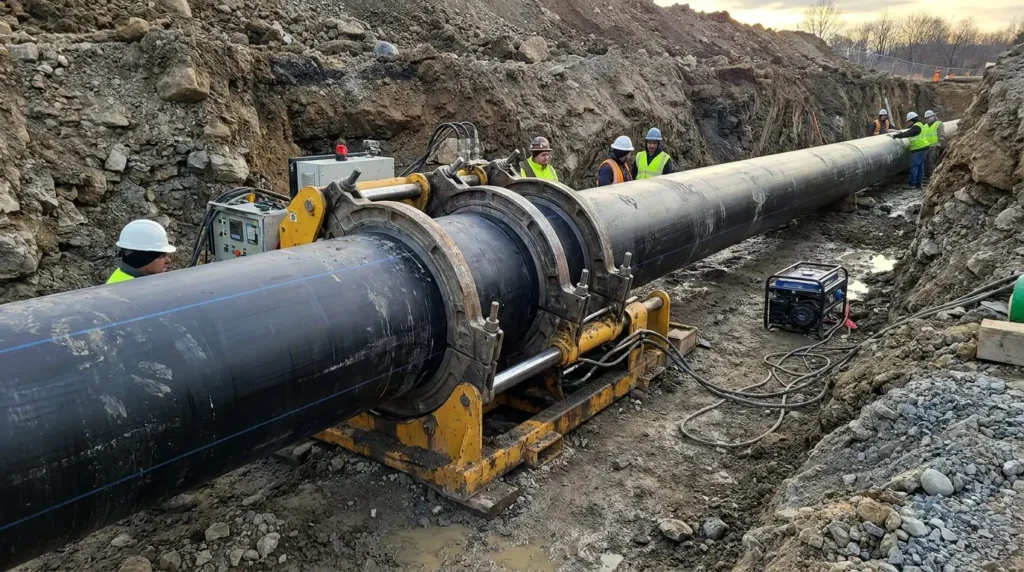
Workshop vs on-site field welding machines
Manufacturers design equipment for either controlled indoor workshop pre-fabrication or rugged on-site field welding. Field butt fusion machines boast heavy-duty frame packaging. For example, a 1000mm model might have a 2200x1800x1700 mm footprint, complete with reinforced chassis and rugged wheels to navigate uneven trench terrain. Workshop pipe fusion machines, meanwhile, focus on static stability so operators can fabricate complex elbows, manifolds, and fittings indoors.
Pipe diameter range and SDR compatibility
Every HDPE pipe welding machine comes rated for a specific diameter range (for instance, a butt fusion welding machine 315mm 450mm 630mm DRC). But diameter isn’t the only metric. Buyers also need to verify Standard Dimension Ratio (SDR) compatibility. Thicker-walled pipes (which have a lower SDR) demand higher clamping forces and significantly longer heating times. Always ensure your butt fusion machine’s hydraulic cylinders have the pressure capacity and stroke length to handle the maximum wall thickness of your pipe.
Key Technical Specifications to Evaluate Before Purchase
Procurement engineers must look deep into the internal technical specifications to ensure the equipment can actually handle the designated pipeline parameters without ruining joint integrity.
Heating plate temperature control and PTFE coating quality
Your heating plate needs to hit a temperature range of 0–300°C. High-precision electronic thermostats aren’t just nice to have; they are mandatory. They need to hold an error margin of ≤±3°C because temperature fluctuations actively cause weak, brittle welds. Furthermore, the PTFE coating must be strictly industrial-grade. This ensures stable thermal transfer and stops molten polymer from sticking when the plate automatically retracts.
Hydraulic pressure system and drag pressure compensation
A good hydraulic system delivers continuous, stable force. Large 1000mm butt fusion welding machines need an adjustment range of 0–16 MPa, while smaller 250mm units operate safely within 0–6.3 MPa. Look for a system that features low starting pressure capabilities alongside highly accurate drag pressure compensation. You need this to counter the heavy frictional resistance of pulling long, heavy pipe strings through the clamps.
Power supply requirements for DRC site conditions (380V/415V, generator use)
Power demands swing wildly depending on the machine size. A 250mm machine usually needs a 220V/50Hz supply drawing around 3.7KW. Step up to a 710–1000mm pipe fusion machine, and you are looking at a three-phase 380V/50Hz supply drawing up to 23.5KW. Grid power is notoriously unreliable across many regions. Contractors must size their on-site diesel generators aggressively, factoring in the startup surge currents so the equipment doesn’t stall out mid-weld.
Match machine size to your HDPE pipe diameter and wall thickness
Sizing a butt fusion welding machine properly is about more than just fitting a pipe into a clamp. The structural rigidity of the machine has to prevent deflection when under maximum hydraulic load. Alignment deviation must stay tightly controlled: ≤0.2mm for smaller pipes and ≤0.3mm for larger diameters. If the deviation is too high, you create stress concentrations at the joint, which will inevitably lead to premature pipeline failure once the system is pressurized.
Get detailed specs and custom configuration options
Request Technical SpecificationsHow to Choose the Right Butt Fusion Machine for Your DRC Project
A smart procurement strategy perfectly aligns the butt fusion machine’s technical specs with the realities of the deployment environment and the skill level of the operational workforce.
Site conditions: remote mine sites, dust, humidity, and power stability
The Congo throws some severe environmental challenges at construction crews. In fact, up to 70% of construction teams stress that a Butt Fusion Machine in DRC needs an IP54 or IP55 protection rating just to survive the intense dust and high humidity. Your equipment must be rugged enough to run reliably for at least 3,000 hours of continuous, high-intensity use out in these harsh outdoor environments.
Operator skill level and training availability in DRC
Even the most advanced HDPE pipe jointing machinery falls flat if the operator doesn’t know what they are doing. Operator skill levels vary wildly across regional construction teams, which is why 75% of contractors demand comprehensive operation manuals, video tutorials, and on-site training directly from the manufacturer. Investing in CNC automatic butt fusion welding machines is a smart workaround here, as it mitigates low skill levels by automating the critical pressure and timing math.
Should you buy, rent, or lease a butt fusion machine in DRC?
For long-term mining operations or multi-year municipal pipeline projects, purchasing a butt fusion machine in DRC may offer better long-term value and greater control over equipment availability. For short-term installation work, emergency repairs, or temporary projects, butt fusion machine rental in Lubumbashi or Kolwezi can help reduce initial investment and avoid the cost of owning equipment that may not be used regularly.
Leasing can be another practical option for EPC contractors that want to preserve working capital while maintaining access to suitable welding equipment. Before choosing any option, contractors should compare the project duration, pipe diameter range, expected machine usage, transport costs, operator availability, maintenance support, and calibration records.
Step-by-step butt fusion welding process
Evaluating butt fusion machine capabilities requires a solid understanding of the step-by-step butt fusion welding process. The sequence goes like this: clamp the pipe, mill the ends to produce continuous long strips of chips, verify alignment, heat under pressure, reduce to drag pressure (P2), execute a rapid switch to minimize transition time, pressurize up to welding pressure without causing collisions, and finally, hold the cooling phase under sustained pressure.
Butt Fusion Welding Procedure and Quality Standards (ISO 21307 / DVS 2207)
Sticking strictly to international standards is the only way to guarantee the longevity of a pipeline. The butt fusion welding procedure ISO 21307 DRC lays out exact parameters that must be logged and verified for every single weld.
Pressure, temperature, and cooling time parameters
These parameters are entirely dictated by the pipe’s diameter and material grade. Take a 63mm pipe, for example. It requires a heat penetration depth of 24mm, 24 seconds of active heating time, a maximum 7-second switching phase, and exactly 6 minutes of cooling time under pressure. If an operator deviates from these manufacturer-provided temperature and pressure charts, the molecular bond will be fundamentally compromised.
How to verify weld quality on site
Visual inspection remains the fastest immediate method for checking weld quality on site. The protrusions—often called beads—that form between the pipes need to roll back symmetrically and look uniform around the entire circumference. They must hit the required height specification before the operator drops the system down to drag pressure. If you see asymmetrical beads, you are looking at misalignment or uneven heating.
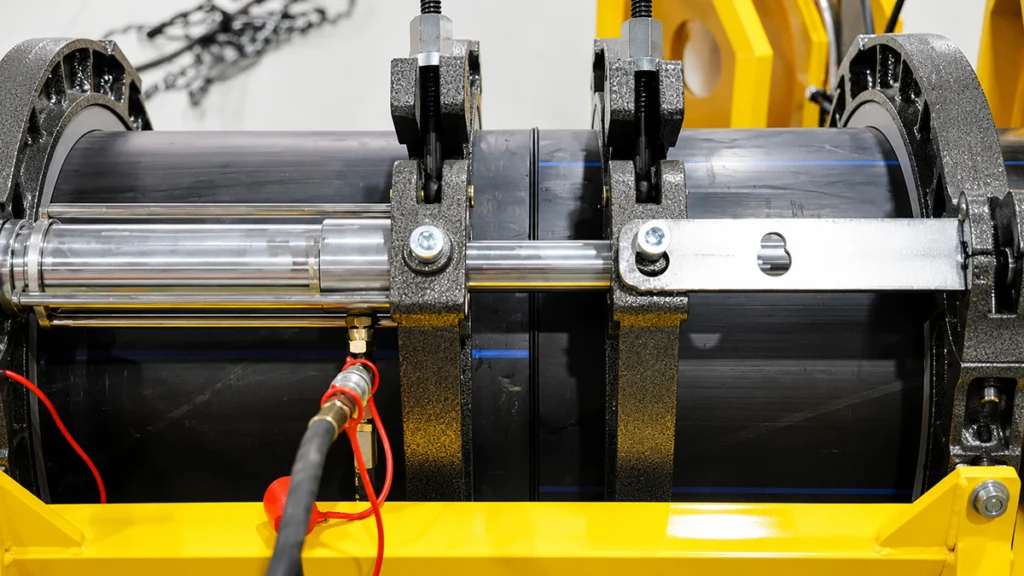
Common welding defects and how to prevent them
High-pressure collisions during the switching phase are a massive culprit behind defective welds. Pressure must always be increased evenly up to the final welding pressure (P3). Cold joints happen when the transition time between heating and pressurization drags on too long, allowing the polymer to cool off. Voids and contamination defects are easily prevented if crews strictly clean the heating plate and pipe ends before starting every cycle.
Butt fusion machine price ranges by size (63–1600 mm)
Hitting these stringent standards requires highly capable equipment, which naturally dictates the butt fusion machine price in DRC. Pricing scales exponentially alongside diameter and automation levels. Small manual 63–250mm machines are a minimal capital investment. On the flip side, fully automated 1000mm+ CNC hydraulic machines demand serious procurement budgets. Buyers should always request specific quotes, as prices shift based on raw material costs and where the hydraulic components are sourced.
Cost, MOQ, Lead Time, and Shipping to the DRC
Calculating the total landed cost requires consideration of equipment price, inland transportation, ocean freight, import duties, and production lead time. Working with an experienced exporter can help simplify shipping arrangements and reduce delays when delivering equipment to mining, municipal, and industrial project sites in the DRC.
MOQ, payment terms, and typical lead time from China to DRC
For hydraulic butt fusion machines, many industrial manufacturers accept a minimum order quantity of one unit. Standard payment terms commonly require a T/T deposit, with the remaining balance paid before shipment after factory inspection or acceptance testing. Production lead times for standard hydraulic butt fusion machines are generally around 2 to 4 weeks, while large-diameter or specially configured models may require approximately 4 to 8 weeks.
Shipping routes: Dar es Salaam, Durban, and Matadi ports
Logistics will ultimately dictate your project timelines. Shipments coming from Asia usually route through Dar es Salaam (Tanzania) or Durban (South Africa) before making the overland trek into the Copperbelt region. If the equipment is heading to Kinshasa or the western provinces, it typically enters via the Matadi port. Every route has its own transit times and freight costs that must be factored into procurement planning.
Total landed cost: duties, inland transport to Lubumbashi and Kolwezi
The Ex-Works (EXW) or FOB price is just a small piece of the total landed cost puzzle. Buyers have to account for ocean freight, port handling fees, DRC import tariffs on industrial machinery, and the notoriously high cost of inland heavy-haul transport to cities like Lubumbashi and Kolwezi. A solid hydraulic butt fusion machine supplier Congo will help optimize packing dimensions to cut down on wasted container space and lower freight costs.
Certifications to look for: CE, ISO 9001, and factory audit reports
Customs clearance and site safety compliance require a mountain of rigorous documentation. Make sure the manufacturer provides valid CE markings to prove they comply with European safety standards. Check their ISO 9001 quality management certification and ask to see recent factory audit reports. This paperwork proves the equipment actually hits the safety and performance thresholds demanded by major mining conglomerates.
Supplier Evaluation: How to Select a Reliable Butt Fusion Machine Manufacturer
Buying a Butt Fusion Machine in DRC is a serious, long-term investment. Taking the time to evaluate a supplier’s post-sale infrastructure is just as important as checking the quality of the machine’s steel and hydraulics.
After-sales support: spare parts, training, and remote troubleshooting
When you are operating in remote African locations, downtime costs a fortune. Over 90% of buyers say 24-hour online technical support is a strict requirement. A trustworthy supplier needs a stable spare parts channel so you can quickly replenish consumables like PTFE plates and facer blades. Seek out partners who offer video solutions, remote troubleshooting, and expedited shipping for those urgent project emergencies.
Warranty terms and machine calibration documentation
Top-tier manufacturers back their equipment with a comprehensive one-year warranty that includes lifetime maintenance support. Elite suppliers might even extend up to a three-year warranty covering specific non-human-induced damage, offering free replacement parts. Additionally, the butt fusion machine must ship with highly accurate calibration documentation. This proves the hydraulic sensors and thermostats were physically tested against international standards before leaving the factory.
Red flags when comparing low-price offers from unverified traders
Be extremely cautious of dirt-cheap quotes from unverified trading companies. These lowball offers usually point to substandard aluminum in the heating plate, cheap hydraulic seals that blow out under high pressure, or terribly inaccurate thermostats. Unverified traders almost never provide post-sale support. This leaves DRC contractors completely stranded without replacement parts or technical manuals when the butt fusion welding machine inevitably breaks down.
Underestimating power supply instability at remote mine sites
One of the biggest supplier evaluation failures is completely ignoring power compatibility. Your supplier must be capable of customizing the butt fusion welding machine’s electrical components to handle the aggressive voltage fluctuations that happen when running off generators at remote mine sites. Failing to address power supply instability early in the procurement phase usually results in burnt-out motors and fried electronic control boards within the first few weeks of operation.
Common Mistakes and Hidden Risks When Using Butt Fusion Machines in DRC
Even high-quality butt fusion equipment can perform poorly or suffer premature failure if operators ignore approved welding procedures, routine inspection, and the manufacturer’s maintenance requirements.
Skipping facer maintenance and heating plate cleaning
Failure to maintain the facer, guide rails, hydraulic components, and heater plate can increase the risk of equipment malfunction and inconsistent fusion quality. Dirt or polyethylene residue on the heater surface may contaminate the fusion interface and prevent uniform heating. Operators should inspect and clean the equipment at the intervals recommended by the machine manufacturer and before each welding operation when necessary.
Using incorrect fusion parameters for imported HDPE pipes
Fusion parameters should be selected according to the applicable welding standard, pipe material, diameter, wall thickness, SDR, and approved project procedure. Heating time, heater temperature, fusion pressure, drag pressure, changeover time, and cooling time should not be copied from an unrelated pipe specification. Using unverified parameters can lead to incomplete fusion, excessive bead formation, misalignment, or reduced joint strength.
Neglecting operator certification and welding records
Untrained or unqualified operators are more likely to make errors during facing, heating, changeover, fusion, and cooling. These mistakes may include pipe-end contact during changeover, incorrect pressure settings, or excessive changeover time. Accurate welding records—including heater temperature, drag pressure, fusion pressure, heating time, and cooling time—are also essential for tracing quality problems to a specific joint, procedure, operator, or equipment issue.
Recommended machine configuration for copper and cobalt mining sites
A butt fusion machine for DRC copper and cobalt mining projects should have a reinforced chassis, stable hydraulic control, durable clamps, and suitable reducing inserts for the required pipe sizes. Electrical enclosures should provide a protection rating appropriate for site dust, moisture, and outdoor operating conditions.
The power supply must be selected according to the combined requirements of the heater plate, facer, and hydraulic unit. Where stable grid power is unavailable, contractors may need a properly sized generator with sufficient starting capacity and safety margin. The final generator rating should be confirmed from the machine manufacturer’s electrical specifications rather than estimated only from pipe diameter.
Final Recommendation: Best Butt Fusion Machine Setup for DRC Mining and Water Projects
Selecting the right butt fusion equipment can improve site productivity, support consistent joint quality, and reduce maintenance and ownership costs over the machine’s service life. The final configuration should be based on pipe diameter, SDR, project duration, site conditions, power supply, welding standard, and documentation requirements.
Recommended setup for municipal water and NGO water projects
For municipal water networks and NGO-supported projects, hydraulic butt fusion machines with a 160–450 mm welding range are a practical choice for medium-diameter HDPE pipelines. They provide controlled alignment and fusion pressure while remaining suitable for transportation and field operation.
Where project traceability is required, the machine may also include welding data recording for heater temperature, pressure, heating time, changeover time, and cooling time. These records can support joint inspection, quality documentation, and project reporting.
Next Steps: Request a Customized Quotation and Project Consultation
Before placing an order, confirm the required machine model, welding range, reducing inserts, power supply, accessories, delivery schedule, operator training, warranty, and after-sales support. The supplier should also verify that the proposed butt fusion machine is suitable for the specified pipe material, diameter, SDR, welding standard, and operating conditions in the DRC.
—
FAQ
Q1: How much does a butt fusion machine cost in the DRC?
The cost depends on the welding range, automation level, accessories, power configuration, and data-recording requirements. Manual and small hydraulic machines generally require a lower initial investment, while CNC automatic machines for large-diameter pipes cost more. Buyers should also include ocean freight, import duties, inland transportation, commissioning, and operator training when calculating the total landed cost in the DRC.
Q2: What size butt fusion machine do I need for 315mm HDPE pipe?
For 315 mm HDPE pipe, select a machine whose welding range includes 315 mm. A 160–315 mm hydraulic butt fusion machine is suitable for projects focused on this diameter, while a 160–450 mm model provides additional capacity for future pipe sizes. Confirm that the machine includes the required clamps or reducing inserts and is suitable for the pipe’s material, SDR, and selected fusion standard.
Q3: Can butt fusion machines weld HDPE pipes at remote mining sites without stable grid power?
Yes. Butt fusion machines can operate at remote mining sites using a properly sized generator. Generator capacity should be calculated from the heater plate, facer, hydraulic unit, voltage, phase, frequency, and operating sequence. Additional capacity should be allowed for motor starting current and site conditions. Contractors should confirm the required generator rating from the specific machine’s electrical data rather than estimating it from pipe diameter alone.
Q4: What is the difference between manual and hydraulic butt fusion machines?
Manual butt fusion machines rely on the operator to move the carriage and apply joining force, making them practical for smaller pipe sizes and projects with limited welding volume. Hydraulic machines use a hydraulic unit to control carriage movement and fusion pressure more consistently, reducing physical effort and improving repeatability. They are generally preferred for larger diameters, thicker-walled pipes, and demanding mining or infrastructure projects.
Q5: Which international standards apply to HDPE butt fusion welding?
Commonly referenced standards include ISO 21307, ASTM F2620, and DVS 2207-1. They provide requirements or procedures covering pipe preparation, heater temperature, heating and changeover time, fusion pressure, cooling, and joint quality assessment. Contractors should follow the standard specified by the project and avoid combining parameters from different procedures.
Q6: How long does shipping a butt fusion machine from China to Lubumbashi take?
Standard production commonly takes about 2 to 4 weeks, depending on the machine model and configuration. Ocean and inland transit may require several additional weeks, especially when cargo is routed through Dar es Salaam or Durban. As a planning estimate, buyers may allow approximately 8 to 12 weeks in total, subject to vessel schedules, customs clearance, border processing, road conditions, and final delivery arrangements.
Q7: Do butt fusion machine suppliers provide operator training in the DRC?
Many suppliers provide operation manuals, training videos, remote technical support, and pre-shipment machine demonstrations. For large mining or infrastructure projects, on-site commissioning and operator training in the DRC may also be available as an optional service. Buyers should confirm the training scope, language, travel costs, and equipment acceptance requirements before placing an order.
Q8: Is it better to rent or buy a butt fusion machine for a short-term mining project?
Renting may be practical for short-duration projects, emergency repairs, or limited welding work because it reduces the initial investment and long-term storage requirements. Purchasing may offer better value when the machine will be used frequently across several projects or must remain available at the site. The decision should consider project duration, expected joint quantity, local rental availability, transport costs, maintenance support, machine condition, and required pipe sizes.
—
Conclusion
Selecting the right butt fusion machine in DRC requires balancing pipe size, project type, site conditions, power supply, and after-sales support. Reliable HDPE joints also depend on qualified operators, correct fusion parameters, and consistent quality control.
CNC automatic machines in the 160–630 mm range are suitable for many water and infrastructure projects, while heavy-duty hydraulic machines up to 2250 mm are better suited to large mining and water-transfer pipelines. Buyers should also confirm machine durability, electrical protection, spare-parts availability, training, and technical support.
Contact us with your required pipe diameter, SDR, project location, power supply, and welding standard to receive a suitable machine recommendation and quotation for your DRC project.
Let our experts help you choose the right equipment for your project
Contact Our Engineering Team