
Butt Fusion Welding Machine Mexico: How to Choose Equipment for HDPE Pipe Projects
Table of Contents
Butt Fusion Welding Machine Mexico buyer's guide: compare manual, hydraulic, and CNC machines for HDPE pipe projects, understand size ranges, ISO 12176 certifications, voltage requirements, pricing, import logistics, and after-sales support — so you can select the right equipment for water, gas, mining, or irrigation pipelines with confidence.
What Is a Butt Fusion Welding Machine and Why It Matters for HDPE Projects in Mexico
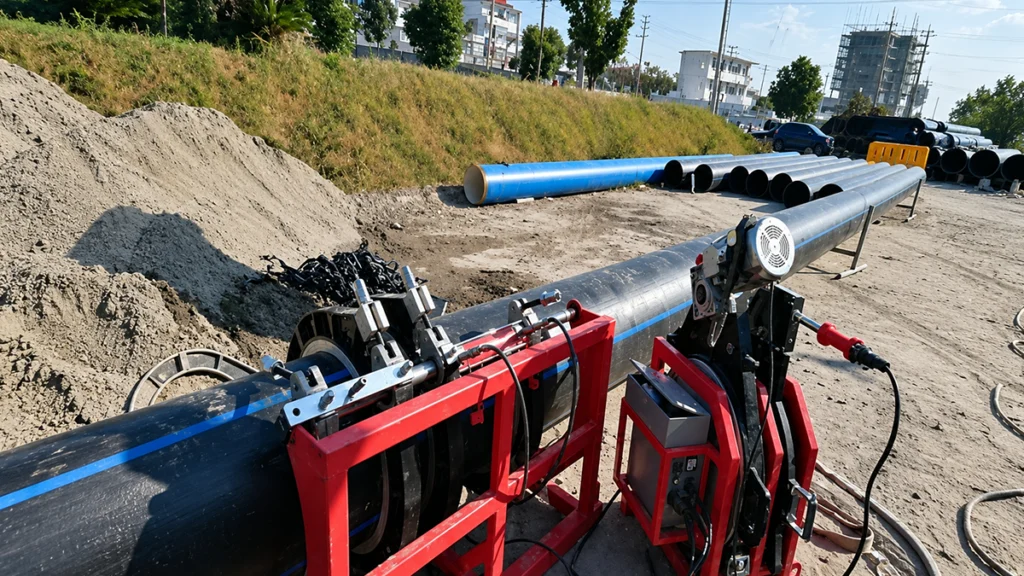
If you’re working with High-Density Polyethylene (HDPE) piping, a Butt Fusion Welding Machine Mexico is your most vital piece of equipment. These specialized industrial units heat pipe ends until they reach a molten state, then press them together using highly controlled mechanical or hydraulic pressure. The result? A perfectly homogeneous, leak-proof joint. In fact, this fused connection actually becomes structurally stronger than the original pipe wall. That kind of reliability is exactly why these machines are non-negotiable for critical infrastructure.
Why does this matter so much for the Mexican market? It boils down to a few core realities:
- Water Conservation: Northern Mexico’s arid climate demands flawless, leak-free distribution networks to protect every drop of critical water.
- High-Altitude Performance: Mining operations in elevated, mountainous terrain require joints that can withstand extreme pressure ratings.
- Seismic Resilience: Active fault lines run across the country. Fused joints offer the flexibility and earthquake resistance necessary to keep pipelines intact during tremors.
- Cost Efficiency: Municipal utility networks dramatically slash their long-term maintenance and replacement budgets when they eliminate joint leaks.
Definition: How butt fusion welding works on HDPE pipes
Thermofusion—commonly known as butt fusion welding—is a highly standardized thermomechanical process. First, the HDPE pipe welding machine securely clamps two sections of HDPE pipe. An electric facer then planes the ends perfectly flat to ensure total contact. Next, the operator applies a PTFE-coated heating plate. This melts the polymer, usually between 210°C and 225°C. Once the operator sees a precise melt bead form, they quickly remove the heating plate and activate the hydraulic system to drive the pipe ends together. As the polymer cools under sustained pressure, its molecular chains cross-link. You are left with one continuous pipe. No extra fittings. No chemical solvents.
Why HDPE pipeline demand is growing in Mexico (water, gas, mining, agri-irrigation)
Driven by nearshoring trends, rapid industrial expansion, and municipal upgrades, Mexico’s infrastructure is undergoing a massive transformation. Agencies like CONAGUA (National Water Commission) strongly favor HDPE for potable water systems. The material’s 50-year lifespan and total immunity to corrosion make it an easy choice.
At the same time, natural gas networks are stretching further to supply newly built industrial parks. Up north in Sonora and Zacatecas, the mining sector depends on thick-walled HDPE to safely transport abrasive slurries. Down in Sinaloa, agricultural hubs are battling severe droughts by replacing open canals with large-diameter HDPE irrigation systems.
What makes equipment selection critical for project success
Your choice of an HDPE pipe butt fusion machine supplier Mexico directly dictates the safety and uptime of your entire pipeline. If you cut corners with substandard equipment, you will likely face inconsistent heating or sudden pressure drops during the critical cooling phase. These flaws create cold welds and brittle joints.
In demanding environments like high-pressure gas lines or heavy mining operations, just one failed joint can trigger catastrophic environmental damage. Add in the severe safety hazards and millions of pesos lost to project delays, and the stakes become clear. Precision equipment guarantees compliance with strict international standards and effectively eliminates these hidden liabilities.
Manual butt fusion machines (small diameter, field repair)
Need to handle quick field repairs or residential plumbing? Manual butt fusion machines might be your best bet. These units use a simple hand-lever or hand-wheel to apply joining pressure. They are highly portable, budget-friendly, and perfect for low-pressure agricultural lines.
However, they do have limitations. You can typically only use them on smaller pipe diameters up to 160mm. Furthermore, because manual butt fusion machines lack hydraulic pressure gauges, the final weld quality rests entirely on the operator’s physical consistency and personal experience.
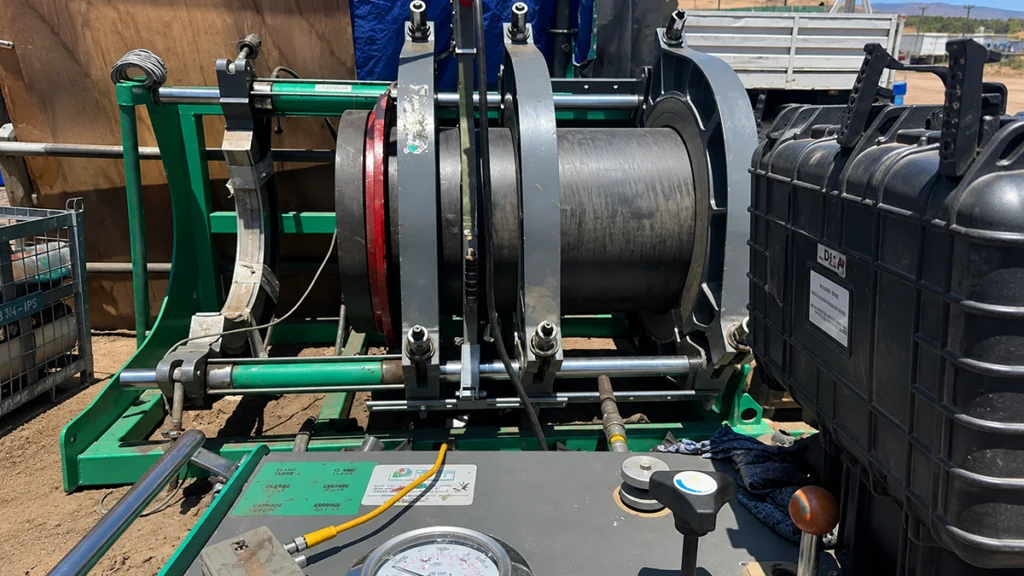
Main Types of Butt Fusion Welding Machines Available in the Mexican Market
Contractors operating in Mexico generally choose from three primary categories of thermofusion equipment: manual, semi-automatic hydraulic, and CNC automatic butt fusion machines. Finding the right fit means weighing your pipe diameter, required production speed, and budget against the rigorous welding standards (like DVS 2207 or ISO 21307) demanded by your contract.
| Machine Type | Diameter Range | Automation Level | Typical Application | Operator Skill Required |
|---|---|---|---|---|
| Manual | 40mm – 160mm | Low (Hand-lever) | Light plumbing, small irrigation, quick repairs | High (relies on feel) |
| Semi-Automatic Hydraulic | 63mm – 1600mm+ | Medium (Hydraulic pump & gauge) | Municipal water, mining slurry, general contracting | Medium |
| Fully Automatic CNC | 90mm – 1200mm+ | High (Computer-controlled cycle) | Natural gas lines, highly regulated industrial plants | Low (Machine controls parameters) |
Semi-automatic hydraulic butt fusion machines
For most civil and industrial contractors, a hydraulic butt fusion welding machine for HDPE pipes represents the gold standard. These butt fusion machines rely on a motorized hydraulic power pack to apply and hold precise drag, heating, and joining pressures. Operators manually control the valves while keeping a close eye on the pressure gauges to ensure the fusion cycle strictly follows parameter charts. These units hit the sweet spot for medium to large-diameter pipes, offering incredible durability, reasonable costs, and rock-solid weld consistency.
Fully automatic CNC butt fusion welding machines
Want to remove human error entirely? CNC (Computer Numerical Control) automatic butt fusion machines do exactly that. The operator simply steps up to the touch-screen interface and inputs the pipe diameter, SDR (Standard Dimension Ratio), and material grade.
From there, the pipe fusion machine takes over. Its internal computer calculates and executes the perfect heating time, changeover time, and cooling pressure. CNC systems actively monitor environmental conditions and will instantly abort the weld if any parameter drifts out of spec. For high-risk installations, this level of automation is absolutely mandatory.
Which type fits municipal, gas, or mining projects in Mexico?
Your project environment largely dictates your HDPE pipe welding machine choice. Municipal water crews typically lean toward semi-automatic hydraulic units. They are rugged enough to survive muddy, dust-choked street trenches while remaining highly adaptable.
Conversely, natural gas distribution leaves zero room for error. These projects require a CNC butt fusion welding machine Mexico distributor to ensure absolute traceability and strict zero-leak tolerances. Meanwhile, mining operations deal with massive, thick-walled pipes in brutal terrain. They need heavy-duty hydraulic units outfitted with reinforced clamps and high-capacity heating plates to get the job done.
Common size ranges and their typical applications
Sizing your equipment comes down to the maximum outer diameter (OD) of the pipe you plan to weld. Small butt fusion machines (63-160mm) are a common sight in commercial and residential developments. Mid-range units (200-500mm) carry the workload for municipal water mains and secondary gas lines.
When you move into major infrastructure, you need heavy-duty equipment (630-1200mm and above). These massive pipe fusion machines tackle desalination plant outfalls, large-scale agricultural aqueducts, and primary mining tailings pipelines.
Factory-direct pricing with technical consultation included
Get Your Free QuoteButt Fusion Welding Machine Size Ranges and HDPE Pipe Diameter Compatibility
Sizing your equipment correctly is about more than just fitting the pipe into the HDPE pipe jointing machine. It guarantees secure clamping, flawless alignment, and enough heating power for your specific dimensions. While manufacturers categorize these butt fusion welding machines by their maximum capacity, every unit comes with a set of reducing inserts. These inserts allow you to step down and grip smaller diameters within the machine’s rated range.
| Size Range (OD) | Typical Applications | Mexican Project Examples |
|---|---|---|
| 63mm – 160mm | Residential water, secondary irrigation | Housing developments in Querétaro |
| 160mm – 315mm | Municipal water distribution, gas lines | CONAGUA network upgrades in CDMX |
| 315mm – 630mm | Main water transmission, industrial fluids | Agricultural mainlines in Sinaloa |
| 630mm – 1200mm+ | Mining slurry, marine outfalls, bulk water | Tailings lines in Sonora copper mines |
How to match machine size to your HDPE pipe SDR and OD
When you are in the market for a butt fusion welding machine 315mm 630mm Mexico, you have to look at both the Outer Diameter (OD) and the Standard Dimension Ratio (SDR). The SDR determines the wall thickness.
A specific butt fusion machine might physically fit a 630mm pipe. However, if that pipe is an SDR 7—meaning it has an exceptionally thick wall designed for high pressure—the butt fusion welding machine’s hydraulic cylinders need serious thrust capacity. They must overcome immense drag force to apply the correct interfacial pressure during the final joining phase.
Do you need one machine or multiple size ranges?
It is a classic contractor debate: buy one massive pipe fusion machine to do it all, or invest in multiple smaller units? Technically, a 1200mm butt fusion machine can weld a 315mm pipe if you stack enough reducing inserts. But practically? It is a nightmare. The setup is highly inefficient, incredibly heavy, and nearly impossible to maneuver inside a tight trench.
The smartest approach is building a fleet tailored to specific size brackets. Operating one 160-315mm unit alongside a 315-630mm unit maximizes your agility on the job site and aggressively cuts down your setup times.
The 5 stages of a butt fusion weld cycle
1. Facing: The electric facer simultaneously shaves both pipe ends. You run it until continuous ribbons of plastic peel off, leaving perfectly parallel, clean surfaces.
2. Alignment: The operator brings the pipe ends together under light pressure. This step checks for high-low misalignment and confirms absolutely zero gaps exist between the two faces.
3. Heating: You insert the PTFE-coated heating plate. The pipe ends press against it until a precise bead size forms. Then, you drop the pressure to let the heat deeply soak into the pipe wall.
4. Joining: You quickly pull the heater out (this is the changeover time) and immediately drive the pipe ends together at the calculated fusion pressure.
5. Cooling: The joint must remain perfectly still under pressure until the core temperature drops below a specific threshold. This solidifies the molecular bond.
Heating plate temperature control and PTFE coating quality
Never underestimate the heating plate. It is the most critical thermal component of your setup. The plate must hold a perfectly uniform temperature across its entire surface, allowing for a maximum deviation of only ±5°C.
Furthermore, a premium PTFE (Teflon) coating is non-negotiable. It stops the molten polyethylene from sticking to the metal during the fast-paced changeover phase. If you use a degraded coating, it will rip polymer away from the pipe end. This creates dangerous voids and catastrophic weak points inside the final weld.
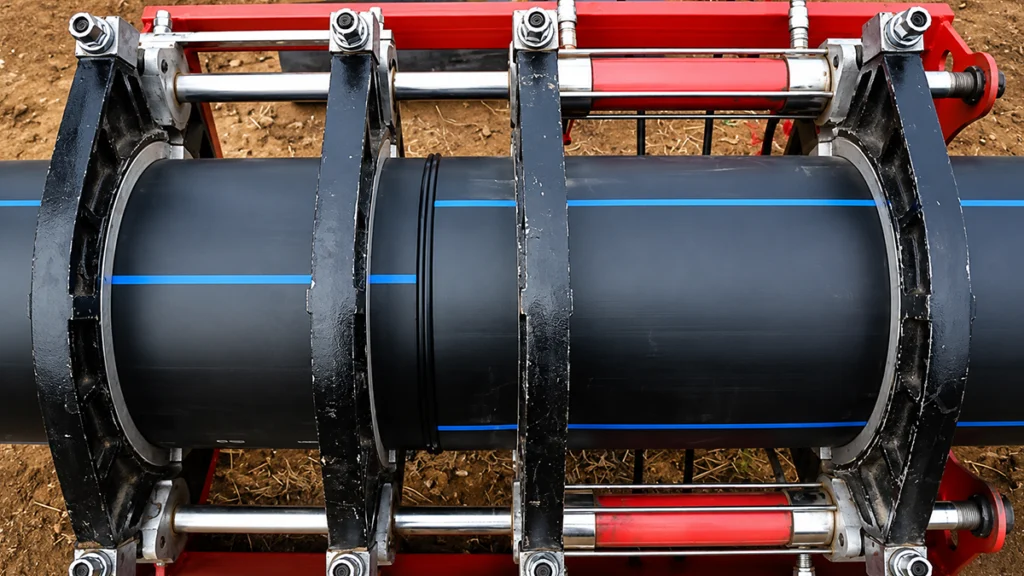
Key Working Principles and Core Components You Should Evaluate
A top-tier butt fusion machine functions through the flawless synchronization of its heating plate, facer, hydraulic unit, and structural frame. By carefully evaluating these core components, you ensure the equipment can hit the strict temperature and pressure parameters demanded by international standards. This prevents expensive re-welds and guarantees the pipeline survives its 50-year design life.
- Chassis/Frame: Look for high-grade aluminum or steel construction. It must resist warping under tons of hydraulic force.
- Hydraulic Pump Station: It needs high-precision valves to lock in steady pressure during the long cooling cycle without straining the motor.
- Electric Facer: Robust gearboxes and hardened steel blades are essential to smoothly slice through thick, high-density polymer.
Hydraulic system pressure stability and clamp alignment accuracy
Your hydraulic system must deliver smooth, surge-free pressure. If that pressure drops even slightly during the cooling phase, you compromise the molecular cross-linking of the HDPE. The result is a weak, unreliable joint.
Clamp alignment is equally crucial. Even a minor 10% wall thickness misalignment creates a nasty stress concentrator. Under surge pressures, that tiny flaw can trigger a premature pipeline rupture. Absolute alignment accuracy is mandatory.
Data loggers and ISO 12176 traceability requirements
If you are wondering how to choose butt fusion welding machine for HDPE projects, start by looking at data logging capabilities. In today’s market, this is rapidly becoming a strict prerequisite. Data loggers capture the exact time, temperature, pressure, and operator ID for every single weld you complete.
You then export this data as a PDF or CSV file to prove you complied with ISO 12176 standards. Try handing over a completed pipeline without this digital traceability, and utility companies will likely refuse to sign off on your work.
Potable water networks (CONAGUA and municipal projects)
When working on municipal water infrastructure in Mexico, CONAGUA sets incredibly strict regulations. Butt fusion machines on these jobs need serious mobility to squeeze into narrow urban street trenches, yet they must remain tough enough for non-stop daily use. More importantly, the equipment has to produce perfectly smooth internal weld beads. Any jagged edges inside the pipe can restrict water flow or create breeding grounds for bacterial buildup in the city’s drinking water.
Natural gas distribution pipelines
Natural gas pipelines operate under extreme, uncompromising safety mandates. Even a microscopic leak can trigger an explosive disaster. Because of this, gas distribution companies almost exclusively specify CNC automatic butt fusion machines equipped with integrated data logging. These advanced units ensure every single parameter is tightly controlled by a computer. By eliminating operator fatigue and miscalculation, they generate a fully auditable digital trail for the entire gas network.
Get detailed specs and custom configuration options
Request Technical SpecificationsApplication Scenarios: Where Butt Fusion Machines Are Used Across Mexico
From the scorching northern deserts down to the humid southern coasts, a Butt Fusion Welding Machine Mexico has to perform flawlessly across incredibly diverse environments. Because HDPE pipelines serve as the backbone of modern Mexican infrastructure, the demand for adaptable, heavy-duty welding solutions has never been higher.
Mining slurry and tailings lines in Sonora, Zacatecas, Chihuahua
Northern Mexico’s mining sector extracts massive quantities of copper, silver, and gold. This requires moving enormous volumes of water and highly abrasive tailings across brutal, mountainous terrain.
The equipment deployed here must be ruggedized. Contractors need heavy-duty off-road chassis, generators rated for high altitudes, and reinforced clamps. These butt fusion machines must easily handle the immense drag forces involved in pulling 1000mm SDR 9 pipes across jagged, rocky ground.
Agricultural irrigation in Sinaloa, Jalisco, and Bajío region
Mexico’s agricultural powerhouses are aggressively abandoning open canals in favor of closed HDPE pipelines. The goal is simple: eliminate evaporation and stop water theft.
Contractors operating in these vital regions generally rely on 315mm to 630mm hydraulic butt fusion machines to lay down kilometers of mainlines. The machinery has to withstand fine, pervasive agricultural dust while operating effectively in blistering summer temperatures that frequently top 40°C.
Industrial and marine outfall applications
Coastal marine outfall projects and chemical processing plants in Monterrey depend on HDPE for its unmatched resistance to corrosion and harsh chemicals. However, welding near the ocean is tough on equipment.
Butt fusion machines operating in coastal zones require high IP (Ingress Protection) ratings to shield their sensitive electrical components from salt spray and heavy humidity. The resulting welds must be structurally flawless to endure the violent dynamic forces of tidal shifts and ocean currents.
Voltage and power supply requirements (220V/380V/440V in Mexico)
Electrical compatibility trips up a lot of buyers. Industrial sites in Mexico generally run on 220V (single or three-phase), 380V, or 440V (three-phase) power.
Here is the catch: standard European or Chinese butt fusion machine might be wired for 380V at 50Hz, but Mexico operates on a 60Hz grid. Buyers must explicitly communicate their exact voltage and frequency requirements to the manufacturer. Failing to do so means your heating plates and hydraulic motors will run inefficiently—or simply burn out.
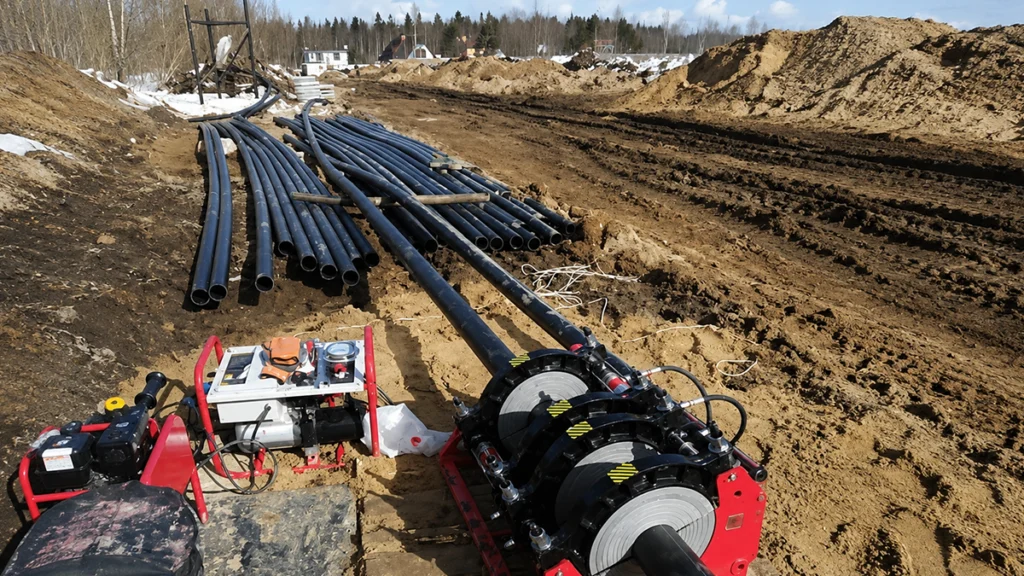
Technical Specifications and Decision Criteria for Buyers in Mexico
Smart procurement teams look far beyond basic pipe diameter. They dive deep into electrical compatibility, environmental resilience, and strict regulatory compliance. Aligning your equipment specs with Mexico’s unique job site conditions is the best way to prevent electrical blowouts, defective welds, and painful project rejections by government inspectors.
- Power Supply: You must strictly match the butt fusion machine to local generator outputs (typically 220V/380V/440V at 60Hz).
- Total Power (kW): Ensure your site generator has at least a 30% surplus capacity. It needs that buffer to handle the massive initial power draw of the heating plate.
- Cylinder Area: You need to know the hydraulic cylinder’s effective area so you can accurately convert the butt fusion welding machine’s gauge pressure into the required interfacial pressure.
Certifications to look for: ISO 12176, DVS 2207, ASTM F2620
Securing an ISO 12176 certified butt fusion welding machine Mexico proves that your equipment meets global manufacturing and data logging benchmarks. Beyond that, the butt fusion machine must accurately execute weld cycles defined by DVS 2207 (the globally recognized German standard) or ASTM F2620 (the American standard heavily favored in Mexico due to geographic proximity). Always ask the manufacturer to supply their CE or ISO 9001 factory certifications upfront.
Operating environment: altitude, dust, humidity, and high-temperature performance
Mexico’s diverse geography throws extreme environmental curveballs at contractors. At elevations above 2,500 meters—such as in Toluca or Zacatecas—diesel generators can lose up to 25% of their total power output. If you do not account for this drop, your butt fusion welding machine will not receive the wattage required to keep the heating plate at the correct temperature.
Likewise, butt fusion machines heading to the desert need dust-proof hydraulic quick-couplers and IP65-rated electrical enclosures to fend off short circuits caused by blowing sand.
Optional features: data logging, GPS, remote diagnostics
Today’s fusion equipment comes packed with smart features that streamline project management. While integrated data loggers are standard on CNC models, you can usually add them to hydraulic units as well.
GPS tagging is another game-changer, recording the exact coordinates of every single weld to generate an instant digital map of your pipeline. Additionally, remote diagnostics let manufacturers troubleshoot electrical or hydraulic faults via a simple cellular connection, drastically cutting down on downtime when you are working in isolated areas.
Weld quality and consistency compared
At the end of the day, the only thing that truly matters is the integrity of the joint. Manual butt fusion welding machines produce highly variable results because operator fatigue inevitably sets in. Hydraulic butt fusion machines deliver fantastic consistency, but only if the operator rigorously follows the parameter charts.
CNC automatic butt fusion machines, however, offer flawless consistency. They churn out identical, textbook-perfect double-roll beads every single time, completely removing the operator’s physical stamina or mathematical abilities from the equation.
Comparison Guide: Manual vs Hydraulic vs CNC Butt Fusion Machines
Deciding between manual, hydraulic, and CNC systems is a balancing act. You have to weigh upfront capital costs against long-term weld quality and labor efficiency. This breakdown helps procurement managers justify their spending based on the exact demands of their pipeline contracts.
| Feature | Manual | Semi-Automatic Hydraulic | Fully Automatic CNC |
|---|---|---|---|
| Weld Consistency | Low to Moderate | High | Perfect |
| Production Speed | Slow | Fast | Very Fast (Optimized cycles) |
| Data Traceability | None | Optional add-on | Standard / Integrated |
| Price Range | Lowest | Medium | Highest |
| Best Fit For | Repairs, small plumbing | Water mains, general civil | Natural gas, strict specs |
Labor skill requirements and training curve
Manual butt fusion machines demand serious physical exertion and a deep, intuitive feel for how the plastic behaves. Surprisingly, this makes their training curve quite steep if you want high-quality results. Hydraulic machines require operators who can handle pressure conversion math and read complex parameter tables.
CNC automatic butt fusion weliding machines actually present the lowest operational skill barrier—if you can navigate a touchscreen, you can run the weld cycle. However, they do require highly specialized technicians when it comes to maintenance and calibration.
Total cost of ownership over 5 years
When you calculate the total cost of ownership over a five-year span, hydraulic butt fusion machines usually hit the sweet spot for most contractors. CNC machines require a larger initial investment and come with pricier electronic repair bills, but they virtually wipe out the costs associated with failed welds and destructive testing.
Manual butt fusion machines might look cheap on the invoice, but their slow productivity and higher joint failure rates make them incredibly expensive over the long haul.
Which option delivers the best ROI for Mexican contractors?
If you are a general contractor managing a diverse portfolio of municipal water, civil, and agricultural projects, a semi-automatic hydraulic HDPE pipe welding machine offers the best Return on Investment (ROI). It is rugged, budget-friendly, and universally accepted by site engineers.
However, if your business strategy involves bidding exclusively on natural gas networks or tightly regulated industrial plant expansions, buying a CNC HDPE pipe jointing machine is not optional—it is the only realistic way to secure those highly lucrative contracts.
Price ranges by machine type and size (indicative USD)
*Keep in mind that prices fluctuate significantly based on the brand, country of origin, and included accessories.*
- Manual (63-160mm): $500 – $1,500 USD
- Hydraulic (160-315mm): $2,500 – $5,000 USD
- Hydraulic (315-630mm): $6,000 – $12,000 USD
- CNC (160-315mm): $5,000 – $9,000 USD
- Heavy-Duty Hydraulic (up to 1200mm): $25,000 – $45,000+ USD
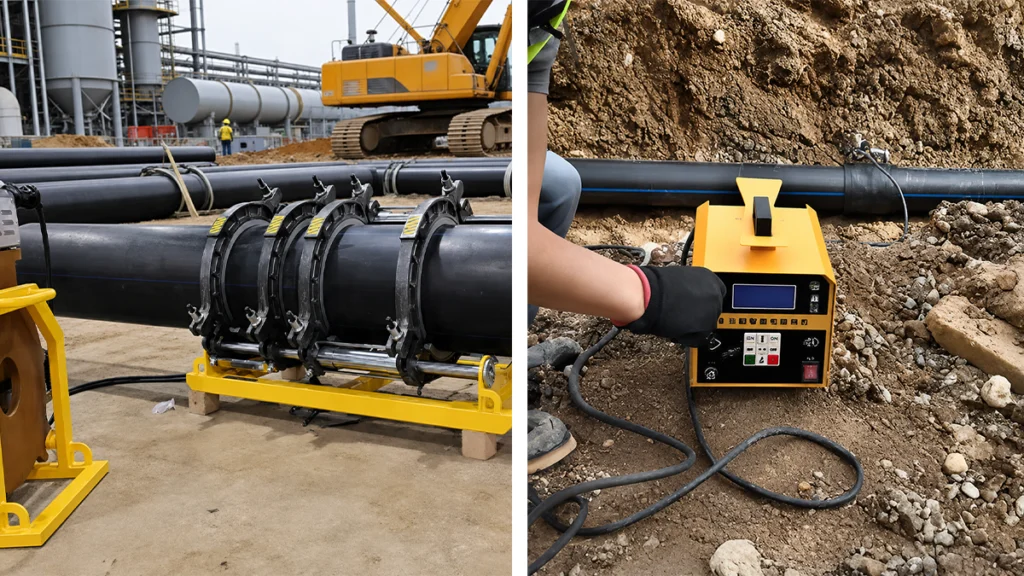
Butt Fusion Welding Machine Price, MOQ, and Import Cost in Mexico
Importing a butt fusion welding machine for water and gas pipelines Mexico means tackling complex shipping logistics, local taxation, and customs duties. By calculating the total landed cost—rather than just looking at the factory sticker price—you can accurately budget your project and avoid exorbitant storage fees at major entry ports.
- FOB Price: What you pay to have the butt fusion machine loaded onto the ship at the port of origin.
- CIF Price: This covers the butt fusion machine itself, ocean freight, and insurance all the way to the Mexican port.
- Landed Cost: The CIF price plus your import duties, IVA (Value Added Tax), and customs broker fees.
Lead time, FOB vs CIF Manzanillo/Veracruz shipping
Standard hydraulic butt fusion welding machines (up to 630mm) are frequently kept in stock and can be shipped out within 7 to 10 days. Conversely, massive 1200mm+ units or custom CNC rigs often demand a 30 to 45-day manufacturing lead time.
Ocean freight from Europe or Asia to the Port of Manzanillo on the Pacific, or Veracruz on the Gulf, usually takes 25 to 40 days. Smart buyers negotiate CIF terms so the supplier takes on the headache of international freight and insurance logistics.
Import duties, IVA, and IMMEX program considerations
When bringing butt fusion machinery into Mexico, you must factor in a 16% IVA (Value Added Tax) applied to the total CIF value, plus any relevant import duties. These duties typically range from 0% to 15%, depending heavily on the butt fusion machine’s country of origin and active free trade agreements.
Companies operating under the IMMEX program (maquiladoras) might qualify to defer or entirely exempt these taxes if the equipment produces export goods. However, this exemption rarely applies to domestic pipeline contractors.
Warranty terms, spare parts availability, and local service coverage
A bargain butt fusion machine becomes a financial nightmare if a $50 hydraulic seal blows out and takes three weeks to replace. When looking into a butt fusion welding machine spare parts and service Mexico, demand a minimum 12-month warranty.
Verify that your supplier either has a local distributor network stocking critical spare parts (like PTFE plates, heating elements, and facer blades) or explicitly guarantees 72-hour DHL/FedEx air shipping for emergency components.
Choosing the cheapest machine without certification
Hunting for the absolute lowest butt fusion welding machine price in Mexico is a recipe for disaster. Bottom-tier machines frequently utilize weak aluminum that twists under pressure, faulty thermostats that scorch the HDPE, and cheap hydraulic cylinders prone to leaking.
Worse still, if the equipment lacks CE, ISO, or DVS certifications, government or utility site inspectors will simply reject it, rendering your “cheap” investment completely worthless.
Common Mistakes and Hidden Risks When Sourcing Fusion Equipment
Sourcing HDPE pipe welding machinery demands rigorous vetting to ensure it holds up under brutal field conditions. Too often, buyers chase low upfront prices and sacrifice long-term reliability. This leads directly to catastrophic joint failures, massive project delays, and a ruined reputation for the contractor.
1. Ignoring Voltage Specs: Purchasing a 380V/50Hz unit for a Mexican site running on 220V/60Hz.
2. Skipping Data Loggers: Securing a lucrative gas contract, only to discover your pipe fusion machine cannot generate the mandatory digital weld reports.
3. Under-sizing Generators: Forgetting to calculate the massive startup power surge required by the heating plate.
4. Neglecting PTFE Quality: Settling for cheap Teflon coatings that start peeling off after just 50 welds.
5. Forgetting Reducing Inserts: Buying a 630mm HDPE pipe jointing machine but failing to order the specific inserts needed to weld a 400mm pipe section.
Underestimating training and welder qualification
Even the most sophisticated hydraulic butt fusion machine will fail if the operator does not grasp the core principles of thermofusion. Contractors make a critical error when they hand brand-new equipment to untrained laborers.
Proper welder qualification—which often includes formal classroom training and destructive testing of sample welds—is paramount. Operators must know exactly how to read parameter charts and adjust for environmental variables like unexpected rain or high winds that drastically alter cooling times.
Ignoring spare parts and after-sales support in Mexico
Machinery breaks, especially when operating in high-vibration, dust-filled trenches. If you buy from a supplier lacking solid after-sales support in Mexico, a minor mechanical hiccup can shut down your entire pipeline project.
Always negotiate a spare parts package (including extra thermocouples, facer blades, and quick connectors) alongside your initial butt fusion machine purchase. This completely bypasses international shipping delays during a job site emergency.
Mismatched voltage or altitude-related performance drops
As mentioned earlier, high altitudes choke diesel generator performance. A contractor laying pipe in the mountains of Puebla might realize their 15kW generator is only pushing out 10kW. If the pipe fusion machine needs 12kW, the heating plate will never hit the crucial 220°C mark, guaranteeing cold, weak welds. Always calculate your power requirements with a hefty safety margin specifically tailored to your job site’s elevation.
Step 1: Define your pipe size, material, and project volume
Start by dissecting the engineering plans. Pinpoint the maximum and minimum Outer Diameters (OD) alongside the thickest wall dimension (SDR) you will face. Next, calculate the total number of joints required.
If you have a short run of 50 joints, a standard hydraulic butt fusion machine is perfectly adequate. But if you are tackling a sprawling aqueduct that requires 5,000 joints, spending the extra capital on a highly automated, high-speed machine will quickly pay for itself through massive labor savings.
Butt Fusion Machine Buying Checklist
A methodical procurement strategy ensures you buy equipment that hits current project specs while bolstering your future fleet capabilities. Use this step-by-step checklist to cut through the noise and source industrial thermofusion equipment efficiently.
Step 2: Match machine type to project complexity
Gauge the strictness of the project owner, whether that is CONAGUA, PEMEX, or a private mining corporation. If your contract dictates 100% weld traceability and digital PDFs, you have no choice but to buy a CNC automatic butt fusion machine or a hydraulic unit featuring an integrated data logger. For standard agricultural irrigation lines, a dependable semi-automatic hydraulic machine remains the most sensible, cost-effective route.
Step 3: Verify certifications, voltage, and site conditions
Always cross-reference the HDPE pipe welding machine’s electrical demands against your site’s power grid. Explicitly demand 60Hz compatibility. Ask to see the manufacturer’s ISO 9001 certificate and verify the unit itself aligns with ISO 12176 standards. If your crew is heading into extreme environments, mandate enclosed hydraulic stations, heavy-duty chassis designs, and upgraded IP ratings.
Step 4: Evaluate supplier support, training, and warranty
Never sign off on a purchase without a legally binding, written warranty agreement. Push the supplier to provide references or case studies from other clients in Mexico or Latin America. Verify that they supply comprehensive digital operation manuals in Spanish, visual troubleshooting videos, and direct access to technical engineers via email or WhatsApp for immediate field support.
Final recommendation: When to buy, rent, or customize
Choosing between butt fusion machine rental vs purchase Mexico ultimately depends on your utilization rates. If you only need the equipment for 30 days out of the year, renting locally makes the most financial sense.
However, if you consistently bid on infrastructure projects, owning your own fleet guarantees immediate availability and slashes your cost-per-weld. For highly specific jobs, like welding incredibly thick-walled mining pipes, it pays to work directly with the manufacturer to customize the hydraulic cylinder capacity. By locking down your pipe dimensions and site conditions early, you secure machinery that will act as a reliable profit center for years.
FAQ
Q1: How much does a butt fusion welding machine cost in Mexico?
Pricing fluctuates based on the machine’s size and level of automation. A basic manual tool for smaller pipes (up to 160mm) usually runs between $500 and $1,500 USD. If you need a standard hydraulic unit for municipal work (up to 315mm), expect to pay between $2,500 and $5,000 USD. For heavy-duty industrial or CNC machines handling massive diameters, prices range from $15,000 to well over $45,000 USD, not including import duties.
Q2: What certifications should a butt fusion welding machine have for HDPE pipe projects?
ISO 12176 is the gold standard; it governs fusion equipment specifications and data logging capabilities. Furthermore, your machine must be able to execute weld cycles that strictly adhere to global joining standards like DVS 2207 (German) or ASTM F2620 (American). Utility companies and site engineers in Mexico heavily enforce these specific standards.
Q3: Can a butt fusion welding machine work with 220V power supply in Mexico?
Absolutely, but you must explicitly request this configuration during the buying process. Many compact hydraulic units (up to 315mm) can run on 220V single-phase or three-phase power at 60Hz. Larger machines, however, draw massive amounts of electricity for their heating plates and generally require 380V or 440V three-phase power. Always verify your site generator’s output before ordering.
Q4: What size butt fusion machine do I need for 630mm HDPE pipes?
You will need a unit rated for a maximum capacity of at least 630mm (often sold as a 315-630mm machine). Crucially, it must possess enough hydraulic thrust to handle the exact SDR (wall thickness) of your pipe. This ensures it can apply and hold the correct interfacial pressure throughout the heating and cooling stages without slipping or dropping pressure.
Q5: Is it better to rent or buy a butt fusion welding machine for a one-time project in Mexico?
If your project is strictly a one-off job lasting less than a month, renting is the smartest move because it removes maintenance and storage overhead. However, if the job extends for several months, or if your firm regularly bids on pipeline contracts, purchasing equipment yields a vastly superior ROI and protects you from local rental shortages.
Q6: How long does it take to import a butt fusion welding machine into Mexico?
For overseas shipments from Europe or Asia, ocean freight to ports like Veracruz or Manzanillo takes roughly 25 to 40 days. Factoring in another 5 to 10 days for customs clearance, plus the initial manufacturing lead time, you should realistically budget for a 45 to 60-day procurement window.
Q7: What is the difference between hydraulic and CNC butt fusion welding machines?
With a hydraulic machine, the operator manually adjusts valves, reads pressure gauges, and tracks heating and cooling times with a stopwatch. A CNC (Computer Numerical Control) machine fully automates this workflow. The operator simply types in the pipe dimensions, and the machine’s onboard computer takes over—precisely managing temperature, pressure, and timing to eliminate human error while recording all weld data.
Q8: How do I qualify welders and ensure weld quality on HDPE pipelines?
Welders must receive formal, hands-on training covering thermofusion principles and the exact machinery they will use. You guarantee quality by strictly adhering to ASTM F2620 or DVS 2207 parameter charts, keeping pipe faces perfectly clean and aligned, and conducting routine destructive testing (like tensile or bend tests) on sample joints before starting the actual pipeline run.
Conclusion
Choosing the correct Butt Fusion Welding Machine Mexico is a high-stakes procurement and engineering decision. It directly dictates the profitability, safety, and lifespan of your HDPE pipeline projects. By grasping the operational differences between manual, hydraulic, and CNC systems, contractors can perfectly align their hardware with the realities of municipal water grids, abrasive mining sites, or high-pressure gas lines.
True project success hinges on verifying critical technical specs—like 60Hz electrical compatibility and high-altitude generator output—while strictly adhering to DVS 2207 and ISO 12176 standards. Moreover, accurately calculating total landed costs, navigating Mexican port logistics, and securing reliable local spare parts will shield you from budget overruns and timeline delays. Ultimately, investing in premium, correctly sized fusion equipment—supported by rigorous operator training and strong manufacturer backing—guarantees the flawless, leak-proof infrastructure Mexico’s rapid expansion demands.
Let our experts help you choose the right equipment for your project
Contact Our Engineering Team