
Table of Contents
HDPE Pipe Welding Machine selection for irrigation pipe comes down to manual vs hydraulic. This guide compares diameter range, weld quality, cost, and project fit, helping contractors and distributors choose the right machine and avoid leak-prone joints.
Manual vs Hydraulic HDPE Pipe Welding Machine: Quick Answer for Irrigation Projects
Making the choice between a manual and hydraulic HDPE pipe welding machine usually boils down to one simple metric: the outer diameter (OD) of your pipeline. If you’re running sub-mains or drip lines under 160mm, manual machines are your go-to standard. But the moment you step up to mainlines exceeding 160mm? You strictly need a hydraulic unit. Human muscle simply can’t generate the sustained fusion pressure required to meet compliance standards on larger pipes.
Which machine type is best for irrigation pipe under 160mm?
Manual butt fusion machines hit the sweet spot for fittings and pipes sizing under 160mm. Standard models easily handle 40mm, 63mm, 90mm, 110mm, 125mm, 140mm, and 160mm jobs. Since these units rely entirely on the operator to manage milling, heating, and cooling pressure, they work flawlessly for smaller dimensions. At these sizes, average human strength is more than enough to lock in the proper fusion force. Plus, they pack a huge advantage for small farm sub-mains: they’re lightweight, highly portable, and incredibly budget-friendly.
When does an irrigation project require a hydraulic welder?
You must switch to a hydraulic welder the second your pipe diameters cross the 160mm threshold. We’re talking 200mm, 250mm, 315mm, right up to massive 1000mm mainlines. Why? Because manual force fails here. A human operator cannot consistently hold the 0.15 N/mm² (roughly 1.5 bar) fusion pressure mandated by DVS 2207 standards against the sheer drag weight of these massive pipes. Furthermore, if you’re working under municipal contracts or large-scale agricultural grants, you’ll likely face strict requirements for semi-automatic or fully automatic control. These hydraulic systems eliminate operator guesswork and generate digital weld joint logs, keeping you fully compliant with TSG D2002-2006.
Short summary: decision in 60 seconds
- Under 160mm + Sub-mains/Repairs: Go manual. You get a low entry cost (usually between $1,200 and $2,400 USD), minimal power draw (around 2.35KW on a 220V setup), and unmatched maneuverability for squeezing into tight trench repairs.
- Over 160mm + Mainlines/Contractors: Go hydraulic. These units bring high-precision pressure regulation to the table (scaling from 0-6.3 MPa all the way to 0-16 MPa). They conquer heavy pipe drag weights and guarantee repeatable, flawless welds. Expect your power needs to range from 4.21KW up to 23.5KW, depending on the machine’s size.
Why HDPE Pipe Welding Machine Selection Matters in Irrigation Pipe Installation
How welding quality impacts irrigation pipe leak rate
Aging concrete canals and poorly fitted mechanical pipes hemorrhage water, often losing 40% to 50% of their flow to leaks. By contrast, properly heat-fused HDPE joints slash that leakage rate by up to 30% compared to traditional mechanical setups, effectively giving you a monolithic, leak-proof pipeline. But achieving that kind of structural integrity demands flawless molecular diffusion. You need exact drag pressures and perfectly timed heat soaks (calculated precisely as 11±1 seconds multiplied by the wall thickness in mm, per ISO 21307).
Cost of weld failures in farm and agricultural projects
Fixing just one failed HDPE weld out in the field isn’t cheap. Data shows that labor, excavation, and equipment redeployment can easily set you back $1,400 per repair. Yet, the indirect costs hit even harder. A blown weld triggers massive water loss, ruins crops, and forces system downtime right when your fields need hydration the most. What causes these disasters? Usually, it’s uneven flange formation from stacking too many fixture layers, using degraded PTFE heating plates, or a sudden drop in operator pressure. Almost all of these issues trace directly back to choosing the wrong equipment.
Common irrigation pipe diameters and the welding implications
Irrigation networks typically rely on standard pipe sizes: 63mm, 75mm, 90mm, 110mm, 125mm, 140mm, 160mm, 200mm, 250mm, and 315mm. Manufacturers classify butt fusion welding machines by their maximum outer diameter (OD). A 160 model maxes out at 160mm, whereas a 315 model tackles everything from 160mm up to 315mm. But diameter isn’t the only metric. Pipe wall thickness (SDR) heavily dictates the fusion process. Thicker walls demand much longer heat soak times and substantially higher drag pressures. This reality often pushes contractors toward hydraulic butt fusion machines even for mid-sized pipes, simply to maintain consistent force over those drawn-out cooling cycles.
Factory-direct pricing with technical consultation included
Get Your Free QuoteWhat Is an HDPE Pipe Welding Machine? Types Used for Irrigation Pipe
At its core, an HDPE pipe welding machine is a specialized piece of industrial gear built to fuse high-density polyethylene. It heats the pipe ends until they reach a molten state, then drives them together under tightly controlled pressure to forge a permanent, monolithic bond.
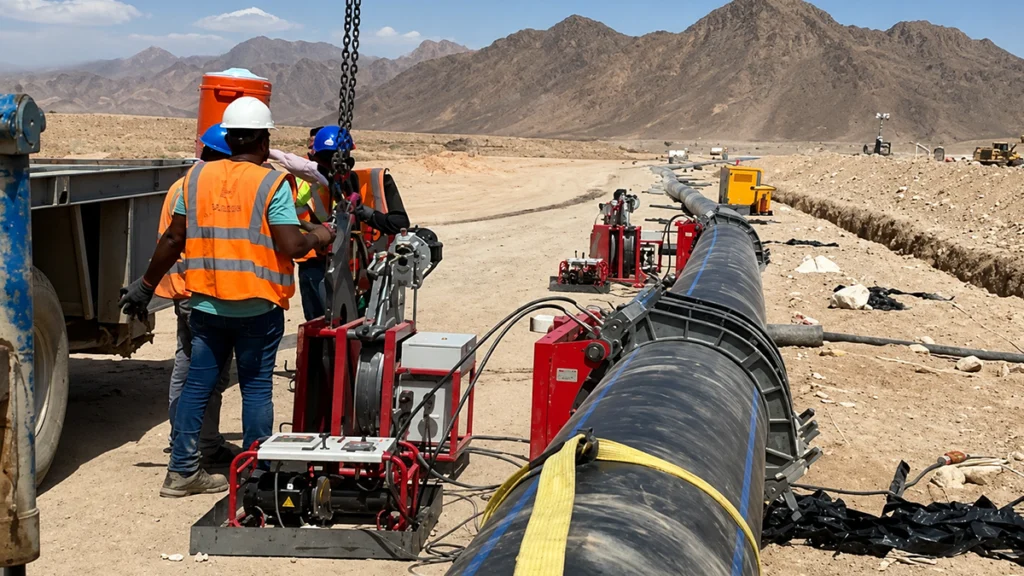
Manual HDPE butt fusion welding machine explained
A manual HDPE butt fusion machine leans entirely on elbow grease. The operator uses a hand-crank or lever to dial in the pressure during the positioning, milling, heating, and cooling stages. The setup is straightforward: a basic alignment frame, an electric heating plate, and an electric planer (milling cutter). Because they lack complex hydraulics, these units draw very little power. A typical 160mm butt fusion welding machine needs just about 2.35KW overall (1600W for the heater and 750W for the planer).
Hydraulic HDPE butt fusion welding machine explained
A hydraulic HDPE butt fusion machine pairs the basic frame with a dedicated hydraulic station to deliver semi-automatic or fully automatic pressure control. The system breaks down into four primary components: the hydraulic control box (operating platform), the clamping frame, the heating plate, and the milling cutter. Higher-end models take the guesswork completely out of the equation. They offer programmable welding parameters, automatic hot plate lift-off, and independent dual-channel timers for both heat absorption and cooling, ensuring every single joint meets exact standards.
Where electrofusion fits in irrigation projects
Electrofusion serves as a specialized alternative, mostly reserved for joining polythene pressure and non-pressure pipes in incredibly cramped trenches where a bulky butt fusion frame just won’t fit. Instead of a heating plate, this method requires meticulous surface scraping to strip away oxidation. Then, an electrical current is applied directly to a wire embedded inside a special fitting. While the equipment takes up less space, electrofusion drives up your per-joint costs significantly because those consumable wire fittings aren’t cheap.
Key components: heating plate, planer, clamps, and frame
- Heating Plate: Built from aluminum alloy and wrapped in a PTFE (polytetrafluoroethylene) coating to stop melted plastic from sticking. It features independent temperature controls (ranging from 0-300°C) with a strict error margin of ≤±3°C.
- Planer (Milling Cutter): Equipped with high-speed carbon steel or tool steel double-edged reversible blades. Driven by a rugged chain or motor, it shaves the pipe ends perfectly square.
- Clamps: These internal fixtures need to meet strict national standards. For HDPE pipe jointing machines under 400 amps, limit yourself to a maximum of three layers to avoid misalignment and uneven flanges.
- Frame: The heavy-duty backbone of the operation. A rigid frame ensures axial alignment deviation stays locked at ≤0.2mm to ≤0.3mm, even under extreme loads.
Manual HDPE Pipe Welding Machine: Strengths, Limits, and Best Use Cases
Typical pipe diameter range: 63mm, 90mm, 110mm, 160mm
Standard manual butt fusion machines hit their operational stride between 63mm and 160mm. Globally, these diameters are the gold standard for agricultural sub-mains, sprinkler lines, and drip irrigation headers. Premium manual frames are specifically engineered to apply a low starting pressure. This feature is absolutely vital for smaller diameters, ensuring you don’t accidentally crush thin-walled irrigation pipes during the initial bead-up phase.
Where manual welders work well in irrigation
Manual units shine during small-scale farm installations, quick leak repairs, and tight trench work where you need maximum maneuverability. Since they pull very little electricity, they are perfect for remote fields running off small portable generators (under 3KW). For independent farmers who need solid sub-main connections but can’t justify dropping thousands on a hydraulic rig, manual butt fusion machines are the smartest investment.
Operator skill and consistency risks
The biggest drawback of manual equipment? Human error. Operating a manual butt fusion welding machine means mentally calculating and physically holding the exact drag and fusion pressures throughout the entire cooling cycle. Let off the pressure too early, and you instantly compromise the weld. Furthermore, operators frequently forget to adjust their heat soak times when the ambient temperature drops. In fact, industry data points out that 75% of field crews need extensive training manuals and video guides just to avoid operator-induced failures on manual setups.
Is a manual machine enough for drip and sprinkler mainlines?
A manual butt fusion machine can handle drip and sprinkler mainlines strictly if your pipe diameter maxes out at 160mm and your operator thoroughly understands ISO 21307 protocols. However, the moment your mainline pushes past 160mm—or if your project involves municipal tie-ins demanding certified digital data logs—a manual butt fusion welding machine becomes completely inadequate and non-compliant.
Get detailed specs and custom configuration options
Request Technical SpecificationsHydraulic HDPE Pipe Welding Machine: Strengths, Limits, and Best Use Cases
Pipe diameter range: 90mm up to 630mm and beyond
Hydraulic models are built for massive scale. They are categorized by their maximum OD capabilities: 250mm (handling 90-250mm), 315mm, 450mm, 630mm, 800mm, and even 1000mm. To force such heavy pipes together, large pipe fusion machines rely on massive hydraulic cylinders. For instance, an 800mm HDPE butt fusion welding machine might utilize a total piston area of 23,179 mm². Because of this heavy-duty engineering, a 710-1000mm hydraulic butt fusion machine can tip the scales at 2,600 kg, requiring cranes or excavators just to position it on-site.
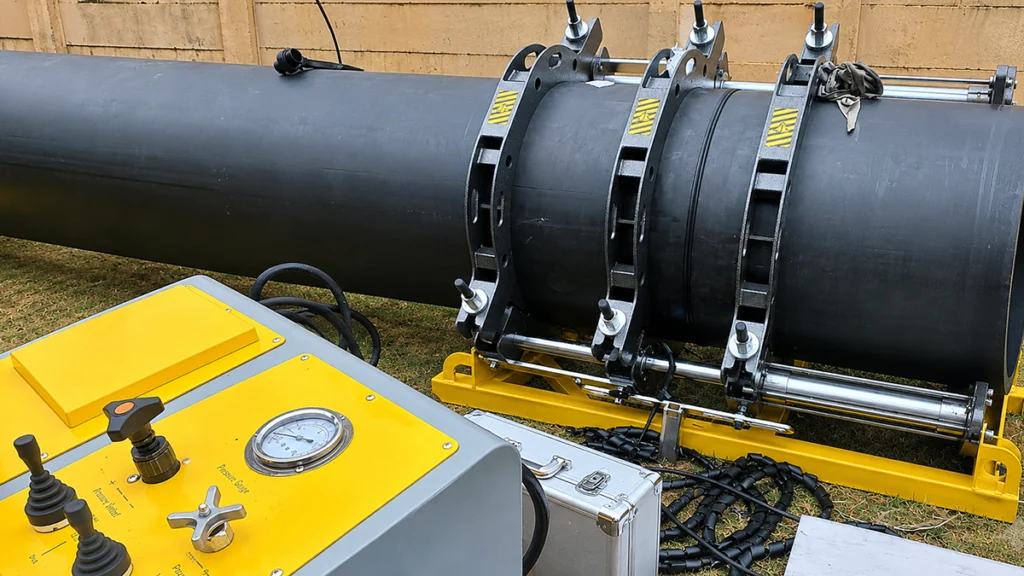
Pressure control and weld consistency advantages
The true power of a hydraulic station lies in its pinpoint pressure adjustment. Smaller units scale from 0~6.3MPa, while large-diameter behemoths push up to 0~16MPa. This raw power allows for fully automatic, uninterrupted control over time, temperature, and pressure. Once fusion begins, parameters lock in automatically. The most advanced units even feature smart ambient temperature compensation, tweaking heat absorption times on the fly and effectively erasing human error.
When hydraulic becomes mandatory for irrigation mainlines
Hydraulic force isn’t just a luxury; it becomes mandatory when pipe OD exceeds 160mm. At that size, a human simply cannot overcome the pipe’s drag weight to hit the required 0.15 N/mm² fusion pressure. Moreover, if your engineering contract demands strict compliance with ISO 21307, DVS 2207, or ASTM F2620 standards, you have no choice. These frameworks require verifiable data logging and electronically locked fusion parameters that only a hydraulic system can provide.
Power supply and field deployment considerations
Deploying hydraulic equipment in the field takes serious power planning. Butt fusion Machines in the 160mm, 200mm, 250mm, and 315mm range usually run on 220V, 50Hz single-phase power. Step up to the larger 450mm to 1000mm units, and you strictly need 380V, 50Hz three-phase power. Total power consumption scales drastically, jumping from 4.21KW on a 250mm rig up to a hefty 23.5KW for a 1000mm unit. Always size your field generators to handle this total draw plus an extra 20-30% surge margin.
Manual vs Hydraulic HDPE Welding Machine: Side-by-Side Comparison
Comparison table: diameter, pressure, output, price
| Feature | Manual HDPE Welding Machine | Hydraulic HDPE Welding Machine |
|---|---|---|
| Diameter Range | 40mm –250mm | 40mm – 2600mm+ |
| Pressure Control | Human force (Lever/Crank) | Hydraulic Station (0-6.3 MPa to 0-16 MPa) |
| Power Output | Low (~2.35KW for 160mm) | High (4.21KW to 94.7KW) |
| Price Range | ~$1,200 – $2,400 USD | ~$3,000 to $10,000+ USD |
| Weld Consistency | Highly dependent on operator skill | High precision, automated locking |
| Portability | High (lightweight, fits tight trenches) | Low (heavy frame, requires lifting equipment) |
| Best Use Case | Small farms, sub-mains, repairs | Large contractors, heavy mainlines, QA logging |
Total cost of ownership over 3-5 years
Hydraulic butt fusion machines undeniably carry a steeper upfront price tag. However, they drastically cut down labor time per joint and virtually wipe out the risk of $1,400+ leak repairs caused by operator fatigue. Keeping a hydraulic unit running smoothly just requires routine fluid checks, basic cylinder upkeep, and sensor calibration. If you partner with reputable suppliers like Ekberg Welding—who provide a 1-year warranty, lifetime maintenance, and free replacements for non-human damage—your 5-year total cost of ownership drops significantly.
Which option fits small farms vs large irrigation contractors?
For small farms, a manual 160mm HDPE pipe jointing machine is the perfect fit. Its low capital expense, minimal generator demands, and easy storage make it ideal for routine agricultural sub-mains. Large irrigation contractors, on the other hand, need the brute strength of hydraulic 315mm or 630mm pipe fusion machines. These units deliver the high-speed productivity, massive clamping force, and QA data logging necessary to secure and execute major municipal and commercial agricultural mainline contracts.
Technical Specifications to Check Before Buying for Irrigation Pipe
Welding diameter range and pipe wall thickness compatibility
Before you pull the trigger on a purchase, confirm that the machine’s low starting pressure capabilities align with the Standard Dimension Ratio (SDR) of your pipes. Premium hydraulic machines excel at applying low starting pressure, which prevents thin-walled irrigation pipes from crushing during the initial heating phase. Remember, wall thickness dictates your heat soak time. ISO 21307 requires you to multiply the wall thickness in millimeters by (11±1) seconds, making highly accurate onboard timers an absolute must.
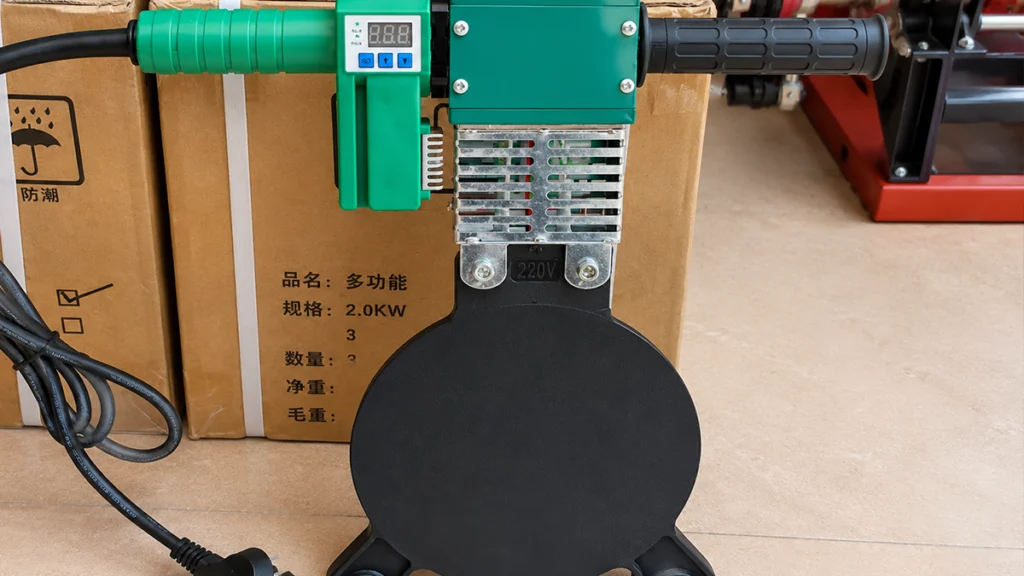
Heating plate temperature accuracy and PTFE coating
Your heating plate needs a high-grade PTFE coating to keep molten HDPE from sticking and tearing the weld bead. Furthermore, high-precision electronic thermostats must lock in temperatures with a strict error tolerance of ≤±3°C to ±5°C. ISO 21307 dictates a target heater plate temperature of 215±15°C. Any temperature drift outside that window will severely compromise the molecular diffusion of the plastic.
Clamping force, alignment, and out-of-roundness tolerance
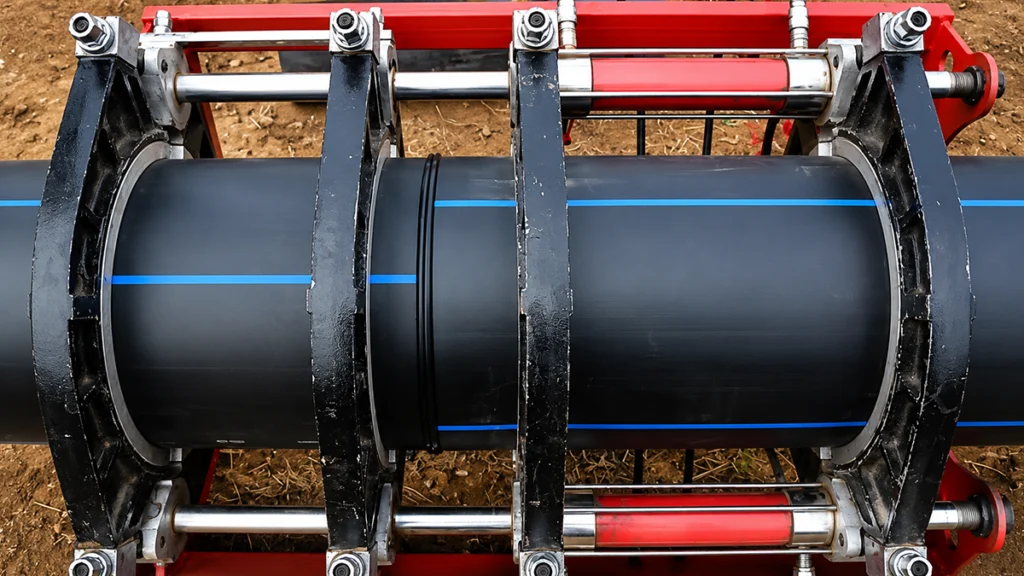
A quality butt fusion machine frame must guarantee an axial alignment deviation of no more than ≤0.2mm to ≤0.3mm. This is especially critical for the coiled HDPE pipes frequently used in agriculture, which notoriously suffer from out-of-roundness. Hydraulic cylinders with massive piston areas (sometimes reaching 23,179 mm²) deliver the extreme clamping force needed to squeeze oval-shaped pipes back into perfect cylindrical alignment before facing begins.
Power supply options: 220V, 380V, generator, and field use
Electrical compatibility will make or break your field operations. Generally, HDPE pipe welding machines sized ≤315mm run on 220V power, while heavy-duty rigs ≥450mm demand a 380V three-phase setup. Your field generator must be capable of handling the simultaneous power draw from the hydraulic station, the milling cutter, and the heating plate. For context, running a 630mm hydraulic butt fusion machine requires a generator that can comfortably sustain a continuous 12.2KW load.
Cost, MOQ, Lead Time, and Supplier Evaluation for B2B Buyers
Price ranges for manual vs hydraulic machines (USD reference)
Budgeting for an HDPE pipe welding machine comes down to diameter capacity and actuation type. A standard 160mm to 200mm manual butt fusion machine will usually run you between $1,200 and $2,400 USD. If you want to step up to an entry-level 250mm hydraulic butt fusion welding machine, expect prices to start around $3,000 USD. As pipe diameters balloon, so does the necessary structural engineering. Consequently, massive hydraulic units built for 800mm+ pipes easily command prices north of $10,000 USD.
MOQ, lead time, and shipping considerations
In this class of heavy pipe fusion machines, standard B2B single-unit purchases are the norm. However, buyers must carefully calculate freight shipping weights and dimensions. A massive 710-1000mm HDPE pipe jointing machine requires frame packaging measuring 2200x1800x1700mm and weighs in at a hefty 2600kg. The best suppliers offset these logistical hurdles by offering expedited shipping, on-site setup services, and even backup equipment to keep urgent agricultural deployments on schedule.
How to evaluate an HDPE welding machine manufacturer
Smart procurement officers judge manufacturers by their parts availability and technical support. Industry surveys reveal that 90% of B2B buyers consider 24-hour online technical support and nationwide warranty services to be non-negotiable. Furthermore, 60% of buyers stress the need for a highly stable supply chain for consumables like PTFE plates and planer blades. Prioritize manufacturers that supply remote engineering guidance, detailed video tutorials, and comprehensive operation manuals.
Warranty, spare parts, and after-sales support checklist
- Standard Warranty: Look for at least a 1-year warranty backed by a lifetime maintenance commitment.
- Coverage Terms: The supplier should offer free replacements for any non-human-induced damage during the warranty window. Once the warranty expires, they should only bill you for the raw material costs.
- Value-Added Services: Keep an eye out for suppliers that sweeten the deal with complimentary annual on-site maintenance or trade-in programs for aging pipe fusion machine.
Common Mistakes and Hidden Risks When Choosing a Welding Machine for Irrigation
Choosing a machine that is too small for future pipe upgrades
Agricultural buyers often fall into the trap of purchasing a 160mm manual butt fusion machine just to save a few bucks today. But what happens when the farm expands next season and requires 200mm mainlines? That 160mm pipe fusion machine becomes dead weight, forcing an entirely new capital expense. Spending a little more on a 250mm hydraulic butt fusion welding machine (which easily covers 90mm to 250mm) provides excellent future-proofing and a vastly superior long-term ROI.
Ignoring heating plate quality and temperature drift
Settling for a bargain-bin heating plate without independent dual-channel temperature controls is a recipe for disaster. These cheap plates suffer from severe temperature drift, often exceeding ±5°C. This rapid fluctuation degrades the PTFE coating, causing the plastic to stick. The inevitable result? Weak molecular diffusion, sloppy weld beads, and guaranteed pipeline blowouts once the system is pressurized.
Underestimating operator training requirements
Assuming that any random laborer can flawlessly operate a manual butt fusion machine is a dangerous misconception. The absolute leading causes of weld failure are incorrect drag pressure calculations and the premature release of fixtures. Always make sure your equipment supplier provides crystal-clear Standard Operating Procedures (SOPs) alongside video tutorials covering the positioning, milling, heating, and cooling phases.
Buying based on price alone instead of weld certification
Buying dirt-cheap butt fusion welding machinery that cannot automatically lock in fusion parameters means you instantly fail to meet CJJ 63 and TSG D2002-2006 requirements. If your equipment can’t generate verifiable digital data logs, your welds will never be certified to ASTM F2620 or ISO 21307 standards. This lack of certification will immediately disqualify your contracting firm from bidding on highly lucrative state-funded or municipal agricultural grants.
How to Choose the Right HDPE Pipe Welding Machine for Your Irrigation Project
Step 1: Define pipe diameter, SDR, and project scale
Start by pinning down the absolute maximum outer diameter (OD) your project demands (e.g., 160mm, 250mm, or 315mm). Next, verify your pipe wall thickness (SDR) so you can accurately calculate drag pressures and heat soak times. Finally, evaluate your total joint count. If you’re tackling hundreds of joints, the high-speed productivity of a hydraulic butt fusion machine will quickly pay for itself.
Step 2: Decide manual or hydraulic based on workload
A manual butt fusion welding machine makes sense if your pipes are strictly under 160mm, your joint volume is minimal, you’re working in painfully tight trenches, and your budget is tight. However, you need to upgrade to a hydraulic unit if your pipes exceed 160mm, you’re handling massive joint volumes, you need a rock-solid 0.15 N/mm² fusion pressure, or your contract requires digital data logging for QA compliance.
Step 3: Match power supply and site conditions
Double-check that your field generators can actually output the correct voltage. You’ll need 220V for HDPE butt fusion welding machines up to 315mm, and 380V for heavy-duty rigs 450mm and up. If your project requires a lot of in-trench welding rather than above-ground pre-fabrication, look for pipe fusion machines designed with separate operating and clamping systems. This modularity makes dropping the gear into confined spaces much easier.
Step 4: Verify supplier credentials and request a sample weld
Never issue a purchase order without verifying that the equipment meets CE, ISO 12176, and DVS 2207 standards. Make sure the supplier backs their product with aggressive post-sale support. This should include remote engineering guidance, video troubleshooting, and a cast-iron guarantee for rapid-response consumable and spare parts delivery.
FAQ
Q1: What size HDPE pipe welding machine do I need for irrigation pipe?
Sizing your HDPE pipe welding machine completely depends on the maximum pipe diameter of your specific project. A 160mm pipe fusion machine (which handles 63-160mm) works perfectly for standard agricultural drip lines and sub-mains. If you’re laying larger mainlines, step up to a 250mm or 315mm unit. Always base your purchase on the absolute largest outer diameter (OD) you expect to weld.
Q2: Is a manual HDPE butt fusion machine reliable for agricultural irrigation?
Absolutely, as long as your pipes stay under 160mm and your operator knows what they’re doing. Because these HDPE pipe jointing machines rely entirely on human muscle, they are strictly reserved for smaller diameters where manual force can easily and consistently maintain the proper fusion pressure throughout the entire cooling phase.
Q3: How much does a hydraulic HDPE pipe welding machine cost?
An entry-level 250mm hydraulic butt fusion machine usually kicks off around $3,000 USD. If you need a mid-size unit like a 315mm or 450mm, expect to spend between $4,000 and $7,000 USD. Heavy-duty butt fusion machines built for 800mm pipes and beyond can easily surpass $10,000 USD, especially when loaded with advanced data logging and automation features.
Q4: Can one HDPE welding machine handle both 63mm drip lines and 160mm mainlines?
Yes. Standard 160mm HDPE butt fusion welding machines feature interchangeable reducer inserts (clamps). This allows a single heavy-duty frame to securely grip and weld 63mm, 75mm, 90mm, 110mm, 125mm, 140mm, and 160mm pipes. It’s an incredibly versatile setup for mixed-diameter irrigation jobs.
Q5: How long does it take to weld one HDPE irrigation pipe joint?
Welding time is directly tied to the pipe’s wall thickness. Under ISO 21307 guidelines, the heat soak phase takes roughly 11±1 seconds per millimeter of wall thickness. When you factor in the alignment, milling, heating, and the mandatory cooling phase under pressure, a typical 160mm joint takes anywhere from 15 to 25 minutes from start to finish.
Q6: What is the difference between butt fusion and electrofusion for HDPE irrigation pipe?
Butt fusion relies on a heating plate to melt the pipe ends, which are then forced together under manual or hydraulic pressure—no consumable fittings required. Electrofusion, on the other hand, uses special fittings embedded with heating coils that melt the plastic from the inside out when an electrical current is applied. While electrofusion is significantly more expensive per joint, it’s a lifesaver in extremely tight trenches.
Q7: What power supply is required for an HDPE welding machine in field irrigation work?
HDPE pipe welding Machines up to 315mm typically run on a 220V single-phase supply, pulling anywhere from 2.35KW to 6KW. Step up to a 450mm or larger butt fusion machine, and you’ll need a robust 380V three-phase supply capable of delivering 12KW or more. Always ensure your field generator can handle the total continuous load plus a 20-30% safety surge margin.
Q8: How do I check weld quality on an HDPE irrigation pipe joint?
Start with a thorough visual inspection. The double roll-back bead should look uniform in shape and size all the way around the pipe’s circumference, without any deep V-notches between the beads. For certified municipal jobs, you’ll also need to check the digital data loggers to prove that precise drag pressure, temperature, and cooling times were strictly maintained during the fusion cycle.
Conclusion
Picking the right HDPE pipe welding machine for your irrigation project isn’t just a procurement detail—it dictates the long-term hydraulic integrity of your entire system. Ultimately, your decision revolves around pipe diameter and strict compliance standards. Manual butt fusion machines bring low capital costs and incredible portability to the table, making them the undisputed standard for sub-160mm lines and tight trench repairs. But the moment your mainlines cross that 160mm threshold, hydraulic butt fusion welding machines transition from a luxury to an absolute engineering necessity. You simply need their massive clamping force and pinpoint pressure regulation (0.15 N/mm²) to satisfy DVS 2207 standards.
Beyond just choosing how the pipe fusion machine is actuated, B2B buyers need to obsess over technical parameters. Your heating plates must hit a 215±15°C target with a razor-thin ≤±3°C margin of error. Your frames must lock in axial alignment at ≤0.2mm. By investing in adequate hydraulic capacity and partnering with suppliers who offer comprehensive operator training and rock-solid spare parts pipelines, you eliminate the devastating hidden costs of weld failures. In the end, the right HDPE pipe jointing machine protects both your agricultural yields and your bottom line.
Let our experts help you choose the right equipment for your project
Contact Our Engineering Team