
Table of Contents
Butt Fusion Welding Machines rely on the right accessories — heater plates, planing tools, hydraulic units, clamping inserts, and data loggers — to deliver compliant HDPE welds. This guide helps B2B buyers identify essential accessories, evaluate suppliers, and avoid costly procurement mistakes.
What Are Butt Fusion Welding Machine Accessories?
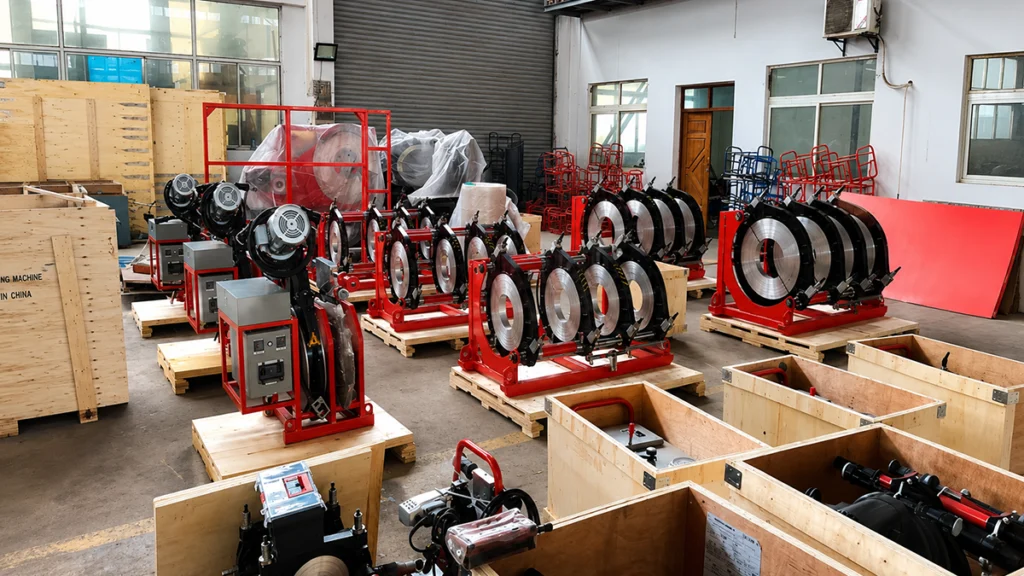
You can’t execute a proper fusion process without the right butt fusion welding machine accessories. Think of heater plates, planing tools, hydraulic power units, and clamping inserts as the hands and muscles of your operation. They lock down temperature precision. They handle the facing alignment. They manage the exact interfacial pressure needed to guarantee your high-density polyethylene (HDPE) pipe joints hit strict international pipeline engineering standards.
Definition and Function of Butt Fusion Accessories
These attachments serve as the frontline operational interface connecting your core butt fusion welding machine to the HDPE pipe. While the main chassis holds everything steady, the accessories do the heavy lifting with the thermoplastic material. The heater plate carefully melts the pipe ends. The planing tool mills the surfaces to achieve flawless parallel alignment. Meanwhile, the hydraulic unit steps in to control the all-important interfacial pressure during both the heat-soak and cooling stages. Try pulling off a standardized fusion joint without high-precision accessories—it simply won’t happen.
How Accessories Differ From Spare Parts and Consumables
Nailing down your inventory categories makes procurement planning much smoother. Accessories are your core functional attachments—think reducer inserts, hydraulic stations, and facers—that you absolutely need to perform the weld. Spare parts, on the other hand, step in for internal maintenance to repair those very accessories. This includes items like thermocouples, limit switches, aviation plugs, and solid-state relays. Finally, consumables are the materials you burn through during standard daily operations. The PTFE coating on your heater plate, planer blades, and hydraulic oil all fall into this bucket.
Why Accessories Determine Weld Quality and Machine Lifespan
Premium accessories act as a buffer, isolating your main welding frame from brutal mechanical stress. Take precision-machined clamping inserts, for example. They guarantee concentric alignment, which stops operators from cranking down on clamp bolts just to force misaligned pipes together. A perfectly calibrated hydraulic unit works the same way, stopping pressure spikes dead in their tracks before they blow out the frame’s cylinders. Spending a little more upfront on premium attachments directly stretches the lifespan of your entire welding fleet. Better yet, it guarantees joint integrity you can repeat, weld after weld.
Why the Right Accessories Matter for HDPE Pipe Welding Quality
Impact on Weld Strength and Joint Reliability
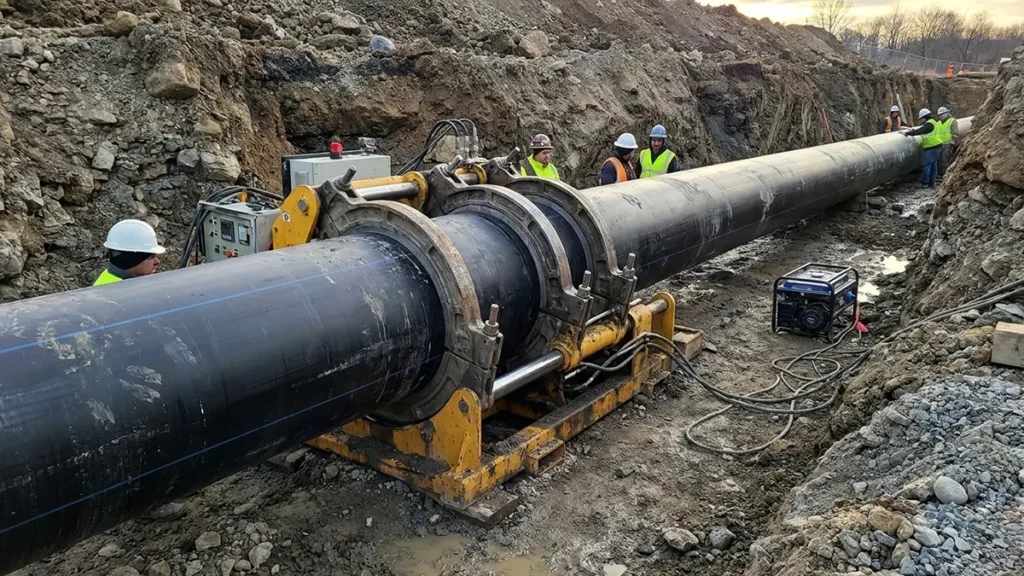
The raw mechanical strength of an HDPE butt fusion joint comes down to molecular entanglement. To get there, you need dead-on temperature, pressure, and alignment. Using the right attachments ensures you completely strip away the oxidized layer by shaving off a continuous 0.5–1.0mm chip during milling. Add precision clamping inserts to the mix, and you keep pipe misalignment strictly under 10% of the wall thickness. This practically wipes out the weak spots that trigger stress cracking once the system faces active hydrostatic pressure.
How Poor-Quality Accessories Increase Project Risk
Cutting corners on accessories injects massive vulnerabilities right into your pipeline infrastructure. Picture a field crew stuck using a generic heater plate that distributes heat unevenly. You get temperature swings pushing past ±5°C, resulting in localized cold welds. Fast forward to high-pressure hydrostatic testing, and the pipeline bursts right at the joint. Now the contractor has to excavate the site, cut out the bad weld, and re-fuse the entire section. That single failure just burned tens of thousands of dollars in rework costs and wrecked the project schedule.
Compliance With ISO 21307 and DVS 2207 Standards
Buying compliant gear isn’t just a best practice; it’s a legal and technical mandate for industrial and municipal pipelines. Your equipment must hit the exact parameters laid out by international standards. Take DVS 2207-1. It demands a rock-solid low interfacial fusion pressure of 0.15 N/mm² (roughly 1.5 bar) to stop excessive bead formation. ISO 21307 lays down equally strict rules for both high- and low-pressure fusion jointing. You can only hit these exact numbers consistently if you’re running calibrated, top-tier accessories.
Factory-direct pricing with technical consultation included
Get Your Free QuoteCore Accessories Included With Every Butt Fusion Welding Machine
| Accessory Name | Primary Function | Typical Material / Specification | Replacement Interval |
|---|---|---|---|
| Heater Plate | Melts pipe ends uniformly | Aluminum alloy, PTFE coated, PT100 sensor | When coating degrades or sticks |
| Planing Tool | Faces pipe ends for alignment | Electric motor, double-sided HSS/Carbide blades | When chips fall below 0.5mm thick |
| Hydraulic Unit | Applies and maintains fusion pressure | 0.75kW – 2.2kW motor, digital pressure gauge | Calibrate every 12 months / 2000 welds |
| Main Frame | Secures and aligns pipe segments | Steel/aluminum four-clamp structure | Frame lifespan (10+ years) |
Heater Plate (Heating Element)
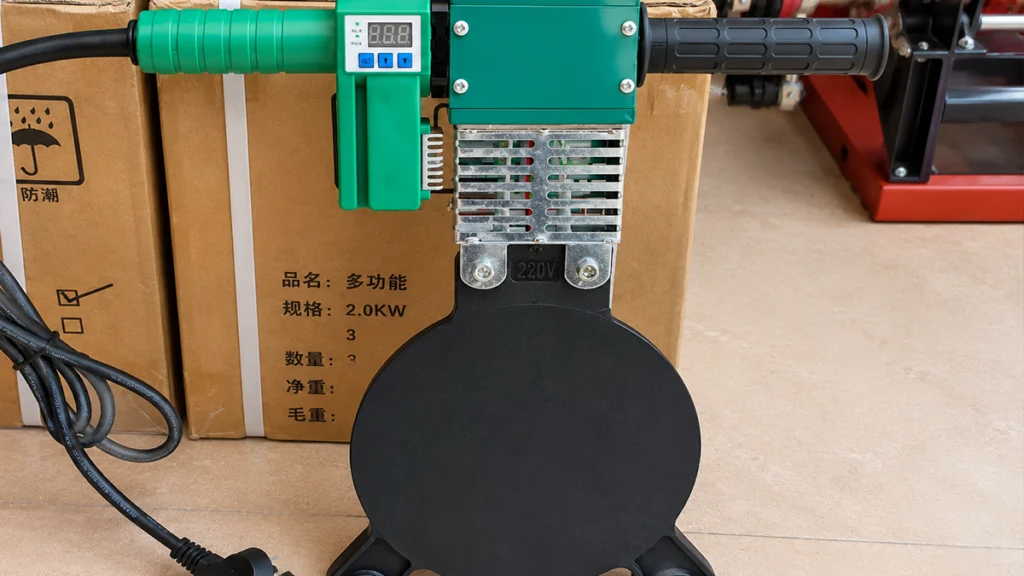
The heater plate operates as the thermal engine of your entire system. Built with an aluminum alloy body, it’s engineered to transfer heat rapidly and spread it evenly across the surface. Top-of-the-line plates feature independent temperature controls that feed real-time data straight to a three-phase solid-state relay. This setup locks in the exact melting temperature required for specific HDPE grades, which usually sits somewhere between 200°C and 230°C.
Planing Tool / Facer / Trimmer
Think of the planing tool—often called a facer or trimmer—as a highly specialized electric milling cutter. Its sole job is to simultaneously shave both ends of the clamped pipe. A heavy-duty motor drives a rotating disc packed with custom-manufactured double-sided blades. For safety, modern planers come equipped with an integrated limit switch. This simple but critical feature stops the motor from firing up unless the tool is firmly locked into the chassis.
Hydraulic Power Unit and Hoses
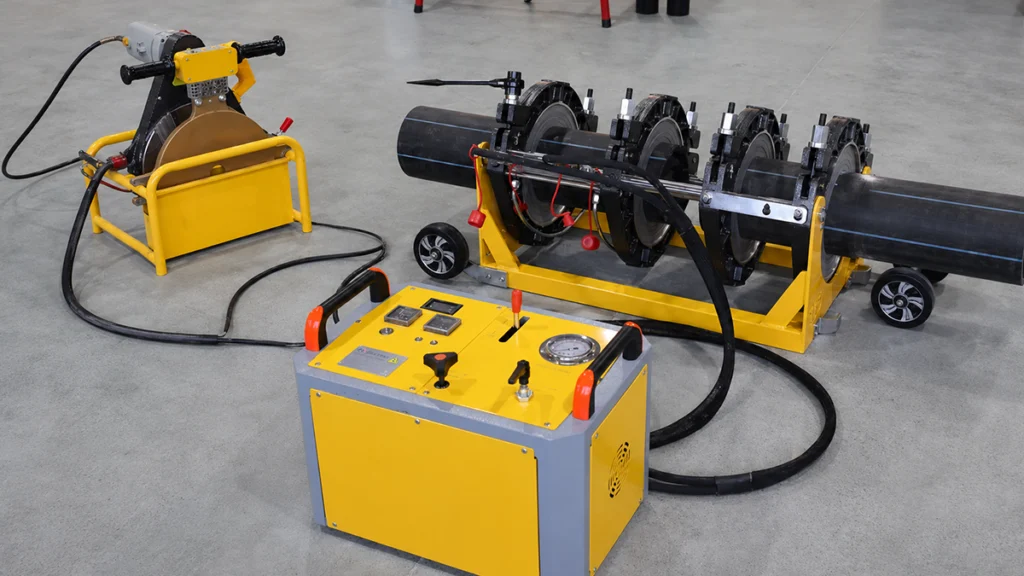
When it’s time to push those melted pipe ends together, the hydraulic power unit steps up. It generates and regulates the exact force needed during both the fusion and cooling cycles. The setup includes an electric motor, a hydraulic pump, directional control valves, and a hyper-accurate pressure gauge. Heavy-duty hydraulic hoses, fitted with quick-connect couplings, push fluid power straight to the main frame’s cylinders to guarantee stable, precise force application.
Main Welding Frame and Clamps
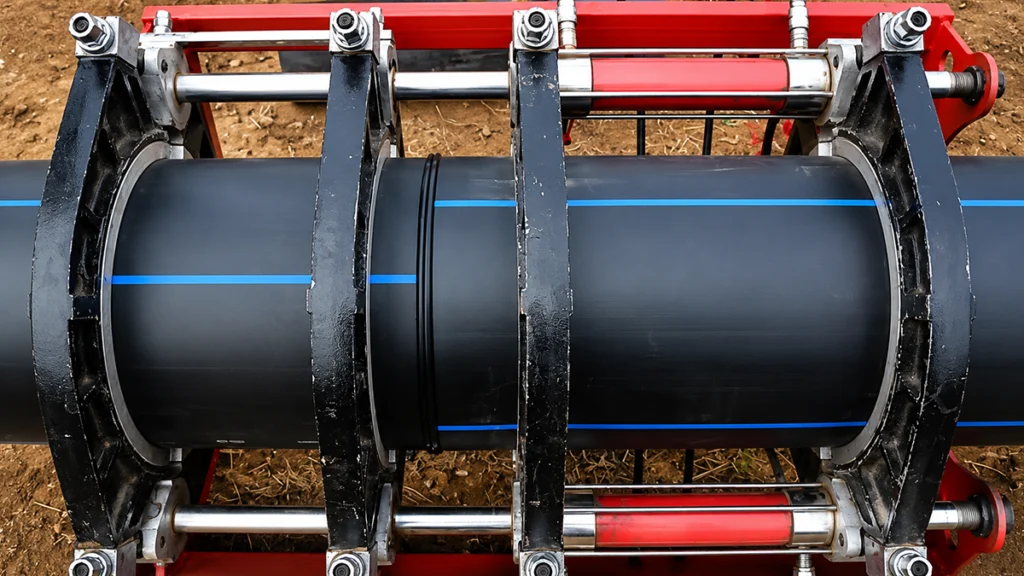
Everything rides on the main frame. Serving as the operation’s chassis, it usually relies on a rugged four-clamp sleeve design. The two inner clamps bite down near the fusion zone to hold the pipe ends steady, while the outer clamps deliver much-needed leverage and stability. The guide rods running through the frame must be perfectly parallel. If they aren’t, the pipes will meet with angular deflection the second the hydraulic cylinders actuate.
Pipe Clamping Inserts and Reducer Sets: Sizing Guide
| Machine Size Classification | Base Machine Capacity | Common Clamping Insert Sizes (OD) |
|---|---|---|
| Small | 160mm | 63mm, 90mm, 110mm, 125mm, 140mm |
| Medium | 250mm | 90mm, 110mm, 160mm, 200mm, 225mm |
| Large | 500mm | 250mm, 280mm, 315mm, 355mm, 400mm, 450mm |
| Extra Large | 800mm | 500mm, 560mm, 630mm, 710mm |
| Mega | 1200mm | 800mm, 900mm, 1000mm |
How to Select Clamping Inserts by Pipe OD and SDR
Your clamping inserts have to precisely match the Outer Diameter (OD) of the pipe on the docket. But keep in mind, Standard Dimension Ratio (SDR) limitations also dictate whether fusion is even possible. You simply cannot butt-fuse pipe components with an OD of 63mm or smaller, or anything with a wall thickness under 6mm. Also, trying to directly butt-fuse pipes from different SDR series is a major red flag. You’ll need to use electrofusion or run specialized machining to equalize the wall thickness before clamping them down.
Standard vs. Custom Reducer Sets
Contractors generally face a choice: standard stacked reducer sets or independent custom ones. Stacked configurations—where a 200mm insert nests neatly inside a 250mm insert—are highly cost-effective and convenient for everyday contractors. Independent custom sets, however, mount each size directly to the master clamp. This dramatically boosts concentric alignment accuracy and cuts down the risk of structural damage from pressure loss. If you’re tackling municipal projects with razor-thin tolerances, independent sets are the way to go.
Common Insert Sizes for 63mm, 250mm, 500mm, 800mm, and 1200mm Machines
The inserts you can use scale directly with the base pipe fusion machine. A standard 250mm setup usually takes inserts down to 90mm. Step up to a 500mm butt fusion machine, and you’re covering mid-range infrastructure from 250mm and up. When you move into the heavy-duty 800mm and 1200mm territory, you need massive, precision-cast aluminum inserts. These beasts are built to handle the extreme drag forces and sheer weight of large-bore water or mining pipelines without warping the pipe’s roundness.
Get detailed specs and custom configuration options
Request Technical SpecificationsHeater Plate, PTFE Coating, and Temperature Control Components
PTFE vs. Anti-Stick Ceramic Coatings: Which Lasts Longer?
| Feature | PTFE (Teflon) Coating | Anti-Stick Ceramic Coating |
|---|---|---|
| Industry Standard | Yes (Preferred for HDPE) | No (Niche applications) |
| Non-Stick Performance | Excellent at melting plastic | Good, but plastic can adhere over time |
| Temperature Resistance | Up to 260°C (Ideal for PE/PP) | Up to 400°C+ |
| Durability / Hardness | Susceptible to scratching | Highly scratch-resistant |
| Cost to Recoat | Moderate | High |
Ceramic coatings definitely bring superior scratch resistance to the table and can survive extreme heat. Even so, PTFE remains the undisputed king of butt fusion. Why? Because PTFE boasts unmatched non-stick chemical properties. It stops molten polyethylene from clinging to the plate during removal, which guarantees a pristine, uncontaminated fusion zone every single time.
Heater Plate Temperature Sensor and PID Controller
If you want true temperature accuracy, you have to look at the internal sensor and the control logic behind it. Industrial heater plates rely on a PT100 modular design—a highly precise resistance temperature detector. This sensor constantly feeds data to a Proportional-Integral-Derivative (PID) controller, which then manages the three-phase solid-state relay. This advanced closed-loop system leaves old-school AC contactors in the dust, keeping temperature swings tightly bound within ±5°C across the entire heating face.
When Should You Replace the Heater Plate?
Heater Plate Replacement Checklist:
- Visible peeling, flaking, or deep gouges in the PTFE coating.
- Molten plastic constantly clings to the plate during the changeover phase.
- The digital display shows a temperature drift from the setpoint that recalibration won’t fix.
- Infrared thermometer sweeps reveal cold spots with more than a 5°C variance across the surface.
- The aviation plug or internal wiring shows obvious electrical shorting or thermal damage.
Planing Tool, Blades, and Cutting Components
Carbide vs. HSS Planer Blades
The blade material you choose directly impacts both your maintenance costs and facing efficiency. High-Speed Steel (HSS) blades are sharp, tough, and highly cost-effective—making them the go-to standard for slicing cleanly through plastic. Tungsten Carbide blades, on the other hand, are incredibly hard and hold their edge much longer, but they suffer from brittleness. Drop a carbide blade into a rugged trench environment, and heavy HDPE butt fusion welding machine vibrations or accidental knocks can easily chip it.
How Often Should Planing Blades Be Replaced?
Blade lifespan really boils down to your usage volume and how contaminated the pipes are. Grinding through sand-covered pipe ends will dull a blade incredibly fast. You need to swap out or rotate your blades—if they are double-sided—the exact moment they stop throwing off continuous, complete shavings. The perfect blade produces a chip between 0.5 and 1.0mm thick that’s longer than the pipe’s circumference. If you’re seeing powdery, interrupted, or overly thick shavings, your blades are dull.
Troubleshooting Uneven Pipe End Facing
Step-by-Step Facing Procedure & Troubleshooting:
1. Lock Clamps: Make sure the pipe is clamped tight, keeping wall thickness misalignment under 10%.
2. Insert Facer: Lock the planing tool into the frame and trip the safety limit switch.
3. Start Motor: Always fire up the facer before you apply an ounce of hydraulic pressure.
4. Apply Pressure: Slowly ramp up light hydraulic pressure to push the pipes against the spinning cutter.
5. Monitor Shavings: Hold steady until you see continuous shavings rolling out from both sides.
6. Release Pressure: Drop the hydraulic pressure back to zero while the blades are still spinning to guarantee a perfectly smooth finish.
7. Inspect: If the face is still uneven, check the motor’s self-locking mechanism and inspect the blades closely for micro-fractures.
Hydraulic Unit Accessories and Pressure Gauges
Hydraulic Pump, Hoses, and Quick Couplings
The hydraulic station is the muscle of the operation. It houses the manifold, the oil reservoir, and the motor—which ranges from 0.75kW for 250mm frames up to a hefty 2.2kW for 800mm butt fuison welding machines. High-pressure oil lines push the force through quick couplings. These couplings absolutely must feature a flat-face design to lock dirt out when disconnected. Furthermore, the entire hydraulic circuit needs to remain perfectly sealed with zero oil leakage. Any drop in pressure during the critical cooling phase can compromise the weld.
Pressure Gauge Calibration Frequency
All your fusion pressure calculations mean nothing if the gauge is lying to you. Operators need to rely on a large-dial, shock-resistant digital hydraulic pressure gauge. Strict pipeline engineering protocols dictate that pressure gauges and the broader hydraulic system require formal calibration and routine maintenance every 2,000 welding interfaces, or every 12 months—whichever hits first.
How to Detect Hydraulic Leaks Early
Hydraulic Maintenance & Leak Detection Checklist:
- Check the oil-gas separator every week and drain out any trapped water.
- Keep a close eye on the pressure gauge during the heat-soak phase. A pressure drop points directly to an external hose breach or an internal valve leak.
- Inspect all quick-connect fittings for oil residue before and after every single shift.
- Verify the reservoir’s hydraulic oil level. If it suddenly drops, inspect the circuit immediately.
- Listen closely for cavitation (a distinct whining noise) in the pump. This usually means air has entered the system or fluid levels are dangerously low.
Optional and Project-Specific Accessories Worth Considering
Data Loggers and DVS-Compliant Weld Recording Modules
- Traceability: Captures the exact time, pressure, and temperature data for every single joint.
- Compliance: Automatically generates the DVS-compliant reports that municipal inspectors demand for handover.
- Automation: Packs independent dual-channel timers for both cooling and heat absorption, firing off audible alerts when the cycle finishes.
Pipe Rollers, Supports, and Alignment Stands
- Drag Reduction: Lifts the pipe off the ground to kill friction. This ensures your hydraulic unit applies pure interfacial pressure instead of fighting drag.
- Alignment: Stops massive, heavy-diameter pipes from sagging, a common issue that causes angular misalignment right at the welding frame.
Tent / Shelter, Power Generator, and Toolboxes
- Environmental Control: Tents shield the critical weld zone from dust, rain, and wind, which stops the heater plate from cooling down rapidly and unevenly.
- Power Stability: Your generator has to match the equipment’s total power draw exactly (e.g., 4.21kW for a 250mm unit, or 16.9kW for an 800mm beast) to avoid dangerous voltage drops.
Spare Parts Kit for Long-Duration Projects
- Downtime Prevention: An absolute lifesaver for remote job sites. Your kit should always pack spare limit switches, solid-state relays, heating plate aviation plugs, and thermocouples.
How to Evaluate Accessory Suppliers: MOQ, Lead Time, and Quality Control
Key Certifications to Request (CE, ISO 9001, DVS)
Procurement teams can’t just take a supplier’s word for it; they need objective proof of manufacturing quality. Push your suppliers to hand over an ISO 9001 certificate for their quality management system, along with CE markings that prove mechanical and electrical safety compliance. Most importantly, demand documentation showing their components fully support ISO 21307 and DVS 2207 welding parameters.
Typical MOQ, Lead Time, and Shipping Considerations
Industrial buyers need to sync supplier capabilities with actual project timelines. Standard gear—like HSS blades or off-the-shelf inserts—should come with low Minimum Order Quantities (MOQ) and ship out within 3 to 5 days. However, if you need custom independent reducer sets or mega-sized 800mm+ components, expect a 4 to 6 week lead time. Always verify that the supplier can arrange expedited air freight for those nightmare breakdown scenarios.
OEM vs. Aftermarket Accessory Sourcing
Market data reveals that 60% of surveyed contractors heavily prioritize stable Original Equipment Manufacturer (OEM) spare parts channels. Sure, aftermarket parts look great on an initial budget spreadsheet, but OEM accessories lock in exact dimensional tolerances, retain your warranty, and guarantee material compatibility. Trying to mix generic electrical components with OEM controllers is a fast track to PID communication errors.
Supplier Evaluation Checklist
1. Certifications: Do they have documented proof of CE, ISO 9001, and DVS parameter compliance?
2. OEM Compatibility: Will the components natively fit your current welding fleet without modifications?
3. Technical Support: Do they offer 24-hour online support alongside remote video troubleshooting?
4. Traceability: Are the pressure gauges shipped with verifiable calibration certificates?
5. Lead Time: Can they actually hit urgent delivery windows for high-wear items?
6. Material Specs: Is the heater plate coating verified as genuine PTFE?
7. Warranty: Is their replacement policy for defective accessories crystal clear?
8. Reference Projects: Can they point to successful deployments in harsh environments similar to yours?
Common Mistakes When Buying Butt Fusion Welding Machine Accessories
Buying Generic Heater Plates Without Coating Verification
Sourcing unverified plates is a gamble that usually ends in poor PTFE coating stability. The coating degrades fast, triggering temperature swings that blow right past the acceptable ±5°C window. The result? Degraded plastic, cold welds, and eventual joint failure.
Overlooking Voltage and Plug Standard Differences
Ignoring power requirements is an easy way to cause catastrophic equipment failure. If you plug a 220V 50Hz small plastic pipe welding machine into a 380V 50Hz industrial power supply without managing the phases properly, you will instantly fry the PID controllers and solid-state relays.
Ignoring Calibration Certificates for Pressure Gauges
Running an uncalibrated digital pressure gauge guarantees you will apply the wrong interfacial pressure. This is a direct violation of ISO 21307 parameters. You will either end up with weak molecular entanglement from under-pressurization or excessive bead formation from over-pressurization.
Additional Procurement Mistakes:
1. Skipping Pipe Rollers: This forces the hydraulic unit to battle ground friction, corrupting your fusion pressure readings.
2. Stocking Only One Blade Set: Production grinds to an absolute halt the second your only set of planer blades chips on a hidden rock.
3. Ignoring SDR Compatibility: Purchasing standard clamping inserts without double-checking the specific SDR wall thickness of the pipes on your project.
4. Mixing Hydraulic Fluids: Topping off the unit with the wrong oil viscosity, which quickly leads to seal degradation and pump cavitation.
Final Recommendation: Building a Reliable Accessory Inventory
Recommended Accessory Kit by Butt Fusion Welding Machine Size
| Machine Category | Base Size | Essential Stock Inventory |
|---|---|---|
| Small | 160mm – 250mm | 1x Spare PTFE heater plate, 2x HSS blade sets, 1x PT100 sensor |
| Medium | 315mm – 450mm | 2x HSS blade sets, 1x Data logger module, 1x Hydraulic seal kit |
| Large | 500mm – 800mm | 1x Custom independent reducer set, 1x Spare digital pressure gauge |
| Mega | 1000mm – 1200mm | Heavy-duty pipe rollers, 1x Spare 2.2kW hydraulic pump, OEM spare parts kit |
Inventory Planning for Multi-Project Contractors
If you manage multiple projects, you simply cannot afford downtime while waiting for international shipping. Inventory planning needs to aggressively target critical-path and high-wear items. Keep a rolling stock of PTFE-coated heater plates, HSS planer blades, quick-connect hydraulic fittings, and thermocouples at your regional depot. From there, dispatch them to field sites alongside the main welding frames.
When to Standardize Across Your Welding Fleet
Fleet standardization is hands-down the best way to slash accessory overhead. By sticking to a single brand—or at least a compatible series of HDPE butt fusion welding machines loaded with recipe controls and smart management systems—contractors ensure that their hydraulic pumps, data loggers, and clamping inserts are fully interchangeable. This unified approach vastly simplifies operator training and dramatically shrinks the total volume of spare parts you need to warehouse.
FAQ
Q1: What accessories are required for a butt fusion welding machine to weld HDPE pipes?
To pull off a successful HDPE pipe weld, your butt fusion machine needs a PTFE-coated heater plate to melt the plastic, an electric planing tool (or facer) to square up the ends, and a hydraulic power unit to dial in precise interfacial pressure. You also need size-specific clamping inserts to hold and align the pipes perfectly within the main chassis.
Q2: How often should the heater plate on a butt fusion machine be replaced?
You need to replace the heater plate—or at least its coating—the minute you spot deep scratches, peeling, or when melted plastic starts sticking to the surface. Furthermore, if the internal PT100 sensor fails to hold temperatures within a ±5°C range of your setpoint, immediate replacement is mandatory.
Q3: Can I use aftermarket accessories on an OEM butt fusion welding machine?
While the market is flooded with aftermarket options, sticking with OEM parts is the smartest play. OEM accessories guarantee exact hydraulic pressure scaling, strict dimensional tolerances, and seamless electrical compatibility with your PID controllers. Gambling on unverified aftermarket parts can void your warranty and jeopardize your compliance with ISO and DVS welding standards.
Q4: What is the difference between manual, semi-automatic, and CNC butt fusion machine accessories?
Manual setups require the operator to physically watch the gauges and time the cooling cycles by hand. Semi-automatic systems take off some of the pressure by using timers and data loggers to assist the crew. CNC (Computer Numerical Control) accessories take it to the next level, featuring closed-loop PID controls and automated hydraulic valves that execute the entire fusion process based on pre-programmed parameters—effectively eliminating human error.
Q5: How do I choose the right clamping inserts for different HDPE pipe diameters?
Your clamping inserts must perfectly match the pipe’s exact Outer Diameter (OD). First, select inserts that fit your HDPE pipe jointing machine’s base capacity (for instance, a 250mm frame handles inserts from 90mm up to 225mm). From there, verify that the inserts can handle the pipe’s Standard Dimension Ratio (SDR) to ensure you get enough clamping force without crushing or distorting the pipe.
Q6: Why is PTFE coating important on a butt fusion heater plate?
PTFE (Polytetrafluoroethylene) delivers massive high-temperature chemical resistance alongside unmatched non-stick properties. It stops the molten HDPE from gluing itself to the aluminum plate during the fast-paced changeover phase. Keeping that PTFE coating pristine guarantees a clean, uncontaminated fusion zone, which is absolutely critical for maximizing joint strength.
Q7: What is the typical lead time for custom butt fusion welding machine accessories?
Standard consumables—think common clamping inserts and planer blades—usually ship out in 3 to 5 days. However, if you are ordering specialized data logging modules, mega-sized inserts (800mm+), or custom butt fusion welding machined independent reducer sets, you should plan for a manufacturing and QA lead time of 4 to 6 weeks.
Q8: Do butt fusion welding machine accessories need to comply with ISO 21307 or DVS 2207?
Absolutely. Your accessories are the components physically executing the parameters outlined by these standards. The heater plate has to hold the strict temperature tolerances demanded by ISO 21307, and the hydraulic unit must accurately push the 0.15 N/mm² pressure required by DVS 2207-1. If your accessories fall short, your pipeline will fail inspection.
Conclusion
Procuring the correct attachments for your butt fusion operations isn’t just an administrative task; it’s a critical engineering decision that makes or breaks pipeline integrity, project deadlines, and your fleet’s overall ROI. The sharpness of your planing tool, the precision of the heater plate, the exact sizing of your clamping inserts, and the stability of the hydraulic unit all work together to determine if a weld can pass the punishing requirements of ISO 21307 and DVS 2207.
Procurement managers and field contractors need to prioritize top-tier materials—like highly accurate PT100 temperature sensors and genuine PTFE coatings—instead of chasing cheap aftermarket alternatives that invite catastrophic joint failures. By adopting a standardized inventory strategy, vetting suppliers for verifiable certifications, and sticking to a rigid calibration schedule for pressure gauges, pipeline operators can wipe out avoidable downtime. At the end of the day, spending the money on premium, standards-compliant accessories protects your main welding frame, secures the infrastructure asset, and delivers defect-free fusion on every single job.
Let our experts help you choose the right equipment for your project
Contact Our Engineering Team