
Hydraulic Butt Fusion Machine for DRC Mining Pipeline Projects
Table of Contents
Hydraulic Butt Fusion Machine for DRC Mining Pipeline Projects explains how to choose the right HDPE fusion equipment for mine sites, compare specs and costs, and avoid welding failures in remote DRC conditions.
What Is a Hydraulic Butt Fusion Machine for DRC Mining Pipeline Projects?
Think of a Hydraulic Butt Fusion Machine as the backbone of pipeline construction in the Democratic Republic of Congo. It’s a heavy-duty industrial welder built specifically to fuse thermoplastic pipes using a precise blend of intense heat and hydraulic pressure. When you’re working deep in the rugged, unforgiving terrain of the DRC, you need equipment that takes human error out of the equation. By driving a highly controlled thermal cycle alongside exact mechanical force, these butt fusion welding machines forge a monolithic joint. The result? A connection that matches—and often exceeds—the structural integrity of the original pipe.
Which pipe materials can it join?
You can use these industrial welders to tackle a variety of plastics, including high-density polyethylene (HDPE), standard polyethylene (PE), polypropylene (PP), and polyvinylidene fluoride (PVDF) pipes and fittings. However, out on the mine site, HDPE reigns supreme. Its unmatched abrasion resistance and flexibility make it the absolute go-to material for heavy-duty hydraulic fusion.
Why is hydraulic clamping important on mine sites?
Imagine trying to hold two massive, heavy HDPE pipes perfectly still by hand. It won’t work. Hydraulic clamping solves this with a rugged four-clamp sleeve design, driven by a standalone hydraulic station. This setup locks the pipe into exact position. Got a pipe that’s slightly oval or misaligned? The clamps force it back into shape, keeping alignment deviations to a microscopic ≤0.2mm to 0.3mm. Out in the dirt and chaos of a mine, this mechanized, unwavering force keeps fusion pressure perfectly uniform. It completely eliminates the weak, compromised joints you get with manual alternatives.
How is it different from other plastic welding methods?
Skip the expensive consumable couplers needed for electrofusion. Forget about mechanical fittings that eventually spring leaks. Butt fusion doesn’t need any extra materials. Instead, it relies on a PTFE-coated heating plate—cranked anywhere from 0 to 270°C—and sheer hydraulic pressure to melt and bond the pipe ends directly together. You get a seamless, monolithic joint. No foreign materials. No internal flow restrictions. Just pure, continuous pipe.
What pipeline duties are common in mining projects?
Mines simply don’t function without the constant movement of fluids and abrasive slurries. Contractors depend on these pipe fusion machines to build and maintain massive networks. We’re talking tailings transport, critical dust suppression systems, active slurry processing lines, heavy-duty open-pit dewatering, and complex heap leaching infrastructure.
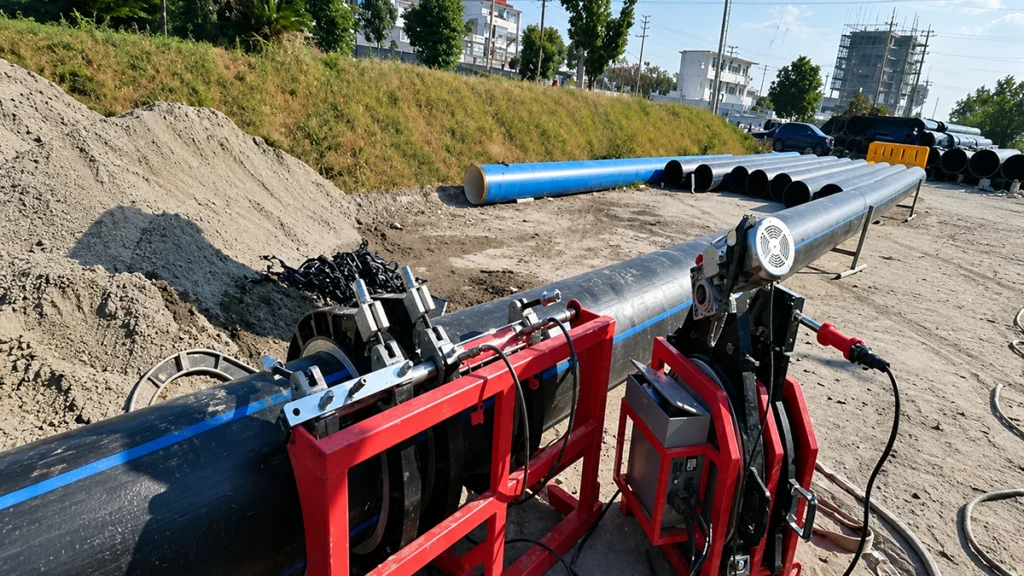
Why DRC Mining Pipelines Need Hydraulic Butt Fusion Equipment
Why are leak-free joints critical for slurry and water lines?
Moving iron ore tailings and dense mineral concentrates means pushing abrasive materials under immense pressure. That’s why engineers often specify thick-walled DR5 pipes. If a joint fails here, the fallout is brutal. A single blowout can easily drain $15,000 from the budget in unexpected downtime and massive environmental cleanup. Rock-solid, leak-free fused joints are your first line of defense against catastrophic pressure drops and toxic site contamination.
What site conditions in the DRC make hydraulic fusion more practical?
The DRC throws everything at your equipment: punishing terrain, blistering heat, and choking laterite dust. Premium pipe fusion machines tackle this head-on with ZL104 die-cast aluminum frames. They shrug off corrosion and take a beating without flinching. Plus, when you use a modular HDPE pipe jointing machine with separate clamping and control units, you can easily drop the carriage into the deep, cramped trenches so typical of African mining projects while keeping the power pack safe on the surface.
Where is it used in water supply and process water lines?
Slurry gets all the attention, but these butt fusion machines actually construct the entire water infrastructure backbone of a site. Crews use them to weld municipal tie-ins, run feeds to massive process water storage tanks, and lay down the reclaim water pump-back lines that send vital fluids right back to the concentrator plant.
How does it support slurry, tailings, and dewatering lines?
HDPE piping naturally features a slick internal bore. This drastically cuts down on friction, saving a fortune in energy costs for those massive slurry pumps. When a hydraulic butt fusion weld is done right, it forms a perfectly controlled internal bead. That bead stays low-profile, meaning it won’t disrupt your flow rates or create dangerous snag points where abrasive tailings can catch and wear down the pipe.
Factory-direct pricing with technical consultation included
Get Your Free QuoteTypical Applications in DRC Mining Operations
Can it be used for underground, plant, and remote field installations?
Absolutely. Today’s hydraulic fusion gear is incredibly versatile. You can drag it out to a remote open-pit site to connect pipes and fittings right in the dirt. You can maneuver it down narrow underground dewatering shafts. Or, you can set it up inside a controlled plant workshop to pre-fabricate complex spool assemblies before shipping them out.
What is the difference between manual, semi-hydraulic, and fully hydraulic models?
Picking the right control system isn’t just a preference—it dictates your project’s ROI and the sheer strength of your joints.
| Feature | Manual / Semi-Hydraulic | Fully Automatic (CNC) |
|---|---|---|
| Operation | Operator calculates pressure and time manually. | Program automation controls the entire cycle. |
| Error Reduction | High reliance on operator skill. | Eliminates human error (TSG D2002-2006 compliant). |
| Plate Removal | Manual removal of the heating plate. | Automatic hot plate lift-off. |
| Best For | Standard jobs with skilled labor. | Critical high-pressure slurry lines requiring traceability. |
What pipe diameter range should you choose?
Manufacturers categorize this equipment strictly by welding range. Laying standard distribution lines? Grab a DN110-250mm or DN160-315mm setup. If you’re tackling process water or medium-duty slurry lines, step up to the DN450-800mm units. But for those main tailings arteries, you’ll need the heavy artillery: massive hydraulic beasts built to handle DN710-1000mm pipe, or sometimes even up to 1600mm.
Should you select a portable or workshop model?
Fieldwork is all about mobility. Wheeled or track-mounted frames equipped with quick-connect hydraulic hoses let your crew hustle the HDPE pipe jointing machine from one rugged spot to another. Workshop models, on the other hand, stay put. They are heavy, stationary, and engineered specifically to crank out high volumes of complex fittings—think tees and elbows—inside a controlled environment.
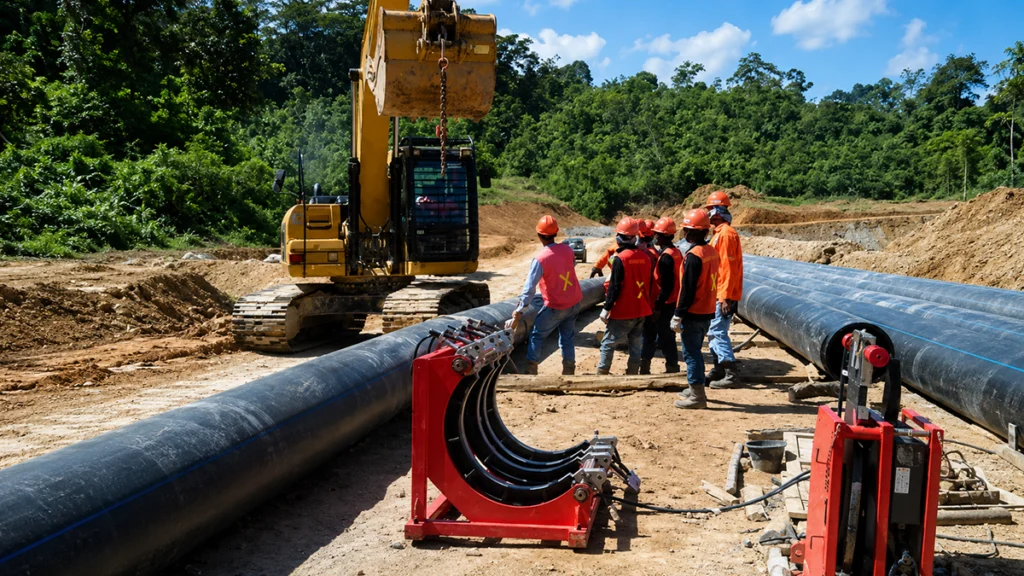
Main Machine Types and Size Ranges
What happens during clamping and facing?
First, the crew locks the heavy pipe sections into the four-clamp system. Next, they drop in an electric milling cutter. (Don’t worry, these have safety limit switches to prevent accidental spinning.) The butt fusion welding machine then applies low hydraulic pressure, pushing the pipe ends against the spinning blades. It shaves the plastic down until a continuous, unbroken ribbon of material peels off both sides. This guarantees the faces are flawlessly clean and perfectly parallel.
How do heating, changeover, and joint formation work?
Next comes the heat. A PTFE-coated heating plate drops between the freshly faced ends. The pipes press against it until the plastic melts and forms a precise bead. At that point, the operator drops the hydraulic pressure to let the heat soak deep into the pipe walls. Once the soak is done, speed is everything. The crew must yank the plate out and drive the molten pipe ends together instantly. Any hesitation lets a “cold skin” form on the plastic, which kills the molecular chain diffusion you need for a bulletproof weld.
Why are cooling time and visual inspection important?
You can’t rush the cooldown. The golden rule is simple: wall thickness multiplied by one minute. The joint has to cool naturally while still clamped under full fusion pressure, completely shielded from rain, wind, and blowing dust. When you finally inspect it, you want to see a smooth, perfectly symmetrical double-flange bead. Run your finger over it—the lowest point in the valley between those two beads should never dip below the pipe’s outer surface.
How do pipe diameter, SDR, and pressure class affect selection?
Your pipe specs totally dictate how much muscle your pipe fusion machine needs. Pushing together a DN250 SDR11 pipe takes far less hydraulic force to hit the required joining pressure (usually 0.15 N/mm² according to DVS 2207-1 standards) than battling a massive DN1000 SDR9 pipe. Because of this, smaller rigs only need a hydraulic range of 0-6.3MPa. Step up to large-diameter mining projects, and you’ll need heavy-duty systems pumping out 0-16MPa.
Get detailed specs and custom configuration options
Request Technical SpecificationsHow the Butt Fusion Process Works
What should you check for hydraulic pressure, heater temperature, and facing performance?
If you’re welding massive mining lines, double-check that your hydraulic station can hold 0-16 MPa without bleeding off pressure. Your heater plate needs to hit 270°C—sometimes 300°C depending on the plastic—and the surface temperature can’t fluctuate by more than ±3°C to ±5°C. Also, look at the milling cutter. Its power has to match the butt fusion welding machine’s size, starting around 1.36 kW for the compact units and ramping up to 3.0 kW for the big boys.
Which power supply, voltage, and mobility requirements matter most?
Out in the DRC bush, diesel generators run the show. Matching your equipment’s power needs to your generator is critical. A compact DN250 rig runs just fine on a standard 220V/50Hz supply, pulling about 4.21 kW. But if you bring out a monster DN1000 butt fusion machine, you’d better have a solid 380V three-phase setup ready to handle a massive 23.5 kW draw.
What accessories should be included in the package?
Don’t skimp on the add-ons. A proper setup demands an independent dual-channel timer so operators can track the heating and cooling phases down to the second. You absolutely need a large-dial, shock-resistant pressure gauge; precision here is non-negotiable. And if your project demands intense quality control, spring for ISO 12176-4 compliant data loggers. They give you total traceability on every single weld.
How do transport, road access, and site layout affect selection?
Tight corners and plunging trenches make equipment placement a nightmare. That’s why modular designs are lifesavers. When the hydraulic station is a separate unit—often packed into a tidy 900x600x650mm box—and the heating plate has its own bracket, your crew can lower just the clamping carriage into the mud. The power and control units stay clean and safe up on the surface.
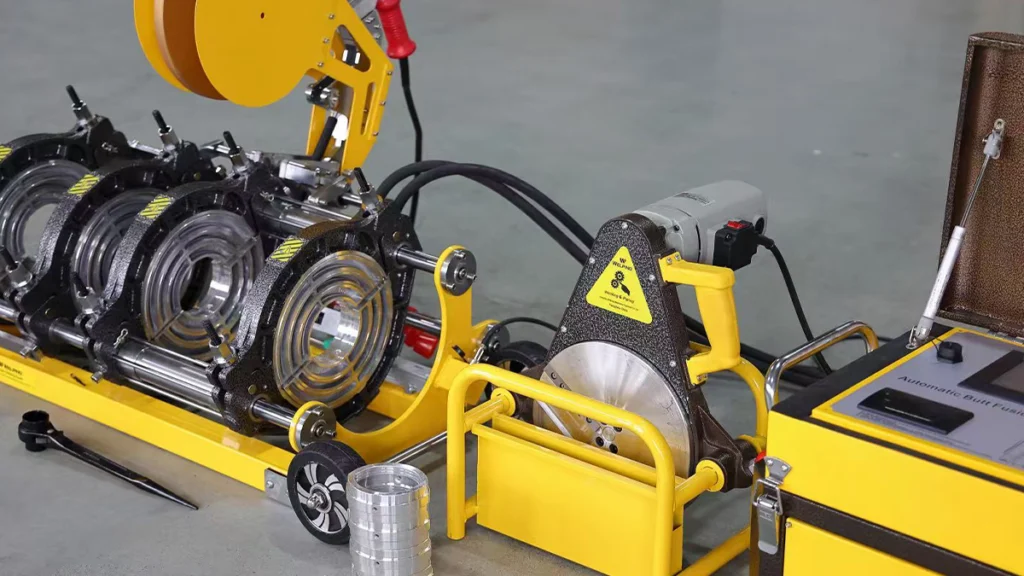
Technical Specifications to Compare Before Buying
| Specification | Standard Mining Requirement | Premium / Large Scale Requirement |
|---|---|---|
| Hydraulic Pressure Range | 0 – 6.3 MPa | 0 – 16.0 MPa |
| Heater Temperature Range | 0 – 270°C | Up to 300°C (±3°C variance) |
| Frame Material | Standard Aluminum | ZL104 Die-Cast Aluminum |
| Protection Rating | IP54 | IP54 with heavy dust sealing |
| Operating Temperature | -5°C to 45°C | -5°C to 50°C |
What should you check for dust, heat, and remote operation?
The DRC takes no prisoners when it comes to climate. Make sure your welder has at least an IP54 rating to block out that fine, pervasive laterite dust that gets into everything. It also needs to run flawlessly whether it’s a chilly -5°C morning or a blistering 50°C afternoon. Look into advanced CNC models, too. Many now pack GPS and remote data transmission, letting your engineers beam welding metrics straight to the cloud for real-time troubleshooting from miles away.
How important are operator training and spare parts availability?
The hardware is only half the battle. Studies show that 75% of field crews need detailed manuals and video guides to nail those perfect joints. Furthermore, standardizing your fleet with butt fusion welding machines that use widely available spare parts is a brilliant move. It stops a five-dollar broken component from paralyzing a multi-million-dollar pipeline job.
What selection mistakes cause problems on site?
The quickest way to burn money is buying budget pipe fusion machines fitted with cheap, low-tier hydraulic seals. High-pressure mining work shreds these inferior seals in no time. Once they go, you lose pressure during the critical cooling phase, ruining the weld. You end up doing full hydraulic overhauls twice a year, which instantly wipes out whatever cash you saved on the purchase price. Do yourself a favor: demand premium imported hydraulic seals from day one.
What factors drive machine pricing?
A few key things dictate the price tag. The frame material is huge—a rugged ZL104 alloy costs more than cheap, brittle metals. Then you have the origin of the hydraulic valves, the accuracy of the temperature sensors, and whether or not it features a full CNC brain. Sure, high-end sensors might bump the price up, but paying for top-tier components upfront buys you years of headache-free reliability in the dirt.
How to Choose the Right Machine for DRC Site Conditions
Picture a copper concentrator plant deep in the DRC. Contractors are tasked with laying a heavy DN630 SDR11 tailings line. They have barely any crane access, the heat is sweltering, and they’re running entirely off a local diesel generator. What’s the fix? A modular semi-hydraulic rig built from ZL104 aluminum, wired for 380V, with a detached hydraulic station. It’s the exact engineering answer to bypass those physical roadblocks while still hitting strict DVS 2207-1 welding standards.
How do shipping, customs, and inland delivery affect total landed cost?
Don’t get fixated on the factory sticker price; it’s just the starting line. Your total landed cost has to factor in sea freight to major African ports like Dar es Salaam or Durban. Then add in customs duties, cross-border tariffs, and the absolute logistical nightmare of trucking heavy butt fusion welding machinery hundreds of miles inland to a remote DRC site.
What documents should you request from the supplier?
Before signing anything, ask for the paperwork. You want ISO 12176-1 compliance certificates and CE marks to satisfy strict mining safety auditors. On top of that, make the supplier prove their HDPE pipe welding machine’s operational specs actually align with the big international rules—specifically ISO 21307 and DVS 2207-1.
What should be in the technical proposal?
A solid technical proposal leaves zero room for guesswork. It should boldly state the exact model, the precise diameter range it can weld (like DN450-DN800), and the total power draw in both kW and voltage. It also needs to map out hydraulic pressure limits, a hard delivery timeline, and crystal-clear after-sales service terms.
Which after-sales services matter most?
Pipeline jobs don’t sleep. That’s why over 90% of mining procurement teams insist on 24/7 online technical support. The non-negotiables include rich video troubleshooting guides, live remote operational help, and lightning-fast DHL or FedEx shipping for emergency parts. Bonus points if the supplier offers annual on-site maintenance audits.
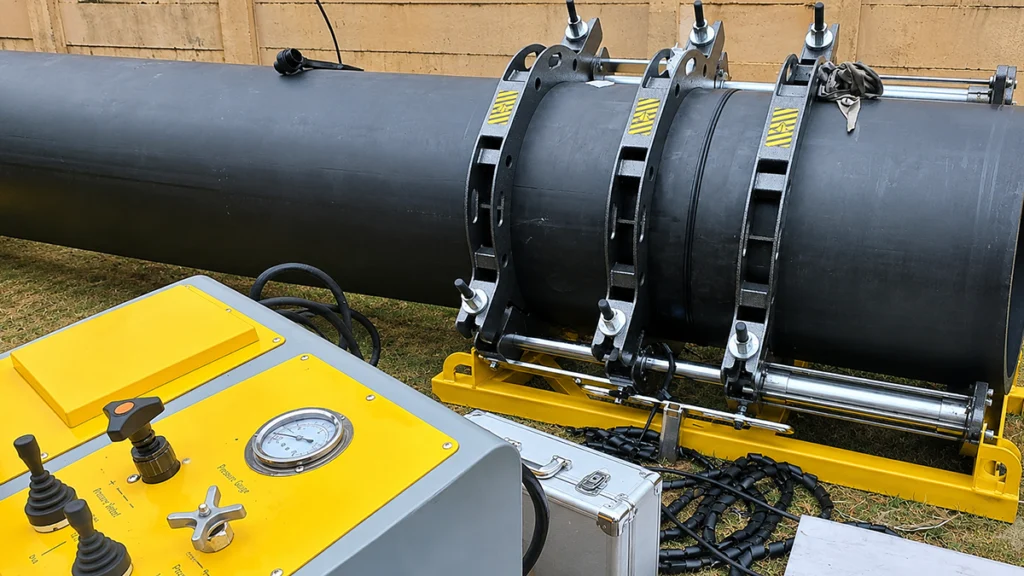
Cost, Lead Time, and Procurement Considerations
| Cost Component | Impact on Procurement Budget |
|---|---|
| Base Machine Price | Varies by size (DN110 vs DN1000) and control type (Manual vs CNC). |
| Accessories & Tooling | Stub end device, data loggers, and crane hoists add 10-15%. |
| Sea Freight & Inland Logistics | Can add 20-40% to the base cost depending on the DRC site location. |
| Spare Parts Kit | Essential upfront investment; typically 5-10% of machine value. |
What should you confirm before issuing a purchase order?
Stop before you send that PO and read the fine print on the warranty. A fair industry baseline is a one-year warranty paired with lifetime maintenance support, which should cover free parts replacement for any non-human-induced damage. Double-check the factory-to-port lead times, and verify one last time that the butt fusion machine’s power specs perfectly match your site generators.
How to Evaluate a Supplier for DRC Mining Projects
Vetting a supplier means peering past that shiny initial quote and digging into their actual manufacturing muscle. Sure, Western heavyweights like McElroy, Georg Fischer, and Ritmo rule the premium tier. However, their gear comes with a massive price tag inflated by brand legacy and high Western labor rates.
If you’re running an African mining project and want rapid ROI, direct factory OEM/ODM suppliers are incredibly compelling. Look for builders who pour ZL104 die-cast aluminum and install premium imported hydraulic seals. They can hand you a butt fusion welding machine boasting a 10-to-15-year lifespan for a fraction of what the big brands charge. Just make sure they can back it up with deep spare parts kits, sharp remote troubleshooting, and strict adherence to TSG D2002-2006 standards. When you pair a top-tier factory-direct butt fusion machine with smart pipe handling, you can easily bump your site’s output from 20 to 29 joints a day. Over the life of a project, those labor savings are massive.
FAQ
Q1: What size hydraulic butt fusion machine is best for a DRC mining project?
It completely hinges on your specific pipeline engineering plans. If you’re laying standard water distribution lines, a DN160-315mm machine usually does the trick. But if you’re running main slurry and tailings arteries, you’ll need the sheer power of a DN450-800mm or even a DN1000mm model. Simply put, always match the rig’s maximum clamping capacity to the largest pipe diameter and SDR rating you plan to weld.
Q2: Can one machine handle both water and slurry pipeline work in mining?
Yes, absolutely. A single unit can seamlessly switch between welding water and slurry HDPE pipes, as long as the pipe diameters fit within the machine’s clamping range (for instance, a DN315 handles anything from 90mm up to 315mm). Remember, you adjust your fusion parameters based on the pipe’s wall thickness, not the type of fluid flowing inside.
Q3: What power supply is required for a hydraulic butt fusion machine on a mine site?
Power needs scale directly with the size of the equipment. Smaller to medium units (anything up to DN250) typically run off a standard 220V/50Hz single-phase supply, pulling roughly 4 to 5 kW. Step up to the large-diameter beasts (DN800 and beyond), and you’ll need a heavy-duty 380V three-phase industrial hookup capable of delivering 20 to 25 kW straight from your site generators.
Q4: How much does a butt fusion machine cost for DRC buyers?
The price tag swings wildly depending on the pipe diameter capacity, the level of automation (manual versus full CNC), and the quality of the internal parts, like imported versus domestic seals. While the baseline factory price might look highly competitive, DRC buyers have to do the math on the Total Landed Cost. That means adding in sea freight to Africa, customs duties, and the notoriously high cost of inland trucking to remote sites.
Q5: What accessories are needed for field welding in remote mining areas?
When you’re out in the bush, you need a few critical add-ons. Grab an independent dual-channel timer, a rugged shock-resistant pressure gauge, and a stub-end device so you can weld flange adapters. On top of that, a deep spare parts kit—packed with extra PTFE coated plates, fresh milling blades, and backup hydraulic seals—is an absolute lifesaver for preventing crushing downtime.
Q6: How do you check whether a supplier can ship to the DRC on time?
Dig into their African export history. Ask them point-blank for references on past deliveries to ports like Dar es Salaam or Durban, and pin them down on their standard production lead times. A trustworthy manufacturer will hand over a technical proposal featuring a transparent, week-by-week manufacturing schedule, plus a list of proven freight forwarders they trust.
Q7: What is the difference between manual and hydraulic butt fusion machines?
Manual machines force the operator to use their own physical strength to push the pipes together, which only really works for tiny, low-pressure lines. Hydraulic machines, however, use motorized pumps and heavy-duty cylinders to drive consistent, highly measurable pressure—sometimes up to 16 MPa. If you’re fusing thick-walled mining pipes and want to meet DVS 2207-1 standards, hydraulics aren’t optional; they’re mandatory.
Q8: How do you avoid weak fusion joints in HDPE mining pipelines?
Dodging weak joints comes down to respecting the fusion cycle. You have to mill the ends perfectly parallel, hit the exact heating temperatures (usually 0-270°C), and move lightning-fast during changeover so a “cold skin” doesn’t form. Finally, you must hold the exact hydraulic pressure until the pipe is completely cool. Want to make it foolproof? Use a CNC machine to lock out human error entirely.
Conclusion
Pulling off a successful HDPE pipeline build in the DRC means finding equipment that perfectly balances brute-force durability with pinpoint thermal control. When mining operators insist on ZL104 die-cast aluminum frames and premium imported hydraulic seals, they effectively eliminate the pressure drops and sudden mechanical failures that constantly haunt budget buyers.
Maybe you need a nimble semi-hydraulic rig to navigate tight trenches. Or perhaps you require a fully automated CNC powerhouse to guarantee TSG D2002-2006 compliance on a critical high-pressure slurry line. Either way, the gear has to match your site’s generator output and survive the local climate. When you calculate the true total landed cost—factoring in brutal inland logistics, spare parts access, and relentless after-sales support—you aren’t just buying a piece of equipment. You’re investing in a long-term asset that can punch out 29 flawless joints a day and survive for 10 to 15 years. Ultimately, rigorously vetting the technical specs and your supplier’s track record is the best insurance policy you can buy against catastrophic pipeline downtime.
Let our experts help you choose the right equipment for your project
Contact Our Engineering Team