
Automatic Butt Fusion Welding Machine: Features and Benefits Explained
Table of Contents
Automatic Butt Fusion Welding Machine helps buyers understand how automated pipe fusion improves joint consistency, welding speed, and quality control, while also guiding model selection, technical evaluation, and supplier comparison.
What Is an Automatic Butt Fusion Welding Machine?
How does butt fusion welding differ from other pipe joining methods?
Think of an automatic butt fusion welding machine as the ultimate tool for creating seamless thermoplastic pipelines. Instead of relying on mechanical fixes like bolts, gaskets, or messy chemical adhesives, this equipment heats pipe ends to a precise molten state and fuses them under tightly controlled pressure. The result? A continuous, homogeneous joint. When done right—following strict standards like ISO 21307 or DVS 2207-1—the fusion zone actually becomes as strong as, if not stronger than, the pipe itself. You effectively erase the usual weak links in a pipeline network, wiping out the long-term risk of leaks.
Which pipe materials are typically welded with this machine?
Manufacturers design these machines specifically for thermoplastics with stable melt-flow characteristics. High-Density Polyethylene (HDPE) and Polypropylene (PP) take the top spots for everyday processing. However, modern automated systems don’t stop there. They easily handle specialized variants, such as the colored HDPE used in gas lines or conductive PE for industrial plants. These demanding materials require incredibly precise temperature profiles to keep the polymers from degrading while heating up.
What makes the process “automatic” in practice?
In the field, “automation” means handing the reins over to a fully integrated, closed-loop Programmable Logic Controller (PLC). Forget about technicians manually cranking hydraulic valves while staring at a stopwatch. Instead, the operator simply punches in the pipe diameter, Standard Dimension Ratio (SDR), and material type. The machine’s CNC interface takes over from there. It calculates and locks in the exact welding parameters, completely stripping human guesswork out of the temperature and pressure equations.
What are the main stages of the welding cycle?
A fully automated cycle moves through six distinct phases with millisecond precision:
1. Positioning: Locking the pipes firmly into the clamps to guarantee flawless axial alignment.
2. Milling (Facing): Shaving down the pipe ends using a high-speed cutter to leave perfectly parallel surfaces.
3. Heating (Bead-up): Pressing the heating plate against the ends under initial pressure to build a uniform melt bead.
4. Soaking: Dropping the pressure to almost zero, allowing heat to soak into the pipe wall to the exact required depth.
5. Fusion: Pulling the heater out and applying calculated interfacial pressure to merge the molten ends.
6. Cooling: Holding that pressure steady until the fresh joint cools to a safe handling temperature.
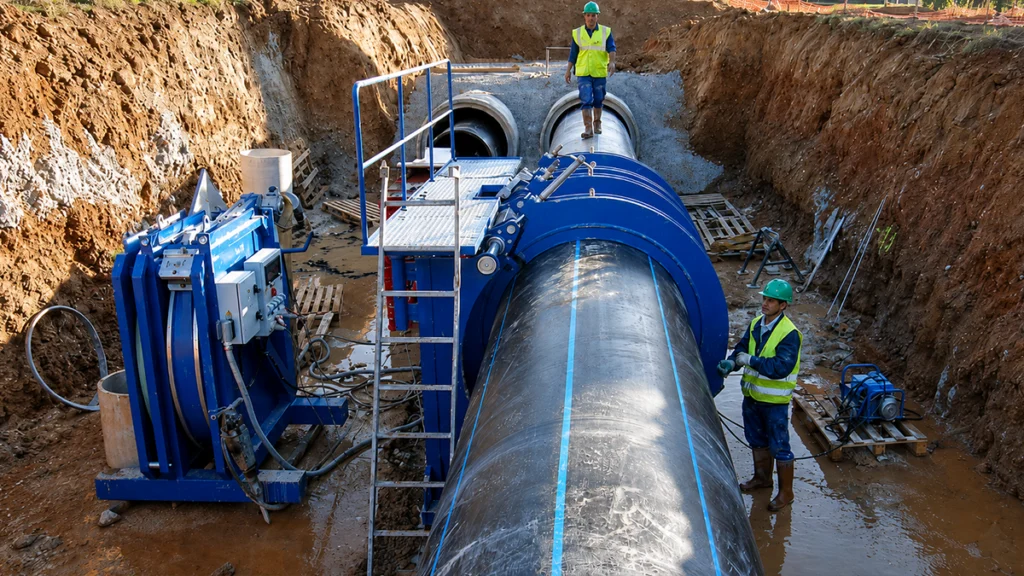
How an Automatic Butt Fusion Welding Machine Works
Which components control temperature, pressure, and timing?
Four main hardware components work together to run the show. First, you have the operating platform, which houses both the electronic PLC brain and the hydraulic power unit. Next up is the clamping device that locks the pipe geometry in place. Then comes the heating plate—usually crafted from a heavy-duty, corrosion-resistant aluminum alloy—delivering pinpoint thermal output. Finally, a precision milling cutter uses high-speed carbon steel blades to face the pipe ends. Throughout the process, the PLC constantly reads live sensor data from the hydraulic lines and heating plate to fine-tune energy and force on the fly.
Why does process control improve weld consistency?
Strict process control wipes out the rogue variables that typically cause joints to fail. Top-tier automated systems don’t just watch temperature and pressure; they actively measure dynamic drag pressure. That’s the frictional resistance caused by dragging heavy lengths of pipe through the clamps. The PLC takes that drag into account, calculating the total fusion pressure required and locking those parameters in from the flanging stage right through to cooling. This guarantees every single joint hits the exact interfacial pressure demanded by standards like ASTM F2620.
Does the machine offer automatic pressure and temperature control?
Absolutely. The closed-loop PLC offers 100% automated command over both pressure and temperature. If anything goes wrong mid-fusion—say, a sudden voltage spike or a hydraulic fixture releasing too early—the system reacts instantly. It triggers a loud alarm and aborts the cycle, forcing the crew to start a fresh fusion process. This built-in fail-safe ensures no one ever finalizes and buries a compromised joint.
Why do data logging and traceability matter?
Verifiable quality assurance isn’t optional for municipal and industrial pipeline contractors; it’s mandatory. An automatic butt fusion welding machine logs all critical parameters for every single joint, spitting out a tamper-proof digital record. This documentation directly satisfies tough regulatory codes like TSG D2002-2006 and GB/T 20674.1. Ultimately, robust data logging delivers total project traceability. Engineers can confidently verify compliance years after the pipeline goes live.
Factory-direct pricing with technical consultation included
Get Your Free QuoteKey Features Buyers Should Look For
Which safety and alignment features improve operator confidence?
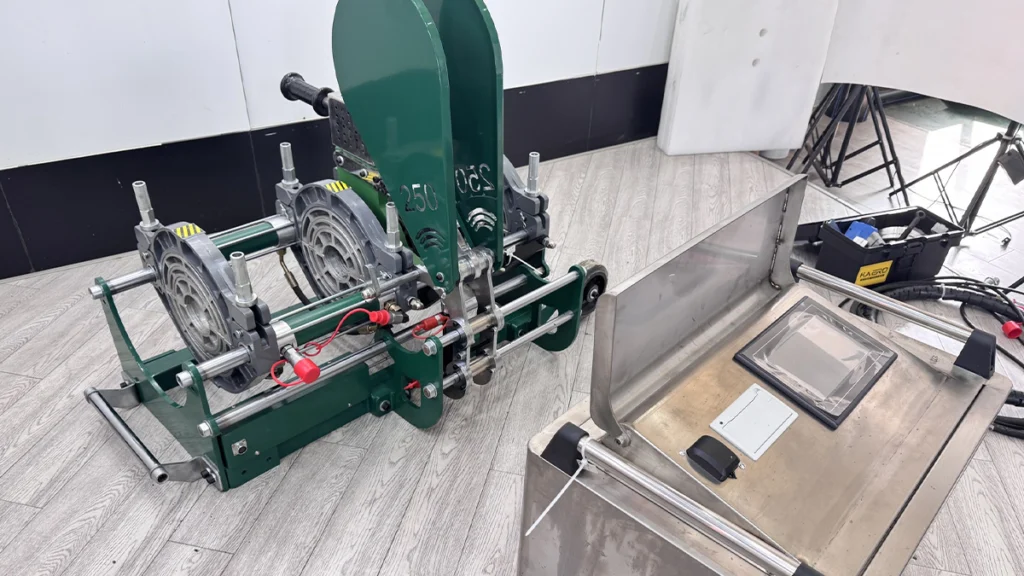
Job sites are inherently dangerous, so equipment safety has to take center stage. Smart buyers look for butt fusion machines featuring oversized touchscreen displays that walk operators through intuitive, step-by-step prompts. A low-voltage control panel is another must-have, keeping the operator safely isolated from high-voltage risks. On top of that, independent clamping structures with self-aligning capabilities ensure dead-on positioning accuracy. This stops heavy pipes from dangerously slipping under massive hydraulic pressure.
What role do clamping range and heating plate quality play?
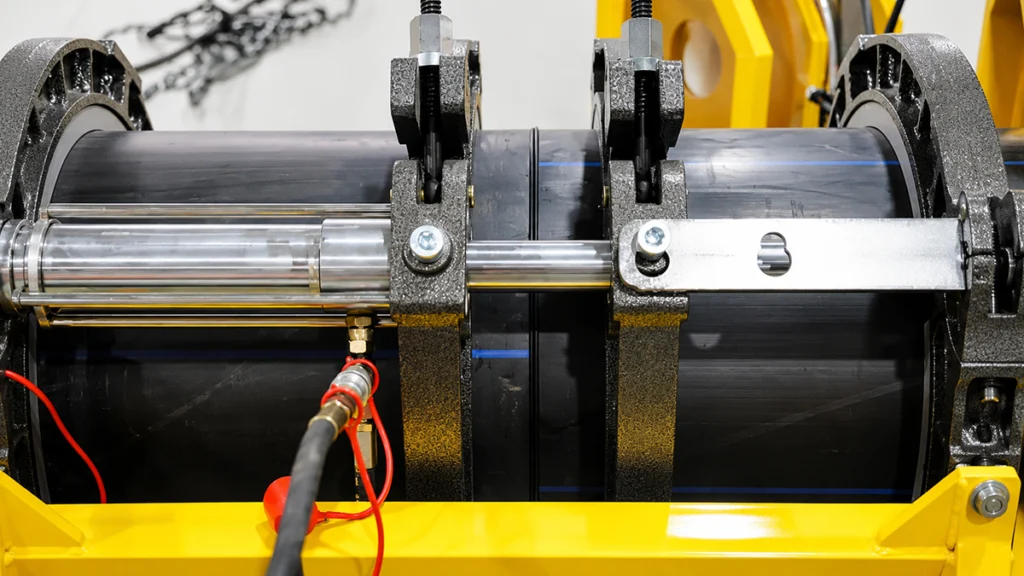
A butt fusion welding machine’s clamping range determines its flexibility across various pipe Outer Diameters (OD). You need rugged inner clamp blocks to keep the pipe perfectly round when high-pressure fusion kicks in. Heating plate quality is just as crucial. It needs to be forged from premium, corrosion-resistant aluminum alloy to guarantee rapid heat transfer and a perfectly even surface temperature. If the plate develops cold spots, you end up with brittle, failure-prone welds.
How does automation improve weld repeatability?
CNC-integrated systems literally block operators from straying off the approved welding path. By stripping away the ability to manually tweak voltages or bump up hydraulic pressures, the HDPE pipe welding machine follows the thermodynamic “recipe” flawlessly every time. It doesn’t matter if you’re fusing the first joint at 8:00 AM or the fiftieth at 5:00 PM. The automated execution stays mathematically identical, delivering perfect repeatability all day long.
Can it reduce labor dependence and operator error?
By taking over the most complex joining phases, these HDPE pipe jointing machines drastically cut down the grueling physical labor of wrestling with heavy hydraulic levers. More importantly, they slash human error. This effectively lowers the barrier for Operator Qualification (OQ) training. Contractors can put less experienced technicians on the line while still maintaining world-class quality control.
Main Benefits for Industrial and Construction Projects
Where do productivity gains show up most clearly?
You see the biggest productivity leaps during high-volume pipeline installations. CNC automated systems currently enjoy an 8.9% CAGR in market adoption for one simple reason: they shave 3 to 5 minutes off every single weld cycle compared to manual setups. Manual butt fusion machines drag their feet building pressure, and operators waste time manually calculating cooling periods. Automation, on the other hand, snaps between heating, soaking, and fusion phases instantly to maximize your daily yield.
How does it help reduce long-term maintenance and failure risk?
Fixing just one busted underground joint—once you factor in excavation, dewatering, cutting, and re-welding—easily runs anywhere from $4,000 to $15,000. By locking into strict international fusion standards and logging every data point, an automatic pipe fusion machine virtually wipes out the risk of catastrophic pipeline leaks. In doing so, it protects contractors from the massive financial liabilities that follow a blowout.
Which industries use automatic butt fusion welding most often?
Any sector that demands absolute zero-leak fluid transport relies heavily on this technology. You’ll find it deployed across municipal water conservancy, natural gas distribution grids, and petrochemical plants. It’s also a staple in mining operations, where highly abrasive slurry lines demand thick-walled HDPE. Even large-scale agricultural irrigation projects are making the switch to automated fusion for their high-pressure mainlines.
What pipe diameters and wall thicknesses are commonly supported?
Standard units easily tackle everyday utility ranges like Dn160-315mm and 315-630mm. Step up to heavy-duty industrial models, and you can handle massive infrastructure pipes spanning 710-1000mm. The most advanced systems on today’s market push the envelope even further. They accommodate staggering diameters up to 1600mm—or even 3000mm—packing enough hydraulic muscle to fuse ultra-thick SDR 7 and SDR 9 pipes without breaking a sweat.
Get detailed specs and custom configuration options
Request Technical SpecificationsTypical Applications and Suitable Pipe Materials
Is it suitable for HDPE, PP, and other thermoplastic pipes?
Yes. Engineers calibrate these butt fusion welding machines specifically for High-Density Polyethylene (HDPE) and Polypropylene (PP). Because the onboard PLC stores multiple material profiles, operators can flip seamlessly between standard black PE100 pipe and highly specialized thermoplastics. Whether the material demands a lower fusion temperature or an extended cooling cycle to keep its structural integrity intact, the machine adapts instantly.
When is it the right choice for field work versus workshop use?
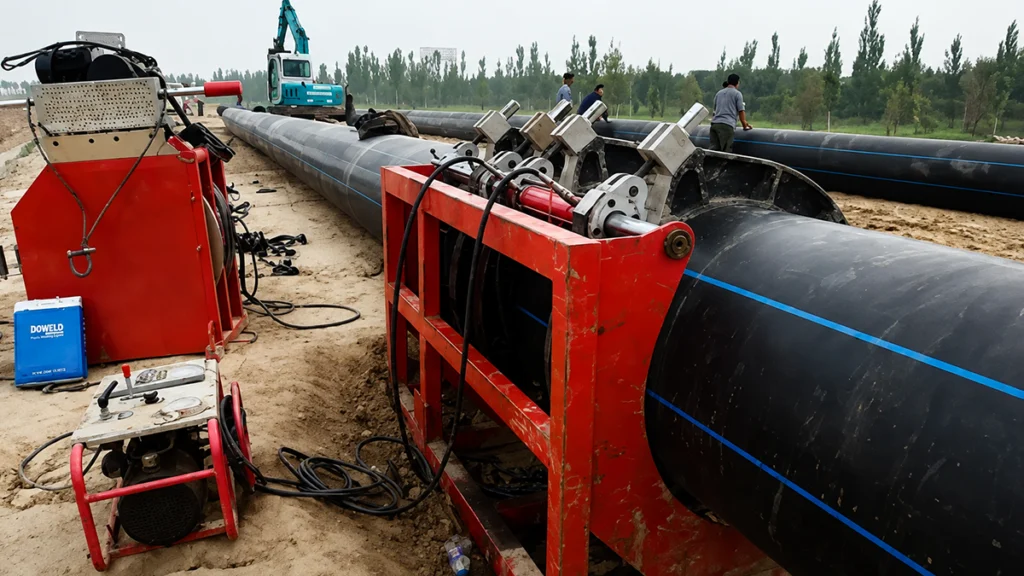
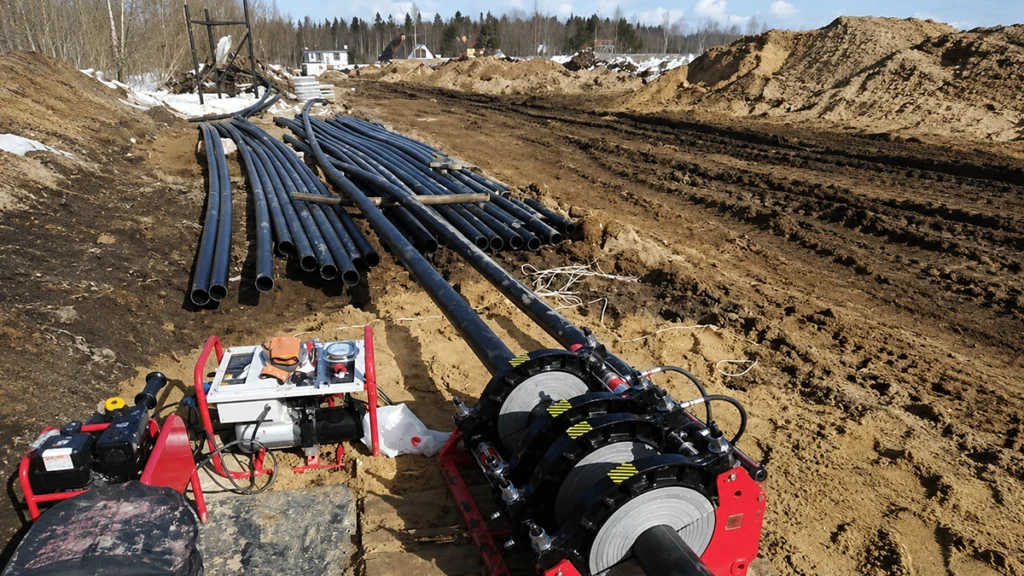
Despite their high-tech brains, these butt fusion machines are built tough for rugged field deployments. They feature separate clamping chassis and remote operating systems linked by heavy-duty hydraulic hoses and quick-connect fittings. This design is perfect for cramped trench work. You can leave the bulky control unit safely above ground while the clamps do the heavy lifting in confined spaces—a massive advantage over rigid, workshop-bound fabricators.
Which pressure, diameter, and voltage ranges should you verify?
Nailing down your power specs is critical before buying equipment for large-scale infrastructure. If you’re eyeing a 710-1000mm pipe fusion machine, double-check its compatibility with industrial voltages (usually 380V/3-phase). The hydraulic system needs to deliver a pressure adjustment range of 0-16 MPa to conquer high drag forces. Meanwhile, the heating plate must hold a tight temperature control range of 0-270°C, strictly limiting variance to a ±3°C error margin.
How do heater plate power and control accuracy affect results?
You simply can’t compromise on heater plate power when dealing with large-diameter pipes. Take a 1000mm pipe, for instance: you need a minimum of 17.5 KW of heating power. Skimp on wattage, and you’ll get agonizingly slow, uneven heating—especially if you’re working in a cold or windy trench. If the temperature accuracy drifts past that ±3°C window, the polymer might fail to melt completely or, worse, scorch. Either way, you’ve completely ruined the joint’s molecular bond.
Technical Specifications That Matter Most
What should you check in the hydraulic and electrical system?
Always scrutinize the total power draw to guarantee your field generators can actually handle the load. A massive butt fusion machine might pull 23.5 KW in total, split between a 3.0 KW hydraulic station motor and a dedicated milling cutter motor. On the hydraulic side, make sure the cylinders utilize high-grade seals. You cannot afford pressure bleed-off during the critical cooling phase.
| Component | Key Specification to Verify | Minimum Requirement for Large OD (>630mm) |
|---|---|---|
| Hydraulic Station | Max Pressure Output | 16 MPa (160 bar) |
| Heating Plate | Temperature Variance | ±3°C across entire surface |
| Electrical System | Total Power Draw | ≥ 20 KW (Requires 380V / 3-Phase) |
| Control Unit | Data Storage Capacity | > 2,000 weld logs |
Which accessories and consumables should be included?
A solid equipment package needs to come fully loaded. Expect a complete set of inner clamp blocks (reduction inserts) to handle the various pipe ODs within the HDPE pipe welding machine’s rated range. The supplier should also throw in spare high-speed carbon steel milling blades, a rugged storage stand to protect the heating plate and facer, and all the necessary data logging hardware or USB export interfaces.
What quality differences can you expect between the three options?
The technical specs you choose directly dictate the quality of your final weld. Manual butt fusion machines lean entirely on human muscle and rely on clunky, analog temperature dials. Semi-automatic models step it up by using hydraulics for pressure, yet the operator still has to manually trigger the transitions between welding stages. A fully automatic butt fusion welding machine, however, leverages a closed-loop PLC system for 100% hands-free execution. The result? Zero variance from one joint to the next.
Which option is best for high-volume production?
If you’re running a high-cycle environment where crews need to knock out 50 to 100+ joints a day, fully automatic butt fusion machines aren’t just an option—they’re mandatory. They completely bypass the bottlenecks caused by operator fatigue and botched manual calculations. This ensures your pipeline construction schedule stays on track without ever compromising joint integrity.
Automatic vs Hydraulic vs Manual Butt Fusion Machines
When does manual equipment still make sense?
Manual gear still holds its ground for technicians working with razor-thin budgets or handling small-scale, non-critical jobs. You’ll often see them used in less regulated environments, like low-pressure agricultural irrigation setups. Generally, these are limited to pipe diameters under 16 inches (400mm), where applying manual leverage remains physically realistic.
How should total ownership cost influence the decision?
Sure, an automatic butt fusion machine might demand an upfront investment three to four times higher than a manual unit. But when you map out the Total Cost of Ownership (TCO), automation wins in a landslide. Factor in the massive reduction in skilled labor hours and the evasion of $15,000 joint failure liabilities. High-volume contractors usually hit full Return on Investment (ROI) well before their first year of operation ends.
How do you match machine capacity to pipe size and project scope?
You have to align your butt fusion machine selection with the project’s maximum pipe diameter and wall thickness (SDR). Manual systems simply lack the muscle to generate the necessary interfacial pressure for large, thick-walled pipes. If your pipeline project involves anything over 400mm, a hydraulic, automated system is an absolute requirement to hit those fusion pressures safely.
What should you ask a supplier before purchase?
Procurement teams need to grill suppliers on their R&D capabilities and inquire about future PLC security upgrades. Don’t forget to ask for the details on annual calibration services to keep your data loggers compliant. Also, verify that the internal fixtures actually meet national standards. For instance, pipe fusion machines under 400 amps shouldn’t use more than three reduction layers if they want to maintain proper clamping rigidity.
How to Choose the Right Machine for Your Project
How do lead time, spare parts, and warranty affect ROI?
Equipment downtime burns through capital at an alarming rate on a pipeline project. Smart buyers prioritize suppliers who back their gear with at least a 24-month warranty and guarantee local availability for spare parts. Lightning-fast troubleshooting support and a low history of warranty claims directly boost your project uptime. You want a butt fusion welding machine that actively generates revenue, not one sitting idle waiting for a replacement hydraulic valve.
Which hidden costs should be included in your budget?
When you build your budget, don’t ignore the hidden expenses. Factor in the price of external data loggers (a sneaky cost if you try upgrading a manual setup), mandatory Operator Qualification (OQ) certification courses for your crew, and the ongoing expense of annual equipment calibration. You need that yearly calibration to keep your PLC sensors compliant with strict ISO and ASTM standards.
Why is choosing the wrong diameter range a costly mistake?
Buying a butt fusion machine that’s massively oversized for your typical pipe runs forces your operators to stack excessive fixture layers (reduction inserts) just to grip the material. Stacking these inserts kills clamping rigidity. That leads directly to pipe slippage, lopsided flange formation, and ultimately, weak welds. Always invest in a HDPE pipe welding machine whose optimal range perfectly matches your most frequent pipe dimensions.
What problems come from weak temperature or pressure control?
Substandard control systems pave the way for devastating pipeline defects. If pressure control is weak, the HDPE pipe jointing machine fails to squeeze out the oxidized polymer layer during fusion, leaving you with a fragile bond line. Poor temperature control is just as bad, causing asymmetrical fusion beads and hidden internal voids. Either scenario guarantees a joint that will eventually crack under environmental stress or sudden internal pressure spikes.
Common Mistakes and Risks to Avoid
How can poor operator training affect weld quality?
Automation handles the heavy lifting, but human operators still have to prep the environment. Poor training breeds critical mistakes. An untrained worker might skip cleaning the heater plate with approved solvents before a weld, forget to cap pipe ends to block wind and dust, or try to yank the pipe out of the clamps before the automated cooling cycle wraps up. All of these errors ruin perfectly good joints.
What should you inspect before accepting delivery?
Never drop new equipment into the trench without a rigorous acceptance inspection. Double-check the main power indicator, confirm that the air and hydraulic pressure gauges are dead-on accurate, and test the emergency switch release. Run a dry-run test fusion to guarantee the timer ticks away without a hitch, and ensure the PLC securely locks down the parameters during the simulated cooling phase.
FAQ
Q1: What does an automatic butt fusion welding machine do?
It seamlessly joins thermoplastic pipes, such as HDPE and PP, by heating the ends to a molten state and pressing them together using PLC-controlled hydraulic pressure. The machine’s automated system handles the temperature, pressure, and timing precisely, creating a continuous, leak-proof joint without ever needing mechanical fittings.
Q2: Which pipe materials can be welded with an automatic butt fusion welding machine?
Engineers design these machines primarily for High-Density Polyethylene (HDPE), standard Polyethylene (PE), and Polypropylene (PP) pipes. High-end models can also tackle specialized plastics, like colored gas-line HDPE or conductive PE, which demand incredibly precise thermal control to fuse properly.
Q3: How is an automatic butt fusion welding machine different from a manual model?
An automatic unit relies on a CNC/PLC brain to calculate and execute exact temperatures, pressures, and cooling times, effectively removing human error from the equation. In contrast, manual models force the operator to physically pump the hydraulics, squint at analog gauges, and time the cooling phases manually with a stopwatch.
Q4: What technical specifications should buyers check before purchasing one?
Procurement teams must verify the maximum pipe diameter range and the total electrical power draw (like 380V/3-phase for heavy-duty models). You also need to check the hydraulic pressure capacity (ideally up to 16 MPa), confirm a heater plate temperature accuracy of ±3°C, and ensure the package includes fully compliant digital data logging.
Q5: Is an automatic butt fusion welding machine suitable for HDPE pipe?
Absolutely. It stands as the industry gold standard for joining HDPE pipe in high-pressure scenarios. The automated cycle ensures the HDPE molecular chains cross-link flawlessly across the joint. This creates a fusion zone that is just as strong—if not stronger—than the original pipe itself.
Q6: How much does an automatic butt fusion welding machine cost?
Costs swing wildly depending on the pipe diameter capacity. A premium automatic machine built for 315mm to 630mm pipes usually runs anywhere from $45,000 to $90,000. Sure, they cost more upfront than manual tools, but the massive labor savings and the prevention of catastrophic joint failures typically deliver a full ROI in under twelve months.
Q7: What are the main causes of poor butt fusion weld quality?
Bad welds usually stem from environmental contamination like dust, wind, or moisture. Other culprits include sloppy facing of the pipe ends, wrong interfacial pressure, or inaccurate heating temperatures. Automated machines completely eliminate the pressure and temperature variables, meaning the operator only has to worry about proper environmental prep.
Conclusion
Picking the right automatic butt fusion welding machine isn’t just a routine purchase; it’s a high-stakes procurement decision that dictates pipeline integrity, project timelines, and your long-term liability. When you upgrade from manual or semi-automatic tools to a fully CNC-controlled system, you instantly strip away the operational guesswork that causes joints to fail. Closed-loop PLC controls guarantee strict compliance with major international standards like ISO 21307 and ASTM F2620. Plus, the integrated data logging hands you the exact traceability needed to secure modern municipal and industrial contracts.
As you evaluate different models, look past the initial sticker shock and run the numbers on the Total Cost of Ownership. You have to verify technical specs—like hydraulic station power, heater plate temperature accuracy, and clamping rigidity—to match the equipment perfectly with the brutal demands of large-diameter, thick-walled HDPE jobs. Prioritizing robust automation doesn’t just speed up your daily trench production; it fundamentally locks down the structural reliability of your entire pipeline network.
Let our experts help you choose the right equipment for your project
Contact Our Engineering Team