
Global Shipping Guide for HDPE Pipe Welding Machines
Table of Contents
Importing an HDPE pipe welding machine requires more than just ticking boxes on a specification sheet; it demands a tactical approach to logistics and capital. Mishandling the transport of a 2,600 kg hydraulic unit can easily bloat your procurement costs by 15–20%. The culprits? Hidden port fees, demurrage charges, and incorrect duty classifications.
This guide cuts through the jargon to reveal the real-world implications of shipping Incoterms (FOB, CIF, DDP), breaks down financing models for heavy infrastructure assets, and details the packaging standards necessary to shield precision CNC tech from the harsh ocean environment. We’ll also walk you through a “site-ready” procurement checklist—covering everything from HS Code verification (8515.29.00) to Factory Acceptance Test (FAT) protocols. By the end, you will have a solid framework for sourcing DN40mm–DN12600mm HDPE pipe fusion equipment without the specification errors that delay pipeline commissioning.

—
Decoding Incoterms: FOB, CIF, or DDP for HDPE Pipe Welding Machine
When you buy heavy industrial machinery internationally, the invoice price is rarely the bottom line. The International Commercial Terms (Incoterms) you agree to define exactly where the risk shifts from the manufacturer to you. With high-value assets like hydraulic butt fusion machines, picking the wrong term can result in stranded cargo or surprise five-figure bills when the ship docks.
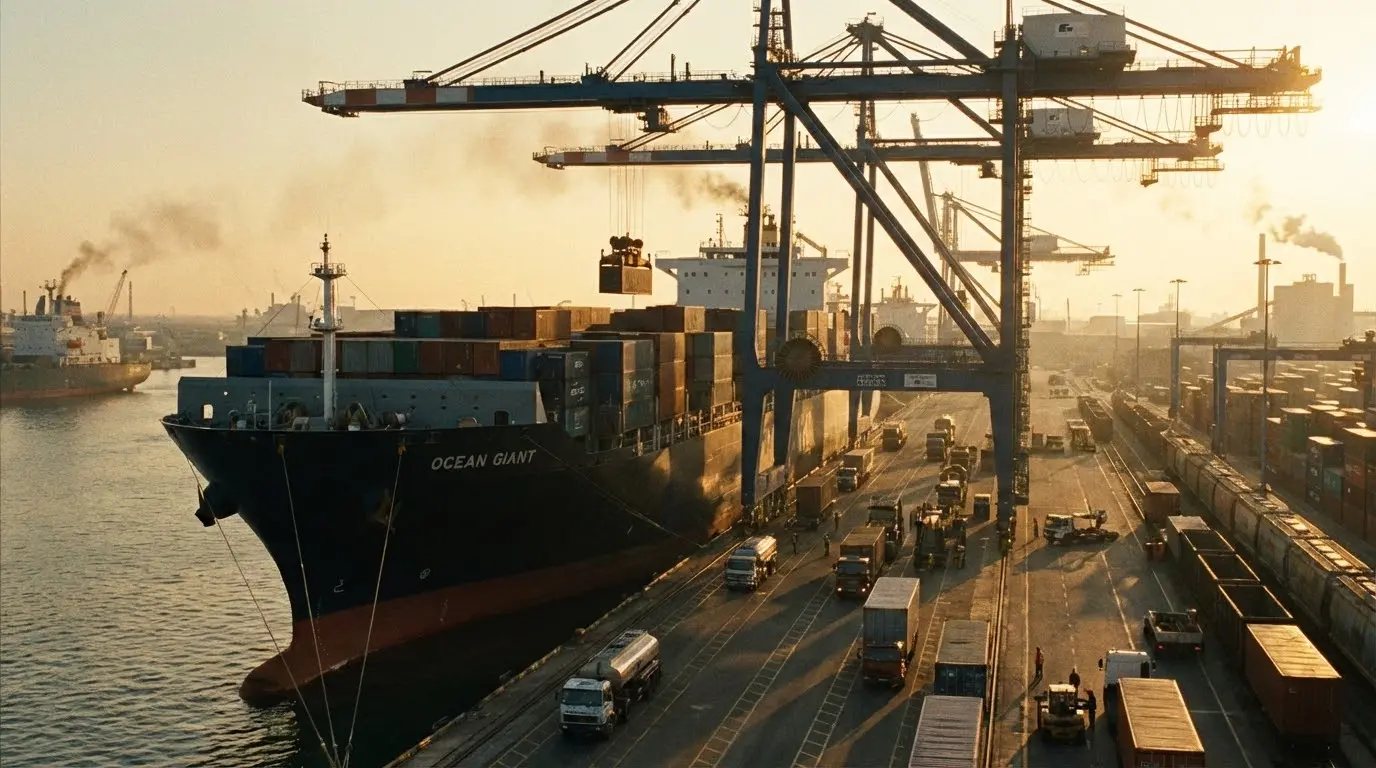
Compare FOB (Free on Board) vs. CIF (Cost, Insurance, Freight) regarding buyer control and risk allocation
Free on Board (FOB) is the standard for seasoned procurement managers who already have trusted freight forwarders on speed dial. Under FOB terms, Ekberg Welding handles the crating, clears export customs, and gets the HDPE pipe welding machine onto the vessel. The moment that crate crosses the ship’s rail, control—and risk—transfers to you. This puts you in the driver’s seat, allowing you to negotiate your own ocean rates and select a forwarder experienced with heavy machinery, ensuring you aren’t paying a premium for the sea voyage.
CIF (Cost, Insurance, Freight), on the other hand, means the seller arranges the ocean transport and insurance to your port. It looks convenient on paper, but it strips you of control. Sellers often default to the cheapest, slowest carrier to protect their margins. Worse, while risk transfers to you once the goods are on the ship, you have zero leverage with the carrier if the vessel is delayed. For critical infrastructure projects where the delivery date of an automatic pipe welding machine is set in stone, relying on a CIF shipment controlled by a third party introduces risks many project managers can’t afford.
Analyze DDP (Delivered Duty Paid) benefits for first-time buyers versus experienced importers
For contractors or utility companies tackling their first direct import, DDP (Delivered Duty Paid) offers maximum security. Under DDP, the manufacturer shoulders every risk and cost—shipping, insurance, import duties, and taxes—right up until the butt fusion machine arrives at your warehouse or job site.
Think of this as a “door-to-door” service. It removes the headache of hiring customs brokers or navigating complex import filings. For instance, importing a 1000mm hydraulic butt fusion machine into the EU under DDP means the supplier settles the VAT (19–25%) and the ~2.7% third-country duty before you ever see the equipment. While the upfront price tag is higher, DDP locks in a fixed “landed cost.” This allows project managers to budget with absolute precision, immune to fluctuating shipping surcharges.
Research the hidden costs in CIF terms (destination port fees) that often surprise contractors
There is a well-known trap in international trade: the “CIF Trap.” Suppliers might quote a rock-bottom CIF rate to win the business, but the freight forwarder they use makes their money back by jacking up fees at the destination port. These are often labeled as Destination Terminal Handling Charges (DTHC) or “handover fees.”
We’ve seen contractors arrive at the port expecting a quick pickup, only to be handed a bill for $800 to $1,500 in unexpected handling, documentation, and forklift fees. Occasionally, these local fees cost more than the ocean freight itself. When purchasing an automatic HDPE pipe welding machine, always demand a “Landed Cost Analysis” that estimates these local charges, or stick to FOB terms where your own forwarder gives you a transparent, all-in quote before the ship sails.
Create a decision matrix: When to choose Ex-Works vs. FOB for an automatic pipe welding machine order based on shipment volume (LCL vs. FCL)
The choice between Ex-Works (EXW) and FOB usually boils down to volume.
- Scenario A: Single Machine (LCL). Buying a single 1000mm unit? It will likely fly as Less than Container Load (LCL). FOB is the safer bet here. The seller manages the complex consolidation at the origin port. Under EXW, you’d have to arrange pickup from the factory floor and transport to the port—a logistical nightmare for foreign buyers.
- Scenario B: Multiple Machines (FCL). Ordering three or four units fills a 40ft High Cube container (Full Container Load – FCL). EXW can work here if you have a top-tier logistics partner, but FOB remains the industry standard.
- The Ekberg Advantage: The Ekberg 1000mm series weighs roughly 2,600 kg. This is significantly lighter than some tracked competitor models that tip the scales at over 4,900 kg. This lighter footprint opens up flexible LCL options or allows you to fit more units into a standard container, driving down the shipping cost per unit.
—
Financial Strategies: Financing and Payment Terms
Buying high-performance fusion equipment is a Capital Expenditure (CapEx) event that hits cash flow hard. Whether you run a municipal water department or a private mining operation, knowing how to structure the deal is just as vital as understanding welding pressures.
Compare lease vs buy automatic pipe welding machine scenarios for short-term municipal projects versus long-term fleet expansion
Should you lease vs buy automatic pipe welding machine units? It depends on your horizon.
- Buying (CapEx): Ideal for long-term fleet growth. If you are sitting on a multi-year pipeline maintenance contract or a massive irrigation rollout, purchasing yields the lowest Total Cost of Ownership (TCO). In the US, Section 179 of the tax code may allow you to write off the full purchase price in year one, softening the blow to your cash reserves.
- Leasing (OpEx): Smart for one-offs. Need a DN1200 beast for a 3-month job and don’t expect to see that pipe diameter again? Leasing preserves working capital. Note that for international deals, “leasing” usually means an “Equipment Finance Agreement” (EFA) where you own the asset at the end, rather than a standard operating lease, due to the difficulty of cross-border asset recovery.
Detail common payment terms for automatic pipe welding machine imports (T/T deposits, Irrevocable Letters of Credit for large orders)
Standard payment terms for industrial machinery usually involve a Telegraphic Transfer (T/T). The norm is a 30% deposit to kickstart manufacturing, with the remaining 70% due before shipment or against a copy of the Bill of Lading (B/L). This balances the risk: you commit capital, and the manufacturer funds the raw materials.
For significant orders (e.g., over $50,000 or multi-unit fleets), an Irrevocable Letter of Credit (L/C) is the gold standard. An L/C is essentially a bank guarantee that releases payment to the manufacturer only after they present verified documents—Commercial Invoice, Packing List, Bill of Lading. It protects you from non-delivery and ensures the seller gets paid only when they fulfill their contract.
Explore automatic pipe welding machine financing options and how to buy automatic pipe welding machine on credit through export credit agencies or supplier partnerships
Global buyers have access to automatic HDPE pipe welding machine financing options that often fly under the radar.
1. Export Credit Agencies (ECAs): Many governments back loans for international buyers to boost exports. You might be able to buy automatic HDPE pipe welding machine on credit with attractive interest rates if an ECA insures the deal.
2. Supplier Financing: Mature manufacturers like Ekberg may extend deferred payment terms (like Net 30 or Net 60) to long-term distributors or verified utility partners. This acts as an interest-free bridge loan, letting you generate revenue from the butt fusion welding machine before paying the full tab.
3. Third-Party Equipment Finance: Specialized industrial lenders can structure loans using the butt fusion machine itself as collateral. This requires the equipment to have a recognized resale value and ISO 12176 compliant traceability.
Calculate the Total Landed Cost (TLC) including currency exchange risks and bank fees
Savvy buyers calculate Total Landed Cost (TLC), not just the FOB price.
The TLC Equation:
FOB Price + Ocean Freight + Marine Insurance + Import Duty + Harbor Maintenance Fees + Inland Trucking + Bank Fees + Currency Buffer.
Don’t ignore currency risk. If your local currency tanks against the USD or EUR between your 30% deposit and the final 70% payment, your real cost could jump 5–10%. Locking in exchange rates via forward contracts or holding a USD reserve account is a smart hedge against volatility.
—
Logistics & Packaging: Protecting Precision Hydraulic Equipment
The hdpe pipe welding machine is a paradox: it’s a heavy steel beast containing delicate hydraulic pumps, CNC touchscreens, and sensitive temperature probes. It has to survive weeks at sea, often in humid, salty air that loves to eat metal.
Research standard export crate dimensions and weight for Ekberg’s 160mm to 1200mm automatic machines to estimate freight costs
precise dimensional data is the key to accurate freight quotes. For the Ekberg 1000mm series:
- Total Weight: ~2,600 kg.
- Frame Crate: 2200 x 1800 x 1700 mm.
- Hydraulic Station: 900 x 600 x 650 mm.
- Milling/Heating Unit: 2300 x 1100 x 800 mm.
Your freight forwarder needs these numbers to plan stowage. Unlike boxes of t-shirts, these crates cannot be stacked. They must be floor-loaded and strapped down. A 20ft General Purpose (GP) container can comfortably swallow one complete 1000mm system with room for spares. Expect to pay roughly $2,500–$4,500 to ship from Shanghai to the US West Coast, though rates fluctuate with the market.
Explain the necessity of ISPM 15 fumigated wooden cases for international customs compliance
Global trade rules (specifically ISPM 15) demand that all solid wood packing be heat-treated and stamped to stop timber pests. Non-compliant wood is a top reason for cargo rejection. If a crate lacks that ISPM 15 stamp, customs in the USA, Australia, or the EU can order the shipment fumigated at your cost—or worse, destroyed. Ekberg ensures every crate is heat-treated and clearly marked to sail through quarantine.
List specific packaging protection measures for sensitive components (data loggers, hydraulic units, CNC touchscreens)
The wooden crate is just the outer shell. Inside, we deploy specific defenses:
- Corrosion Protection: The heating plate (operating at 200–270°C) is coated with a protective film and sealed in Vapor Corrosion Inhibitor (VCI) bags. These emit a gas that forms a molecular barrier against rust on precision-ground aluminum surfaces.
- Hydraulic Stabilization: The hydraulic station is drained or stabilized to prevent leaks, with all hoses capped.
- Electronics: The CNC controller and 10-inch touchscreen are wrapped in anti-static bubble wrap and suspended in an inner carton, isolating them from ship engine vibrations and rough crane handling.
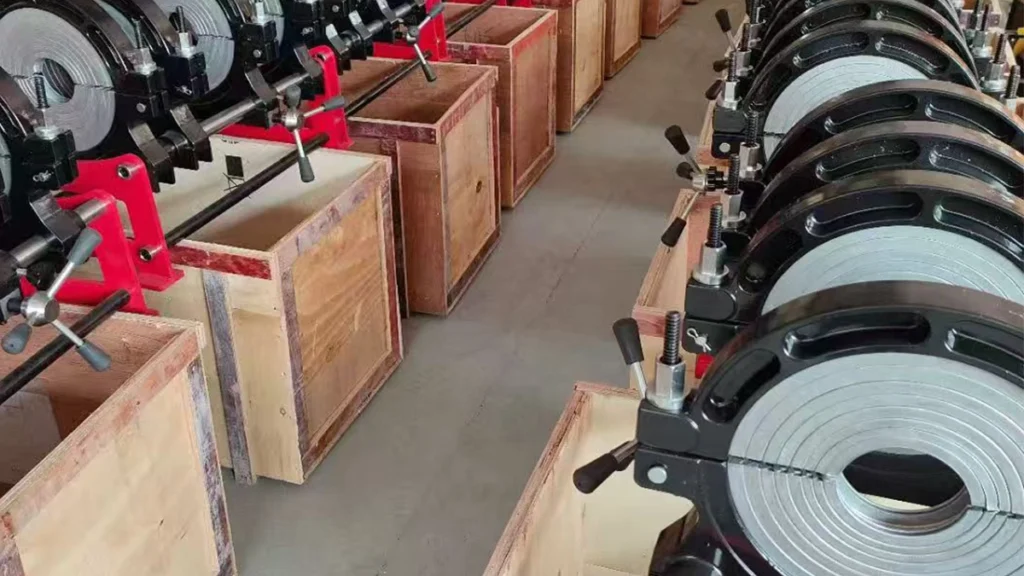
Compare air freight vs. sea freight timelines and costs for urgent replacement parts vs. main machine units
The main hdpe fusion machine should almost always travel by sea (3–6 weeks) due to the sheer weight. Spare parts require a different strategy. If a project halts because of a blown seal or damaged blade, air freight is your only move.
- Sea Freight: Cheap ($0.50–$2.00/kg), but slow.
- Air Freight: Fast (3–5 days), but pricey ($5.00–$12.00/kg).
Pro Tip: Include a “Critical Spares Kit” (extra blades, thermocouples, seals) in your initial sea shipment. It prevents downtime and saves you from paying emergency air freight rates later.
—
Smart Procurement: Checklist for Choosing the Right Machine Before Shipping
Once the butt fusion welding machine leaves the factory dock, fixing a spec error becomes expensive. A rigorous pre-shipment verification process is your best insurance policy.
Define the critical specs to verify before shipment (ISO 21307 compliance, welding pressure parameters)
Before the crate is nailed shut, match the butt fusion machine’s performance data to your project needs.
- Pressure Capability: Can the hydraulic system hit the 160 Bar (16 MPa) needed for high-pressure fusion?
- Standard Compliance: Is the software pre-loaded with the right welding standards (ISO 21307, DVS 2207, or GIS/PL2)? ISO 21307 High Pressure requires specific drag pressure calculations that the CNC must handle automatically.
- Welding Range: Do the inserts provided actually cover your full pipe range (e.g., DN710 to DN1000)?
Create a pre-shipment inspection checklist: Voltage compatibility, plug types, and language settings on the automatic controller
- Voltage: Does your site run on 380V/50Hz (Europe/Asia), 415V, or 480V/60Hz (USA)? Running a 50Hz motor on 60Hz power causes overheating and voids warranties.
- Plugs: Industrial plugs are not universal (5-pin 3-phase red plugs vs. hard-wired terminals). Ask for photos of the power cable termination before shipping.
- Language: The Ekberg CNC interface is multilingual. Ensure it’s set to your operators’ native language (English, Spanish, French) so they aren’t fumbling through menus on day one.
Verify the inclusion of essential accessories (inserts, spare blades, calibration certificates) to avoid separate shipping fees
A butt fusion machine is useless without its accessories. Check the Packing List for:
- Reduction Inserts: For every diameter in the range.
- Calibration Certificate: Mandatory for ISO 12176 compliance and project sign-off.
- Tool Kit: Specialized wrenches for blade changes.
- Data Logger Cable: Required for extracting reports to a PC.
Research the import duty rates using the specific HS Code for plastic pipe welding machinery in target markets (USA, EU, Australia)
Classification dictates your tax bill. The standard HS Code for an automatic pipe welding machine is 8515.29.00 (“Machines and apparatus for resistance welding of metals – Butt welding machines”) or sometimes 8515.80.90.
- USA: Generally duty-free, but watch out for Section 301 tariffs on Chinese goods (potential +25%).
- Australia: 5% duty, often waived with a valid ChAFTA Certificate of Origin.
- EU: ~2.7% duty plus local VAT.
Always validate the HS Code with your broker before the commercial invoice is cut.
—
Manufacturing Excellence, Quality Control & Global Export Capability
Logistics reliability is tied directly to manufacturer competence. Ekberg Welding blends precision engineering with export know-how.
Describe Ekberg’s Factory Acceptance Test (FAT) protocols before crating any automatic pipe welding machine
Every Ekberg butt fusion machine survives a brutal Factory Acceptance Test (FAT) before it ships. This includes:
1. Heating Uniformity: Ensuring the plate holds temperature within ±3°C across the entire surface at 220°C.
2. Pressure Hold Test: Maxing out the hydraulic system (160 Bar) and checking for any pressure drop over an hour.
3. Alignment Check: Laser measurement to confirm pipe misalignment is ≤ 0.2mm—critical for gas and water lines.
We can send a video of the FAT for remote approval before the unit leaves our floor.
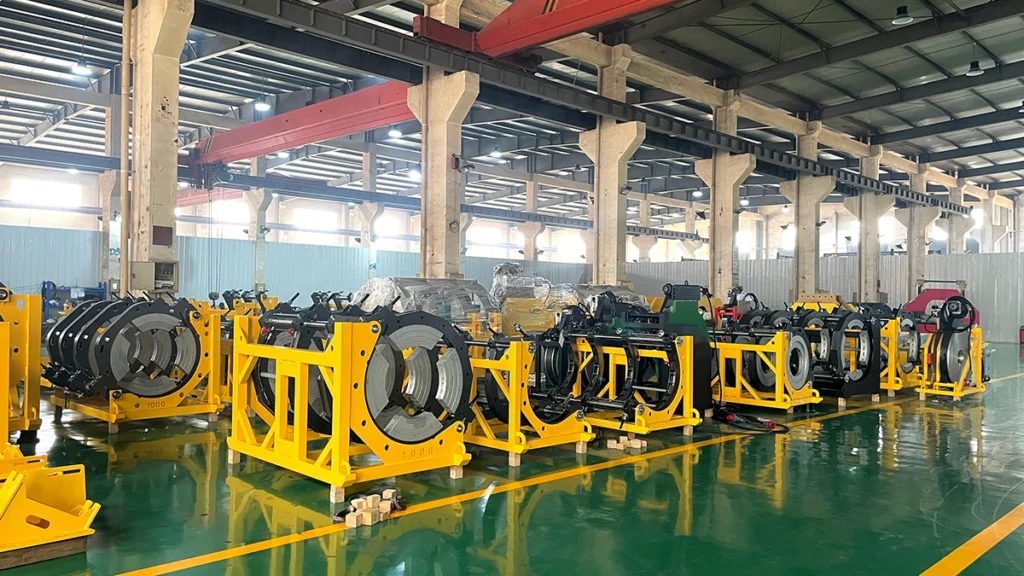
Explain the factory’s capability to handle complex documentation (Certificates of Origin, CE Declaration, Commercial Invoices)
Paperwork errors stall shipments. Ekberg’s export team handles the heavy lifting, providing the CE Declaration of Conformity (for Europe), Certificates of Origin (for duty reduction), and detailed Commercial Invoices that separate the value of the main unit and spare parts to streamline tax assessment.
Highlight Ekberg’s global logistics network and relationships with top-tier freight forwarders for reliable delivery
We don’t just build butt fusion machines; we get them where they need to go. Ekberg partners with top-tier global forwarders like DHL Global Forwarding and Kuehne+Nagel to secure shipping slots even during peak chaos. Whether you need a butt fusion welding machine in Houston, Hamburg, or Perth, our network delivers.
Discuss after-sales support infrastructure: resolving shipping damage claims and remote technical setup
If damage happens in transit, Ekberg supports the insurance claim with photographic evidence from our loading dock. Once the HDPE pipe welding machine arrives, we shift to technical setup. Our CNC units feature Ethernet ports, allowing our engineers to remotely diagnose faults, update software, or help with configuration, getting your team welding within hours of delivery.
—
Frequently Asked Questions
Q1: What is the correct HS Code for an automatic HDPE pipe welding machine?
The most common code is 8515.29.00 (Machines and apparatus for resistance welding of metals – Butt welding machines). However, some regions classify plastic fusion equipment under 8515.80.90. Confirm this with your customs broker before shipping to avoid reclassification fines.
Q2: Is it better to lease or buy an automatic HDPE pipe welding machine for a one-off project?
For a single project under 6 months, leasing (or renting) is usually the financial winner—it converts CapEx to OpEx and solves the storage problem later. For projects longer than 9 months or recurring work, buying is more economical. The payback period for an Ekberg 1000mm hydraulic butt fusion machine in continuous use is typically just 6–9 months.
Q3: Can I buy an automatic HDPE pipe welding machine on credit directly from the manufacturer?
Direct credit is usually reserved for established distributors. However, for new buyers, manufacturers like Ekberg often accept Irrevocable Letters of Credit (L/C) for large orders. This gives you a secure credit structure where your bank guarantees the payment, so you don’t have to prepay 100% of the cash upfront.
Q4: Does DDP shipping include unloading at my warehouse?
Usually, no. DDP covers transport and duties to your door, but it typically implies “Unloaded at Place” (DAP/DDP). This means the truck arrives, but you are responsible for the forklift or crane needed to offload the 2,600 kg crate. Always clarify “including unloading” if you don’t have heavy lifting gear on site.
Q5: How do you prevent the heating plate from rusting during sea shipment?
Sea air is corrosive. We protect the Teflon-coated heating plate and hydraulic rams by wrapping them in Vapor Corrosion Inhibitor (VCI) bags. These bags create a molecular barrier against rust. We also apply a temporary waxy film to exposed metal, which wipes off easily upon arrival.
—
Conclusion
Navigating the logistics of heavy infrastructure equipment is a balancing act between risk, control, and cost. While FOB terms give the experienced buyer maximum control over their freight spend, DDP offers a streamlined path for those who want a fixed, risk-free landed cost. Whether you decide to lease vs buy automatic pipe welding machine units or leverage export financing, the goal is the same: securing high-performance tech that delivers ROI from the first weld.
A reliable partner supports more than just the welding technology; they support the entire logistics chain—from ISPM 15 compliant crating to remote technical commissioning. Don’t let shipping complexities derail your pipeline project.
Ready to streamline your procurement? Contact Ekberg Welding today for a factory-direct quote on your next HDPE pipe welding machine, complete with transparent shipping options delivered right to your doorstep.