
Butt Welding Machine in Uruguay: HDPE Pipe Fusion Guide for Utility Projects
Table of Contents
Butt Welding Machine in Uruguay helps utility buyers choose the right HDPE fusion equipment, compare specs, control joint quality, and evaluate cost, lead time, and supplier support for pipeline projects.
What Is a Butt Welding Machine and Why It Matters in Uruguay
What is butt fusion in simple terms?
Think of a butt fusion machine as the ultimate heavy-duty pipe joiner. This specialized industrial equipment fuses two thermoplastic pipes by heating their perfectly squared ends against a hot plate—usually running between 200°C and 232°C. Once the polymer melts, controlled hydraulic pressure forces the ends together. What you get is a monolithic, completely leak-proof bond. In fact, this thermo-mechanical process creates a joint that often boasts a higher tensile strength than the pipe itself. No mechanical fittings required. Just one continuous, indestructible pipeline.
Why is HDPE widely used in utility pipelines?
High-Density Polyethylene (HDPE) is the undisputed king of modern utility infrastructure. Why? It fights off corrosion, bends without breaking, and easily delivers a service life pushing past 50 years. Unlike rigid steel or heavy concrete, HDPE handles serious ground shifts and high-pressure fluid dynamics without cracking. Its natural flexibility means it adapts effortlessly to wild temperature swings and unstable soil conditions. For long-distance underground routes, it is simply the best material available.
Which utility projects benefit most from butt welding?
Bringing a reliable butt welding machine to a job site in Uruguay changes the game for municipal water management, complex drainage networks, gas distribution, and marine outfall builds. Contractors transport kilometers of HDPE pipe to both coastal and inland locations, relying on butt fusion to forge leak-proof flange and pipe connections. Whether a crew is swapping out decades-old urban water mains or laying down massive agricultural irrigation systems, this fusion method guarantees the lowest lifecycle cost for utility operators.
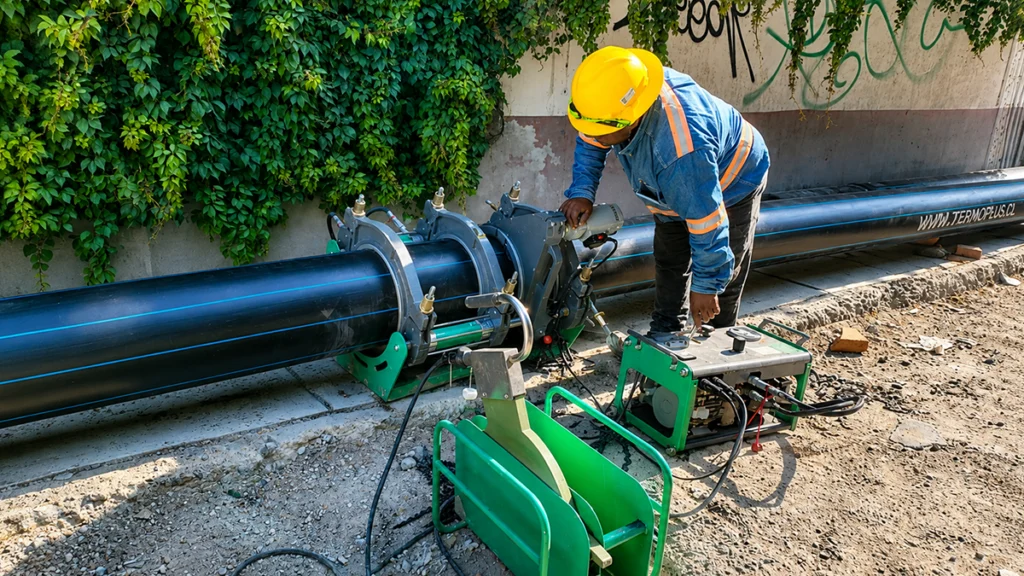
How Butt Fusion Works: Core Components and Process
What are the main parts of the machine?
A standard butt fusion machine breaks down into four essential pieces. First, the base framework—or clamping device—locks the pipes in perfect alignment. Next, the milling cutter (often called the facer) spins high-speed carbon steel blades to shave the pipe ends until they are flawlessly square. Then comes the aluminum alloy heating plate, coated in non-stick PTFE, which delivers exact thermal energy to the plastic. Finally, the hydraulic power station steps in to regulate the interfacial pressure needed during the critical joining and cooling stages.
How do heat, pressure, and cooling create one joint?
The real magic of butt fusion happens at the molecular level. Applying heat shifts the HDPE from a rigid crystalline state into a soft, malleable form. As soon as the pipe ends hit the sweet spot in temperature, the butt fusion welding machine applies fusion pressure. This forces the polymer chains from both sides to mix, tangle, and bond across the interface. The trick is keeping the joint completely still under steady pressure while it cools. This lockdown allows the molecules to re-crystallize, cementing the structure permanently.
What does a standard fusion cycle look like step by step?
To meet strict international standards like ISO 21307 and DVS 2207, operators must follow five non-negotiable phases:
1. Preparation and Facing: Shave the pipe ends until long, continuous ribbons of plastic peel off. This guarantees perfectly parallel faces.
2. Heating: The bead-up phase makes initial contact, followed immediately by a heat soak at near-zero pressure so the thermal energy penetrates the pipe wall.
3. Changeover: Quickly yank the heating plate out of the way. You only have seconds before you lose too much heat.
4. Joining: Ramp the system up to the target interfacial pressure (for instance, 0.15 N/mm² for DVS guidelines or 60-90 psi for ASTM specs).
5. Cooling: Lock the joint down under constant pressure until the core drops safely below the polymer’s crystallization point.
Factory-direct pricing with technical consultation included
Get Your Free QuoteButt Welding Machine Types: Manual, Semi-Automatic, and Fully Automatic
Manual vs semi-automatic vs fully automatic: what changes?
The big difference here comes down to how the HDPE pipe jointing machine applies pressure and who controls the parameters.
| Machine Type | Pressure Control | Parameter Input | Ideal Project Scope |
|---|---|---|---|
| Manual | Human force (levers) | Operator judgment | Small-diameter, low-pressure residential pipes |
| Semi-Automatic | Hydraulic power station | Manual dial adjustment | Standard municipal works, utility sub-contracting |
| Fully Automatic (CNC) | Closed-loop PLC | Pre-programmed (ISO/DVS) | Strict EPC tenders, high-pressure gas lines |
Which type fits small contractors and which fits utility tenders?
Smaller outfits usually lean toward manual or semi-automatic hydraulic rigs. These models are highly portable, require less cash up front, and easily handle everyday water and irrigation jobs. On the flip side, municipal utility tenders and major Engineering, Procurement, and Construction (EPC) firms demand fully CNC automatic butt fusion machines. These high-end units completely remove operator guesswork. They guarantee the strict quality assurance compliance that government infrastructure contracts demand.
When does automation improve quality and traceability?
You need automation the second a project specification calls for bulletproof, verifiable joint integrity. CNC automatic butt fusion machines take over the heavy lifting: they measure drag pressure automatically, adjust for the ambient temperature, and nail the exact heat soak and cooling times. Better yet, integrated data loggers can store up to 4,000 individual welding cycles. Crews can simply export these reports via USB or Bluetooth to prove they met ISO 12176 standards, handing over complete digital traceability for every single weld on the line.
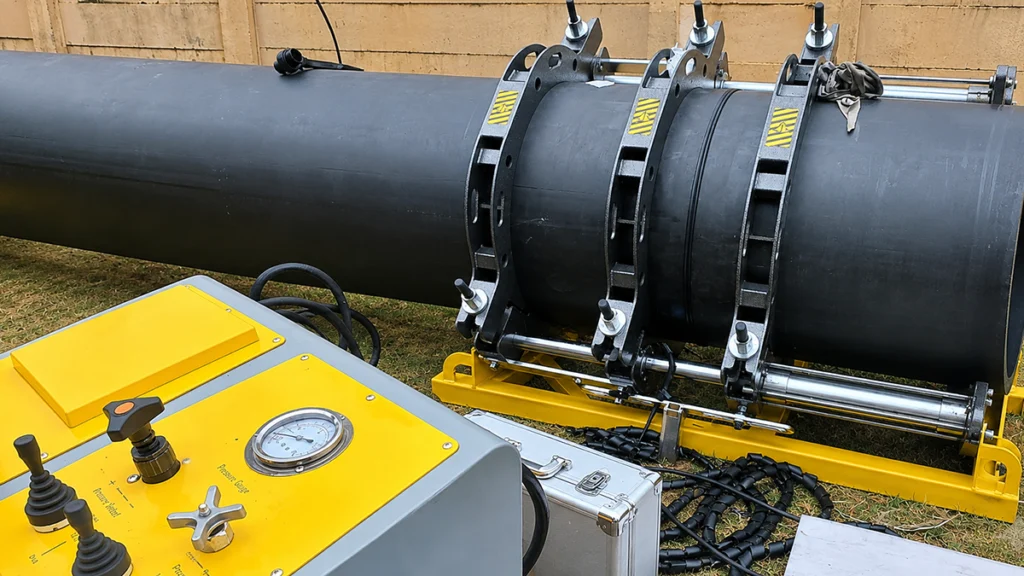
Technical Specifications to Check Before You Buy
Which pipe diameter and SDR range do you need?
Manufacturers categorize these HDPE pipe welding machines by their maximum working range—think 90-315mm or 500-800mm. Before you authorize a purchase, double-check that the pipe fusion machine’s clamping inserts actually match the Outside Diameter (OD) of your specific pipes. Also, pay attention to the hydraulic system. It must pack enough punch to handle the pipe’s Standard Dimension Ratio (SDR). Heavy-wall pipes (those with lower SDR numbers like SDR 9 or 11) demand substantially more fusion pressure than thin-wall alternatives (SDR 17 or 21).
Why do temperature, pressure, and alignment accuracy matter?
Precision isn’t just a buzzword; it dictates whether a weld holds or bursts.
- Temperature: You have to keep the heating plate deviation tight (usually within ±5°C). Cold spots inevitably create weak bonds.
- Pressure: The hydraulic adjustment range normally runs from 0 to 6.3 MPa. If your gauges are off, you risk over-pressurizing the joint and squeezing all the molten material right out of the weld zone.
- Power: Electrical stability is a must. A typical 250mm hydraulic rig needs about 4.21 kW of total power (2.1 kW for the heater, 1.36 kW for the facer, and 0.75 kW for the hydraulics) running at 220V 50Hz.
Do you need data logging, printer output, or digital traceability?
If you are bidding on massive utility projects, ISO 12176-compliant data loggers aren’t just nice to have—they are usually mandatory. These smart systems record everything: operator ID, ambient weather conditions, heat soak duration, changeover speed, and cooling pressure. Having a built-in printer or a quick digital export tool lets site inspectors instantly verify that a joint meets ASTM or DVS standards. You get sign-off before the trench gets backfilled, completely mitigating future liability risks.
Get detailed specs and custom configuration options
Request Technical SpecificationsCommon Utility Applications in Uruguay
Where are butt fusion joints commonly used?
Across the board, butt fusion is the go-to joining method for municipal water networks, gas transmission lines, sprawling agricultural irrigation grids, and heavy-duty industrial fluid systems. Because the process creates a perfectly seamless joint with a slick internal surface, it stops flow blockages dead in their tracks. It minimizes friction loss and totally eliminates the biological buildup issues that constantly plague mechanical fittings.
Is butt fusion suitable for municipal water and drainage projects?
Absolutely. Butt fusion stands as the gold standard for municipal water and drainage operations. The fused joints deliver a 100% leak-free pipeline. This rock-solid structural integrity guarantees that raw effluent won’t leak into the surrounding soil, and groundwater won’t seep into the drainage network. That kind of reliability is essential for keeping urban sanitation standards high and water treatment costs low.
What site conditions in Uruguay can affect machine choice?
Uruguay’s landscape throws a mix of environmental curveballs at contractors, from breezy coastal zones to rugged agricultural interiors. High coastal winds demand welding tents to stop drafts from cooling the heating plate too fast—a surefire recipe for cold welds. In the dead of winter, if temperatures dip below -5°C, crews must wrap the pipes in thermal blankets while they cool. Choosing a butt welding machine in Uruguay equipped with heavy-duty weather shielding and reliable CNC temperature compensation keeps your crews working year-round.
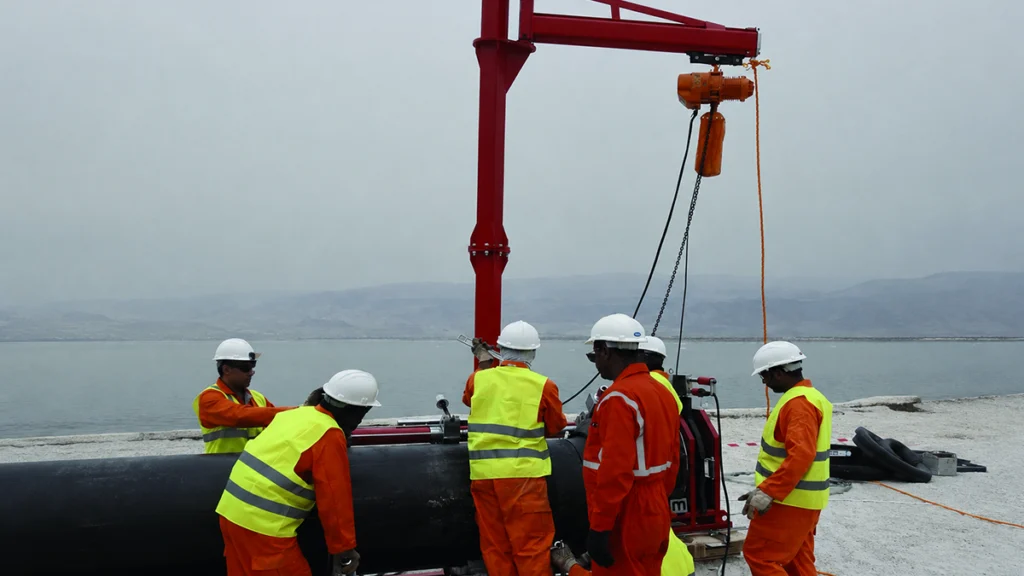
How to Choose the Right Machine for Your Project Scale
What should a small contractor prioritize?
Small contractors need to focus on portability, fast setup times, and overall versatility. A lightweight, semi-automatic hydraulic rig with low start-up pressure is perfect for knocking out small-diameter pipe welds in cramped urban trenches. If you can toss the equipment into the back of a standard pickup truck and run it with just a two-person crew, you will maximize daily productivity while keeping overhead costs incredibly low.
What should a municipal or EPC buyer prioritize?
Municipal buyers and EPC contractors operate on a different level; they must prioritize high-capacity hydraulics, CNC automation, and rigorous data logging. When wrestling with massive, heavy-wall pipes (like 630mm or 800mm), immense frame rigidity is critical to stop the pipes from misaligning under extreme clamping forces. Investing in butt fusion machinery that spits out ISO-compliant weld reports means the EPC firm can smoothly hand over the finished asset to the utility operator without any red tape.
How do portability and power supply affect field work?
Taking equipment off the grid introduces a whole new set of power headaches. You have to perfectly match the pipe fusion machine’s total power draw with a rock-solid portable generator. Take a mid-sized rig requiring 4.21 kW—it needs a generator that delivers steady voltage without unexpected surging. Jumbo butt fusion welding machines might pull 10+ kW. Even a slight voltage drop during the heating or joining phases will trash the weld cycle, leading to expensive pipe cut-outs and massive rework delays.
Cost, Lead Time, and Supplier Evaluation
What drives the total project cost?
The capital you spend on fusion equipment swings wildly depending on size and automation levels. A bare-bones hydraulic setup might run you around 30,000 RMB, whereas fully loaded CNC models boasting premium pressure sensors and data loggers easily smash past the 100,000 RMB mark (with mid-range Western machines hovering around $45,000 USD). But the real driver of total project cost is labor efficiency. Dropping cash on CNC automation wipes out the 10-15% rework penalty caused by manual operator errors. Over kilometers of pipeline, those savings are massive.
How should you evaluate a supplier or distributor?
Don’t just buy from anyone—rigorously vet your suppliers by checking their CE and ISO manufacturing certifications. Look hard at the warranty terms; a solid industry standard is 12 to 24 months. You also need to know if they handle OEM/ODM customization, like tweaking the voltage and frequency to match local 220V/50Hz power grids. Ultimately, your operational uptime lives or dies based on their after-sales support and how fast they can ship spare parts.
Should you buy, rent, or outsource fusion work?
Renting a decent mid-range hydraulic butt fusion machine usually sets you back $350 to $600 a day. If you are just doing a quick repair or a one-off project, renting or hiring a specialized subcontractor makes total financial sense. But if you are an EPC firm tackling multi-year utility contracts, or a contractor laying down FTTX and water mains every week, buying the equipment outright delivers a dramatically higher Return on Investment (ROI). Plus, you never have to wait around for a rental to become available.
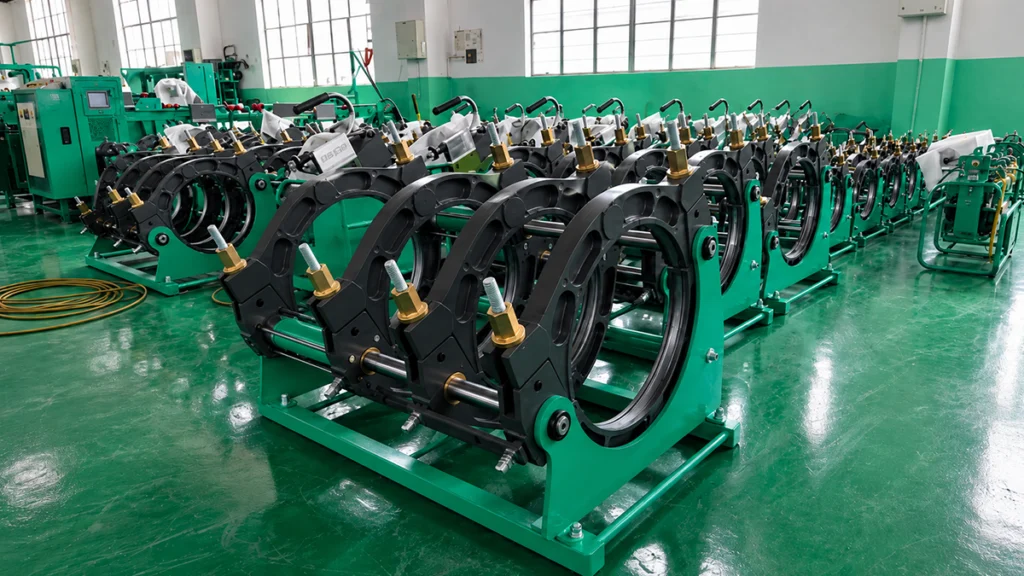
Installation, Calibration, and Operator Best Practices
How should the jobsite be prepared before fusion?
Skipping jobsite prep invites contamination, which is the number one killer of fused joints. First, elevate the pipe ends on rollers to cut down on drag force and wipe away all dirt, mud, and moisture. Before initiating every single fusion cycle, operators must clean the heating plate’s PTFE non-stick coating. A quick wipe down with 90% isopropyl alcohol and a lint-free cloth removes lingering polymer residue and airborne dust.
What calibration and maintenance checks are essential?
Routine calibration keeps your gear running flawlessly. Crews need to check hydraulic oil levels daily, making sure the tank stays at least two-thirds full. Inspect the milling cutter blades constantly; dull blades will butcher the pipe faces. Most importantly, operators should use a calibrated surface pyrometer to verify that the actual heat across the plate perfectly matches the reading on the butt fusion machine’s digital gauge.
How do training and records reduce weld risk?
Human error is responsible for almost every weak joint out there. Solid training ensures the crew actually understands the science of polymer fusion, especially why the cooling phase is so delicate. Operators must learn to never, ever release the hydraulic clamps early. Setting up dual-channel timers with loud alarms guarantees that both the heat absorption and cooling periods are strictly respected. Combine that with daily weld logs, and you enforce real accountability on the site.
Common Mistakes and Hidden Risks
What causes weak or inconsistent joints?
A few specific blunders will ruin a joint’s integrity every time:
- Cold Welds: These happen when the heating plate is too cold or the operator takes too long during the changeover.
- Misalignment: If the high-low gap between the pipe ends exceeds 10% of the wall thickness, you create dangerous stress concentrations.
- Excessive Drag Pressure: Pushing too hard squeezes all the molten polymer out of the weld zone, leaving a brittle, starved connection.
- Short Cooling: Popping the clamps open before the polymer chains lock together triggers immediate micro-cracking.
How do weather and contamination affect fusion quality?
The environment can wreck fusion quality in a heartbeat. Dust particles and trapped moisture act like tiny voids, becoming crack-initiating points when the pipe faces long-term fatigue. Wind is just as brutal. A stiff breeze can unevenly cool the pipe face while it’s heating, leaving you with a joint that looks fine on the surface but lacks deep penetration on the windward side.
Which quality checks should never be skipped?
Never skip the visual bead inspection. A structurally flawless butt fusion joint produces a double rollback bead that looks uniform in both size and shape all the way around the pipe. That bead needs to be smooth, free of any pores, and show no sharp V-notches between the two halves. If the bead looks asymmetrical, you have a severe parameter failure. Cut the joint out and do it again.
Final Buyer Checklist and Procurement Next Steps
What should be confirmed before placing an order?
Right before you issue that purchase order, lock down the exact pipe Outside Diameter (OD) range and the SDR (wall thickness) the butt fusion machine needs to handle. Confirm the electrical voltage and frequency required for your specific jobsite. Finally, dig into the project tender documents. Find out if the utility owner legally mandates CNC data logging or specific standards like ISO 21307.
Which documents and project details should you share with a supplier?
To get a quote that actually means something, hand the supplier a detailed Bill of Materials (BOM). Tell them exactly what pipe material you are using (HDPE versus PP-R), describe the site environment (is it coastal, high altitude, or freezing?), and lay out your budget. Demand hard proof from the supplier that their equipment meets ISO 12176 standards and can successfully execute DVS 2207 or ASTM F2620 welding parameters.
What is the fastest path to a matched recommendation?
The smartest procurement move is to talk directly with the manufacturer’s technical sales team. Give them your exact pipe sizes, targeted daily production rates, and generator capacities right out of the gate. Technical specialists can take that data and immediately pair you with the perfect hydraulic or CNC setup. This cuts out weeks of back-and-forth guessing and guarantees the butt welding machine will perform flawlessly the minute it hits the dirt.
FAQ
Q1: What size butt welding machine do I need for HDPE pipe in Uruguay?
The size you need depends entirely on your project’s pipe Outside Diameter (OD). Standard municipal water lines usually run between 90mm and 315mm, which calls for a mid-sized hydraulic unit. Massive transmission mains might demand a 500mm to 800mm beast. Always pick a machine with a clamping range that comfortably handles both your largest and smallest pipes.
Q2: Is butt fusion better than electrofusion for utility pipelines?
Yes, for long, straight utility runs, butt fusion wins hands down. It is much faster and cheaper per joint because you aren’t buying consumable fittings every time. Electrofusion is better kept for tight trench repairs, awkward tie-ins, or spots where a bulky butt welding machine simply won’t fit.
Q3: What technical specs matter most when buying a butt welding machine?
Focus on the hydraulic pressure range (usually 0 to 6.3 MPa), the temperature control precision (aim for a ±5°C deviation), and the total power draw (kW). Beyond that, frame rigidity and an ISO 12176-compliant data logger are absolute must-haves if you are working with heavy-wall SDR pipes.
Q4: How much does a butt welding machine cost for a project in Uruguay?
Pricing heavily depends on size and how automated the system is. A basic manual or semi-automatic rig for smaller pipes might run you $4,000 to $6,000 USD. If you need a heavy-duty, fully CNC automated machine for a major utility EPC project, expect to pay anywhere from $30,000 to over $45,000 USD—and that doesn’t include shipping or import duties.
Q5: Can one machine handle multiple pipe diameters and SDRs?
Absolutely. These machines use a system of reducing inserts (or liner clamps) that lock into the main chassis. A 315mm rig can weld 315mm, 280mm, 250mm, 225mm, all the way down to 90mm pipe just by swapping out the aluminum inserts. The hydraulic system then scales the pressure to match the specific SDR.
Q6: What causes butt fusion joints to fail?
When a joint fails, operator error or contamination is almost always to blame. The usual suspects are poor cleaning (leaving dust or moisture in the weld), wrong heating temps (resulting in cold welds), cranking the interfacial pressure too high, or popping the clamps open before the mandatory cooling time finishes.
Q7: Should I buy or rent a butt welding machine for a utility project?
If you are an EPC contractor staring down a multi-year municipal water or gas contract, buying outright gives you a massive ROI and ensures you always have the gear on hand. Renting (which runs about $350 to $600 a day) really only makes sense for short-term fixes or specialized tie-ins that wrap up in a few weeks.
Conclusion
Picking the right butt welding equipment is a make-or-break procurement choice. It directly influences the safety, lifespan, and overall profitability of any utility pipeline build. Once contractors grasp the core mechanics of thermo-mechanical fusion, they can easily judge machines on hard metrics like hydraulic stability, temperature control, and CNC data logging. Whether you need a portable semi-automatic rig for rural irrigation or a fully automated CNC powerhouse for a municipal EPC tender, matching the specs to your pipe’s OD, SDR, and site conditions ensures flawless, leak-proof joints. By prioritizing ISO 12176 compliance, securing reliable power, and enforcing strict operator training, you eliminate the nightmare of costly rework and guarantee a successful project handover.
Let our experts help you choose the right equipment for your project
Contact Our Engineering Team