
HDPE Pipe Welding Machine in Brazil: Guide for Irrigation, Mining and Water Projects
Table of Contents
HDPE Pipe Welding Machine in Brazil helps buyers compare fusion methods, technical specs, and supplier options for irrigation, mining, and water projects, with practical guidance to reduce weld risk and choose the right machine.
What Is an HDPE Pipe Welding Machine and How Does It Work?
Think of an HDPE pipe welding machine as the backbone of modern pipeline construction. This heavy-duty equipment joins high-density polyethylene pipes through a precise combination of heat and pressure. For commercial projects, the goal is simple but critical: fuse two pipes so seamlessly that the joint becomes just as strong—and handles the exact same pressure—as the original material. The result? A continuous, completely leak-free system.
Basic welding process explained
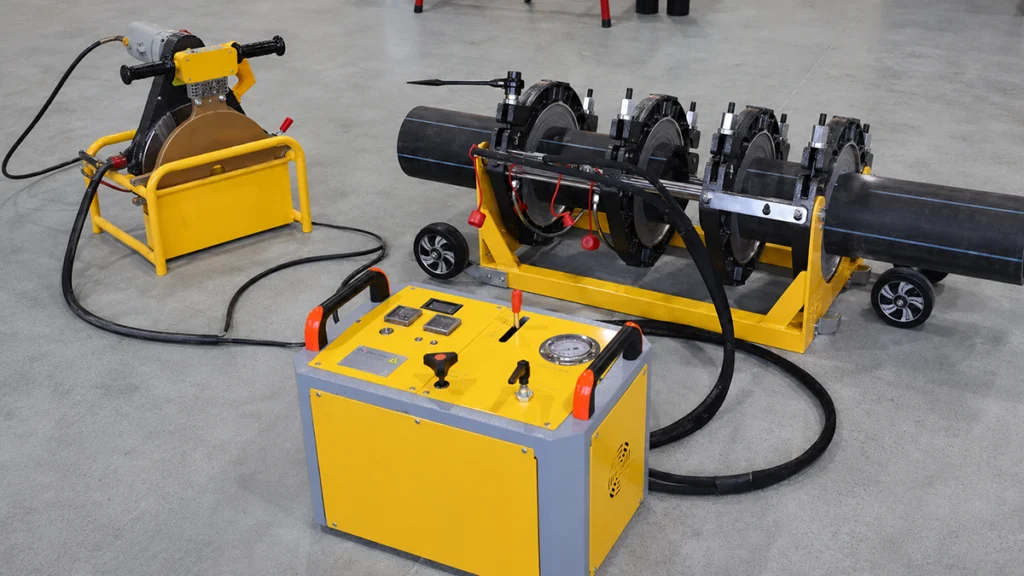
At its core, the process revolves around a pull-out heating plate. First, the butt fusion machine uses electric heat to melt the cleanly prepped pipe ends to a very specific depth. Right when the plastic hits that perfect melting point, the operator—or the automated CNC system—quickly pulls the heating plate out of the way. Next comes the pressure. Hydraulic or pneumatic forces push the molten ends together, locking them under constant pressure until the newly formed joint cools and solidifies.
Main machine components
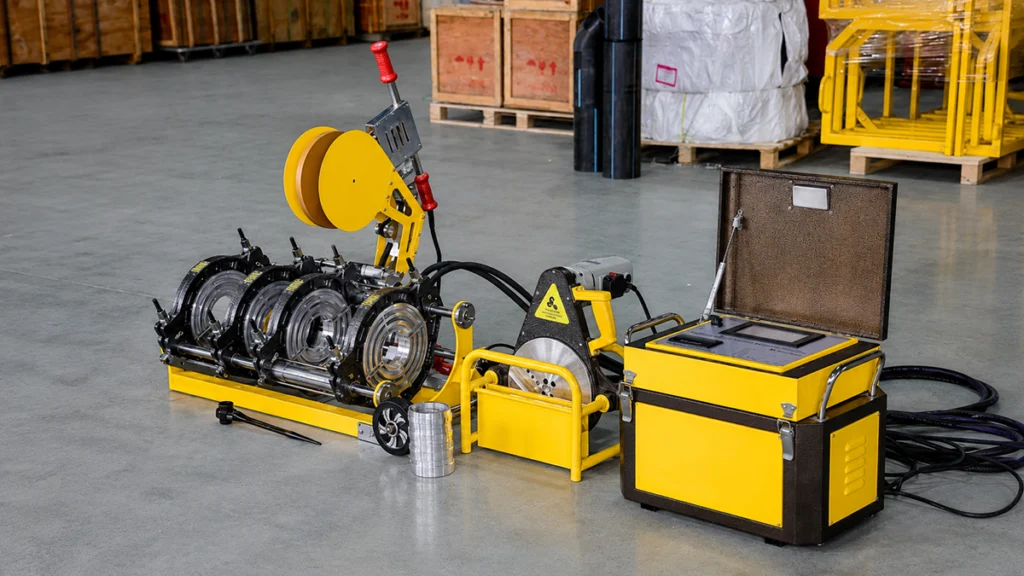
A standard commercial setup packs several highly engineered parts. You start with the frame, which firmly grips and aligns the pipes. Then there’s the milling cutter. Usually driven by a 750W to 1100W motor, this tool shaves the pipe ends so they sit perfectly flat against one another. The real heavy lifter is the heating plate, pulling anywhere from 1600W to 2550W to deliver intense thermal energy. Tying it all together is a hydraulic control box and a three-phase solid-state relay, keeping the temperature dead-accurate across the entire plate.
Compatible pipe materials and standards
Manufacturers design these rigs specifically for HDPE and MDPE (medium-density polyethylene). For HDPE, operators generally aim for a heating plate temperature of 210±10°C. Thin-walled pipes need heat closer to that upper limit, while thicker walls perform better at the lower end. To keep everything up to code, global standards like ISO 21307, DVS 2207-1, and ASTM F2620 step in. They map out the exact temperature, pressure, and cooling times you need to sign off on a certified, field-ready weld.
Why HDPE is widely used in Brazilian field conditions
Walk onto almost any major infrastructure site in Brazil, and you will see HDPE. It dominates the market thanks to its incredible plasticity, straightforward weldability, and stubborn resistance to corrosion. Underground networks face aggressive soils and harsh chemical exposure, but HDPE handles these threats permanently. Plus, its natural flexibility absorbs ground shifts and seismic stresses that would easily crack rigid steel or PVC lines.
Why HDPE Welding Matters for Irrigation, Mining, and Water Projects in Brazil
Sourcing top-tier welding equipment in Brazil isn’t just a purchasing task; it is a major risk-management strategy. A pipeline stretching for kilometers is only as reliable as its weakest joint.
Operational risks of poor weld quality
Lose control over your pressure, heat, or timing during fusion, and the weld will fail. It really is that simple. In high-pressure water or slurry lines, a busted joint triggers catastrophic leaks, environmental hazards, and total operational shutdowns. You are then looking at massive pipe replacement bills. While mechanical joints have their place, they simply cannot match the continuous, leak-proof guarantee of a perfectly executed thermal fusion weld.
Climate, terrain, and distance as selection factors
Field conditions across Brazil change drastically. Down in the windy, humid, or colder southern regions, operators have to bump up heating temperatures to offset rapid heat loss when pulling the plate. Geography plays a huge role, too. Remote projects demand rugged butt fusion welding machines that can survive brutal transport over unpaved dirt roads. You need equipment that runs flawlessly when the nearest repair shop is hundreds of miles away.
Butt fusion for large-diameter field work
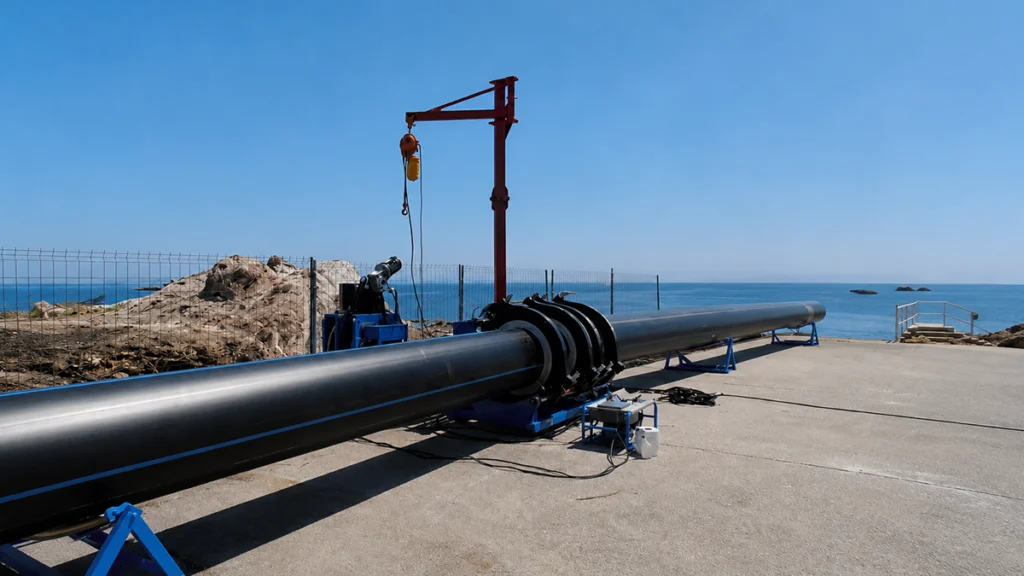
When dealing with massive 710mm to 1000mm pipes in heavy industry, butt fusion is non-negotiable. This technique delivers maximum joint strength and unbeatable sealing, which is crucial for high-stress mining environments. Deploying a heavy-duty butt fusion machine guarantees the final pipeline can push harsh, abrasive slurries day after day without eating away at the joints.
Electrofusion and socket fusion in smaller or restricted jobs
Socket fusion works well, but only if you stick to diameters under 90mm and hold a steady 220°C. Electrofusion steps in for the tricky stuff: gas lines, emergency fixes, and cramped trench-crossings where dropping a bulky hydraulic frame just isn’t physically possible. Instead of a heating plate, electrofusion uses special fittings packed with embedded coils that melt the plastic directly from the inside out.
Factory-direct pricing with technical consultation included
Get Your Free QuoteMain Types of HDPE Pipe Welding Machines and Fusion Methods
Choosing the right pipe fusion machine format dictates both how fast you build the pipeline and how long it actually lasts.
Manual, semi-automatic, and hydraulic machine formats
Manual butt fusion machines operate via a basic hand-crank. They are cheap, but they open the door wide to operator error and misalignment on bigger pipes because human strength can only clamp so hard. Semi-automatic hydraulic models step it up by automating pressure application and plate insertion, though the operator still handles step transitions. Need absolute precision? Fully automatic CNC machines program the parameters, lift the hot plate on their own, and log continuous drag pressure. Human error essentially vanishes.
How large-diameter and small-diameter projects differ
You can tackle small-diameter pipes with manual tools or lightweight semi-automatics. But once you cross the 315mm threshold, heavy-duty hydraulic frames become mandatory. Think about the sheer weight of a 710mm pipe. You need massive hydraulic clamps just to pull the pipe into perfect axial alignment. A human operator simply cannot generate enough physical force to overcome that kind of drag resistance.
Irrigation networks and farm water distribution
HDPE pipes are widely used in agricultural irrigation because they are flexible, corrosion-resistant, and suitable for long-distance water distribution. Pipe diameters vary according to flow rate, pressure, field size, and system layout.
For smaller pipes and occasional repairs, manual butt fusion machines may be sufficient. Hydraulic butt fusion machines are generally more suitable for regular farm pipeline installation and medium-diameter irrigation mains because they provide more consistent pressure control and higher productivity. Automatic CNC butt fusion machines may be selected when the project requires welding records, repeatable parameter control, or greater process traceability.
Mining slurry and dewatering lines
Mining slurry and dewatering pipelines often operate in abrasive environments and may involve large pipe diameters, high flow rates, changing site conditions, and demanding installation schedules. Hydraulic butt fusion machines are commonly used because they provide controlled carriage movement and stable fusion pressure for medium- and large-diameter HDPE pipes.
Automatic CNC machines may be selected when a project requires repeatable welding parameters, digital weld records, and greater process traceability. The final machine choice should be based on pipe diameter, SDR, welding volume, site access, power supply, and the applicable project welding procedure.
| Machine Type | Best Application | Automation Level | Data Logging | Investment Level |
|---|---|---|---|---|
| Manual Butt Fusion Machine | Small-diameter pipes, repairs, irrigation, and occasional welding | Manual carriage and joining-force control | Usually manual welding records | Lower |
| Hydraulic Butt Fusion Machine | Municipal water, mining, drainage, industrial, and infrastructure pipelines | Hydraulic carriage movement and fusion-pressure control | Manual or optional digital records | Medium to high |
| Automatic CNC Butt Fusion Machine | High-volume projects requiring repeatable parameters and weld traceability | Computerized control of selected welding stages | Automatic or optional digital logging | Higher |
| Electrofusion Machine | Repairs, tie-ins, confined spaces, and branch connections | Controlled electrical fusion cycle | Optional, depending on the model | Varies |
Actual pipe ranges, automation functions, data-recording capabilities, and investment levels vary by machine model, configuration, and project requirements.
Where HDPE Pipe Welding Machines Are Used in Brazilian Projects
Because HDPE is so adaptable, it has taken over multiple infrastructure sectors. Naturally, each environment demands a specific pipe fusion machine configuration.
Potable water and municipal systems
City water grids and gas lines run on HDPE. Municipal contractors usually bring in semi-automatic hydraulic rigs for medium-sized pipes ranging from 160mm to 315mm. These units hit the strict quality codes required by city engineers, yet they remain compact enough to navigate tight, congested street trenches.
Remote site projects that need portable equipment
Deep in the agribusiness sector or out on remote infrastructure builds, portability is everything. Field crews need plastic pipe welding machines built with reinforced frames and weather-sealed control boxes. Throw in heavy-duty wheels or track systems, and these units can push through thick mud and jagged terrain without knocking their sensitive calibration out of whack.
Pipe diameter range and wall thickness
Pipe dimensions dictate your butt fusion welding machine choice. Period. Standard models easily handle 160mm, 200mm, and 250mm lines, while heavy-duty beasts scale up to weld 710mm, 800mm, or even 1000mm pipes. Beyond diameter, the hydraulic system has to adapt to various wall thicknesses—anywhere from a thin 0.2mm up to a beefy 12.0mm. It must adjust the pressure profile perfectly to match the pipe’s Standard Dimension Ratio (SDR).
Voltage, power source, and generator compatibility
Out in the field, power logistics make or break the schedule. Procurement teams absolutely must check voltage compatibility—specifically whether the site supports 220V or 380V. While 220V is standard for smaller units, industrial butt fusion machines demand 380V three-phase power. When sizing a field generator, calculate the simultaneous draw of the heating plate (hitting up to 2550W) alongside the milling cutter (around 1100W). Always bake in at least a 20% power buffer to prevent tripped breakers.
Get detailed specs and custom configuration options
Request Technical SpecificationsTechnical Specifications to Check Before You Buy
Digging into the technical specs separates professional-grade pipeline hardware from cheap, unreliable knockoffs.
Heating plate, pressure control, and alignment features
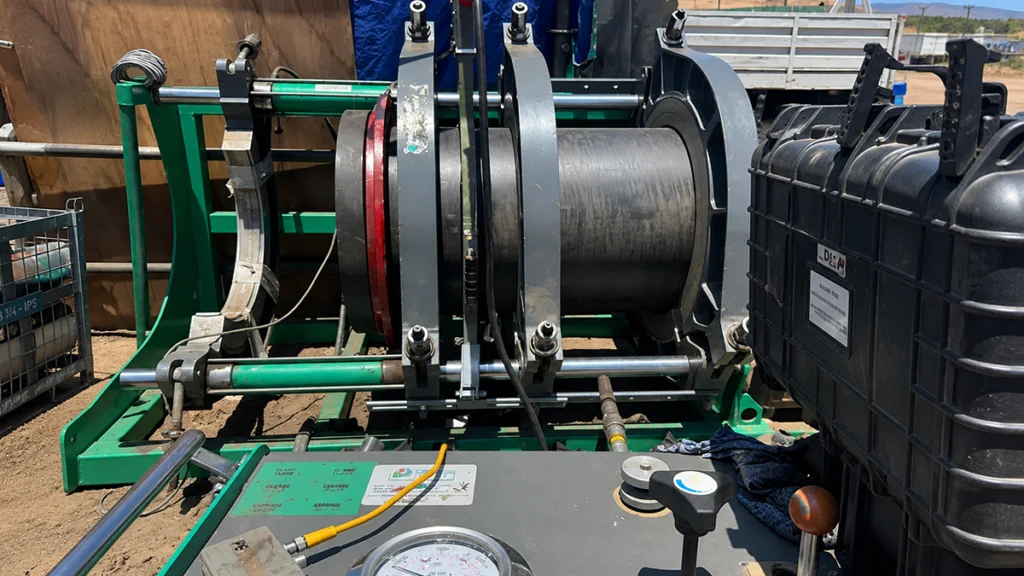
Look closely at the heating plate. It needs an independent temperature control system that locks in anywhere from 0 to 300°C. It also requires a high-grade PTFE (Teflon) coating so melting plastic doesn’t stick and ruin the weld. For pressure management, insist on a large, easy-to-read dial paired with a shockproof gauge. A built-in buffer adjustment valve is also crucial for capturing accurate drag pressure readings mid-cycle.
Accessories, clamps, and spare parts
You rarely weld just one pipe size, so a single butt fusion machine must adapt. This requires precision-machined inner clamp blocks—inserts that let a massive 250mm clamp securely grip a 160mm pipe. Check the milling cutter, too. It should run on high-speed carbon steel, utilizing double-edged, reversible blades. Driven by a tough chain mechanism, this ensures the pipe ends get a perfectly parallel shave every time.
Project factors procurement teams should compare first
Procurement managers need to look at the actual construction environment. Are crews working indoors, or are they battling the elements in the field? Is this a quick job or a continuous, 24/7 operation? Because different pipe batches and grades melt at slightly different rates, the pipe fusion machine’s control unit must allow operators to dial in micro-adjustments for both heat and pressure.
Site conditions and crew skill level
Buy equipment that matches your crew’s actual skill level. A fully automatic CNC butt fusion machine covers for a less experienced team by strictly locking down the fusion parameters. On the flip side, handing a manual butt fusion machine to a novice is asking for leaks; it takes a highly skilled operator to read the environment and perfectly time the heating and cooling cycles by hand.
How to Choose the Right Machine for Your Project
Getting the right equipment on-site is a balancing act. You have to weigh upfront capital costs against the long-term survival of the pipeline.
Buyer checklist before ordering
Do not issue a purchase order until you cross-check the following:
- The exact outer diameters (OD) and wall thicknesses (SDR) of your pipes.
- The specific welding codes you must meet (ISO, DVS, ASTM).
- Your site’s power capacity (220V single-phase versus 380V three-phase).
- Whether the client demands printed or digital data logging for the welds.
- The immediate availability of local spare parts.
When a comparison table helps narrow the options
For water supply projects, butt fusion and electrofusion serve different installation needs. Butt fusion is generally more economical for long, accessible pipeline runs, while electrofusion is useful for repairs, tie-ins, confined spaces, and locations where a butt fusion machine cannot be positioned. A comparison table can help buyers evaluate pipe diameter, site access, jointing speed, fitting cost, equipment requirements, and documentation needs.
Total cost beyond the machine price
Buyers should consider the total cost of ownership rather than only the machine price. Important factors include equipment configuration, reducing inserts, labour, power supply, maintenance, spare parts, training, fittings, and possible rework. Automatic CNC machines require a higher initial investment but may improve process consistency and simplify weld-data recording on projects that require greater traceability.
Shipping, customs, and local support lead time
When importing butt fusion equipment into Brazil, buyers should account for ocean freight, customs clearance, inland transport, import documentation, and local delivery. Suppliers should provide clear shipping terms, estimated lead times, packing details, spare-parts availability, and after-sales support. Final delivery schedules may vary depending on the destination, customs procedures, machine size, and transport method.
Cost, Lead Time, and Supplier Evaluation in Brazil
Solid commercial terms and fast after-sales support matter just as much as the steel and hydraulics of the machine itself.
Training, warranty, and spare parts questions
Never sign a purchase contract unless it clearly spells out the exact model, quantity, locked-in pricing, delivery dates, and after-sales guarantees. Push your supplier hard on two things: local spare parts and hands-on training. You can buy the most advanced CNC welder on the market, but without proper operator training, it will still churn out rejected joints.
When local service matters more than the lowest quote
Heavy industrial use eventually wears down even premium tools. Field crews regularly deal with burnt heating tubes, frayed wires, or blown hydraulic seals. Having local access to qualified technicians and niche parts—like thermocouples or aviation connectors—is an absolute lifesaver. Opting for the cheapest online quote usually backfires when your site shuts down for three weeks waiting on a single proprietary part from overseas.
Contamination and poor pipe alignment
When large-diameter welds fail, misalignment and sloppy clamping are usually the culprits. If your butt fusion machine’s frame is even slightly warped, or if the reducing clamps are poorly butt fusion machined, the pipe ends will never meet squarely. This creates an ugly, asymmetrical weld bead that is guaranteed to blow apart during pressure testing.
Temperature, pressure, and timing errors
Too much pressure, too little heat, or rushing the cooling phase—these are the fastest ways to ruin a joint. A high-quality HDPE pipe jointing machine naturally mitigates these risks. It delivers rock-solid, calibrated outputs, allowing the operator to trust the hardware entirely during the most sensitive stages of the fusion cycle.
Common Welding Mistakes and Quality Risks to Avoid
Reliable butt fusion joints depend on correct pipe preparation, alignment, heating, pressure control, changeover time, and cooling. Operators should follow the selected welding procedure and inspect each joint for visible defects, dimensional irregularities, contamination, and process interruptions.
Weld rejection and rework criteria
A joint should be reviewed or rejected when the welding cycle falls outside the permitted procedure limits, such as an interrupted heating stage, unstable pressure, excessive changeover time, contamination, misalignment, or abnormal bead formation. Rework requirements should follow the applicable project specification and welding procedure. Where a completed joint is rejected, the affected section is generally removed and welded again using properly prepared pipe ends.
Field inspection steps for higher reliability
Before welding, operators should confirm pipe cleanliness, machine condition, clamp alignment, heater-plate temperature, facer performance, drag pressure, and the required welding parameters. Pipe ends should be faced until continuous shavings are produced, then checked for full contact and acceptable alignment. During the cycle, heating, changeover, fusion pressure, and cooling time should be monitored and recorded where required.
Best-fit machine profile for each project type
Selecting the machine should be based on pipe diameter, SDR, welding volume, site access, documentation requirements, and available power supply. Manual machines may suit smaller pipes, repairs, and occasional irrigation work. Hydraulic machines are commonly used for regular municipal, agricultural, industrial, and mining pipelines. Automatic CNC machines may be preferred when projects require repeatable parameter control, digital weld records, and greater process traceability.
Information to prepare for a supplier inquiry
To receive an accurate recommendation and quotation, provide the pipe material, outside diameter range, SDR or wall thickness, expected welding volume, application, site conditions, power supply, required welding standard, automation level, data-recording needs, accessories, delivery destination, and preferred shipping terms. This information helps the supplier recommend a suitable machine configuration and calculate the total project cost more accurately.
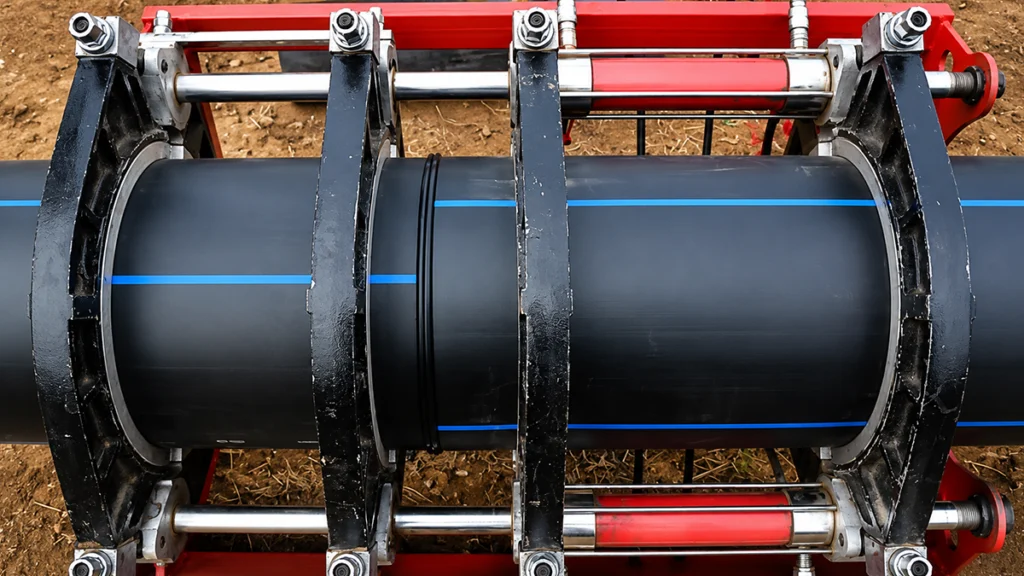
Final Recommendation for Buyers Planning Brazilian HDPE Projects
Success in pipeline construction comes down to mindset. Treat your welding machine as a core infrastructure asset, not just a disposable tool to be used and discarded.
Moving from shortlisting to quote request
When locking in your final equipment choice, look at the big picture. Build a matrix covering your technical needs, market research, and the supplier’s after-sales reach. Jumping at the lowest initial quote is a rookie mistake. Before signing off on procurement, verify that the supplier can instantly provide technical manuals, honor warranty claims, and dispatch spare parts directly within the country.
Frequently Asked Questions
Q1: What type of HDPE pipe welding machine is best for irrigation projects in Brazil?
The suitable machine depends on pipe diameter, SDR, welding volume, site access, and project documentation requirements. Manual machines may be sufficient for smaller pipes and occasional repairs, while hydraulic butt fusion machines are generally more practical for regular farm pipeline installation and medium-diameter irrigation mains. Automatic CNC machines may be selected when repeatable parameter control and digital weld records are required.
Q2: Can one HDPE welding machine handle different pipe diameters?
Yes. Many butt fusion machines use interchangeable reducing inserts to accommodate several pipe diameters within the machine’s rated range. For example, a 315 mm model may also weld smaller sizes when the correct inserts are installed. Buyers should confirm the complete welding range and included inserts with the supplier.
Q3: What voltage do HDPE pipe welding machines use in Brazil?
Voltage requirements vary by machine size and configuration. Smaller machines may use single-phase power, while larger hydraulic or CNC models may require three-phase power. Because available voltage can differ by location and industrial facility in Brazil, buyers should confirm the site voltage, phase, frequency, plug type, and generator capacity before ordering.
Q4: Is butt fusion better than electrofusion for mining pipelines?
Butt fusion is commonly used for long, accessible mining pipelines because it does not require a separate fitting at every straight joint. Electrofusion is useful for repairs, tie-ins, confined spaces, branch connections, and locations where butt fusion equipment cannot be positioned. The better method depends on pipe diameter, site access, joint design, installation schedule, and project requirements.
Q5: How much does an HDPE pipe welding machine cost in Brazil?
The price depends on welding range, manual, hydraulic, or CNC configuration, reducing inserts, power supply, data-recording functions, accessories, warranty, freight, import duties, and local delivery. Buyers should request a model-specific EXW, FOB, or landed-cost quotation rather than rely on fixed online price ranges.
Q6: What should I check before buying from an overseas supplier?
Confirm the machine’s rated pipe range, power requirements, heater temperature control, hydraulic performance, included accessories, technical documentation, warranty, training, spare-parts availability, and after-sales support. ISO 12176-1 relates to performance requirements for PE butt fusion equipment, while ISO 21307 covers butt fusion procedures rather than serving as a general supplier certificate.
Q7: How do I know if a welded HDPE joint is strong enough for water projects?
The joint should be evaluated according to the approved welding procedure and project inspection requirements. Operators should review pipe preparation, alignment, heating, changeover time, fusion pressure, cooling time, and bead appearance. A digital data log can support traceability, but it does not replace visual inspection, operator qualification, or any required testing.
Q8: What maintenance does an HDPE pipe welding machine need?
Routine maintenance includes cleaning the heater plate with approved non-abrasive materials, checking facer blades, clamps, guide rails, cables, hydraulic hoses, fluid levels, seals, pressure gauges, and temperature controls. Calibration and replacement intervals should follow the manufacturer’s maintenance schedule and the project’s quality requirements.
Conclusion
Selecting the right HDPE pipe welding machine requires careful consideration of pipe diameter, SDR, welding volume, site conditions, power supply, documentation requirements, and total cost of ownership. Manual machines may suit smaller pipes and occasional work, while hydraulic machines are generally more practical for regular municipal, agricultural, industrial, and mining pipeline projects. Automatic CNC machines may be preferred when repeatable parameter control and digital weld records are required.
Buyers should also evaluate heater temperature control, hydraulic performance, machine configuration, calibration, spare-parts availability, operator training, warranty, and after-sales support. Matching the equipment to the project requirements and the crew’s operating capability can improve welding consistency, reduce avoidable rework, and support reliable long-term pipeline performance.
Need help selecting the right HDPE pipe welding machine for your project?
Request a Machine Recommendation