
HDPE Pipe Welding Machine Production and Delivery Guide
Table of Contents
Introduction
If an HDPE pipe welding machine arrives on site just two weeks late, the financial bleeding starts immediately. For a pipeline contractor, idle crews and missed connection penalties can easily rack up costs exceeding $15,000. For procurement managers handling infrastructure projects, the lead time for butt fusion equipment is often just as critical as the hydraulic pressure specs. While factory-direct pricing is incredibly attractive, failing to account for the intricate manufacturing lifecycle—from chassis casting to CNC calibration—can derail a project schedule before the first pipe is even fused.
This guide breaks down the granular stages of the production timeline, the specific impact of customization on delivery dates, and the logistical realities of shipping heavy industrial machinery. We will navigate the trade-offs between immediate distributor availability and factory-direct savings, detailing how volume impacts the wholesale hdpe pipe welding machine price. By the end, you will have a clear framework to calculate accurate lead times and select the right equipment for DN160–DN1200 HDPE projects without compromising your critical path.

—
Anatomy of the Production Timeline: What Happens After You Order?
Understanding the manufacturing lifecycle is the first step in accurate project planning. A high-quality butt fusion machine isn’t simply pulled off a shelf; it is a precision instrument that undergoes rigorous assembly and testing.
The Manufacturing Phases of a CNC Butt Fusion Machine
Producing an Ekberg hydraulic automatic welder follows a strict sequence designed to ensure structural integrity and welding precision. Once an order is confirmed, the clock starts on Component Sourcing (Days 1-5). While we stock standard steel and aluminum, specialized hydraulic seals and specific PLC units often require just-in-time retrieval from upstream suppliers.
Following sourcing, the Chassis Casting and Machining phase (Days 5-12) begins. This involves casting the main butt fusion machine body and clamps from high-strength aluminum alloys, followed by precision CNC milling. This step is non-negotiable; clamp alignment must remain within a <0.5mm tolerance to ensure accurate pipe butt alignment. Finally, Assembly (Days 12-15) integrates the hydraulic circuit with the electrical control systems.
Sourcing Critical Components
Lead times are frequently dictated by the availability of sub-components. For an automatic butt fusion machine, the most time-sensitive parts are often the hydraulic seals and electronic control modules. High-performance seals, essential for maintaining fusion pressures up to 16 MPa (160 bar) without leakage, are often imported to ensure longevity.
Similarly, the aluminum heating plates require a specialized industrial-grade PTFE (Teflon) coating process. This coating must be applied and cured at specific temperatures to ensure non-stick performance at operating ranges of 200–230°C. If a batch of heating plates is currently in the curing oven, a rush order cannot speed up the chemical bonding process without risking coating failure in the field.
The “Burn-in” Testing Phase
Speed should never compromise the “Burn-in” testing phase. Before crating, every automatic hdpe pipe welding machine undergoes a mandatory calibration and stress test period, typically lasting 48 to 72 hours. This includes software logic checks to verify the CNC system correctly calculates parameters based on ISO 21307 standards.
Technicians perform temperature stability tests to ensure the heating plate maintains ±3°C precision across the entire surface. Furthermore, the hydraulic system is subjected to a 24-hour pressure holding test to detect any micro-leaks in the quick-connect fittings or cylinders. Skipping this phase to save a few days is the primary cause of “dead-on-arrival” equipment.
Production Complexity: DN160 vs. DN1200
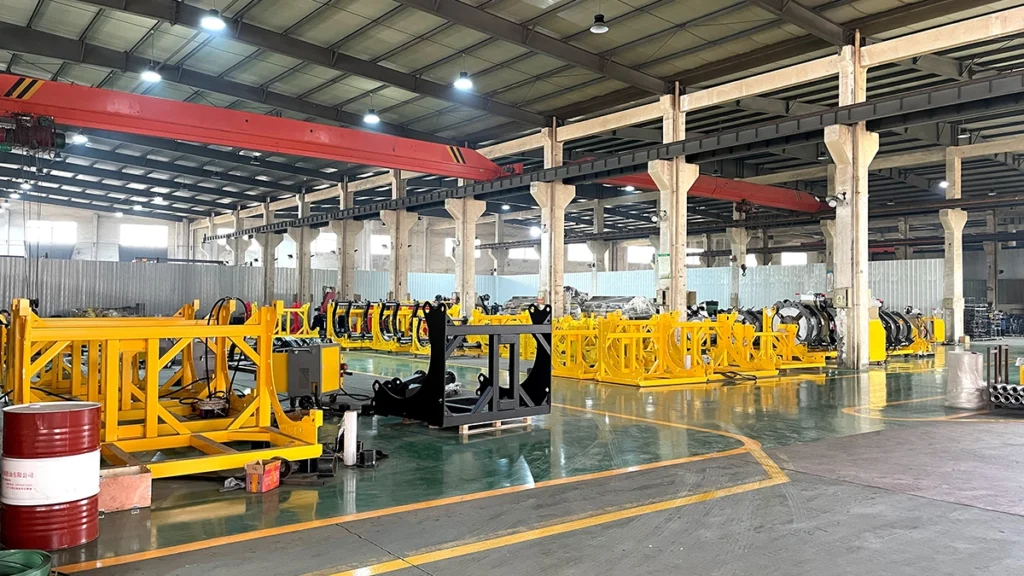
The physical scale of the hdpe pipe welding machine drastically alters production velocity. A standard 160mm automatic welder is a high-turnover item with streamlined assembly lines, allowing for a turnaround of 10–15 days.
In contrast, a large-scale 1200mm automatic welder requires significantly more labor and time. The chassis casting for a DN1200 unit is massive, requiring longer cooling times to prevent warping. The hydraulic cylinders are larger (up to 23,179 mm² cylinder area), requiring more complex oil circuit purging and pressure testing. Consequently, buyers should anticipate a 20–25 day production window for large-diameter hdpe pipe welding machines, exclusive of shipping.
—
Key Factors Influencing Lead Times for Automatic Pipe Welding Machines
Beyond standard assembly, external variables and specific buyer requirements can expand the delivery window. Smart procurement involves anticipating these delays.
Impact of Customization Requirements
Customization is the single largest internal factor extending lead times. While standard units operate on 380V/50Hz (3-phase), many international projects require modifications. Converting a hdpe fusion machine to 380V/60Hz for markets like Saudi Arabia or the Philippines involves sourcing non-standard motors and transformers, adding 7–10 days to the timeline.
Similarly, OEM branding requests—where a distributor requires butt fusion machines painted in their corporate colors with private labeling—disrupt the standard painting batch schedule. This can add 5–7 days as the chassis must be pulled from the standard line, stripped, and refinished to specific RAL color codes.
Bulk Orders and Container Logic
The size of the order fundamentally changes logistics. The bulk order automatic hdpe pipe welding machine cost is generally lower, but it requires synchronization of production. If a buyer orders a Full Container Load (FCL) of 40 mixed units, the shipment cannot leave until the last machine is tested and crated. This means the lead time is dictated by the slowest-to-produce unit in the batch. However, FCL shipping is significantly safer and more cost-effective than Less-than-Container Load (LCL) shipping, which involves consolidation warehouses and multiple handling points, increasing the risk of damage and adding 5-7 days to transit time.
Raw Material Supply Chain Fluctuations
The price and availability of raw materials—specifically aluminum for the clamps and copper for electric motors—fluctuate seasonally. During periods of high global demand or supply chain constriction, factory throughput can slow down as manufacturers wait for raw aluminum billets. While Ekberg Welding maintains a strategic buffer of raw materials, severe market shortages can occasionally force production pauses. Procurement managers should be aware that “Just-in-Time” manufacturing models are susceptible to these upstream ripples.
The “Chinese New Year” Effect
For any equipment sourced from global manufacturing hubs in Asia, the Lunar New Year (CNY) is a critical blackout period. Factories typically close for 2–3 weeks, but the disruption extends for a month on either side. In the weeks leading up to the holiday, the “pre-CNY rush” causes congestion at ports and factories, often delaying automatic hdpe pipe welding machine shipments. Post-holiday, factories take time to ramp back up to full capacity as workers return. Ordering in late January or February without accounting for this can result in delays of 4–6 weeks.
—
Sourcing Strategy: Wholesale vs. Factory Direct vs. Distributor Stock
Balancing budget constraints with project deadlines requires a strategic approach to sourcing. The wholesale HDPE pipe welding machine price is attractive, but it comes with the “cost” of time.
Distributor vs. Factory Direct: The Trade-off
Buying from a local distributor offers the ultimate speed advantage: immediate availability. If a butt fusion welding machine fails on a job site, a distributor can often ship a replacement overnight. However, this convenience commands a premium, often 30–50% higher than factory-direct pricing. Sourcing directly from the factory unlocks the lowest possible price but necessitates a 15-day production wait plus shipping time. For planned inventory replenishment, factory direct is the logical financial choice. For emergency replacements, the distributor premium is a necessary operational cost.
Volume Pricing and Unit Costs
The automatic hdpe pipe welding machine price per unit is highly sensitive to order volume. Manufacturers prefer continuous production runs. An order for a single unit disrupts this flow, whereas an order for 20+ units allows for batch casting and assembly. Consequently, buyers purchasing in tiers of 20+ units can negotiate significant discounts (often 10-15%) compared to the 1-5 unit tier. Furthermore, the fixed costs of export documentation and local handling are amortized over more units, further reducing the landed cost per machine.
Minimum Order Quantities (MOQ) and Prioritization
A common concern for smaller contractors is the hdpe pipe welding machine price with low MOQ. Does a small order get pushed to the back of the queue? At reputable butt fusion machine manufacturers like Ekberg, production slots are generally allocated on a first-come, first-served basis. However, low MOQ orders (1-2 units) are often grouped with larger batches to maximize efficiency. While this doesn’t usually delay production, it can affect shipping. A single machine must be shipped via LCL or air freight, which is disproportionately expensive. Buyers of single units should ask about “piggybacking” their order onto a larger shipment to a regional hub if possible.
Sourcing Decision Matrix
| Factor | Factory Direct (Custom Order) | Factory Stock (Standard Model) | Local Distributor |
|---|---|---|---|
| Lead Time | 10-20 Days + Shipping | 3-5 Days + Shipping | Immediate – 2 Days |
| Price Point | Lowest (Wholesale) | Low | High (Retail Premium) |
| Customization | Full (Voltage, Color, OEM) | None (Standard Specs) | None |
| Min. Order | Low MOQ available | Low MOQ available | Single Unit |
| Best For | Planned Fleet Expansion | Urgent Restocking | Emergency Replacement |
—
Logistics and Shipping: The Final Leg of Lead Time
Once the hdpe pipe welding machine leaves the factory floor, logistics become the primary variable. This is the “final leg” where delays often occur if not actively managed.
Air Freight vs. Sea Freight
The mode of transport is a stark trade-off between cost and speed.
- Sea Freight: The standard for industrial machinery. Transit times range from 25–35 days to the US West Coast and 35–45 days to Europe. It is cost-effective but slow.
- Air Freight: While technically possible, air freighting a 300kg hdpe pipe welding machine is prohibitively expensive, often costing as much as the machine itself. It is reserved exclusively for “project-critical” emergencies where downtime costs exceed $10,000/day.
- Rail Freight: For European buyers, the China-Europe Railway Express offers a middle ground, with transit times of 18–25 days at a cost lower than air but higher than sea.
Expedited vs. Consolidated Shipping
For buyers needing a wholesale automatic butt fusion machine price, consolidation is key. Consolidating multiple orders into a single container prevents damage associated with LCL shipments, where goods are handled multiple times. However, consolidation requires waiting until the container is full. For urgent pipeline repairs, expedited LCL or direct courier (for smaller 160mm hydraulic butt fusion machines) cuts out the consolidation wait time but increases risk and cost. A cost-benefit analysis usually favors expedited shipping only when liquidated damages for project delays are in play.
Documentation and Customs Compliance
Nothing halts a shipment faster than incorrect paperwork. Customs delays can add 5–15 days to lead times. Essential documents include the Commercial Invoice, Packing List, and Bill of Lading. Crucially, the HS Code must be accurate to avoid re-classification delays. For European imports, a valid CE Declaration of Conformity is mandatory. Without it, the equipment may be seized at the border. Ekberg Welding ensures all documentation is pre-validated to prevent these bureaucratic bottlenecks.
Packaging for Survival
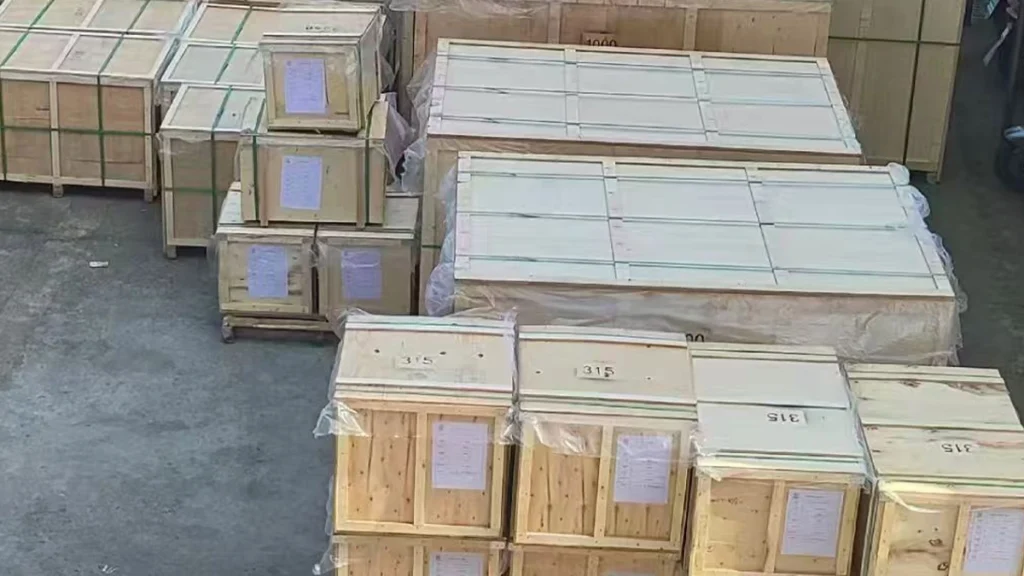
Proper packaging is a logistics necessity, not just a detail. HDPE pipe welding machines must be secured in fumigated wooden crates compliant with ISPM 15 standards to clear international customs. Inside, the butt fusion welding machine requires anti-rust oil on machined surfaces and vacuum-sealed control units to survive the humidity of ocean transit. Poor packaging leads to corrosion or impact damage, resulting in return-logistics delays that can take months to resolve.
—
Ekberg Welding’s Manufacturing Capability & Global Support
At Ekberg Welding, we bridge the gap between mass-production speed and engineering precision. Our facility is designed to support global infrastructure projects with reliable timelines.
Factory Capacity and Throughput
Our manufacturing plant operates multiple dedicated production lines for butt fusion equipment. We separate small-diameter (DN160–DN630) assembly from heavy-duty (DN1000–DN2600) fabrication to prevent bottlenecks. This allows us to maintain a steady monthly output of over 500 units. By decoupling these lines, a complex order for a custom 1000mm hydraulic butt fusion machine does not impede the rapid assembly of standard 250mm units, ensuring consistent lead times across our product range.
Strategic Inventory for Maintenance
We understand that an automatic hdpe pipe welding machine is only useful if it is operational. To support this, Ekberg maintains a “Ready-to-Ship” inventory of critical consumables and spare parts. Replacement heating plates, facing tool blades, and hydraulic inserts are stocked for immediate 24-hour dispatch via DHL or FedEx. This inventory strategy ensures that while a new machine may take weeks to arrive, the parts needed to keep existing fleets running are never more than a few days away.
Quality Systems: Speed with Standards
Our commitment to speed never supersedes our adherence to standards. We operate under an ISO 9001 Quality Management System. Every welder we produce is verified against DVS 2207 and ISO 21307 welding parameters. This means that even during “Rush Order” protocols—where we accelerate production for emergency infrastructure repair projects—the 48-hour burn-in and pressure testing phases remain non-negotiable. We deliver compliant equipment, not just fast equipment.
—
Buyer’s Checklist: How to Plan Procurement to Avoid Delays
To secure your hdpe pipe welding machine on time, you must work backward from your project start date. Use this checklist to build a realistic procurement timeline.
The Backward Timeline Calculation
Do not guess your order date. Calculate it:
1. Project Start Date: [Date]
2. Minus Shipping Buffer: (e.g., 40 days for Sea Freight + 5 days for Port Handling)
3. Minus Customs Clearance: (5 days)
4. Minus Production Time: (15 days for standard, 25 for large/custom)
5. = Latest Order Date
*Note: Always add a 7-day “contingency buffer” for unforeseen weather or customs inspection delays.*
Specifying Requirements in the RFQ
Ambiguity causes delays. When submitting a Request for Quote (RFQ), be explicit to avoid weeks of back-and-forth clarification.
- Voltage: Specify clearly (e.g., “380V 50Hz 3-Phase”).
- Standard: State the required welding standard (ISO 21307 High Pressure vs. Low Pressure).
- Plug Type: Send a photo of your site’s standard industrial socket.
- Data Logging: Confirm if ISO 12176 data recording is required.
The “Critical Spares Kit” Strategy
The best way to avoid downtime waiting for parts is to have them on hand *before* they break. We strongly recommend ordering a “Critical Spares Kit” with every butt fusion welding machine purchase. This kit should include a spare heating plate, a set of facer blades, and a hydraulic seal kit. Having these items in your site container eliminates the shipping lead time entirely for the most common maintenance issues.
—
Frequently Asked Questions
Q1: What is the standard production lead time for a single hdpe pipe welding machine?
For standard models (DN160–DN315mm) with standard voltage (380V), the production lead time is typically 10–15 working days. Larger models (DN630mm+) or custom configurations require 20–25 working days. This timeframe covers assembly, CNC calibration, and the mandatory 48-hour burn-in quality testing. Shipping time is calculated separately based on your location and freight method.
Q2: How does requesting a private label (OEM) affect the delivery schedule?
Requesting OEM customization, such as specific paint colors or branded control panels, typically adds 5–7 working days to the production timeline. This additional time is necessary to pull the chassis from the standard line, strip it, apply your specific RAL color coating, and print custom faceplates. It requires batch scheduling, which prevents “off-the-shelf” speed.
Q3: Can I get a better wholesale automatic hdpe pipe welding machine price if I agree to a longer lead time?
Generally, yes. By placing a forward order with a longer lead time (e.g., 60-90 days), you allow the factory to optimize material sourcing and production scheduling. This flexibility can often be leveraged to negotiate a better wholesale automatic hdpe pipe welding machine price, particularly for bulk orders where the manufacturer can plan raw material purchases during low-cost windows.
Q4: What are the shipping options for urgent low MOQ orders of small hdpe welding machines?
For urgent low MOQ orders (1-2 units) of smaller butt fusion machines like the DN160, air freight is the fastest option (5-7 days) but is expensive. A middle-ground solution for some regions is LCL (Less-than-Container Load) sea freight, but this takes longer due to consolidation. For European clients, rail freight offers a balance of speed (18-25 days) and cost efficiency.
Q5: Does the factory keep stock of standard models like the 160mm or 315mm automatic butt welders?
Yes, Ekberg Welding maintains a buffer stock of standard configuration models (380V/50Hz, red/black chassis) for popular sizes like 160mm, 250mm, and 315mm. These “Ready-to-Ship” units can often be dispatched within 3-5 days after voltage verification and final testing. However, stock levels fluctuate, so always confirm availability before committing to a project start date.
—
Conclusion
Successfully procuring an hdpe pipe welding machine is an exercise in balancing production speed, technical compliance, and logistical reality. While the temptation to prioritize the fastest delivery is understandable, bypassing critical quality assurance steps like burn-in testing or proper crating can lead to disastrous equipment failures in the field. The most successful contractors are those who plan backward from their project start date, accounting for the 15-25 day production cycle and the realities of global freight.
By engaging with the manufacturer early, you not only secure your production slot but also position yourself to negotiate the best possible terms. Whether you need a single unit for an urgent repair or a container load for a new pipeline, clarity and timing are your best assets.
Contact Ekberg Welding today to discuss your project timeline and request a quote with estimated lead times for your specific automatic welding machine requirements.