
Essential Butt Fusion Machine Features for Contractors
Table of Contents
Introduction
Choosing the wrong butt fusion machines for critical infrastructure projects isn’t just a minor oversight—it’s a liability. A single failed DN400 joint can cost a contractor upwards of $15,000 in excavation rework, liquidated damages, and severe reputational hits. These hydraulic units act as the technological backbone for modern HDPE pipeline installations, powering everything from municipal water distribution to high-pressure mining slurry lines.
However, the market is currently saturated with equipment that struggles to hold consistent welding pressure or maintain stable heating plate temperatures. The result? Joint failures that remain invisible until the pipeline is pressurized.
This guide cuts through the marketing noise to highlight the specific engineering features that separate reliable machinery from liability risks. We will cover hydraulic precision under ISO 21307, the critical role of PID temperature control, and why data logging is becoming non-negotiable for utility compliance. By the end, you will have a decision-oriented framework to select the right equipment for DN63–DN2600 HDPE pipe projects, helping you avoid costly specification mistakes.

Hydraulic Power & Pressure Control Systems
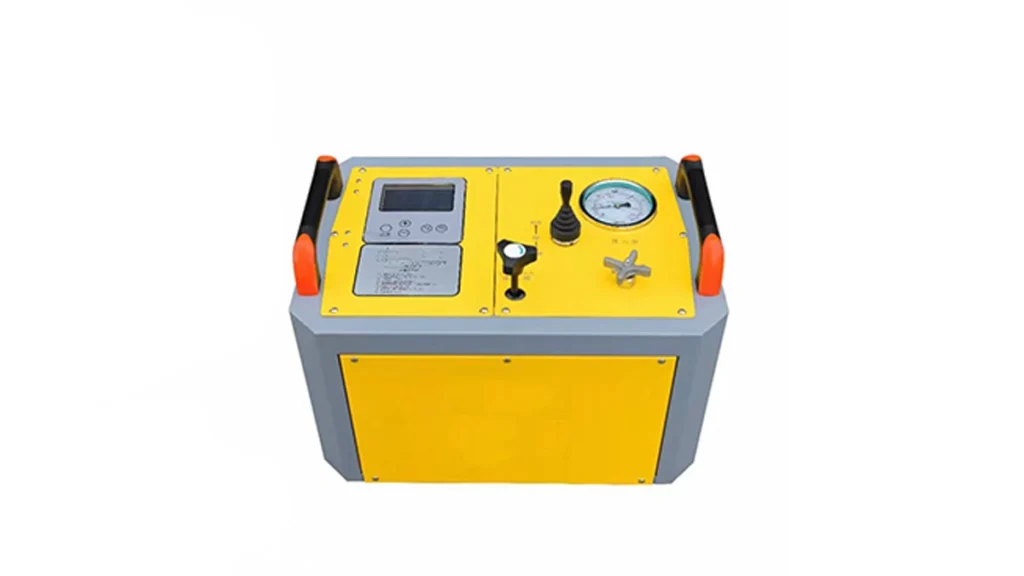
The hydraulic unit is the heartbeat of any fusion operation. Its job goes beyond simply moving clamps; it must maintain specific interfacial pressures with absolute stability during the critical heating and cooling cycles.
Research precision requirements for hydraulic units in butt fusion machines
For a weld to comply with DVS 2207 or ISO 21307 standards, the butt fusion welding machine must sustain a specific interfacial pressure—often 0.15 N/mm² for low pressure or up to 0.52 N/mm² for high-pressure ASTM F2620 applications—throughout the cooling phase. Depending on the pipe size, this phase can last anywhere from 10 minutes to over an hour for large mains like DN630 SDR 11.
A premium hydraulic unit must feature a heavy-duty accumulator. The accumulator keeps system pressure locked in during the static cooling phase without forcing the hydraulic pump to run continuously. Without one, the pump has to cycle on and off to maintain pressure, creating spikes and vibrations that can disturb the molten bead as it tries to crystallize. Contractors need systems capable of holding pressure with less than 5% deviation over the full cooling duration. If pressure drops during this window, voids or brittle spots form in the joint, inviting catastrophic failure during hydrostatic testing.
Compare analog pressure gauges vs. digital pressure sensors
Traditional analog gauges might be standard on entry-level gear, but they introduce significant risks in precision welding. They are prone to parallax errors—where the reading changes based on the angle you look at the needle—and vibration, making it nearly impossible for an operator to distinguish between 25 bar and 27 bar. in high-pressure scenarios, that margin of error can push a weld outside the acceptable process window.
Modern butt fusion machines equipped with digital pressure sensors offer resolution down to 0.01 MPa (0.1 bar). This precision is non-negotiable when calculating drag pressure—the force needed to move the carriage and pipe before the ends even touch. Drag pressure must be measured for every weld and added to the theoretical bead-up pressure. Digital readouts remove the guesswork, ensuring the force actually applied to the pipe ends matches the welding standard exactly.
Analyze the importance of leak-free hydraulic seals and quick-couplers
Field environments are brutal. Dusty mine sites, muddy trenches, and rain-soaked municipal works are the natural enemies of hydraulic systems. The integrity of your circuit depends entirely on the quality of the seals and couplers.
Contractors should insist on butt fusion welding machines using flat-face quick couplings. Unlike standard poppet couplers, flat-face designs can be wiped clean before connection, stopping sand and grit from entering the hydraulic circuit. Contaminated oil is the number one killer of solenoid valves and cylinder seals. Furthermore, high-quality seals from reputable international suppliers ensure the HDPE pipe welding machine doesn’t suffer from “pressure droop.” A leaking seal forces the pump to re-engage constantly, disrupting the weld and potentially violating compliance standards.
Heating Plate and Facing Tool Performance
The quality of a fusion joint is determined chemically by the heating plate and mechanically prepared by the facing tool (trimmer). Shortcomings in either component will inevitably lead to rejected welds.
Investigate PTFE coating quality and temperature uniformity
The heating plate must bring pipe ends to a plastic state, typically between 200°C and 230°C for PE100 materials. The metric that matters here is temperature uniformity. ISO standards dictate that temperature deviation across the entire plate surface must not exceed ±5°C. Cheaply manufactured plates often suffer from “cold spots” near the edges or “hot spots” near the heating elements, causing uneven melt patterns and weak joints.
Equally critical is the non-stick coating. Premium plastic pipe welding machines utilize high-grade Daikin PTFE (Polytetrafluoroethylene) coatings. This double-layer protection is essential for preventing molten plastic from sticking to the heater plate during removal (changeover). If plastic sticks, it ruins the smooth surface of the pipe end, forcing the operator to restart the entire facing and heating process. Inferior generic coatings degrade rapidly, peeling off after a few hundred welds and leading to frequent, expensive replacements.
Evaluate safety mechanisms in the facing tool (trimmer)
The facing tool uses rotating blades to shave pipe ends flat and parallel. Without proper engineering, this component is a significant safety hazard. A mandatory feature for any professional setup is a micro-switch interlock system. This ensures the trimmer motor cannot engage unless the tool is properly seated in the butt fusion machine chassis. It prevents accidental activation while the hdpe fusion machine is open or while an operator is clearing shavings, drastically reducing the risk of severe injury.
From a cost perspective, examine the blade design. The best facing tools use reversible, double-edged blades made from High-Speed Steel (HSS). When one edge dulls after shaving abrasive HDPE or PP pipes, the operator can simply flip the blade to a fresh edge, effectively doubling the lifespan of the consumable.
Analyze temperature control electronics (PID vs. Thermostat)
Temperature stability is governed by the electronic controller. Older or budget hdpe welding machines often rely on simple bi-metallic thermostats that function on a crude on/off cycle. This leads to temperature swings of ±15°C or more—overshooting the target and then cooling too much before kicking back in.
Advanced butt fusion machines utilize PID (Proportional-Integral-Derivative) controllers. A PID algorithm continuously calculates the difference between the set point and the actual temperature, making micro-adjustments to power output. This results in a stable temperature profile that stays within ±2°C of the target, even when wind or cold weather tries to cool the plate. For contractors working in variable climates, PID control is essential for consistent compliance.
Structural Rigidity and Clamp Alignment
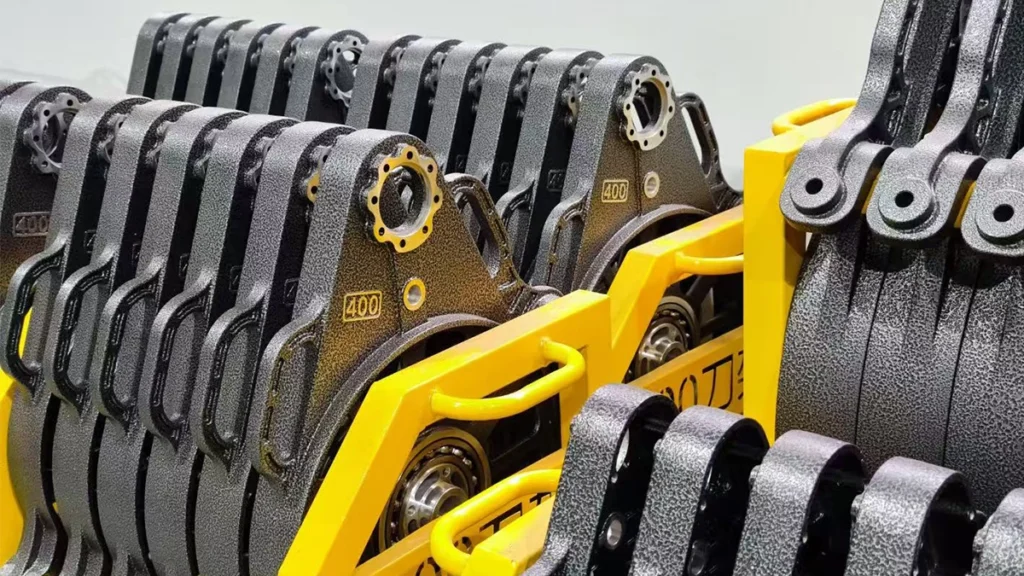
The butt fusion machine chassis must be rigid enough to withstand the high forces required to fuse thick-walled pipes (e.g., SDR 9 or SDR 7.4) without bowing. Chassis flex causes misalignment, resulting in a “high-low” joint where the pipe walls fail to match up perfectly.
Assess the impact of chassis material on field durability
The material used in the chassis dictates both portability and durability. For small to medium-range HDPE pipe welding machines (DN63 to DN630), high-pressure die-cast aluminum alloy is the standard. It offers an excellent strength-to-weight ratio, allowing a two-person crew to maneuver the unit in a trench while resisting corrosion in wet environments.
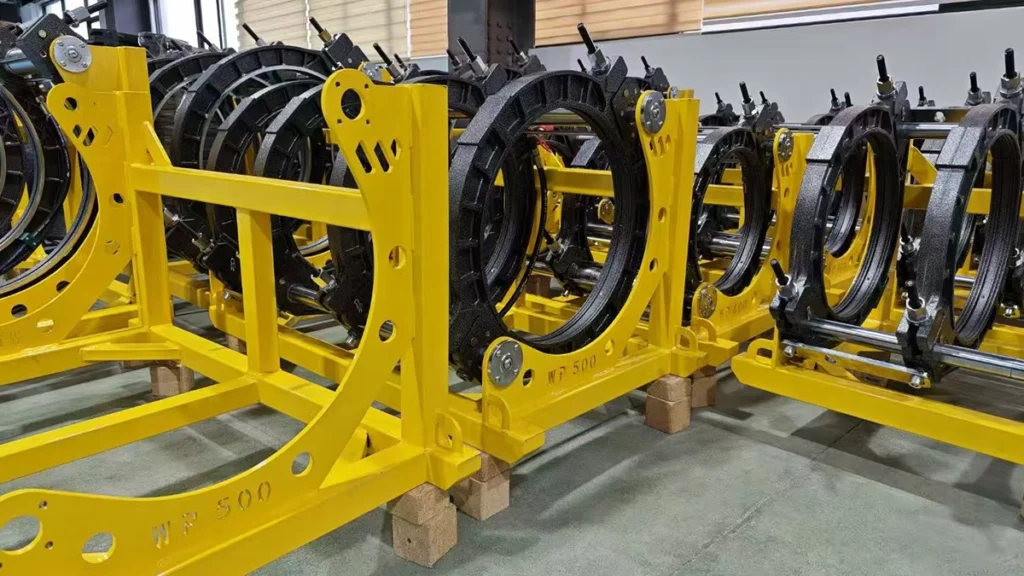
However, for large-scale butt fusion welding machines (DN1000 to DN2600), aluminum is often insufficient to handle the multi-ton drag and fusion forces. Heavy-duty butt fusion machines should feature a high-strength carbon steel frame, often utilizing a 4-column structure for maximum rigidity. While heavier, these steel frames ensure geometry remains true even under maximum hydraulic load, preventing ovality issues in the final weld.
Explain “High-Low” Misalignment Solutions
Pipe is rarely perfectly round, especially after being stored in stacks or coils. When clamping two pipe ends, vertical misalignment (High-Low) is a common issue that violates welding standards (typically limited to <10% of wall thickness).
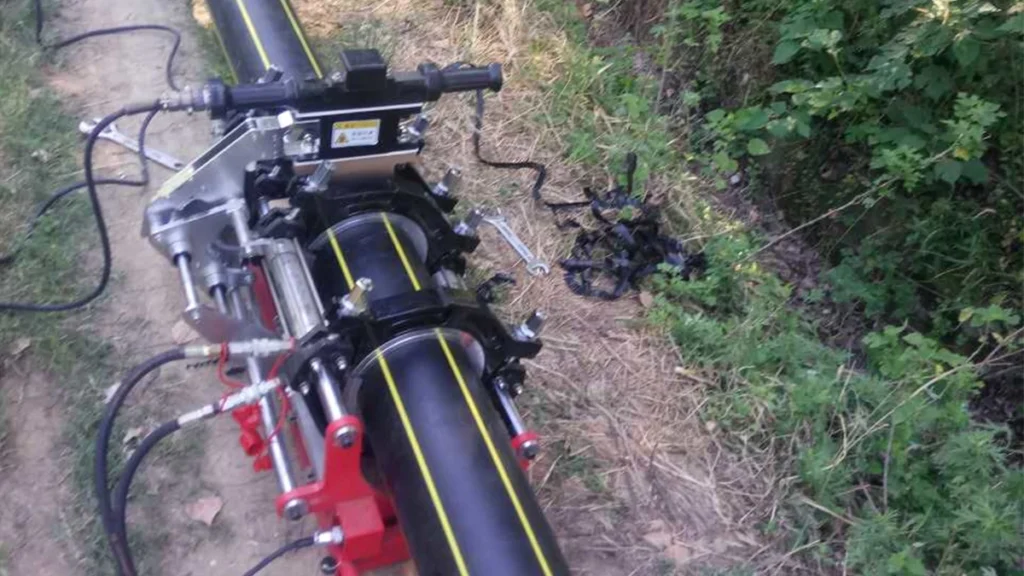
Top-tier butt fusion machines include mechanical alignment features that allow operators to adjust pipe position without releasing the clamps. Look for butt fsuion welding machines where the third clamp can be axially adjusted or where specific alignment knobs allow for vertical fine-tuning. Furthermore, the ability to detach or slide the third and fourth clamps is vital for welding fittings, elbows, and flanges. A fixed-clamp plastic pipe welding machine will struggle to hold short-neck fittings, severely limiting its utility on complex piping manifolds.
Research insert reduction capabilities and ease of change
Contractors rarely work with a single pipe diameter. A butt fusion machine rated for 315mm will frequently be used for 250mm, 200mm, or 160mm pipes using reduction inserts (liners). The design of these inserts impacts daily productivity.
Screw-in inserts are secure but slow to change, often taking 20-30 minutes to swap out a full set. Modern designs feature “quick-change” or clip-on inserts that can be swapped in under 5 minutes. While it seems like a minor detail, the cumulative time saved over a long project with frequent diameter changes translates into significant labor cost reductions.
Automation and Data Logging Capabilities
As infrastructure projects face tighter regulations, the “trust me, it’s welded” approach no longer flies. Utility companies and project owners now demand digital proof of quality.
Define ISO 12176 traceability standards for gas and water utilities
ISO 12176 standards govern the traceability of fusion equipment and operations. For gas distribution and municipal water contracts, it is increasingly mandatory to use butt fusion machines equipped with a Data Logger (LDU). This system records critical variables for every joint: operator ID, GPS location, ambient temperature, drag pressure, bead-up pressure, heat soak time, and cooling time.
Without this data, a contractor cannot prove a specific joint was welded to standard. If a leak occurs five years later, the data log serves as the contractor’s insurance policy, proving the weld was performed correctly and that the failure likely stems from ground shifting or material defects rather than workmanship.
Compare Semi-Automatic vs. CNC Automatic machines
- Semi-Automatic (Hydraulic): The operator manually controls hydraulic levers based on a printed parameter table. While effective, it introduces human error—an operator might cut the cooling time short to finish a shift early.
- Fully Automatic (CNC): Computer Numerical Control automatic butt fusion machines automate the entire pressure/time cycle. The operator scans the pipe barcode, and the machine calculates the parameters. Once the process starts, the CNC system controls the pressure and locks the machine during the cooling phase. It will not allow clamps to open until the full cooling time has elapsed, eliminating “short-cooling”—the number one cause of premature joint failure.
Review data retrieval and reporting formats
Data collection is useless if it’s trapped in the machine. Buyers should evaluate connectivity options. Modern units offer USB ports, WiFi, or Bluetooth connectivity. The most contractor-friendly butt fusion welding machines export encrypted reports directly to PDF or CSV formats without requiring proprietary, expensive software dongles. This allows site supervisors to email welding reports to the project engineer instantly at the end of the day, accelerating approval and payment.
Selection Checklist: Matching Butt Fusion Machine to Project Scope
Choosing the right hdpe pipe fusion machine requires balancing technical capability with project realities.
Create a sizing matrix for pipe diameters and SDR ratings
Avoid buying a machine that constantly operates at its maximum limit.
- Small Range (63-160mm): Ideal for house connections and small irrigation.
- Medium Range (90-250mm / 160-315mm): The workhorses for municipal water mains and industrial fire loops.
- Large Range (400-630mm+): Required for transmission mains and mining operations.
Note on SDR: Ensure the butt fusion machine has enough cylinder force to weld heavy-wall pipes (e.g., SDR 7 or SDR 9) at high-pressure standards (ASTM F2620). A hdpe pipe fusion machine designed only for low-pressure sewage pipe (SDR 26) will stall or fail to achieve fusion pressure on thick-wall high-pressure gas pipes.
Evaluate power requirements and generator compatibility
Power supply is a frequent source of onsite frustration.
- Voltage: Machines up to 315mm typically run on 220V single-phase. 355mm hydraulic butt fusion machine and larger usually require 380V/415V three-phase power.
- Generator Sizing: The generator must handle the peak load (heater + facer + pump startup). A general rule is to size the generator at 1.3x to 1.5x the machine’s total power rating.
- Example: A 315mm hydraulic butt fusion machine drawing 5.85kW needs a minimum 7.5 kVA generator. Undersized generators cause voltage drops that can fry the electronic controller or cause the heater to fail temperature validation.
Calculate Total Cost of Ownership (TCO)
The purchase price is just the entry fee. A cheap butt fusion welding machine that requires new seals every month, has a heater plate that peels in six months, and has zero resale value is far more expensive than a $4,000 unit that runs trouble-free for five years.
- Maintenance: Check for the availability of standard seal kits and relays.
- Consumables: Factor in the cost of replacement blades and heater plates.
- Resale: Recognized brands and machines with data logging capabilities hold value significantly better in the used equipment market.
Comparison: Manual vs. CNC Systems
| Feature | Manual / Semi-Auto | Fully Automatic (CNC) |
|---|---|---|
| Operator Skill Req. | High (Must read charts/gauges) | Low (Automated process) |
| Error Risk | Moderate to High | Very Low |
| Cooling Phase | Operator dependent | Machine Locked |
| Data Logging | Optional add-on | Integrated Standard |
| Initial Cost | Low | High |
| Suitability | General Irrigation, Drainage | Gas, Potable Water, Mining |
Ekberg Factory Capability, Certification & Global Support
When you buy a butt fusion machine, you are effectively “hiring” the manufacturer’s engineering team.
Detail Ekberg’s Quality Control (QC) protocols for welding equipment
At Ekberg Welding, we understand that a butt fusion welding machine failure in a remote mine or on a busy city street is unacceptable. Every hdpe pipe welding machine leaving our factory undergoes a rigorous QC protocol. This includes a 24-hour hydraulic pressure holding test to guarantee zero leaks, voltmeter validation of heating plate uniformity, and chassis load testing to ensure structural integrity under maximum drag conditions. We don’t spot-check; we test every single unit.
List essential international certifications (CE, ISO 9001)
Compliance is non-negotiable. Ekberg butt fusion machines carry CE certification, ensuring they meet strict European safety standards for low voltage, electromagnetic compatibility, and machinery safety. Our manufacturing facility operates under ISO 9001 quality management systems, ensuring consistent production standards from the first bolt to the final paint finish.
Highlight spare parts availability and technical training
We build long-term partnerships with our contractors. Ekberg maintains a comprehensive stock of standard spare parts—from hydraulic seals and quick couplers to electrical relays and facing blades. We utilize standard industrial components (e.g., Schneider electronics) wherever possible to make local repairs easy. Furthermore, we offer extensive technical training resources, including video tutorials and manuals, ensuring your team can operate and maintain the equipment effectively from day one.
Frequently Asked Questions
Q1: What is the difference between manual and hydraulic butt fusion machines?
Manual butt fusion machines rely on the operator’s physical strength to apply pressure via a rack-and-pinion or screw mechanism, making them suitable only for small diameters (typically <160mm) and low-pressure drainage. Hydraulic butt fusion machines use an electric pump and cylinders to apply precise, high force. This is essential for larger pipes and critical pressure applications like gas or water mains where constant pressure must be maintained for long periods.
Q2: Can one butt fusion machine weld all pipe SDR ratings?
Not necessarily. While the clamps may fit the outer diameter, the hydraulic cylinders must be powerful enough to generate the required interfacial pressure for the pipe’s wall thickness. Heavy-wall pipes (e.g., SDR 7 or 9) require significantly more force than thin-wall pipes (SDR 26). Always check the butt fusion welding machine’s maximum total cylinder force against the required fusion pressure for your specific pipe schedule.
Q3: How often does a butt fusion machine require calibration?
For butt fusion machines used in regulated industries (gas/water), calibration is typically required every 12 months. This involves verifying the accuracy of the pressure gauge/sensor, the temperature of the heating plate, and the timer functions. Ekberg recommends an annual service check to ensure the butt fusion welding machine remains compliant with ISO 21307 and local utility standards.
Q4: Is data logging mandatory for all HDPE welding projects?
It depends on the client. For critical infrastructure (gas distribution, potable water, fire mains), data logging is almost universally required to provide traceability and warranty assurance. For agricultural irrigation or non-critical drainage, data logging may not be mandatory, but it is still highly recommended for contractor quality assurance and dispute resolution.
Q5: What generator size is needed for a 630mm hydraulic butt fusion machine?
A 630mm hydraulic butt fusion machine typically has a total power consumption of around 12-14 kW (Heater + Facer + Hydraulic Motor). To handle the startup current without a voltage dip, you should use a generator rated for at least 18-20 kVA. Using an undersized generator is a primary cause of electronic controller failure and unstable heating.
Conclusion
Selecting the right equipment is a strategic decision that directly impacts your project’s profitability and risk profile. We have explored the critical features that define a high-performance unit: hydraulic systems with accumulators for precise pressure holding, PID-controlled heating plates for thermal stability, rigid chassis designs for alignment accuracy, and the growing necessity of data logging for compliance.
Investing in a quality butt fusion machine is essentially buying “sleep insurance.” It prevents the nightmare of failed joints, excavated roads, and costly rework. Whether you are welding DN63 service lines or DN1200 transmission mains, the equipment you choose must deliver consistent, standards-compliant welds in the harshest field conditions.
Ready to equip your team with machinery that meets global standards? Contact Ekberg Welding today for a technical consultation. Our engineering team can provide detailed spec sheets, generator sizing advice, and a factory-direct quote tailored to your next pipeline project.