
Table of Contents
Butt Fusion Machine sourcing from China requires checking specifications, supplier credibility, quality documents, inspection steps, payment terms, and after-sales support before placing a safe B2B order.
What Is the Safest Way to Buy a Butt Fusion Machine from China?
Sourcing a butt fusion machine from China safely demands a highly structured evaluation. You can’t just wing it. Procurement teams need to nail down exact technical specs right out of the gate—think pipe diameter and wall thickness. Next, dig into the manufacturer’s actual engineering muscle. Verify those crucial ISO or DVS certificates. Smart buyers also lock in staged payment terms, demand rigorous pre-shipment inspections, and finalize ironclad after-sales support agreements before a single dollar changes hands.
The short answer for procurement teams
Predictable buying hinges on systematic risk reduction. Follow these exact steps to protect your investment:
1. Pinpoint pipeline parameters (diameter range, material grade, and standard compliance).
2. Vet suppliers heavily on their manufacturing footprint, not just their trading status.
3. Demand granular technical datasheets. Look closely at hydraulic pressure ranges and heating plate tolerances.
4. Require factory calibration reports alongside unedited video proof of the HDPE pipe welding machine under load.
5. Link milestone payments directly to successful third-party or video inspections.
6. Draft crystal-clear warranty terms that guarantee critical spare parts will be available years down the line.
Key risks buyers must control before payment
Handing over cash without vetting the equipment exposes contractors to massive operational blowback. Take heating plates, for instance. Worn or poorly coated plates distribute heat unevenly. The result? Weak joints that blow out under pressure. Another massive red flag is the absence of built-in safety overrides, like overheat and overpressure protections. Missing these can trigger catastrophic equipment failure or even severe operator injury. Furthermore, if the butt fusion welding machine fails to comply with strict pressure tolerances, it simply won’t meet baseline specifications like ISO 21307 or ASTM F2620. That renders the entire pipeline uncertifiable.
What a low-risk sourcing process looks like
A bulletproof sourcing strategy kicks off with a harsh needs analysis. You need to map out specific pipe diameters, wall thickness schedules, and real-world field conditions. From there, conduct targeted market research to weed out novices and find factories with a rock-solid export history. Before signing anything, force the supplier to conduct on-site testing or provide live video demonstrations of the rig operating under load. Finally, your procurement contract must leave zero room for interpretation. Specify the exact model, component counts, itemized pricing, rigid delivery timelines, and legally binding after-sales commitments.
Why Many Buyers Source Butt Fusion Welding Machines from China
Price advantages and production capacity
Teaming up with a vetted Chinese manufacturer gives pipeline contractors and utility providers a massive financial edge. You can often slash capital expenditures by up to 50% compared to buying from premium Western brands like McElroy, Georg Fischer, or Ritmo. And you don’t have to sacrifice performance. Top-tier Chinese HDPE butt fsion welding machines consistently hold the critical 200–270°C heating parameters necessary for heavy-duty DN160–DN2600 HDPE pipelines. Plus, their massive production capacity means bulk orders for sprawling infrastructure projects ship out without crippling lead time delays.
Wide model availability for HDPE pipe projects
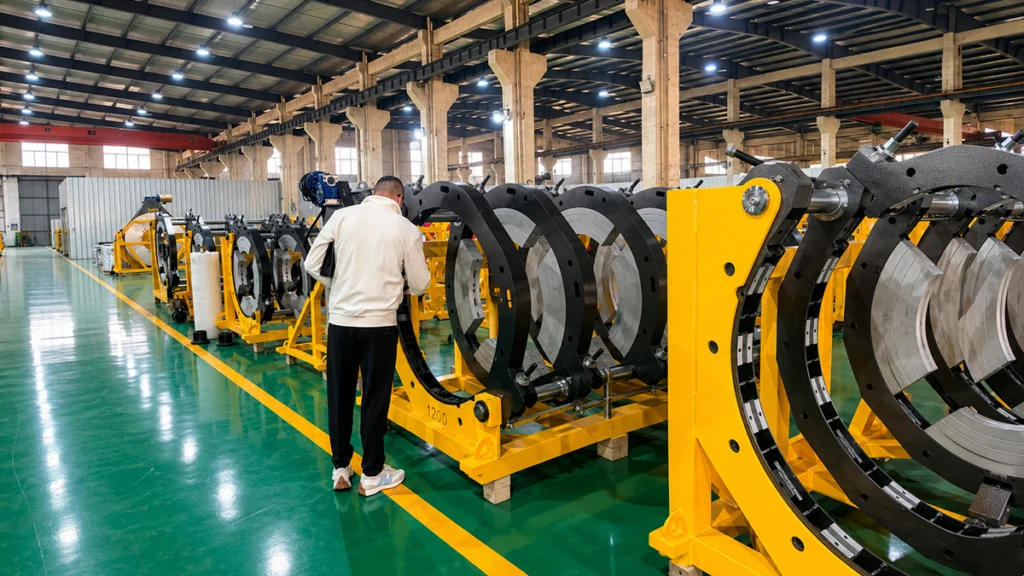
Chinese factories produce a staggering variety of equipment engineered for diverse pipeline specs. Standard configurations handle distinct ranges: 40-160mm, 63-250mm, 90-315mm, 180-450mm, 315-630mm, 450-800mm, and massive 630-1000mm setups. This broad availability is a game-changer. Distributors and contractors can buy every piece of plastic pipe welding machine they need from a single source. That guarantees component compatibility and takes the headache out of hunting down spare parts across multiple job sites.
Export experience and customization options
Veteran exporters know how to adapt their HDPE pipe jointing machines to meet hyper-local engineering demands. Need specific heating copper block dimensions like 5×20 or 7×18? They can build it. Require up to 12 distinct fusion head configurations for a niche application? Consider it done. These experienced suppliers also navigate international shipping logistics, complex export packaging protocols, and customs paperwork with ease, stripping the friction out of importing heavy industrial gear.
Where Chinese suppliers may differ in quality and service
While elite exporters offer incredible value, the broader market remains highly fragmented. Roughly 90% of buyers expect round-the-clock technical support, and 75% demand exhaustive operation manuals paired with video guides. Industry leaders step up, delivering these assets alongside integrated welding quality detection systems—like ultrasonic scanning or data logging, which 60% of construction crews now require. Conversely, lower-tier trading companies fall flat. They simply lack the engineering backbone required to offer ongoing technical troubleshooting, software upgrades, or fast spare parts dispatch.
Factory-direct pricing with technical consultation included
Get Your Free QuoteUnderstand the Main Types of Butt Fusion Machines Before Buying
Manual butt fusion machines
Manual butt fusion machines are bare-bones, cost-effective units built for tight budgets and non-critical jobs. They rely 100% on operator muscle for pressure application and timing. Because of this, temperature adjustments are often coarse, and the final weld’s integrity hinges entirely on the worker’s skill level. You’ll generally only see these deployed on smaller pipe diameters where extreme clamping force isn’t necessary.
Hydraulic butt fusion machines
Step up to a hydraulic butt fusion machine, and you introduce a dedicated power station that delivers semi-automatic control over the welding cycle. This upgrade is absolutely vital for larger pipe diameters. The milling, heating, and cooling phases demand immense, sustained pressure that a human simply cannot generate manually. The hydraulic station locks in consistent force, drastically cutting down operator fatigue while massively boosting joint reliability.
Automatic butt fusion machines
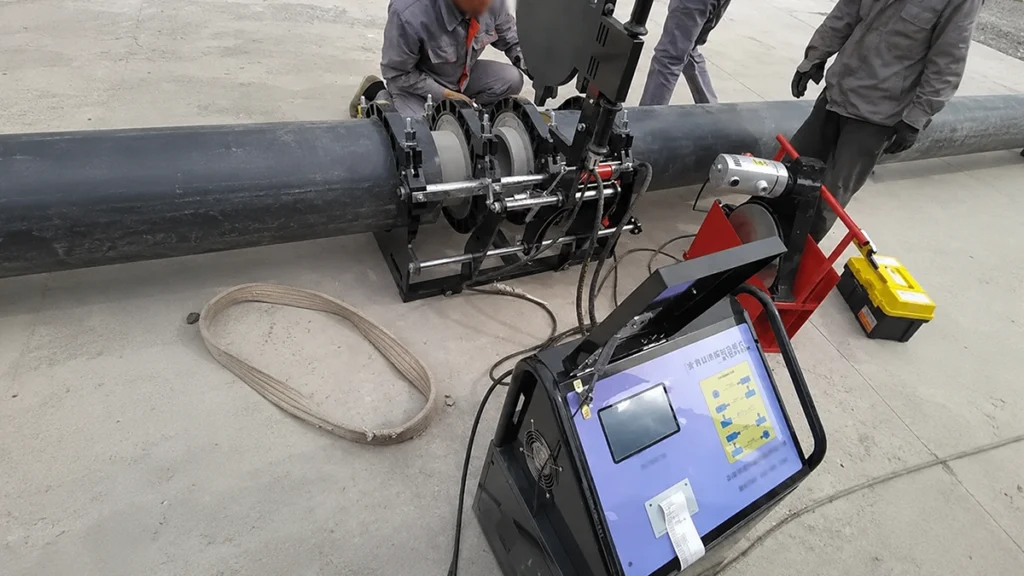
Fully automatic butt fusion machines or CNC (Computer Numerical Control)—models represent the top tier of fusion tech. They leverage closed-loop systems packed with solenoid valves, PLCs, sensors, and electronic feedback loops. Operators interact with oversized touchscreen displays that handle automatic monitoring, issue step-by-step prompts, and precisely govern the entire fusion cycle. If your project mandates rigorous data logging compliance, like ASTM F3124, CNC units are non-negotiable.
Which type fits contractor, distributor, and utility projects?
| Machine Type | Control Level | Best Suited For | Advantages | Relative Cost |
|---|---|---|---|---|
| Manual | Human control | Small contractors, low-pressure agricultural irrigation | Minimal initial investment, highly portable, lightweight | Baseline ($) |
| Hydraulic | Semi-automatic | Standard distribution grids, municipal water/gas contractors | Delivers consistent pressure, effortlessly handles medium-to-large pipes | Moderate ($$) |
| Automatic (CNC) | Closed-loop PLC | Critical utility networks, industrial chemical plants | Eradicates operator error, full data logging capabilities, exceptional ROI | Premium ($$$) |
Key Specifications to Confirm with the Supplier
Pipe diameter range and pipe material compatibility
Never assume a electrofusion welding machine fits your project. Always verify that the equipment’s clamping capacity matches your exact outer diameter (OD) requirements. You’ll typically see standard ranges like 160-315mm, 400-630mm, and 710-1000mm. Also, double-check compatibility with your specific pipeline polymers. High-Density Polyethylene (HDPE), Polypropylene (PP), and Polyvinylidene Fluoride (PVDF) all demand unique heating parameters to fuse correctly.
Heating plate temperature control and coating quality
A premium heating plate needs to be cast from corrosion-resistant aluminum alloy to ensure heat transfers rapidly and evenly. A flawless PTFE (Teflon) coating is non-negotiable; otherwise, molten plastic will stick to the metal and ruin the weld. On the control side, the system must span 0-270°C and hold a razor-thin error margin of ±3°C. Anything looser risks material degradation or catastrophic cold welds.
Facing tool power, hydraulic pressure, and clamping accuracy
Milling cutters demand high-speed carbon steel blades powered by a heavy-duty chain drive to guarantee perfectly parallel pipe ends. Meanwhile, your hydraulic station should offer an adjustable pressure range—usually 0-16 MPa. It must hold that force steady without dropping a single PSI during the cooling phase. Clamping accuracy is equally vital. The maximum allowable butt joint deviation must stay at or below 0.2mm to guarantee flawless structural integrity.
Voltage, plug type, working environment, and local compliance needs
Electrical requirements shift drastically depending on butt fusion machine size and where you operate. Smaller units up to 315mm generally run on 220V two-phase power. Scale up to heavy-duty 450mm+ models, and you’ll need 380V three-phase power. Spell out your exact voltage, frequency (50Hz vs. 60Hz), and industrial plug requirements to the supplier. Finally, ensure the rig is rated for your specific job site conditions, especially if you deal with blistering ambient heat or extreme humidity.
| Technical Parameter | Standard Requirement | Buyer Checkpoint |
|---|---|---|
| Heating Temp Range | 0 – 270°C | Demand ±3°C accuracy |
| Hydraulic Pressure | 0 – 16 MPa | Verify stable hold during the cooling phase |
| Joint Deviation | ≤0.2mm | Closely inspect clamp alignment |
| Power Supply (≤355mm) | 220V / Single or Two-phase | Cross-check local grid compatibility |
| Power Supply (≥400mm) | 380V / Three-phase | Confirm industrial site power availability |
Get detailed specs and custom configuration options
Request Technical SpecificationsHow to Verify a Chinese Butt Fusion Machine Manufacturer
Factory license, export records, and business scope
Ask for the supplier’s official business license right away. Check their registered business scope to ensure it explicitly covers the manufacturing and production of plastic pipe welding equipment—not just wholesale or export trading. Ask to see historical export records or bills of lading routed to your specific region. This proves they actually know how to navigate your local customs and adhere to regional engineering standards.
How to distinguish a manufacturer from a trading company
Authentic manufacturers run their own independent research and development divisions. They staff dedicated mechanical and electrical engineers who handle complex future maintenance, custom calibrations, and deep PLC system upgrades. Trading companies? They just flip standard, off-the-shelf units. Ask them a highly technical question about hydraulic schematics or custom copper block dimensions, and they will likely struggle to give you a straight answer.
Questions to ask before requesting a formal quotation
- Does your hydraulic system rely on an open-loop or closed-loop control architecture?
- Can your CNC models maintain the strict low-pressure parameters (0.15 N/mm²) required by the DVS 2207-1 standard?
- Do these butt fusion welding machines feature integrated data logging that complies with ASTM F3124?
- Which specific brands do you use for hydraulic seals and electrical contactors?
Warning signs of an unreliable supplier
Bad suppliers dodge hard questions. If they avoid detailing technical parameters like the specific heating plate power or the plastic pipe welding machine’s total kilowatt (KW) rating, walk away. Refusing to provide unedited video evidence of the HDPE pipe jointing machine running under load is another massive red flag. Keep an eye out for vague warranty policies or non-committal answers about the long-term availability of spare parts. These are clear indicators of a high-risk purchase.
Quality Standards, Certifications, and Test Reports to Request
Which certificates are commonly requested?
Compliance hinges entirely on your project specs and destination market. ISO 21307 acts as the universal baseline for global water and gas infrastructure. If you’re importing into the European market, CE certification is absolutely mandatory to prove electrical and mechanical safety. Get these documents in your hands early in the sourcing phase to guarantee seamless customs clearance and fast site approvals.
Factory test reports and machine performance records
External certifications are great, but internal quality control matters just as much. Demand specific factory calibration reports tied directly to the exact serial numbers you intend to buy. These documents must map out hydraulic cylinder pressure accuracy and validate heating plate temperature stability over a prolonged, sustained testing cycle.
Why certification should match your market requirements
Welding parameters vary wildly across different global regions. Take the German DVS 2207-1 standard: it governs high-precision industrial welds using a single, ultra-low pressure of 0.15 N/mm² across bead-up, joining, and cooling phases. In stark contrast, North American gas pipelines lean on ASTM F2620, which demands aggressive interfacial fusion pressures hitting 60–90 psi. Your HDPE butt fusion welding machine’s hydraulic and control brains must be precisely calibrated to the exact standard your project engineers dictate.
How to confirm documents are valid and relevant
Never take a certificate at face value. Ensure CE or ISO documents originate from internationally recognized testing authorities like SGS, TUV, or Bureau Veritas. Run the certificate numbers through the issuing agency’s official online database to verify authenticity. Check that the company name on the paperwork perfectly matches the manufacturer you are paying, and confirm the document’s scope explicitly lists pipe fusion machine.
Price, MOQ, Lead Time, and Payment Terms
Typical factors that affect butt fusion machine price
Two main factors drive equipment pricing: pipe diameter capacity and automation level. Stepping up from a basic manual hydraulic unit to a sophisticated CNC automatic butt fusion machine will bump your initial cost by 3x to 4x. This premium covers the complex integration of PLCs, electronic sensors, and automated hydraulic valves. But look at the big picture. Over a 6-month project, replacing manual labor with a CNC unit can easily generate $20,000 to $30,000 in labor savings, offsetting that higher capital expenditure in record time.
How MOQ changes for standard and customized models
Because this is heavy industrial butt fusion welding machinery, the Minimum Order Quantity (MOQ) for standard hydraulic or CNC models usually sits at just 1 set. What if you need heavy customization—like bespoke frame colors, unique data logging software, or non-standard voltage setups? Most suppliers will still honor an MOQ of 1, though you should expect them to tack on engineering design fees for that initial build.
Lead time expectations for sample, bulk, and customized orders
Standard models (up to 315mm) are frequently kept in stock, or they require a brief 7 to 14 days for assembly and bench testing. Massive rigs (think 710-1000mm) or fully customized CNC units take much longer, generally spanning 1 to 3 months. Always factor in peak manufacturing seasons. Don’t forget to pad your timeline with an extra 30 to 45 days for ocean freight, depending on your destination port.
Safer payment structures for international buyers
Never wire 100% of the funds upfront for heavy butt fusion machine. Stick to standard international terms like Telegraphic Transfer (T/T) or a Letter of Credit (L/C) for massive orders. The smartest, lowest-risk play? Put down a 30% deposit to kick off production. Hold the remaining 70% hostage until the factory passes a rigorous inspection (either via live video or a third-party auditor) and officially issues the Bill of Lading.
Pre-Shipment Inspection and Acceptance Checklist
What to inspect before the machine leaves the factory
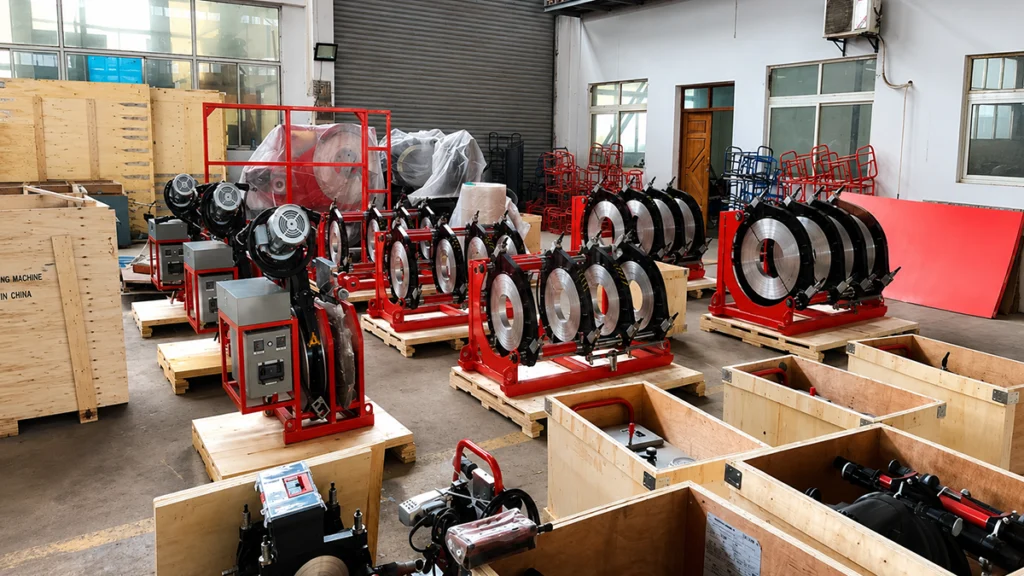
Before you authorize that final wire transfer, run a brutal visual and mechanical audit. Scrutinize the main pipe fusion machine frame for structural integrity and any hint of warping. Test the clamp locking devices to ensure they are flexible yet secure. If the clamps are rigid or misaligned, you will suffer from weld instability and eventual joint failure out in the field.
Performance testing for heating, facing, and hydraulic systems
Require video documentation of the equipment executing a full dry-run cycle. Check the heating plate circuit to confirm it heats up rapidly and evenly. Watch the milling cutter; it should spin smoothly without violently vibrating. Most importantly, push the hydraulic station to the limit. It needs to hit the required 0-16 MPa threshold and hold that exact pressure without a single drop of fluid leaking during the simulated cooling phase.
Accessories, spare parts, manuals, and nameplate checks
Comb through the electrical safety hardware. Inspect the power cord, verify the grounding connections, and test the overheat and overpressure safety switches. Ensure the physical metal nameplate perfectly aligns with your invoice specs (voltage, KW, serial number). Finally, confirm that every requested accessory, toolkit, English operation manual, and spare part is accounted for and tightly packed.
When to use a third-party inspection company
If you are dropping cash on high-value CNC butt fusion welding machines or buying multiple large-diameter units, bring in a heavy hitter. Hiring a third-party inspection agency like SGS or Intertek is a very smart move. They will dispatch an inspector to the factory floor to physically measure butt joint deviation (ensuring it stays ≤0.2mm), verify temperature error margins (±3°C), and test hydraulic pressure stability. You get an unbiased, hyper-detailed technical report before the equipment ever hits a crate.
Shipping, Import, Warranty, and After-Sales Support
Choosing EXW, FOB, CIF, or DDP terms
Your Incoterm choice dictates both your final bill and your liability. Free On Board (FOB) usually represents the smartest long-term strategy for heavy HDPE pipe butt fusion welding machine because it grants you full control over sea freight and insurance providers. Cost, Insurance, and Freight (CIF) might look appealing, but it can artificially spike your import duties since customs calculates taxes based on the inflated CIF value. Delivered Duty Paid (DDP) offers maximum convenience but almost always carries the steepest premium.
Export packaging for heavy industrial equipment
Ocean transit is brutal. Heavy fusion equipment demands heavy-duty, fumigated wooden crates to survive the journey. Take a 710-1000mm butt fusion welding machine, for instance. It requires multiple crates: one for the main frame (2200x1800x1700mm), one for the hydraulic station (900x600x650mm), and another for the milling cutter and heating plate assembly (2300x1100x800mm). That’s a gross weight hovering around 2600kg. Force your supplier to guarantee industrial-grade moisture-proof wrapping inside every single crate.
Spare parts availability and warranty responsibilities
A solid standard warranty covers primary components for 12 to 18 months post-shipment. Get extremely specific about what is actually covered. Heating plate coatings and milling blades usually fall under “consumables” and won’t be replaced for free. To protect your investment, force the supplier to guarantee the availability of proprietary spare parts—like specialized PLC modules or custom hydraulic seals—for a minimum of 5 to 10 years.
Remote technical support, training, and maintenance documents
Heavy industrial gear demands elite operational support. Ensure the supplier ships comprehensive English maintenance manuals, detailed hydraulic schematics, and accurate electrical wiring diagrams. The best manufacturers go a step further, offering 24-hour remote video support. This allows field operators to troubleshoot complex hydraulic faults or PLC data logging glitches right from the trench.
Final Buying Checklist for a Low-Risk Order
Documents to collect before payment
- Commercial Invoice paired with a granular Packing List.
- Official Bill of Lading (B/L).
- Verified CE or ISO 21307 Certificates.
- Factory calibration and internal performance test reports.
- Certificate of Origin (crucial if you want to reduce import duties).
Technical details to confirm before production
- Precise pipe diameter capacity and polymer material compatibility.
- Electrical specs: Voltage (220V vs 380V), frequency, and specific industrial plug type.
- Hydraulic pump output and targeted pressure standard (DVS vs ASTM).
- Data logging mandates and required software language.
Inspection steps before shipment
- Ensure butt joint deviation remains ≤0.2mm.
- Verify the heating plate temperature error holds tight at ±3°C.
- Push the hydraulic pressure to maximum load and check for stability.
- Audit all export packaging materials and confirm crate dimensions.
What to confirm before placing a repeat order
- Scrutinize the real-world field performance and weld failure rates of the first batch.
- Grade the supplier’s actual response time when you requested technical support.
- Verify that their pricing, lead times, and spare parts policies haven’t shifted.
FAQ
Q1: How do I know if a Chinese butt fusion machine supplier is reliable?
A dependable supplier functions as an actual manufacturer with dedicated R&D teams, rather than just acting as a middleman trading company. Prove their legitimacy by demanding granular factory calibration reports and verifying compliance with strict standards like ISO 21307 or DVS 2207-1. Always request unedited video proof of equipment testing. Top-tier suppliers will also outline transparent warranty terms and promise long-term availability for crucial spare parts.
Q2: What specifications should I check before buying a butt fusion machine?
Start by locking down the exact pipe diameter range (e.g., 160-315mm) and verifying polymer compatibility. Scrutinize the heating plate—it needs a temperature range of 0-270°C with an accuracy tolerance of ±3°C. Next, check the hydraulic pressure range (usually 0-16 MPa) and ensure clamping deviation stays at ≤0.2mm. Finally, confirm that the electrical voltage and plug configuration match your local power grid.
Q3: Is an automatic butt fusion machine better than a hydraulic model?
For high-stakes utility projects, absolutely. Automatic (CNC) butt fusion machines utilize closed-loop PLCs to completely remove operator error and ensure comprehensive data logging (compliant with ASTM F3124). The catch? They cost three to four times as much. For standard municipal water or gas distribution where strict automated data logging isn’t legally required, standard hydraulic models offer a highly effective and budget-friendly alternative.
Q4: What certificates are needed for importing butt fusion welding machines?
Certification depends entirely on where you are shipping the equipment. CE certification is legally required in the European Union to validate electrical and mechanical safety. ISO 21307 acts as a global benchmark for water and gas networks. North American buyers need to confirm hydraulic capabilities meet ASTM F2620 standards, whereas the German market demands strict DVS 2207-1 compliance.
Q5: How much does an HDPE pipe butt fusion machine from China cost?
Pricing swings wildly depending on the HDPE pipe jointing machine’s diameter capacity and level of automation. A simple manual hydraulic unit for smaller pipes is very budget-friendly. Step up to a fully automated CNC rig, and your costs will multiply by 3 to 4 times. However, buying directly from a vetted Chinese factory typically slashes your overall capital expenditure by up to 50% compared to purchasing from premium Western brands.
Q6: Can I request a pre-shipment inspection before the machine is shipped?
Yes, and you absolutely should. Smart buyers tie their final payment to a passed inspection. You can handle this via a live video walkthrough with the factory, or better yet, hire a third-party auditor like SGS. They will travel to the facility to physically test hydraulic pressure stability, heating plate accuracy, and clamp alignment before the pipe fusion machine is sealed in its wooden crate.
Q7: What spare parts should be included with a butt fusion machine order?
Always bundle consumables into your initial order. Ask for extra high-speed carbon steel milling blades and backup PTFE (Teflon) coated heating plates. Beyond that, stock up on critical hydraulic seals, replacement thermocouples or electronic sensors, and specific electrical contactors. Make sure the supplier guarantees that proprietary parts will remain available for at least 5 to 10 years.
Q8: Which shipping term is best when importing butt fusion machines from China?
FOB (Free On Board) stands out as the optimal shipping term for heavy but fusion machinery. It hands the buyer full control over the freight forwarder and ocean shipping costs. CIF (Cost, Insurance, and Freight) might seem easier, but it can artificially inflate your import duties. Customs authorities base their tax calculations on the total CIF value, which ultimately drives up your overall landed costs.
Conclusion
Sourcing butt fusion equipment from overseas can deliver massive ROI, but only if you ruthlessly manage the technical and commercial risks. Success means looking far beyond the initial price tag. You have to evaluate the supplier’s engineering capabilities, the quality of their hydraulic components, and their strict adherence to global standards like ISO 21307, DVS 2207-1, or ASTM F2620. By dictating precise technical specs, demanding factory calibration data, and enforcing aggressive pre-shipment inspections, contractors can lock down high-performance butt fusion machine that easily meets pipeline integrity demands. Focus on closed-loop hydraulic stability, razor-thin temperature tolerances, and ironclad after-sales support to guarantee a safe, predictable, and highly profitable procurement cycle.
Let our experts help you choose the right equipment for your project
Contact Our Engineering Team