
Butt Fusion Machines for High-Pressure HDPE Pipeline Projects
Table of Contents
Introduction
Choosing the right butt fusion machines for high-pressure pipelines isn’t just a box to check on a procurement list; it is a calculated risk management strategy. A single joint failure can trigger excavation fees and downtime costs exceeding $15,000. While brand loyalty often steers buyers toward familiar names, the physical demands of fusing DN630 HDPE pipe at 0.52 MPa interfacial pressure care little for logos. The equipment must be defined by engineering specs, not marketing. Market giants like McElroy or Ritmo have established historical standards, yet true reliability in unforgiving environments boils down to three things: chassis rigidity, hydraulic seal integrity, and thermal stability.
This guide cuts through the noise to expose the engineering factors that actually determine butt fusion welding machine longevity. We’ll look at chassis material science, hydraulic performance in temperature swings from -20°C to +60°C, and the Total Cost of Ownership (TCO) gap between premium global brands and heavy-duty industrial alternatives. You will see how ISO 21307 compliance shifts equipment needs and why “smart engineering” often beats proprietary complexity. By the end, you’ll have a technical framework to specify gear that balances capital efficiency with the rugged performance your infrastructure projects demand.

The Engineering Behind Reliable Butt Fusion Machines in Harsh Environments
Reliability isn’t an abstract idea. It is the direct result of specific material choices and mechanical tolerances. Whether you are operating in the Australian outback, the Chilean Andes, or the frozen tundra of Northern Canada, a hdpe fusion machine has two jobs: maintain dead-on alignment under massive force and deliver consistent heat. Fail at either, and you get a “cold weld” or a misaligned joint that becomes a ticking time bomb for leaks.
Chassis Rigidity and Material Science for High-Pressure Alignment
The chassis is the machine’s backbone. During the fusion cycle—specifically the drag and bead-up phases—the unit exerts tremendous force to pull pipe ends together. In High Pressure (ISO 21307) applications, interfacial pressures hit 0.52 MPa. If the chassis flexes or twists under that load, the pipe faces won’t meet perfectly parallel. The result? Uneven bead formation and stress concentration points that compromise the weld.
To stop this, high-performance butt fusion machines ditch standard cast aluminum for high-tensile strength aluminum alloys. These materials offer the rigidity needed to resist deformation without making the unit impossible to transport. In Ekberg Welding’s heavy-duty series, the chassis uses a reinforced “pull-out plate” structure designed to handle forces far exceeding the standard drag pressure of large pipes like DN800 or DN1200. This guarantees that even when welding thick-walled SDR 7.4 pipe for mining slurry lines, alignment stays within the strict <10% wall thickness mismatch tolerance mandated by DVS 2207 standards.
Hydraulic System Durability in Extreme Temperatures
The hydraulic system provides the muscle, but it is also the subsystem most likely to fail in extreme climates. Standard seals and hoses often turn brittle and crack at -20°C or lose viscosity and leak at +60°C. Reliable butt fusion machines must use closed-loop hydraulic controls fitted with seals rated specifically for these wild temperature fluctuations.
Moreover, a high-capacity accumulator is non-negotiable. The cooling phase for thick-walled pipes can last anywhere from 20 to 45 minutes. During this time, generators can fluctuate, or pumps may cycle off. A properly sized accumulator acts as a pressure buffer, maintaining consistent interfacial pressure without active pumping. This prevents voids from forming in the cooling melt. Ekberg butt fusion welding machines integrate these accumulators to safeguard joint integrity, even if power delivery gets shaky.
Heating Plate Technology and Temperature Stability
The heating plate (or heater mirror) has to deliver precise thermal energy. For HDPE (PE100), the surface temperature needs to sit between 200°C and 230°C. In windy or sub-zero conditions, however, cheap heating plates lose heat rapidly at the edges, creating a “cold zone” that ruins the weld.
Engineering reliability here comes down to coating quality and electronic control. Industrial-grade PTFE (Teflon) coatings need to be thick enough to stop sticking but uniform enough for efficient heat transfer. More critically, the electronic thermostat must hold ±5°C accuracy. Top-tier units use dual-zone temperature control and high-wattage elements (like 16.2 kW for an 800mm hydraulic butt fusion machine) to instantly recover heat lost to the wind, ensuring the entire pipe face melts simultaneously.
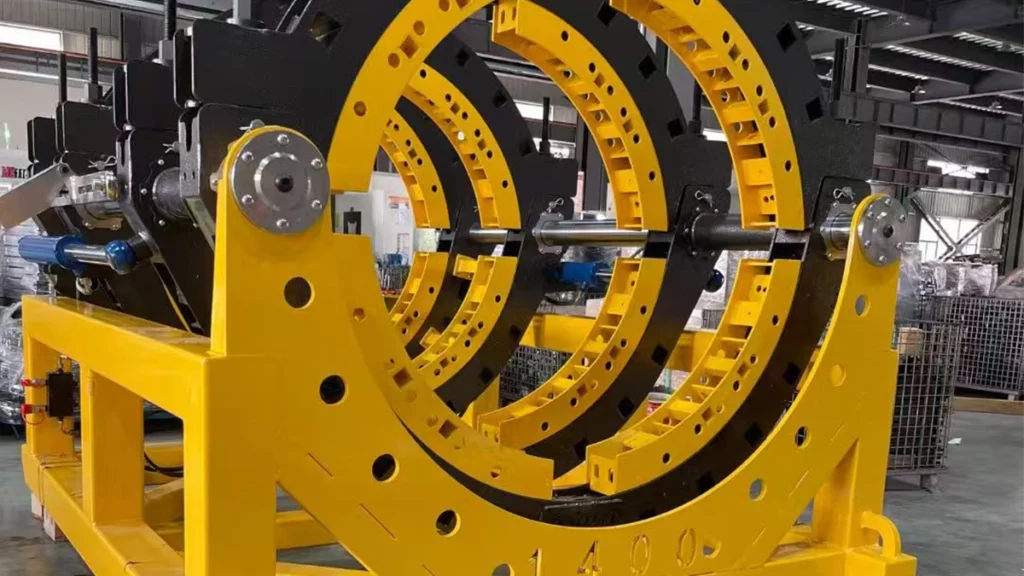
Comparing Global Market Leaders vs. Heavy-Duty Value Alternatives
Procurement managers are often stuck between a rock and a hard place: buy the “safe” Tier 1 brand with the massive price tag, or bet on a value alternative that feels risky. Understanding the engineering differences clarifies the decision.
Tier 1 Global Brands: What You Pay For
Brands like McElroy (USA) and Rothenberger (Germany) built their reputations on decades of innovation. When you buy Tier 1, you pay for proprietary tech—like “TracStar” mobility systems—and a vast, though costly, dealer network. These hdpe pipe welding machines are often over-engineered, featuring complex proprietary electronics and unique hydraulic connectors.
The performance is excellent, but the downside is “Vendor Lock-in.” If a hydraulic coupling snaps in a remote region, you can’t just swap it with a standard Parker or Eaton part from a local supply house. You have to order the specific proprietary part, potentially halting work for days. Plus, the capital cost is often 30-50% higher than functional equivalents, which hits the ROI hard for small to mid-sized contractors.
The Rise of High-Performance Industrial Manufacturers (Ekberg Analysis)
Ekberg Welding represents a shift toward “Smart Engineering.” The philosophy is simple: offer 95% of the capability of a Tier 1 brand at roughly 60% of the cost. That “missing” 5% usually consists of luxury features like fully autonomous robotic tracks, which don’t actually improve weld quality.
Instead, Ekberg doubles down on open architecture. By using standard industrial hydraulic fittings, seals, and electrical components, these machines are field-serviceable. If a hose blows in rural Brazil or Southeast Asia, a local mechanic can fabricate a replacement on the spot. This “Right to Repair” approach is a massive reliability advantage for projects where logistics chains are weak or non-existent.
Total Cost of Ownership (TCO) Analysis
Looking at TCO over a 5-year period, the purchase price is just the tip of the iceberg. You have to factor in maintenance, spares, and the crippling cost of downtime.
| Cost Factor | Tier 1 Global Brand | Ekberg Heavy-Duty Series | Impact on ROI |
|---|---|---|---|
| Initial CapEx | $50,000 – $80,000+ | $30,000 – $45,000 | Immediate capital savings of 30-40%. |
| Spare Parts | Proprietary pricing (High) | Standard Industrial pricing (Low) | Lower long-term maintenance costs. |
| Service Model | Certified Dealer Only | Open / Local Mechanic Friendly | Reduced downtime risks in remote areas. |
| Resale Value | High | Moderate | Tier 1 retains value better, but Ekberg pays for itself faster. |
| Consumables | Brand-specific inserts/blades | Universal/Standard compatibility | Ongoing operational savings. |
For a contractor managing a fleet, the savings on three Ekberg units compared to three Tier 1 units can essentially cover the cost of an entire spare machine plus two years of parts. That significantly de-risks the project.
Critical Features for Extreme Climates: From Mining to Municipal Water
A butt fusion machine that runs perfectly in a sterile factory might fail within hours on a dusty mine site. Environmental protection is the silent guardian of reliability.
Dust and Moisture Protection (IP Ratings)
Mining environments are brutal. Fine dust—silica, coal, iron ore—is abrasive and conductive. If it gets into the electrical control box (CNC unit), it shorts out circuit boards and clogs relays. For these conditions, butt fusion machines need a minimum IP54 rating.
Ekberg butt fusion welding machines use sealed electronic housings and “potted” circuit boards, where electronics are encased in protective resin. This stops moisture ingress during tropical storms and keeps conductive dust off sensitive components. The hydraulic power units are also fully enclosed to keep dirt out of the oil reservoir—the leading cause of hydraulic pump failure.
Off-Road Mobility and Field Handling
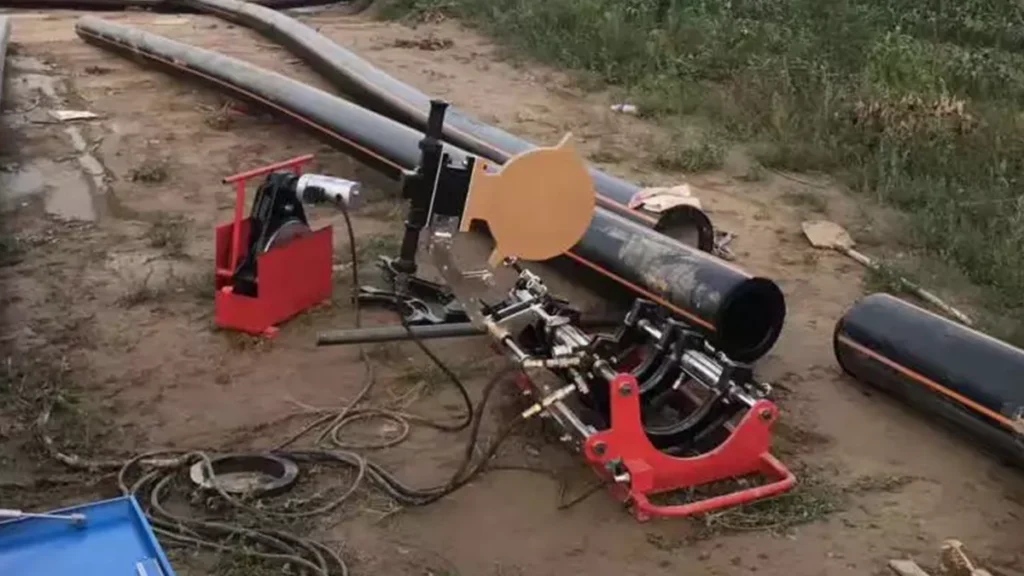
Moving a 630mm or 800mm hydraulic butt fusion machine across a pipeline right-of-way is a logistical nightmare. Tracked vehicles are great for mud, but they add weight and maintenance headaches. For most projects, a robust wheeled carriage with all-terrain tires strikes the best balance between mobility and simplicity.
A game-changer for trench work is the “detachable hydraulic unit.” Municipal trenches often lack space for the full chassis and power unit. Ekberg designs allow the hydraulic power pack and control station to detach and operate from the top of the trench (up to 5-10 meters away). This improves operator safety and clears up the excavation zone.
Power Stability in Remote Locations
Remote pipeline projects run on portable diesel generators. These often supply “dirty power” full of voltage spikes and harmonic distortion (THD > 5%). Sophisticated CNC automatic butt fusion machines can get fried by these fluctuations.
Reliable gear needs high-quality internal rectifiers and voltage stabilizers to “clean” incoming power before it touches the control logic. Generator sizing matters, too. As a rule of thumb, size the generator at 1.3x to 1.5x the machine’s total power draw. For an Ekberg 630mm model drawing 12.2 kW, you want at least 18-20 kVA to prevent voltage sag when the heater plate kicks on.
Strategic Selection Guide: Matching Machine Specs to Job Site Realities
Not every project needs a fully automated CNC butt fuison welding machine, and manual butt fusion machines aren’t right for every pipe size. The right choice depends on how critical the application is and the pipe schedule.
Selecting Between Manual, Hydraulic, and CNC Models
- Manual Machines: Best for small drainage pipes (<250mm) where pressure requirements are low and you don’t need heavy documentation.
- Hydraulic (Semi-Automatic): The standard for general infrastructure. The operator controls phases via levers, but the hydraulic butt fusion machine provides the muscle. Perfect for water and fire mains with skilled operators.
- CNC (Fully Automatic): Essential for critical gas lines and mining where 100% traceability is the law. The CNC unit auto-calculates drag pressure, heat soak time, and cooling cycles based on the standard (ISO/DVS). This eliminates “finger trouble”—human error—which causes the majority of joint failures.
Sizing the Machine for Your Pipe Schedule
Don’t just look at Pipe Outer Diameter (OD); look at the Standard Dimension Ratio (SDR). A butt fusion machine might physically fit a DN630 pipe, but if that pipe is a thick-walled SDR 7.4 (high pressure), the machine’s hydraulic cylinders need enough effective area (cm²) to generate the required pressure.
Common Ekberg Heavy-Duty Models:
- 630mm Model: Range 315-630mm. Ideal for municipal water mains. Total Power: 10.1 kW.
- 1200mm Model: Range 630-1200mmmm. The workhorse for industrial pipelines.
- 1800mm Model: Range 1200-1800mm. Heavy infrastructure. Total Power: 78 kW.
Data Logging and Quality Assurance Requirements
Modern infrastructure projects, especially in the EU and North America, increasingly demand data logging (LDU) to comply with ASTM F3124 or ISO 12176. Inspectors want proof the weld cooled under pressure for the correct time.
Ekberg’s integrated data systems record key parameters—time, temperature, fusion pressure, drag pressure—and generate an encrypted PDF report for every joint. Unlike bolt-on loggers that can be bypassed, integrated systems ensure the record matches actual butt fusion machine performance, making the handover to inspectors painless.
Manufacturing Excellence, Quality Control & Global Support
Reliability is determined before the hdpe pipe jointing machine ever reaches the job site. It starts on the factory floor.
Factory-Direct Quality Assurance Protocols
Ekberg Welding runs a QA protocol that goes far beyond a quick visual check. Every hydraulic cylinder and manifold undergoes a 24-hour pressure holding test to catch micro-leaks that wouldn’t show up in a short cycle. Heating plates get thermal imaging scans to verify temperature uniformity, ensuring no “cold spots” compromise the weld. All hdpe fusion machines are CE marked and built under ISO 9001 quality management systems, guaranteeing consistency from batch to batch.
Supply Chain and Spare Parts Availability
In heavy infrastructure, availability is a capability. Ekberg keeps a strategic stock of critical spares—solenoid valves, seal kits, heater elements, planing blades—ready for immediate global dispatch. By mixing proprietary structural components with universal hydraulic and electrical parts, Ekberg ensures supply chain hiccups won’t paralyze your project.
Technical Training and After-Sales Service
Buying the butt fusion machine is half the battle; operating it right is the rest. Ekberg provides comprehensive support, including video troubleshooting guides and detailed manuals. For complex projects using non-standard materials like PVDF or Polypropylene, Ekberg offers remote engineering support to help technicians configure welding parameters, ensuring compliance with DVS 2207 regardless of the material.
Frequently Asked Questions
Q1: How does extreme cold weather affect the butt fusion welding process?
Extreme cold (-20°C) thickens standard hydraulic oil, making the butt fusion welding machine sluggish. You need to switch to ISO VG 32 fluid. Also, the heating plate requires “tenting” to block wind chill. Cooling times are tricky; while the pipe cools faster, rapid cooling can cause brittle stress. Operators must strictly follow the machine’s CNC compensations for ambient temperature.
Q2: Can Ekberg butt fusion machines weld pipes from different manufacturers?
Yes. Ekberg butt fusion machines are universal. They can weld any thermoplastic pipe (HDPE, PP, PVDF) regardless of the brand, as long as diameters and SDRs match. You can adjust pressure settings for different polymer grades (like PE80 vs. PE100) and configure them to follow standards like ISO 21307, ASTM F2620, or DVS 2207.
Q3: What is the difference between High Pressure (ISO 21307) and Low Pressure butt fusion?
Low Pressure fusion (DVS 2207) typically uses an interfacial pressure of 0.15 MPa and needs longer cooling times. High Pressure fusion (ISO 21307), common in mining and North America, uses roughly 0.52 MPa. This higher pressure slashes cooling time, boosting productivity. However, butt fusion machines need robust hydraulics and chassis rigidity to handle that force without flexing.
Q4: How often do butt fusion machines require calibration and maintenance?
Plan for a full service and calibration check annually or every 1,000 welds—whichever comes first. This includes checking hydraulic pressure gauges, verifying heating plate accuracy, and inspecting trimmer blades. Regular maintenance means checking oil levels daily and keeping clamp inserts clean for proper alignment.
Q5: Why is hydraulic butt fusion preferred over manual for pipes larger than 250mm?
Once you pass 250mm, the force needed to drag the pipe and apply fusion pressure exceeds human strength. A DN315 pipe might require hundreds of kilograms of force just to move. Hydraulic systems provide the consistent force needed to meet standards. Manual butt fusion machines simply can’t guarantee the continuous pressure required during bead-up and cooling for large diameters, leading to non-compliant welds.
Conclusion
Reliability in pipeline construction is a three-legged stool: robust engineering, environmental protection, and strategic specification. The market offers plenty of options, but the best butt fusion machine isn’t necessarily the most expensive one. It’s the one that keeps running when the temperature drops and the dust rises. By prioritizing chassis rigidity, hydraulic durability, and open-architecture maintenance, contractors can shield their projects from costly downtime.
Butt fusion machines are the critical link in your infrastructure supply chain. Whether you are welding municipal water lines in a city center or slurry pipes in a remote mine, Ekberg Welding provides the optimal balance of rugged industrial reliability and cost-effectiveness.
Ready to equip your projects with proven heavy-duty technology? Contact Ekberg Welding today for a technical consultation and a competitive quote on heavy-duty butt fusion equipment tailored for your next project. Ensure your welds meet global standards without breaking your budget.