
Butt Fusion Machine Manufacturers: US Market Guide
Table of Contents
High-performance butt fusion machines capable of sustaining 0.52 MPa (75 psi) interfacial pressure are the backbone of America’s massive infrastructure overhaul. With the domestic pipeline construction market expanding at breakneck speed, procurement managers are stuck at a crossroads: do you wait months for established domestic brands, or do you integrate agile global manufacturers that hit the exact same engineering benchmarks?
This guide breaks down the leading US manufacturers, dissects the differences between ASTM F2620 and ISO 21307 welding standards, and evaluates the true technical ROI of domestic versus global equipment. We will drill down into butt fusion welding machine specifications, hydraulic stability, and how to validate equipment quality regardless of the logo on the chassis. By the end, you will have a solid procurement framework to select the right gear for DN63–DN1600 projects, balancing rigid compliance with capital efficiency.

The US Butt Fusion Equipment Market Landscape
The United States market for HDPE fusion equipment operates on its own island, separated from the rest of the world by unique regulatory standards and a flood of federal funding. Grasping these macro-factors is the first step for any buyer trying to navigate the supply chain without getting stuck in a backlog.
ASTM F2620 vs. ISO 21307: The Standards Divide
The main wedge in the US market is strict adherence to ASTM F2620. This standard dictates specific parameters for heat fusion joining of polyethylene pipe. Unlike the European ISO 21307 standard—which offers flexibility between “High Pressure” (up to 0.52 MPa) and “Low Pressure” (0.17 MPa) fusion—US projects almost exclusively demand the high-pressure interface of 75 psi (0.52 MPa).
For buyers, this creates a binary choice: the butt fusion machines you buy must have hydraulic power packs with the muscle to sustain high pressures without wavering. A hdpe pipe welding machine built solely for low-pressure ISO applications might lack the hydraulic force needed to satisfy the drag pressure plus interfacial pressure calculations US inspectors demand. However, advanced global butt fusion machines, including the lineup from Ekberg Welding, utilize programmable logic controllers (PLCs) that let operators toggle between ISO and ASTM pressure curves, ensuring universal compliance.
The Infrastructure Investment and Jobs Act Impact
The *Infrastructure Investment and Jobs Act* injected over $50 billion into water infrastructure, with a laser focus on replacing lead service lines and expanding rural gas distribution. This cash injection triggered a massive surge in demand for HDPE pipe and the welding rigs needed to join it.
The result? Domestic manufacturing capacity is redlining. The scramble for machines ranging from 4-inch IPS to 36-inch OD has created significant backlogs for major US brands. This supply/demand imbalance is forcing contractors to look past traditional domestic suppliers to avoid project delays, prioritizing equipment availability and technical specs over brand loyalty.
Supply Chain Challenges and Lead Times
In today’s US landscape, ordering a large-diameter hdpe pipe butt fusion machine from a top-tier domestic manufacturer often comes with a 12 to 16-week lead time. for a contractor with a mobilized crew burning daily overhead, that delay is a dealbreaker.
Global suppliers with agile manufacturing lines can often ship standard hydraulic units (160mm–630mm) within 7–10 days. The critical decision for the buyer is weighing the convenience of a local distributor against the speed and cost savings of direct-from-factory global procurement. While US manufacturers offer proximity, the rigid production schedules of massive OEMs simply cannot match the flexibility of leaner global operations.
Industry-Specific Requirements: Gas vs. Water
Technical requirements in the US vary wildly depending on what flows through the pipe. High-pressure gas distribution networks (regulated by 49 CFR 192) require 100% data logging and traceability. Butt fusion welding machines must record operator ID, heating time, fusion pressure, and cooling time without fail.
Municipal water projects might be slightly less regulated regarding data logging in some jurisdictions, but they demand extreme durability. Machines must survive trench conditions where mud and water are the norm. This necessitates IP54 or higher ratings for electrical components and galvanized or powder-coated chassis frames to fight off corrosion—specs you need to verify on the datasheet, regardless of who built the plastic pipe welding machine.
Top Companies Manufacturing or Distributing Butt Fusion Machines in the US
The US market is consolidated around a handful of key players who have set the operational tempo for decades. However, it is vital to distinguish between the Original Equipment Manufacturers (OEMs) and the value-added distributors.
Ekberg Welding
Ekberg Welding is a global manufacturer specializing in butt fusion machines for HDPE and other thermoplastic pipelines. The company focuses on delivering reliable, large-diameter welding equipment for infrastructure sectors such as municipal water systems, gas distribution, mining, and industrial pipelines.
Market Positioning: The cost-efficient performance alternative for contractors who need industrial welding capability without the premium price of legacy Western brands.
Product Range: Ekberg butt fusion machines cover a wide welding range, typically DN40 mm to DN2600 mm (approximately 102 inches), supporting most municipal and industrial pipeline construction projects worldwide.
Engineering Focus: Ekberg emphasizes stable hydraulic pressure control, consistent heating performance, and modular machine structures, allowing operators to achieve reliable fusion quality while simplifying field maintenance and transport.
Cost Advantage: Compared with premium brands, Ekberg plastic pipe butt welders typically offer similar welding capacity at a significantly lower capital cost, making them attractive for large-scale pipeline projects that require multiple fusion unit.
McElroy Manufacturing
Based in Oklahoma, McElroy is the undisputed heavyweight in the United States. They are famous for their series, which features self-propelled, all-terrain tracks allowing the butt fusion machine to crawl independently along the pipeline right-of-way.
- Market Positioning: The Premium “Gold Standard.”
- Key Technology: machines integrate the carriage, heater, and facer into a single mobile unit.
- Cost Implications: Mobility comes at a steep price. A new 630 or 900 series requires a capital expenditure that can be 300% to 400% higher than a stationary hydraulic butt fusion machine of equivalent welding capacity. For contractors who don’t need self-propulsion, this is a massive operational inefficiency.
Ritmo America
Ritmo is an Italian manufacturer with a robust US subsidiary in Florida, effectively bridging the gap between European engineering and American support.
- Product Range: Their Delta and Basic series are widely respected. The Delta 630 and Delta 1000 trailer units compete directly with domestic options.
- Engineering Style: Ritmo butt fusion machines often lean toward the European style of removable heating plates and facers, which some operators find lighter and easier to service than integrated American designs.
- Pricing: Generally positioned below McElroy but significantly above direct-import global alternatives.
Rothenberger USA
While Rothenberger is a global giant in pipe tools, their US presence in butt fusion leans heavily toward the plumbing and mechanical sectors.
- Focus: Their Roweld series is excellent for smaller diameter, in-building, or tight-trench applications.
- Application: They are less dominant in the large-diameter cross-country pipeline sector but hold significant market share in indoor mechanical HDPE installations.
Major Distributors (e.g., ISCO Industries)
It is important to note that many companies popping up in search results, such as ISCO Industries, are primarily distributors and rental houses. They maintain massive fleets of McElroy equipment and provide critical field support. They don’t manufacture the butt fusion machines, but they are vital to the ecosystem. For buyers, purchasing through a distributor adds a margin layer compared to buying factory-direct, though it does provide immediate access to local rental fleets.
Critical Selection Criteria: How to Evaluate Machine Quality
When evaluating butt fusion machines—whether American, Italian, or from Ekberg Welding—the brand name is secondary to the engineering specifications. A compliant weld relies on physics, not the logo on the chassis.
Compare Hydraulic Systems
The hydraulic station is the heartbeat of the fusion process. It must deliver precise pressure to face the pipe ends, overcome drag, and fuse the interface.
- Requirement: Look for a closed-loop hydraulic control system.
- Stability: The system must maintain pressure within a ±2% tolerance during the cooling phase. If pressure drops during the cooling cycle (which can last 30–90 minutes for thick-walled pipe), joint integrity is compromised.
- Power: For a 1000mm hydraulic butt fusion machine, the hydraulic station should be rated for at least 3.0 kW to ensure rapid response times during the critical “changeover” phase.
Analyze Heating Plate Technology
The heating plate must transfer thermal energy uniformly to the pipe ends to create a proper melt pattern.
- Uniformity: ISO 21307 and ASTM F2620 require temperature uniformity across the entire plate surface. High-quality butt fusion machines achieve ±3°C uniformity.
- Coating: The plate must be coated with high-grade PTFE (Polytetrafluoroethylene) to prevent molten PE material from sticking to the heater during removal. Inferior coatings flake off after a few hundred welds, leading to contamination.
- Control: Digital temperature control is mandatory. Analog dials are simply not precise enough for modern compliance standards.
Evaluate Chassis and Clamping
For large diameter pipes (DN630–DN1600), the rigidity of the butt fusion machine chassis is non-negotiable. HDPE pipe often arrives at the job site slightly ovalized due to storage and transport.
- Rigidity: The butt fusion machine clamps must have enough hydraulic force and structural backbone to re-round the pipe.
- Alignment: Misalignment during fusion cannot exceed 10% of the wall thickness. A weak chassis will flex under high pressure (0.52 MPa), causing misalignment and immediate weld rejection.
Assess Data Logging Capabilities
In the US market, the rule is simple: “if it isn’t recorded, it didn’t happen.”
- Traceability: Modern butt fusion welding machines must support ISO 12176-compliant data logging.
- Parameters: The system must record operator ID, job number, GPS location, ambient temperature, heater temperature, drag pressure, fusion pressure, and cooling time.
- Compatibility: While US manufacturers use proprietary software, Ekberg butt fusion machines utilize open-standard data formats (CSV/PDF) that integrate easily into project management reports without expensive licensing fees.
| Feature | Manual Machine | Hydraulic Semi-Auto | CNC Fully Automatic |
|---|---|---|---|
| Pressure Control | Hand Pump / Gauge | Hydraulic Lever / Digital | PLC Controlled |
| Data Logging | None (Manual Log) | Optional Add-on | Integrated |
| Human Error Risk | High | Moderate | Low |
| Typical Application | Non-critical drainage | Water/Industrial | Gas/High-Spec Water |
Global Manufacturing Alternatives: The Case for Ekberg Welding
For buyers tasked with maximizing budget efficiency without sacrificing technical compliance, Ekberg Welding offers a compelling alternative to high-premium US brands.
Cost-Benefit Analysis
The price gap between domestic US machines and Ekberg equipment is driven largely by brand positioning and overhead, not fundamental performance differences.
- CapEx Savings: Buyers typically realize 30-40% lower capital expenditure with Ekberg.
- Scenario: On a large municipal project requiring three 630mm hydraulic butt fusion machines, the savings generated by choosing Ekberg over a premium US brand can effectively pay for a fourth machine or a significant stock of spare parts.
- ROI: With lower upfront costs and an equivalent operational lifespan (5-10 years with proper maintenance), the Return on Investment accelerates by 12-18 months.
Supply Chain Agility
Ekberg Welding operates on a “Factory Direct” model. By bypassing the multi-tiered distribution network typical in the US, we cut out the friction.
- Availability: Standard models (160mm, 250mm, 315mm) are frequently in stock or on rapid production cycles.
- Shipping: Air freight options can deliver butt fusion machines to US worksites in under 10 days, solving the “12-week backlog” crisis faced by domestic OEMs.
Technical Compatibility
A common misconception is that non-US machines cannot meet ASTM standards. This is false.
- Configurability: Ekberg butt fusion machines feature adjustable parameters. An operator can manually input the specific pressure (psi/MPa), temperature (200–230°C), and soak times required by ASTM F2620.
- Versatility: This flexibility allows a single machine to work on a US gas project (ASTM) one month and an international mining project (ISO) the next.
Service & Spare Parts
Proprietary parts are the enemy of uptime. Ekberg designs machines using standardized industrial components for hydraulics and electronics.
- Serviceability: Seals, solenoids, and relays are often standard sizes available at industrial supply houses (like Grainger or McMaster-Carr) in the US.
- Support: We provide global dispatch for specific fabricated parts, ensuring that a hdpe pipe welding machine is never down for weeks waiting for a custom component.
Ekberg Welding: Manufacturing Excellence, Quality Control & Global Support
We don’t just assemble machines; we engineer them for the harshest environments. Our manufacturing philosophy centers on precision and durability.
Factory Capabilities
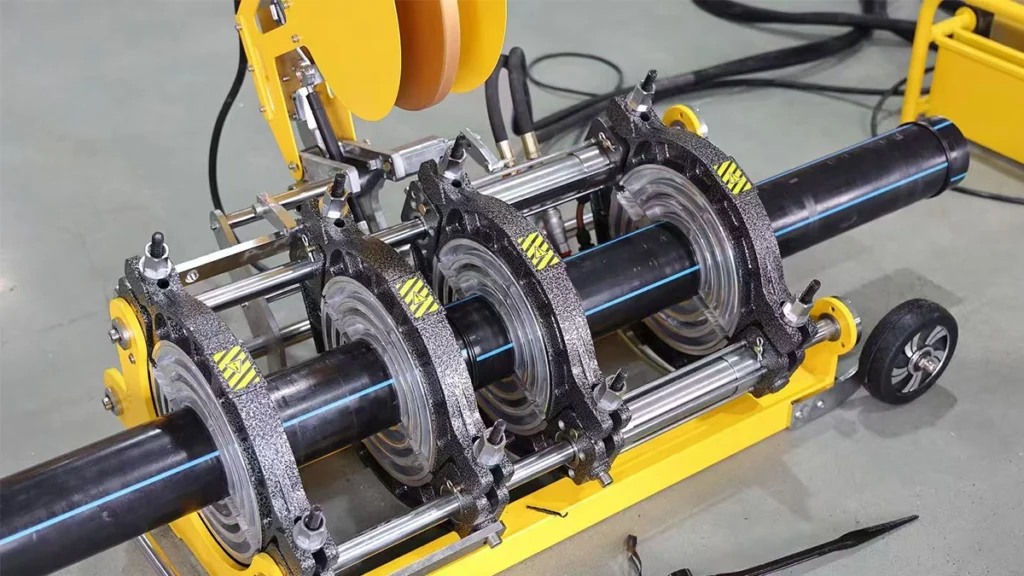
Ekberg utilizes advanced CNC automatic butt fusion machining centers to produce hydraulic cylinders and clamping inserts. This automated precision ensures that every clamp aligns perfectly. Unlike manual casting and finishing, CNC machining guarantees that the alignment tolerance of the chassis meets the strict <0.5mm deviation standards required for high-pressure fusion.
Quality Assurance Protocols
Before any hdpe pipe welding machine leaves our facility, it undergoes a rigorous testing regime:
1. 24-Hour Pressure Holding Test: The hydraulic system is pressurized to max capacity (e.g., 16 MPa) and left for 24 hours to detect micro-leaks.
2. Thermal Mapping: The heating plate is scanned to verify that temperature distribution stays within the ±3°C tolerance zone.
3. Functional Load Test: The facer and clamps are operated under load to simulate actual pipe fusion conditions.
Certification Compliance
Our manufacturing processes are ISO 9001 certified, and our equipment carries CE marking. More importantly, our butt fusion machines are built to comply with ISO 21307 High Pressure and Low Pressure standards. This certification isn’t just a sticker; it is proof that the hdpe fusion machine can deliver the force and thermal energy required to create a bond stronger than the pipe itself.
After-Sales Support
We stand behind our engineering with a warranty that often exceeds industry standards.
- Warranty: 18-24 months on main components (chassis, hydraulics, heater).
- Training: We offer virtual technical training for US crews, ensuring they understand how to configure the butt fusion machine for ASTM F2620 compliance.
- Documentation: All butt fusion machines ship with comprehensive English manuals and parameter guides.
Frequently Asked Questions
What is the difference between ASTM and ISO butt fusion standards, and can Ekberg machines do both?
ASTM F2620 generally requires a higher interfacial pressure (75 psi) compared to ISO 21307’s low-pressure option. Ekberg butt fusion machines are fully compatible with both. Our hydraulic systems are powerful enough to meet the high-pressure ASTM requirements, and our digital controls allow operators to manually input specific pressure, temperature, and time parameters to match whichever standard the project engineer specifies.
How does the warranty of US-made machines compare to Ekberg’s warranty?
Most US manufacturers offer a standard 12-month warranty. Ekberg Welding typically provides an 18-24 month warranty on core components. We can offer this extended coverage because we control our manufacturing tolerances strictly via CNC production. Our warranty covers parts replacement for any manufacturing defects, ensuring your investment is protected longer than with many domestic options.
Are spare parts for non-US butt fusion machines easy to find in the United States?
Yes. Ekberg prioritizes “serviceability by design.” We use industry-standard specifications for hydraulic seals, hoses, and electrical relays. This means many consumables can be sourced from local US industrial suppliers like Grainger. For proprietary structural parts, we maintain a rapid-dispatch system to ship components via air freight, often arriving faster than ground freight from domestic hubs.
What is the typical lead time for ordering a large-diameter (1200mm+) butt fusion machine?
Domestic US manufacturers often quote 12–16 weeks for large-diameter butt fusion machines due to production backlogs. Ekberg Welding can typically manufacture and ship a 1200mm unit in 3–4 weeks. Even with ocean freight times, the total arrival time is often competitive, and with air freight options, we can have a machine on your site significantly faster than domestic custom orders.
Can Ekberg machines integrate with existing data logging software used by US contractors?
Ekberg butt fusion machines come with integrated data logging systems that record all critical welding parameters (pressure, time, temperature, operator ID) in compliance with ISO 12176. The data is exported via USB in standard formats (CSV/PDF) that are universally readable. While we do not run proprietary US software directly, our data outputs provide the exact verification documentation required by project inspectors and engineers.
Conclusion
The market for butt fusion machines in the US is shifting. While legacy domestic manufacturers like McElroy offer established brand recognition and specialized mobility features, they are no longer the only viable option for professional contractors. The premium price tag and extended lead times of US brands are increasingly difficult to justify against the technical equivalence and cost-efficiency of global leaders like Ekberg Welding.
When specifying equipment for your next pipeline project, prioritize the physics of the weld over the origin of the butt fusion machine. Look for verifiable specs: closed-loop hydraulics, ±3°C heating uniformity, and robust data logging.
If you are ready to reduce your capital expenditure by 40% without compromising on weld quality or compliance, it is time to evaluate the global alternative.
Contact Ekberg Welding today to request a technical comparison sheet and a factory-direct quote for your next DN63–DN1600 fusion project.