
Butt Fusion vs Electrofusion Machine for HDPE Pipe: Cost, Strength and Application Comparison
Table of Contents
A practical butt fusion vs electrofusion comparison for HDPE pipe, covering machine cost, joint strength, application scenarios, technical specs, and supplier evaluation — helping B2B buyers, contractors, and engineers select the right welding method with confidence.
Butt Fusion vs Electrofusion: Quick Answer for HDPE Pipe Jointing
Pipeline contractors weighing butt fusion against electrofusion face a classic trade-off: high capital expenditure (CapEx) versus hefty operational costs (OpEx). Butt fusion relies on a heated plate to melt and seamlessly press pipe ends together. While the upfront equipment costs are substantial, you pay absolutely nothing for consumable fittings. On the flip side, electrofusion depends on specialized fittings packed with embedded electrical coils. You’ll save heavily on the initial equipment, but expect to pay a premium for every single joint you fuse.
What is the main difference between butt fusion and electrofusion?
The core difference boils down to how heat is applied and whether you need consumables. Butt fusion machines wield a PTFE-coated heating plate to directly melt the pipe ends. Once melted, controlled hydraulic pressure steps in to forge the joint—no extra materials needed. Electrofusion, however, requires a dedicated consumable fitting for every single connection. An operator scans a barcode on the fitting, prompting a control unit to send precise electrical voltage to embedded resistance wires. This melts the inside of the fitting and the outside of the pipe at the exact same time.
Which method is stronger, butt fusion or electrofusion?
As long as your crew follows ISO 21307 or ASTM F2620 standards, both techniques deliver joints that meet—or even exceed—the burst pressure rating of the original HDPE pipe. Destructive testing reveals that both methods hit a maximum apparent tensile strength of roughly 2,700 psi for standard HDPE. In fact, if a system is pushed to its breaking point, the pipe wall itself usually blows out before the weld ever gives way. Ultimately, joint integrity doesn’t depend on the method you choose. It relies entirely on flawless surface preparation and strict parameter control.
Which is more cost-effective for large HDPE projects?
If you’re tackling a massive infrastructure project with hundreds or thousands of joints, butt fusion wins hands down. Because the per-joint material cost is zero, you’ll quickly recoup that hefty $10,000 to $30,000+ machine investment. Electrofusion simply doesn’t make financial sense for miles of continuous pipeline. Large-diameter fittings—like a 12-inch coupling—can easily run upwards of $480 USD a pop, instantly wrecking a project’s budget at scale.
Core components of a butt fusion machine
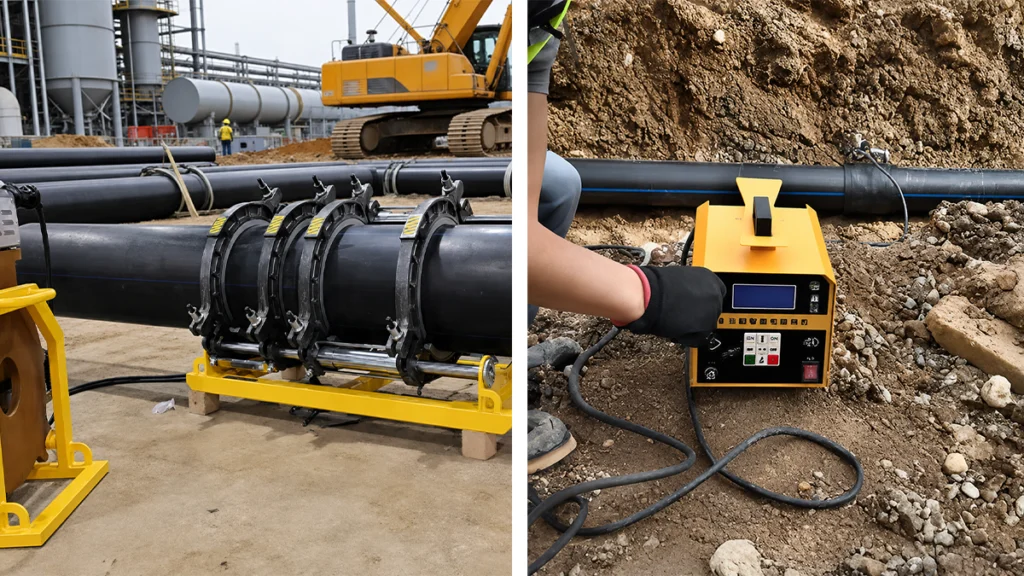
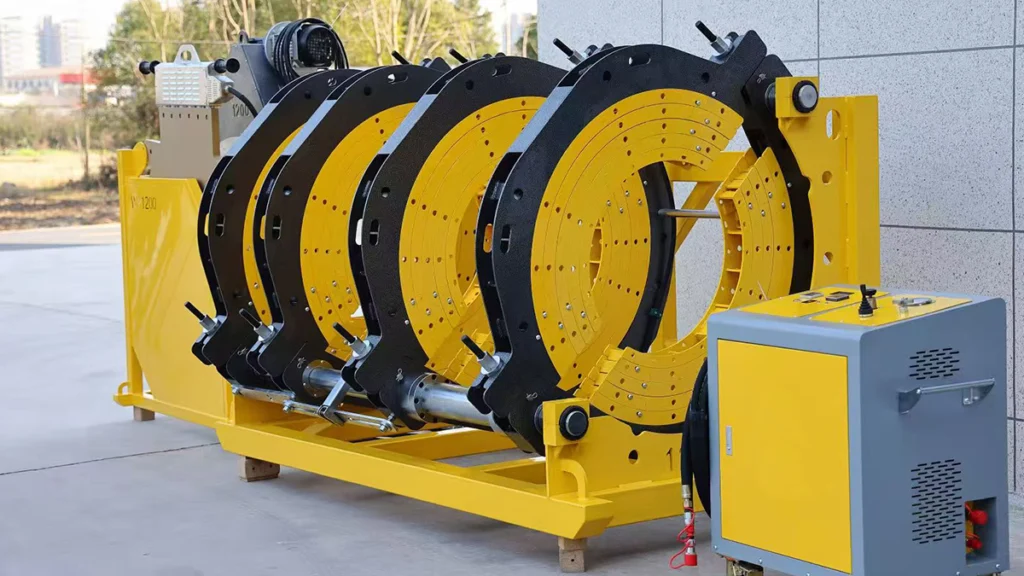
Industrial butt fusion heavily relies on three synchronized subsystems:
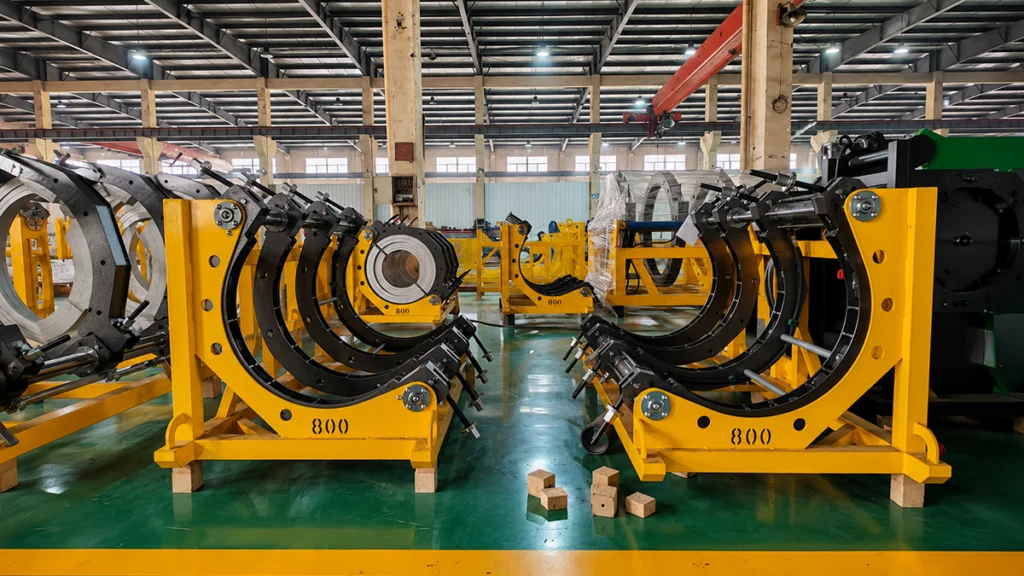
- Heating Plate: A precisely calibrated, PTFE-coated aluminum surface that offers independent temperature regulation. Depending on the chassis size, these plates typically generate anywhere from 1.6KW to 17.5KW.
- Milling Cutter: This electric or hydraulic facer uses double-edged tool steel blades to shave pipe ends perfectly square before the heating phase begins.
- Hydraulic Station & Clamps: Acting as the machine’s structural backbone, this frame secures pipe alignment and delivers controlled axial compression. You’ll usually see an adjustment range of 0-16 MPa.
How Butt Fusion Welding Works on HDPE Pipe
Think of butt fusion as a highly controlled thermomechanical process. It banks on exact temperature, precise axial pressure, and specific timing to force molecular diffusion across the pipe interfaces. Automatic (CNC) butt fusion machines take human error out of the equation entirely by locking down these parameters during the most critical phases of the weld.
Step-by-step butt fusion welding process
1. Preparation and Facing: First, lock the HDPE pipes firmly into the hydraulic clamps. Drop in the milling cutter and shave the pipe ends until you see continuous, uniform plastic ribbons. This guarantees perfectly parallel faces.
2. Alignment Check: Pull the cutter out. Bring the pipe ends together under light pressure to spot any “high-low” misalignment.
3. Heating (T1 Stage): Drop the heating plate into place. Push the pipe ends against it using a specific interfacial pressure until a defined bead forms. Next, drop the pressure to let the heat soak deep into the pipe walls.
4. Fusion and Flanging: Quickly yank the heating plate out. Ram the molten pipe ends together under high fusion pressure to forge a solid joint.
5. Cooling: Maintain that axial pressure while the joint cools completely. Expect to wait 4-6 minutes for 40-63mm pipes, and much longer for heavy-wall variants.
Pipe sizes and pressure ratings supported by butt fusion
Butt fusion scales beautifully for medium to massive infrastructure jobs. It thrives on nominal diameters larger than 90mm. Standard machines easily cover 160-315mm and 450-800mm ranges, while heavy-duty 4-column beasts can tackle up to 1200mm. However, industry standards strictly prohibit butt fusion for pipe components with a diameter (dn) of 63mm or less, or a wall thickness (e) under 6mm. Also, keep in mind that butt fusion only works when joining pipes with the exact same Standard Dimension Ratio (SDR).
What temperature and pressure are required for butt fusion?
Your specific parameters will always depend on the governing standard. Generally, the standard heating head temperature hovers right at 260±5°C.
- Low-Pressure Welding (DVS 2207-1 / ISO): This requires roughly 0.15 N/mm² (1.5 bar) of interfacial pressure during the fusion phase.
- High-Pressure Welding (ASTM F2620): Common across North American markets, this method cranks up the interfacial fusion pressure to aggressively force molecular bonding.
Factory-direct pricing with technical consultation included
Get Your Free QuoteHow Electrofusion Works on HDPE Pipe
Electrofusion welding machine shifts the technical burden away from bulky mechanical clamps and places it squarely on microprocessors and highly engineered fittings. It’s a localized, precision-driven welding method tailor-made for tight, confined spaces.
How electrofusion fittings and control units work together
The control unit and the HDPE pipe fittings talk to each other through a standardized barcode system. An operator simply scans the fitting’s barcode, instantly transmitting the exact voltage, heating time, and cooling duration needed for that specific ambient temperature. The control unit then fires power into the electrical resistance wires embedded inside the fitting. As these wires heat up, they simultaneously melt the fitting’s internal surface and the scraped pipe’s exterior. The expanding plastic generates internal fusion pressure, locking everything together.
Step-by-step electrofusion jointing process
1. Pipe Preparation: Cut the pipe perfectly square. You must use a mechanical scraper to strip away the oxidized surface layer from the pipe ends. Do not rely on solvent wiping—physically removing that top layer of plastic is non-negotiable.
2. Cleaning: Wipe down both the scraped area and the inside of the fitting using highly volatile isopropyl alcohol. This strips away any lingering dust or grease.
3. Assembly: Slide the pipe into the electrofusion coupling right up to the marked insertion depth. Lock the whole assembly into an alignment clamp so nothing shifts.
4. Welding: Hook up the control unit leads, scan the barcode, and kick off the automated heating cycle.
5. Cooling: Leave those alignment clamps exactly where they are until the prescribed cooling time fully elapses.
Why is electrofusion preferred in tight or trench-limited spaces?
Electrofusion completely eliminates the need for massive hydraulic carriages and wide axial movement. Because you aren’t pulling pipe ends apart to squeeze in a heating plate—or ramming them together for fusion—electrofusion has become the gold standard for in-situ repairs, vertical shafts, and cramped urban trenches. An operator literally only needs enough room to spin a mechanical scraper and attach a couple of control unit leads.
Pipe sizes and fitting types supported by electrofusion
This method handles an incredible variety of sizes, stretching from tiny 1/2″ CTS lines all the way up to monstrous 48″ DIPS couplings. Unlike butt fusion, electrofusion safely bridges the gap between different SDR series. Why? Because the fitting itself provides independent structural reinforcement. The technology seamlessly supports standard couplings, elbows, tees, and even saddle fittings for live branch connections.
Butt Fusion vs Electrofusion: Joint Strength and Reliability
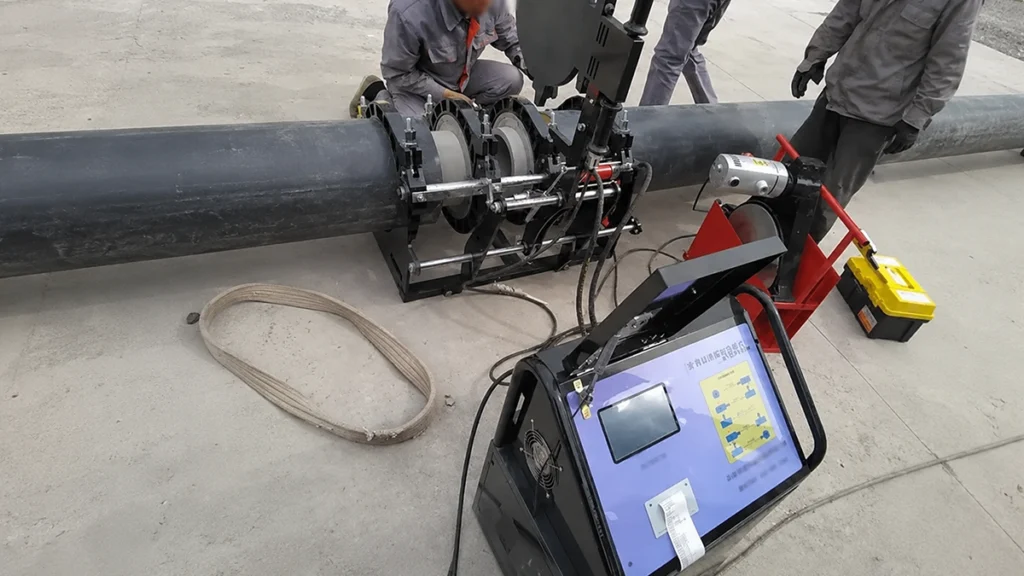
Both techniques easily deliver 50-plus years of reliable service in municipal gas and water networks—assuming your crew follows the rules. However, the specific variables that can wreck a joint differ wildly between the two technologies.
Tensile and burst strength comparison
Whether you choose butt fusion or electrofusion, the resulting joint will match or beat the burst pressure capacity of the original pipe. Standard destructive tests routinely show apparent tensile strengths hitting the ~2,700 psi mark. A flawless weld won’t snap at the joint interface; the surrounding pipe wall will actually yield before the fusion zone ever separates.
Long-term pressure performance and SDR considerations
Butt fusion demands identical wall thicknesses (matching SDRs) to guarantee even heat distribution and uniform pressure. Try mixing SDRs, and you’ll end up with uneven melting and dangerous stress concentrations. Electrofusion, on the other hand, thrives in mixed-SDR scenarios. The fitting simply bridges the gap, melting independently of whatever the pipe’s internal wall thickness happens to be. Internally, butt fusion leaves behind a remarkably smooth surface (save for that uniform bead), which minimizes water flow turbulence and fights off pressure fatigue for decades.
Common failure modes and how to avoid them
- Electrofusion Failures: These almost always stem from terrible pipe scraping. If you leave the oxidized layer intact, the melt will never achieve true molecular diffusion. Dirt and moisture contamination take the silver medal for causing failures.
- Butt Fusion Failures: These are usually driven by mechanical misalignment (“high-low”), botched heating plate temperatures, or impatient operators dropping the hydraulic pressure before the cooling cycle wraps up.
- Prevention: Arm your butt fusion machines with displacement detection systems and automated data logging to lock down your parameters. For electrofusion, absolutely mandate the use of rotary mechanical scrapers instead of cheap hand tools.
Which method offers more consistent weld quality?
When operating at scale, fully automatic (CNC) butt fusion machines deliver unmatched consistency. By stripping out human intervention, CNC systems automatically lock parameters from the flanging stage straight through to cooling, meticulously recording displacement, temperature, and pressure. Electrofusion is incredibly consistent when it comes to energy input, but it still heavily relies on an operator executing flawless manual scraping and cleaning.
Get detailed specs and custom configuration options
Request Technical SpecificationsCost Comparison: Equipment, Consumables and Per-Joint Cost
Choosing between butt fusion and electrofusion ultimately comes down to finding that critical break-even point between CapEx and OpEx.
Butt fusion machine price ranges by pipe diameter
Your initial investment scales right alongside pipe diameter and the level of automation you need.
- Small Manual/Hydraulic (2″ to 8″): These usually run between $4,500 and $6,000 USD.
- Mid-to-Large Hydraulic (up to 315mm/800mm): Expect to spend anywhere from $10,000 to over $30,000, depending heavily on CNC integration and the sheer power of the hydraulic station.
Despite the steep upfront CapEx, your return on investment (ROI) skyrockets on long pipeline runs because you aren’t buying any consumable fittings.
Electrofusion processor and fitting cost structure
Electrofusion processors are surprisingly affordable. You can often snag a universal barcode-scanning unit for under $3,000 USD. The real financial hit comes from the OpEx burden of consumable fittings. A tiny 1/2″ coupling might only set you back $10 USD, but large-diameter fittings scale exponentially. A 12″ coupling, for example, can easily blow past $480 USD per joint.
Per-joint cost: which method is cheaper at scale?
At scale—think hundreds or thousands of joints—butt fusion is unquestionably the cheaper route. Your per-joint cost basically boils down to operator labor, generator fuel, and a tiny fraction of butt fusion machine depreciation. Conversely, if you’re just knocking out a localized repair that only needs 5 to 10 joints, electrofusion takes the crown. Buying a handful of specific fittings is far cheaper than renting or mobilizing a massive butt fusion carriage.
Hidden costs: training, downtime, and rework
- Training: Roughly 75% of construction crews need deep-dive operation manuals and video tutorials just to get a handle on butt fusion hydraulics and parameter charts.
- Downtime: A broken butt fusion welding machine paralyzes an entire pipeline project. It’s no surprise that 60% of B2B buyers obsess over a stable spare parts supply to dodge this exact nightmare.
- Rework: Fail a pressure test on an electrofusion weld, and that expensive fitting is permanently trashed. You can’t reuse it, which immediately doubles your material cost for that specific node.
Application Scenarios: When to Choose Butt Fusion vs Electrofusion
Picking the right methodology means carefully analyzing your trench environment, the pipe diameter, and the sheer volume of joints on the docket.
Best applications for butt fusion
Butt fusion is the undisputed king of long, straight runs. It dominates municipal water supplies, gas distribution networks, agricultural irrigation, and rugged mining slurry lines. It’s also the go-to method for fabricating custom fittings (like elbows and tees) straight from pipe segments in a controlled workshop. If you need to join miles of identical pipe in wide-open trenches, nothing beats it for speed and economy.
Best applications for electrofusion
Electrofusion shines in congested urban grids where trench space is a luxury you don’t have. It is the mandatory standard for emergency leak repairs, dropping vertical shafts, and executing tie-ins on active lines. You’ll also need it when bridging pipes made of different materials (like PE to PP-R) or transitioning between different SDR ratings.
How pipe diameter affects method selection
- Small Diameters (<63mm): Butt fusion isn’t even allowed by industry standards here; you must pivot to electrofusion or socket fusion.
- Medium to Large (>90mm): Butt fusion quickly takes over, largely to avoid the staggering cost of large-diameter electrofusion fittings.
- Massive Diameters (>1000mm): Butt fusion remains the standard. Crews bring in heavy-duty 4-column hydraulic machines just to manage the crushing weight of the pipe.
Hybrid projects: when to use both methods together
Smart contractors blend both technologies to squeeze out maximum efficiency. Crews will use butt fusion to assemble massive strings of pipe above ground, where space is infinite and joint costs are zero. Once assembled, they lower those long strings into the trench and use electrofusion couplings to tie them together. This strategy minimizes the use of expensive fittings while easily navigating tight trench limitations.
Technical Specifications and Decision Criteria for Buyers
Procurement managers need to scrutinize technical specs against international standards. Cut corners here, and you’re inviting field failures and municipal rejections.
Key parameters to check on a butt fusion machine
- Welding Range: Make sure the chassis actually fits your required diameters (for example, 160-315mm or 710-1000mm).
- Power Output: Verify the total power draw (like 23.5KW for heavy units). The heating plate must pack enough punch for rapid, deep heat soaking.
- Pressure & Temperature Precision: Accept nothing less than a temperature error margin of ≤±3°C. You also need a hydraulic pressure adjustment range spanning 0-16 MPa to safely cover both DVS and ASTM standards.
Key parameters to check on an electrofusion control unit
- Automation Profile: The processor needs a ruggedized barcode scanner. Automatic parameter entry is the only way to kill manual keying errors.
- Voltage Compatibility: Ensure the unit can handle local power grid fluctuations (such as an AC 176V to 245V tolerance).
- Safety & Alarms: Demand a system loaded with alarm notifications for voltage drops, extreme ambient temperatures, or unexpectedly interrupted heating cycles.
Compatibility with international standards (ISO 21307, ISO 12176)
Your gear has to align with the regulatory frameworks of your installation region. ISO 21307 is the global benchmark for butt welding HDPE pipe, dominating 95% of metric countries. Over in Europe, DVS 2207-1 dictates “low-pressure” welding parameters, while North America relies on ASTM F2620 for “high-pressure” applications. At a bare minimum, the HDPE pipe jointing machinery itself must comply with ISO 12176 standards for fusion equipment.
Data logging, traceability, and certification requirements
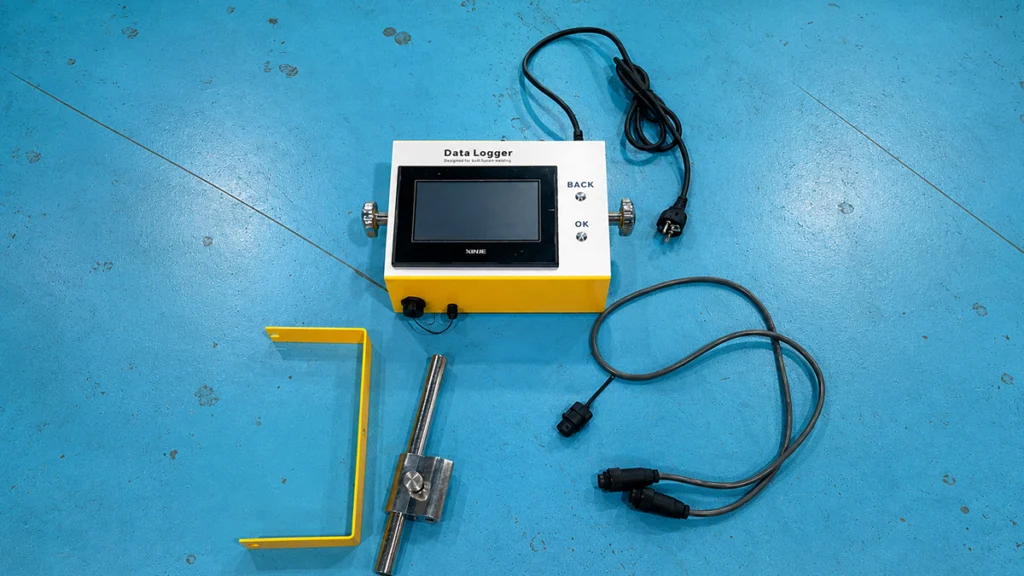
Municipalities are cracking down, increasingly demanding absolute traceability. Your HDPE pipe welding machines should align with TSG D2002-2006 and GB/T 20674.1 for weld joint data recording. The system must automatically log the weld joint number, operator ID, and ambient temperature, while locking parameters down during the fusion cycle. Being able to export this data via USB is non-negotiable for project sign-offs and warranty protection.
Common Mistakes and Hidden Risks in HDPE Pipe Welding
Even the most expensive, premium equipment on the market won’t save a project from sloppy execution or a compromised supply chain.
Top installation mistakes that cause joint failure
- Skipping Mechanical Scraping: Wiping down an electrofusion joint with solvent without physically scraping away the oxidized plastic is a guaranteed recipe for failure.
- Premature Pressure Relief: If you release the hydraulic clamps on a butt fusion rig before the core of the pipe wall fully cools, you’re injecting micro-fractures straight into the joint.
- Environmental Exposure: Welding in the rain, heavy snow, or high winds without a proper shelter triggers rapid, uneven cooling and introduces deadly moisture contamination to the melt.
Why low-cost machines often increase total project cost
Bargain-basement butt fusion machines are plagued by wild temperature swings (often >±5°C on the heating plate), which result in cold welds or thermally scorched plastic. Flimsy hydraulic cylinders bleed pressure during the cooling phase, and misaligned clamps create “high-low” mismatches that instantly fail visual inspections. Without displacement detection, these fragile joints stay hidden until a pressure test blows them apart.
How to spot unreliable suppliers and uncertified equipment
Shady suppliers act as mere middlemen with zero control over manufacturing. They don’t stock spare parts, which means your project grinds to a halt the second a specialized hydraulic seal blows. Equipment missing a CE mark, ISO 12176 compliance, or DVS 2207 certification is a glaring red flag. Furthermore, considering 90% of buyers expect 24/7 online technical support, it’s telling that unreliable vendors usually ghost you the moment the sale clears.
What documentation should every welded joint include?
Every single certified joint demands a meticulous weld log. This document must capture the joint number, the operator’s ID, ambient conditions, heating plate temperature, applied fusion pressure, and the exact cooling time. It also needs to log any system alerts or alarms that tripped during the process, ensuring a bulletproof chain of accountability.
Supplier Evaluation, MOQ, Lead Time and After-Sales Support
For heavy-hitting contractors and equipment distributors, the relationship you build with a supplier is just as vital as the steel and hydraulics you purchase.
What MOQ and lead times are typical for fusion machines?
A standard 315mm hydraulic butt fusion rig usually requires a production lead time of 7 to 15 days. If you need custom configurations—like a 1200mm heavy-duty setup or specialized paint curing—expect to add another 3 to 5 working days. Premium OEM suppliers understand the market and offer flexible Minimum Order Quantities (MOQs), allowing distributors to scale without being choked by massive inventory holds.
Warranty, spare parts, and on-site training expectations
The baseline industry standard is a solid 1-year comprehensive warranty backed by lifetime maintenance support. If a part fails and it wasn’t human error, the supplier should replace it for free during that warranty window. Top-tier vendors provide deep video libraries, remote troubleshooting, and ideally, on-site training for complex CNC deployments. You should also plan for routine maintenance calibration every 12 months or 2,000 joints.
Certifications to request from your fusion machine supplier
Always demand to see the CE mark and ISO 12176 certification for the hardware itself. This proves the gear meets strict international safety and operational benchmarks. Beyond the butt fusion welding machine, verify that the actual manufacturing plant holds an active ISO 9001 quality management certificate. This guarantees they maintain tight, consistent production tolerances.
How to qualify an OEM or ODM partner for HDPE welding equipment
Vet potential partners by testing their engineering agility. You want a manufacturer that can easily configure custom clamp sizes or adapt to localized voltage demands (whether that’s 110V, 220V, or 380V). Elite partners go the extra mile by offering trade-in programs for fleet upgrades, fast-tracked shipping for emergency infrastructure jobs, and solid backup equipment provisions.
Final Recommendation: Choosing the Right HDPE Welding Method
Ultimately, deciding between butt fusion and electrofusion comes down to three things: pipe diameter, trench conditions, and the sheer volume of joints you need to weld.
Decision matrix: butt fusion vs electrofusion at a glance
| Project Variable | Recommend Butt Fusion | Recommend Electrofusion |
|---|---|---|
| Pipe Diameter | >90mm up to 1200mm+ | <63mm up to 48" DIPS |
| Joint Volume | High (Hundreds/Thousands) | Low (Repairs/Tie-ins) |
| Trench Space | Open Trench / Above Ground | Confined Space / Vertical |
| Pipe Wall Thickness | Identical SDR Required | Mixed SDRs Supported |
| Cost Structure | High CapEx, Zero OpEx | Low CapEx, High OpEx |
Recommended setup for contractors and utility projects
For sprawling infrastructure projects, build your core fleet around fully automatic (CNC) hydraulic butt fusion machines that cover the 160-315mm and 450-800mm ranges. Make sure these units are armed with displacement detection and onboard data printers to easily clear municipal traceability hurdles. Pair them with premium double-edged milling cutters and heavy-duty generators to ensure your voltage never drops.
Recommended setup for repair, maintenance, and urban networks
If your crews are navigating urban gas and water grids, standardize your trucks with universal, barcode-scanning electrofusion control units that feature robust alarm systems. Most importantly, strictly mandate that rotary mechanical pipe scrapers are included in every single kit to eradicate the oxidized layer. Finally, enforce the use of rigid alignment clamps to lock the pipe down during the cooling phase.
—
FAQ
Q1: Is electrofusion stronger than butt fusion for HDPE pipe?
Not at all. When executed properly, both techniques deliver the exact same level of strength. According to strict ISO and ASTM standards, both methods produce joints that match or beat the burst pressure rating of the original HDPE pipe, hitting an apparent tensile strength of roughly 2,700 psi. If you test them to destruction, the pipe wall itself will usually fail before the weld does.
Q2: What is the cost difference between butt fusion and electrofusion per joint?
Butt fusion boasts a per-joint material cost of absolutely zero. This makes it incredibly cost-effective at scale, easily offsetting the initial $4,500 to $30,000+ machine price tag. Electrofusion processors are much cheaper upfront (often under $3,000), but you have to buy a consumable fitting for every single weld. Those fittings range from $10 for a small coupling to well over $480 for large-diameter versions, making it a budget-killer for long pipelines.
Q3: Can the same machine perform both butt fusion and electrofusion?
No, they utilize entirely different mechanical architectures. Butt fusion relies on a heavy hydraulic carriage, a milling cutter, and a PTFE-coated heating plate to physically press melted pipe ends together. Electrofusion, however, uses a microprocessor-driven control unit to push precise electrical voltage into coils embedded inside specialized consumable fittings.
Q4: What pipe diameter requires butt fusion instead of electrofusion?
While electrofusion can technically tackle massive pipes, butt fusion becomes an economic necessity for long runs of pipe larger than 90mm. The cost of massive electrofusion fittings simply scales too aggressively. On the flip side, industry standards actively prohibit butt fusion for pipes smaller than 63mm—in those cases, you must rely on electrofusion or socket fusion.
Q5: How long does a butt fusion or electrofusion joint last?
If welded strictly to ISO 21307 or ASTM F2620 standards, both joint types are engineered and verified to last over 50 years in municipal water and gas networks. The joint literally becomes a permanent, monolithic segment of the entire pipeline.
Q6: What certifications should an HDPE fusion machine have?
Any industrial HDPE fusion machine worth its salt should carry a CE mark and fully comply with ISO 12176 standards for plastic pipe fusion hardware. Furthermore, the onboard data logging systems need to meet TSG D2002-2006 and GB/T 20674.1 requirements. Finally, ensure the manufacturer holds an active ISO 9001 quality management certification.
Q7: Which welding method is faster on a large pipeline project?
Butt fusion takes the lead on massive projects. Crews can stage a heavy-duty CNC butt fusion rig above ground and relentlessly weld long strings of identical pipe. This completely bypasses the tedious process of prepping, scraping, and installing individual electrofusion fittings at every single joint intersection.
Q8: Do electrofusion fittings work with all HDPE pipe brands?
Yes, electrofusion fittings are largely universally compatible with standard HDPE pipes, regardless of the brand. As long as both the pipe and the fitting utilize compatible PE resins (like PE100), you’re good to go. The control unit simply reads the barcode to dial in the correct voltage and heating time, ensuring a flawless weld no matter who manufactured the pipe.
—
Conclusion
The ongoing debate between butt fusion and electrofusion isn’t really about joint strength—it’s a calculated decision driven by scale, trench environments, and project economics. When executed to rigorous ISO 21307 and ASTM F2620 standards, both methods yield monolithic joints easily capable of 50-plus years of service. Butt fusion demands a much steeper initial CapEx, but it mercilessly drives OpEx down to zero. That makes it the ultimate choice for long-haul water mains, gas lines, and heavy industrial networks where joint volume is massive.
On the other hand, electrofusion keeps your equipment investment remarkably low but hits you with steep consumable costs on every joint. Its real superpower is its compact operational footprint. It is the undeniable, mandatory solution for cramped urban trenches, emergency in-situ repairs, and multi-SDR transitions where a bulky hydraulic carriage simply won’t fit. Ultimately, the smartest contractors deploy a hybrid fleet. By using data-logging CNC butt fusion machines for above-ground pipe assembly, and nimble barcode-scanning electrofusion units for tight trench tie-ins, crews can maximize labor efficiency while keeping total project costs on a tight leash.
Let our experts help you choose the right equipment for your project
Contact Our Engineering Team