
Butt Fusion Machine in Italy: HDPE Pipe Welding Equipment Selection Guide
Table of Contents
Butt Fusion Machine in Italy buyers can use this guide to compare PE pipe welding equipment types, specifications, price factors, supplier checks, and selection criteria for reliable project use.
What Is a Butt Fusion Machine for PE Pipe Welding?
A butt fusion machine in Italy serves as specialized industrial equipment designed to join thermoplastic pipes. It works by heating the pipe ends until they reach a molten state, then pressing them together under tightly controlled hydraulic pressure. This method creates a continuous, homogeneous pipeline system. You don’t need mechanical fittings or chemical solvents, which is exactly why it has become the go-to joining method for modern infrastructure projects.
How butt fusion creates a leak-resistant PE pipe joint
Precise thermodynamics and mechanical pressure drive the entire butt fusion process. First, the equipment heats the prepped pipe ends to a highly specific molten state. The operator (or automated system) rapidly removes the heat source and immediately fuses those ends together under high pressure. As the molten plastic cools and solidifies, the molecular chains intertwine directly across the joint interface. When executed correctly according to standards like ISO 21307 and DVS 2207, this joint achieves a tensile strength matching—or even exceeding—that of the original pipe. The result? A fully leak-resistant connection.
Main machine components: clamps, facing tool, heating plate, and hydraulic unit
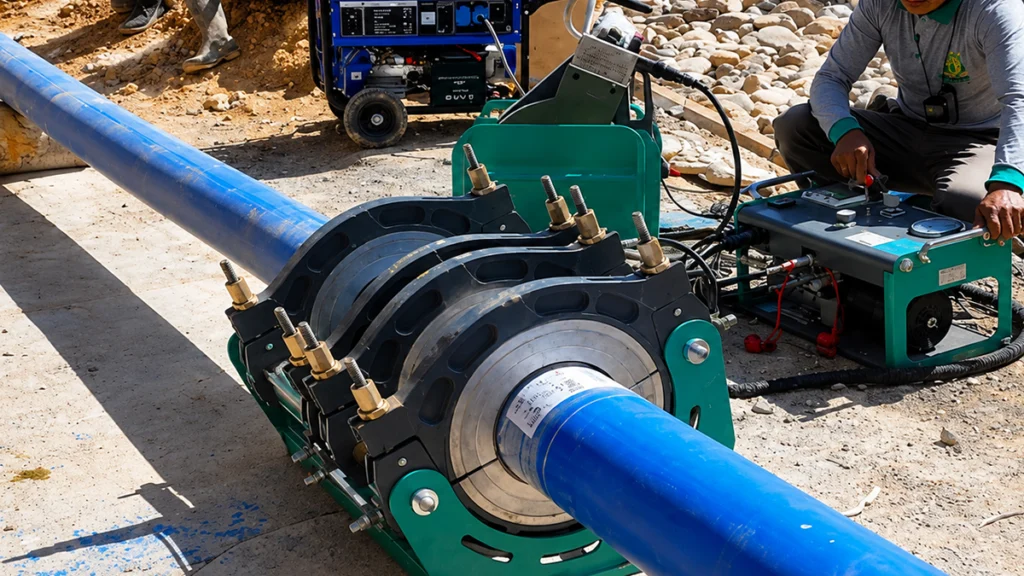
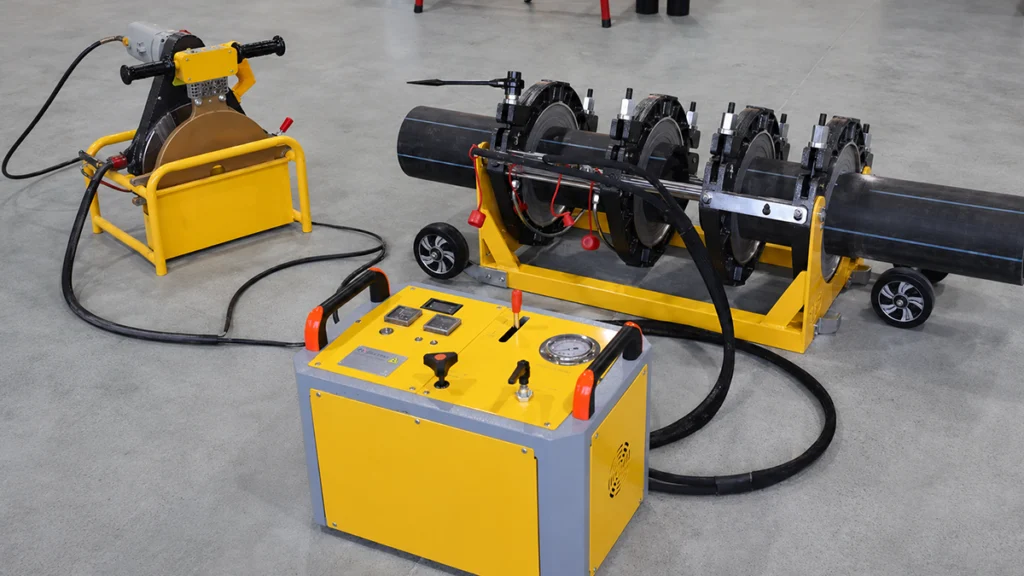
Industrial PE pipe welding equipment relies on a few critical components working in perfect sequence. Heavy-duty clamps secure and align the pipes, preventing any unwanted shifting during the weld cycle. Next, a facing tool (often called a milling cutter) planes the pipe ends so they sit perfectly parallel and free of surface oxidation. A PTFE-coated heating plate then steps in, applying uniform heat to the pipe ends—usually between 200°C and 270°C for polyethylene. Finally, the hydraulic unit generates the controlled transmission force needed to push the pipes together during the fusion and cooling phases.
Which pipe materials are suitable for butt fusion welding?
Engineers designed this welding technology specifically for thermoplastic piping systems. The most widely used materials include Polyethylene (PE), High-Density Polyethylene (HDPE), Polypropylene (PP), and Polyvinylidene Fluoride (PVDF). Because these materials possess distinct thermoplastic properties, they melt uniformly and fuse seamlessly. Be warned, though: attempting to butt fuse dissimilar materials or thermosetting plastics will practically guarantee a joint failure.
Why Butt Fusion Machines Matter for Projects in Italy
PE pipeline applications in Italian infrastructure and utilities
Italy’s rugged topography and aging municipal networks fuel a massive, ongoing demand for robust pipeline infrastructure. Sourcing a high-quality butt fusion machine in Italy is a critical step for building reliable water supply networks, natural gas distribution lines, agricultural irrigation systems, and industrial chemical transport pipelines. Municipalities and utility contractors heavily depend on HDPE pipe welding equipment in Italy to conquer tough terrains. Whether they are routing Alpine water distribution lines or laying coastal drainage pipes, pipeline integrity remains the top priority.
Why joint quality affects long-term pipeline reliability
Pipeline failures rarely happen along the pipe body itself; they usually strike at the joints. Fusion welding completely eliminates the weak points inherent to mechanical couplings, which tend to degrade or loosen over time from ground settlement and pressure spikes. By producing high-quality welded joints, contractors drastically cut down the long-term expenses tied to leaks, emergency repairs, and premature pipe replacements. Ultimately, this extends the entire service life of the utility network.
When contractors should invest in equipment instead of outsourcing welding
Looking at the long-term financials, buying a butt fusion welding machine for HDPE pipes in Italy delivers an outstanding ROI for contractors who handle regular pipeline installations. Sure, outsourcing the welding to specialized subcontractors saves some upfront capital. However, it also introduces rigid scheduling dependencies and significantly higher per-joint costs. Contractors managing multi-phase infrastructure projects gain a massive edge by owning their equipment. Doing so hands them total control over project timelines, wipes out subcontractor markups, and builds valuable in-house technical expertise.
Factory-direct pricing with technical consultation included
Get Your Free QuoteMain Types of Butt Fusion Machines Available in Italy
| Machine Type | Best Use Case | Advantages | Limitations |
|---|---|---|---|
| Manual | Small diameter pipes, tight budgets | Cost-effective, highly portable | Relies heavily on operator skill, coarse temperature control |
| Hydraulic | Municipal water/gas, general contractors | Consistent 2-6 MPa pressure, semi-automatic control | Heavier frame, requires robust power supply |
| Automatic/CNC | High-spec infrastructure, gas lines | Traceable data logging, eliminates human error | Higher initial investment cost |
| Workshop | Prefabricating fittings (tees, elbows) | Heavy-duty stability, multi-angle welding | Not suitable for trench work |
Manual butt fusion machines for small-diameter PE pipes
Manual butt fusion machines provide a highly cost-effective solution for small-diameter piping systems where heavy hydraulic pressure simply isn’t necessary. These units are lightweight, highly portable, and operate on straightforward mechanics. However, you get what you pay for in terms of consistency. The final welding quality rests squarely on the operator’s personal experience and technique. Because they feature coarse temperature adjustments and require the user to physically apply and hold the fusion pressure, there is a higher margin for human error.
Hydraulic butt fusion machines for contractor and municipal use
Hydraulic butt fusion machines step up the game by using a mechanized hydraulic system to deliver semi-automatic control over the weld cycle. You absolutely need this equipment for medium to large pipe diameters. Milling, heating, and cooling at these sizes demand significant, sustained pressure—usually between 2 and 6 MPa—which no human could achieve manually. By ensuring consistent force application, these machines practically eliminate the risk of cold welds and uneven bead formation.
Automatic and CNC butt fusion machines for traceable welding quality
Highly regulated jobs, like natural gas pipeline installations, mandate the use of automatic and CNC butt fusion machines. These advanced units take the guesswork out of the equation by automatically controlling heating time, changeover time, and fusion pressure based on preset parameters. Top-tier models feature displacement detection systems alongside Siemens analog-to-digital conversion modules to guarantee rock-solid, repeatable weld quality. More importantly, they log comprehensive joint data to meet strict standards like TSG D2002-2006, giving you 100% traceability for every single weld on the site.
Workshop fitting machines vs field butt fusion machines
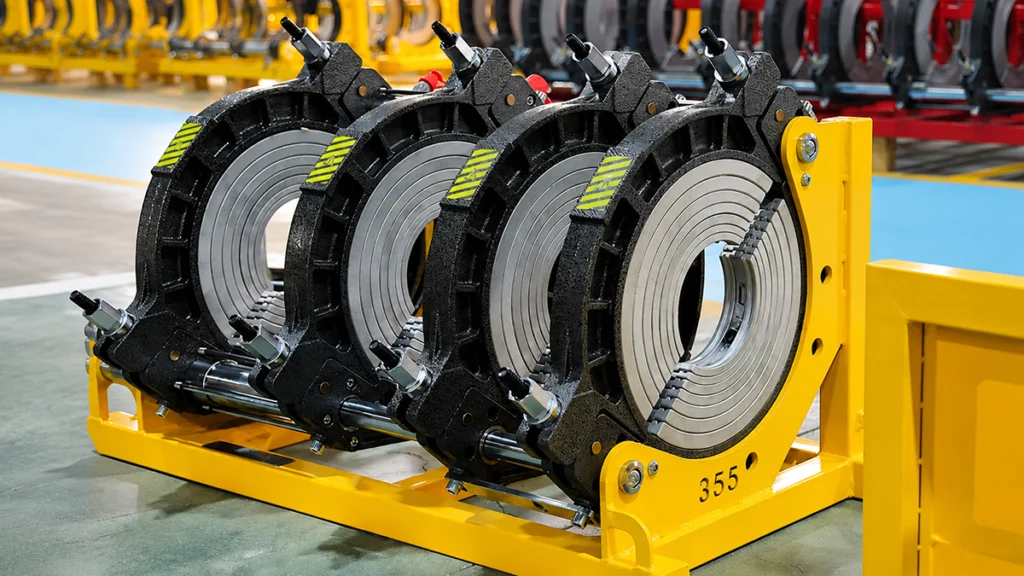
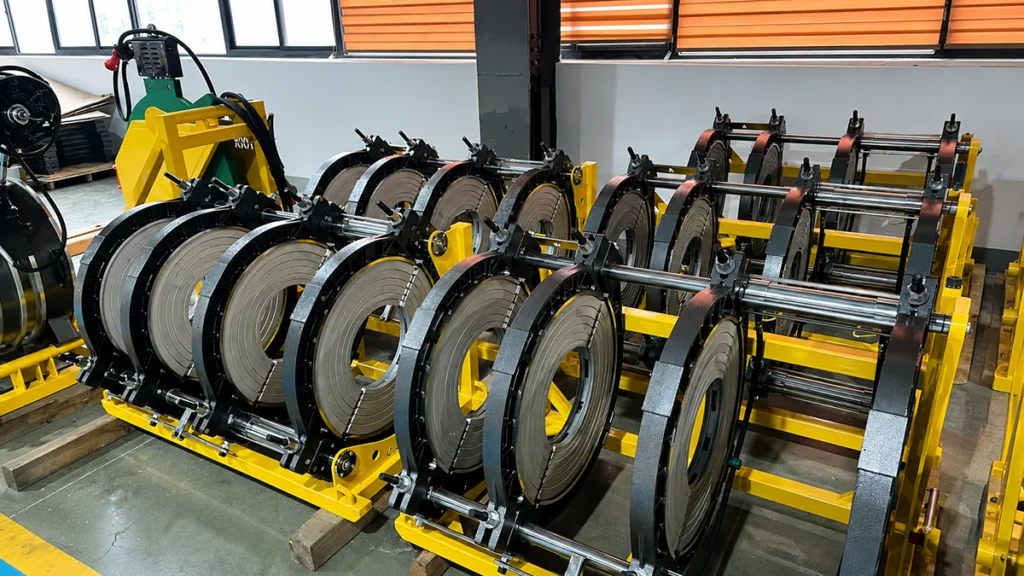
Field butt fusion machines are built for mobility. They feature separate clamping and operating systems, allowing crews to maneuver them easily inside cramped, narrow trenches. Workshop fitting machines take a completely different approach. They rely on heavy-duty, four-column designs optimized strictly for factory floors. While workshop HDPE pipe jointing machines excel at prefabricating segmented elbows, tees, and crosses under perfectly controlled conditions, field machines are the rugged workhorses designed to survive harsh outdoor environments.
How to Choose the Right Butt Fusion Machine for PE Pipes
What pipe diameter range do you need to weld?
Finding the perfect pipe fusion machine starts with pinning down your project’s pipe dimensions. Standard equipment capacities fall into specific brackets, such as DN160-315mm, 280-450mm, 400-630mm, or 630-800mm. Since no single HDPE pipe welding machine can weld every possible diameter, you need to analyze your most frequent project requirements. Buying a massive unit capable of handling sizes far beyond your typical scope just saddles you with unnecessary equipment weight and bloated power consumption.
How much welding pressure and alignment accuracy are required?
A pipeline’s overall integrity hinges on dead-on alignment and sufficient pressure. Premium hydraulic models will hold a steady 2-6 MPa working pressure throughout the entire cooling phase. Furthermore, the butt fusion machine’s chassis and clamps must be rigid enough to cap alignment deviation at ≤0.3mm. If the equipment flexes or bends under pressure, the pipes will misalign. That leads straight to rejected welds and budget-draining rework.
Should you choose manual, semi-automatic, or automatic control?
The control system you select heavily influences both productivity and regulatory compliance. Industry feedback shows that over 80% of field crews prefer touchscreen interfaces for their intuitive parameter settings, and 75% actively want one-touch preset fusing programs. Use manual control for basic, low-pressure water lines. Upgrade to semi-automatic hydraulic control for standard municipal contracts. If project specs demand automated data logging and zero operator interference during the fusion cycle, fully automatic CNC control is your only option.
Decision guide for contractors, rental companies, and distributors
Different business models require distinctly different procurement strategies. Contractors need to prioritize robust hydraulic butt fusion machines tailored exactly to their immediate project pipeline diameters. Rental companies, on the other hand, should buy versatile, ultra-durable semi-automatic machines built to survive rough handling by a rotating cast of users. If you are a distributor searching for an automatic butt fusion machine Italy supplier, look for manufacturers that offer a broad model lineup, full CE certification, and the heavy-duty technical support needed to handle diverse local market demands.
Get detailed specs and custom configuration options
Request Technical SpecificationsKey Technical Specifications to Compare Before Buying
| Technical Specification | Why It Matters | Buyer Check Point |
|---|---|---|
| Diameter Range | Determines project compatibility | Match to frequent pipe sizes (e.g., DN160-315mm) |
| SDR Compatibility | Ensures proper wall thickness fusion | Verify machine handles specific SDR ratings |
| Heating Plate Control | Prevents polymer degradation | Must reach 300°C with ≤±3°C error |
| Hydraulic Pressure | Drives fusion strength | Look for stable 2-6 MPa output |
| Power Supply | Dictates job-site generator needs | 220V (small) vs 380V (large diameter) |
Pipe diameter capacity and SDR compatibility
External diameter isn’t the only metric that matters; the Standard Dimension Ratio (SDR) dictates the pipe’s wall thickness. As a rule, butt fusion isn’t permitted for pipe components with an external diameter (dn) of ≤ 63mm or a wall thickness (e) of < 6mm. Also, if you need to weld pipes from different SDR series, electrofusion is usually the safer bet. Otherwise, you have to use specialized machining to equalize the wall thickness prior to butt fusion. Always double-check that your butt fusion machine’s clamps and pressure ratings can actually handle the SDR of your materials.
Heating plate temperature range and control accuracy
When working with thermoplastics, temperature precision is non-negotiable. The heating plate needs a premium PTFE surface coating so the molten plastic doesn’t stick to it. On a technical level, the plate must operate within a 0-300°C range. Even more importantly, the temperature variance across the entire plate surface must remain fiercely controlled at ≤±3°C. Uneven heating creates localized weak spots, which will inevitably compromise the final joint.
Hydraulic pressure, facing tool power, and clamping stability
A HDPE pipe jointing machine’s raw power dictates how efficiently it gets the job done. Take a standard 315mm hydraulic butt fusion machine used for water and gas lines, for instance. It needs about 1KW of milling power, 2KW of heating power, and a 0.75KW hydraulic system to run smoothly at 0-6 MPa. Clamping stability is equally critical. If the clamps slip even a fraction of an inch during the high-pressure fusion phase, the weld fails instantly.
Power supply options for Italian and European job sites
Electrical requirements scale aggressively with butt fusion machine size. Smaller units (63-315mm) usually run perfectly fine on a standard 220V single-phase power supply, making them easy to operate off portable job-site generators. Step up to large-capacity butt fusion machines (280-800mm and beyond), and you will need a heavy-duty 380V three-phase power supply. Whatever the voltage, a proper grounding wire is an absolute must to protect operators working in wet, muddy trench conditions.
Butt Fusion Machine Price Factors in Italy
Why larger pipe diameter capacity increases equipment cost
The PE pipe butt welding machine price in Italy scales directly with its diameter capacity. Rigs built for massive diameters (like 450-800mm) demand 380V power systems, heavy-duty hydraulic cylinders capable of pushing 4-6 MPa, and intensely reinforced steel frames that won’t flex under load. The sheer volume of raw materials required to build these monsters, combined with their upgraded power components, drives up both manufacturing and shipping costs significantly.
How automation and data logging affect the final price
Baking advanced technology into a HDPE pipe welding machine naturally raises its initial price tag. Fully automatic setups boast displacement detection systems, PLC controllers, Touchwin interfaces, and integrated data loggers. While these premium components do increase your upfront capital expenditure, they more than pay for themselves. They guarantee compliance with brutal natural gas pipeline standards and completely remove the financial liabilities tied to human error and joint failure.
What should be included in a complete quotation?
When you are vetting a butt fusion machine distributor in Italy, insist on a bulletproof quotation. A professional quote needs to spell out the exact equipment model, total quantity, unit price, estimated delivery lead time, and comprehensive after-sales service terms. It must also itemize every included accessory—think reduction inserts, stub end holders, and hydraulic hoses. Vague quotations are usually hiding missing components that will force you to open your wallet again later.
Total cost considerations: training, spare parts, maintenance, and downtime
The sticker price represents just a fraction of your Total Cost of Ownership (TCO). Savvy buyers factor in the expenses of operator training, routine maintenance, and consumable replacements like fresh PTFE coatings and sharp milling blades. Above all, you have to calculate the cost of potential project delays. If a bargain-bin butt fusion machine breaks down and spare parts are three weeks away, those downtime penalties will obliterate any savings you made on the initial purchase.
Supplier Evaluation: What Italian Buyers Should Check
How to verify product quality and manufacturing capability
To guarantee equipment reliability, dig into the supplier’s independent R&D capabilities, manufacturing infrastructure, and technical chops. Ask for raw video footage of their factory floor, specifically targeting the assembly and pressure-testing phases of their hydraulic units. A trustworthy supplier will proudly showcase their quality control protocols and hand over detailed technical data sheets for every single model they sell.
Which certificates and documents are useful for B2B purchasing?
Compliance documentation is the lifeblood of European job sites. Verify that the equipment meets baseline industry benchmarks like ISO 21307, DVS 2207, and EN 12007. If you are buying automated systems, you also need proof of compliance with data-controlled operating system standards such as TSG D2002-2006, GB/T 20674.1, and CJJ 63. These papers are your proof that the butt fusion welding machine actually meets strict municipal and utility specifications.
Questions to ask before selecting a butt fusion machine supplier
Don’t sign a purchase order until you have asked the supplier these critical operational questions:
- What is the guaranteed availability timeline for spare parts on this specific model?
- Do you offer remote technical support to handle system upgrades or calibration issues?
- What is the exact warranty coverage for the hydraulic pump and the heating plate?
- Can the pipe fusion machine’s data logger export reports in the specific formats required by Italian municipal inspectors?
Local distributor vs direct manufacturer: which option fits your buying model?
Buying from a local Italian distributor gives you the perks of lightning-fast delivery, localized training, and immediate on-site support. This route is perfect for contractors who need to deploy equipment yesterday. On the flip side, purchasing directly from an international manufacturer slashes the unit price dramatically. That makes it an incredibly viable strategy for large fleet buyers or rental houses that already manage their own maintenance and keep a deep inventory of spare parts.
Common Mistakes When Selecting PE Pipe Welding Equipment
Choosing only by the lowest price
The lowest-price fallacy destroys pipeline procurement budgets. Picking a butt fusion machine just because it has the cheapest quote usually means you are ignoring critical performance metrics, daily usage needs, and after-sales support. Budget-tier HDPE pipe welding machines are notorious for packing inferior hydraulic seals and uneven heating plates. That combination leads to failed welds, massive rework, and catastrophic pipeline leaks that will end up costing you exponentially more than a premium machine ever would.
Ignoring pipe SDR, diameter range, and job-site conditions
Contractors routinely make the mistake of buying equipment without verifying if it actually matches their project’s Standard Dimension Ratio (SDR). Trying to butt fuse pipes from different SDR series without proper machining or electrofusion backups will cause immediate joint failure. Furthermore, buying a massive workshop HDPE pipe jointing machine and trying to cram it into a muddy, narrow trench environment will completely bottleneck your project’s productivity.
Underestimating operator training and maintenance needs
Too many project managers wrongly assume that manual butt fusion machines are foolproof. The truth is, manual welding quality relies 100% on the operator’s personal experience and physical technique. If you skip training on thermodynamics, pressure calculation, and proper cooling times, you are guaranteeing inconsistent welds. Likewise, ignoring basic maintenance—like cleaning the PTFE plate or topping off hydraulic fluid levels—will accelerate equipment degradation fast.
Buying a machine without spare parts and technical documentation
Purchasing welding equipment without locking down a guarantee for spare parts and system upgrades is a massive operational gamble. If a milling cutter motor burns out or a hydraulic hose bursts mid-job, a lack of immediate replacement parts will bring pipeline construction to a grinding halt. Always force the supplier to hand over comprehensive technical documentation, a robust troubleshooting guide, and a starter kit loaded with essential spare parts.
Best Practices for Reliable Butt Fusion Welding on Site
Step-by-step PE pipe butt fusion process
Pulling off a flawless weld means following a rigid, standardized sequence without cutting corners:
1. Positioning: Securely lock and align the pipes inside the clamps.
2. Milling: Shave down the pipe ends until continuous, clean ribbons of plastic emerge.
3. Heating: Apply the heating plate under drag pressure until a uniform bead forms around the edges.
4. Switching: Rapidly remove the heating plate (you must minimize changeover time).
5. Pressurization: Bring the molten ends together and steadily increase the pressure.
6. Cooling: Hold that pressure steady until the joint is completely solidified.
If you interrupt this process at any point, you have to cut the joint out and start over.
How to control heating time, pressure, and cooling time
Precision is everything during the transition phases. Operators have to yank the heating plate out within strict time limits to stop the molten plastic from oxidizing. When pushing the pipe ends together, pressure must ramp up evenly to the calculated welding pressure (p3). High-speed, high-pressure collisions are a massive mistake—they just force the molten material completely out of the fusion zone, leaving you with a weak, brittle joint.
What should operators inspect before and after welding?
Pre-welding inspections are a mandatory step for quality control. Operators need to finish milling, check alignment to ensure deviations are ≤0.3mm, verify the inherent stroke, measure the drag pressure, and confirm the heating plate’s temperature using a separate external thermometer. Once the weld is done, the operator has to visually inspect the joint to confirm the bead is perfectly uniform and matches all size specifications.
Simple quality checklist for field welding teams
Field crews should run through a quick, visual checklist for every single joint they produce:
- Is the molten plastic extruded evenly around the entire circumference of the pipe?
- Has a uniform fusion bead formed on both the inner and outer surfaces?
- Is the bead completely free of pores, dirt, contaminants, and weird discoloration?
- Is the V-groove sitting between the two beads positioned slightly above the outer surface of the pipe?
If the joint fails even one of these checks, reject it immediately.
Final Recommendation: Matching the Machine to Your Project
Recommended machine choices by buyer type
To squeeze the best ROI out of your budget, align your equipment with your actual operational profile. Standard manual butt fusion machines work great for technicians running low-pressure agricultural irrigation setups on tight budgets. Semi-automatic hydraulic butt fusion machines serve as the ultimate workhorse for municipal water and drainage contractors who need dead-reliable pressure control. Finally, fully automatic CNC butt fusion machines are non-negotiable for large-scale professional crews tackling high-pressure natural gas projects that demand comprehensive, digital data logging.
When to prioritize automation, portability, or large-diameter capacity
Look hard at the primary constraints of your typical job site. If your crews spend their days down in deep, narrow trenches, prioritize portability and pipe fusion machines that feature separate clamping and operating systems. If you are fabricating massive pipeline components inside a controlled workshop, prioritize heavy-duty hydraulic frames and large-diameter capacities. And if your client’s specs demand strict traceability and digital weld reports, make automation your top priority.
Information to prepare before requesting a quotation
Want an accurate proposal for a butt fusion machine in Italy? Put together a comprehensive needs analysis before you even pick up the phone. Document your exact pipe diameter range (e.g., DN160-315mm), the pipe material, SDR ratings, the voltage available on your job sites (220V vs 380V), and the level of automation you need. Handing this data over upfront guarantees the supplier will recommend a HDPE pipe jointing machine perfectly matched to your technical specs and commercial budget.
FAQ
Q1: What size PE pipes can a butt fusion machine weld?
Standard butt fusion machines are broken down into specific diameter ranges to guarantee the right clamping force and pressure. You will typically see capacities like DN160-315mm, 280-450mm, 400-630mm, and 630-800mm. Since one machine can’t weld every size on the market, you need to pick a model that covers the pipe diameters your crews handle most often.
Q2: How much does a butt fusion machine cost in Italy?
Pricing swings wildly depending on the machine’s diameter capacity, automation level, and hydraulic power. Basic manual machines are highly affordable, whereas large-diameter, fully automatic CNC units with integrated data logging require a serious capital investment. When calculating your total cost, don’t forget to factor in shipping fees, operator training, and spare parts.
Q3: What is the difference between manual and hydraulic butt fusion machines?
Manual machines force the operator to physically apply and hold the fusion pressure, which is why they are really only good for small diameters. Hydraulic machines, on the other hand, utilize a mechanized pump to deliver stable, semi-automatic pressure (usually between 2 and 6 MPa). That sustained force is absolutely essential for medium to large pipes to ensure the weld holds up over time.
Q4: Which butt fusion machine is best for HDPE water pipelines?
For standard municipal HDPE water pipelines, a semi-automatic hydraulic butt fusion machine is the undisputed industry standard. It delivers the crucial 2-6 MPa working pressure and alignment stability needed to forge leak-resistant joints. It perfectly balances daily operational efficiency with reliable, long-term joint performance.
Q5: What information is needed to request a butt fusion machine quotation?
To get a quote that is actually accurate, tell the supplier your required pipe diameter range (like 160-315mm), the pipe material, the SDR rating, and the level of automation you want (manual, hydraulic, or CNC). You should also specify your available job-site voltage (220V or 380V) and mention any specific accessories you need, like data loggers or stub end holders.
Q6: How can I check the quality of a PE pipe butt fusion weld?
Always start with a thorough visual inspection. Make sure the extruded bead is uniform, continuous, and completely free of pores or discoloration around the whole pipe. For highly critical applications, contractors step it up by using built-in welding quality detection systems, ultrasonic scanning, or even destructive tensile testing to prove the joint’s strength.
Q7: Should I buy from a local Italian distributor or a direct manufacturer?
Buying from a local Italian distributor gets you faster delivery, on-site training, and rapid maintenance support when things break. Buying directly from a global manufacturer, however, usually scores you a much better price and direct access to technical engineers. That direct route is great for large fleets or rental companies that handle their own maintenance anyway.
Q8: What accessories and spare parts should be included with a butt fusion machine?
A proper equipment package needs to include reduction inserts for different pipe sizes, a stub end holder for flange welding, and heavy-duty hydraulic hoses with quick-release couplings. You should also demand a spare set of milling cutter blades, replacement PTFE coating materials, and a full toolkit so your crew can make on-site adjustments.
Conclusion
Choosing the right butt fusion machine for HDPE pipe projects in Italy requires balancing project requirements, equipment capability, and long-term operating costs. Reliable pipeline welding depends on accurate temperature control, stable hydraulic performance, and proper alignment during the fusion process.
By evaluating key factors such as pipe diameter range, SDR compatibility, automation level, and welding standards, contractors can select equipment that matches their specific applications. Whether you need a portable hydraulic butt fusion machine for field installation or a fully automated CNC system for large infrastructure projects, choosing the right configuration helps achieve reliable joints, improve welding efficiency, and maximize your investment.
Let our experts help you choose the right equipment for your project
Contact Our Engineering Team